Anonymous letters signed 'Hiram' precipitated heavy withdrawals from Southern Bank & Trust (run), prompting the bank to request State Comptroller Ernest Amos to take charge (suspension). Articles state the bank would reopen about March 15 (or March 16). OCR variations in articles corrected (e.g., 'Amos' for 'Amost').
Events (3)
1.February 6, 1928Run
Cause
Rumor Or Misinformation
Cause Details
Anonymous letters mailed Jan. 28 signed 'Hiram' advising depositors to 'quietly get your money out' of the Southern Bank & Trust Co., causing heavy withdrawals over several days.
Measures
Bank officials requested State Comptroller Ernest Amos assume charge; police sought author of letters; assurances deposits in open accounts and trust funds were protected.
Newspaper Excerpt
heavy withdrawals of deposits caused by circulation of anonymous letters predicting its failure.
Source
newspapers
2.February 6, 1928Suspension
Cause
Government Action
Cause Details
Bank requested State Comptroller Ernest Amos to assume charge of its affairs pending strengthening of finances after heavy withdrawals; Comptroller ordered two other small banks temporarily not to open as precaution.
Newspaper Excerpt
The Southern Bank & Trust company requested Comptroller Amos assume charge of its affairs, pending strengthening of finances.
Source
newspapers
3.March 15, 1928Reopening
Newspaper Excerpt
Southern Bank & Trust company had suspended business but would reopen March 15.
Source
newspapers
Newspaper Articles (19)
1.February 6, 1928Merced Sun-StarMerced, CA
Click image to open full size in new tab
Article Text
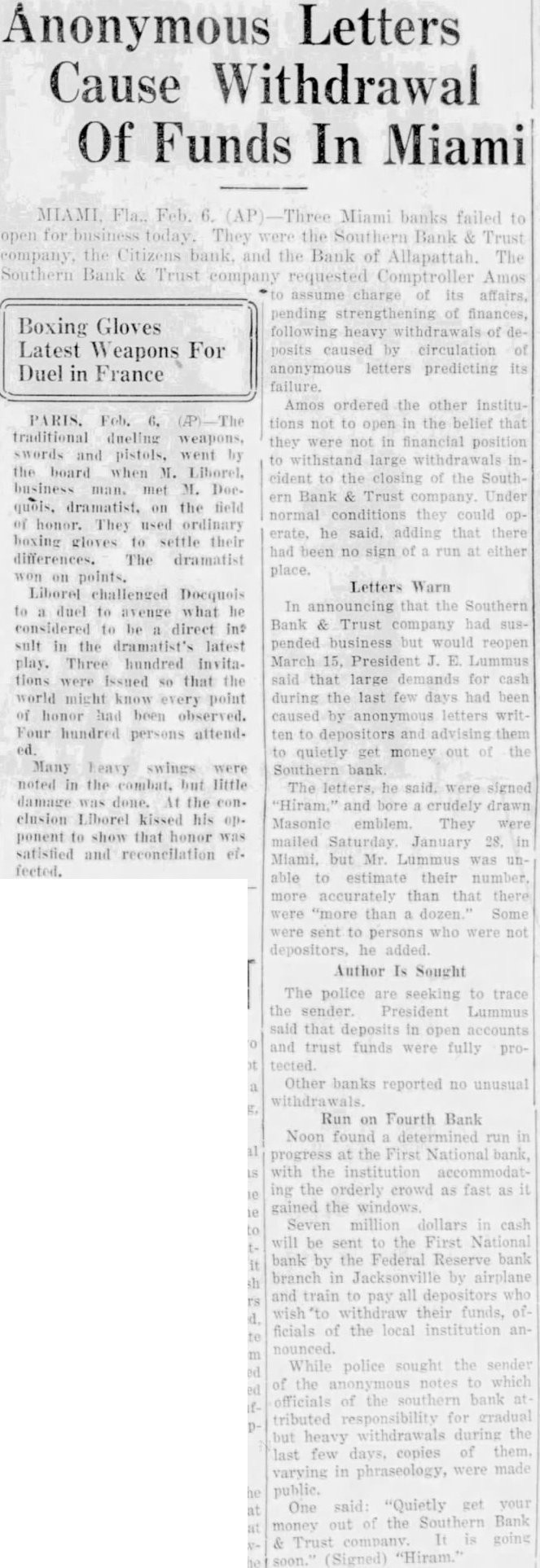
Anonymous Letters Cause Withdrawal Of Funds In Miami
Boxing Gloves Latest Weapons For Duel in France
MIAMI. Fla.. Feb. Miami banks failed to for business today. They were the Southern Bank & Trust company, the Citizens bank. and the Bank of Allapattah. The Bank & Trust company requested Comptroller Amos assume charge of its affairs, pending strengthening of finances, following heavy withdrawals of posits caused by circulation anonymous letters predicting its failure. Amos ordered the other InstituFob. 6. tions not to open in the belief that traditional dueling weapons, they were not in financial position swords and pistols, went to withstand large withdrawals inthe board when M. Liborel, cident to the closing of the Southbusiness man. met M. Doeern Bank & Trust company. Under quois. dramatist. on the field normal conditions they could opof honor. They used ordinary erate, he said. adding that there boxing gloves to settle their had been no sign of run at either differences. The dramatist place. on points. Liborel challenged Docquois to a duel to avenge what he considered to be direct in: sult in the dramatist's latest play. Three hundred invitations were Issued so that the world might know every point of honor had been observed. Four hundred persons attended.
Many heavy swings were noted in the combat. but little damage was done. 11 the conclusion Liborel kissed his ODponent to show that honor was
Letters Warn In announcing that the Southern Bank & Trust company had suspended business but would reopen March 15. President J. E. Lummus said that large demands for cash during the last few days had been caused by anonymous letters written to depositors and advising them to quietly get money out of the Southern bank The letters, he said. were signed "Hiram." and bore crudely drawn Masonic emblem. They were mailed Saturday January 28. Miami. but Mr. Lummus was un able to estimate their number, more accurately than that there were "more than a dozen." Some sent to persons who were not depositors, he added. Author Is Sought
The police are seeking to trace the sender. President Lummus said that deposits in open accounts and trust funds were fully protected. Other banks reported no unusual Run on Fourth Bank Noon found determined run progress at the First National bank, with the institution accommodating the orderly crowd as fast as gained the windows Seven million dollars in will be sent to the First National bank by the Federal Reserve bank branch in Jacksonville by airplane and train to pay all depositors who wish 'to withdraw their funds, of ficials of the local institution nounced. While police sought the sender of the anonymous notes to officials of the southern bank tributed responsibility for gradual but heavy withdrawals during the last few days. copies of them. varying in phraseology, were public. One said: "Quietly get your money out of the Southern Bank is & Trust (Signed) "Hiram."
2.February 6, 1928The TimesTrenton, NJ
Click image to open full size in new tab
Article Text
PATRONS OPEN RUN ON BANK
Three Institutions Keep Closed, Agitating Financial Circles
PUBLIC ASKED TO KEEP COOL
Fla., Feb. Seven million dollars in cash will be sent to the First National Bank by the Federal Reserve Bank branch in Jacksonville by airplane and train to pay all depositors who wish to withdraw their officials of the local tion this afternoon lowing an orderly run on the growing out of the closing of other local financial thi morning. Taking charge of affairs of Southern Bank and Trust Company the request of its pending strengthening of its finances, Ernest State ordered Bank and the Bank of pattah not open in the that they might be At the comptroller the public for and that public this ought to found run progress First the orderly the While police sought the sender the attributed sibility gradual but drawals during the copies of made public. One get your money out of Southern Company. It (Signed) the district and outskirts the latter is suburban The Southern Bank and Trust Comcapitalized on pany Saturday night had the in the Allapattah and deposits estimated Amos emphatically asserted that Mr. under normal all closed usual and their There had although there been withfrom the Southern Bank Trust Company over period circulation of the
Meanwhile. of the Southern Bank that would be reopened March 15. said that deposits in accounts and trust funds were fully tected.
3.February 6, 1928Lebanon Semi-Weekly NewsLebanon, PA
Click image to open full size in new tab
Article Text
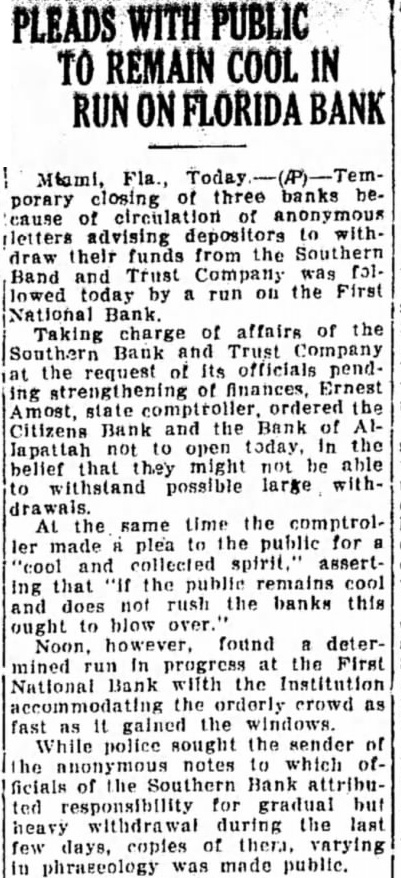
PUBLIC COOL IN TO
Miami, closing of three banks porary of circulation of depositors to withadvising their funds from the Southern Band and Trust Company was on the First lowed today by National Bank. of affairs of the Taking charge Bank and Trust Company the officials pendrequest of finances, Ernest state ordered the Amost, Bank and the Bank of Citizens today, In the open that might not be able belief they withstand possible large withdrawais. time the comptrolAt the same to the public for made and collected assertthat the public remains cool not rush the banks this and does ought to blow however, found determined run In progress at the First National Bank with the Institution the orderly crowd fast as galned the windows. While police sought the sender notes to which ficials of the Southern Bank attributed responsibility for gradual but heavy withdrawal during the last few days, copies of thera. phraseology made public.
4.February 6, 1928The Daily TimesDavenport, IA
Click image to open full size in new tab
Article Text
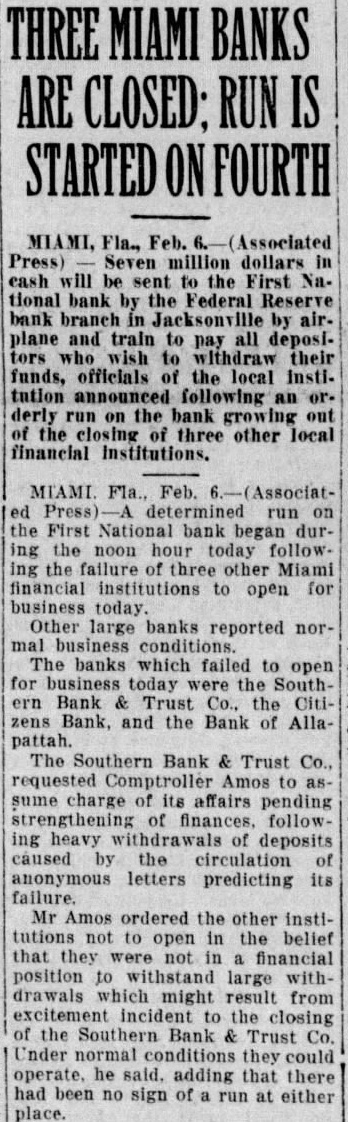
THREE BANKS CLOSED; RUN
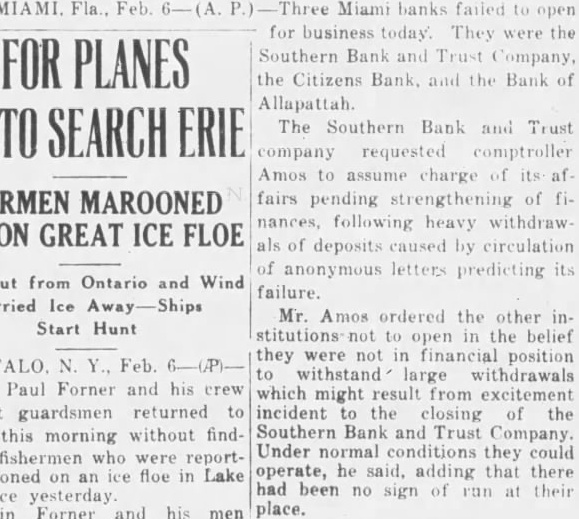
Fla., Press) Seven million dollars in cash will be sent to the First National bank by the Federal Reserve bank branch in by airplane and train to pay all depositors wish to withdraw their funds, officials of the local Institution following an or. derly run on the bank growing out the of three other local financial Institutions. determined run on the First National bank began during the noon hour today following the failure three other Miami financial institutions to open for business today. Other large banks reported normal business conditions. The banks which failed to open for business today were the Southern Bank & Trust Co., the Citizens Bank, and the Bank of Allapattah. The Southern Bank & Trust Co., requested Comptroller Amos to assume charge of its affairs pending strengthening of finances. following heavy of deposits caused by the of anonymous letters predicting its failure. Mr Amos ordered the other institutions not to open in the belief that they not in financial position withstand large withdrawals which might result from excitement incident to the closing of the Southern Bank & Trust Co. Under normal conditions they could operate. he said. adding that there had been no sign of run at either place.
5.February 6, 1928The Index-JournalGreenwood, SC
Click image to open full size in new tab
Article Text
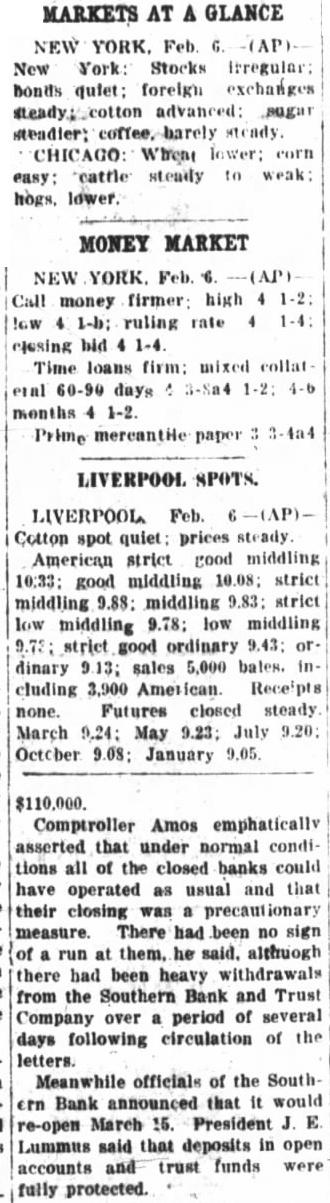
MARKETS AT A GLANCE
NEW YORK. Feb. New York: Stocks bonds quiet: foreign exchanges advanced: sugar CHICAGO: corn easy: cattle steady weak: lower.
MONEY MARKET
NEW Feb. Call money firmer: high ruling rate 1-4: elesing bid 1-4. Time loans firm: mixed collat 60-90 days months 1-2. mereantHe paper
LIVERPOOL SPOTS.
LIVERPOOL Feb. Cotton spot quiet: prices steady. American strict good middling 10:33: good middling strict middling 9.88: middling 9.83: strict middling low middling strict good ordinary 9.43: dinary sales 5,000 bales. cluding 3,900 Receipts none. Futures closed steady March May July 9.20: October 9.08: January 9.05.
Comptroller Amos emphatically asserted that under normal conditions all of the closed banks could have operated as usual and that their closing was measure. There had been no sign at them. he said. there had been heavy withdrawals from the Southern Bank and Trust Company over period of several days following circulation of the letters. Meanwhile officials of the South ern Bank announced that it would re-open March 16. President Lummus said that deposits in open accounts and trust funds fully protected.
6.February 6, 1928Norfolk Daily NewsNorfolk, NE
Click image to open full size in new tab
Article Text
ACTION CLOSING THREE OTHER MIAMI
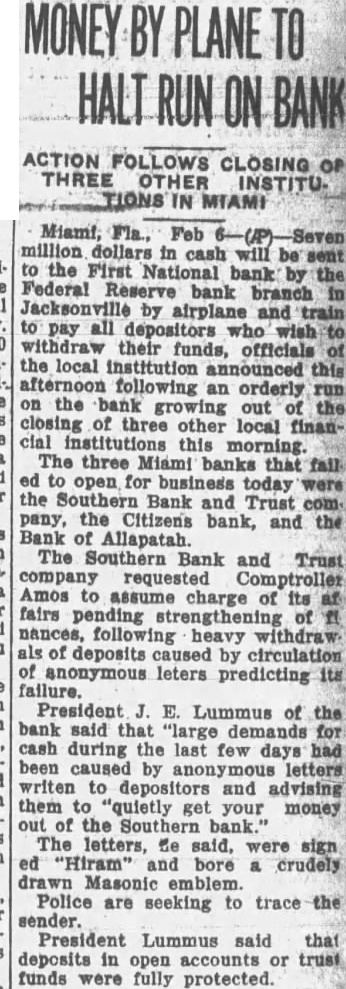
Miami, million dollars cash the First National bank Federal Reserve bank branch Jacksonville by airplane and all depositors who withdraw their funds, officials local institution announced afternoon following orderly bank growing out closing of three other local cial institutions morning. The three banks that open for business today Southern Bank and Trust pany, the Citizens bank, and Bank of The Bank and Trust company requested Comptroller Amos assume charge of its fairs pending nances, following heavy withdraw. deposits caused circulation of anonymous leters predicting failure. President Lummus bank said that "large demands during the last days been caused letters writen to depositors and them to "quietly your money the The letters, said, were sign "Hiram" bore crudely drawn Masonic Police are seeking to trace sender. President Lummus said that deposits in funds were fully protected.
7.February 6, 1928Wichita Falls TimesWichita Falls, TX
Click image to open full size in new tab
Article Text
Runs Close Three Miami Banks
BANKS CLOSE FOLLOWING RUMOR SPREAD BY ANONYMOUS LETTERS RUN STARTED ON FOURTH FIRM
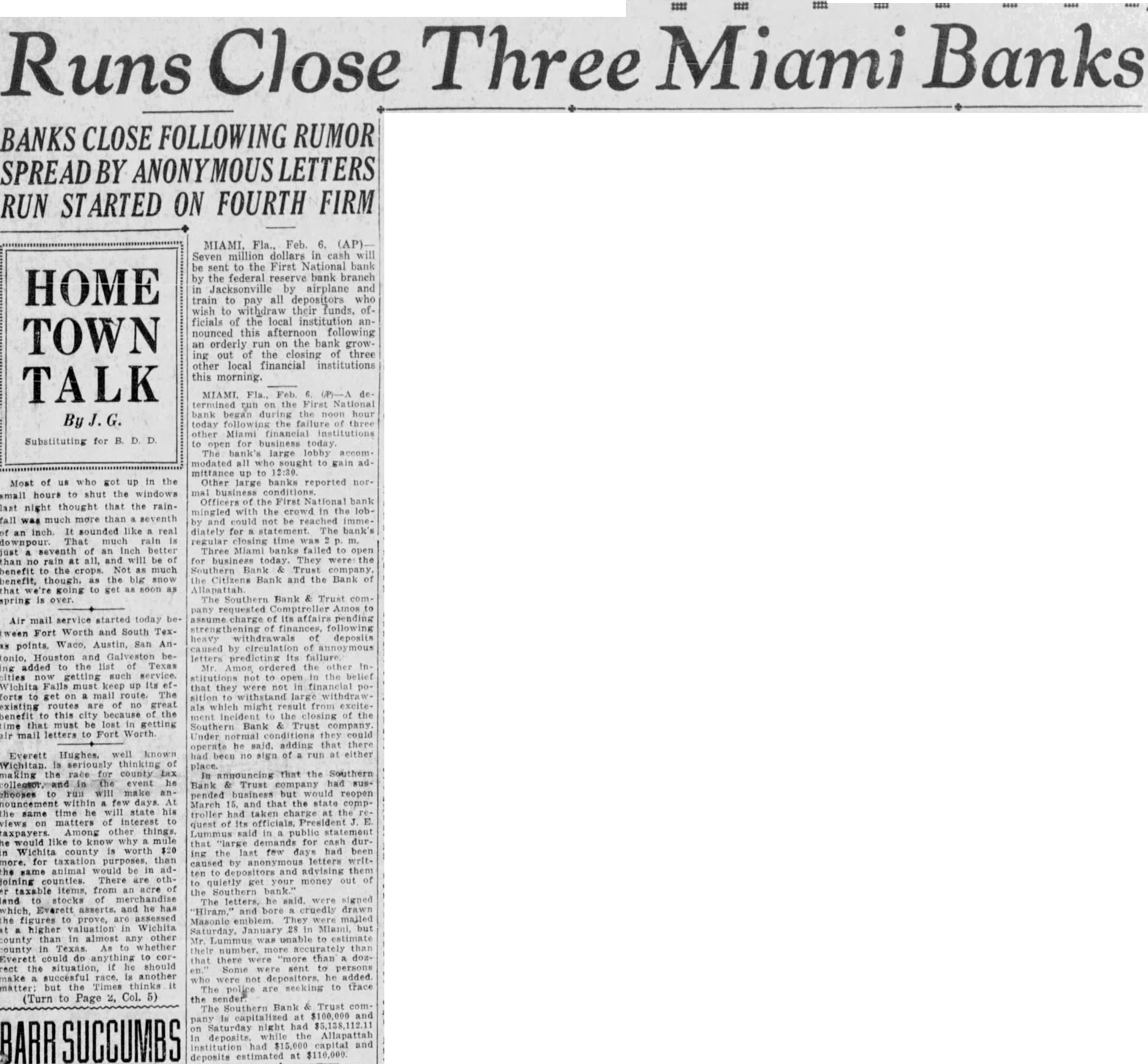
MIAMI, Fla., Feb. 6. (AP). Seven million dollars in cash be sent to the First National bank by the federal bank branch in Jacksonville airplane and train to all who wish to their funds, officials of the local institution announced this afternoon following an orderly run on the bank growing out of the closing of three other local financial institutions this morning.
Feb. termined run on the First National began during the noon hour today the failure three Miami institutions to open for business today The large lobby all who sought to gain adup to Other large banks reported norbusiness the First tional bank mingled with the crowd in the lobnot be immediately for The bank's regular closing time was m. Miami banks failed to open for business the Trust the Bank and the Bank of The Southern Bank & Trust company requested Amos to assume charge of its affairs pending of following heavy of deposits caused by circulation letters predicting Its failure Amos, ordered the innot the belief that they were not financial poals which might result the of the company Under could operate he said, adding that there had been no sign of run at either In that the Southern Bank Trust had pended but reopen March the state comptroller had taken the of its President quest Lummus said in statement that "large for cash durhad been letters writcaused by ten and advising them to quietly your money out of the Southern bank. he signed "Hiram," and Masonic They mailed January 28 Miami, but Mr. Lummus to their than "more than dozthat there Some sent to persons were not depositors, he added. are seeking to trace the Bank & Trust comSouthern capitalized $100,000 had $5,138,112.11 Saturday night the Allapattah deposits, institution had $15,000 capital and deposits estimated at $110,000
8.February 6, 1928Greenfield Daily RecorderGreenfield, MA
Click image to open full size in new tab
Article Text
Miami banks failed for business They the Southern Bank and Trust Company, the Citizens Bank, and the Bank of Allapattah. The Southern Bank and Trust company requested comptroller Amos assume charge fairs pending strengthening of nances, following heavy withdraw of deposits caused by circulation of letters predicting its failure. Mr. Amos ordered the other stitutions in the belief they financial position withstand large withdrawals which might result from excitement incident the closing Southern Bank and Trust Company. Under normal conditions they could operate, he said, adding that there had been sign of their run place.
9.February 7, 1928Evening StarWashington, DC
Click image to open full size in new tab
Article Text
LETTERS BLAMED FOR RUN ON BANKS Miami Police Seek Author of Warnings That Severely Hit Four Institutions. By the Associated Press. MIAMI, Fla., February 7.-Financial circles in this city today were reacting from the cumulative effects of "more than a dozen" anonymous letters which precipitated suspension of one bank's business, brought on temporary closing for two others and were responsible for an orderly but determined run on a fourth institution. Meanwhile, police sought the mysterious author of an indeterminate number of letters mailed January 28 in Miami, signed "Hiram," and adorned with a crudely drawn Masonic emblem. Quietly get your money out of the Southern Bank & Trust Co.: it 18 going soon," these lettters said. in varying language, but similar substance. Four Banks Suffer. Results of these missives today had included: Taking over of the Souther Bank & Trust Co. by State Controller Ernest Amos. at the instance of bank officials, stimulated to this step by heavy withdrawals. Orders by Controller Amos that the Citizens' Bank and the Bank of Allapattah. sm 1 institutions. temporarily close to avoid possible demands on their resources. A in on the First National Bank. which kept tellers busy until closing time, handing out money to depositors as L. / demanded it. Other institutions of the city today had prepared for their possible part in . the emergency. Increased supplies of currency had been requisitioned. Nearly all of them experienced slight withdrawal increases early yesterday. but. several reported later that deposits showed a jump. the City National announcing a $400,000 boost. Heavy Demands Met. James H. Gilman, president of the Bank of Bay Biscayne, largest bank of the section, and next to the First National most heavily beleagued in yesterday's excitement, announced: "While withdrawals were numerous. due to unfounded rumors which caused temporary excitement, we have satisfied every demand and we have on hand and in transit sufficient funds to continue to do so." President E. C. Romfh of the First National Bank declared that the Jacksonville branch of the Atlanta Federal Reserve Bank was answering his instifution's call for $7,000,000 in funds to bolster the, cash reserves. but said the institution would not need it. He characterized the run as a "temporary flurry attributable to other closings. which will diminish as people see the lack of need for withdrawing their funds." Letters Blamed. President J. E. Lummus of the Southern Bank & Trust held the mysterious letters responsible for the withdrawals that caused his institution to summon State aid and issued a statement which said the bank would reopen March 15. While this bank was capitalized at $100,000. it had deposits of $5,138,112. officials said. Some of the anonymous letters were addressed to persons not depositors at the Southern Bank & Trust Co., It was said. Chief of Police H. Leslie Quigg was one recipient. Bank officials a placed their number at "more than dozen." Postal inspectors doubted the existence of a Federal law which could operate against the senders. LETTERS NOT ILLEGAL.
MIAMI REACTING FROM BANK RUNS Anonymous Letters Cause Withdrawals From Institutions Miami, Fla., Feb. 7 A cricles in this city today were reacting from the cumulative effects of "more than a Jozen" anonymous letters which precipitated suspension of one bank's business, brought on temporary closing for two others and were responsible for an orderly but determined, run on a fourth institution. Meanwhile, police sought the mysterious author of an indeterminate number of letters mailed Jan. 28 in Miami, signed "Hiram," and adorned with a crudely drawn Masonic emblem. "Quietly get your money cut of the Southern Bank and Trust Company: it is going soon," these letters said, in varying language. but similar substances. Results of these missives today had included: Taking over of the Southern-Bank and Trust Company by State Comptroller Ernest Amos at the instance of bank officials. stimulated to this step by heavy withdrawals. Orders by Comptroller Amos that the Citizen's Bank and the Bank of Allapattah. small institutions. temporarity closed to avoid possible demanda of their resources. Run on 1st National. A run on the First National Bank which kept tellers busy until closing time handing out money to depositors as they demanded it. Other institutions of the city today had prepared for their possible part in the emergency. increased supplies of currency had been 1equisitioned. Nearly all of them experienced slight withdrawal increases early yesterday, but several reported latter that deposits showed a. jump, the City National announcing a $400,000 boost. James H. Gilman, president of the Bank of Bay Biscayne, largest bank of the section, and next to the First National. most heavily beleaguered in yesterday's excitement. announeed: While withdrawals were numerous, due to unfounded rumors which caused temporary excitement. we have satisfied every demand and we have on hand and in transit sufficient funds to continue to do so." $7,000,000 Ready. President E. C. Romfh. of the 1st National Bank, declared that the Jacksonville branch of the Atlanta Federal Reserve Bank was answering his institution's call for $7,000.000 in funds to holster the cash rcserves, but said the institution would it. He characterized the run not as need a "temporary flurry attributable to other closings, which will diminish as people see the lack of need for withdrawing their funds." President J. E. Lummus, of the Southern Bank and Trust, held the mysterious letters responsible for the withdrawals that caused his institution to summon state aid and issued D statement which said the bank March 15. a would re-open While this r bank was capitalized at $100,000 it had deposits of $5,138,112. officials : said. Some of the anonymous letters addressed to persons not dei the Southern positors were at Bank and Trust Company. it was said. Chief I of Police H. Leslie Quigg was one recipient.
11.February 7, 1928The Tampa TimesTampa, FL
Click image to open full size in new tab
Article Text
RUN CROWDS GROWING LESS
Institutions Report Sufficient Funds on Hand.
The Associated Press Miami, Feb. diminishing excitement following yesterday's flurry which resulted from the closing of three Miami banks today encouraged financiers and state banking officials. Some withdrawals were being made, but the lines tellers' cages were not as long or as insistent as yesterday's. State officials anticipated no more suspensions. recovery really might classed as remarkable," said Porter, chief state bank examiner. "Usually, in such cases, the excitement more intense on the second and third day than on the first. Here the flurry seems to have died out overnight."
Emergency Funds Received.
Emergency funds had been received by practically every major institution in town. No accurate estimate of the total sent in could be made. but bankers' unofficial guesses from $6,000,000 to funds brought secretly late at night. got plenty of money,' the only bankers would don't they should it, but if they get As was the case yesterday. the First National bank, with the Bank of Bay Biseayne second, was servthe longest the nervous. Both admitted in financial ciramong the strongest institutions in the state. Seek Poison Letter Writer.
Meanwhile police are seeking the writer letters signed, which started the run the Southern Bank and Trust company, causing with the Citizens bank Bank Allapattah closed yesterday by the state comptroller. said that these banks will be as the present flurry over.
Tampa bankers consider the First National Miami the strongest banking institutions in the south, and that cannot be hurt any run made on it. has reputathey for keeping itself in liquid shape. On January 1st the First National had deposits, and of quick assetsbonds securities immediately saleable.
12.February 7, 1928The Brooklyn Daily TimesBrooklyn, NY
Click image to open full size in new tab
Article Text
$5,000,000 SENT TO FLORIDA BANK
First National of Miami Takes Precautions After Three Institutions Close.
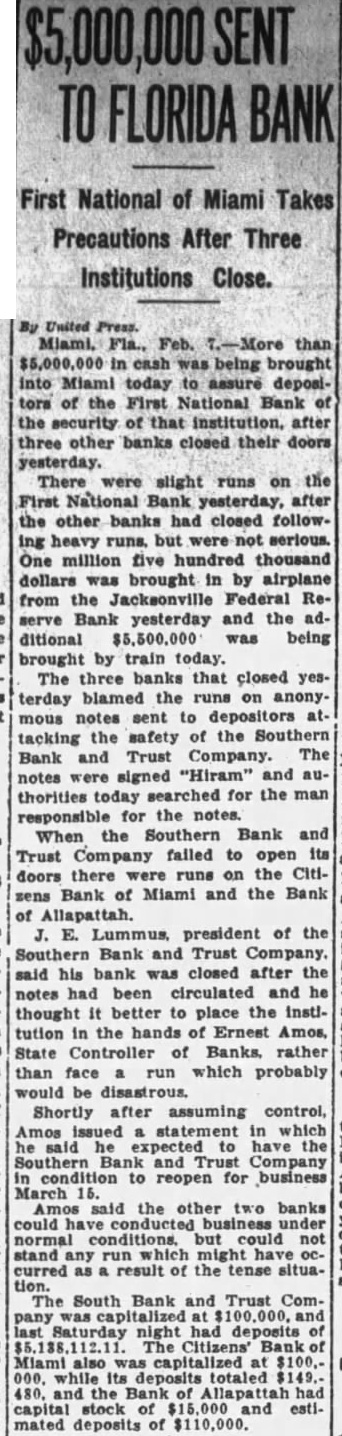
By United Press. Miami, Fla., Feb. 7.-More than $5,000,000 in cash was being brought into Miami today to assure depositora of the First National Bank of the security of that institution. after three other banks closed their doors yesterday. There were slight runs on the First National Bank yesterday, after the other banks had closed following heavy runs. but were serious. One million five hundred thousand dollars was brought in by airplane from the Jacksonville Federal Reserve Bank yesterday and the additional $5,500,000 was being brought by train today. The three banks that closed yesterday blamed the runs on anonymous notes sent to depositors attacking the safety of the Southern Bank and Trust Company. The notes signed "Hiram" and authorities today searched for the man responsible for the notes. When the Southern Bank and Trust Company failed to open its doors there runs on the Citizens Bank of Miami and the Bank of Allapattah. J. E. Lummus, president of the Southern Bank and Trust Company. said his bank was closed after the notes had been circulated and he thought it better to place the institution in the hands of Ernest Amos, State Controller of Banks, rather than face run which probably would be disastrous. Shortly after assuming control, Amos issued statement in which he expected to have the Southern and Trust Company condition to reopen for business March Amos said the other two banks could conducted business under normal conditions. but could not stand any run which might curred as result of the tense situaThe South Bank and Trust Company capitalized at $100,000. and last Saturday night had deposits The Citizens' Bank Miami also was capitalized at $100.. 000. while its deposits totaled $149.480. and the Bank of Allapattah had capital stock of 000 and estimated deposits of $110,000.
13.February 7, 1928The Spokesman-ReviewSpokane, WA
Click image to open full size in new tab
Article Text
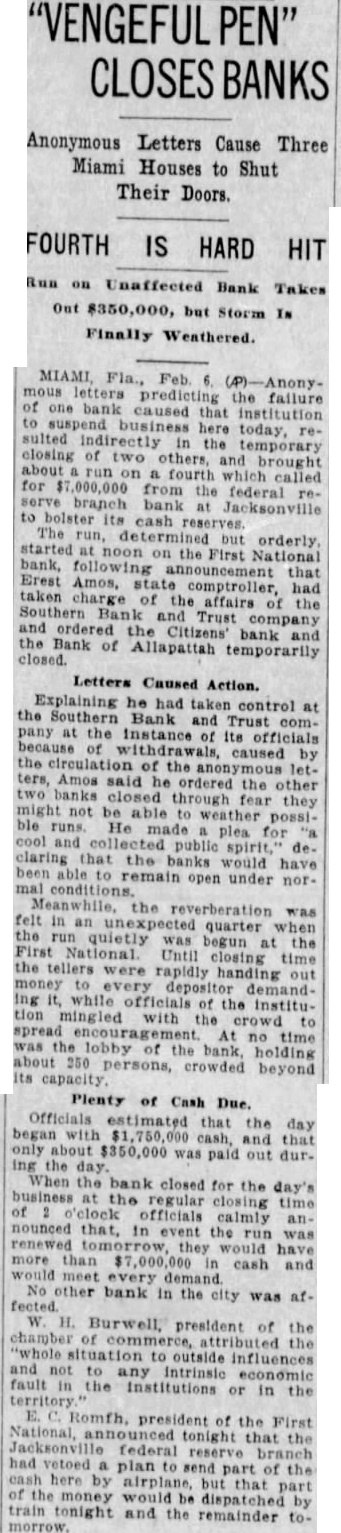
"VENGEFUL PEN" CLOSES BANKS
Anonymous Letters Cause Three Miami Houses to Shut Their Doors.
FOURTH IS HARD HIT
Run on Unaffected Bank Takes Out $350,000, but Storm IN Finally Weathered.
(P)-Anonypredicting the failure caused that institution here today, sulted the closing of brought about on fourth which called for from federal rebranch bank Jacksonville to bolster its cash reserves but started at noon on the First National bank, Erest Amos, state comptroller, had taken charge of the affairs of the Southern Bank and Trust company ordered the Citizens' bank and the Bank of Allapattah temporarily closed. Letters Caused Action. Explaining he had taken control at the Southern Bank and Trust company at the Instance of its officials because of withdrawals, caused by the of the letters, Amos said he ordered the other two banks closed through fear they might not be able to weather possible runs. He made plea for and public claring that the banks would have been able remain open under mal conditions the was felt in quarter when the run quietly was begun at the First National Until closing time the tellers were rapidly handing out depositor demandit, while officials of the institution mingled the spread was the lobby the holding about 250 persons, crowded beyond its
Plenty of Cash Due. Officials estimated that began with cash, about $350,000 was paid out the the bank closed the regular of officials nounced event the renewed would more than in cash and No other bank in the city was H. president the to outside and not any fault in Institutions or in territory president of the tonight federal had vetoed plan to send part of the cash here by of the money would be by train tonight and the remainder to.
14.February 7, 1928The Spokesman-ReviewSpokane, WA
Click image to open full size in new tab
Article Text
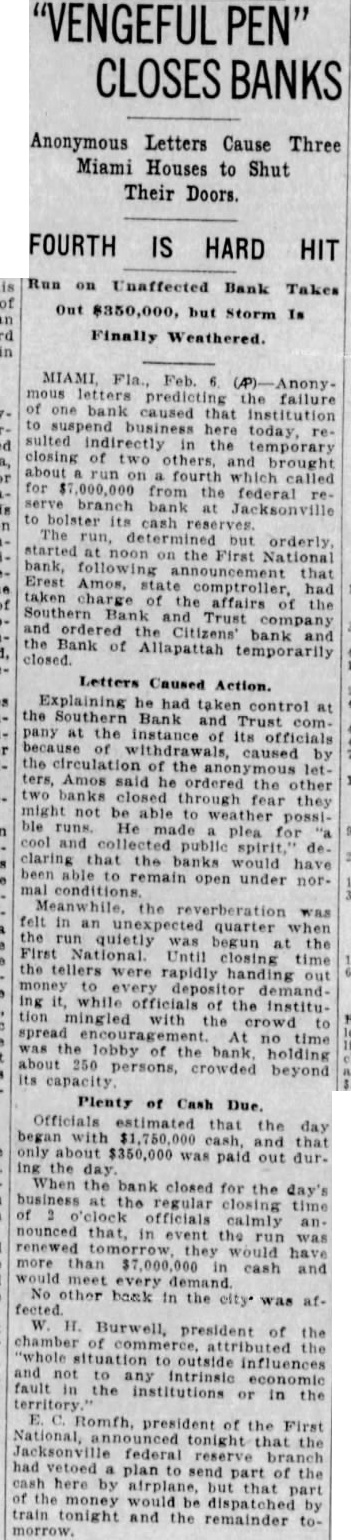
VENGEFUL PEN" CLOSES BANKS
Anonymous Letters Cause Three Miami Houses to Shut Their Doors.
FOURTH IS HARD HIT
Run on Unaffected Bank Takes Out $350,000, but Storm Is Finally Weathered.
Fla., Feb. 6. mous letters predicting the failure one bank caused that to business sulted indirectly the temporary closing of and brought about on fourth called for $7,000,000 from the federal reserve branch bank at Jacksonville to bolster its cash The determined but orderly started at noon on the First National bank, following announcement that Erest Amos, state comptroller, taken charge of the affairs of the and Southern and Trust ordered the Citizens' bank and closed. the Bank of Allapattah temporarily
Letters Caused Action. Explaining he had taken control at the Southern Bank and Trust com. pany at the instance of its officials because of withdrawals, caused by the circulation of the anonymous letters, Amos said he ordered the other two banks closed through fear they might not be able to possible runs. He made plea for cool and public spirit," de. claring that the banks would have been able to remain open under normal the was felt in an quarter when the run quietly was begun at the First National Until closing time the tellers were rapidly handing out money to every depositor demanding it, while officials of the institution mingled with the crowd to spread At no time was the lobby of the bank holding about 250 persons, crowded beyond capacity
Plenty of Cash Due. Officials estimated that the day began cash, and that only $350,000 was paid out the day When the bank closed for the day's business the regular closing time o'clock officials calmly nounced that, in event the run was renewed they would have more than in cash and would meet every No other in the was H. president of the chamber of attributed the to outside influences and not to any Intrinsic economic fault in the institutions or in the territory Romfh, president of the First inounced tonight that the Jacksonville federal reserve vetoed plan to send part of the cash here by but that part the money would be by train tonight and the remainder to-
15.February 8, 1928Republican and HeraldPottsville, PA
Click image to open full size in new tab
Article Text
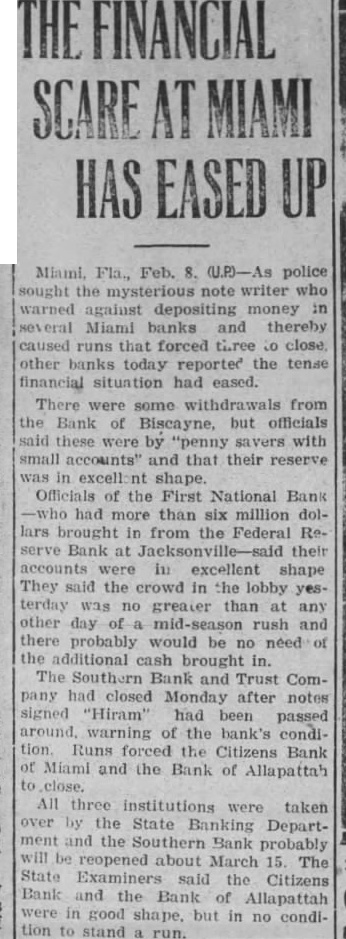
THE FINANCIAL SCARE AT MIAMI HAS EASED UP
Miami, Fla., Feb. 8. (U.P)-As police sought the mysterious note writer who warned against depositing money in several Miami banks and thereby caused runs that forced three to close other banks today reported the tense financial situation had eased. There were some withdrawals from the Bank of Biscayne, but officials said these were by "penny savers with small accounts" and that their reserve was in excell nt shape Officials of the First National Bank had more than six million dollars brought in from the Federal Reserve Bank at Jaeksonville-said their accounts were in excellent shape They said the crowd in the lobby yes. terday was no greater than at any other day of mid-season rush and there probably would be no need of the additional cash brought in. The Southern Bank and Trust Company had closed Monday after notes signed "Hiram" had been passed around. warning of the bank's condition Runs forced the Citizens Bank of Miami and the Bank of Allapattah to All three institutions were taken over by the State Banking Department and the Southern Bank probably will be reopened about March 15. The State Examiners said the Citizens Bank and the Bank of Allapattah were in good shape, but in no condition to stand run.
16.February 8, 1928Evening CourierCamden, NJ
Click image to open full size in new tab
Article Text
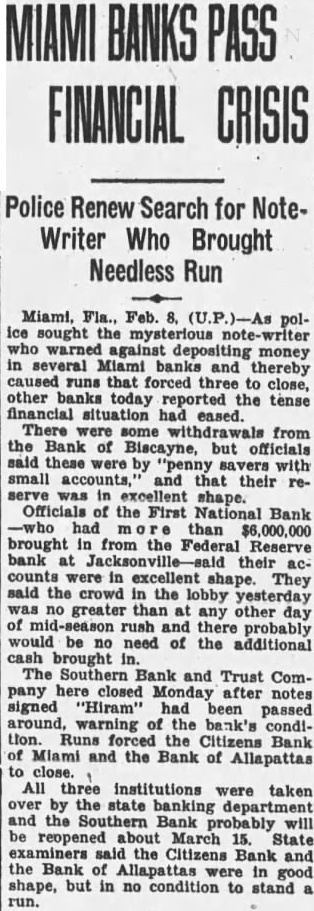
CRISIS
Police Renew Search for NoteWriter Who Brought Needless Run
Miami, Fla., Feb. 8, polsought who in several Miami and thereby money runs that forced close, other banks today reported the tense financial situation had eased. There were withdrawals the Bank of Biscayne, but officials said these by "penny with and that their reOfficials the First shape. Bank had than $6,000,000 brought in from the Federal Reserve at their acThey said the in the was no greater any other day rush and probably would be no need of the additional cash brought The Southern Bank and Trust Comclosed Monday after signed "Hiram" had been passed the bank's condition. the of Miami and the Bank of Allapattas to close. All three institutions were taken over by banking department and Southern will be March 15. State said the Citizens and the Bank of in good shape, but in no condition to stand run.
17.February 8, 1928The Brooklyn CitizenBrooklyn, NY
Click image to open full size in new tab
Article Text
RESERVES OF MIAMI BANKS EASE TENSION
Three Banks Forced to Close by Sudden Run Will Reopen
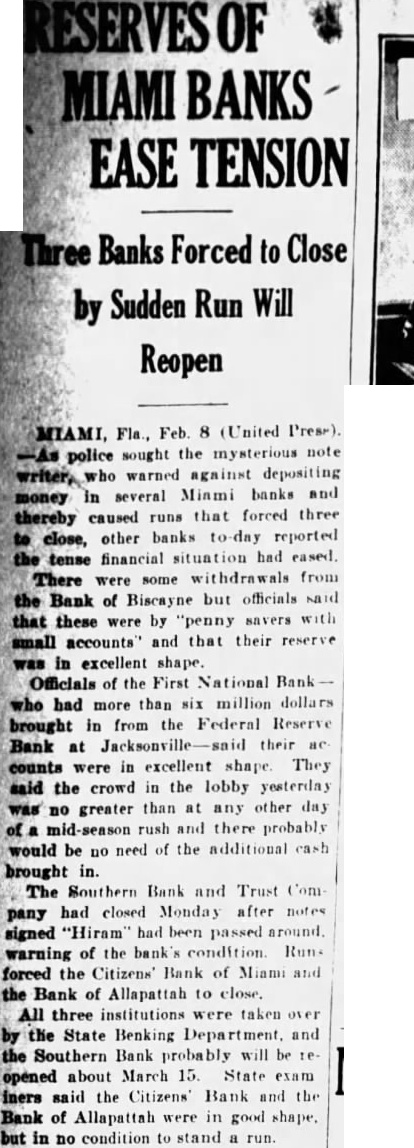
MIAMI, Fla., Feb. 8 (United Prese). police sought the mysterious note writer, who warned against depositing money in several Miami banks and thereby caused runs that forced three to close, other banks to-day reported the tense financial situation had eased. There were some withdrawals from the Bank of Biscayne but officials said that these were by "penny savers with small accounts and that their reserve was in excellent shape. Officials of the First National Bank who had more than six million dollars brought in from the Federal Reserve Bank at Jacksonville-sa their ac counts were in excellent shape They said the crowd in the lobby yesterday was no greater than at any other day of a mid-season rush and there probably would be no need of the additional cash brought in. The Southern Bank and Trust Com pany had closed Monday after notes signed "Hiram" had been passed around. warning of the bank's condition. Runs forced the Citizens' Bank of Miami and the Bank of Allapattah to close. All three institutions were taken over by the State Benking Department. and the Southern Bank probably will be 10. opened about March 15. State exam iners said the Citizens' Bank and the Bank of Allapattah were in good shape. but in no condition to stand a run.
18.February 8, 1928The Brooklyn Daily TimesBrooklyn, NY
Click image to open full size in new tab
Article Text
BANKS IN FLORIDA WEATHER CRISIS
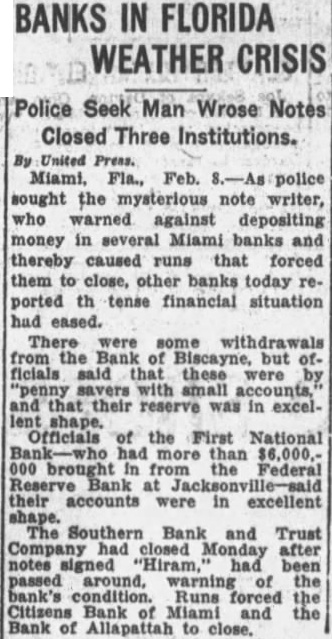
Police Seek Man Wrose Notes Closed Three Institutions. United Feb. police sought the writer, warned against depositing money in several Miami banks thereby caused runs that forced them close, other banks today ported th tense financial situation had eased. were withdrawals the Bank but ficials said these were savers that their reserve was in excelshape. Officials the First National than 000 brought from the Federal Bank their accounts in excellent The Southern Bank and Trust Company closed Monday after signed been passed around, warning the bank's condition. Runs Citizens Bank Miami and the Bank Allapattah to close.
19.February 8, 1928The Record AmericanMahanoy City, PA
Click image to open full size in new tab
Article Text
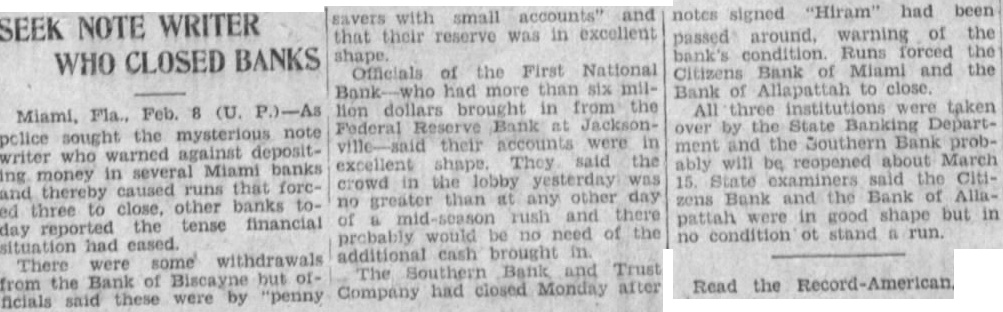
SEEK NOTE WRITER WHO CLOSED BANKS lion dollars brought in from the Miami, Fla., Feb. 8 (U. P.)-As Federal Reserve Bank at Jacksonpolice sought the mysterious note ville-said their accounts were in writer who warned against depositexcellent shape They said the ing money in several Miami banks crowd in the lobby yesterday was and thereby caused runs that forcno greater than at any other day ed three to close. other banks toof a mid-season rush and there day reported the tense financial probably would be no need of the situation had eased. additional cash brought in There were some withdrawals The Southern Bank and Trust from the Bank of Biscayne but ofCompany had closed Monday after ficials said these were by "penny savers with small accounts" and that their reserve was in excellent Officials of the First National Bank who had more than six mil- notes signed "Hiram" had been passed around, warning of the bank's condition. Runs forced the Citizens Bank of Miami and the Bank of Allapattah to close. All three institutions were taken over by the State Banking Department and the Southern Bank probably will be reopened about March 15 State examiners said the Citizens Bank and the Bank of Allapattah were in good shape but in no condition ot stand a run.
Read the Record-American.