20446. National Bank of Commerce (Pierre, SD)

Bank Information

Episode Type
Suspension → Closure
Bank Type
national
Bank ID
4279
Charter Number
4279
Start Date
March 1, 1923*
Location
Pierre, South Dakota (44.368, -100.351)

Metadata

Model
gpt-5-mini
Short Digest
1cdd8bfb

Response Measures

None

Receivership Details

Depositor recovery rate
51.3%
Date receivership started
1925-02-11
Date receivership terminated
1936-11-30
OCC cause of failure
Governance
Share of assets assessed as good
50.9%
Share of assets assessed as doubtful
19.1%
Share of assets assessed as worthless
30.0%

Description

The bank is repeatedly described as the closed National Bank of Commerce; articles state it closed in March 1923 and a receiver was appointed. The president (A. W. Ewert) was later convicted for embezzling, and litigation over state deposits followed. There is no explicit description of a depositor run prior to suspension in the provided articles; the cause of closure is bank-specific adverse information (embezzlement, illegal deposits by an officer). Receiver appealed liquidation decision as late as 1928.

Events (5)

1. April 4, 1890 Chartered
Source
historical_nic
2. March 1, 1923* Suspension
Cause
Bank Specific Adverse Info
Cause Details
Bank closed after illegal/irregular handling of rural credit deposits by officer A. W. Ewert and subsequent insolvency; president later convicted of embezzling funds (~$211,000).
Newspaper Excerpt
the closed National Bank of Commerce ... This bank closed in March, 1923.
Source
newspapers
3. February 11, 1925 Receivership
Source
historical_nic
4. March 21, 1925 Receivership
Newspaper Excerpt
C. F. Fiman, as receiver in charge of the bank of Commerce ... the bank receiver was a petitioner because of notes by Ewert held by the bank.
Source
newspapers
5. January 27, 1928 Other
Newspaper Excerpt
The case involves claims totaling $616,000 made by the Rural Credits Board of the State of South Dakota on the National Bank of Commerce at Pierre, an institution whose failure was followed by the conviction of its president. A. W. Ewert. This conviction has been appealed to the State Supreme Court.
Source
newspapers

Newspaper Articles (9)

Article from Argus-Leader, March 23, 1925

Click image to open full size in new tab

Article Text

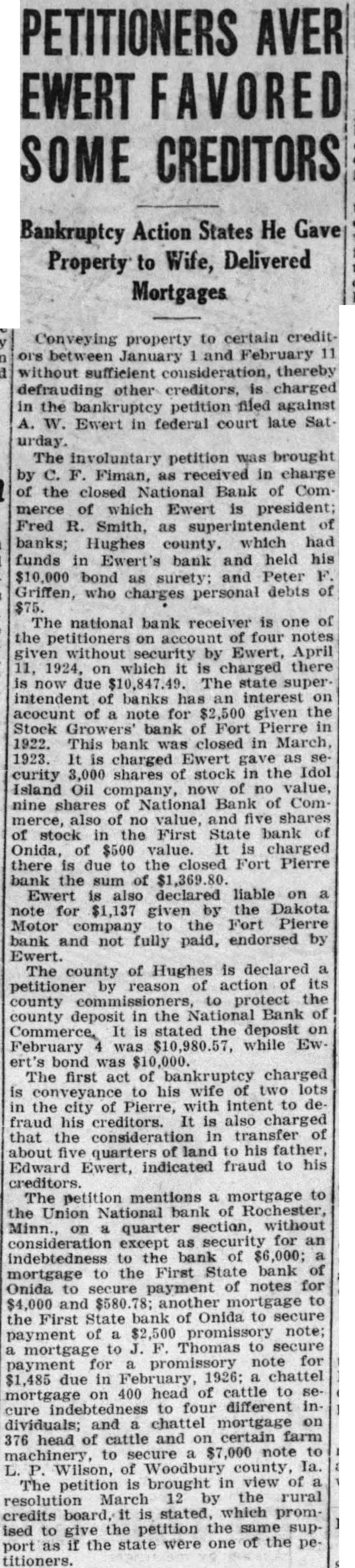
PETITIONERS AVER EWERT FAVORED SOME CREDITORS Bankruptcy Action States He Gave Property to Wife, Delivered Mortgages Conveying property to certain creditors January and without sufficient consideration, thereby defrauding other creditors, charged in the bankruptcy petition filed against W. Ewert in federal court late Sat urday. The involuntary petition was brought C. Fiman, as in charge the closed Bank of Commerce of which Ewert is Fred Smith, as of banks; Hughes which had funds in Ewert's bank and held his bond Peter Griffen, who charges personal debts of $75. The national bank receiver is one of the petitioners on of four notes given without security by Ewert, April 11, 1924, which charged there now due $10,847.49. The intendent banks interest acocunt of for $2,500 given the Stock bank Fort Pierre This bank closed in March, 1923. charged Ewert as 3,000 shares of stock in the Idol curity Island Oil company, of no value, nine shares of National Bank of Commerce, no value, and five shares of First State bank Onida, value. charged there the closed Fort Pierre the Ewert also declared liable on note for $1,137 given the Dakota Motor company the Fort Pierre bank and not fully paid, endorsed by Ewert. The county of Hughes declared reason of action of its county to protect the county deposit in the National Bank of Commerce, stated the deposit February was while EW bond was The first of charged his wife two lots the city of Pierre, with intent to de fraud creditors. It is also charged that the consideration in transfer about quarters land his father. Edward Ewert, indicated fraud to creditors. The mortgage to the Union National Minn., on quarter section, without consideration except security an indebtedness the bank of $6,000; the First State bank mortgage Onida payment of notes for and mortgage to the First Onida to note; Thomas to secure mortgage to note chattel for $1,485 due in February, 1926; 400 head of cattle to mortgage cure indebtedness to four different individuals; and mortgage 376 head cattle and certain $7,000 note Wilson, of Woodbury la. The petition is brought the view rural March credits stated, which promised to give the petition the same port as the state were one of the petitioners.

Article from Rapid City Journal, July 4, 1925

Click image to open full size in new tab

Article Text

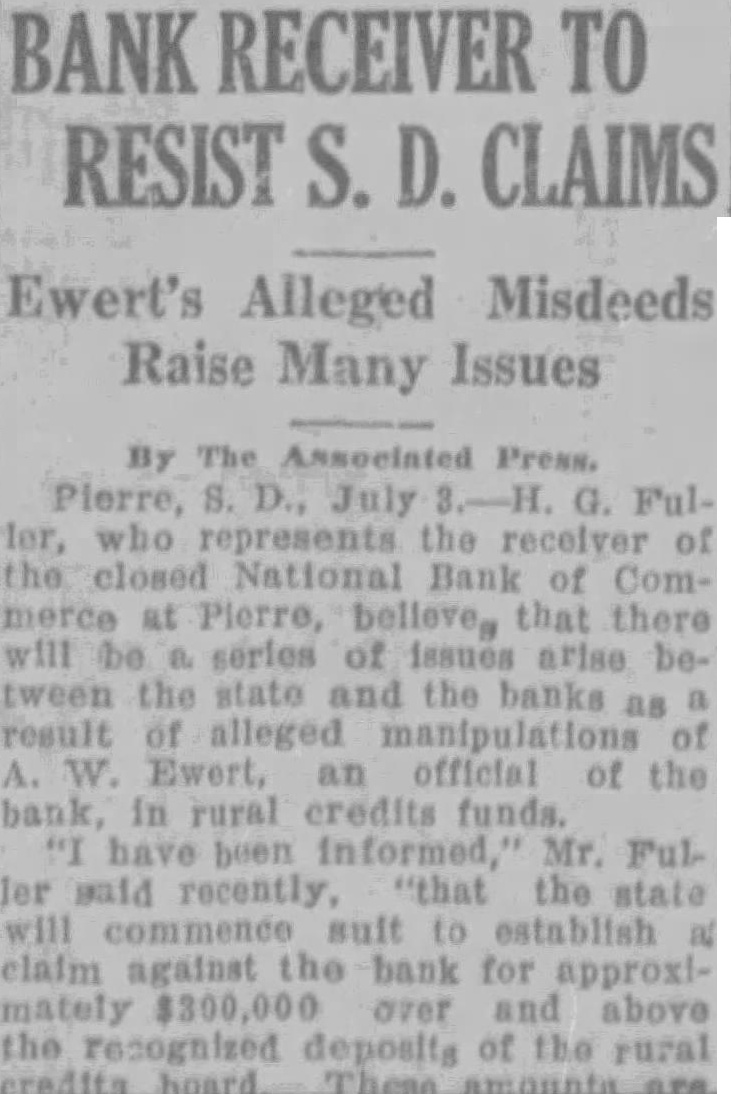
BANK RECEIVER TO RESIST S. D. CLAIMS Ewert's Alleged Misdeeds Raise Many Issues By The Associated Press. Pierre, July G. Fuller, who represents the receiver of the closed National Bank of Commerce at Pierre, believe that there will be series of issues arise between the state and the banks as result alleged manipulations A. W. Ewert, an official of the bank, in rural credits funds. have been informed, Mr. Ful"that the state will commence suit to establish claim against the bank for approximately $300,000 over and above


Article from The Daily Deadwood Pioneer-Times, October 1, 1925

Click image to open full size in new tab

Article Text

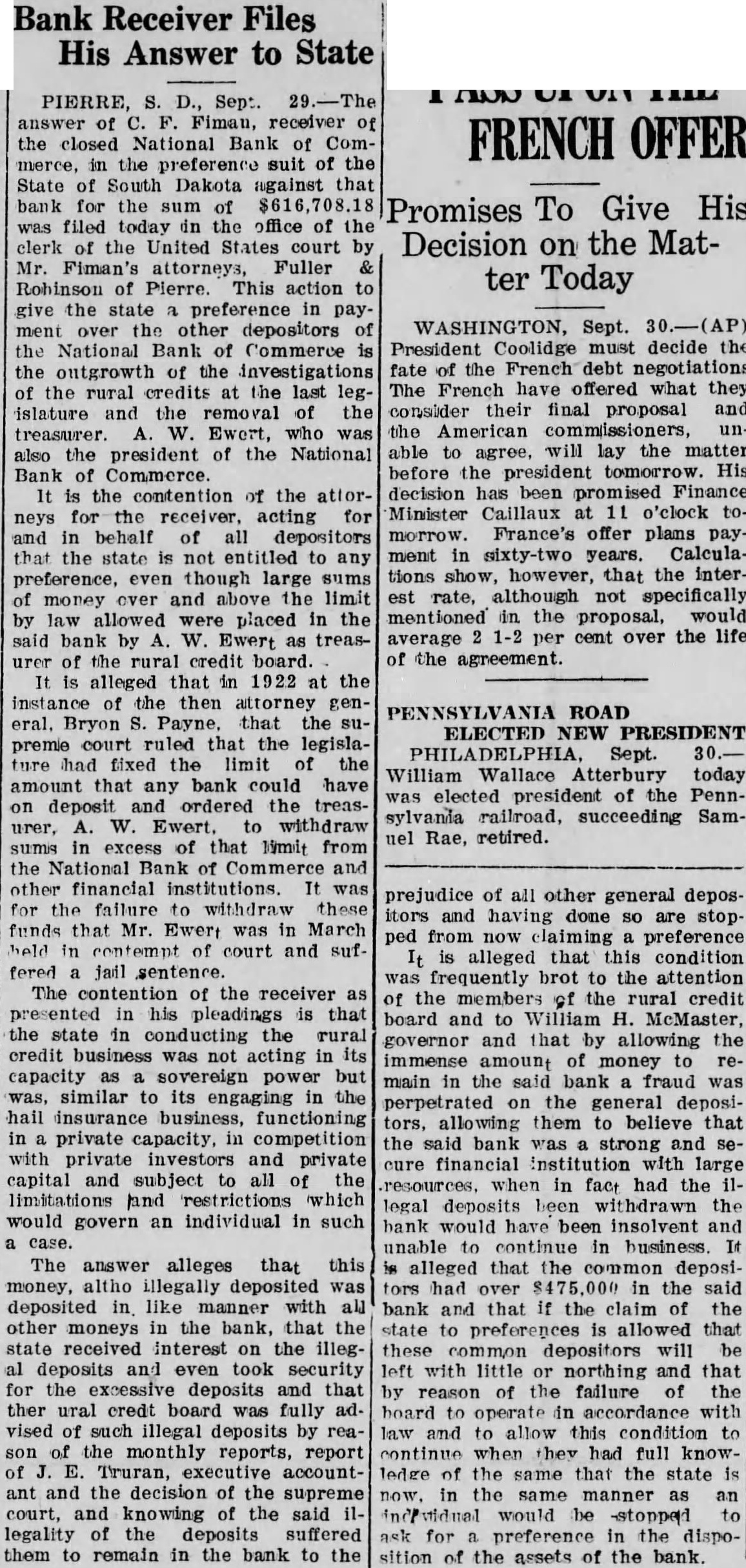
Bank Receiver Files His Answer to State PIERRE, Sept. of receiver the closed National Bank of Commerce. in the preference suit of the State of South Dakota against that bank the sum of filed today in the office of the clerk of the United court Mr. Fiman's attorneys, Fuller Robinson of Pierre. This the state preference in payment over other depositors National Bank of Commerce the outgrowth of the of the rural credits at the last legislature and the removal of the W. who also the president of the National Bank of Commerce. the contention the attorneys for the receiver. acting for and in behalf of all depositors the state not entitled to any preference, even though large sums of morey over and above the limit by law allowed were placed in the said bank by W. Ewert as tre of the rural credit board. is alleged that in 1922 at the instance of the then attorney general. Bryon Payne, that the premie court ruled that the legislature had fixed the limit of the amount that any bank could have on deposit and ordered the treasurer. A. W. Ewert. to withdraw sums in excess of that limit from the National Bank of and other financial institutions It was for the failure to withdraw these funds that Mr. Ewert was in March held contempt of court and suffered jail sentence. The contention of the receiver presented in his pleadings is that the state in conducting the rural credit was not acting in its capacity as sovereign power but was. similar to its engaging in the hall insurance business, functioning private capacity. in competition with private investors and private capital and subject to all of the restrictions which would govern an individual in such case. The answer alleges that this money, illegally deposited was deposited in like manner with all other moneys in the bank, that the state received interest on the deposits and even took security for the excessive deposits and that ther ural board was fully advised of such illegal deposits by reason of the monthly reports, report of Truran. accountant and the decision of the and knowing of the said legality of the deposits suffered them to remain in the bank to the


Article from The Weekly Pioneer-Times, October 1, 1925

Click image to open full size in new tab

Article Text

Bank Receiver Files His Answer to State PIERRE, Sept. answer Fiman, receiver the closed National Bank of Commerce, in the preference suit of the State of South Dakota against that bank for the sum of was filed today in the office of the clerk of the United States court by Mr. Fiman's attorneys, Fuller Robinson of Pierre. This action give the state preference in payment over the other depositors the National Bank of Commerce the outgrowth of the investigations of the rural credits at the last legislature and the removal of the treasurer. W. Ewert, who was also the president of the National Bank of Commerce. It the contention of the attorneys for the receiver, acting for and in behalf of all depositors that the state not entitled to any preference, even though large sums of money over and above the limit by law allowed were placed in the bank by W. Ewert treasof the rural credit board. alleged that in 1922 at the instance of the then attorney general. Bryon Payne. that the supremie court ruled that the legislature had fixed the limit of the amount that any bank could have on deposit and ordered the treasurer, W. Ewert. to withdraw excess of that limit from the National Bank of Commerce and other financial institutions. was for the failure to withdraw these funds that Mr. Ewert was in March held court and suffered jail sentence. The contention of the receiver presented in his pleadings is that the state in conducting the rural credit business was not acting in its capacity as sovereign power but similar to its engaging in the hail insurance business, functioning in private capacity, in competition with private investors and private capital and subject to all of the limitations and restrictions which would govern an individual in such case. The answer alleges that this money, illegally deposited was deposited in like manner with all other moneys in the bank, that the state received Interest on the al deposits even took security for the excessive deposits and that ther ural credt board was fully vised of such illegal deposits by son the monthly reports, report of Truran, executive accountant and the decision of the supreme court, knowing of the said legality of the deposits suffered them to remain in the bank to the prejudice of all other general depositors and having done are stopped from now claiming preference alleged that this condition frequently brot to the attention of the members of the rural credit board and to William H. McMaster, governor and that by allowing the immense amount of money main in said bank fraud was perpetrated on the general depositors, allowing them to believe that the said bank was strong and cure Institution with large when fact had the legal deposits been withdrawn the bank would have been insolvent unable to continue business. alleged that the common depositors had over in the said bank and that the claim of the state to preferences is allowed that these common depositors will left with little or northing and that by reason of the failure the board to operate accordance with law and to allow this condition to continue when they had full knowledge of the same that the state in the same manner as would be -stopped for preference the dispoof the assets of the bank.


Article from Rapid City Journal, December 16, 1925

Click image to open full size in new tab

Article Text

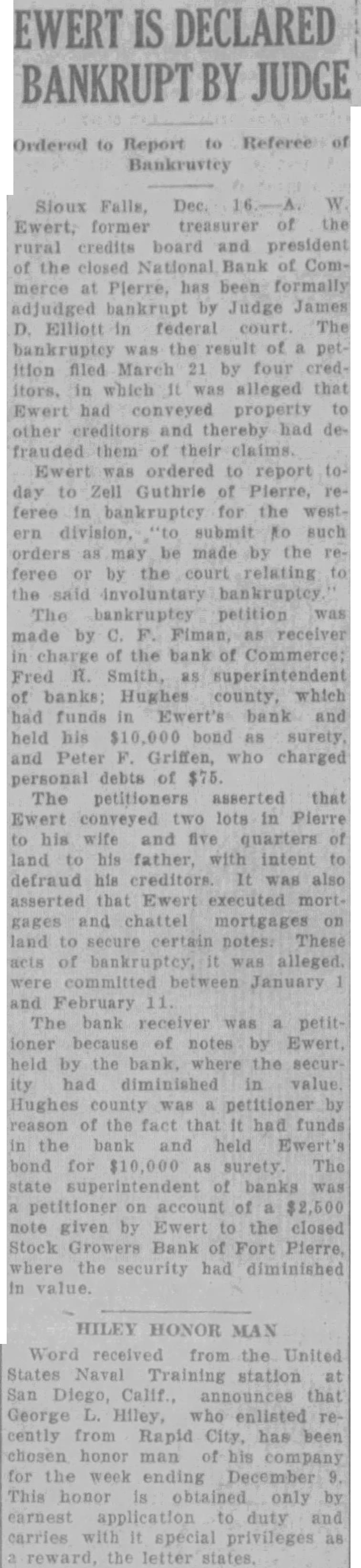
EWERT IS DECLARED BANKRUPT BY JUDGE Ordered to Report to Referee of Bankruvtey Sioux Falls, Dec. 16-A. W Ewert. former treasurer of the rural credits board and president of the closed National Bank of Commerce at Pierre, has been formally adjudged bankrupt by Judge James D. Elliott in federal court. The bankruptcy was the result of a pet ition filed March 21 by four creditors. in which It was alleged that Ewert had conveyed property to other creditors and thereby had defrauded them of their claims. Ewert was ordered to report today to Zell Guthrie of Pierre, referee in bankruptcy for the western division, to submit to such orders as may be made by the referee or by the court relating to the said involuntary bankruptcy The bankruptey petition was made by C. F. Fiman, as receiver in charge of the bank of Commerce: Fred R. Smith, as superintendent of banks Hughes county, which had funds in Ewert's bank and held his $10,000 bond as surety and Peter F. Griffen, who charged personal debts of $75. The petitioners asserted that Ewert conveyed two lots in Pierre to his wife and five quarters of land to his father, with intent to defraud his creditors. It was also asserted that Ewert executed mort. gages and chattel mortgages on land to secure certain notes: These acts of bankruptcy, was alleged. were committed between January 1 and February 11. The bank receiver was a petitloner because of notes by Ewert. held by the bank. where the security had diminished in value Hughes county was a petitioner by reason of the fact that It had funds in the bank and held Ewert's bond for $10,000 as surety The state superintendent of banks was a petitioner on account of a $2,500 note given by Ewert to the closed Stock Growers Bank of Fort Pierre. where the security had diminished in value. HILEY HONOR MAN Word received from the United States Naval Training station at San Diego, Calif., announces that George L. Hiley, who enlisted recently from Rapid City, has been chosen honor man of his company for the week ending December 9. This honor is obtained only by earnest application to duty and carries with It special privileges as reward, the letter states.


Article from Evening Star, January 27, 1928

Click image to open full size in new tab

Article Text

STATE'S BANK CLAIM INVOLVED IN SUIT South Dakota Receiver Appeals Liquidation Decision. By the Associated Press. PIERRE. S Dak., January 27.-A challenge to the sovereign rights of States when they engage in proprietary enterprise. is embodied in a record which was settled in the United States District Court yesterday for appeal to the Federal Circuit Court. The case involves claims totaling $616,000 made by the Rural Credits Board of the State of South Dakota on the National Bank of Commerce at Pierre. an institution whose failure was followed by the conviction of its president. A. W. Ewert. also treasurer of the Rural Credits Board. on a charge of embezzling $211,000. This convictio has been appealed to the State Supreme Court, The whole affair has been in South Dakota politics for years. In the civil litigation the State has been given the preference over ordinary depositors of the closed bank. The United States District Court awarded the commonwealth $263,093.21 -the cash on hand in the bank when it closed-besides recognizing it as a common creditor for the balance of its $616,000 deposit. The bank receiver appealed.


Article from The Bismarck Tribune, January 27, 1928

Click image to open full size in new tab

Article Text

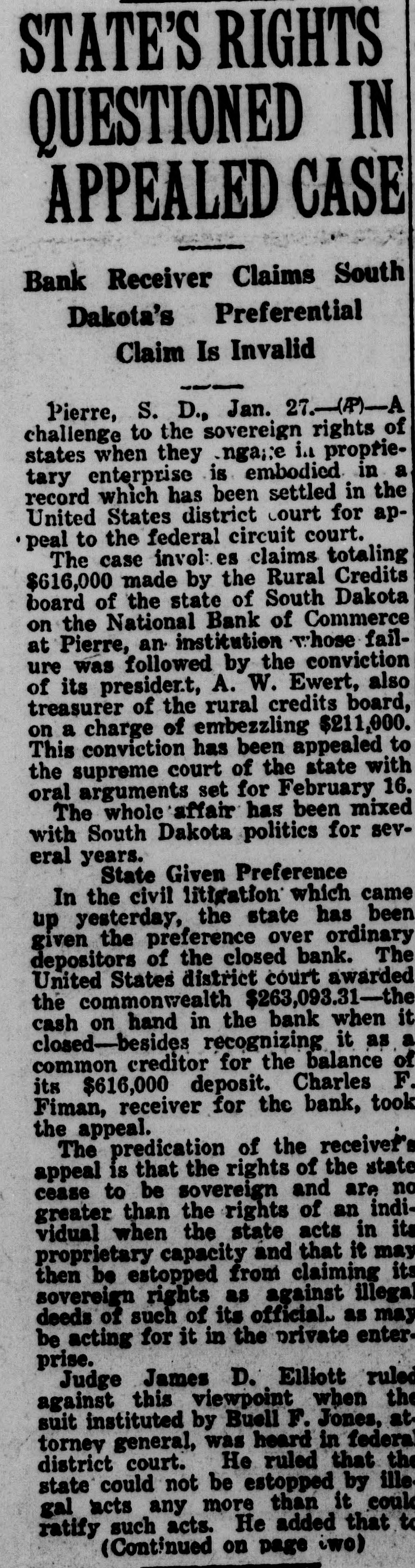
STATE'S RIGHTS QUESTIONED IN APPEALED CASE Bank Receiver Claims South Dakota's Preferential Claim Is Invalid Pierre, S. D., Jan. 27.-(P)-A challenge to the sovereign rights of states when they ngaite is proprietary enterprise is embodied in a record which has been settled in the United States district court for appeal to the federal circuit court. The case invol: es claims totaling $616,000 made by the Rural Credits board of the state of South Dakota on the National Bank of Commerce at Pierre, an- institution whose failure was followed by the conviction of its presider.t, A. W. Ewert, also treasurer of the rural credits board, on a charge of embezzling $211,000. This conviction has been appealed to court the supreme of the state with oral arguments set for February 16. The whole affair has been mixed with South Dakota politics for several years. State Given Preference In the civil litigation which came up yesterday, the state has been the over given preference bank. ordinary The depositors of the closed United States district court awarded the commonwealth $263,093.31-the cash on hand in the bank when it closed-besides recognizing it as a common creditor for the balance of its $616,000 deposit. Charles F. Fiman, receiver for the bank, took the appeal. The predication of the receiver's appeal is that the rights of the state cease to be sovereign and are no greater than the rights of an individual when the state acts in its proprietary capacity and that it may then be estopped from claiming its sovereign rights as against illegal deeds of such of its official. as may be acting for it in the private enterprise. Judge James D. Elliott ruled against this viewpoint when the suit instituted by Buell F. Jones, at torney general, was heard in federal district court. He ruled that the state could not be estopped by ille gal acts any more than it could ratify such acts. He added that to (Continued on page iwo)


Article from Evening star, January 27, 1928

Click image to open full size in new tab

Article Text

STATE'S BANK CLAIM INVOLVED IN SUIT South Dakota Receiver Appeals Liquidation Decision. By the Associated Press PIERRE S Dak. January challenge to the sovereign rights of States when they engage in proprietary enterprise. embodied in record which was settled in the United States District Court yesterday for appeal to the Federal Circuit Court. The case involves claims totaling $616,000 made by the Rural Credits Board of the State of South Dakota on the National Bank of Commerce at Pierre. an institution whose failure was followed by the conviction of its president. A. Ewert also treasurer the Rural Credit Board on charge of embezzling $211,000 This convictio has been appealed to the State Supreme The whole affair has been in South Dakota politics for years In the civil litigation the State has been given the preference over ordinary depositors of the closed bank The United States District Court awarded the commony $263,093.21 -the cash on hand in the bank when it closed- besides recognizing common creditor for the balance of its $616,000 deposit. The bank receiver appealed Spain holds the world's record as the largest producer and exporter of


Article from The Grand Island Independent, January 27, 1928

Click image to open full size in new tab

Article Text

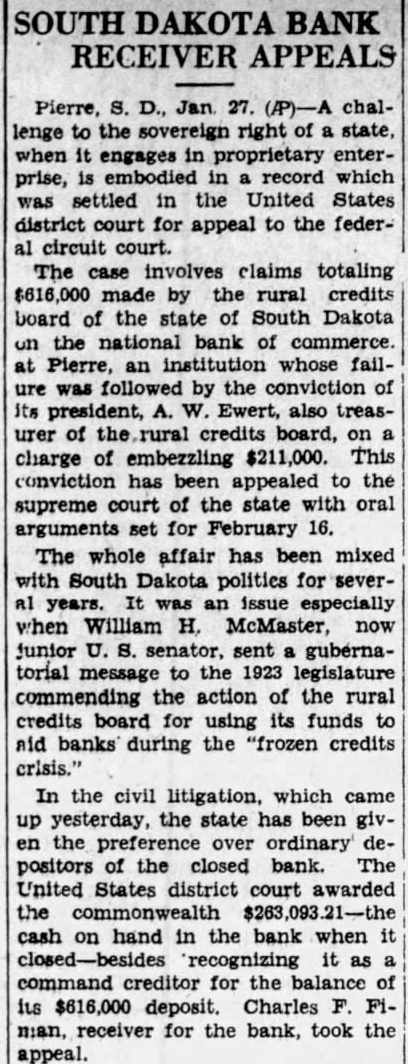
BANK RECEIVER APPEALS Pierre, Jan. challenge to the sovereign right of state, when engages in proprietary enterprise, embodied in record which was settled in the United States district court for appeal to the federcircuit court. The case involves claims totaling $616,000 made by the rural credits board of the state of South Dakota on the national bank of commerce. at Pierre, an institution whose failure followed by the conviction of its W. Ewert, also treasurer of credits board, charge embezzling $211,000. This conviction has been appealed to the supreme court of the state with oral arguments set for February 16. The whole affair has been mixed with South Dakota polities for severyears. It was an issue especially when William H. McMaster, now junior senator, sent gubernatorial message to the 1923 legislature commending the action of the rural credits board for using its funds to aid banks during the "frozen credits crisis." In the civil litigation, which came up yesterday, the state has been the preference over ordinary positors of the closed bank. The United States district court awarded the cash on hand in the bank when recognizing command creditor for the balance of its $616,000 deposit. Charles man, receiver for the bank, took the appeal.