2027. German National Bank (Washington, DC)

Bank Information

Episode Type
Suspension → Closure
Bank Type
national
Start Date
January 1, 1882*
Location
Washington, District of Columbia (38.895, -77.036)

Metadata

Model
gpt-5-mini
Short Digest
b147537e

Response Measures

None

Description

Articles report the German National Bank had failed and a receiver was in place (B. U. Keyser). No newspaper text describes any depositor run; the bank's failure and receiver appointment indicate a suspension/closure by authorities. Dates: failure occurred in 1882 (article 2 references 1882 failure); receiver referenced in Jan 1883 article.

Events (2)

1. January 1, 1882* Suspension
Cause
Government Action
Cause Details
The bank failed and its affairs were placed with a receiver (formal failure leading to suspension/closure).
Newspaper Excerpt
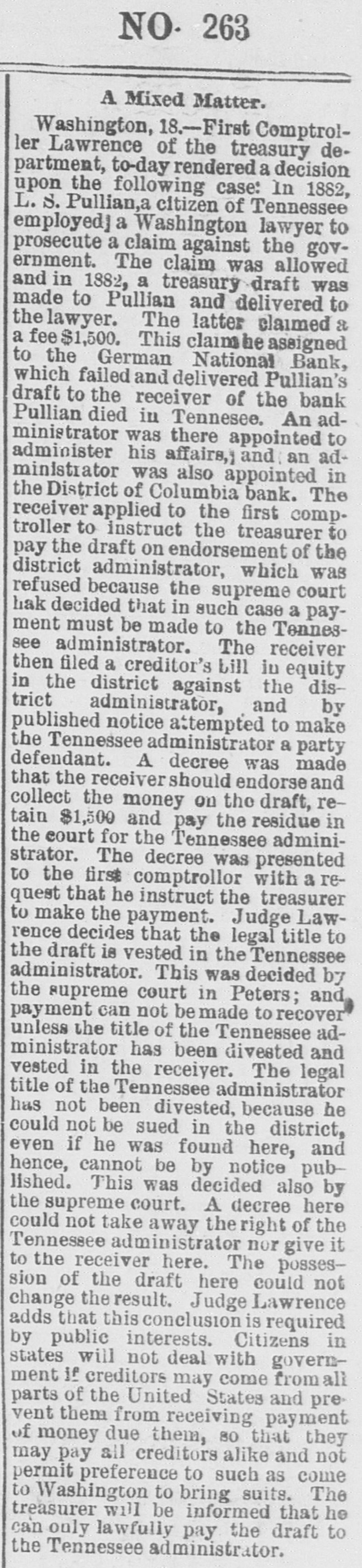
the German National Bank, which failed and delivered Pullian's draft to the receiver of the bank
Source
newspapers
2. January 1, 1883 Receivership
Newspaper Excerpt
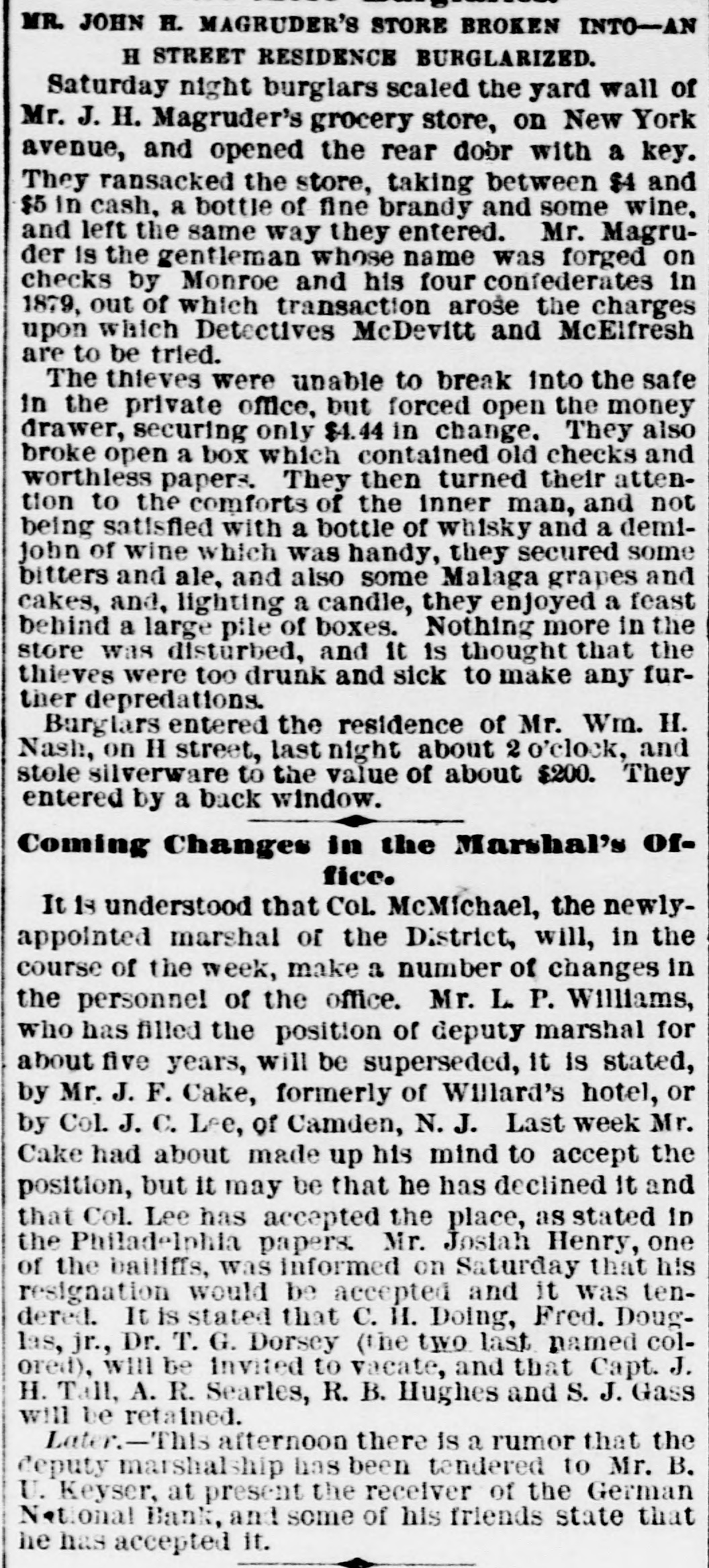
there is a rumor that the deputy marshalship has been tendered to Mr. B. U. Keyser, at present the receiver of the German National Bank, and some of his friends state that he has accepted it.
Source
newspapers

Newspaper Articles (2)

Article from Evening Star, January 1, 1883

Click image to open full size in new tab

Article Text

# MR. JOHN H. MAGRUDER'S STORE BROKEN INTO-AN # H STREET RESIDENCE BURGLARIZED. Saturday night burglars scaled the yard wall of Mr. J. H. Magruder's grocery store, on New York avenue, and opened the rear door with a key. They ransacked the store, taking between $4 and $5 in cash, a bottle of fine brandy and some wine, and left the same way they entered. Mr. Magruder is the gentleman whose name was forged on checks by Monroe and his four confederates in 1879, out of which transaction arose the charges upon which Detectives McDevitt and McElfresh are to be tried. The thieves were unable to break into the safe in the private office, but forced open the money drawer, securing only $4.44 in change. They also broke open a box which contained old checks and worthless papers. They then turned their attention to the comforts of the inner man, and not being satisfied with a bottle of whisky and a demi-John of wine which was handy, they secured some bitters and ale, and also some Malaga grapes and cakes, and, lighting a candle, they enjoyed a feast behind a large pile of boxes. Nothing more in the store was distürbed, and it is thought that the thieves were too drunk and sick to make any further depredations. Burglars entered the residence of Mr. Wm. H. Nash, on H street, last night about 2 o'clock, and stole silverware to the value of about $200. They entered by a back window. # Coming Changes in the Marshal's Office. It is understood that Col. McMichael, the newly-appointed marshal of the District, will, in the course of the week, make a number of changes in the personnel of the office. Mr. L. P. Williams, who has filled the position of deputy marshal for about five years, will be superseded, it is stated, by Mr. J. F. Cake, formerly of Willard's hotel, or by Col. J. C. Lee, of Camden, N. J. Last week Mr. Cake had about made up his mind to accept the position, but it may be that he has declined it and that Col. Lee has accepted the place, as stated in the Philadelphia papers. Mr. Josiah Henry, one of the bailiffs, was informed on Saturday that his resignation would be accepted and it was tendered. It is stated that C. H. Doing, Fred. Douglas, jr., Dr. T. G. Dorsey (the two last named colored), will be invited to vacate, and that Capt. J. H. Tall, A. R. Searles, R. B. Hughes and S. J. Gass will be retained. Later. This afternoon there is a rumor that the deputy marshalship has been tendered to Mr. B. U. Keyser, at present the receiver of the German National Bank, and some of his friends state that he has accepted it.


Article from The Salt Lake Herald, April 19, 1883

Click image to open full size in new tab

Article Text

NO. 263 A Mixed Matter. Washington, 18.-First Comptroller Lawrence of the treasury department, to-day rendered a decision upon the following case: In 1882, L.S. Pullian,a citizen of Tennessee employed a Washington lawyer to prosecute a claim against the government. The claim was allowed and in 1882, a treasury draft was made to Pullian and delivered to the lawyer. The latter claimed a a fee $1,500. This claim he assigned to the German National Bank, which failed and delivered Pullian's draft to the receiver of the bank Pullian died in Tennesee. An administrator was there appointed to administer his affairs, and an administrator was also appointed in the District of Columbia bank. The receiver applied to the first comptroller to instruct the treasurer to pay the draft on endorsement of the district administrator, which was refused because the supreme court hak decided that in such case a payment must be made to the Tonnessee administrator. The receiver then filed a creditor's bill in equity in the district against the district administrator, and by published notice attempted to make the Tennessee administrator a party defendant. A decree was made that the receiver should endorse and collect the money on the draft, retain $1,500 and pay the residue in the court for the Tennessee administrator. The decree was presented to the first comptrollor with a request that he instruct the treasurer to make the payment. Judge Lawrence decides that the legal title to the draft is vested in the Tennessee administrator. This was decided by the supreme court in Peters; and payment can not be made to recover unless the title of the Tennessee administrator has been divested and vested in the receiver. The legal title of the Tennessee administrator has not been divested, because he could not be sued in the district, even if he was found here, and hence, cannot be by notice published. This was decided also by the supreme court. A decree here could not take away the right of the Tennessee administrator nor give it to the receiver here. The possession of the draft here could not change the result. Judge Lawrence adds that this conclusion is required by public interests. Citizens in states will not deal with government if creditors may come from all parts of the United States and prevent them from receiving payment of money due them, 80 that they may pay all creditors alike and not permit preference to such as come to Washington to bring suits. The treasurer will be informed that he can only lawfully pay the draft to the Tennessee administrator.