20215. Peoples Bank (Union, SC)

Bank Information

Episode Type
Suspension → Closure
Bank Type
state
Start Date
August 4, 1908
Location
Union, South Carolina (34.724, -81.625)

Metadata

Model
gpt-5-mini
Short Digest
d55aa48d

Response Measures

None

Description

The People's Bank of Union (SC) suspended operations Aug 4, 1908 pending voluntary liquidation (statement cites general depression). Receivers were appointed within days and additional receivers later; no run is reported. Bank remained in liquidation, assets sold in 1909 and receivers pursued fraud charges. Classified as suspension leading to closure/receivership.

Events (5)

1. August 4, 1908 Suspension
Cause
Voluntary Liquidation
Cause Details
Board decided owing to continuous decline in deposits and general depression in securities held by the bank to suspend pending voluntary liquidation; president cited general depression.
Newspaper Excerpt
Just before the regular time for the bank to open the following notice was posted on the closed doors: August 4, 1908. Bank suspended.
Source
newspapers
2. August 7, 1908 Receivership
Newspaper Excerpt
Judge D. E. Hydrick has appointed as receivers of the People's bank of this city... B. F. Arthur, president of the bank, and W. H. Gist, cashier of the Bank of Carlisle.
Source
newspapers
3. August 21, 1908 Receivership
Newspaper Excerpt
On Wednesday Judge D. E. Hydrick appointed Mr. H. B. O'Shields... as co-receiver of the People's bank which recently went into voluntary liquidation.
Source
newspapers
4. September 22, 1908 Other
Newspaper Excerpt
Thomas C. Duncan is under arrest here charged with fraud... The charge was made by the receivers of the People's Bank of this city, which several months ago went into voluntary liquidation, ... relating to certain checks and drafts ... Duncan had no funds on deposit.
Source
newspapers
5. September 1, 1909* Other
Newspaper Excerpt
The People's bank building and fixtures at Union was sold at a receiver's sale Monday. W. J. Haile was the highest bidder, his bid being $14,300.
Source
newspapers

Newspaper Articles (18)

Article from Evening Star, August 4, 1908

Click image to open full size in new tab

Article Text

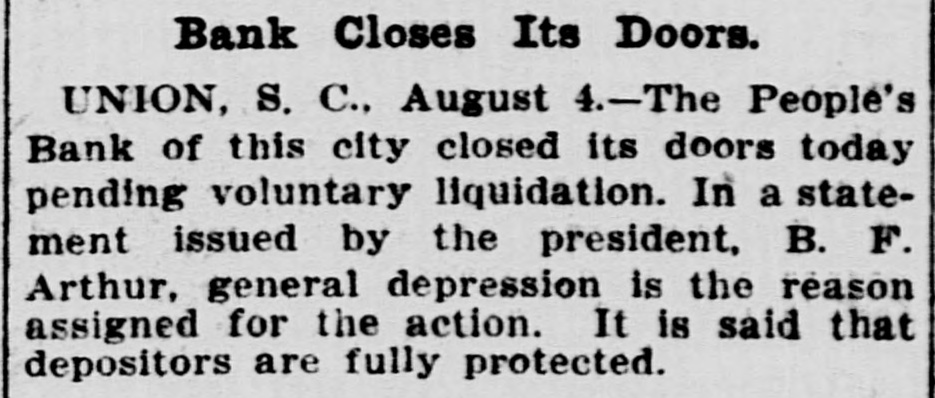
Bank Closes Its Doors. UNION, S. C., August 4.-The People's Bank of this city closed its doors today pending voluntary liquidation. In a statement issued by the president, B. F. Arthur, general depression is the reason assigned for the action. It is said that depositors are fully protected.


Article from The Montgomery Advertiser, August 5, 1908

Click image to open full size in new tab

Article Text

A Bank Suspends. Union, S. C., August The People's Bank of this city, closed its doors pending voluntary liquidation. In statement Issued by the president, F. Arthur, general depression is the reason assigned for the action. It is said that the depositors are fully protected.


Article from The Times Dispatch, August 5, 1908

Click image to open full size in new tab

Article Text

Union, S. C., Bank Falls. UNION, S. C., August 4.-The People's Bank of this city closed its doors to-day pending voluntary liquidation. In a statement issued by the president, B. F. Arthur. general depression is the reason assigned for the action. It is said that depositors are fully protected.


Article from The Times and Democrat, August 7, 1908

Click image to open full size in new tab

Article Text

BANK AT UNION CLOSES. Depositors Are Said to Be Fully Protected. The People's Bank of Union closed its doors Tuesday pending voluntary liquidation. In a statement issued by the president, the general depression is the reason assigned for the action. It is said that depositors are fully protected.


Article from The Herald and News, August 7, 1908

Click image to open full size in new tab

Article Text

UNION BANK SUSPENDS. Institution of Which B. F. Arthur is Head Goes to Wall-Depositors Protected. Union, August 4.-The People's Bank, of this city,' suspended this morning pending going into voluntary liquidation. Just before the regular time for the bank to open the following notice was posted on the closed doors: 1, 1908-Ba k suspend. ed." At a meeting of the board of directors of this bank last night it was decided that owing to the continuous decline in our deposits and the general depression in the stock owned by this bank that it was best to suspend further business pending arrangements for voluntarily liquidating its affairs for the protection of all parties concerned. Depositors are fully protected. The State bank examiner has been notified and requested to apply at once to a circuit judge for the appointment of liquidating officers according to law. B. F. Arthur, President. The People's Bank was organized in February, 1904, with a capital stock of $60,000, and up to the time of the Duncan failure was doing quite a good business. It was somewhat handicapped by that failure, however, as Mr. Duncan was vice president of the bank and had considerable interest in it. Last fall when the panie began in New York it naturally affected this institution as it did


Article from The Lancaster News, August 8, 1908

Click image to open full size in new tab

Article Text

Union Bank Fails. Union, S. C., Aug. 4.-The People's Bank, of this city, closed its doors to-day pending voluntary liquidation. In a statement issued by the bresident, B. F. Arthur, general depression is the reason assigned for the action. It is said that depositors are fully protected.


Article from Edgefield Advertiser, August 12, 1908

Click image to open full size in new tab

Article Text

Bank at Union Fails. Union, Special.-The People's Bank of this city, closed its doors Tuesday pending voluntary liqiudation. In a statement issued by the president, B. F. Arthur, general depression is the reason assigned for the action. It is said that depositors are fully protected.


Article from The Manning Times, August 12, 1908

Click image to open full size in new tab

Article Text

BANK AT UNION CLOSES. Depositors Are Said to Be Fully Protected. The People's Bank of Union closed its doors Tuesday pending voluntary liquidation. In a statement issued by the president. the general depression is the reason assigned for the action. It is said that depositors are fully protected.


Article from The Watchman and Southron, August 12, 1908

Click image to open full size in new tab

Article Text

UNION BANK CLOSES ITS DOORS. The People's Bank at Union, B. F. Arthur, President, Suspends- Depositors Protected. Union, Aug. 4.-The People's Bank of this city suspended this morning pending going into voluntary liquidation. Just before the regular time for the bank to open the following notice was posted on the closed doors: "August 4, 1908. Bank suspended. "At a meeting of the board of directors of this bank last night it was decided that owing to the continuous decline in our deposits and the general depression in the stock owned by the bank that it was best to suspend further business pending arrangements for voluntary liquidation its affairs for the protection of all parties concerned" depositors are fully protected. "The State bank examiner has been notified and requested to apply at once to a circuit judge for the appointment of liquidating officers, according to law." B. F. Arthur, "President." The People's bank was organized in February, 1904, with a capital stock of $60,000 and up to the time of the Duncan failure was doing quite a good business, was handicapped by that failure, as Mr. Duncan was vice president of the bank and had considerable interest in it. Last fall when the panic began in New York it naturally affected this institution, as it did more or less every concern throughout the country and though the suspension was not expected at this time it is not altogether a surprise. At the present time its officers are: President, B. F. Arthur, and vice president, L. M. Jordan. Dr. W. J. Murray, chairman of the State dispensary commission, stated last night that the State funds in the People's Bank of Union were fully protected. While Mr. Arthur was a member of the commission $10.000 was deposited with this bank. Last winter a call was made upon all the banks having dispensary funds to remit 22 per cent. of the total amount deposited. The People's Bank of Union complied with this call, which leaves but $7,800 of dispensary funds on deposit, with a small amount of interest added. There are securities to the amount of $12,000 in the State treasury to protect this deposit, but whether the State held any security or not the funds are protected by the temporary injunction issued early in January by United States Judge Pritchard. By this restraining order the People's Bank of Union was prohibited from paying out or otherwise disposing of the funds in its hands belonging to the State dispensary funds.


Article from The Bamberg Herald, August 13, 1908

Click image to open full size in new tab

Article Text

UNION BANK CLOSES. The People's Bank of Union, B. F. Arthur, President, Suspends. Union, August 4.-The People's bank of this city suspended this morning pending going into voluntary liquidation. Just before the regular time for the bank to open the following notice was posted on the closed doors: "August 4, 1908. Bank suspended. "At a meeting of the board of directors of this bank last night it was decided that owing to the continuous decline in our deposits and the general depression in the stock owned by the bank that it was best to suspend further business pending arrangements for voluntary liquidation of its affairs for the protection of all parties concerned. "DEPOSITORS ARE FULLY PROTECTED. "The State bank examiner has been notified and requested to apply at once to a circuit judge for the appointment of liquidating officers, according to low. B. F. ARTHUR, "President." The People's bank was organized in February, 1904, with a capital stock of $60,000 and up to the time of the Duncan failure was doing quite a good business, was handicapped by that failure, as Mr. Duncan was vicepresident of the bank and had considerable interest in it. Last fall when the panic began in New York it naturally affected this institution, as it did more or less every concern throughout the country and though suspension was not expected at this time it is not altogether a surprise. At the present time its officers are: President, B. F. Arthur, and vice president, L. M. Jordan. These with Dr. J. H. Hamilton, Dr. H. K. Smith and W. D. Arthur of this city, B. G. Wilburn of Cross Keys, and W. N. Garner of Pinckney, forming the directorate. It will be recalled that at the time that Judge Pritchard was appointed to take charge of the State dispensary winding up affairs this bank had on deposit $10,000 of the State dispensary money and it is supposed that it is still in the bank's custody as both the State and federal courts forbade its removal and no judicial order changing this has been received so far as is generally known. What effect this will have in the winding up finally of the affairs is not known. State Bank Examiner Giles L. Wilson has been notified of the bank's suspension and is expected to reach Union to-morrow. There has been no excitement incident to the bank's suspension, everything moving on smoothly in business circles here, though, of course, it has been the topic of conversation.


Article from The Bamberg Herald, August 13, 1908

Click image to open full size in new tab

Article Text

Receivers Appointed. Union, Aug. 7.-Judge D. E. Hydrick has appointed as receivers of the People's bank of this city, which on Tuesday morning went into voluntary liquidation, B. F. Arthur, president of the bank, and W. H. Gist, cashier of the Bank of Carlisle. What the assets and liabilities are can not yet be ascertained, several directors having stated that they are not in possession of information upon which any definite figure can be based. State Bank Examiner Giles L. Wilson of Spartanburg is expected here to-day.


Article from The Bamberg Herald, September 3, 1908

Click image to open full size in new tab

Article Text

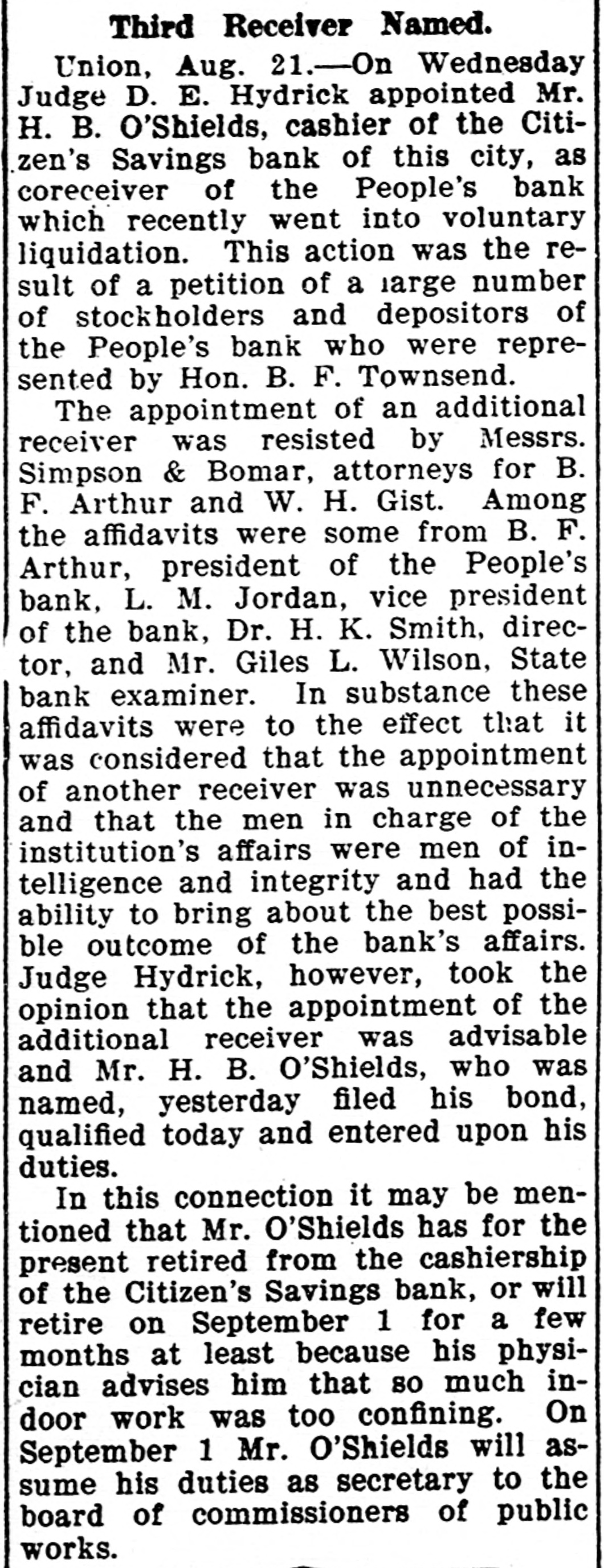
Third Receiver Named. Union, Aug. 21.-On Wednesday Judge D. E. Hydrick appointed Mr. H. B. O'Shields, cashier of the Citizen's Savings bank of this city, as coreceiver of the People's bank which recently went into voluntary liquidation. This action was the result of a petition of a large number of stockholders and depositors of the People's bank who were represented by Hon. B. F. Townsend. The appointment of an additional receiver was resisted by Messrs. Simpson & Bomar, attorneys for B. F. Arthur and W. H. Gist. Among the affidavits were some from B. F. Arthur, president of the People's bank, L. M. Jordan, vice president of the bank, Dr. H. K. Smith, director, and Mr. Giles L. Wilson, State bank examiner. In substance these affidavits were to the effect that it was considered that the appointment of another receiver was unnecessary and that the men in charge of the institution's affairs were men of intelligence and integrity and had the ability to bring about the best possible outcome of the bank's affairs. Judge Hydrick, however, took the opinion that the appointment of the additional receiver was advisable and Mr. H. B. O'Shields, who was named, yesterday filed his bond, qualified today and entered upon his duties. In this connection it may be mentioned that Mr. O'Shields has for the present retired from the cashiership of the Citizen's Savings bank, or will retire on September 1 for a few months at least because his physician advises him that so much indoor work was too confining. On September 1 Mr. O'Shields will assume his duties as secretary to the board of commissioners of public works.


Article from Evening Star, September 22, 1908

Click image to open full size in new tab

Article Text

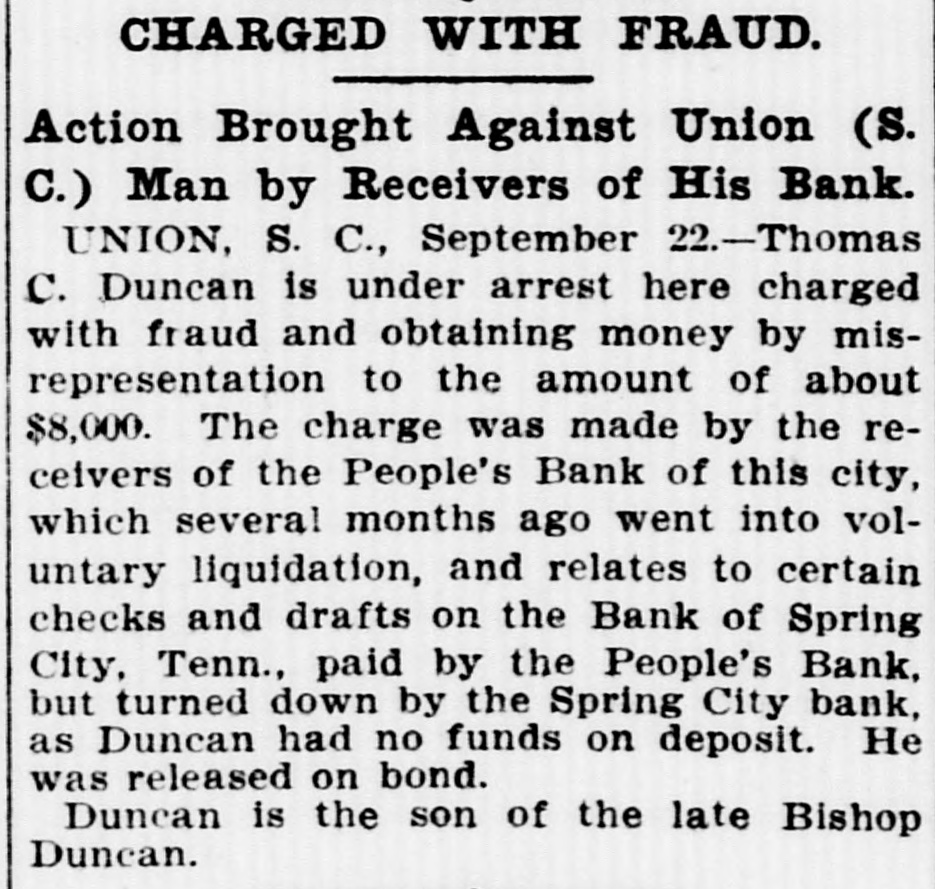
# CHARGED WITH FRAUD. Action Brought Against Union (S. C.) Man by Receivers of His Bank. UNION, S. C., September 22.-Thomas C. Duncan is under arrest here charged with fraud and obtaining money by misrepresentation to the amount of about $8,000. The charge was made by the receivers of the People's Bank of this city, which several months ago went into voluntary liquidation, and relates to certain checks and drafts on the Bank of Spring City, Tenn., paid by the People's Bank, but turned down by the Spring City bank, as Duncan had no funds on deposit. He was released on bond. Duncan is the son of the late Bishop Duncan.


Article from Yorkville Enquirer, September 22, 1908

Click image to open full size in new tab

Article Text

SOUTH CAROLINA NEWS. - President Johnson of Winthrop college, last week, received a fonation of $25,000 from J. Pierpont Morgan, which makes a total of $75,000 for the new model school. - Hon. R. G. Rhett of Charleston, has been assigned by Chairman Mack of the national Democratic executive committee, to make campaign speeches for Bryan and Kern in Iowa, Nebraska and Illinois during October. - Union, September 21: Thomas C. Duncan was arrested here today charged with obtaining money by misrepresentation to the amount of about $8,000. The charge was made by the receivers of the People's Bank, of this city, which several months ago went into voluntary liquidation, and relates to certain checks and drafts on the Bank of Spring City, Tenn., paid by the People's Bank, but turned down by the Spring City bank as Duncan had no funds on deposit. He was released on bond. Duncan is the son of the late Bishop Duncan. - Columbia State: Following up letters from the war department, which has issued strict orders on the term of enlistment before encampment, as published in the State yesterday, Adjutant General Boyd has issued orders to the state militia along the same lines. It is stated by the war department that in many instances companies short of the necessary number will take in raw recruits for a trip of 10 days and the government holds this to be an absolutely useless expense. The order of Gen. Boyd, which goes into detail on the subject, is given below as follows: "The attention of the National Guard of the state is called to the following extract letter received from war department, division of militia affairs: 'It is profitless and an unnecessary expense to the state and to the United States to have men participate in coast defense exercises, or other field manoeuvres or exercises, who have not received previous instruction in the armories in the 'school of the soldier' and such other elementary instruction as recruits should receive before participating in such military exercises. So important is this regarded that the department will not hereafter approve the muster and payment of enlisted men of the organized militia from United States funds who have not been bona fide members of the organizations for at least six months prior to the date of the commencement of the maneouvres or exercises, and who have not been reasonably well instructed in the 'school of the soldier,' 'small-arms firing regulations' and 'manuel of guard duty,' to include the following: "Drill regulations, United States army, edition of 1904; paragraphs 30 to 37, inclusive; paragraphs 39 to 79, inclusive; paragraphs 94 to 157, inclusive. Small arms firing regulations: paragraphs 1 to 56, inclusive. Manual of guard duty: Paragraphs 194 to 269, inclusive: paragraphs 364 to 368, inclusive; paragraphs 372 to 376, inclusive. It is hereby ordered that no regimental or company commander shall take in any coast defense exercises, or other field manoeuvre camp, any enlisted man who has not been a bona fide member of the National Guard of South Carolina for at least six months prior to date of commencement of the exercises or manoeuvres, and who has not received the prescribed preliminary instruction outlined by the war department." - Columbia special of September 19, to the Charlotte Observer: A great "campaign of education" is now being waged in North Carolina, but it is not SO much a campaign for education. Within the next six weeks much will be written and said about the tariff, trusts, railroad regulation, predatory wealth. injunctions and other questions of national concern. but there will be little said about the duty of the state to provide more money for the elementary public schools. The legislative candidates all over the state will discuss learnediy the national issues, but most of them will betray great ignorance about the actual conditions of


Article from The Watchman and Southron, September 23, 1908

Click image to open full size in new tab

Article Text

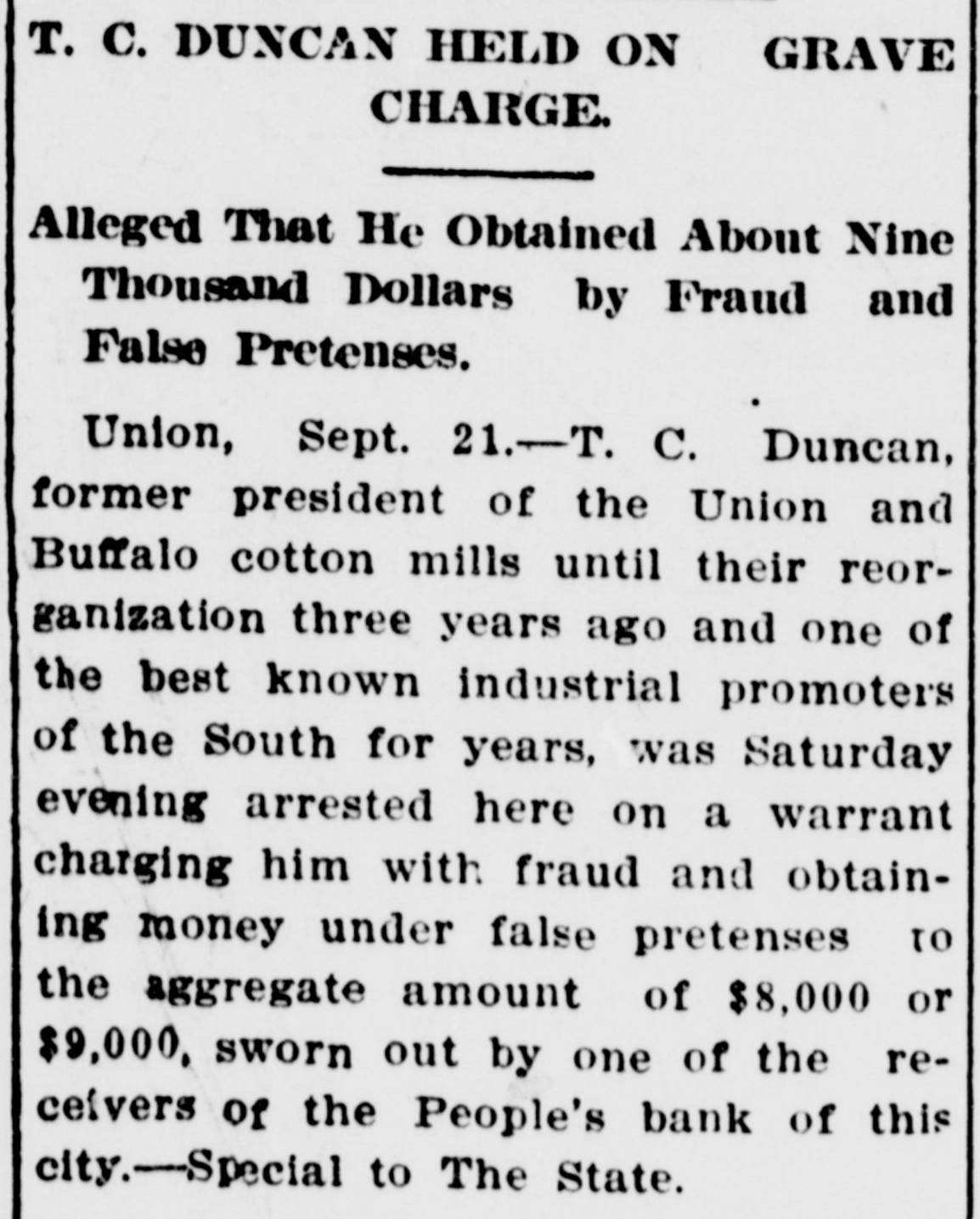
T. C. DUNCAN HELD ON GRAVE CHARGE. Alleged That He Obtained About Nine Thousand Dollars by Fraud and False Pretenses. Union, Sept. 21.-T. C. Duncan, former president of the Union and Buffalo cotton mills until their reorganization three years ago and one of the best known industrial promoters of the South for years, was Saturday evening arrested here on a warrant charging him with fraud and obtaining money under false pretenses to the aggregate amount of $8,000 or $9,000, sworn out by one of the receivers of the People's bank of this city.Special to The State.


Article from The Bamberg Herald, September 24, 1908

Click image to open full size in new tab

Article Text

T. C. DUNCAN IN TROUBLE ARRESTED AT INSTANCE OF PEOPLE'S BANK RECEIVERS. Alleged That He Obtained About Nine Thousand Dollars by Fraud and False Pretenses. Union, Sept. 21.-T. C. Duncan, former president of the Union and Buffalo cotton mills until their reorganization three years ago and one of the best known industrial promoters of the South for years, was Saturday evening arrested here on a warrant chaging him with fraud and obtaining money under false pretenses to the aggregate amount of $8,000 or $9,000, sworn out by one of the receivers of the People's bank of this city. The arrest was guarded with the utmost secrecy by them, having it made on account of busuiness reasons, but news of it has leaked out and been confirmed. It seems, from information obtained, that during December two years ago the People's bank of this city cashed a check for $1,515 drawn on the Bank of Spring City, Tenn., by the American Lime company, of which corporation T. C. Duncan, formerly of this city, was head, he having organized that concern after leaving Union with the understanding that the funds to meet the check were at a Spring City bank named. The People's bank here also cashed several drafts within the next few days which were, it is understood, drawn by the same American Lime company and which, on being forwarded to the Spring City bank, were returned with the information that the company had no funds there. When, about the 1st of August, the People's bank of this city went into voluntary liquidation and B. F. Arthur, former president, and W. H. Gist, of Carlisle, were appointed receivers, H. B. O'Shields being later named, the matter of these drafts was drawn to their attention and W. H. Gist, acting for the receivers, wrote Mr. Duncan at Spring City, Tenn., that the matter must be closed up promptly, intimating that unless the money was forthcoming criminal proceedings would be instituted. It is learned that in the meantime a voluminous amount of evidence in the shape of correspondednce referring to the payment of these checks and the fact that there was no money on deposit in Spring City with which to meet them came into the possession of the receivers. Thus they feel confident of their ground. After being notified, Mr. Duncan wrote the receivers that he would be here last week. He came on Tuesday and asked that the matter be deferred until Saturday. On that day, after consulting his counsel, James Munroe, of this city and P. K. Bryan, of Charleston, his lawyers had a consultation with the bank receivers and their counsel and after considerable parley which did not result in the money being paid, agreement was arrived at and the warrant was issued. It sems that Mr. Duncan was advised of this action and came to the office of his counsel, Mr. Munroe, where he was arrested and taken next door to the office of -Magistrate Vinson, who released him on $500 bond, which was furnished by Capt. A. H. Foster. When asked to-day if he had any statement to make for publication, Mr. Munroe, for his client, said that he did not. Since the news of the arrest has become public it has been much talked of. What future developments there will be remains to be seen, though it is strongly intimated that other arrests may follow in the event that the matter is not settled by the payment of the amount of the check and drafts with interest to date. In the event that this case is not settled outside of the court it will probably come up for trial next February.


Article from Yorkville Enquirer, July 2, 1909

Click image to open full size in new tab

Article Text

# SOUTH CAROLINA NEWS. Columbia special of June 30, to the Charlotte Observer; Magistrate J. D. Easterling of Columbia, will have to appear before Governor Ansel on the 6th of July to show cause why he should not be removed for "misconduct in office." The governor sent the papers to the sheriff for service today. The summons is the outcome of the local grand jury's presentment last May of Easterling and his constable, J. D. Dunaway, for malfeasance in office. The presentment names W. F. Wider and Molly Pitts as witnesses, and charges that on the 15th of May the magistrate and his constables collected $28 from Wider to compromise a case against him for sending obscene letters, paying only $6 over to the prosecutor and never turning in any of the remainder to the county. It is believed in the governor's office that this form of graft is prevalent to an alarming degree in many counties over the state, and the governor will welcome further grand jury reports along this line. Union, June 30: T. C. Duncan, former president of the Union-Buffalo Mills and other allied enterprises of this city, and late head of the American Lime Company, bankrupt, of Spring City, Tenn., must answer to the charge of fraud before a higher court in this county. This was the outcome of the preliminary hearing before Magistrate J. Frost Walker, Jr., held here yesterday in the criminal proceedings brought by John H. Morris, who charges T. C. Duncan with fraud on account of a check issued December, 1906, when it is alleged there were no funds in the bank of Spring City, Tenn., to meet it, the first step of which was the arrest of Mr. Duncan several weeks ago and his immediate release on bail in the sum of $1,500. Yesterday's preliminary was held in Magistrate Walker's office and about 25 persons were present, Duncan was represented by J. P. K. Bryan of Charleston, James Munro and Ben F. Townsend of this city. John H. Morris, who instituted the proceedings and swore out the warrants, had no counsel. Four witnesses were sworn. B. F. Arthur, former president of the People's bank, H. B. O'Shields, former assistant cashier of the same institution, W. H. Gist, president of the Bank of Carlisle, the three foregoing being receivers of this bank. The testimony of these witnesses was such that after all the evidence had been given in and various letters and telegrams admitted in evidence Magistrate Walker ruled that the case should go to a higher court. Following the preliminary hearing Magistrate Walker allowed the same bond to remain in force. Columbia Record: There is a two-horse load of fine sample whisky in Camden going begging among hundreds suffering intensely wih a terribly droughty feeling. The samples were shipped by the whisky houses to Treasurer McCaskill, of Kershaw county, who was here today to seek advice about what to do with it. He had to go back no nearer a solution than when he came, and he looked worried. Auditor West said he could not undertake to advise him, further than to quote the law that it cannot be given away, and the county board of control can sell it only after analyzing each package, unless they have analyzed stock of the same kind. Some of his friends advised Mr. McCaskill to do like a certain up-state county treasurer has told friends he is doing. When a good fellow comes along and asks him for a bunch of samples he tells him that he can not give them away and then winks the other eye and turns his back, and an armful of samples mysteriously disappears. Mr. West threw a fearful scare into members of the Richland board recently when he was informed that they were in the habit of disposing of samples by dumping them into one vat and bottling from that. "Why, man alive," he is reported to have said to a member of the board, "don't you know that the moment you do that you are then working as blenders, for which you have no license from your Uncle Sam?" "Good Lord," was the response, "we'll never do that again." The Richland board sells for the county such samples as it knows from analysis of similar are all right. Once before the problem reached an acute stage in Camden, when Salesman Samuels came to the rescue by writing the whisky houses and getting authority to sign release orders on the stuff for his friends about Camden. The result was that many people got nice set-ups in booze gratis. Columbia State, Thursday: By a vote of 28 to 8 the state board of equalization yesterday defeated the resolution offered by Mr. Jeremiah Smith of Horry which would have required all property listed to be placed at its true valuation instead of on the present basis of 60 per cent. The resolution was not tabled however, until Mr. Smith made a few remarks in favor of its provisions and pointing out the section of the constitution on the subject. Mr. Smith said that it was to the interest of all classes to have property listed at its true valuation and he believed that the present system was not only unjust but deprived the schools of a large amount of money and affected the credit of the counties and towns. On the vote, however, the resolution was defeated. The resolution read as follows: "Whereas, the present system of listing property for taxation at 60 per cent of its true value is in violation of the constitution of the state of South Carolina, and Whereas, the said system deprives the counties and towns of this state of 40 per cent public credit, which is authorized and provided for by the constitution, and Whereas, the said system represents our citizenship as being non-progressive and thriftless, and at the same time increases the rate of tax levied for the support of the government, and Whereas, our oath of office requires our respect for and obedience to the constitution, therefore be it resolved: First, That it is the sense of this state board of equalization that the interest of the state, her institutions and her citizenship, requires that all classes of property be hereafter listed for taxation at its actual value as required by the constitution. Second, That we will use our utmost influence with our respective county boards of assessors to have all property in our counties listed at its actual value as required by the constitution.
Article from The Watchman and Southron, September 11, 1909

Click image to open full size in new tab

Article Text

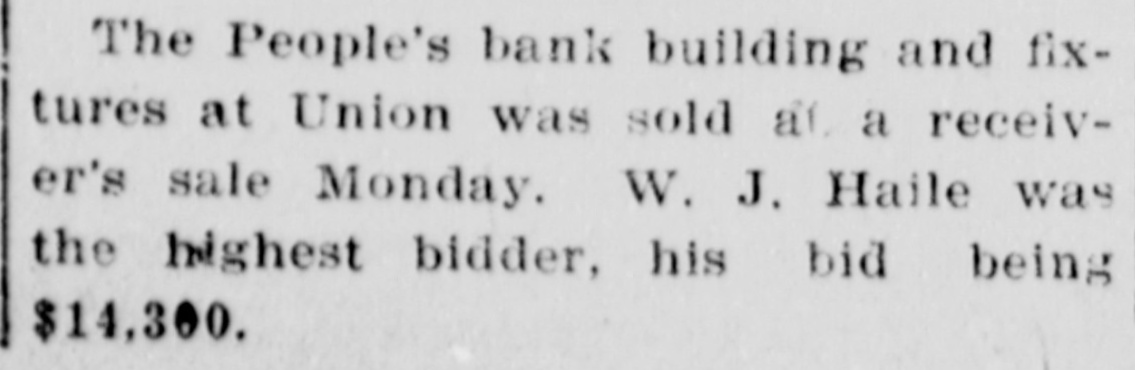
The People's bank building and fixtures at Union was sold at a receiver's sale Monday. W. J. Haile was the highest bidder, his bid being $14,300.