Click image to open full size in new tab
Article Text
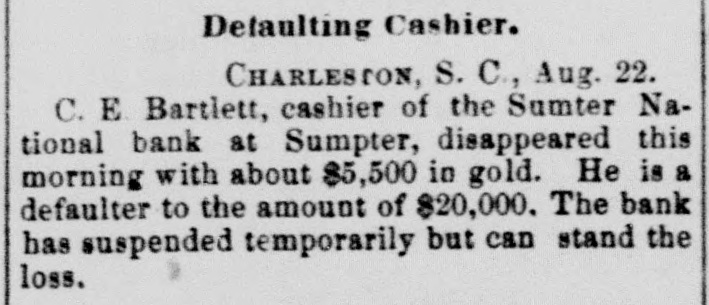
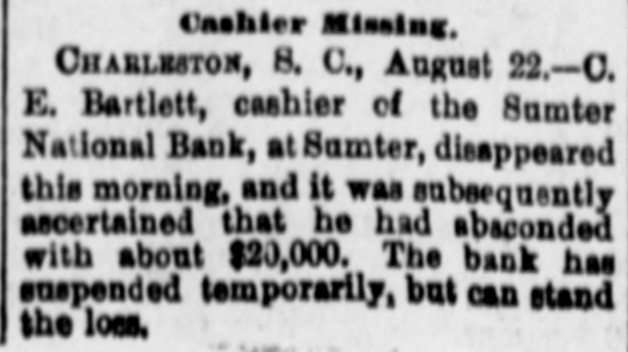
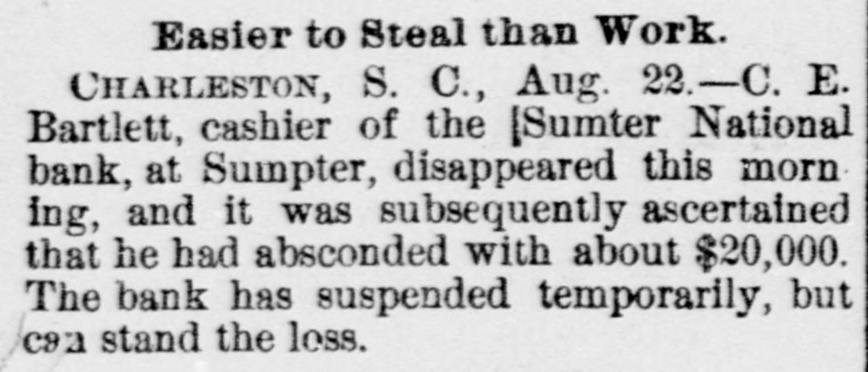
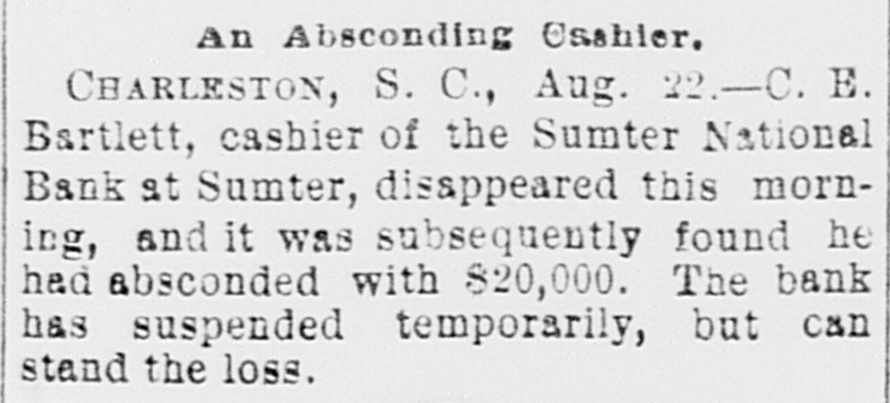
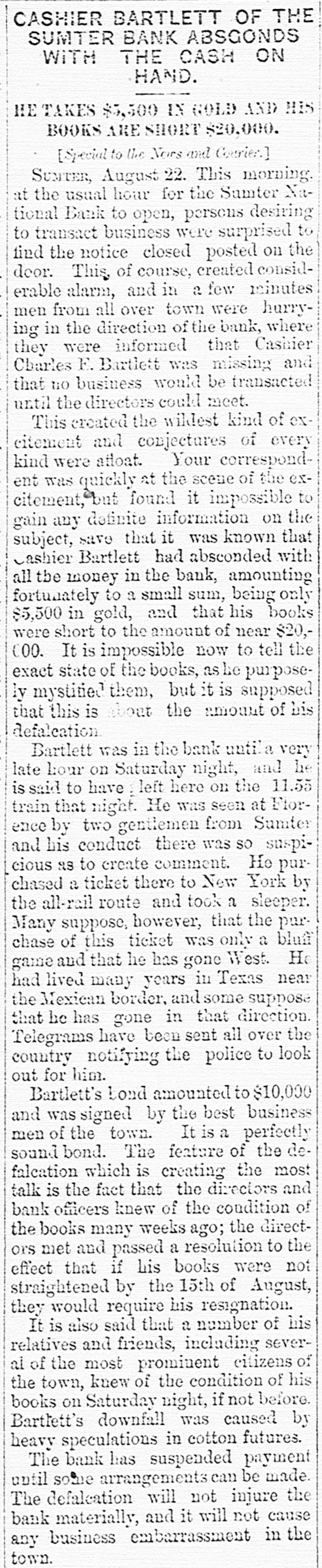
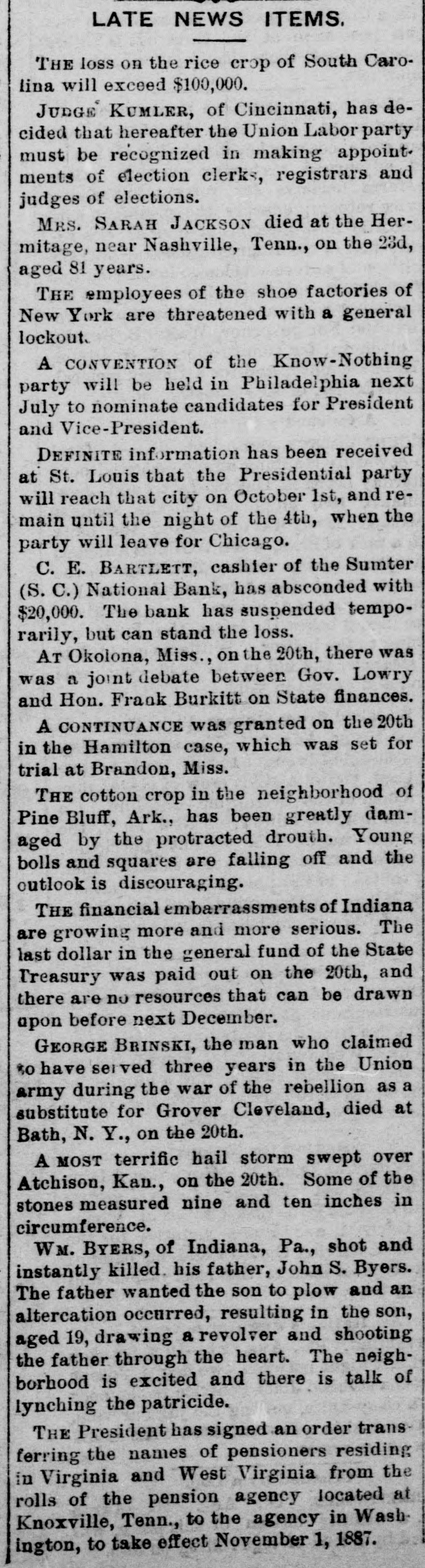
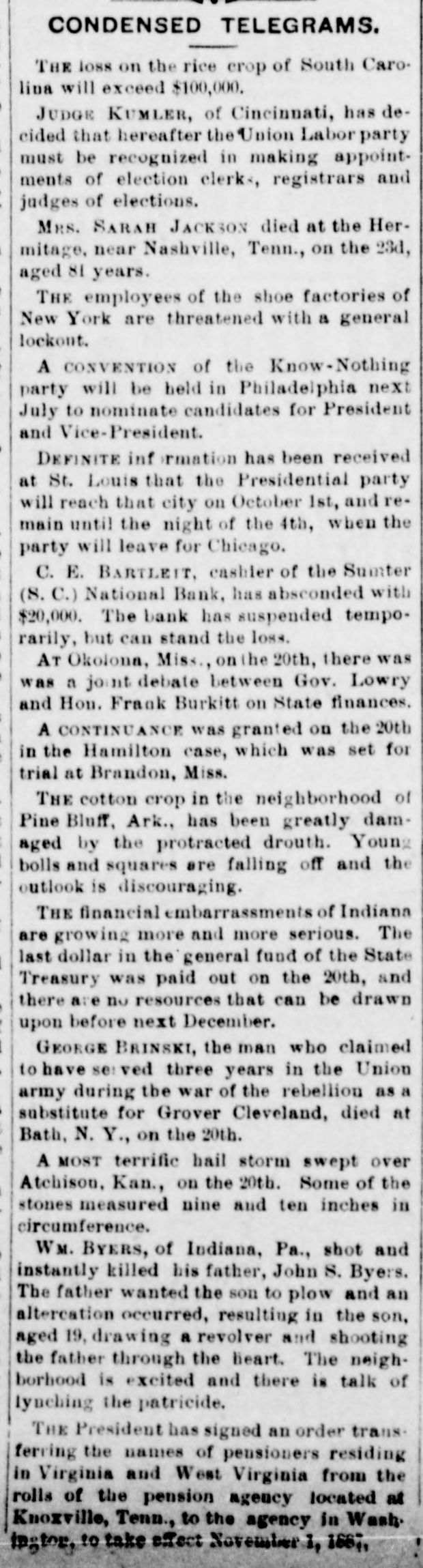
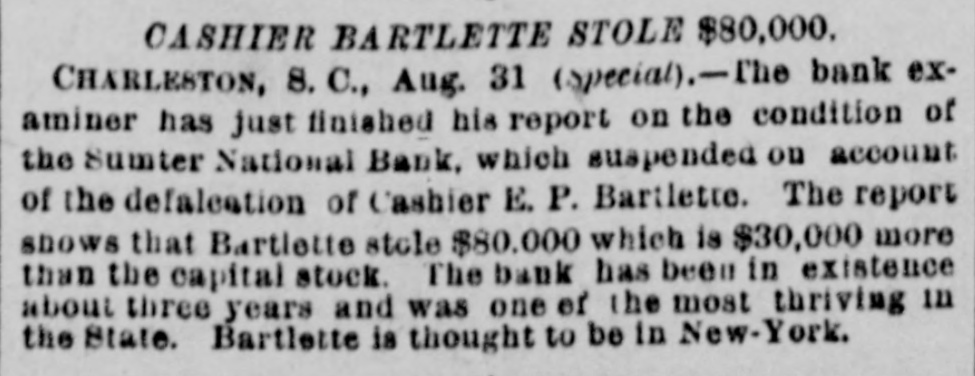
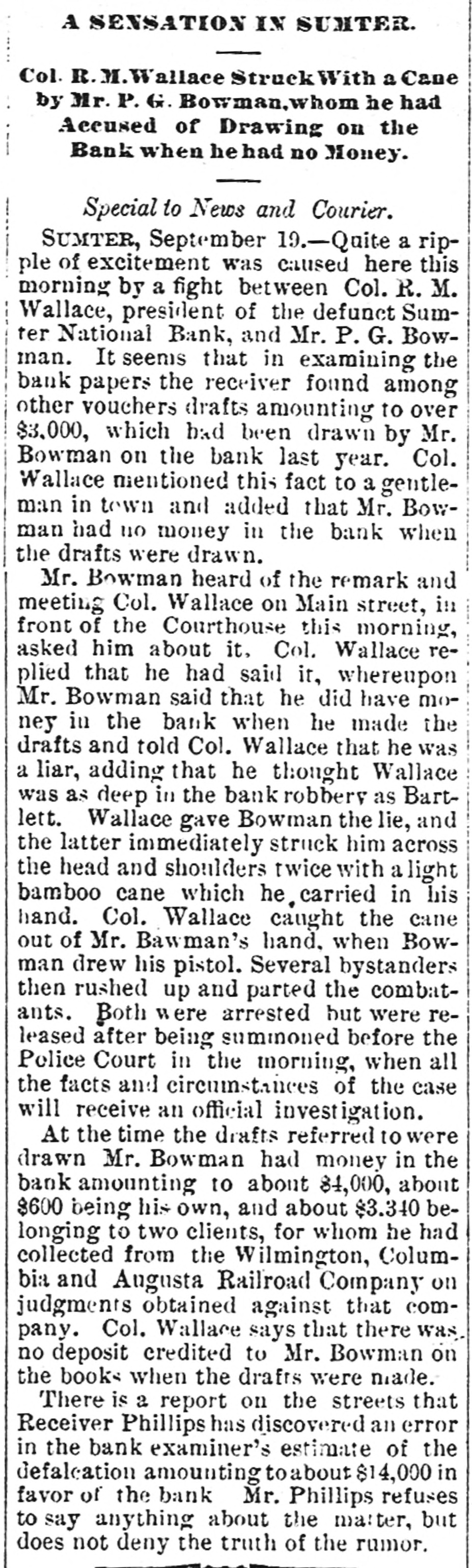
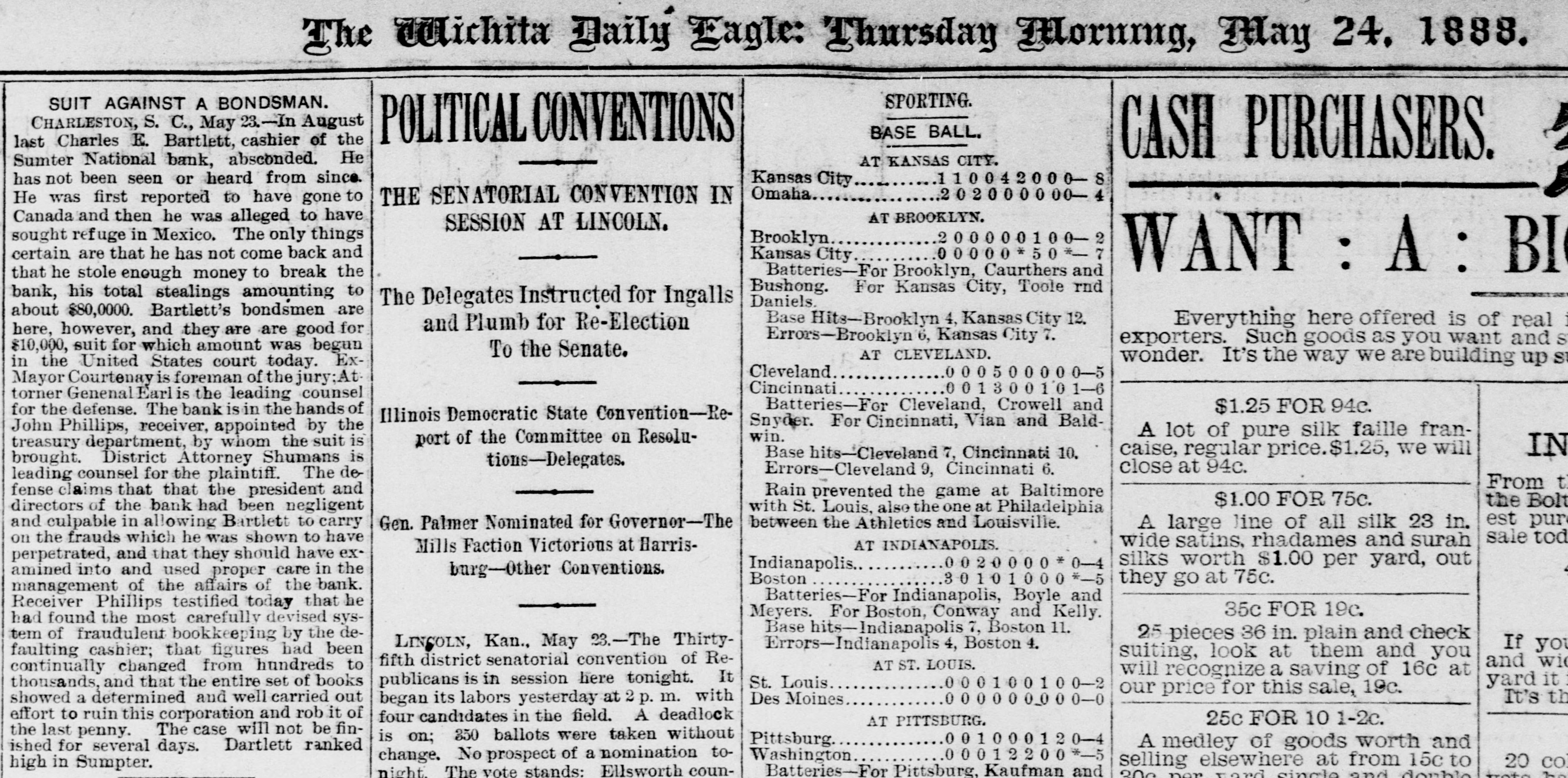
hibits. The inquiries for information about the fair are more numerous than usual, and the indications favor an exceptionally large exhibit of live stock. At Spartanburg, Saturday was appoiuted as the day for the Clifton strikers to show cause before Trial Justice Thackston why they should not be evicted. Mr. Wilson represented the employes and Mr. Simpson the company. The case of Mr. Busby was taken up, and after much evidence and short arguments the Judge decided that the company was entitled to have the writ of ejectment enforced. There are twenty-two other similar cases. C. W. Forster, of Gergetown, expected to make a considerable quantity of scuppernong wine this fall from the vineyard at Friendfield plantation. The vines bore abundantly, and were jealously watched and guarded until a few days ago, when they were left unprotected for a brief interval. When Mr. Forster returned to gather some grapes his vines had been swept clean by the negroes, and not a cluster of the fruit could be found. Richmond Fraser (colored) died after an illness of several weeks. He jumped from a window in the new school building which is being put up in Abbeville for the benefit of the colored people, and hurt ankle. The injury was not thought to be severe at the time, and he continued to work for several days, when he began to suffer. He took his bed, mortification set in, the foot was amputated. and now he is dead. He was study. ing theology with a view to preaching. The fact that SO many deaths have OCcurred among the South Carolina College students, at Camden, caused by fever, is be ing freeiy discussed. The matter ought to be investigated, and, if the cause is in the college buildings or in the water supply of the students, it ought to bespeedily removed or the fact made known that such is not the case, for at present it seems to be believed that the cause of this fever, which has produced death in various parts of the State, lies in the buildings or water supply of the college." The case of W. A. Pollard, ex-postmaster at Greer's Station, near Greenville, for obthe mail and opening letters to pry to secrets, was heard before Commissioner Hawthorn Monday. Pollard was postmaster at Greer's for twelve years before his removal last June on account of complaints of this character. He is charged with breaking open two letters written by Congressman Perry to Dr. League, at Greer's, concerning the management of the office. Pollard was sent up to court, giving bond for $300. The ginning outfit and corn mill of Mr. O. P. Wilson, situated about half a mile from Campbellton, was destroyed by fire Monday. The fire was discovered in the lint room, about 8 o'clock, while the gin was in motion, and the generally accepted theory is that it originated from a match or friction. The loss, including nine bales of cotton, a quantity of cotton seed, damage to engine, etc., will probably amount to $2,000 he property was insured in the Home, of New York, for $1,000, two-thirds of which amount is collectible. Jesse Blaine, a colored man living on Waccamaw, was shot and killed at Clifton plantation on Monday night by Titus Small (colored). The shooting was done with a shotgun, and death ensued almost immediately. The tragedy is said to have been caused by Blaine's intimacy with Small's wife. It is said that Blaine sent the woman over to Georgetown Monday night, and had made arrangements to meet her the next morning, when they were to go to Charleston together. The murderer fled, and has not yet been arrested. Mr. A. K. Mann, while working at Cruise's mill, in Anderson county, last week, was bitten twice on the right forearm by a spider, and the result was a highly inflamed wound and a great deal of physical suffering. Before going to work Mr. Mann donned an old woolen shirt, expecting to get wet while working about the wheel, and did not notice until after he felt the sting of a bite the second time that a large spider had made a nest in the sleeve of the shirt. When he felt the first sting he rubbed the place slightly, thinking it was a splinter, and at the second sting he rubbed more vigorously, but still kept at work. In about an hour the pain increased a great deal and the wrist began to swell, when an examination showed the remains of a large spider and a nest of eggs mashed over the arm. Theskin came off all over the surface touched by the mashed substance, showing the intensely poisonous nature of the insect. E. W Moise, Jr., a son of Charles H, Moise, of Sumter, has written home that he saw Charles E. Bartlett. the defaulting bank cashier, in San Antonio, Texas, a few days ago. Mr. Moise has been a resident of San Antonio for a number of years, and knew Bartlett both out there and at home. This verifies the belief that many persons have that Bartlett went to Mexico, although it is somewhat a mystery how he could have also been seen in Washington and New York, as has been reported on reliable authority. There is also a belief among a large number of people that he has gone to South America. When he took the North-eastern train for Charleston, on the night of his flight, he could have continued to Tampa, Fla., and reached that city the same day that a vessel was advertised to sail for South America. There is nothing new relative to the bank failure. Receiver Phillips isquietly working away winding up the business, although it is hard to tell when he will finish. Bartlett's bondsmen hold occasional meetings, but nothing can be gotten out of them concerning their proposed course. Some of them intend to fight to the lastagainst being held liable, while a number of them express themselves as willing to pay up their quota of the bond and have no further trouble about it. It is not yet known whether or not the matter will be tried at the October court. SUMTER, Sept. 19.-Special -Q a ripple of excitement was caused at Sumter Monday morning by a fight between Col. R. M. Wallace, President of the defunct Sumter National Bank, and Mr. P. G Bowman. It seems that in examining the bank