Drovers Trust & Savings Bank (Chicago, IL)

Episode Information

Episode UID
2012471256
Episode Type
Run Only
Bank Type
trust
Bank ID
201247 routing
Routing Number
2-0124
Start Date
August 5, 1904
Location
Chicago, Illinois (41.850, -87.650)

Metadata

Model
gpt-5-mini (chosen from majority vote of a three-model LLM ensemble)
Short Digest
001283b54b638433

Response Measures

None

Events (1)

1. August 5, 1904 Run
Cause
Rumor Or Misinformation
Cause Details
Unfounded rumors that the bank had loaned its funds to packers or was being used to pay strikebreakers; reports a packer representative withdrew funds.
Measures
Doubled force of paying tellers, kept bank open late, paid all withdrawals in full; drew $100,000 each from two correspondent national banks to ensure liquidity.
Newspaper Excerpt
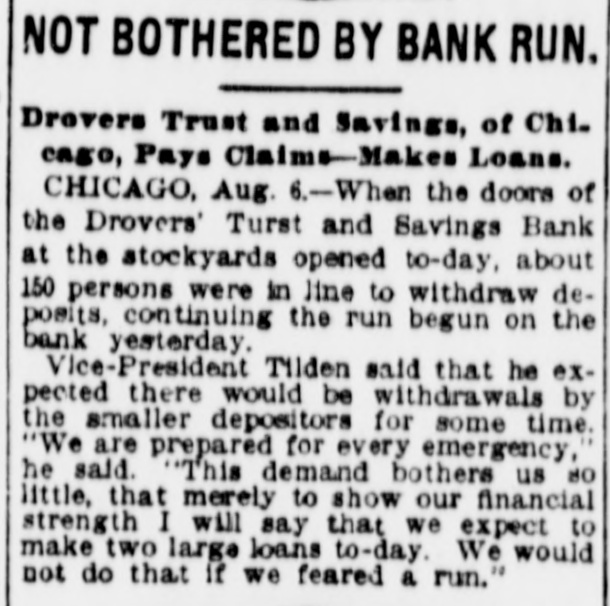
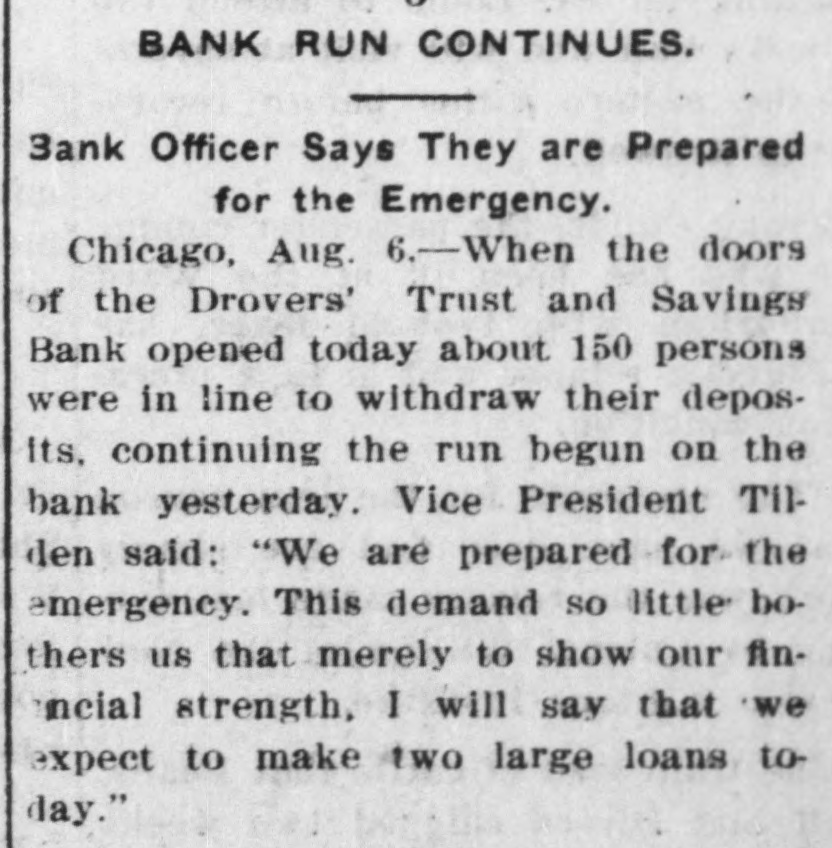
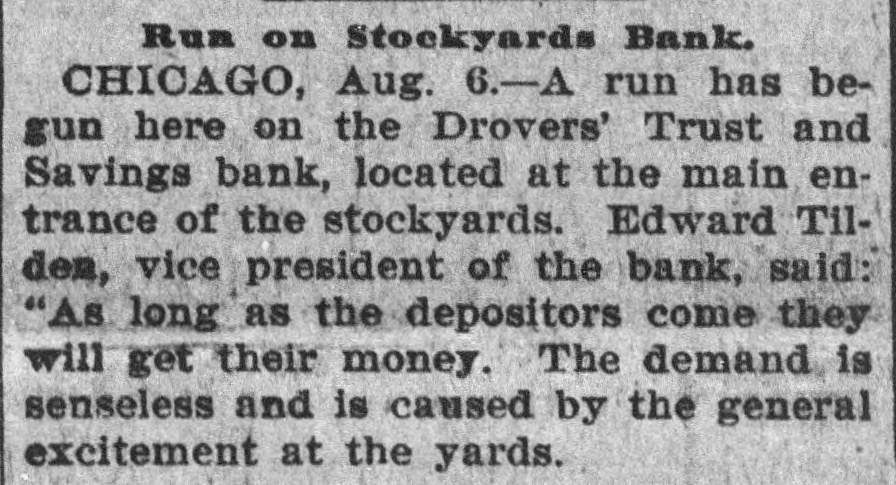
A run began today on the Drovers' Trust and Savings Bank... The demand is senseless and is caused by the general excitement at the yards.
Source
newspapers

Newspaper Articles (10)

Article from Santa Fe New Mexican, August 5, 1904

Click image to open full size in new tab

Article Text

RUN ON A CHICAGO BANK. The Strike is Responsible for the Uneasiness of the Depositors.Force of Tellers Doubled. Chicago, Illinois, August 5, 1904.'A run began today on the Drovers' Trust and Savings Bank, located at the main entrance of the stock yards. Edward Tilden, vice-president of the bank said: "As long as the depositors come they will get their money. The demand is senseless and is caused by the general excitement at the yards." Shortly after the bank opened, a crowd of people appeared with their deposit books and forming a line demanded their money. The bank began paying and the officials declared that every depositor who wanted his money would get it in full. Vice-president Tilden declared that the run was started by the statement made by irresponsible persons that the bank had loaned all its money to the packers for the purpose of beating the strikers. Many strikers had deposits, but the majority of people demanding their money were small tradesmen doing business in the stock yards vicinity and working people not connected with the packing plants. The Drovers' Trust and Savings Bank is located in the same building with the Drovers' Deposit National Bank, its local correspondent. Its capital is $200,000, and its surplus and profits are named at $30,000. It has a long list of depositors. When the run began, the officials doubled the force of paying tellers and met all withdrawal demands. Both banks are located in the same room, and this fact helped to give rise to the reports that there was a run on the national bank. The run, however, is exclusively on the savings bank.


Article from New-York Tribune, August 6, 1904

Click image to open full size in new tab

Article Text

STATESES MARI A not. BANK PAYS ALL WHOCALL Thought Packers Were Using It in Paging Off Strike Breakers. Chicago, Aug. 5.--Hundreds of strikers and others to-day thronged to the Drovers' Trust and Savings Bank, near the main entrance of the stockyards, and withdrew their deposits. whether large or small. The unusual scene attracted a large crowd. set all manner of rumors in circulation, and created a general run on the Institution. The strikers acted in retaliation for the alleged action of one of the packing firms. Libby, McNeill & Libby, in making the bank an adjunct to their pay department. On Wednesday, it is said, Edward Tilden, a director of the company. led strike breakers to the bank in order that they might be paid off in cash, instead of having to experience the embarrassments growing out of the packers' system of paying in checks. Long before the bank opened rumors were in circulation that the strikers would start a run on the institution. and when the hour for opening came a double line extending into the street greeted the bank officials. Without protest or explanation the officials doubled the force of paying tellers and met all demands. The deposits withdrawn ranged from $10 to $500. Among those who withdrew was Mollie Daiy. head of the women's union at the stockyards. The police detail at the bank was increased at 2 o'clock to handle the increasing crowd, which then extended in a line two hundred feet each way from the entrance, and was beginning to show signs of restlessness. At one time more than 1,500 ciamoring depositors were massed about the institution, while fifty policement were at work. to keep the throng in order. Meantime the bank had huge piles of greenbacks and silver stacked up on the counters. The officials announced that they would keep the bank open all night, if necessary. and that more cashiers' windows would be opened. After the regular closing time three hundred persons were in line waiting to withdraw money. The paying windows were kept open until after 8 o'clock. Nearly two hours before that time the last man in line had been paid his deposit in full and fresh arrivals had ceased coming. It is estimated that upward of three thousand depositors withdrew their deposits during the day. When the run was at its height the bank withdrew $100,000 of its deposit with the Commercial National Bank and a like amount from the First National Bank in order to prevent any possibility of being unable to meet its obligations. The Drovers Trust and Savings Bank is in the same building with the Drovers' Deposit National Bank, its local correspondent. Its capital is $200,000 and its surplus and profits are named at $30,000. It has a long list of depositors among the workmen about the yards and pays 3 per cent interest on their savings. It opened its doors February 3. 1902. and its last report. June 10. 1904. shows resources and liabilities amounting to $1,865,506. "There is no truth in the statements that caused the run." said William A. Tilden, vicepresident of the bank. Mr. Tilden is a brother of the Libby, McNeill & Libby director whose action is said to have caused the run. "We are simply meeting the situation by paying without question or argument all depositors who wish to withdraw their money. That is all I care to say." Strike breakers continued to pour into the yards to-day. The new arrivals included another train load of immigrants. The recruits were frightened into hysterics by a series of explosions caused by strike sympathizers placing dynamite caps and saltpetre on the tracks. No property damage resulted Nearly ten thousand strikers were paid to-day from the strike treasury $7 each. the so-called weekly benefit. This is the first benefit paid to the strikers.


Article from Perth Amboy Evening News, August 6, 1904

Click image to open full size in new tab

Article Text

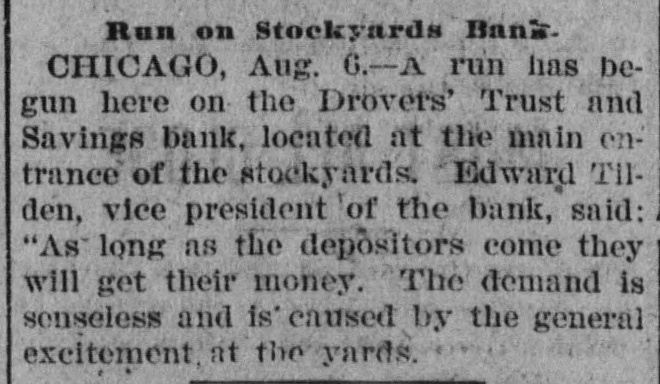
Run on Stockyards Bank CHICAGO, Aug. G.-A run has begun here on the Drovers' Trust and Savings bank, located at the main entrance of the stockyards. Edward TIIden, vice president of the bank, said: "As long as the depositors come they will get their money. The demand is senseless and is' caused by the general excitement at the yards.


Article from The Morning Astorian, August 6, 1904

Click image to open full size in new tab

Article Text

Bank Officials Meet Emergency by Employing Help and Paying All Their Money. STOCKMEN VISIT WINDY CITY Montana Delegation Arrives to Investigate Cause of Strike, and May Make Over. tures for Peace. Chicago, Aug. 5.-The strike In the packing houses had a counter attraction today In the excitement attending the run on the Drovers' Trust & Savings bank. which is in the stockyards. The rush of depositors to the bank started early today because of an unfounded rumor that one of the packers' representatives had withdrawn his money from the Institution and reports that the bank was used by the packing companies as an adjunct in paying employes who have taken the places of the strikers. All day long hundreds of depositors stood In line and withdrew their small deposits. When closing time came this afternoon thousands of persons were waiting. The bank determined to meet the emergency, called in extra tellers and the place was. ken open until every depositor who present ed himself had been satisfied. Rumors of another peace conference between the packers and the strikers were occasioned by the presence at the livestock exchange of John M. Boardman and M. E. Milner, president and secretary of the Montana Round-up an organization of drovsends nearly head ers. Association, which 250,000 of cattle to the yards each year. The Montana men represent several million of dollars and announced that they were in Chicago to Investigate the causes and conditions surrounding the strike. Government May Intervene. That the federal government is preparing to take an active part in the stockyards strike was indicated today when International Secretary Call, of the Butcher Workmen, divulged the fact that he has been in conference with an emissary of the United States bureau of commerce and labor. Who this agent is, or what his Immediate plans are, Mr. Call refuses to say, but the strike leader made this significant remark: "In everything the packing trust is doing they are violating the law. Their very business combination is in restraint of trade and there is none of them that is not amenable to the federal laws. A sample of their operations came to my knowledge after stories had been printed in the newspapers telling of the importation of emigrants from foreign lands to take the place of American working men who are on 1 strike. One of our pickets found in c the street an emigrant receipt showing t that the emigrant had been paid $58.70 h for passage to Chicago. At the bottom n of the printed slip was the sentence: t 'We hereby agree to rebate $58.70 on presentation of this receipt at our Chicago office.' I showed this document to I an official of the United States bureau of commerce and labor and inadvertently allowed him to keep it." Recording Secretary Shanahan, of the Packing House Teamsters' Union, announced today that orders would be issued Immediately to stop the removI al of meats from the several cold storage warehouses in the city. The Allied Trades executive committee, he said, would act upon the teamsters' position, and a report favoring sympathetic action by teamsters who have been distributing meat from warehouses would mean the immediate isa suance of a strike order to those drivers. f t Prsident Donnelly, the strike leader, 1: who has been on a trip to Kansas City


Article from The Daily Telegram, August 6, 1904

Click image to open full size in new tab

Article Text

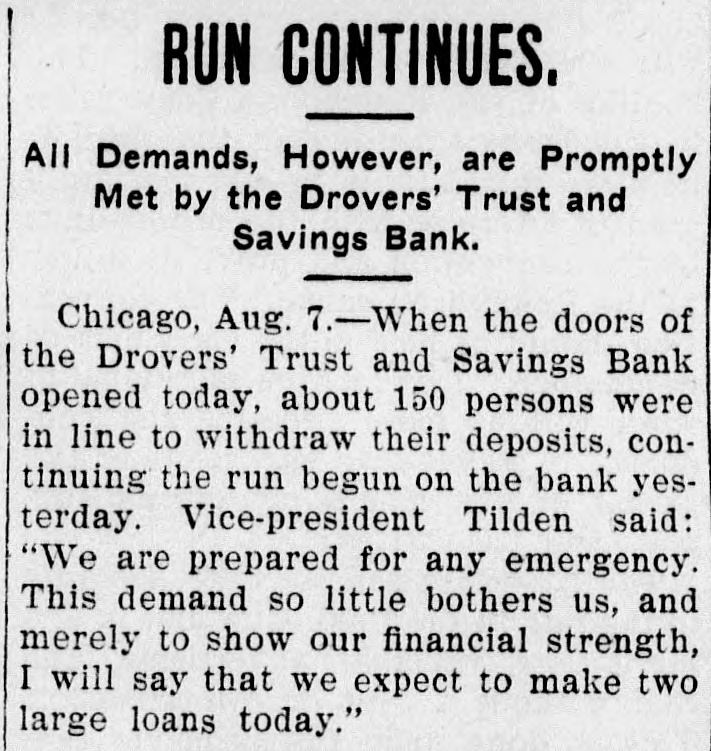
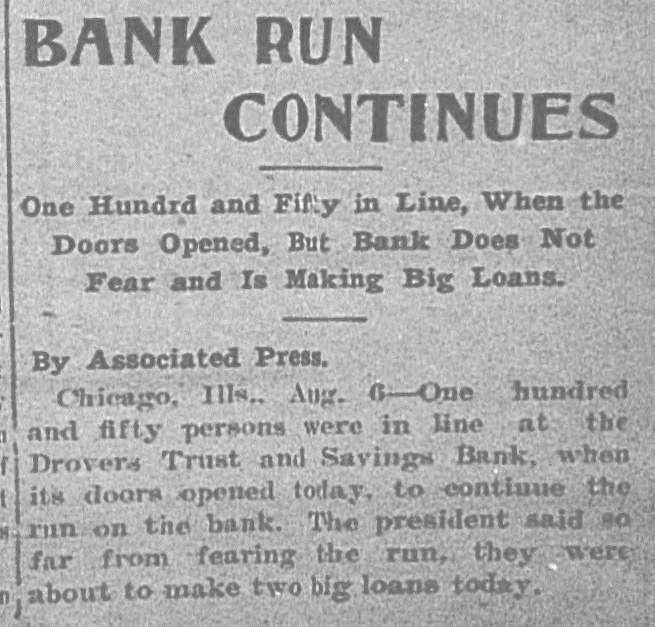
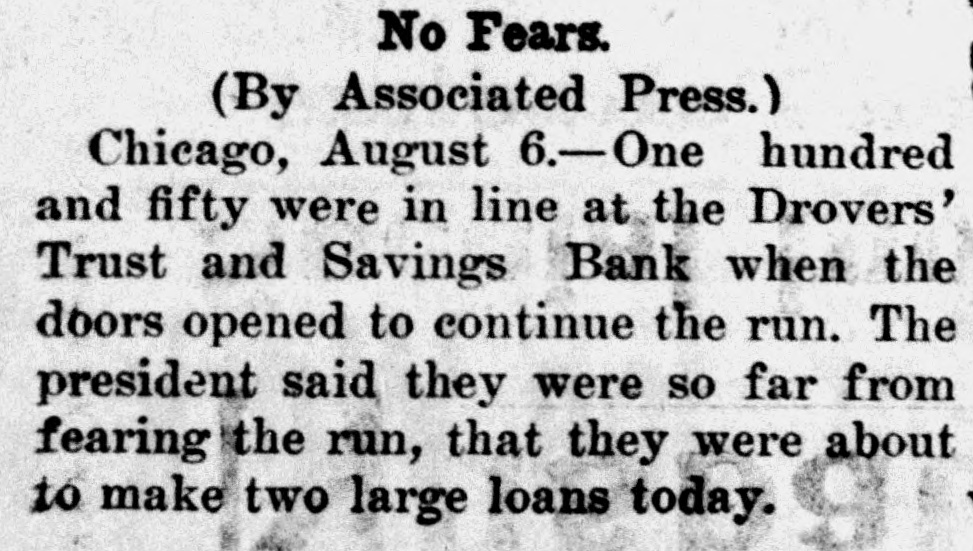
BANK RUN CONTINUES One Hundrd and Fifty in Line, When the Doors Opened, But Bank Does Not Fear and Is Making Big Loans. By Associated Press. Chicago, Ills.. Aug. 6-One hundred and fifty persons were in line at the Drovers Trust and Savings Bank, when its doors opened today, to continue the run on the bank. The president said so far from fearing the run, they were about to make two big loans today.


Article from The Barre Daily Times, August 6, 1904

Click image to open full size in new tab

Article Text

BEEF STRIKE TO GO ON Efforts to Bring About Peace Not Successful. RUN ON STOCKYARDS BANK. Strikers Alleged to Have Instigated It For Revenge-Both Sides Stand Firm. Leaders Plan Demonstration to Encourage Their Followers. Chicago, Aug. 6.-In the face of persistent peace rumors, strikers and pack ers alike gave evidence of a determina tion to stand their ground and carry the struggle over into next week. There were indications that by that time both sides would regard the offices of inter mediaries with favor, unless either side should develop weakness warranting the other in holding out with renewed determination to fight the issue to an end. To the strikers the approach of Sun day comes as a menace, because of the difficulty of holding the ranks together over the opening of a new week. The strike leaders claim to have positive information that emissaries of the packers are at work in all directions quietly offering highly skilled men tempting inducements to break away Pressure is also being brought upon the strikers' wives through direct individ ual appeal. To offset this the leaders count on the return of President Donnelly to arouse enthusiasm. They have prepared a large demonstration with the same end in view. While feeling sure of the men, it was admitted that it is not easy to hold hungry families in line. Efforts were therefore especially directed toward impressing the women with the solidity of the strike and with the necessity of remaining firm. The efforts to bring about a peace conference were explained as being due to the cattle shippers and the Union Stockyards and Transit company, both neutrals, who have lost heavily through the strike. Run on Savings Bank. During the day a run began on the Drovers' Trust and Savings bank, located at the main entrance of the stockyards. In reply to inquiries regarding the withdrawals, William Tilden, vice president of the bank, who has been one of the spokesmen for the employ. ers during the packing house strike. said: "As long as the depositors come they will get their money. The demand is senseless and is caused by the general excitement at the yards. The latest report of the condition of the bank gave resources and liabilities as each $5,878,301. Vice President Tilden declared that the run was started by a statement made by some irresponsible person that the bank had loaned all its money to the packers for the purpose of beating the strikers. Many of the strikers nad deposits in the bank, but a majority of the people who thronged about the place to demand money were small tradesmen doing business in the stockyards vicinity. One version of the reason for the run was retaliation for the alleged action of one of the packing firms, Libby, McNeill & Libby, in making the bank an adjunct to the firm's pay department. On Wednesday it was said a di rector led strikebreakers to the bank in order that they might be paid off in cash instead of having to experience the embarrassments growing out of the packers' system of paying in check.


Article from The Bennington Evening Banner, August 6, 1904

Click image to open full size in new tab

Article Text

Run on Stockyards Bank. CHICAGO, Aug. 6.-A run has begun here on the Drovers' Trust and Savings bank, located at the main entrance of the stockyards. Edward Tilden, vice president of the bank, said: "As long as the depositors come they will get their money. The demand is senseless and is caused by the general excitement at the yards. At one time more than 1,500 clamoring depositors were massed about the institution, while fifty police were at work to keep the throng in order. Meantime the bank had huge piles of greenbacks and silver stacked up on the counters. The officials announced that they would keep the bank open all night if necessary. Vice President Tilden declared that the run was started by a statement-made by some irresponsible person that the bank had loaned all its money to the packers for the pur-


Article from The Times Dispatch, August 6, 1904

Click image to open full size in new tab

Article Text

FEARED LOSS OF DEPOSITS Stock Yards Bank Besieged Yesterday By Excited People. (By Associated Press.) CHICAGO, August 5.-The strike in the packing houses was practically lost sight of to-day in the excitement attending a run on the Drovers' Trust and Savings Bank, one of the stock-yard Institutions. The rush of the depositors to the bank started early to-day, because of an unfounded rumor that one of the packers representatives had withdrawn his money from the institution, and reports that the bank was being used by the packing companies as an adjunct in paying off their new employes who have taken the place of the strikers. All day long hundreds of excited depositors, most of whom had only small accounts in the bank stood in line to withdraw their deposits. When, closing time came this afternoon, there were at least a. thousand persons waiting for their money. The officials of the bank determined to meet the emergency, called in extra tellers and the place was kept open until every depositor who presented himself at the window had been satisfied. Trying for Peace. Rumors of another peace conference between the packers and the strikers were occasioned to-night by the appearance at the Live Stock Exchange of John M, Boardman and M. E. Milner, president and secretary of the Montana Roundup Association, an organization of drovers which sends nearly 250,000 head of cattle to the yards each year. Although the stock yards officials and packers' representatives deny knowledge of any peace movement, It is understood that the Montana men will try to arrange a conference. In a statement given out to-night by the packers, it is asserted there was a considerable increase in to-day's business over that of yesterday. The strikers tonight declare that the strike from now on would be "active." It was said some action in regard to calling a strike of the truck drivers throughout the city will be taken to-morrow. Appeal for Protection. Besleged families, whose homes have been continuously attacked by certain strike breakers, appealed to the police for protection to-day. John Kioll, an employe of Swift and Company, reported that the entire front of his home had been wrecked. Crowds hurled stones, clubs and refuse through broken windows, and the inmates were notified that the house would be burned over their heads. A police detail was assigned to protect the house. Similar action was taken regarding six other places where like conditions were reported.


Article from The Times Dispatch, August 7, 1904

Click image to open full size in new tab

Article Text

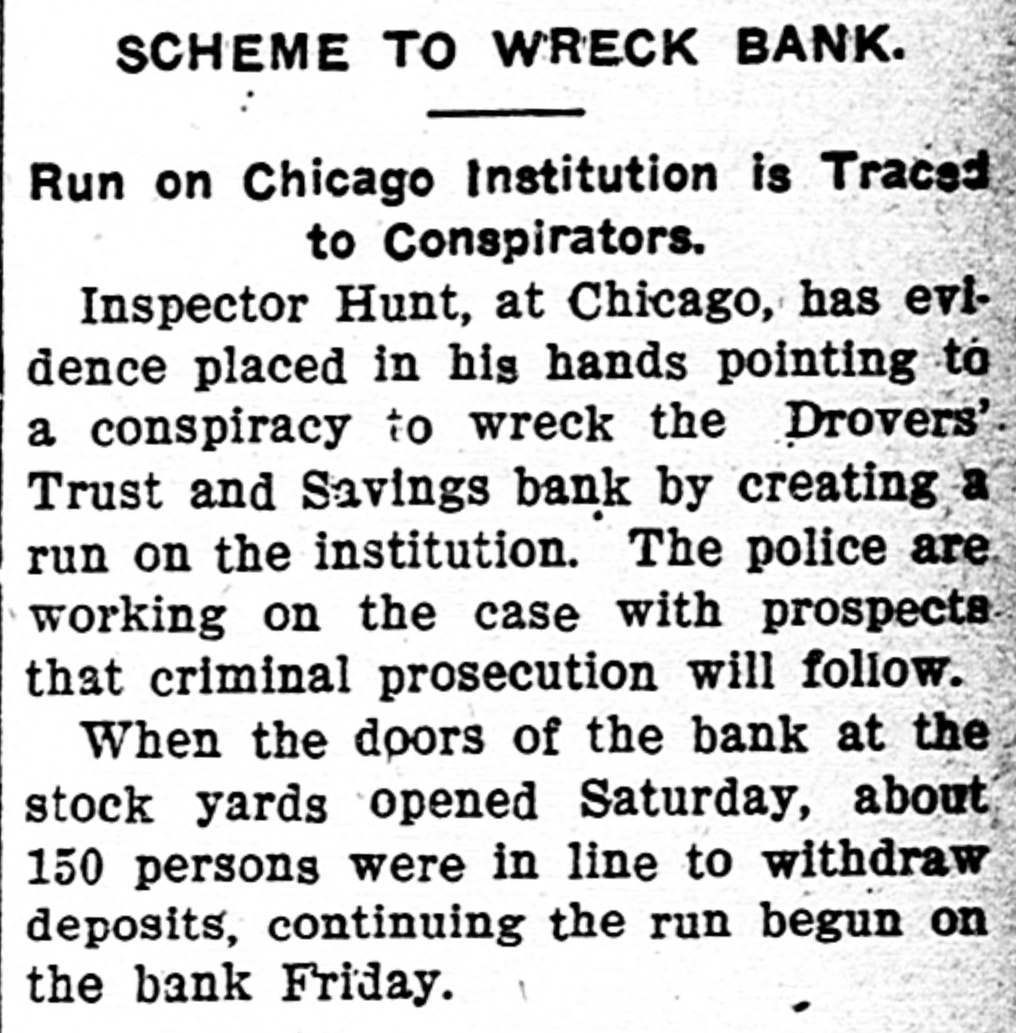
STRIKERS IN BIG PARADE Fully 25,000 Men, Women and Children Were in the Line. ENDED WITH GREAT PICNIC Packers Busy While Butchers Were at Play and Still Claim Victory. (By Associated Press.) CHICAGO, August 6.-The stock-yards strikers forgot their animosities and their troubles to-day long enough to join in a peaceful demonstration, the first since the strike was called, nearly four weeks ago. In a street parade several miles in length fully 25,000 strikers and their families encircled the stock-yards district, marching to the music from a dozen bands. The demonstration ended with a picnic at Oswald's Grove, where addresses were made by prominent labor leaders. While these events were in progress, there was peace and quiet around the big packing plants at the stockyards. Even the question of extending the strike by involving the teamsters was held in abeyance. The committee of the allied trades unions, which was appointed to take up the question of ordering out the truck and coal teamsters, met early in the day, but adjourned on account of the merry-making. The question of shutting off the ice supply at the yards will also wait until Monday. While the strikers were at their sport, the packers kept up their work of killing and shipping. The usual number of nonunion men were received at the different plants and put to work. Country butchers were numerous among the day's arrivals, and in a statement issued by the packers to-night it is asserted that a few more days like to-day will put then in such a position that It will not he necessary to add to the forces of butchering and easing departments. The run on the Drovers' Trust and Savings Bank came to an end to-day. Several small depositors withdrew their money from the bank in the morning, but by noon the run was over. The police are now endeavoring to discover the identity of the persons who were responsible for the circulation of anonymous letters and circulars which caused the run on the institution.


Article from Iowa County Democrat, August 18, 1904

Click image to open full size in new tab

Article Text

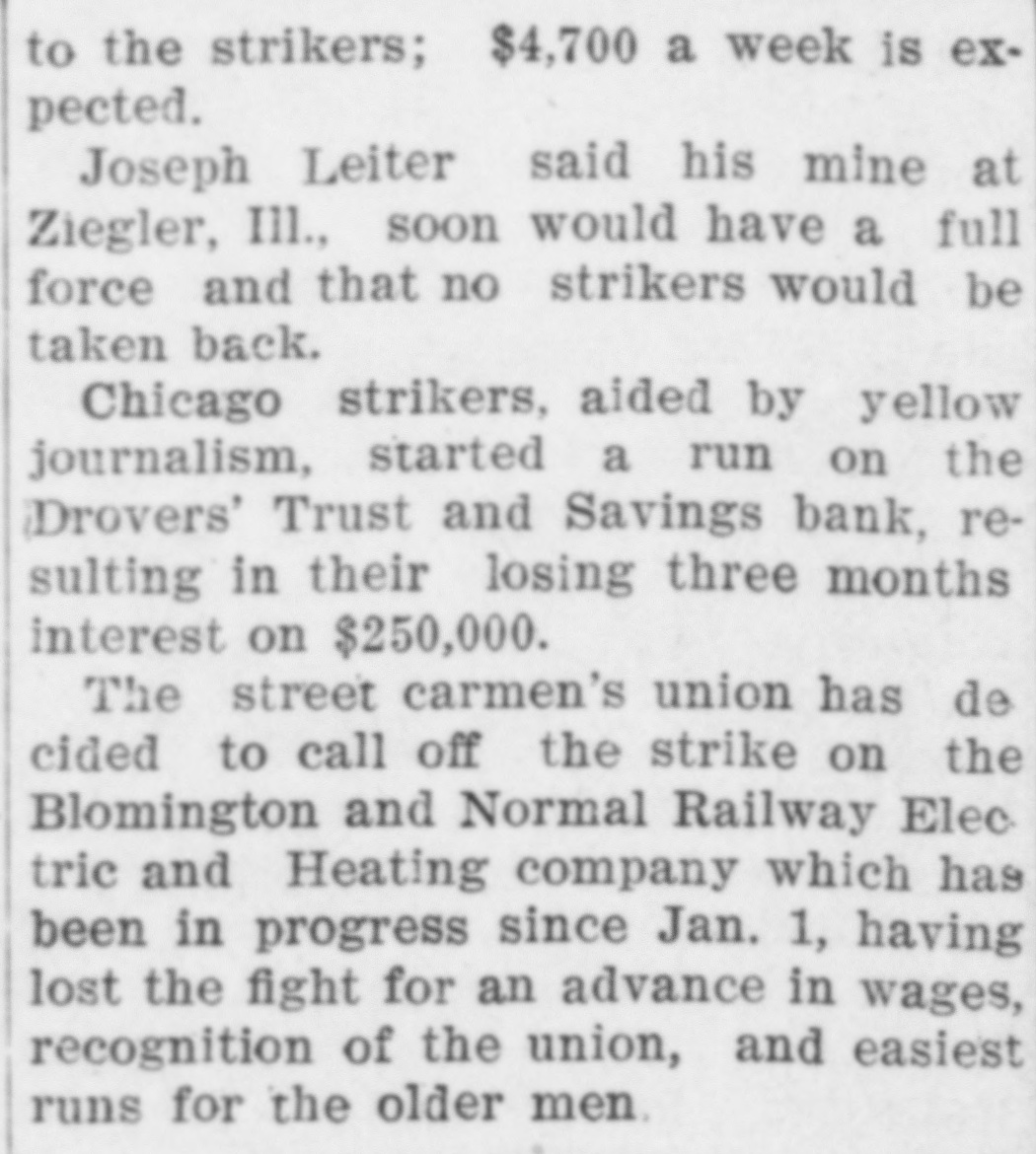
LABOR. Martial law has been declared at Ziegler, III., and W. C. Dowell assumes the position of chief deputy marshal. Pennsylvania coal strike may be avoided by the submission of the en tire controversy to Judge George Gray. The trades unions of New York ignored building trades employers ultimatum and a great lockout OC. curred. The federation of labor asked every union in Chicago to give financial aid to the strikers; $4,700 a week is expected. Joseph Leiter said his mine at Ziegler, III., soon would have a full force and that no strikers would be taken back. Chicago strikers, aided by yellow journalism. started a run on the Drovers' Trust and Savings bank, resulting in their losing three months interest on $250,000. The street carmen's union has de cided to call off the strike on the Blomington and Normal Railway Elee trie and Heating company which has been in progress since Jan. 1, having lost the fight for an advance in wages, recognition of the union, and easiest runs for the older men.