Illinois Trust & Savings Bank (Chicago, IL)

Episode Information

Episode UID
2001671122
Episode Type
Run Only
Bank Type
trust
Bank ID
200167 routing
Routing Number
2-0016
Start Date
June 6, 1893
Location
Chicago, Illinois (41.850, -87.650)

Metadata

Model
gpt-5-mini (chosen from majority vote of a three-model LLM ensemble)
Short Digest
952d310692283989

Response Measures

None

Events (1)

1. June 6, 1893 Run
Cause
Local Banks
Cause Details
Failure of Hermann Schaffner & Co. and other private bank failures plus brokers circulating sensational rumors triggered runs on Chicago savings banks.
Measures
Stayed open late/overnight, increased paying-teller force (seven windows), posted notices remaining open and paid depositors on demand.
Newspaper Excerpt
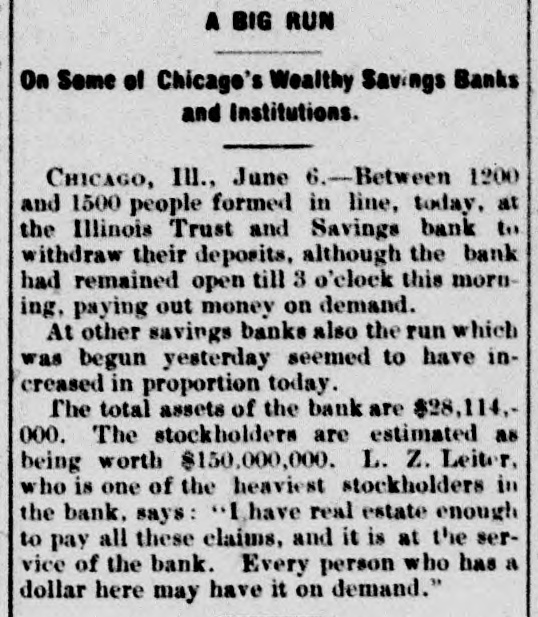
Between twelve and fifteen hundred people formed in line today at the Illinois Trust and Savings bank to withdraw their deposits, although the bank had remained open until long after midnight last night, paying out money, on demand.
Source
newspapers

Newspaper Articles (18)

Article from The Herald, February 11, 1893

Click image to open full size in new tab

Article Text

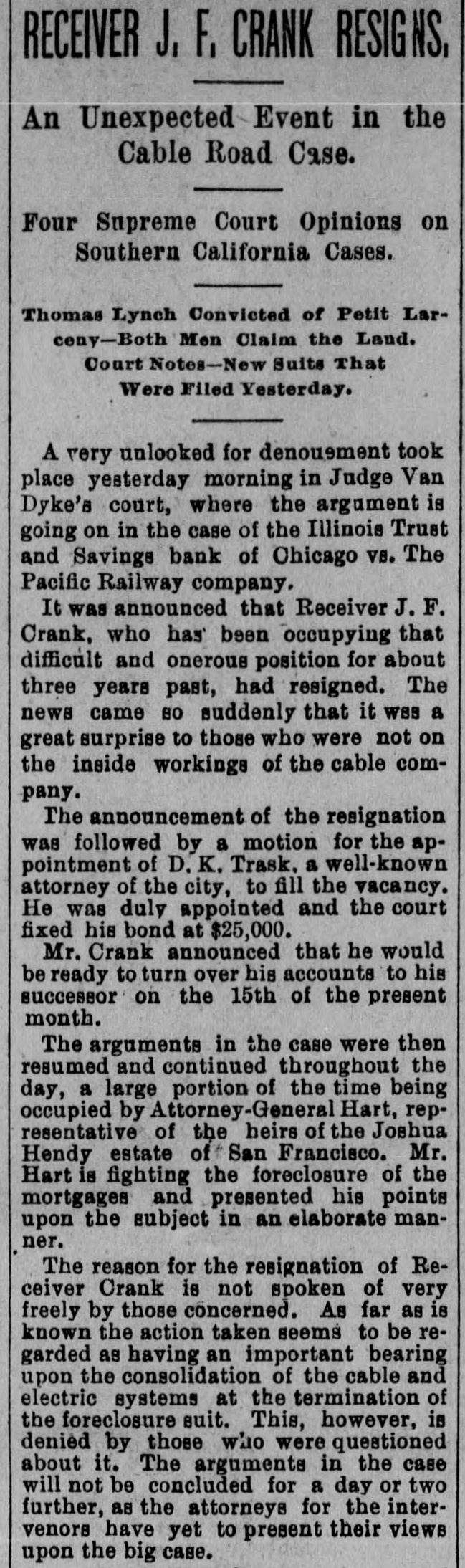
RECEIVER J, F, CRANK RESIGNS, An Unexpected Event in the Cable Road Case. Four Supreme Court Opinions on Southern California Cases. Thomas Lynch Convicted of Petit Larceny-Both Mon Claim the Land. Court Notes-New Suits That Were Filed Yesterday. A very unlooked for denouement took place yesterday morning in Judge Van Dyke's court, where the argument is going on in the case of the Illinois Trust and Savings bank of Chicago VS. The Pacific Railway company. It was announced that Receiver J. F. Crank, who has been occupying that difficult and onerous position for about three years past, had resigned. The news came SO suddenly that it was a great surprise to those who were not on the inside workings of the cable company. The announcement of the resignation was followed by a motion for the appointment of D. K. Trask. a well-known attorney of the city, to fill the vacancy. He was duly appointed and the court fixed his bond at $25,000. Mr. Crank announced that he would be ready to turn over his accounts to his successor on the 15th of the present month. The arguments in the case were then resumed and continued throughout the day, a large portion of the time being occupied by Attorney-General Hart, representative of the heirs of the Joshua Hendy estate of San Francisco. Mr. Hart is fighting the foreclosure of the mortgages and presented his points upon the subject in an elaborate manner. The reason for the resignation of Receiver Crank is not spoken of very freely by those concerned. As far as is known the action taken seems to be regarded as having an important bearing upon electric the systems consolidation at the of termination the cable and of the foreclosure suit. however, is were case denied about it. by The those arguments who This, in questioned the will not be concluded for a day or two further, as the attorneys for the intervenors have yet to present their views upon the big case.
Article from The Helena Independent, June 6, 1893

Click image to open full size in new tab

Article Text

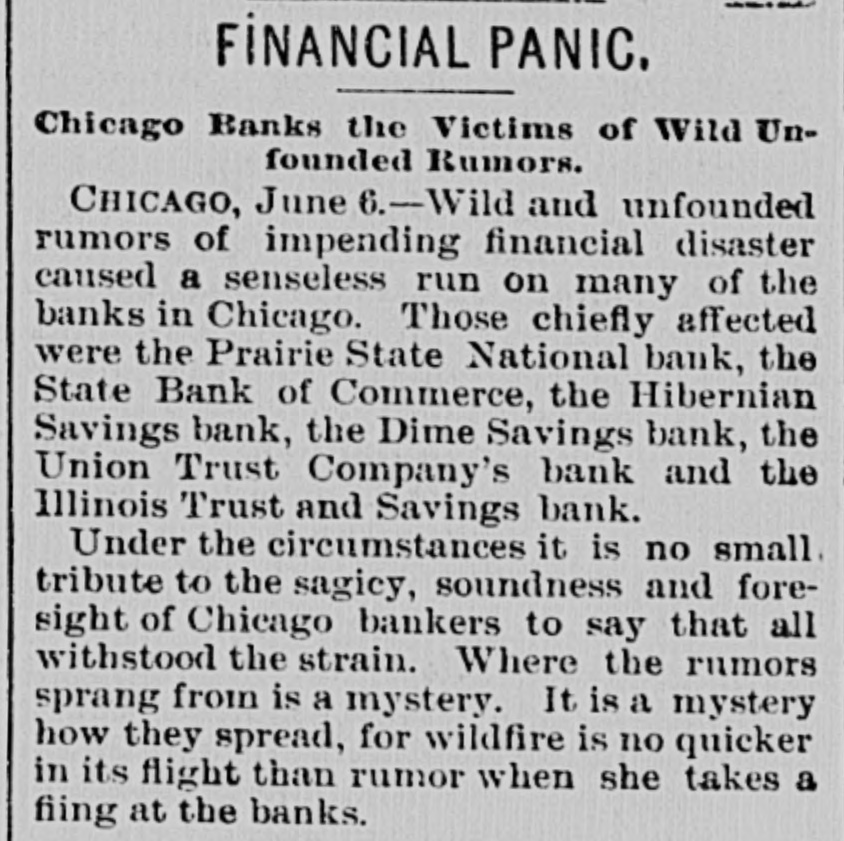
Not the Slightest Uneasiness Over the Condition of the Leading Institutions. Depositors in Savings Banks Ask for Their Money and Get It. The Demonstration of Solidity Should Go n Long Way Toward Reassuring the Whole Country. CHICAGO, June 5.-The failure of Herrmann Schaffner & Co.'s bank, which occarred last week, bore fruit to-day in well defined rans which were perceptible on almost. if not every one, of the savings banks of Chicago. The first to feel the effect of the excitement was the Bank of Commerce, where a great many Jewish oitizens of the poorer class kept their accounts: The Schaffner failure had alarmed them and they bore down upon the Bank of Commerce at the opening hour. Tellers were doubled up and paid obocks ns fast as presented throughout the day, the officials of the bank expressing no ala in whatever and saying they were able to meet any demands. The Illinois Trust and Savings bank, which has a larger line of this class of deposits than any other bank in the city, amounting at times to over $12,000,000, put on an extra force of tellers and paid everyone as rapidly as possible. At three o' clock this afternoon they posted fl notice on the front door that the bank would remain open until 10 o'cleck to-night and so long as the present excitement continues. The Hibern. ian bank, which, as its name implies, was the depository for a large numbes of IrishAmericans of small means, was crowded all day, but found no difficulty in meeting all demands. The Dime Savings bank took advantage of the rule requiring, if necessary, sixty day notice of withdrawal, and paid only a small percentage of deposits to-day. The Globe Savings bank applied the thirty day rule. The Milwaukee Avenue Savings bank sustained a moderate run throughout the day and they, too, kept open house until nine o'clook to-night. Equally spirited checking was noted upon the Prairie State National and Preirio State Savings banks, as well as upon the Union Trust company and Avenue Savings bank, but in no ease WAS any alarm felt by well informed people. In fact, at many of these institutions, large ositors dame in during the afternoon, and made heavy deposits. To-day's situation was greatly aggravated by a number of board of trade brokers. who, for reasons of their own, devoted themselves to the circulation of sonsational ramors at which they involved at one time or another nearly every bank in the oity, and R large number of leading stook yards operators. Notwithstanding these malicious efforts, no fear is felt as to the safety of any of the leading banking institutions of the city. The failure of Meadowcroft Brothers. a minor institution with a total deposit of perhaps $200,000, aroused little or no interest. CHICAGO, June 6., 1:30 A. m.-The Illinois Trust and Savings bank is still open. the force of paying telle's at seven windows having been relieved by fresh men, and enough people are still waiting for money to keep the bank open two hours more. President Mitchell said there is plenty of money on hand and plenty of mon to pay it out. KANSAS CITY. June 5.-The Kansas Grain company. which claims to be the largest purchaser of grain from producers in the world, has failed. The officers here decline to make any statement of the Assets and liabilities Bill they are authorized by President Tompler, who is in charge of the office at Hutchinson. The company has elevators in over A hundred towns in Kansas, all containing grain. Tight money was the cause of the failure. SPOKANE. June 5.-The Bank of Spokane temporarily closed its doors this morning. The suspension caused no excitement. The embarrasement is due to the tightness of the money market. A. M. Cannon, president of the bank. has many large interests in this city and is reported a mniti-millionai e. CHICAGO, June 5.-F. A. Armstrong & Co., manufacturers and dealers in society and military uniforms. failed. Their liabilities are $105,000 and the assets $205,000.


Article from San Antonio Daily Light, June 6, 1893

Click image to open full size in new tab

Article Text

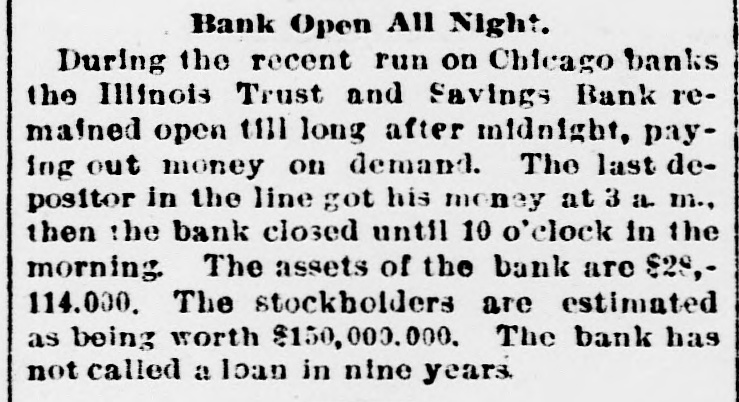
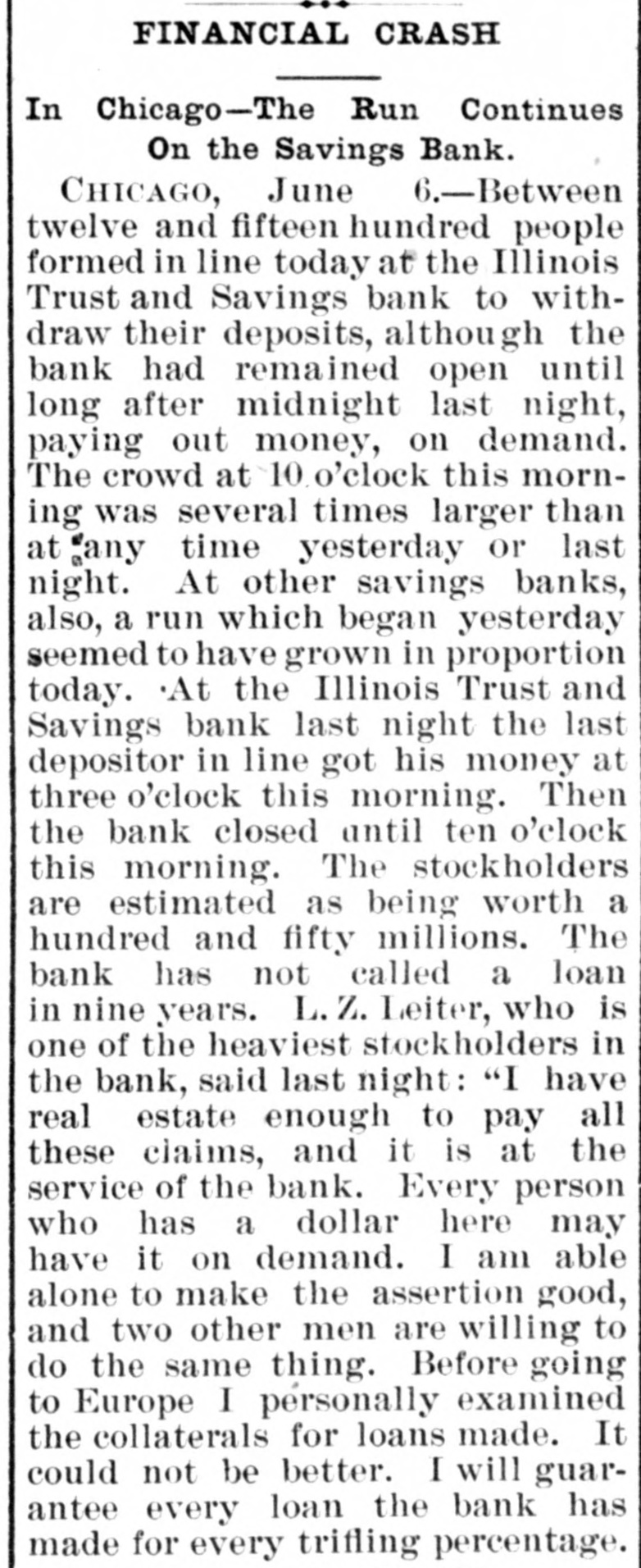
FINANCIAL CRASH In Chicago-The Run Continues On the Savings Bank. CHICAGO, June 6.-Between twelve and fifteen hundred people formed in line today at the Illinois Trust and Savings bank to withdraw their deposits, although the bank had remained open until long after midnight last night, paying out money, on demand. The crowd at 10.o'clock this morning was several times larger than at any time yesterday or last night. At other savings banks, also, a run which began yesterday seemed to have grown in proportion today. .At the Illinois Trust and Savings bank last night the last depositor in line got his money at three o'clock this morning. Then the bank closed until ten o'clock this morning. The stockholders are estimated as being worth a hundred and fifty millions. The bank has not called a loan in nine years. L.Z. Leiter, who is one of the heaviest stockholders in the bank, said last night: "I have real estate enough to pay all these claims, and it is at the service of the bank. Every person who has a dollar here may have it on demand. I am able alone to make the assertion good, and two other men are willing to do the same thing. Before going to Europe I personally examined the collaterals for loans made. It could not be better. I will guarantee every loan the bank has made for every trifling percentage.


Article from The Daily Morning Astorian, June 6, 1893

Click image to open full size in new tab

Article Text

THE SITUATION NOT IMPROVING Heavy Rnn on Nearly all the Chicago Banks Yesterday. ALL DEMANDS PROMPTLY MET Some of the Houses Kept Open Till a Late Hour-Brokers Circulated Disturbing Rumors. Associated Press. Chicago. June 5.-The failure of Herman Schaffner lb Company's bank, which occurred last week, bore fruits today in well defined runs which were precipitated on almost, if not everyone of the savings banks of Chicago. The first to feel the effect of the excitement was the Bank of Commerce, wher a great many Jewish citizens and the poorer class kept their accounts. The Schaffner failure had alarmed them and they bor down on the Bank of Commerce at the opening hour. The tellers were doubled up and paid the check as fast as presented throughout the day, the officials of the bank expressing nq alarm whatever, and saying they were able to meet any demands. The Illinois Trust & Savings Bank, which has a larger line of this class of depositors than any other bank in the city. amounting at times to we uo and '000'000'7I$ of tellers and paid every one as rapidly as possible. They posted a notice on the front door that the bank would remain open until 10 o'clock, and so long as the present excitement continues. The Hibernian bank, which was the depository for a large number of IrishAmericans of small means, was crowded all day, but found no difficulty in meeting the demands. The Dime Savings Bank took advantage of the rule requiring, if necessary, sixty days' notice of withdrawal, and paid only a percentage on the deposits today. The Globe Savings Pank applied the thirtyday rule. The Milwaukee Avenue Savings Bnk sustained a moderate run throughout the day, and they, too, kept open house until 9 o'clock tonight. An equally spirited was noted up An equally spirited checking was noted on the Prairie State National and the Prairie State Savings Bank, as well as upon the Union Trust Company's and Avenue Savings Bank, but in no case was any alarm felt by wellinformed people. In fact at many of these institution the larger depositors came in during the afternoon and made heavy deposits. Today's situa. tion was greatly aggravated by a number of board of trade brokers, who for reasons of their own, devoted themselves to the circulation of sensational rumors in which they involved at one time or another nearly every bank in the city, and a large number of leading stockyard operators. Notwithstanding these malicious efforts, no fear is felt as to the safety of any of the leading banking institution of the city. The failure of Meadowcroft Bros, a minor institution with deposits of perhaps $200,000. aroused little or no interest. At 1:30 a. m. the Illinois Trust and Savings Bank was still open, the force of paying tellers at the seven windows having been relievedd by fresh men, and enough people still waiting for their money to keep the bank open two hours more. The bank officials are rater pleased than otherwise to saving to the institution in interest. So far the net profit is about $35,000. It is announced that the bank would not close as long as a single depositor cared to draw out a dollar. President Mitchell said: "We will stay right here for three months, and not close our doors night or day if such proceedings should become necessary. We are good for any run, no matter how long it keeps up. run, no matter how long it keeps up."


Article from Evening Star, June 6, 1893

Click image to open full size in new tab

Article Text

THE WESTERN BANKS Chicago Institutions Withstand the Run of Depositors. BOLD ROBBERY AT LITTLE ROCK, ARK. Victims of the Texas Mining Disaster. OTHER TELEGRAPHIC NEWS DEPOSITORS' ALARM GROUNDLESS. The Chicago Banks Able to Stand the Run. CHICAGO, June 6.-It was not until after 2 o'clock this morning that the Illinois Trust and Savings Bank closed its doors after paying the last depositor that remained in line at that hour. As early as 7 o'clock. however, another batch of depositors had made their appearance. At the Bank of Commerce as well as at the Dime Savings Bank, the Union Trust and the Hibernian Bank the same scenes were being enacted. By 10 o'clock it was apparent that yesterday's experiences would be repeated at each institution. Officers of all the institutions insisted that they were able to weather the storm. and with the exception of the Dime Savings Bank not one has so far found it necessary to enforce even the thirty days' notice rule. Over two millions in currency has been offered to the Illinois Trust since the run commenced yesterday. L. Z. Leiter. one of the directors, himself offered a round million, but the assistance was declined with thanks and an intimation that it was not needed. The number of savings institutions upon which a run was made vesterday was increased this morning by the addition of the Globe Savings Bank. which has savings and individual deposits to a total of about $600,000. Its officers, however, were prompt in announcing that the thirty days' notice would be required. NO APPRBHENSION AT ST. LOUIS. ST. LOUIS, Mo., June 6.-The fact that there has been trouble in New York and some Chicago banks have been in difficulty has caused some anxiety to be felt by stockholders and depositors in local banks. Inquiry developed the fact that there was not the smallest cause for this. Unusually heavy reserves have been accumulated and the banks are preparing for any demand. Several have extended aid to their Chicago correspondents. WESTERN BANKERS IN TROUBLE. TROY, N. Y., June 6.-The inventory and schedules of James H. Carpenter, banker and eastern agent of the Northwestern Guaranty Loan Company. were filed today. The statement shows liabilities to be $235,223.28 and the nominal assets $237,852.94. The actual assets are placed at $131,671.95. MANITOWOC, WIS. June 6.-The state bank of Manitowoe did not open for business this morning. There has been a continued run on the institution for the past three weeks and the officers have made a fight against the failure which, by developments yesterday, was made inevitable. C. C. Barnes, the president, it is understood, has turned over all his personal property to cover any possible loss by depositors. TOLEDO, OHIO, June 6.-A Blade special says: Savings bank of Andrew Sauer at Defiance has failed.


Article from The Indianapolis Journal, June 7, 1893

Click image to open full size in new tab

Article Text

THE PANIC SUBSIDING. Confidence Partly Restored Among Chicago's Saving Banks Depositors. Special to the Indianapolis Journal. CHICAGO, June. 6.-To-day's developments in the financial situation showed an increased steadiness among the monetary instructions of Chicago. True, the people continued to walk up to the wickets of the paying tellers to demand their deposits, but the numbers were reduced and a more widespread feeling of confidence assumed the place of the panicky outburst of yesterday. Those banks upon which the run was continued to-day were the Illinois Trust and Savings. the Hibernian, the Union Trust and Savings, the Globe Savings, the Dime Savings and the Bank of Commerce. Those that demanded the lawful notice of withdrawal of deposits were the Union Trust and Savings, the Dime Savings and the Globe Saving. At the Illinois Trust and Savings Bank last night the last depositor in the line got his money at 3 A. M. then the bank closed until 10 o'clock this morning. The assets of the bank are placed at $28,114,000. The stockholders are estimated as being worth $150,000,000. The bank has not called in a loan in nine years. L. Z. Leiter, who is one of the beaviest stockholders in the bank, says: "I have real estate enough to pay all these claims, and it 18 at the service of the bank. Every person who has a dollar here may have it on demand. I am able alone to make that assert a good, and two other men are willing 10 do the same thing. Before going to Europe I personally examined the collateral for loans made; it could not be better. I will guarantee every loan the bank has made for a very trifling percentage." " This afternoon it was easy to see the excitement was dying out. Philip Armour was responsible for the allaying of the fears of many of the depositors of the Illinois Trust and Savings, by walking up to the people and saying that he would guarantee their savings. About one hundred took advantage of the millionaire's offer, and some accepted a written guaranty. One woman received $1,800 in gold. The banks closed their day's business at the usual hour, and the directors make the statement that they are prepared to stand the run for an indefinite period, and are satisfied with the condition of affairs as sho wn by to-day's signs of returning confidence. Little more than the usual daily demand for currency in exchange for coin was made at the subtreasury to-day by the local banks. The Clearing House Association discussed the general situation. and gratifying reports were received, indicating that the savings banks were in good shape to meet all requisitions.


Article from The Herald, June 7, 1893

Click image to open full size in new tab

Article Text

THE GREAT FINANCIAL UPHEAVAL Continued Runs on Chicago Savings Banks. The Baldwin Locomotive Works Forced to Assign. Three Banks Close Doors at Spokane, Wash -Bank Failures in Ohio, Indiana, Wisconsin and Other States. By the Associated Press. CHICAGO, June 6.-In spite of the fact that the Illinois Trust & Savings Bank remained open till 3 o'clock this morning to give anxious depositors a chance to draw funds, a new line began to form before 8 o'clock this morning, and at 10 o'clock, the hour for opening, between 1200 and 1500 people were waiting at the doors, with savings books. The crowd was several times larger than at any time yeaterday. The bank is considered absolutely sound. Its assets are figured upat over $28,000,000, and its stockholders are estimated to be worth in the aggregate fully $150,000,000. At other savings banks the runs which began yesterday seem to have increased in size. During the time when the run on the Illinois Trust bank was hottest this afternoon, Philip D. Armour, the millionaire pork packer, sent out some of his clerks to bring into his office 100 or more of the excited depositore, mostly women. To these Mr. Armour madea brief speech. assuring them that the bank was all right, and added that Armour & Co. will guarantee to each of them the full amount of their deposit; if any of them were not satisfied with this let them speak up and he would give them their money. Two women asked for the amount of their deposits, which were immediately paid in gold, while the remainder of the people went away satisfied. WASHINGTON, Jane 6.-Comptroiler Eckels said to the Associated Press this morning that 80 far as he was advised no national bank in Chicago has been affected by yesterday's financial flurry. The clearing house there stands ready to assist its members whenever necessary. The abstract of the condition of the Chicago national banks on the date of last call, shows a reserve of 29.45 per cent, 4.45 per cent above the legal requirement. The total resources are $160,864,804, R surplus of $11,510,700; undivided profits, $1,593,000.


Article from The Evening Herald, June 7, 1893

Click image to open full size in new tab

Article Text

CHICAGO'S FINANCIAL FLURRY. Confidence of Poorer Classes of Depositors Not Yet Restored. CHICAGO, June 7. -Notwithstanding the evident stability of Chicago's saving institutions, as demonstrated by their prompt response to Monday's run and the refusal of a large majority to take advantage of the sixty and ninety days' notice, it was apparent yesterday that the confidence of the poorer classes of depositors is not entirely restored. Lines of people began to form in front of the Illinois Trust and Savings Bank, the Bank of Commerce, the Union Trust company, the Globe Savings Bank, and other institutions of the same class, as early as ? o'clock Notices were posted on the doors of all the banks that they would be open for business at 10. Ev ry institution is stated to be well supplied with funds, and no fears are entertained in financial circles that any of them will go to the wall. It was 3 o'clock yesterday morning when the Illinois Trust and Savings company paid off the last of the depositors in waiting. This is the first time in the history of the United States that a bank has kept open all night to assist in maintaining CO fidence. It has savings deposits amount ing to $10,500,000, and it claims its ability to pay off every cent without requiring the legal notice and then to have several millions in its safes. Its stockholders com ) prise some fifty or more of the wealthiest e men in Chicago, any one of them good for 3 a quarter to a half of the bank's liability. WASHINGTON, June .-Comptroller t Eckels said to a reporter, in reply to a question, that "so far as present advices go from Chicago, no national bank has t been affected by the financial flurry. The I Clearing House Association stand ready and willing to assist one another, and give aid in every manner needed. This fact will do much to give confidence to the I people, and prevent anything like a run t upon any nat. onal bank. The savings bank failures have not produced any consternation among the depositors of the national banks, and will not." The abstract of the condition of national ] banks in Chicago on the date of the last , call showed a reserve of 29.45 per cent, or 1 4.45 per cent. above the reserve required y by law. The total resources are stated at $160,864,804. The surplus tund was $11. e 516,700, and undivided profits $2,596,000.


Article from Omaha Daily Bee, June 7, 1893

Click image to open full size in new tab

Article Text

CHICAGO BANKS BESIEGED Frightened Depositors Anxious to Withdraw Their Money. RUNS ON ALL THE SAVINGS INSTITUTIONS Long Lines of People Wait Before Their Doors-Every Demand Satisfied-An Unusual Pante-Business Troubles at Many Other Places. CHICAGO, Ill., June 6.-In spite of the fact that the Illinois Trust and Savings bank remained open till 3 o'clock this morning to give anxious depositors a chance to draw their funds, a new line began to form before 8 o'clock this morning, and at 10, the hour for opening, between 1,200 and 1,500 people were waiting at the doors with savings books. The crowd was several times larger than at any time yesterday. The bank is considered absolutely sound. The assets are figured up at over $88,000,000 and its stockholders are estimated to be worth in the aggregate fully $150,000,000. At the other savings banks the runs which began yesterday seem to have increased in size. During the time when the run on the bank this afternoon was hottest, Phillip D. Armour, whose office is across the street from the bank, sent out some of his clerks to bring into his office a hundred or more of the most excited depositors. When his office was crowded with them Mr. Armour made a short speech telling them that the bank was all right and assuring them that they stood no danger of losing any of their money. "If it will make you people any easier," he said, "Armour & Co. will guarantee to each one of you the full amount of his deposit in the Illinois Trust and Savings bank. If there is any person here who is not satisfied with the guarantee of Armour & Co., all that person has to do is to speak up and I will give him a check for his deposit." Two women said they would like their money, one of them having over $1.800 in the bank. They were immediately paid in gold and the balance of the depositors went away satisfied.


Article from Grand Rapids Herald, June 8, 1893

Click image to open full size in new tab

Article Text

END OF THE RUNS. Chicago Hanks Have a Chance to Breathe Freely Again. CHICAGO. June 7.- With one excep tion. the Hibernian Savings bank, the runs inaugurated are not nearly so heavy today. the crowde being less than half as large as yesterday. At the Hibernian the long line of depositors was confront ed for the first time this morning by a notice to the effect that a thirty days' notice would be required on deposits of $100 or less and sixty days on amounts above that figure. Phil Ar mour, the multi-millionaire, walked up and down the line of depositors in front of the Illinois Trust & Savings bank for an hour today and assured the people that he personally know the bank to be solvent and able and willing to pay everybody on demand. At the same time he told them that a run was injurious to everybody. and especially to the deposit ore with money in a solid bank, and advised them to drop out of the line and return to their homes. He even went so far as to assure those who were in need that if they would step into his office across the street he would cash their books without discount.


Article from Echo De L'ouest, June 8, 1893

Click image to open full size in new tab

Article Text

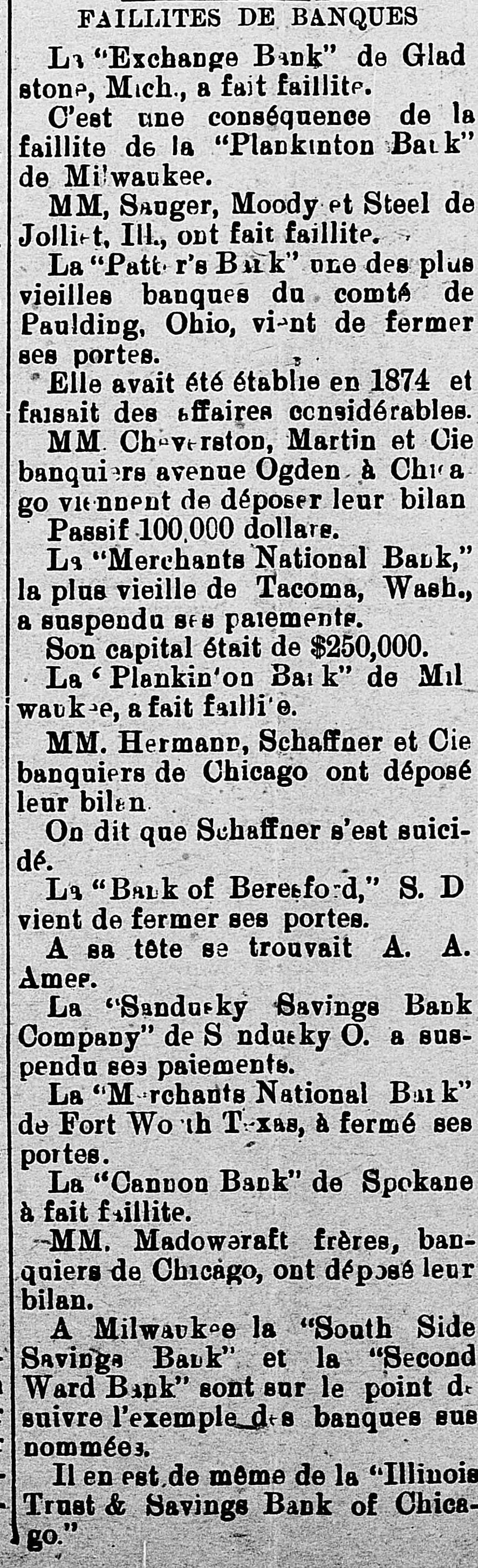
FAILLITES DE BANQUES L "Exchange Bank" de Glad stone, Mich., a fait faillite. C'est une conséquence de la faillite d6 la "Plankinton BaLk" de Mi'waukee. MM, SAuger, Moody et Steel de Jolliet, Ill., ont fait faillite. La "Patt r's Bak" one des plus vieilles banques du comté de Paulding, Ohio, viont de fermer ses portes. Elle avait été établie en 1874 et faisait des affairea considérables. MM Ch-vraton, Martin et Cie banquiers avenue Ogden à Chra go viennent de déposer leur bilan Passif 100.000 dollare. Lq "Merchants National Bank," la plus vieille de Tacoma, Wash., a suspendu BEB paremente. Son capital était de $250,000. La Plankin'on Bai k" de Mil waukee, a fait failli'e. MM. Hermann, Schaffner et Cie banquiers de Chicago ont déposé leur bilan On dit que Schaffner B'est suicidé. La "Bank of Beresford," S. D vient de fermer ses portes. A sa tête se trouvait A. A. Amee. La "Sandusky Savings Bank Company" de S ndueky O. a suspendu 803 paiements. La "M rchants National Bank" de Fort Wo th Texas, à fermé ses portes. La "Canyon Bank" de Spokane à fait faillite. -MM. Madowaraft frères, banquiers de Chicago, ont déposé leur bilan. A Milwaukee la "South Side Savinga Bauk" et la "Second Ward Bank" sont sur le point de suivre l'exemple d - 8 banques BUB nommée3. Il en est de meme de la "Illinois Trust & Savings Bank of Chica go."


Article from The Times, June 9, 1893

Click image to open full size in new tab

Article Text

LATER. THE village of Woodington, O., was almost entirely leveled by a cyclone and many persons were injured and Mrs. Mary Smith was killed beneath her building. NEARLY 400 delegates were in attendance at the opening session of the world's temperance congress in Chicago. THE office of the Hustler, a paper in Breathitt county, Ark., that advocated local liquor license, was blown up by dynamite. THE Savings bank at Sandusky, O.,' with liabilities of $205,000, closed its doors. IN a runaway at Kalamazoo, Mich., Mrs. L. A. Fagan was thrown from a wagon and killed and Mrs. T W. Murphy and Mrs. Ellison were fatally injured. CHOLERA was said to be spreading rapidly in Asiatic Turkey. THE fire loss of the United States and Canada for the month of May is estimated at $10,427,000. This is about a million greater than the aggregate for May, 1882. THE president authorizes the statement that he will call an extra session of congress early in September. THE People's bank at Bentonville, Ark., was robbed by six men of $10,000. THE Kansas Grain company at Kansas City, Mo., which claims to be the greatest buyer of grain from producers in the world, has failed. THE supreme court of Nebraska acquitted the state officials, against whom impeachment proceedings were brought. THE Merchants' national bank of Fort Worth, Tex., with a capital of $250,000, closed its doors. EPHRAIM DOMEDLAN, a Braceville (III.) miner, killed his wife and then blew out his own brains. Whisky was the cause. EIGHTEEN persons were injured in a wreck on the Iron Mountain road near Mill Spring, Mo. THE house of John Redding, a Kentucky farmer, was struck by lightning and three of its occupants instantly killed. THE president has appointed Charles W. Dayton as postmaster of New York. THE private banking house of Meadowcroft Bros. in Chicago suspended, and runs were made by frightened depositors upon the Bank of Commerce, the Prairie state national bank, the Prairie State Savings and Trust company, the Union trust bank, the Hibernian bank and the Illinois trust and savings bank, but these institutions met all demands promptly.


Article from Morning Journal and Courier, June 9, 1893

Click image to open full size in new tab

Article Text

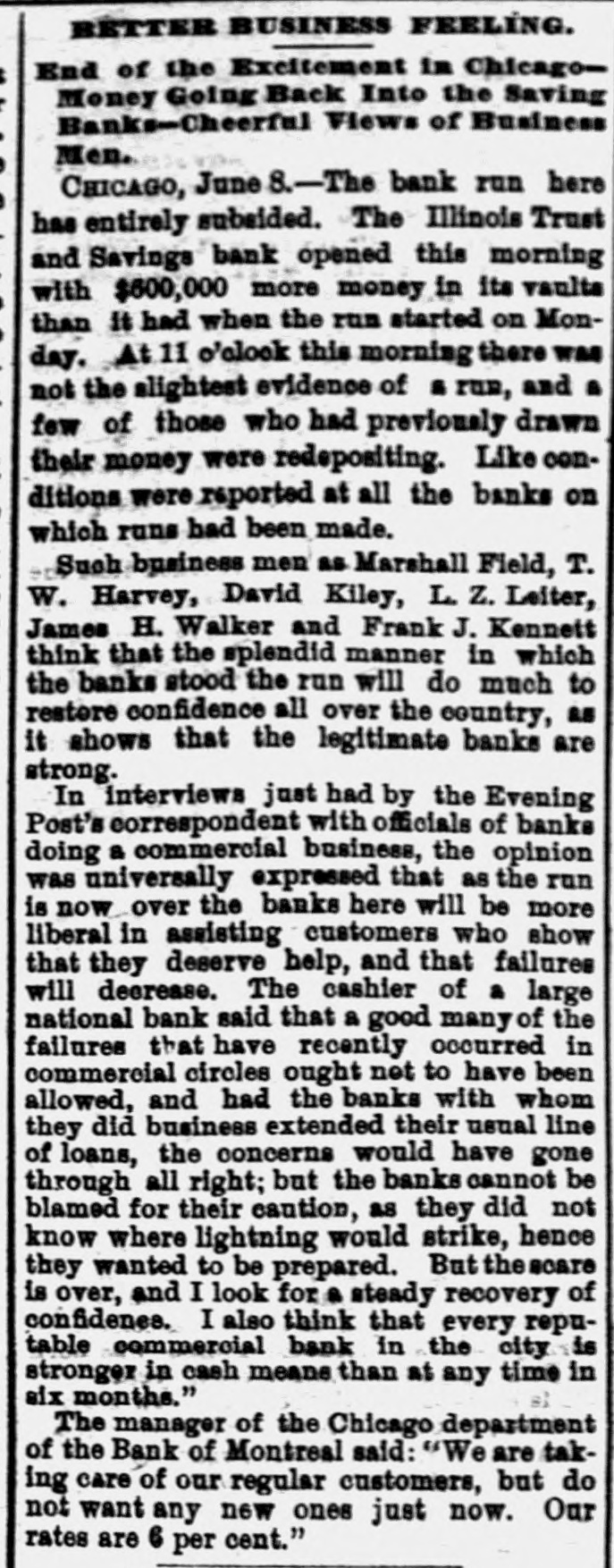
BETTER BUSINESS FEELING. End of the Excitement in ChicagoMoney Going Back Into the Saving Banks-Cheerful Views of Business Men. CHICAGO, June 8.-The bank run here has entirely subsided. The Illinois Trust and Savings bank opened this morning with $600,000 more money in its vaulta than it had when the run started on Monday. At 11 o'clock this morning there was not the slightest evidence of a run, and a few of those who had previously drawn their money were redepositing. Like conditions were reported at all the banks on which runs had been made. Such business men as Marshall Field, T. W. Harvey, David Kiley, L. Z. Leiter, James H. Walker and Frank J. Kennett think that the splendid manner in which the banks stood the run will do much to restore confidence all over the country, as it shows that the legitimate banks are strong. In interviews just had by the Evening Post's correspondent with officials of banks doing a commercial business, the opinion was universally expressed that as the run is now over the banks here will be more liberal in assisting customers who show that they deserve help, and that failures will decrease. The cashier of a large national bank said that a good many of the failures that have recently occurred in commercial circles ought net to have been allowed, and had the banks with whom they did business extended their usual line of loans, the concerns would have gone through all right; but the banks cannot be blamed for their caution, as they did not know where lightning would strike, hence they wanted to be prepared. But the scare is over, and I look for a steady recovery of confidence. I also think that every reputable commercial bank in the city is stronger in cash means than at any time in six months." The manager of the Chicago department of the Bank of Montreal said: "We are taking care of our regular customers, but do not want any new ones just now. Our rates are 6 per cent."


Article from The Abbeville Press and Banner, June 21, 1893

Click image to open full size in new tab

Article Text

South and West. THE Old Kentucky Home at the Chicago Fair Grounds was dedicated. It is the Blue Grass State Building and one of the most attractive in the grounds. Miss Enid Yandel's statue of Daniel Boone was unveiled. AT the Sisseton Agency, South Dakota, Miss Cynthia Rockwell, an Illinois teacher at Coodwill Mission, has married Richard King, an Indian, studying for the Presbyterian ministry. THE Plankinton Bank in Milwaukee, Wis., closed its doors. The bank had loaned $200,000 to F. A. Lappen & Co. and the Lappen Furniture Company, and this was the principal cause of its suspension. THE Victoria Cordage Company, Cincinnati, Ohio, members of the Cordage Trust, has assigned. Assets, $500,000; liabilities, $400,000. TORNADOES did great damage to property in Mississippi, Tennessee, Arkansas and Kentucky. At Rosedale, Miss., W. L. Bawdre and wife were killed. IOWA Prohibitionists nominated a full State ticket. THE members of the graduating class at Annapolis (Md.) Naval Academy, forty-four in number, received their diplomas at the hands of Secretary Herbert. W. V. N. Powelson, of New York, received the honors of his class graduating No. 1. A RECEIVER was appointed at Charleston. W. Va., for the Norfolk and Western Railroad. DURING a heavy rain storm fire was discovered in a block on Farnum street, Omaha, Neb. The entire city Firs Department was called to the scene. A high wind was blowing. One of the walls fell on seven firemen. Five of them were instantly killed. WHILE a primary election was held in Bell County, Kentucky, by the Democratic party, excitement ran high, and in a fight at Pineville, the county seat, John Jones and Levi Hoskins were killed and two others were fatally injured. OVING to a storm less than 60,000 persons visited the World's Fair on the second Sunday opening. TWENTY-FIVE men walked into Decatur, Ill., 8 city of 22,000 people, and lynched Samuel Bush on the principal street without opposition. Bush was a colored man accused of assaulting two white women. AT Chicago, Ill., Herman Schaffner & Co., private bankers. made an assignment. Schaffner & Co. have been the largest private bankers in the Northwest, dealing exclusively in commercial paper. JOHN C. MINING, Town Treasurer of Fort Jennings, Ohio, has disappeared with $5000 cash, and an additional shortage of $10,000 has been discovered. WILD and unfounded rumors of impending financial disaster caused a senseless run on many of the banks in Chicago. Those chiefly affected were the Prairie State National Bank, the State Bank of Commerce, the Hibernian Savings Bank, the Dime Savings Bank, the Union Trust Company's Bank and the Illinois Trust and Savings Bank. Meadoweroft Brothers, private bankers of Chicago, failed with liabilities estimated at $450000. THE Bank of Spokane, Washington, has failed. It is a private institution, owned by A. M. Cannon, who is reported to be worth $3,000,000. The Sandusky (Ohio) Savings Bank assigned, The Merchants' National Bank, of Fort Worth, Texas, capital $250,000, has failed.


Article from The Providence News, July 14, 1893

Click image to open full size in new tab

Article Text

Refused to Make an Accounting. CHICAGO, July 14.-The Illinois Trust and Savings bank, administrator of the estate of Walter M. Lovett, has made application for a receiver for the Smith Corrugating company. It is claimed that a large amount of money is due to the estate of Lovett, and that John Smith, proprietor of the Smith Corrugating company, who has the firm's books in his possession, refused to make any accounting.


Article from The Star, November 28, 1894

Click image to open full size in new tab

Article Text

NO ASSETS IN SIGHT. The American Debenture Company of Chicago Has Assigned. When a corporation fails with liabilities of $2,000,000, and then turns over to the receiver one book and three second-hand desks, the prospect for the stock and bondholders cannot be considered very rosy, This is what happened in the case of the American Debenture Company, which was organized by Coffin & Stanton, of New York with offices in Chicago. It failed October 10, soon after the parent house succumbed in New York. At the request of Messrs. Trimmingham, Turner and Rlack, of New Jersey, Elias Summerfield was appointed receiver. The foreign holders of $1,000,000 or more of the debentures then stepped in and demanded that the Illinois Trust and Savings Bank be given the receivership. Mr. Summerfield was consequently relieved, and the bank was appointed. It is now six weeks since the Illinois Trust and Savings Bank took hold of the wreck of the Debenture Company. In that time the desks and the book have been all the assets the receiver could secure. The other books of the concern have disappeared, at least the receiver cannot find them. The one book turned over goes back only to last January and is very vague in important points. The Debenture Company was organized under the laws of West Virginia, one of which provides "that one corporation cannot hold the stock and bonds of another corporation." but this is just what the Debenture Company did. It took the stocks and bonds of every corporation and company it could prevall upon to give them up, and issued against them "guaranteed debentures" for investment, and they still have them. Besides the "debentures," the company floated, or had authority to float, common stock to the amount of $2,000,000. It was capitalized for that amount, and most of the stock is held in the East.


Article from The Topeka State Journal, January 12, 1895

Click image to open full size in new tab

Article Text

CHAMPION SWINDLERS. New Move of Coffin & Stanton Who Figured in Topeka Waterworks Deal. NEW YORK, Jan. 12.-A new move regarding the American Debenture company, Coffin & Stanton's concern, is under way. When they broke up six months ago the Illinois Trust and Savings Bank of Chicago and W. K. Okley, ex-secretary of state of West Virginia, were appointed receivers. Today the news leaked out in Wall street that a quiet effort is being made to have the present receivership proceedings in West Virginia and Chicago dismissed and new ones begun. The object is to set aside the Illinois Savings Bank and Trust company, and W. H. Okley as receivers, and have two new receivers appointed. One of the men mentioned as one of the new receivers is said to be a relative of Coffin, of Coffiu & Stanton, and the other is said to be a relative of Stanton. This change, it was learned, will be made within a very few days if the creditors do not interfere. From the day on wnich the failure of Coffin & Stanton was announced the American Debenture company has been a veritable will-o'-the-wisp from a creditor's view point. Several times they have thought they had the property of the elusive company in their grasp, but each time they were mistaken. This American Debenture company, incorporated under the law of West Virginia, with its main office in Chicago and all its actual business in Europe and New York, has debenture bonds to the extent of nearly $2,000,000 in the hands of investors, and there is believed to be nothing back of the bonds but a conglomeration of worthless stock-stock of incorporations which are in the hands of receivers.


Article from The Topeka State Journal, January 11, 1897

Click image to open full size in new tab

Article Text

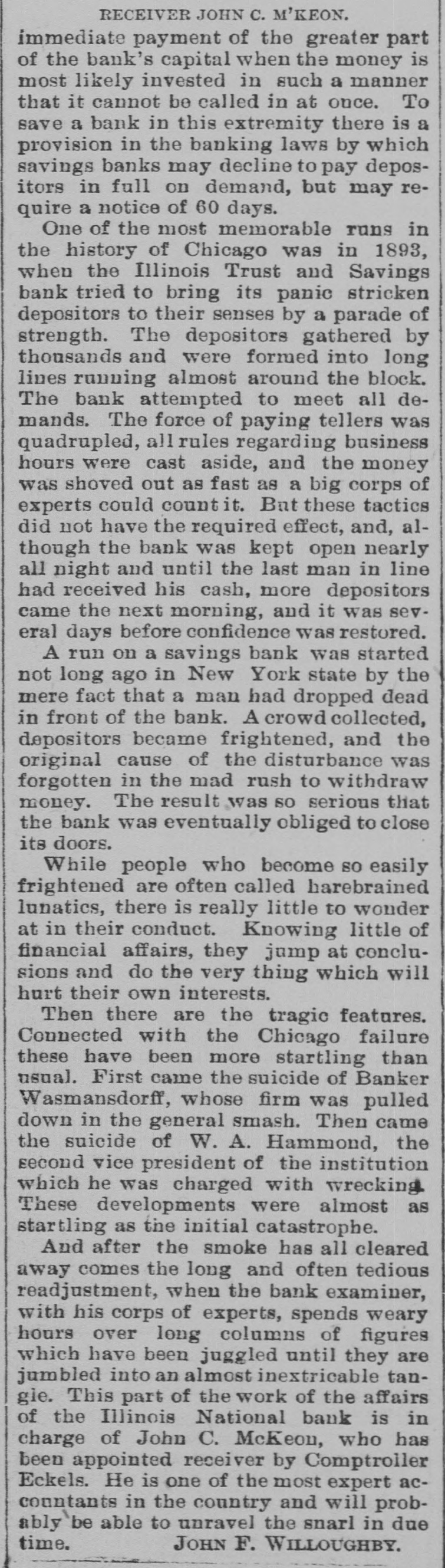
# RECEIVER JOHN C. M'KEON. immediate payment of the greater part of the bank's capital when the money is most likely invested in such a manner that it cannot be called in at once. To save a bank in this extremity there is a provision in the banking laws by which savings banks may decline to pay depositors in full on demand, but may require a notice of 60 days. One of the most memorable runs in the history of Chicago was in 1893, when the Illinois Trust and Savings bank tried to bring its panic stricken depositors to their senses by a parade of strength. The depositors gathered by thousands and were formed into long lines running almost around the block. The bank attempted to meet all demands. The force of paying tellers was quadrupled, all rules regarding business hours were cast aside, and the money was shoved out as fast as a big corps of experts could count it. But these tactics did not have the required effect, and, although the bank was kept open nearly all night and until the last man in line had received his cash, more depositors came the next morning, and it was several days before confidence was restored. A run on a savings bank was started not long ago in New York state by the mere fact that a man had dropped dead in front of the bank. A crowd collected, depositors became frightened, and the original cause of the disturbance was forgotten in the mad rush to withdraw money. The result was so serious that the bank was eventually obliged to close its doors. While people who become so easily frightened are often called harebrained lunatics, there is really little to wonder at in their conduct. Knowing little of financial affairs, they jump at conclusions and do the very thing which will hurt their own interests. Then there are the tragic features. Connected with the Chicago failure these have been more startling than usual. First came the suicide of Banker Wasmansdorff, whose firm was pulled down in the general smash. Then came the suicide of W. A. Hammond, the second vice president of the institution which he was charged with wrecking. These developments were almost as startling as the initial catastrophe. And after the smoke has all cleared away comes the long and often tedious readjustment, when the bank examiner, with his corps of experts, spends weary hours over long columns of figures which have been juggled until they are jumbled into an almost inextricable tangle. This part of the work of the affairs of the Illinois National bank is in charge of John C. McKeon, who has been appointed receiver by Comptroller Eckels. He is one of the most expert accountants in the country and will probably be able to unravel the snarl in due time. JOHN F. WILLOUGHBY.