Article Text
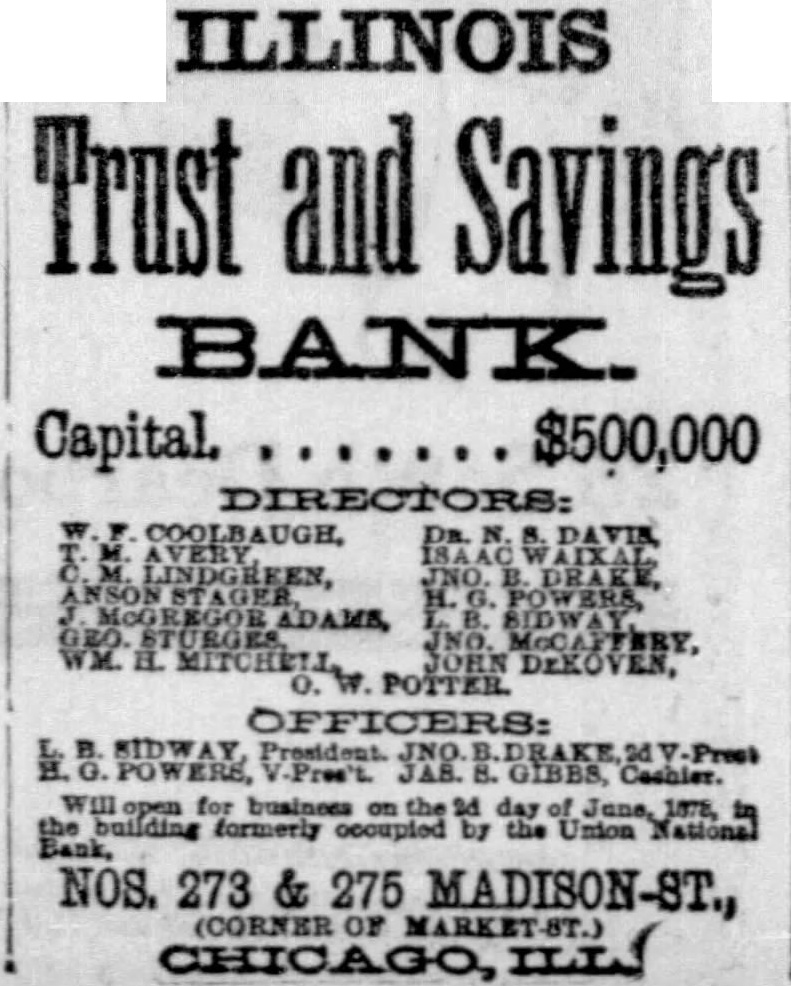
Continued from Page One, pedestrianism and clerking. We had a capital of $500,000, and began business early in 1873. The disastrous panic of that year occurred in October. While the financial and commercial depression was severe in all parts of the United States, It did not become dangerous in Chicago until three years later, when most of the savings banks were driven into bankruptey. We rode the storm in safety, but reduced our capital to $100,000, paying $400,000 back to our shareholders. Of our $1,000,000 in deposits, $600,000 was withdrawn by frightened or needy customers. The bank, SO it seemed to us, was absolutely without a future. "At that dreary period of our history I was cashier, assistant cashier, and bookkeeper, and could do all the work easily. Presently a corner in corn was started by speculators. Every elevator in the city was soon filled, but the corn kept coming. There was an empty elevator on the Chicago and Alton Railroad, and we were asked to act as trustee and to open It for business. I represented the bank in that responsibility. We did well in our stewardship, making money for all interests and $8,000 for ourselves during the two years of our management. Becomes Bank President. "When the capital of the bank was reduced It was agreed that if we could not earn 8 per cent on $100,000 we would Immediately go into liquidation. But we earned considerably more than $8,000 a year, counting the profits we received through our operations of the elevator. The president was in bad health, and being a rich man, the bank to him was rather insignificant. So the directors chose me as his successor, I went into office with the understanding that I could make certain important changes in the bank's policy. No more money, for instance, would be loaned unless it were amply secured by collateral-mere names on notes, no matter how solid, would not be accepted. The rule then adopted has never been modified or suspended. "We have two distinct classes of customers-depositors and borrowers," Mr. Mitchell continued to say. "We specialize in short loans and do not care for those that run for' a year or a longer period. Consequently, our assets have always been liquid, and of such a character as to be quickly turned into money. We now have $58,000,000 out on collateral, we own $20,000,000 of good bonds and stocks that are salable any hour of any day in the week, and we have only $481,000 loaned on real estate. "After Grant and Ward suspended, in May, 1884, money became tight here and elsewhere. Philip D. Armour had recently come to Chicago from Milwaukee. He was doing an extensive business, and his credit was exceptionably good in this part of the country. One day his representative came into my office and asked for a loan of $100,000. After the rate of Interest had been arranged he went away. In & short time he returned with Mr. Armour's note. Name Not Enough. 'But where is your collateral?' I asked. Collateral?' the agent repeated. 'Do you mean to say that Mr. Armour's name is not enough?' 'Mr. Armour's name,' I replied, 'is not enough for the Illinois Trust and Savings Bank. It is our unbroken rule to demand collateral.' 'Let me inform you,' the man shouted as he walked away, 'that Mr. Armour will tell you to go to hades.' "When the agent found Mr. Armour he