City Trust Company (Indianapolis, IN)

Episode Information

Episode UID
20007571570
Episode Type
Suspension โ†’ Closure
Bank Type
trust
Bank ID
2000757 routing
Routing Number
20-0075
Start Date
October 23, 1930
Location
Indianapolis, Indiana (39.768, -86.158)

Metadata

Model
gemini-3-flash-preview (chosen from majority vote of a three-model LLM ensemble)
Short Digest
f89df9dc7b5ce81a

Response Measures

None

Description

The bank closed voluntarily on October 23, 1930, and was subsequently placed in receivership; while other local banks experienced runs, the articles describe this specific closure as voluntary or due to frozen assets rather than a direct run on this institution.

Events (3)

1. October 23, 1930 Suspension
Cause Details
Closed voluntarily by directors; later reports cited frozen assets and insolvency.
Newspaper Excerpt
The City Trust company... closed by the state banking department here this afternoon.
Source
newspapers
2. November 17, 1930 Receivership
Newspaper Excerpt
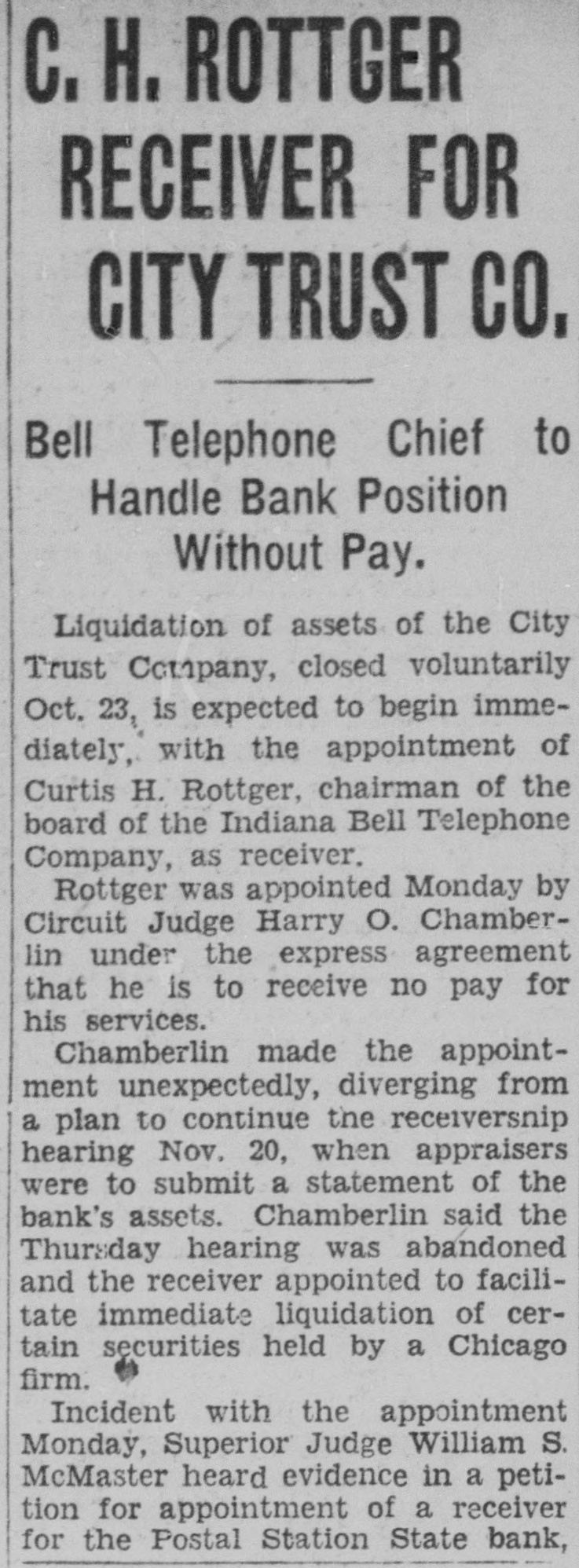
C. H. ROTTGER RECEIVER FOR CITY TRUST CO. ... Liquidation of assets of the City Trust Cotipany, closed voluntarily Oct. 23, is expected to begin immediately
Source
newspapers
3. June 26, 1934 Other
Newspaper Excerpt
ten directors of the bank were sued for $500,000 by Oren S. Hack, receiver, on the ground that illegally they had declared dividends out of the bank's capital and reserve.
Source
newspapers

Newspaper Articles (20)

Article from The Times, October 23, 1930

Click image to open full size in new tab

Article Text

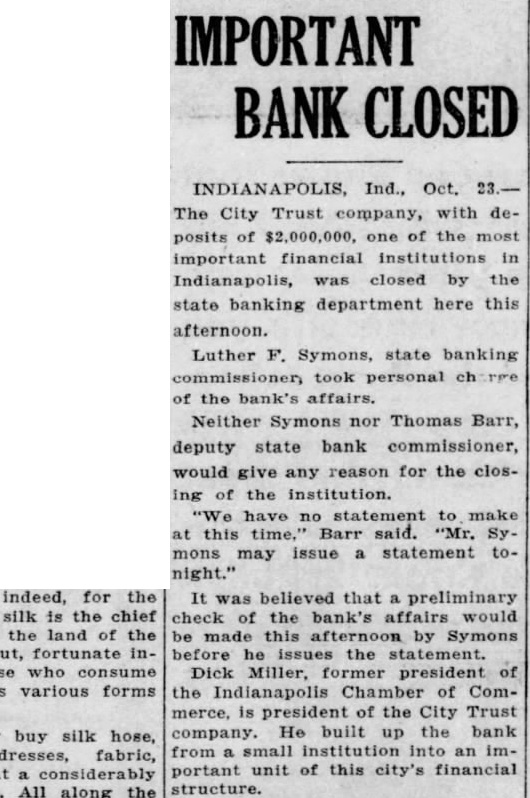
IMPORTANT BANK CLOSED INDIANAPOLIS, Ind., Oct. The City Trust company, with deposits of one of the most important financial institutions in Indianapolis, closed by the state banking department here this afternoon. Luther F. Symons, state banking took personal of the Neither Symons Thomas Barr, deputy state bank commissioner, would reason for the closof the institution. make Barr mons may issue statement night." was believed that preliminary check of the bank's would by before he the Dick Miller, former president of the Indianapolis Chamber Commerce, president of the City Trust company. He built the bank from small institution important unit of this city's financial structure.


Article from The Times, October 23, 1930

Click image to open full size in new tab

Article Text

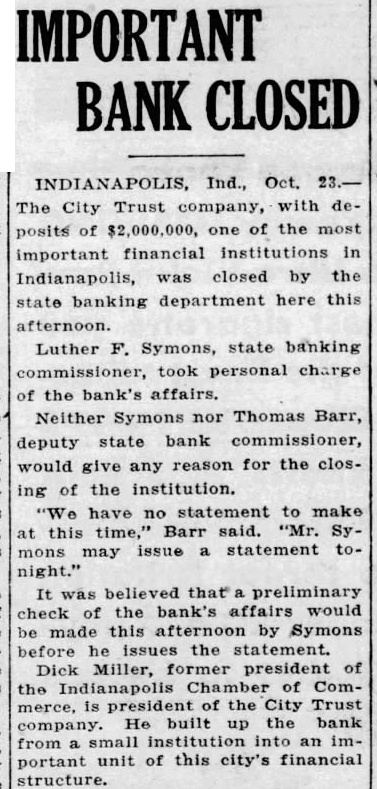
IMPORTANT BANK CLOSED INDIANAPOLIS, Ind., Oct. The City Trust company, with deposits of one of the important financial institutions in closed by the Indianapolis, banking department here this afternoon. Luther F. Symons, state banking commissioner, took charge of the bank's Neither Symons nor Thomas Barr, deputy state bank commissioner, would reason for the closing of the institution. "We no statement to make at this Barr said. Systatement night." It was believed preliminary check the bank's would afternoon by Symons before issues the statement. Dick Miller, president of the Comthe City Trust company. He built up the bank from institution an important unit of this city's financial structure.


Article from Muncie Evening Press, October 28, 1930

Click image to open full size in new tab

Article Text

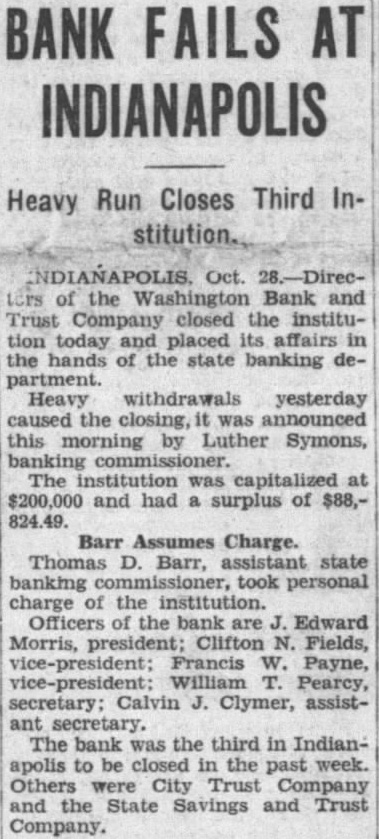
BANK FAILS INDIANAPOLIS Heavy Run Closes Third Oct. of the Washington Bank and Trust Company closed the institution today and placed its affairs the hands of the state banking partment. Heavy withdrawals yesterday caused the closing, was announced this morning by Luther Symons, banking The institution was capitalized and had surplus of Barr Assumes Charge. Thomas Barr, assistant state banking took personal charge of the institution. of the bank are Edward Morris, president; Clifton Fields, Francis Payne, Pearcy, secretary; Calvin Clymer, assistsecretary. The bank was the third in Indianapolis to be closed in the past week. Others City Trust Company and the State Savings and Trust Company.


Article from Franklin Democrat, October 30, 1930

Click image to open full size in new tab

Article Text

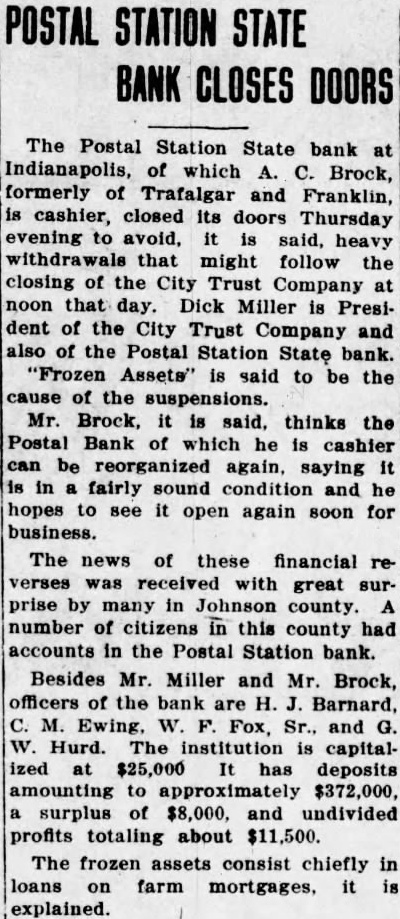
The Postal Station State bank Indianapolis, of which C. Brock, formerly of Trafalgar and Franklin, cashier, closed its doors Thursday evening to avoid, it said, heavy withdrawals that might follow the closing of the City Trust Company noon that day. Dick Miller is President of the City Trust Company and also of the Postal Station State bank. "Frozen Assets" is said to be the cause of the suspensions. Mr. Brock, it is said, thinks the Postal Bank of which he is cashier can be reorganized again, saying in fairly sound condition and he hopes to see it open again soon for business. The news of these financial verses was received with great prise by many in Johnson county. number of citizens in this county had accounts in the Postal Station bank. Besides Mr. Miller and Mr. Brock, officers of the bank are Barnard, M. Ewing, W. Fox, Sr., and Hurd. The institution capitalized at $25,000 has deposits amounting to approximately $372,000, surplus of $8,000. and undivided profits totaling about The frozen assets consist chiefly in loans on farm mortgages, it explained.


Article from The Indianapolis Times, November 6, 1930

Click image to open full size in new tab

Article Text

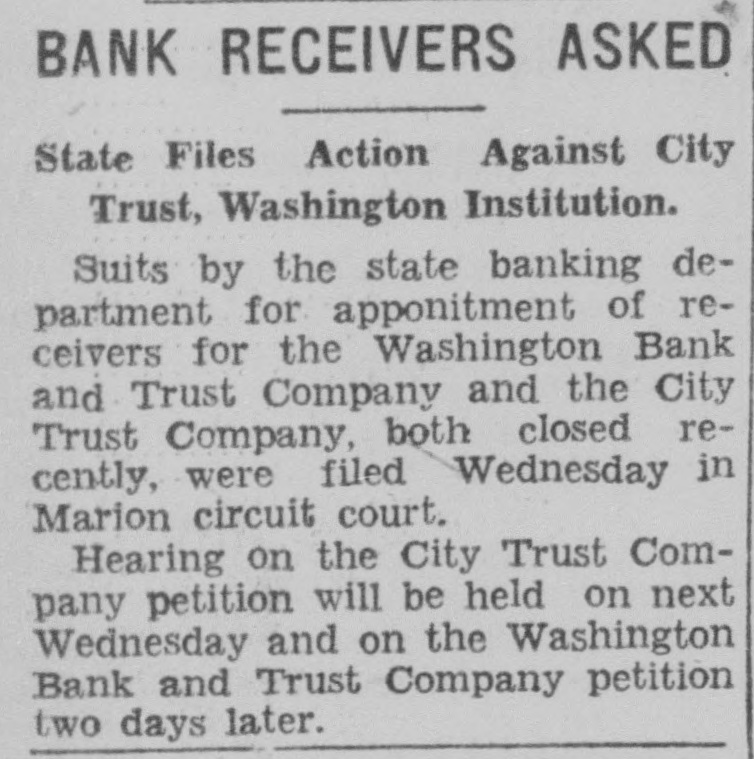
State Files Action Against City Trust, Washington Institution. Suits by the state banking department for apponitment of receivers for the Washington Bank and Trust Company and the City Trust Company. both closed recently. were filed Wednesday in Marion circuit court. Hearing on the City Trust Company petition will be held on next Wednesday and on the Washington Bank and Trust Company petition two days later.


Article from The Indianapolis Star, November 7, 1930

Click image to open full size in new tab

Article Text

TWO BANK RECEIVER SUITS TRANSFERRED An of mystery yesterday rounded the transfer by Luther Symons, banking of two Indianapolis bank receivership suits from Circuit court to other courts. The original petitions filed by deputy attorney general, on behalf the banking asked receivers named the City Trust Company and the Washington Bank and Judge Harry of Cir for hearings petitions and prepared name advisable Mr. Symons and asked that the Symons appeared as his and actions, which were identical with the first Mr. Ogden said the receivership filed without The original petitions Charles Werner, deputy attorney Ogden Agrees Procedure. Judge Chamberlin informed Mr Symons he would not permit dismispetitions without consent The attorney general agreed the procedure and the City Trust Company suit sent Probate the Washington Bank and petition Room Mr. refused discuss the action after paying with his the costs of dismissing the original petitions talk about the matter. declared that make the transfers. Judges both and Superior Room for election Tuesday Judge Chamberlin Circuit court judge The State Trust cuit and the Wild bank receivership Probate


Article from The Indianapolis Times, November 10, 1930

Click image to open full size in new tab

Article Text

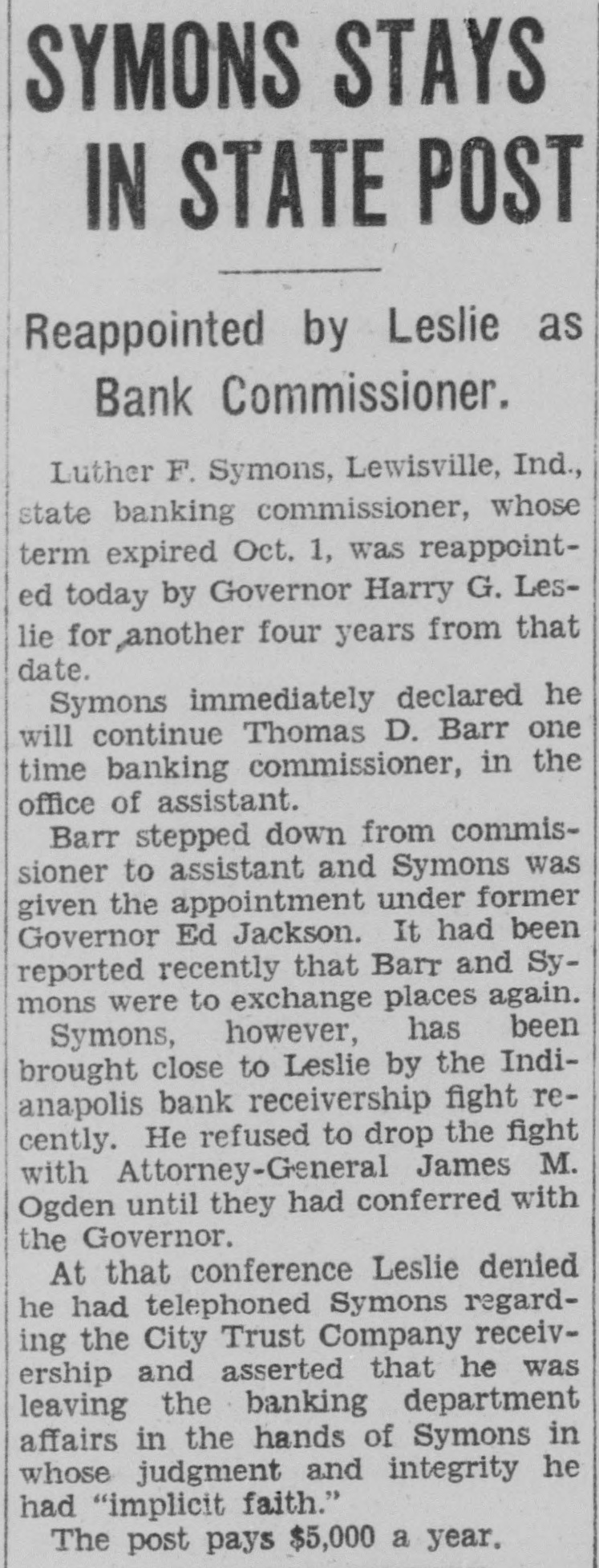
Jess Murden, state highway commissioner and sometimes termed "unofficial Governor of Indiana." Murden denied he had interested himself in the City Trust suit, but Symons previously had confided that Murden had suggested getting the suit before Milner if possible. This also was said to have been suggested by Governor Harry G. Leslie in a telephone conversation with Symons last week. McTurnan, who appeared as Symons' counsel today, is known to have conferred with Thomas D. Barr, Symons' assistant, at Barr's home Friday night. Barr originally was reported to be slated for one of the receiverships, but vigorously denied any such intention. He has been with the department many years and was chief before Symons was appointed by former Governor Ed Jackson. ### Symons' Term Ended Symons' term expired Oct. 1, and Barr was reported in line for the chieftainship again, but Leslie, following his policy, neither reappointed Symons nor appointed any one else to the place. Under these circumstances, the present office holder stays on without reappointment. Affirming jurisdiction of probate court in the appointment of receivers, a jurisdiction questioned by Ogden, Probate Judge Mahlon E. Bash issued a lengthy statement today in defense of his position. The statement cites statutory provisions as well as decisions in superior courts throughout the state. Among them is listed the receivership action against the Tuxedo State bank, which was prosecuted through the probate court and in which Attorney-General Ogden represented a creditor and obtained a judgment on a claim. ### Another Suit Entered Ogden is a director of the defunct City Trust Company. Erve Hanford, attorney, 511 Meyer-Kiser Bank building, contended today that he has a suit for receiver filed in circuit court against the City Trust Company, which takes priority over all of them. It was filed Oct. 29 by Hanford as guardian for Richard Hinton Menges, who had $428.25 in the City Trust bank when it closed. Hanford contends that the state banking department has no exclusive right to ask for a receiver and he wants his suit pressed. Should Barr be given a receivership, he would not be the first graduate of the department to receive one. Two former examiners are receivers in bank suits now pending in the supreme court, the record discloses. ### Parker Is Rebuffed One is Morris E. Stults, receiver for the Studebaker State bank, Bluffton, and the Lynn Grove bank in Wells county, and the other is Kenneth Kunkle, receiver for the Poneto State bank. When the State Savings and Trust bank closed here, Charles R. Parker, clerk in the banking department, is reported to have gone to Governor Leslie to ask if it would be all right for him to be made receiver. The Governor is reported to have said "no," in no uncertain way.


Article from The Indianapolis Times, November 13, 1930

Click image to open full size in new tab

Article Text

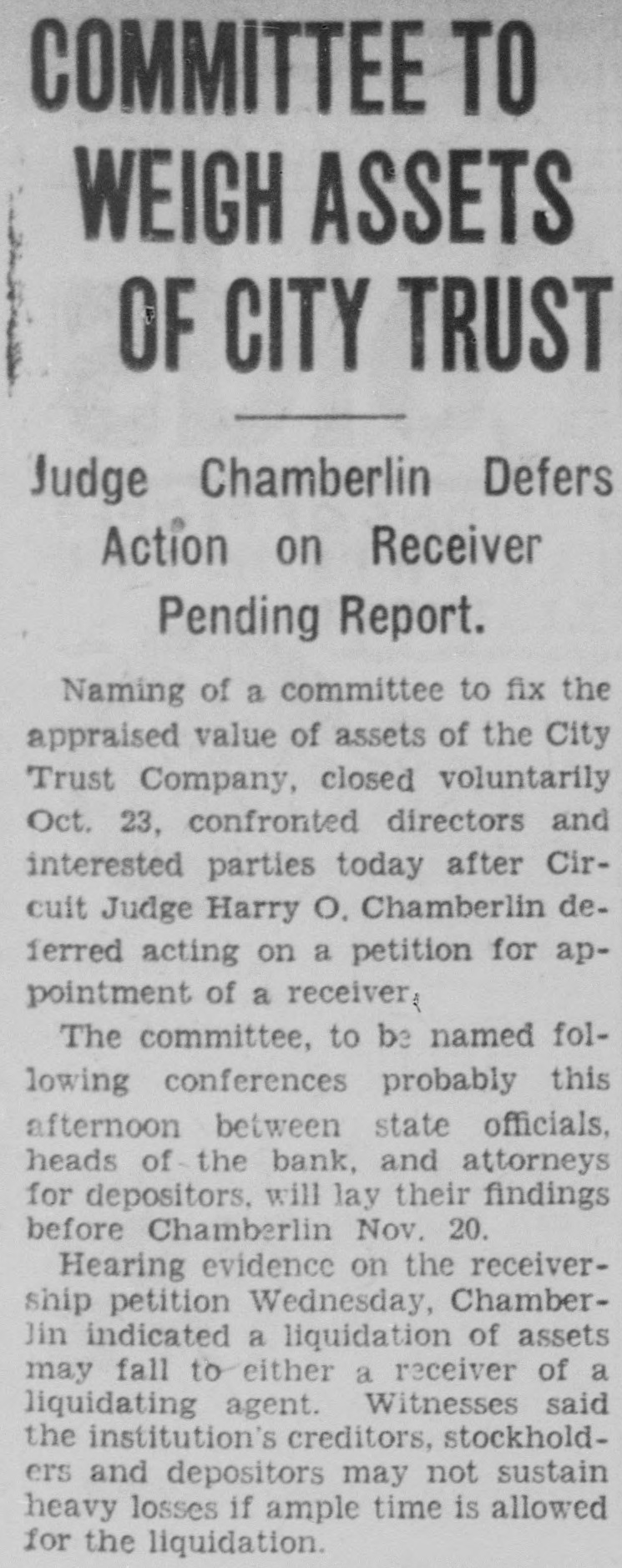
COMMITTEE TO WEIGH ASSETS OF CITY TRUST Judge Chamberlin Defers Action on Receiver Pending Report. Naming of a committee to fix the appraised value of assets of the City Trust Company, closed voluntarily Oct. 23, confronted directors and interested parties today after Circuit Judge Harry O. Chamberlin deferred acting on a petition for appointment of a receiver, The committee, to be named following conferences probably this afternoon between state officials, heads of the bank, and attorneys for depositors, will lay their findings before Chamberlin Nov. 20. Hearing evidence on the receivership petition Wednesday, ChamberJin indicated a liquidation of assets may fall to either a receiver of a liquidating agent. Witnesses said the institution's creditors, stockholders and depositors may not sustain heavy losses if ample time is allowed for the liquidation.


Article from The Indianapolis Star, November 18, 1930

Click image to open full size in new tab

Article Text

BANK RECEIVER. to the financial disadvantage of the Mr. Rottger will take charge of affairs the bank today ney for the receiver probably named within few days. provided bond of Judge McMaster found the Postal subsidiary insolvent after hearing Mr. three examined the bank after it was closed Oct. 23. All told the court the institution was insolvent when closed. Dick Miller, president of the City Trust Company, in an informal statement to the court, declared that officers and directors the that receiver was necessary to give depositors and creditors the highest dividends possible. He the hope that the bank might be organized after receiver is named. Asaccording to Wallace Weatherhold, special deputy bank examiner, were $415,913 assets the same figure bank closed voluntarily by directors. The assets, however, actually were $62,000 than reported by the bank in that certain stocks and bonds were carried 50 to 100 per cent above their actual value, said. Deposits were $340,000. The examiner cited an instance stock issue being valued $15,000 by the bank when the securities were worthless. This was the stock of the City Shareholders Corporation, holding company of the City Trust Company, he Earl Conder, member the law firm of Pickens, Cox, Conder & Bain, named attorney for Brandt Downey, receiver for the Washington Bank and Trust Company. Mr. Downey, financial secretary of the Methodist hospital, was ceiver the Circuit court Saturday Mr. Conder will represent the all legal matters relative to the receivership. JURY PROBES BANK CLOSINGS Further investigation of affairs of the City Trust Company and the Washington Bank and Trust Company will be made the Marion grand jury today. The probe of surrounding the closing of the institutions several days ago was opened by the grand jury yesterday. Four officers and employes of the Washington bank have subpenaed to appear before the jurors today, understood. Good, deputy state bank examiner, charge of the audit the City Trust Company, was in the jury more yesterday and William Rider, deputy charge examination of the City Trust Company, also was before the jury for some time. They were the only witnesses called yesterday. Judson L. Stark, prosecutor. declined discuss investigation other than declare that several persons had laid before him charges of irregularities in conduct of the stitutions.


Article from The Indianapolis Times, November 18, 1930

Click image to open full size in new tab

Article Text

C. H. ROTTGER RECEIVER FOR CITY TRUST CO. Bell Telephone Chief to Handle Bank Position Without Pay. Liquidation of assets of the City Trust Cotipany, closed voluntarily Oct. 23, is expected to begin immediately, with the appointment of Curtis H. Rottger, chairman of the board of the Indiana Bell Telephone Company, as receiver. Rottger was appointed Monday by Circuit Judge Harry O. Chamberlin under the express agreement that he is to receive no pay for his services. Chamberlin made the appointment unexpectedly, diverging from a plan to continue the receiversnip hearing Nov. 20, when appraisers were to submit a statement of the bank's assets. Chamberlin said the Thursday hearing was abandoned and the receiver appointed to facilitate immediate liquidation of certain securities held by a Chicago firm. Incident with the appointment Monday, Superior Judge William S. McMaster heard evidence in a petition for appointment of a receiver for the Postal Station State bank,


Article from The Indianapolis Times, December 17, 1930

Click image to open full size in new tab

Article Text

GRAND JURORS ASK PROBE OF CLOSED BANKS Retiring Group States Quiz of Officers' Liability Is Not Complete. VOTE CHARGES DROPPED No New Evidence Found in Primary Frauds; Lack of Funds Blamed. Recommendation that the 1931 grand jury continue a probe into the recent closing of three Indianapolis banks was made by the retiring Marion county grand jury in a final report to Criminal Judge James A. Collins. The retiring jury has been "unable to determine whether there is any criminal liability on part of the officers" of the bank, it stated in its last report. Banks into which the grand jury "made quite an extended probe" are the State Savings and Trust Company, the City Trust Company, and the Washington Bank and Trust Company, all now in receivership. Disposing of another important issue submitted six months ago for its investigation, the grand jury dropped the primary election fraud probe because, it stated, it was "without provisions for conducting the investigation." Headed by Manifold "This jury has not been able to unearth anything in addition to what the former grand jury rcported," the report stated. The spring grand jury after an extensive investigation under Earl Cox, Democratic attorney, reported the unearthing of "startling instances of graft and corruption," but returned no indictments. It referred the probe to the grand jury which today made its final report to Collins. Submission of the final report marked the end of service of Vinson H. Manifold, attorney and grand jury deputy prosecutor under Prosecutor Judson L. Stark. Manifold has been at the head of grand jury activities for two years, and with the end of his incumbency will enter private law practice. Council Denied Plea On the subject of a probe into the defunct banks, the jury stated: "For the reason that the full value of property therein has not been determined. this jury is unable to determine whether there is any criminal liability on the part of officers of said banks, and this jury would recommend that the next grand jury investigate to ascertain if any such liability exists on the part of said officers." The election probe was dropped because the county council refused to appropriate funds for hiring a special investigator In their verdict on the condition of nine institutions supported by the county, grand jurors made recommendations for several improvements. Particular attention, they stated, should be paid to the relocation of the Marion county infirmary, exposed recently by The Times. Infirmary Too Crowded Their verdict reads. "Investigation shows there are 520 inmates. The institution is crowded far beyond capacity. A portion of the men's building is in good condition, but the old buildings are crowded, and to make a place for a number of people who are there now it was necessary in the men's department to fill all corridors with beds, some of which consist merely of straw mattreses on the floor, not having bedsteads on which to sleep. "It would seem this institution, considering its age, and its dilapidated condition, is about as well cared for and inmates are receiving as good care as can be expected under the circumstances. "The age of the buildings makes it impossible to keep it in the sanitary condition that it should be." Management Lauded The jury found fault with the juvenile detention home, 225-East Michigan street. asserting the county should do all in its power to arrange for new quarters. "The old building is unfitted for the purpose, and it is impossible to keep it clean," the jury stated. Superintendents of seven other institutions were lauded for "excellent management.' The institutions are the Indiana Woman's Prison, the Colored Orphans' Home, the Marion County Tuberculosis hospital at Sunnyside, the Board of Children's Guardians' Home, the Marion County Hospital for the Insane at Julietta and the county jail and courthouse.


Article from The Indianapolis Times, January 14, 1931

Click image to open full size in new tab

Article Text

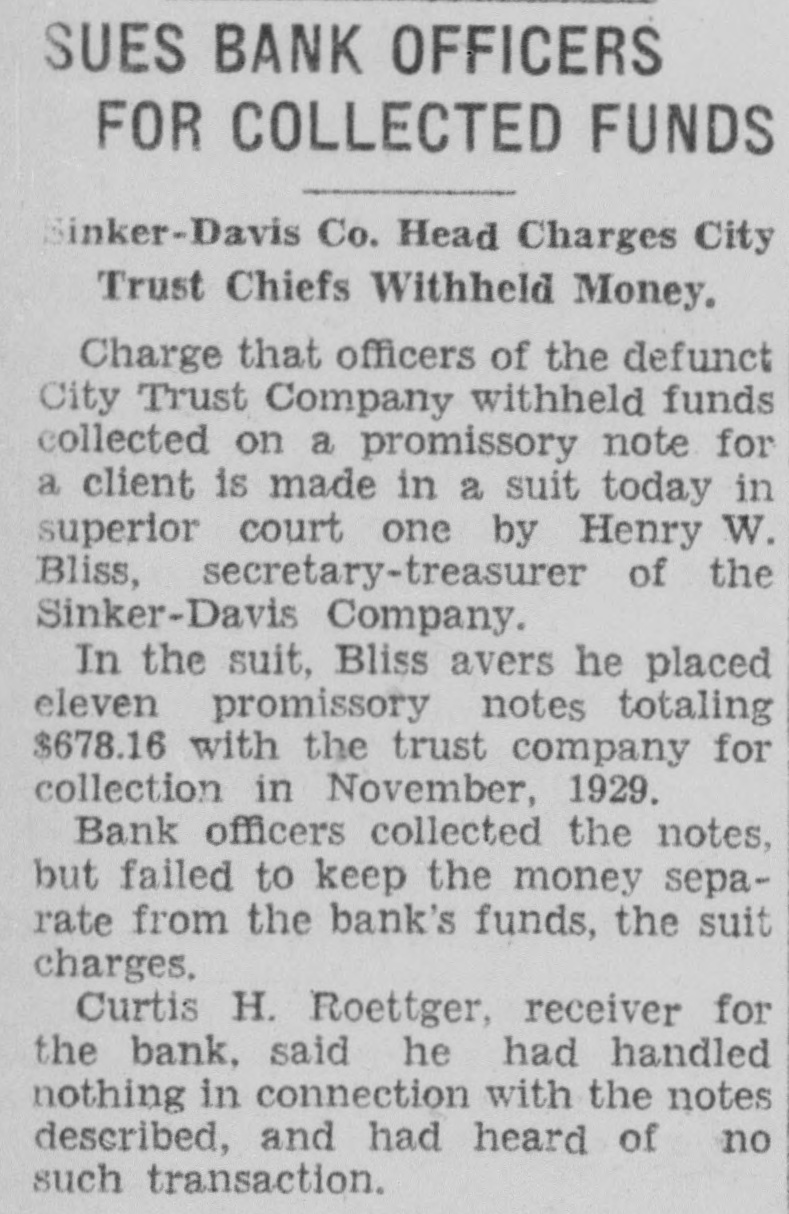
# SUES BANK OFFICERS # FOR COLLECTED FUNDS Sinker-Davis Co. Head Charges City Trust Chiefs Withheld Money. Charge that officers of the defunct City Trust Company withheld funds collected on a promissory note for a client is made in a suit today in superior court one by Henry W. Bliss, secretary-treasurer of the Sinker-Davis Company. In the suit, Bliss avers he placed eleven promissory notes totaling $678.16 with the trust company for collection in November, 1929. Bank officers collected the notes, but failed to keep the money sepa- rate from the bank's funds, the suit charges. Curtis H. Roettger, receiver for the bank, said he had handled nothing in connection with the notes described, and had heard of no such transaction.


Article from The Indianapolis News, January 25, 1933

Click image to open full size in new tab

Article Text

TO AIR BANK AFFAIRS Judge Cox Asserts Much Silence Sur Alleging a "conspiracy of silence' has affairs of closed banks for which receivers have been named in three closed banks in the Marion circuit courts. Judge Earl R. IX said Wednesday closer scrutiny was to be vaid to the operations of the banks' affairs and that current reports would be asked of the receivers, Judge Cox said claim for $200 which had been deposited in the Washington Bank and Trust ComDany only few before it closed its doors would be decreed by him as a preferred the would be ordered returned to the Harrah Coal Company. which deposited the money. The company has sued the bank's receiver for the money preferred claim Judge Cox also has under claim for 900 against the Washington Bank filed by Mrs. Anne Miller who had been given bank cashier's check for that amount was closed. Brandt Downey, receiver for the bank to pay the to the charge crought by Mrs. Miller The court said there is no need for silence in any of the defunct should the to know of being other banks which Judge Cox named are the City Trust and the State Savings and Trust Company


Article from The Indianapolis Times, March 2, 1933

Click image to open full size in new tab

Article Text

Co-Receivers Are Chosen for Three City Banks Homer Elliott and Oren S. Hack Will Replace Trio Who Resigned Posts. Receiverships of three defunct Indianapolis banks were being consolidated receivers. today, following appointment of two local attorneys as coOren S. Hack and Homer Elliott were named to handle affairs of the Washington Bank and Trust Company, the State Savings and Trust Company and the City Trust Company. A


Article from The Richmond Item, February 21, 1934

Click image to open full size in new tab

Article Text

FOUR OFFICERS OF INDIANAPOLIS BANK INDICTED Affidavits Charging Criminal Actions Signed by Bank Receiver INDIANAPOLIS, Feb. 20. (P) Affidavits charging four officials of the defunct Meyer-Kiser bank with criminal actions were presented today to Prosecuting Attorney Herbert E. Wilson by Alvah J. Rucker, special investigator for the circuit court. The affidavits were signed by Thomas Garvin, receiver for the closed bank. The officials named were the president, Sol Meyer, and three vice presidents, Julian J. Kiser, Melvin Cohen and Fred S. Meyer. The affidavits were first placed before Judge P. Baker of the criminal court. Wilson, notified that the affivavits had been prepared, said: "It has not been the spirit of our lawmakers to have the prosecutor file affidavits when the grand jury is in session. The matter is of such grave importance I think it should go before the grand jury. Rucker reported to Circuit Judge Earl R. Cox earlier in the day that he had found ample evidence in the records the bank for prosecution of the officials on felony charges. Rucker at the direction of Judge Cox has been making an investigation of the affairs of several closed banks here including the City Trust, the Washington Bank and Trust and the State Savings and Trust. In his report to Judge Cox Rucker advanced the theory that the active officers of the Meyer-Kiser bank knew of its insolvency before the institution was closed and despite this knowledge continued to accept deposits.


Article from The Indianapolis Times, June 26, 1934

Click image to open full size in new tab

Article Text

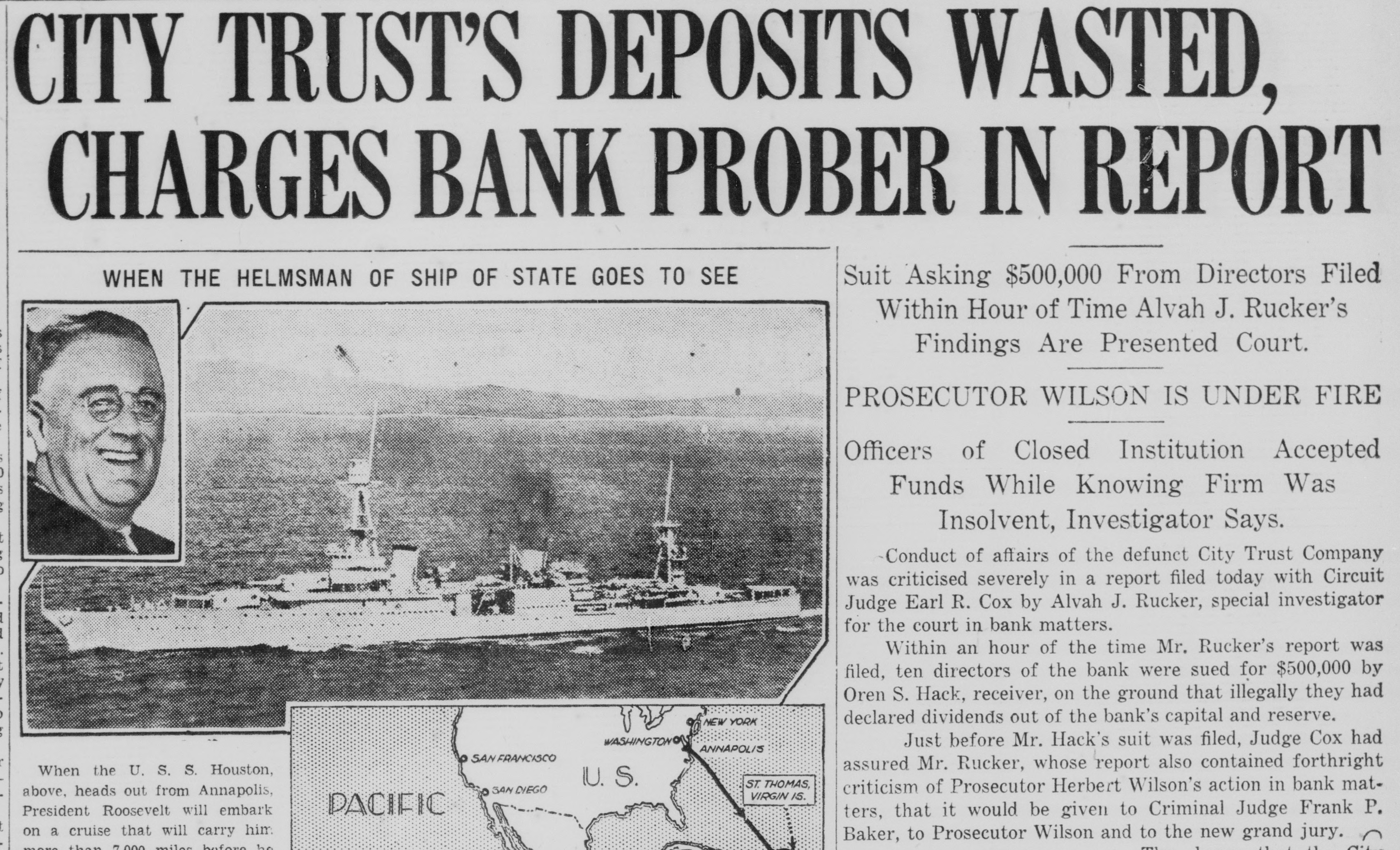
# CITY TRUST'S DEPOSITS WASTED, # CHARGES BANK PROBER IN REPORT WHEN THE HELMSMAN OF SHIP OF STATE GOES TO SEE When the U. S. S. Houston, above, heads out from Annapolis, President Roosevelt will embark on a cruise that will carry him more than 7,000 miles before be- Suit Asking $500,000 From Directors Filed Within Hour of Time Alvah J. Rucker's Findings Are Presented Court. # PROSECUTOR WILSON IS UNDER FIRE Officers of Closed Institution Accepted Funds While Knowing Firm Was Insolvent, Investigator Says. Conduct of affairs of the defunct City Trust Company was criticised severely in a report filed today with Circuit Judge Earl R. Cox by Alvah J. Rucker, special investigator for the court in bank matters. Within an hour of the time Mr. Rucker's report was filed, ten directors of the bank were sued for $500,000 by Oren S. Hack, receiver, on the ground that illegally they had declared dividends out of the bank's capital and reserve. Just before Mr. Hack's suit was filed, Judge Cox had assured Mr. Rucker, whose report also contained forthright criticism of Prosecutor Herbert Wilson's action in bank matters, that it would be given to Criminal Judge Frank P. Baker, to Prosecutor Wilson and to the new grand jury.


Article from The Indianapolis Times, June 26, 1934

Click image to open full size in new tab

Article Text

CITY TRUST'S FUNDS WASTED, SAYS PROBER Prosecutor Wilson Under Fire in Report Filed by Alvah Rucker. (Continued from Page One) gave a judgment in favor of the plaintiffs in a large sum. "On Oct. 22, 1930. the sum of $20,913.78 was deposited in the bank and on the next day the sum of $9,089.72 was SO deposited. All deposits after 10:30 a. m., Oct. 23, 1930, were after banking hours of that day and after it closed, were returned to the depositors making the same Incidentally the sums SO returned were preferences and could be recovered by the receiver from the individuals." Mr Rucker charges the bank was $731,910.73 "in the red at the time it closed its doors. "The company therefore clearly was insolvent when it suspended," the report asserts. The circuit court's investigator then points out Section 2479 of the state statutes as making it fraud and embezzement to receive deposits after insolvency of a bank is assured. "In cases such as these, it is advisable that criminal charges, if returned, should be drawn for conspiracy to violate Section 2479. A charge of conspiracy," says the report, "may be wider in scope and more free from certain technical objections than a specific charge involving only one matter and one person. "Here a conspiracy charge if brought. should allege the union to take the deposits of certain persons stating the names of as many as are known, and the public generally. Rulings Are Cited Comment on this phase of indictments was taken by some as a direct slap at the indictments in the Meyer-Kiser bank case which charge specific transactions instead of a blanket charge as proposed by Mr Rucker's report He cites numerous rulings showing that manual receiving of deposits after a bank has closed its doors is not necessary in the charge of conspiracy to defraud A prosecuting official," continues the report, "who would refuse to indict upon the ground that manual receiving was a requisite, might perpetrate a kindred faux pas in indicting some one for embezzling money or in charging him with appropriating funds to his own use when actually he had appropriated them to the use of another Time Wasted, He Asserts Mr Rucker relates how affidavits which he prepared in the MeyerKiser case had been termed faulty and how later he sent witnesses at "great cost" to various parts of the country to appraise properties. He tells how those witnesses were heard in the Meyer-Kiser case by the grand jury "Then," continues the report, "to the surprise of all. the prosecuting attorney's office drew indictments on an incident only in reference to the Meyer-Kiser bank. wasting the time of your officers, the appraisers, the grand jurors, and I fear of every one concerned or to be concerned with them. 'Why the intrinsic charge should be set aside for an incident, not at all peculiar to banking corporations in general, after all the evidence was or should have been heard by the grand jury on an intrinsic banking offense, seems incomprehensible. No excuse (apparently referring to the prosecutor's office) seems ever to have been offered. "It is my earnest wish that these bank matters, wherein 30,000 to 40.000 of our people have lost their lifelong savings be honestly, fearlessly and tenaciously investigated.' Pleads for Courage "I have reached the stage in life." adds the report, "that I do not care whether a prosecuting attorney or any officer is a Democrat or Republican. My only insistence is that he be an upright representative of the people and not a poltroon or a coward. "There is no reason." further adds the report to the court, "that the present incumbent in the office of prosecuting attorney (Mr. Wilson) is unequal to his aforesaid predecessors. Mistakes have been made, but they can be rectified easily.' The report ends with praise for Judge Cox and his continuous pressing of investigations of defunct banks of Marion county Wilson Makes Reply In reply to the attacks on him. Prosecutor Wilson said: "The grand jury will be glad to receive any facts regarding bank cases in the circuit court at any time Mr. Rucker or the court will present them. It was my understanding with Judge Cox that the grand jury would receive the results of any investigation "In the Meyer-Kiser case, the grand jury viewed all testimony presented by Mr. Rucker and his associates. The exact form of the affidavits filed by Mr. Rucker was used with the exception of a slight change in preparation of indictments." The ten directors named in Mr. Hack's $500,000 suit are Mr. Miller, Mr. Garman. Mr. Kelly, Mr. Murphy, Mr. Peterson, Mr. Richardson, John T. Van Zant, Arthur C. Ayres, James M. Ogden and William F. Fox


Article from The Indianapolis Times, June 29, 1934

Click image to open full size in new tab

Article Text

CITY TRUST TO ISSUE DIVIDEND OF 5 PER CENT Court Indicates Approval of Proposal Suggested by by Receiver. Depositors and creditors of the defunct City Trust Company will receive a 5 per cent dividend this fall, Oren S. Hack, receiver, announced today. Mr. Hack, in a report filed with Circuit Judge Earl R. Cox petitioned the court to allow the dividend. It will be the first paid by any of the major Indianapolis banks in receivership in circuit court. The receiver explained that because of court adjournment for the summer and becausce hearings must be held on preferred claims in circuit court in September, the dividend checks will not be issued until Nov. 15. General depositors and creditors will be paid the 5 per cent dividend,


Article from The Indianapolis Times, June 30, 1934

Click image to open full size in new tab

Article Text

# CITY TRUST COMPANY # RECEIVER'S SON SHOT John Hack Wounded by Bullet Fired at Sick Rabbit. John Hack, 23, son of Mr. and Mrs. Oren S. Hack, living near Boggstown, was seriously wounded yesterday when a bullet fired at a sick pet rabbit ricocheted from a rock and struck Mr. Hack, penetrating his upper right lung. He was taken to the Major hospital in Shelbyville, and later was brought to Methodist hospital here. X-ray pictures showed the bullet had lodged in his back. Oren S. Hack, father of the young man, is receiver for the City Trust Company.


Article from The Indianapolis Times, December 23, 1935

Click image to open full size in new tab

Article Text

3 DEFUNCT CITY BANKS DECLARE YULE DIVIDENDS $141,000 Is Distributed to Depositors in Time for Christmas. Depositors of three defunct Indianapolis banks have received Christmas presents of dividends in excess of $141,000, it was announced today by the receivers. The City Trust Co. declared a 5 per cent dividend amounting to $80,000 last Saturday, Oren S. Hack, receiver, said. A similar dividend payment was made in October, 1934. The Aetna Trust & Savings Co., declared a 7ยฝ per cent dividend amounting to $60,000 last month, officials said. A 2 per cent dividend was paid this week by Maple-rd State Bank, E. Kirk McKinney, receiver, said. The amount paid was $1534 and brings the total dividend payment up to 39ยฝ per cent. Litigation prohibits the. Washington State Savings & Trust Co., Farmers Trust Co. and Meyer-Kiser Bank from declaring dividends at this time, receivers said. Receivers for the J. F. Wild & Co. State Bank and State Savings & Trust saw no prospect of dividend payments, and the Belmont State Bank anticipates a dividend payment soon after the holidays.