City Trust Company (Indianapolis, IN)

Episode Information

Episode UID
20007571564
Episode Type
Suspension โ†’ Closure
Bank Type
trust
Bank ID
2000757 routing
Routing Number
20-0075
Start Date
April 18, 1930
Location
Indianapolis, Indiana (39.768, -86.158)

Metadata

Model
gpt-5-mini (chosen from majority vote of a three-model LLM ensemble)
Short Digest
c015e413a113d36a

Response Measures

None

Description

Closure clearly permanent with receivership and criminal charges; exact closing date ambiguous in these articles.

Events (2)

1. April 18, 1930 Suspension
Cause
Bank Specific Adverse Info
Cause Details
Bank was insolvent (claims of insolvency since 1928), illegal dividends and heavy bad loans; alleged embezzlement by officers.
Newspaper Excerpt
that there no cash value to the sets on Oct. and for at least several months theretofore Frantic efforts were made by the officers to borrow from $100,000 to $150,000 on them... when it closed Mr. Rucker said
Source
newspapers
2. February 6, 1933 Receivership
Newspaper Excerpt
Continuation of the probe... regarding the affairs of defunct city banks and receivership... Washington Bank and Trust Company, the State Savings and Trust Company and the City Trust Company, all of which are closed and in receivership.
Source
newspapers

Newspaper Articles (18)

Article from The Indianapolis Times, February 6, 1933

Click image to open full size in new tab

Article Text

BANKING QUIZ DELAYED Other Court Matters to Be Disposed of First, Cox Announces. Continuation of the probe instituted by Circuit Judge Earl R. Cox regarding the affairs of defunct city banks and receivership will be delayed until disposal of other court matters, Cox said today. In rapid succession last week Cox heard twelve cases involving the Washington Bank and Trust Company, the State Savings and Trust Company and the City Trust Company, all of which are closed and in receivership.


Article Text

Closed Bank Head Admits Loaning Without Security Testimony that officials of the defunct City Trust Company, prior to its made huge loans to enterprise which they were interested, in hands of. Circuit Judge Earl R Cox today. Dick Miller. Trust president. chief witness Wednesday's probe of defunct banks. admitted the bank carried loan of $159,000 on its books The money was advanced to finance construction the Postal Station bank building in this city, according to testimony. Cox Miller concerning deals with D. Brown, postal station bank in promotion and sale of stock for erection the and in negopost in cities. The bank president's testimony ended a hearing in suit brought by Brown against Curtis H. ger, City Trust Company receiver Cox ordered attorneys to file briefs, he would fix date for final arguments in the case within few days. matter fact wasn't the holding the bag for 000 for which had no liability until settlement in April. 1927?" Cox asked Miller. 'Yes, that is right,' Miller replied.


Article from The Indianapolis Times, February 17, 1933

Click image to open full size in new tab

Article Text

Washington Bank and Trust Company, the City Trust Company and the State Savings and Trust Company, evidence before Cox discloses. Cox, who proposes to consolidate receivership as an economy move, said he will seek to preserve remaining assets of these defunct banks. "It has not been good business sense to continue operation of receiverships for a long period," Cox declared. "My conference with receivers have disclosed," he continued, "that they postponed liquidation because they thought business conditions would improve. Instead, cash reserves of the banks gradually are disappearing." Several banks are loaded more heavily with real estate now than when they collapsed, although receivers hoped to sell much of this burden by waiting, receivers' reports indicate. Many parcels of real estate have returned to the banks because buyers have been unable to continue payments. More than a quarter million Times readers read the Wan


Article from The Indianapolis Times, March 2, 1933

Click image to open full size in new tab

Article Text

Co-Receivers Are Chosen for Three City Banks Homer Elliott and Oren S. Hack Will Replace Trio Who Resigned Posts. Receiverships of three defunct Indianapolis banks were being consolidated receivers. today, following appointment of two local attorneys as coOren S. Hack and Homer Elliott were named to handle affairs of the Washington Bank and Trust Company, the State Savings and Trust Company and the City Trust Company. A


Article from The Indianapolis Times, April 21, 1933

Click image to open full size in new tab

Article Text

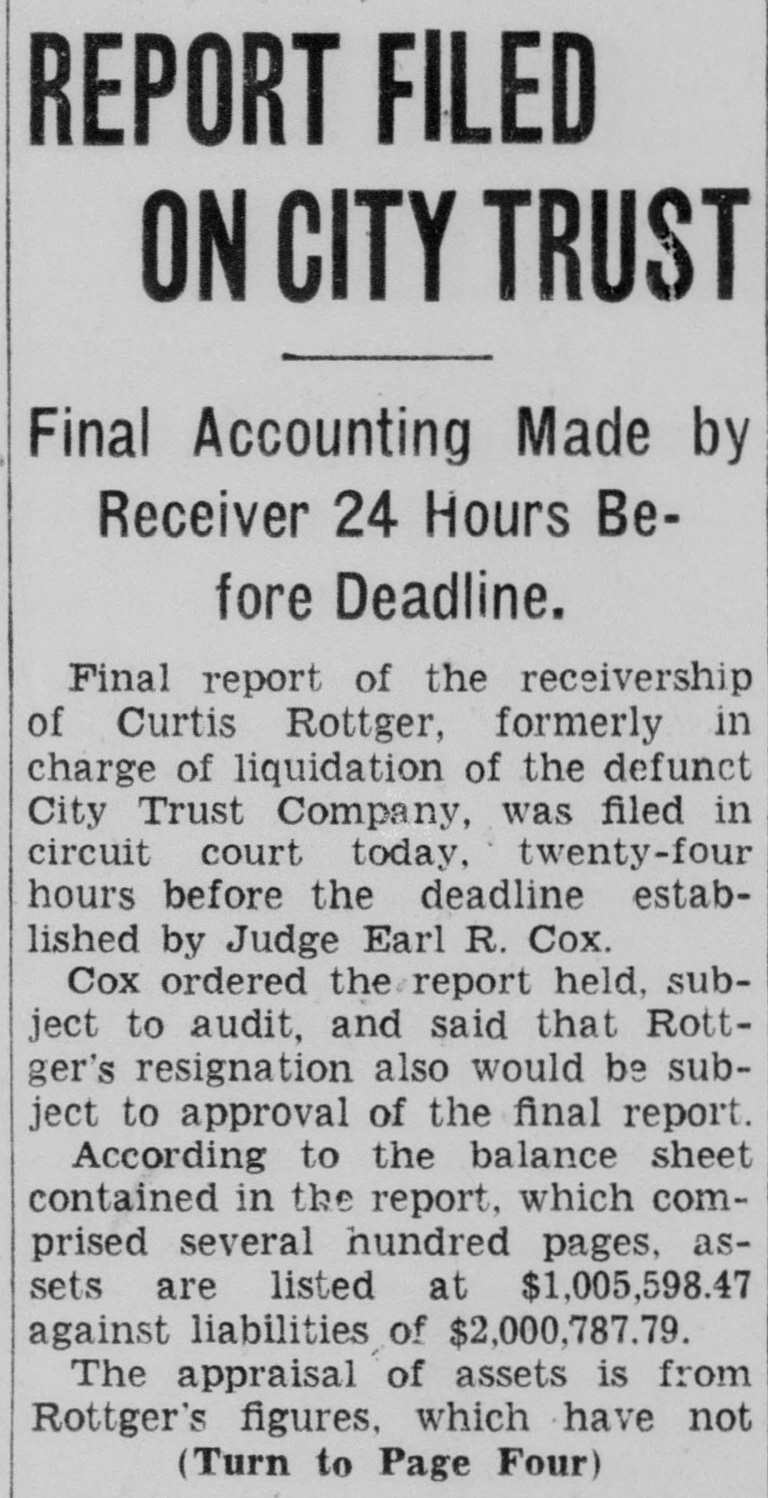
# REPORT FILED # ON CITY TRUST Final Accounting Made by Receiver 24 Hours Before Deadline. Final report of the receivership of Curtis Rottger, formerly in charge of liquidation of the defunct City Trust Company, was filed in circuit court today, twenty-four hours before the deadline established by Judge Earl R. Cox. Cox ordered the report held, subject to audit, and said that Rottger's resignation also would be subject to approval of the final report. According to the balance sheet contained in the report, which comprised several hundred pages, assets are listed at $1,005,598.47 against liabilities of $2,000,787.79. The appraisal of assets is from Rottger's figures, which have not (Turn to Page Four)


Article from The Indianapolis Times, April 25, 1933

Click image to open full size in new tab

Article Text

# Assets Are Low Reports filed by former receivers of the State Savings and Trust Company, Washington Bank and Trust Company, and City Trust Company reveal little cash, with principal assets represented by real (Turn to Page Five)


Article from The Indianapolis Times, May 8, 1933

Click image to open full size in new tab

Article Text

Filing of final report by Brandt C. Downey, former receiver of the Washington Bank and Trust Company, opened the way for an audit of his records of twenty-eight months' operation. The report now is being audited by the court. Operating expense of more than $111,000 was reported by Downey, which, with operating expense of the City Trust Company under Curtis Rottger, brought the cost of receiverships, as listed in final reports, to more than $200,000. Finding that expense of liquidating the Meyer-Kiser bank during less than a two-year period had reached approximately $232,000, Thomas E. Garvin, new receiver, slashed the cost more than $2,500 monthly last Saturday. Garvin, former judge in municipal court one, was appointed by Cox Thursday and assumed his new duties Friday. The following day he


Article from The Indianapolis Times, February 20, 1934

Click image to open full size in new tab

Article Text

EMBEZZLING CHARGED TO BANK HEADS Four Officials of Defunct Meyer-Kiser Firm Are Named. THREE AFFIDAVITS FILED Bank Insolvent Since 1928, Is Claim: Casualty Company Sued. Three affidavits charging four former officials of the defunct Meyer-Kiser bank with criminal actions were signed by Thomas Garvin, bank receiver, in circuit court today. From circuit court, the affidavits were sent to criminal court, and eventually they reached the hands of Prosecutor Herbert E. Wilson, who indicated he thought the charges properly should be gone into by the grand jury, but promised to consider the affidavits in the next few days The affidavits were submitted to Circuit Judge Earl R Cox by Alvah J. Rucker. special investigator in affairs of banks in receivership. following the reading in court today of a lengthy partial report disclosing evidence obtained by Mr. Rucker in a five-months' probe into the bank's operations. Defendants named in the affidavits are Sol Meyer, president, and Julian J. Kiser. Melvin Cohn and Ferd S. Meyer, vice-presidents. Casualty Company Sued The affidavits charge the former officials of the bank with conspiring to accept deposits in an insolvent institution, with accepting deposits in an insolvent institution. and with embezzling funds from the bank. Launching criminal action followed by a few hours a civil suit against the Fidelity and Casualty Company of New York. seeking to recover approximately $1,250,000 on bonds of the four former officials of the Meyer-Kiser bank. This suit was filed by the receiver under direction of Judge Cox. It charged the officers dissipated large sums of money through "dishonest acts" and failure to perform their duties as officers and directors for which they were bonded. They were charged with making unauthorized loans, contributing the bank's funds to the Meyer-Kiser Bank Realty Company, and transferring $119,358 of the bank's funds to the Meyer-Kiser bank of Miami. Fla. Other Banks Probed The court action is the result of five months' investigation of circumstances of the closing of the Mever-Kiser bank. together with those of the Washington Bank and Trust Company, City Trust Company and State Savings and Trust Company. At the conclusion of the report. which Judge Cox interrupted frequently to ask questions and make pungent comments, the court instructed Mr. Garvin to sign the affidavits, then sent them to Criminal Judge Frank P. Baker, with the comment that now the investigation had passed from hands of circuit court into that of criminal court. "If our banking institutions are in bankruptcy because of the depression," said Judge Baker, when the matter was taken before him. "that is one thing. but if any of these banks have been looted, that is another matter." Urges Immediate Action He took the affidavits before Prosecutor Wilson, who commented he felt the bank case should be taken up by the grand jury He agreed to study the matter for the next few days. with the view of signing the affidavits with Mr. Garvin. Mr. Rucker previously had stated that after spending five months times in preparing the evidence, he saw no reason for expending further time and money on a grand jury investigation 'We prepared the affidavits to avoid the waste of time that would be entailed in a grand jury investigation," he said. $2,357,521 Shrinkage Shown The report explains charges included in the affidavits and outlines an appraisal of assets of the bank just completed by Albert E. Uhl. John Roberts and Russell W. Lookabill, Indianapolis, and Harold Phipps and John Fox. Gary. Shrinkage of $2,357,521.97 in the assets of the bank is disclosed by the appraisal. it is alleged. It is pointed out that assets of the bank, carried at a book value of $3,004.003.82 by officers of the bank. have been appraised at only $646,511.85 leaving depositors small hope of salvaging dividend. It is charged in the embezzlement affidavit prepared that bank officials took $18,000 of the bank's funds to pay dividends of a defunct subsidiary. Another of the affidavits sets out that the bank was insolvent since 1928, with knowledge of the defendants. The action in preparing affidavits is believed to have been based on the fact that the Marion county grand jury failed to return indictments when evidence in the Washington bank and the State Savings
Article Text

FOUR OFFICERS OF INDIANAPOLIS BANK INDICTED Affidavits Charging Criminal Actions Signed by Bank Receiver INDIANAPOLIS, Feb. 20. (P) Affidavits charging four officials of the defunct Meyer-Kiser bank with criminal actions were presented today to Prosecuting Attorney Herbert E. Wilson by Alvah J. Rucker, special investigator for the circuit court. The affidavits were signed by Thomas Garvin, receiver for the closed bank. The officials named were the president, Sol Meyer, and three vice presidents, Julian J. Kiser, Melvin Cohen and Fred S. Meyer. The affidavits were first placed before Judge P. Baker of the criminal court. Wilson, notified that the affivavits had been prepared, said: "It has not been the spirit of our lawmakers to have the prosecutor file affidavits when the grand jury is in session. The matter is of such grave importance I think it should go before the grand jury. Rucker reported to Circuit Judge Earl R. Cox earlier in the day that he had found ample evidence in the records the bank for prosecution of the officials on felony charges. Rucker at the direction of Judge Cox has been making an investigation of the affairs of several closed banks here including the City Trust, the Washington Bank and Trust and the State Savings and Trust. In his report to Judge Cox Rucker advanced the theory that the active officers of the Meyer-Kiser bank knew of its insolvency before the institution was closed and despite this knowledge continued to accept deposits.


Article from The Indianapolis Times, June 15, 1934

Click image to open full size in new tab

Article Text

COX ASKS REPORTS ON DEFUNCT BANKS Probability of Dividends Is Sought. Letters asking receivers of four Indianapolis banks in receivership to inform the court as to the probability of early dividends for depositors were sent yesterday by Circuit Judge Earl R. Cox. Judge Cox asserted that bank depositors are entitled to know whether they are going to receive any dividends soon. Banks in receivership in circuit court are the Washington Bank and Trust Company, City Trust Company, State Savings and Trust Company and the Meyer-Kiser bank.


Article Text

Lash Officials of City Trust CONCLUDED FROM PAGE ONE. when it closed Mr. Rucker said and he quoted from the decision of the Appellate Court as follows: eighteen months before the trust company was closed its cash reserve had been averaging from to 10 per cent of the aggregate amount of demand and time deposits instead of the 151 per cent required by law This was matter general discussion at directors meetings and among the officers of the trust company During this entire time its being gradually The officers of the trust company were cognizant of these on April 18, 1930 he continued "the minutes the that there no cash value to the sets on Oct. and for at least several months theretofore Frantic efforts were made by the officers to borrow from $100,000 to $150,000 on them. but no No banker thought enough of them to advance that although the assets were listed books as being worth more than $2,000,000. Dick Miller Bank President Dick Miller was president of the bank when it closed its doors, and other controlling officers were Dwight A. Murphy, vice president and secretary J. Dwight Peterson. vice president C. Milton Kelly, vice president and treasurer and Earl H. Richardson and Harry O. Garman, Mr Rucker reviewed the alleged refusal of Prosecutor Wilson to present the of by Meyer Kiser officials to the grand jury, and again suggested that the Criminal Court judge might appoint special nothing he it be demonstrated that while the bandit punished inside bandit goes free then there would be remedy The statute of not begin to run any bank case fore On when judge and prosecuting sworn the evidence may be presented as well as now. Alleges Dividends Illegal. The Hack suit asks $500,000 from the officers and directors of the City Trust Company alleging that in 1928. 1929 and 1930 the bank declared dividends cash and stock illegally. The defendants are Mr. Miller, Mr Garman, Mr. Kelly Mr. Mr. Murphy, Mr Richardson and James M. Ogden, John T. A. B. Ayres and William F. Fox.


Article from The Indianapolis Times, June 29, 1934

Click image to open full size in new tab

Article Text

CITY TRUST TO ISSUE DIVIDEND OF 5 PER CENT Court Indicates Approval of Proposal Suggested by by Receiver. Depositors and creditors of the defunct City Trust Company will receive a 5 per cent dividend this fall, Oren S. Hack, receiver, announced today. Mr. Hack, in a report filed with Circuit Judge Earl R. Cox petitioned the court to allow the dividend. It will be the first paid by any of the major Indianapolis banks in receivership in circuit court. The receiver explained that because of court adjournment for the summer and becausce hearings must be held on preferred claims in circuit court in September, the dividend checks will not be issued until Nov. 15. General depositors and creditors will be paid the 5 per cent dividend,


Article from The Indianapolis Times, June 30, 1934

Click image to open full size in new tab

Article Text

# CITY TRUST COMPANY # RECEIVER'S SON SHOT John Hack Wounded by Bullet Fired at Sick Rabbit. John Hack, 23, son of Mr. and Mrs. Oren S. Hack, living near Boggstown, was seriously wounded yesterday when a bullet fired at a sick pet rabbit ricocheted from a rock and struck Mr. Hack, penetrating his upper right lung. He was taken to the Major hospital in Shelbyville, and later was brought to Methodist hospital here. X-ray pictures showed the bullet had lodged in his back. Oren S. Hack, father of the young man, is receiver for the City Trust Company.


Article Text

NAME RINEHART, MILLER, MEYER IN AFFIDAVITS Officials of Defunct City Banks Charged With Accepting Deposits Knowing Institutions Were Insolvent. BONDS ARE FIXED BY JUDGE BAKER Capias Warrants Are Issued for Arrest of Trio After Filing of Counts in Criminal Court. Dick Miller, president of the defunct City Trust Co.; Mark V. Rinehart, vice president and director of the wrecked Washington Bank and Trust Co., and Sol S. Meyer, president of the closed Meyer-Kiser bank, were charged today, by affidavit, with the embezzlement of deposits. The affidavits, presented in the Marion County Criminal Court by Prosecutor Herbert M. Spencer and signed by John F. Dugan, investigator for the prosecutor's office, culminated months of effort in probing closed banks in Indianapolis by grand juries and special investigators. Criminal Judge Frank P. Baker fixed bonds on the charges at $15,000 for Mr. Miller and Mr. Rinehart and $5000 for Mr. Meyer who is now out on a $15,000 bond in connection with a similar charge. Capias warrants were issued for the arrest of the three bankers. Extradition proceedings to bring Mr. Meyer back to this city from his home in Miami, Fla., and Mr. Rinehart from his residence in Louisville, Ky., will be started next week, Prosecutor Spencer said. Mr. Miller has been reported ill at his home, 3130 N. Delaware-st. The three affidavits are identical in that they charge each former bank officer with accepting deposits with the knowledge that each of the banks was insolvent on or about the date of the closing of the three institutions.


Article Text

THREE MORE CITY BANKERS ARE CHARGED WITH EMBEZZLEMENT Miller, Meyer and Rinehart Accepted Cash Deposits Knowing Institutions Were Solvent, Affidavits Allege. BONDS ARE FIXED BY JUDGE BAKER Capias Warrants Are Issued for Arrest of Trio After Filing of Counts in Criminal Court. Dick Miller, president of the defunct City Trust Co.; Mark V. Rinehart, vice president and director of the wrecked Washington Bank and Trust Co., and Sol S. Meyer, president of the closed Meyer-Kiser bank, were charged today, by affidavit, with the embezzlement of deposits. The affidavits, presented in the Marion County Criminal Court by Prosecutor Herbert M. Spencer and signed by John F. Dugan, investigator for the prosecutor's office, culminated months of effort in probing closed banks in Indianapolis by grand juries and special investigators.


Article Text

Affidavit, charging embezzlement of deposit, was filed today in Marion County Criminal Court against Dick Miller, president of the defunct City Trust Co. Mr. Miller was one of three former bankers against whom affidavits were sworn to today.


Article from The Indianapolis Times, December 14, 1935

Click image to open full size in new tab

Article Text

CITY BANK RECEIVER PAYS OUT $80,000 Depositors to Receive Payment on Monday. Approximately $80,000 is to be distributed today to the more than 4000 depositors of the defunct City Trust Co., Oren S. Hack, receiver, declared. This payment represents a 5 per cent dividend and will go to all depositors, both common and preferred. No additional dividend will be given to preferred creditors at this time. This is the second dividend distributed by Mr. Hack. Last November a 5 per cent dividend totaling approximately $80,000 was paid with an additional 3 per cent totaling about $17,000 being given to preferred creditors. The checks are to be placed in the mails this afternoon, Mr. Hack announced.


Article Text

All Seem To Have Turned Over Cash To Noteholders Before Closing. When J. W. Carpenter, receiver of the Citizens National, Howard National and Russiaville National banks, was shown a press dispatch from Indianapolis, stating that a superior court judge there had just held that where money had been left in banks to pay notes and the banks had closed before the noteholders had been paid, the note-makers and not the banks are liable for the payment, he said he knew of not a single case of the kind in any of the receiverships he is handling. This statement was made by Mr. Carpenter after he conferred with a member of his clerical staff who was in service during much of the receivership of Frank W. Bryant, who held the position nearly four years. This assistant said he had never heard of a case of the kind in connection with the administration of the affairs of any of the closed banks here, and felt reasonably confident there had been none. It would seem therefore that, despite the fact the press dispatch says the decision, should it be sustained on appeal, would affect millions of dollars in Indiana, no cases of the kind are likely to come to light here. In other words, it would seem that in instances in which money was left with local banks to be paid to noteholders, the latter, in all instances, received their money before the banks were closed. Text of Press Dispatch. The press dispatch received by the Tribune on the Indianapolis judge's decision is as follows: "Superior Judge Herbert E. Wilson in a decision today held that where banks closed their doors before paying noteholders money deposited for such notes, the original maker of the note and not the closed bank is liable for payment. "The decision, which affects millions of dollars in Indiana, is expected to be appealed to the state supreme court. "Judge Wilson said his ruling was contrary to decisions in Michigan, Florida and Kansas but supported by the Iowa supreme court. "The case concerns the Seymour National bank, administrator of the estate of James M. Shields, which brought suit against the Commercial Credit company. Shields had bought a note issued by the defendant company and backed by pledged paper held by the City Trust Company of Indianapolis as trustee. "When the note became due the finance company paid to the bank a sufficient sum to meet the payment, but before the note was presented for payment, the City Trust Company failed. "The ruling in the case was in behalf of the plaintiff."