Washington Bank & Trust Company (Indianapolis, IN)

Episode Information

Episode UID
20006371570
Episode Type
Run โ†’ Suspension โ†’ Closure
Bank Type
trust
Bank ID
2000637 routing
Routing Number
20-0063
Start Date
October 27, 1930
Location
Indianapolis, Indiana (39.768, -86.158)

Metadata

Model
gpt-5-mini (chosen from majority vote of a three-model LLM ensemble)
Short Digest
38c74769d801c233

Response Measures

None

Description

Directors voted to place the bank in state hands after heavy withdrawals; receiver later appointed.

Events (3)

1. October 27, 1930 Run
Cause
Local Banks
Cause Details
Heavy withdrawals following recent downtown bank closings in Indianapolis produced a run on the Washington Bank and Trust.
Measures
Directors canvassed situation and decided to voluntarily place affairs in hands of state banking department to protect depositors.
Newspaper Excerpt
heavy withdrawal of deposits during the day...heavy withdraws Monday caused the closing
Source
newspapers
2. October 28, 1930 Suspension
Cause
Voluntary Liquidation
Cause Details
Directors voted to go into voluntary liquidation and asked the state banking department to take charge after the heavy withdrawals.
Newspaper Excerpt
closed the institution today and placed its affairs in the hands of the state banking department
Source
newspapers
3. November 15, 1930 Receivership
Newspaper Excerpt
Brandt C. Downey...was appointed receiver of the Washington Bank and Trust Company by Circuit Judge Harry O. Chamberlin.
Source
newspapers

Newspaper Articles (21)

Article from The Indianapolis Times, October 28, 1930

Click image to open full size in new tab

Article Text

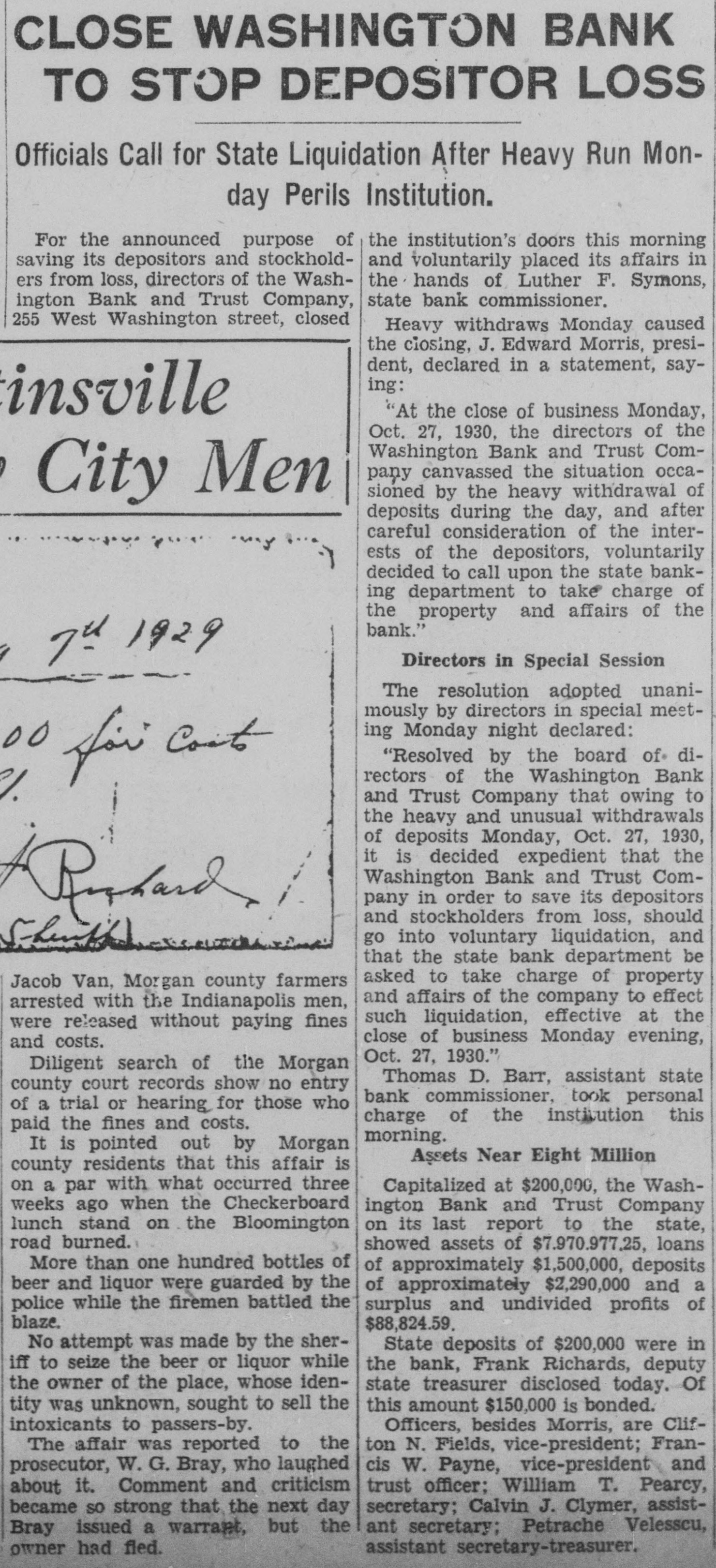
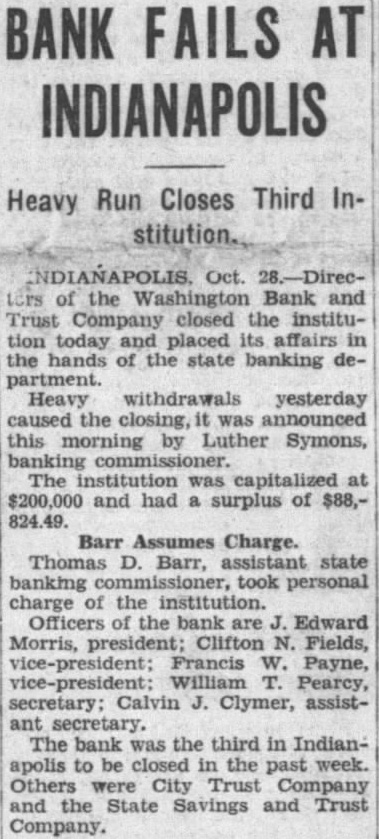
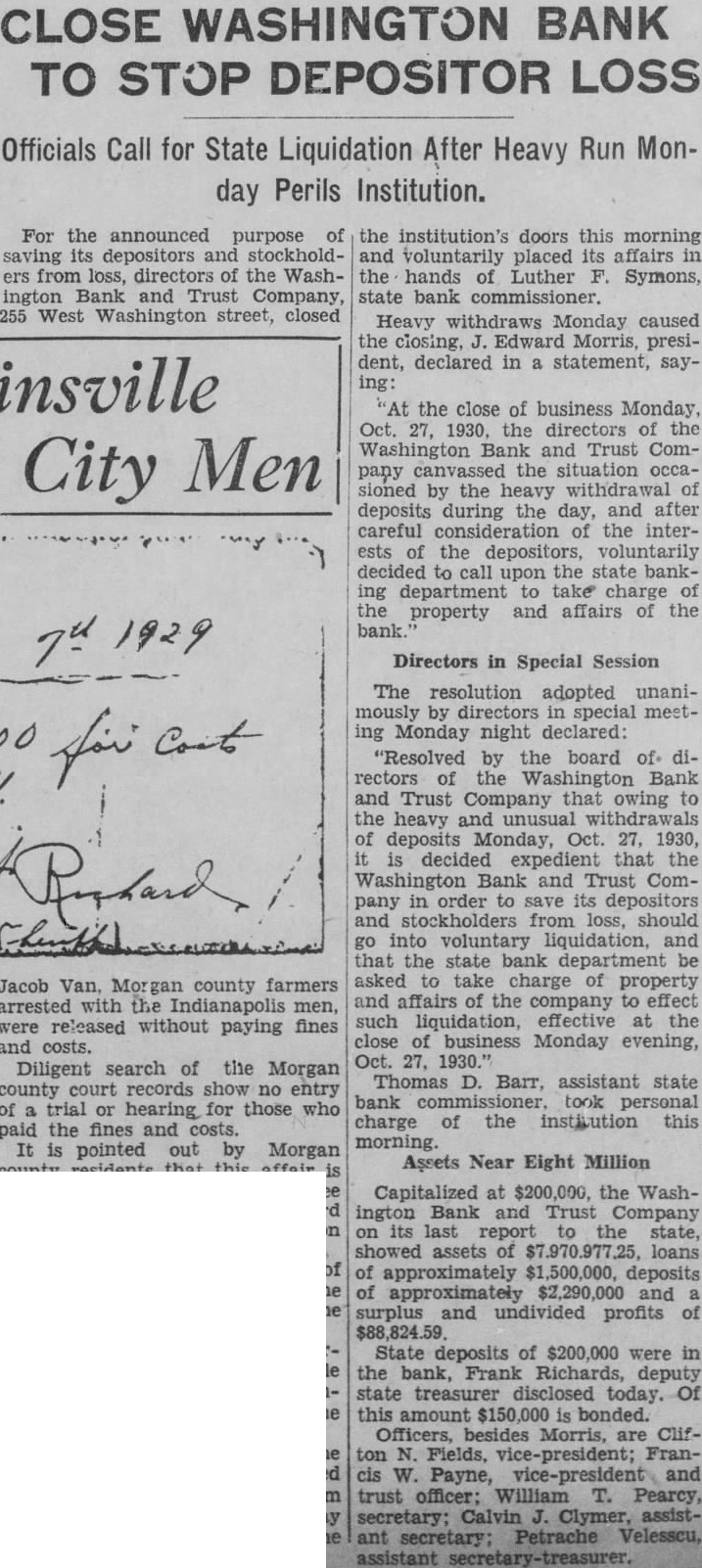
CLOSE WASHINGTON BANK TO STOP DEPOSITOR LOSS Officials Call for State Liquidation After Heavy Run Monday Perils Institution. For the announced purpose of the institution's doors this morning saving its depositors and stockholdand voluntarily placed its affairs in ers from loss, directors of the Washthe hands of Luther F. Symons, state bank commissioner. ington Bank and Trust Company, 255 West Washington street, closed Heavy withdraws Monday caused the closing, J. Edward Morris, president, declared in a statement, saying: insville "At the close of business Monday, Oct. 27, 1930, the directors of the Washington Bank and Trust Company canvassed the situation occasioned by the heavy withdrawal of City Men deposits during the day, and after careful consideration of the interests of the depositors, voluntarily decided to call upon the state banking department to take charge of the property and affairs of the bank." 7th 1929 Directors in Special Session The resolution adopted unanimously by directors in special meeting Monday night declared: "Resolved by the board of directors of the Washington Bank for Cost and Trust Company that owing to the heavy and unusual withdrawals of deposits Monday, Oct. 27, 1930, it is decided expedient that the Washington Bank and Trust Company in order to save its depositors and stockholders from loss, should Rishard go into voluntary liquidation, and that the state bank department be asked to take charge of property Jacob Van, Morgan county farmers and affairs of the company to effect arrested with the Indianapolis men, such liquidation, effective at the were released without paying fines close of business Monday evening, and costs. Oct. 27, 1930." Diligent search of the Morgan Thomas D. Barr, assistant state county court records show no entry bank commissioner, took personal of a trial or hearing for those who charge of the institution this paid the fines and costs. morning. It is pointed out by Morgan Assets Near Eight Million county residents that this affair is on a par with what occurred three Capitalized at $200,000, the Washweeks ago when the Checkerboard ington Bank and Trust Company lunch stand on the Bloomington on its last report to the state, road burned. showed assets of $7.970.977,25, loans More than one hundred bottles of of approximately $1,500,000, deposits beer and liquor were guarded by the of approximately $2,290,000 and a police while the firemen battled the surplus and undivided profits of blaze. $88,824.59. No attempt was made by the sherState deposits of $200,000 were in iff to seize the beer or liquor while the bank, Frank Richards, deputy the owner of the place, whose idenstate treasurer disclosed today. Of tity was unknown, sought to sell the this amount $150,000 is bonded. Officers, besides Morris, are Clifintoxicants to passers-by. ton N. Fields, vice-president; FranThe affair was reported to the prosecutor, W. G. Bray, who laughed cis W. Payne, vice-president and trust officer: William T. Pearcy, about it. Comment and criticism secretary; Calvin J. Clymer, assistbecame so strong that the next day ant secretary; Petrache Velesscu, Bray issued a warrant, but the assistant secretary-treasurer. owner had fled.
Article from Muncie Evening Press, October 28, 1930

Click image to open full size in new tab

Article Text

BANK FAILS INDIANAPOLIS Heavy Run Closes Third Oct. of the Washington Bank and Trust Company closed the institution today and placed its affairs the hands of the state banking partment. Heavy withdrawals yesterday caused the closing, was announced this morning by Luther Symons, banking The institution was capitalized and had surplus of Barr Assumes Charge. Thomas Barr, assistant state banking took personal charge of the institution. of the bank are Edward Morris, president; Clifton Fields, Francis Payne, Pearcy, secretary; Calvin Clymer, assistsecretary. The bank was the third in Indianapolis to be closed in the past week. Others City Trust Company and the State Savings and Trust Company.


Article from The Indianapolis Times, October 28, 1930

Click image to open full size in new tab

Article Text

CLOSE WASHINGTON BANK TO STOP DEPOSITOR LOSS Officials Call for State Liquidation After Heavy Run Monday Perils Institution. For the announced purpose of depositors and from the Washand Trust Company, West Washington street, closed the institution's doors this morning voluntarily placed its affairs the hands Luther Symons, state bank Heavy withdraws caused the Morris president, declared in statement, say- the close of business Monday, 1930, the the Washington Company the occasioned by the deposits during the day, and after careful the interthe depositors, decided call the state bankdepartment property and affairs of the Directors in Special Session The resolution adopted unanimously directors special meeting Monday night declared: "Resolved by the board rectors Washington Bank and Trust Company that owing to the heavy and unusual deposits Monday, 27, 1930, expedient that the Washington and Trust Company in order to its depositors from should voluntary and state department be asked charge of and affairs effect liquidation, effective the close of business Monday evening, Oct. 1930." Thomas D. Barr, assistant state bank personal charge of the institution this morning. Assets Near Eight Million Capitalized $200,000, the Washington Bank Trust Company report state, showed assets approximately $1,500,000, deposits approximately $2,290,000 and surplus and undivided profits State deposits of were the bank, Frank Richards, deputy state today. this amount $150,000 bonded. Morris, Clifton Fields, FranPayne, and trust officer: William Pearcy, Calvin assistPetrache Velesscu,


Article from The Spokesman-Review, October 29, 1930

Click image to open full size in new tab

Article Text

HEAVY RUNS CLOSE BANK $7,970,977 Institution Third to Fall Town Washington Bank and Trust pany of Indianapolis its doors Failure this tution other banks last week. They were the company and the Postal Station State Luther state bankin the last few responsible for the closing the Washington bank. Symons said the was According its report, it had assets of $7,970,977.


Article from Franklin Democrat, October 30, 1930

Click image to open full size in new tab

Article Text

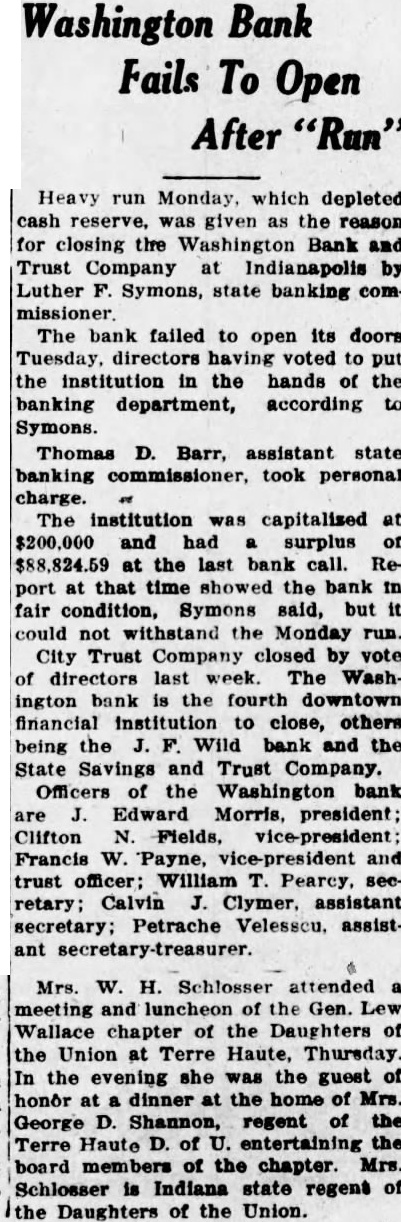
Washington Fails To "Run" Heavy run Monday, which depleted cash was given as the reason for closing the Washington Bank and Trust Company at Indianapolis by Luther Symons, state banking commissioner. The bank failed to open its doors Tuesday, directors having voted to put the institution in the hands of the banking department, according to Symons. Thomas D. Barr, assistant state banking commissioner, took personal charge. The institution was capitalised at $200,000 and had surplus $88,824.59 at the last bank call. Report at that time showed the bank in fair condition, Symons said, but could not withstand the Monday run. City Trust Company closed by vote of directors last week. The Washington bank is the fourth downtown financial institution to close, others being the Wild bank and the State Savings and Trust Company. Officers the Washington bank Edward Morris, president: Clifton Fields, Francis W. Payne, and trust officer; William Pearcy, secretary; Calvin assistant secretary; Petrache assist- Mrs. W. H. Schlosser attended meeting and luncheon of the Gen. Lew Wallace chapter of the Daughters of the Union at Terre Haute, Thursday. In the evening she was the guest of honor at dinner the home of Mrs. George Shannon, regent of the Terre Haute D. of U. entertaining the board members of the chapter. Mrs. Schlosser is Indiana state regent of Daughters of the Union.


Article from The Indianapolis Times, November 4, 1930

Click image to open full size in new tab

Article Text

# SECOND SUIT FOR BANK RECEIVERSHIP FILED Appointment Is Asked for Washington Trust Co. by Iva P. Heeb. Appointment of a receiver for the Washington Bank and Trust Company, closed voluntarily Oct. 29, is asked in a suit filed Monday in superior court one by Iva P. Heeb, a depositor. Second receivership suit filed against the company since its closing, the petition charges the bank is unable to pay $125 Heeb had on deposit at the time of closing. The state banking department probably will file a receivership suit against the bank this week in circuit court, taking precedence over other suits.


Article from The Indianapolis Times, November 10, 1930

Click image to open full size in new tab

Article Text

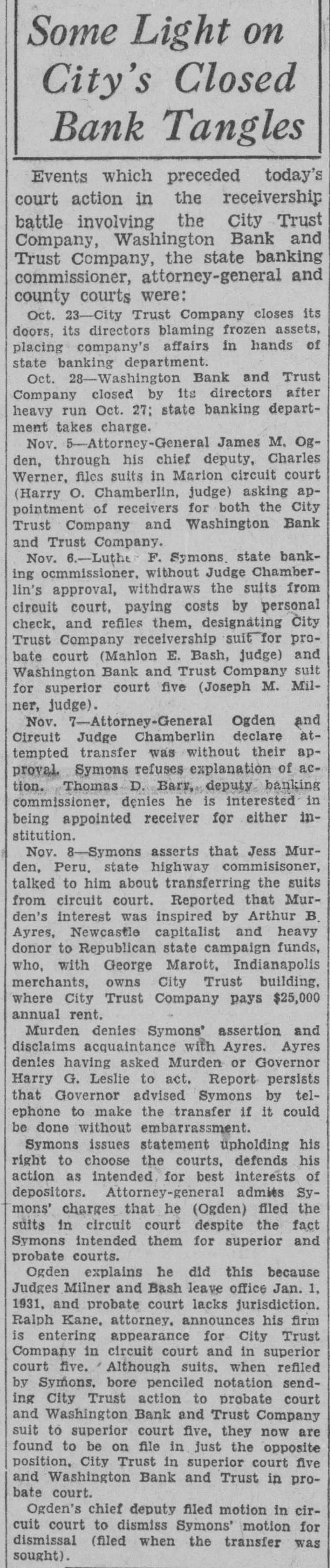
Some Light on City's Closed Bank Tangles Events which preceded today's court action in the receivership battle involving the City Trust Company, Washington Bank and Trust Company, the state banking commissioner, attorney-general and county courts were: Oct. 23-City Trust Company closes its doors, its directors blaming frozen assets, placing company's affairs in hands of state banking department. Oct. 28-Washington Bank and Trust Company closed by its directors after heavy run Oct. 27; state banking department takes charge. Nov. 5-Attorney-General James M. Ogden, through his chief deputy, Charles Werner, files suits in Marion circuit court (Harry O. Chamberlin, judge) asking appointment of receivers for both the City Trust Company and Washington Bank and Trust Company. Nov. 6.-Luthe F. Symons. state banking ocmmissioner, without Judge Chamberlin's approval, withdraws the suits from circuit court. paying costs by personal check, and refiles them, designating City Trust Company receivership suit for probate court (Mahlon E. Bash, judge) and Washington Bank and Trust Company suit for superior court five (Joseph M. Milner, judge). Nov. 7-Attorney-General Ogden and Circuit Judge Chamberlin declare attempted transfer was without their approval. Symons refuses explanation of action. Thomas D. Barr, deputy banking commissioner, denies he is interested in being appointed receiver for either institution. Nov. 8-Symons asserts that Jess Murden, Peru. state highway commisisoner, talked to him about transferring the suits from circuit court. Reported that Murden's interest was inspired by Arthur B. Ayres, Newcastle capitalist and heavy donor to Republican state campaign funds, who, with George Marott, Indianapolis merchants, owns City Trust building, where City Trust Company pays $25,000 annual rent. Murden denies Symons assertion and disclaims acquaintance with Ayres. Ayres denies having asked Murden or Governor Harry G. Leslie to act. Report persists that Governor advised Symons by telephone to make the transfer if it could be done without embarrassment. Symons issues statement upholding his right to choose the courts, defends his action as intended for best interests of depositors. Attorney-general admits Symons' charges that he (Ogden) filed the suits in circuit court despite the fact Symons intended them for superior and probate courts. Ogden explains he did this because Judges Milner and Bash leave office Jan. 1, 1931, and probate court lacks jurisdiction. Ralph Kane. attorney. announces his firm is entering appearance for City Trust Company in circuit court and in superior court five. Although suits. when refiled by Symons. bore penciled notation sending City Trust action to probate court and Washington Bank and Trust Company suit to superior court five, they now are found to be on file in just the opposite position, City Trust in superior court five and Washington Bank and Trust in probate court. Ogden's chief deputy filed motion in circuit court to dismiss Symons' motion for dismissal (filed when the transfer was sought).


Article from The Indianapolis Times, November 14, 1930

Click image to open full size in new tab

Article Text

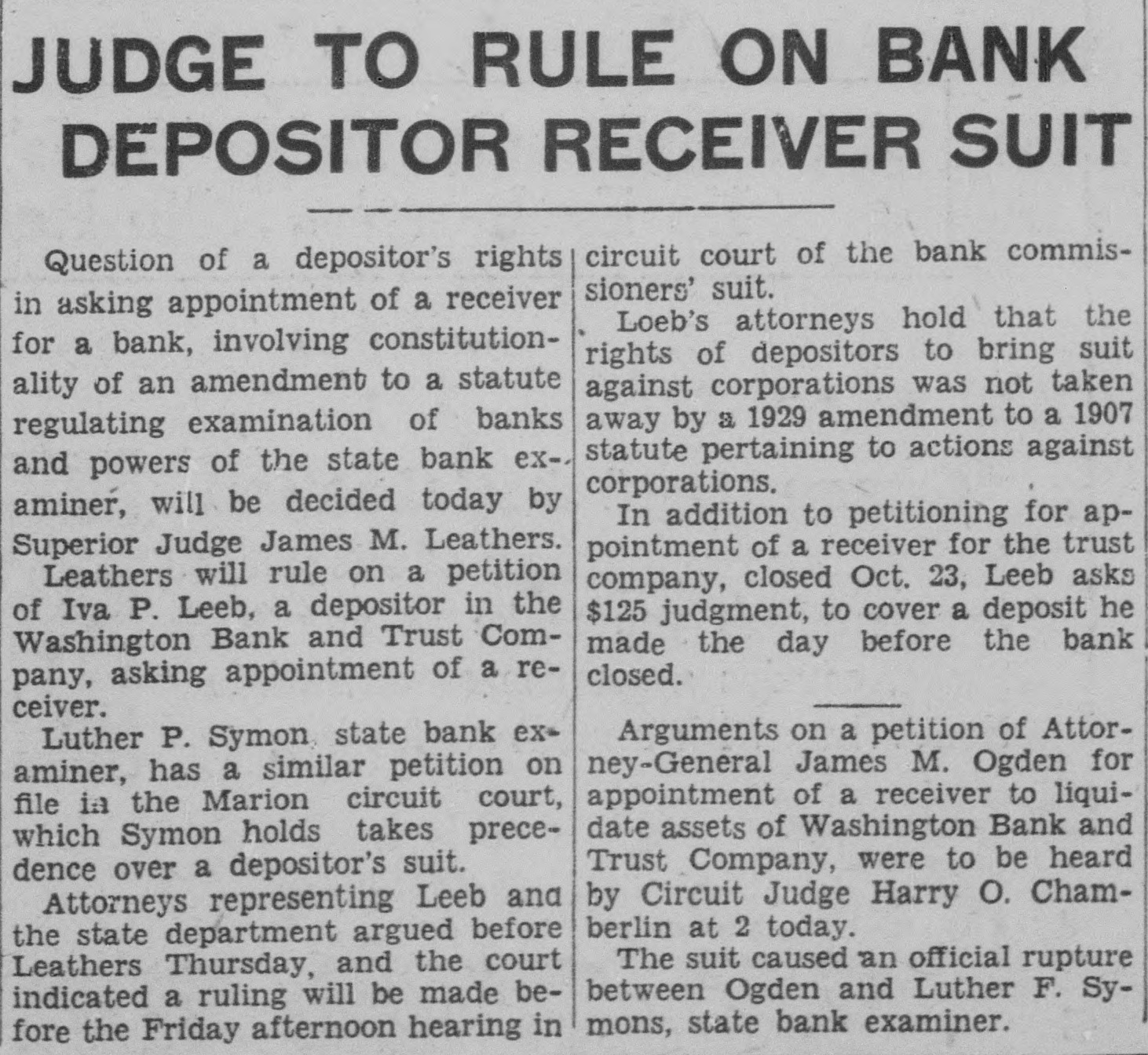
JUDGE TO RULE ON BANK DEPOSITOR RECEIVER SUIT circuit court of the bank commisQuestion of a depositor's rights sioners' suit. in asking appointment of a receiver Loeb's attorneys hold that the for a bank, involving constitutionrights of depositors to bring suit ality of an amendment to a statute against corporations was not taken away by a 1929 amendment to a 1907 regulating examination of banks statute pertaining to actions against and powers of the state bank ex-, corporations. aminer, will be decided today by In addition to petitioning for apSuperior Judge James M. Leathers. pointment of a receiver for the trust Leathers will rule on a petition company, closed Oct. 23, Leeb asks of Iva P. Leeb, a depositor in the $125 judgment, to cover a deposit he Washington Bank and Trust Commade the day before the bank closed. pany, asking appointment of a receiver. Arguments on a petition of AttorLuther P. Symon state bank exney-General James M. Ogden for aminer, has a similar petition on appointment of a receiver to liquifile in the Marion circuit court, date assets of Washington Bank and which Symon holds takes preceTrust Company, were to be heard dence over a depositor's suit. by Circuit Judge Harry O. ChamAttorneys representing Leeb and berlin at 2 today. the state department argued before The suit caused an official rupture Leathers Thursday, and the court between Ogden and Luther F. Syindicated a ruling will be made bemons, state bank examiner. fore the Friday afternoon hearing in


Article from The Indianapolis Times, November 15, 1930

Click image to open full size in new tab

Article Text

# WASHINGTON BANK RECEIVER NAMED Brandt C. Downey Is Court Choice to Handle Case of Insolvency. Brandt C. Downey, financial secretary of the Methodist hos-pital, and former president of the Indiana State bank, and of the Brandt C. Downey Financial Company, today was appointed receiver of the Washington Bank and Trust Company by Circuit Judge Harry O. Chamberlin. Circuit Judge Harry O. Chamberlin today will appoint a receiver for the Washington Bank and Trust Company, closed voluntarily Oct. 23. Chamberlin held the institution to be insolvent following a hearing Friday afternoon on a receivership petition of Luther F. Symons, state banking commissioner. The receiver will be paid "unusually reasonable" fees for his services in order to realize every cent possible for depositors, Chamberlin stated. Directors of the institution and bank examiners expressed hope that the trust company will be able to refund a large per cent of deposit accounts. Reviews Bank's Books William Rider, Waynetown, state bank examiner, testified a review of the bank's books after the closing showed assets to be $3,127,975, and liabilities $3,127,975. Deposits amounted to $1,374,251, including demand deposits of $681,821, and time deposits totaling $376,764. Largest liabilities, according to Rider, are: Lien savings certificates, $647,751; mortgage certificates, $303,300, and bills payable, $222,800. A building debt of $111,500 is listed as a liability. Under assets were listed real estate loans, $709,907; personal loans, $623,141; mortgage notes, $300,705; lien certificates, $473,421, and first lien certificates, $229,184. Cash on hand at the time of closing, $114,280, Rider testified. Rider said the institution has reached the limit of its borrowing power, lacking cash to meet demands, and that all cash reserve had been borrowed. Defends State's Right Earlier Friday, Superior Judge James M. Leathers threw out of court a receivership petition of a depositor of the Washington Bank and Trust Company. The depositor, Iva P. Leeb, filed his petition three days before Symons, bank commissioner, filed the state's petition. Leathers held that the bank commissioner has exclusive right in petitioning for receivership of a bank or trust company under a 1929 amendment to a 1907 statute regulating bank receiverships. # News of World at a Glance New Landslide at Lyons By United Press LYONS, France, Nov. 15.-Rescue workers laboring in mud and wreckage caused by a huge landslide here early Wednesday were forced to abandon their work today when a fresh landslide piled on top of the debris. The latest death roll in the disaster stood at thirty-seven. No Fear for U. S. Dictator By United Press ANN ARBOR, Mich., Nov. 15.--Dictatorships similar to those in Europe and Latin America could not hope to succeed in face of the American press and educational systems, Karl A. Bickel, president of the United Press, told members of the University Club at their annual banquet Friday night. Lash at Liquor Ring By United Press NEW YORK, Nov. 15.-Raids in which eighteen persons were arrested and thousands of dollars in contraband liquor was seized Friday night may be the means of breaking up a liquor smuggling ring owning a fleet of rum running vessels and a string of outlaw radio stations along the Long Island and New Jersey coast. Postal Probe to Milwaukee By United Press CHICAGO, Nov. 15.-Taking with them evidence obtained in a three-day Chicago hearing, Senator John J. Blaine's congressional investigating committee members prepared today to leave for St. Paul, Minn., to continue Monday their investigation of governmental postoffice leasing. English-as It Is Spoken By United Press NEW YORK, Nov. 15.-The chief fault in the English spoken in America is "sloppiness" and the chief fault of the English as spoken in England is "snippiness," according to George Arliss, actor, whose good diction has just won for him a gold medal awarded by the American Academy of Arts and Letters. Cuba Adopts Sugar Plan By United Press HAVANA, Nov. 15.-The Chad-


Article from The Pharos-Tribune, December 19, 1930

Click image to open full size in new tab

Article Text

MOTORISTS NOT LIABLE TO REASSESSMENT INDIANAPOLIS, Dec. 19- (UP) Attorney General James M. Ogden held au opinion to Frank Mayr. Jr., secretary of state. that 800 persons whose auto license fees were held in trust by the defunct Washington Bank and Trust Company here are not liable to reassessment, even if the state's claim to the bank receiver is not allowed. Ogden's opinion was made as the result of a petition now on file before circuit judge Harry O. Chamberlain asking that the state's auto license fund be held a preferred claim. The fund total $7,505. Ogden held the stato liable.


Article from The Indianapolis Times, March 28, 1931

Click image to open full size in new tab

Article Text

CLOSED BANK HEAD KILLED BY GAS OF MOTOR CAR ENGINE Coroner to Determine If Edward Morris Died by Accident. Coroner's investigation was under way today to determine whether death of J. Edward Morris, 52, president of the defunct Washington Bank and Trust Company, was accidental. Mr. Morris' body was found in his garage at his home, near Eighteenth street and College avenue, late Friday. Corbon monoxide from the exhaust of an automobile, motor of which was running, caused death. He died only a day after Herbert E. Wilson, Marion county prosecutor, announced he would begin grand jury investigation of the bank's failure Oct. 28, 1930. Brandt C. Downey, receiver, recently had declared that affairs of the bank would permit no payments to depositors. for some time. "I do not know whether the J. Edward Morris probe of the bank's failure will be continued," Wilson said today. "However, I believe that it probably will be carried on." EXPECT BURKE Insurance Receipts Found Reposing on a blanket on the garage floor, the head pillowed on a CUSTODY ACTION door mat, the body was found by Mrs. Helen Johnson, sister of Mr. Morris. She called Dr. D. R. Lee, Missouri Governor Will of Broad Ripple, who notified police. Mr. Morris apparently was dead when his sister entered the garage, Give Decision Today. according to Coroner Fred Vehling. By United Press Vehling and Drs. Emil Winters ST. JOSEPH, Mo., March 28. and Henry Allburger, deputy coroAuthorities expected to reach a deners, performed an autopsy at city cision today on the extradition of hospitl, but beyond stating that Fred (Killer) Burke, gunman, whose carbon monoxide gas caused death, custody several states have asked reported nothing from the postsince his arrest at a north Missouri mortem. farm home. In Mr. Morris' pockets were found Governor Henry S. Caulfield said several insurance receipts, all of he would hold a hearing at Jefferwhich had been paid during the son City during the day, and expast month, according to the coropects to announce then which of ner. There was also a small amount the claims for Burke would be of money in the pockets. granted. The corner said he probably Federal government, Michigan and would return a verdict Tuesday after Illinois authorities planned to dea formal inquest. mand legal custody of the man who is charged with twenty killings and Was Real Estate Dealer numerous robberies in eighteen Mr. Morris was born on a farm states, and who has been termed near Broad Ripple, and at one time "the most dangerous criminal alive." taught public schools in this county. Burke's blonde 20-year-old wife, who For a number of years he was conmarried him under name of Richnected with several telephone comard F. White, visited Burke late panies, and in 1910 formed a real Friday night. She was released a estate business. few hours earlier from the Kansas In 1914 he was chairman of a City jail, where officers detained her committee of realtors that organafter Burke was arrested. ized the Indianapolis Real Estate At Burke's request, the police capBoard, and was president of that tain made out a requisition for $325 organization. Later he was named of the $1,000 he had when arrested, president of the Washington bank, and gave it to Mrs. Burke. which had numerous real estate She said she would return to holdings. Kansas City, where she was a stuMr. Morris belonged to Broaddent nurse before she married way M. E. church, Chamber of Burke. Commerce, Indianapolis Athletic William L. Vandeventer, United Club, Murat Temple of the Shrine, States district attorney of Kansas Scottish Rite, Kiwanis Club and City, said the federal government the Columbia Club. sought possession of Burke in conSurvivors are: The widow, Mrs. nection with the theft at Toledo, O., Ida Morris; two daughters, Miss of interstate shipments. Isabelle Morris and Miss Asberene Burke and two companions were Morris; two brothers, Irvin and charged with robbing an express Oscar Morris, and the sister, Mrs. truck of jewelry there in April, Johnson. 1928.


Article from The Indianapolis Times, June 26, 1931

Click image to open full size in new tab

Article Text

# BANK 'PAPER' # WILL BE SOLD Mortgages May Pay Up Preferred Claims. Bondholders will attempt to recover part of their losses in the Washington Bank and Trust Company failure through a sale of mortgages totaling $1,400,000 and preferred claims amounting to $600,000, July 14. Judge Smiley N. Chambers ordered the Union Trust Company, substitute trustee, to conduct the public sale at the courthouse on that date, after a hearing in probate court Thursday. The Washington company was closed Oct. 28, 1930. Brandt C. Downey was named receiver by circuit court. Proceeds of the sale, which must be for not less than two-thirds of the appraised value, will go to bondholders in New York, Baltimore and Louisville. Losses to bondholders resulted from failure of the bank to apply payments made by real estate purchasers on contract to the mortgage debt. The preferred claim is being sold, but is not allowed yet. A petition to make the $600,000 a preferred claim against the bank will be decided by Circuit Judge Harry O. Chamberlin in whose court the receivership action rests.


Article from The Indianapolis Times, June 17, 1932

Click image to open full size in new tab

Article Text

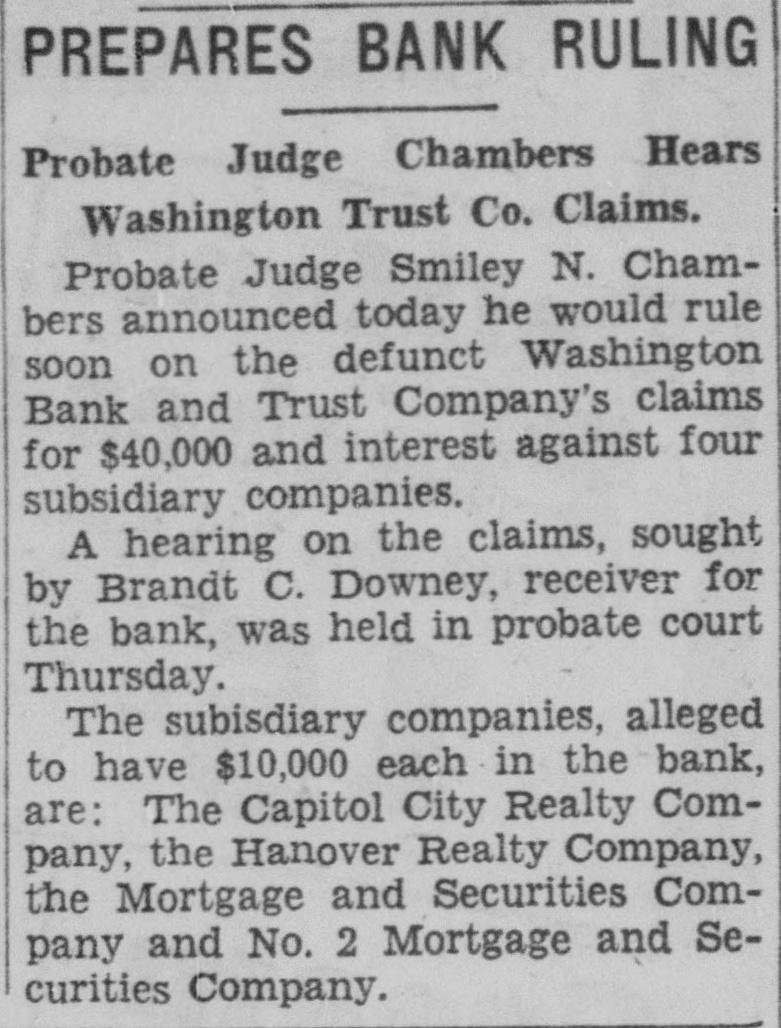
# PREPARES BANK RULING Probate Judge Chambers Hears Washington Trust Co. Claims. Probate Judge Smiley N. Chambers announced today he would rule soon on the defunct Washington Bank and Trust Company's claims for $40,000 and interest against four subsidiary companies. A hearing on the claims, sought by Brandt C. Downey, receiver for the bank, was held in probate court Thursday. The subisdiary companies, alleged to have $10,000 each in the bank, are: The Capitol City Realty Company, the Hanover Realty Company, the Mortgage and Securities Company and No. 2 Mortgage and Securities Company.


Article from The Indianapolis Times, September 9, 1932

Click image to open full size in new tab

Article Text

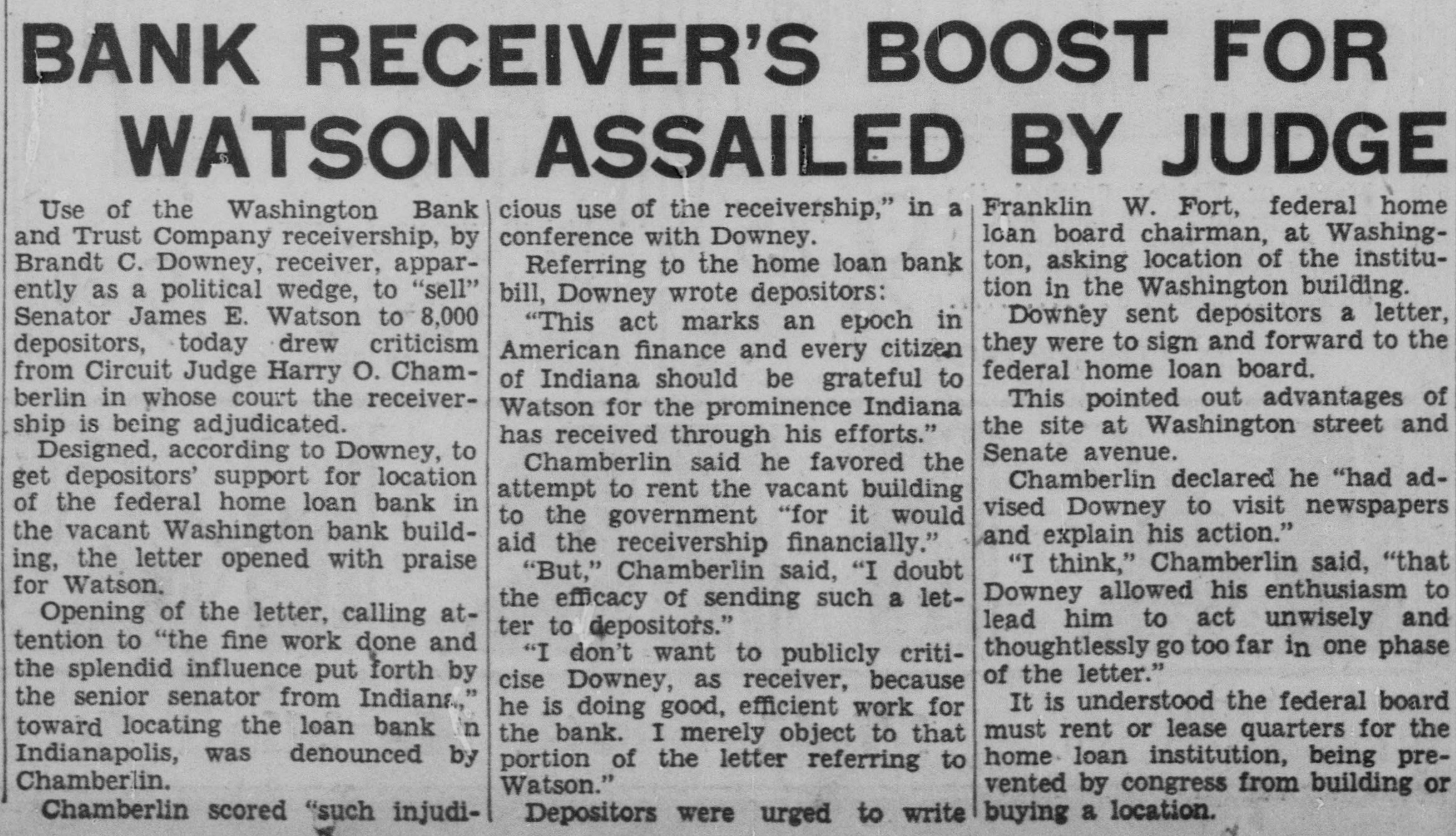
# BANK RECEIVER'S BOOST FOR # WATSON ASSAILED BY JUDGE Use of the Washington Bank and Trust Company receivership, by Brandt C. Downey, receiver, apparently as a political wedge, to "sell" Senator James E. Watson to 8,000 depositors, today drew criticism from Circuit Judge Harry O. Chamberlin in whose court the receivership is being adjudicated. Designed, according to Downey, to get depositors' support for location of the federal home loan bank in the vacant Washington bank building, the letter opened with praise for Watson. Opening of the letter, calling attention to "the fine work done and the splendid influence put forth by the senior senator from Indiana," toward locating the loan bank in Indianapolis, was denounced by Chamberlin. Chamberlin scored "such injudicious use of the receivership," in a conference with Downey. Referring to the home loan bank bill, Downey wrote depositors: "This act marks an epoch in American finance and every citizen of Indiana should be grateful to Watson for the prominence Indiana has received through his efforts." Chamberlin said he favored the attempt to rent the vacant building to the government "for it would aid the receivership financially." "But," Chamberlin said, "I doubt the efficacy of sending such a letter to depositors." "I don't want to publicly criticise Downey, as receiver, because he is doing good, efficient work for the bank. I merely object to that portion of the letter referring to Watson." Depositors were urged to write Franklin W. Fort, federal home loan board chairman, at Washington, asking location of the institution in the Washington building. Downey sent depositors a letter, they were to sign and forward to the federal home loan board. This pointed out advantages of the site at Washington street and Senate avenue. Chamberlin declared he "had advised Downey to visit newspapers and explain his action." "I think," Chamberlin said, "that Downey allowed his enthusiasm to lead him to act unwisely and thoughtlessly go too far in one phase of the letter." It is understood the federal board must rent or lease quarters for the home loan institution, being prevented by congress from building or buying a location.


Article from The Indianapolis Times, April 12, 1933

Click image to open full size in new tab

Article Text

REPORT FILED ON CITY TRUST Receiver Tells of Assets Possessed by Defunct Institution. Cash balance in the receivership of the defunct City Trust Company is $70,757.72, now on deposit in local banks, according to a monthly report filed in circuit court by Oren S. Hack, receiver. Remainder of the estimated $1,700,000 assets of the bank is in real estate, stocks, bonds, notes and mortgages. Reappraisal of the property and paper assets of the bank has been ordered by Circuit Judge Earl R. Cox. Cox also ordered former receivers of three defunct local banks to submit final reports within ten days. The order was issued to Curtis Rottger, former receiver of the City Trust Company; Brandt C. Downey, former receiver of the Washington Bank and Trust Company, and Eben H. Wolcott, former receiver of the State Savings and Trust Company. "These former receivers have been given ample time in which to file detailed final reports and there is no reason why they should be granted an extension of time," Cox declared. Hack asked the court for an reappraisal of the City Trust assets, with the declaration that he believed the remaining assets of the bank would be revealed more fully with a new valuation. J. Harry Miles and Joseph V. Hurley were named by the court to reappraise the real estate. Gavin L. Payne and Rollin W. Spiegel were appointed appraisers for the paper assets.


Article from The Indianapolis Times, April 22, 1933

Click image to open full size in new tab

Article Text

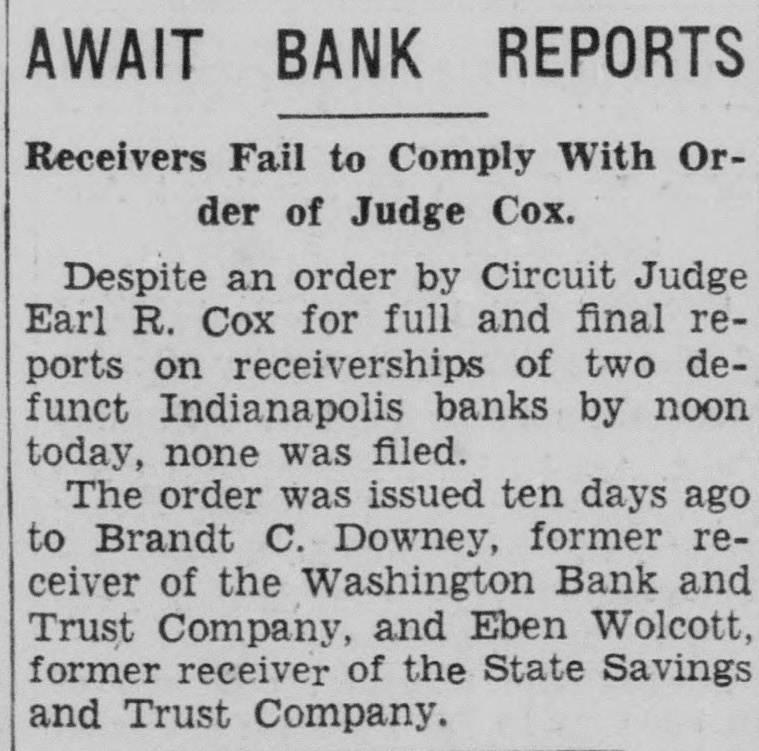
AWAIT BANK REPORTS Receivers Fail to Comply With Order of Judge Cox. Despite an order by Circuit Judge Earl R. Cox for full and final ports of two funct banks by noon today, none was filed. The order was issued ten days ago to Brandt Downey, former ceiver of the Washington Bank and Trust Company, and Eben Wolcott, the State Savings and Trust Company.


Article from The Indianapolis Times, May 23, 1933

Click image to open full size in new tab

Article Text

# JUDGE ORDERS # SUIT AGAINST # BANK OFFICERS Cox Grants Permission to Receiver to Demand $1,150,000. # CHARGE DISHONEST ACTS Washington Trust Leaders Guilty of Criminal Moves, Is Claim. Permission to file three suits seeking $1,150,000 was granted today by Circuit Judge Earl R. Cox to Oren S. Hack, receiver of the Washington Bank and Trust Company. Grand jury investigation of transactions involving former officials of the defunct State Savings and Trust Company was ordered to begin Wednesday by Prosecutor Herbert E Wilson. Suits which Hack is to file will be based on alleged dishonest and criminal acts of directors and officials of the Washington bank, which was closed Oct. 27, 1930. Of the total sought, $1,000,000 would be asked in a suit alleging directors by "omission, commission, malfeasance, misfeasance and non-feasance" caused loss to the bank. False Entries Charged Among the specific allegations is one that the directors permitted Edward Morris, former president, who died of carbon monoxide poisoning from the exhaust of his automobile, to negotiate loans with worthless paper as security. They also charged directors permitted false entries, allowed reports to the state banking department which did not disclose the true condition of the bank, and made loans to corporations in which they were interested. Second suit would be based on an indemnity bond of the Fidelity Deposit Company of Maryland, which was for protection of the bank against loss due to dishonest and criminal acts of officers or employes. Cites Confidential Report Basis of the third suit will be an allegation that $50,000 was lost to the bank through unlawful action of directors in declaring dividends when it is declared the bank did not have net earnings or surplus in sufficient amounts to warrant dividends. The allegations on which the suits would be based, Hack declared in petitions for permission to sue, are based on statements in a confidential report to Brandt C. Downey, replaced as receiver by Hack on the order of Cox. The State Savings probe will center on a charge that $40,000 was carried as an asset of the bank, when in reality it was a liability of the State Property Company, a subsidiary, Wilson said. Bank Statements Probed Bank statements showing notes totaling $500,000 also will be investigated. Wilson declared that the actual total of the notes was $700,000 when the statement was made to the bank examining department. Assistance of Mrs. Ida Broo, accountant who audited the records at direction of Circuit Judge Earl R. Cox, and the accounting firm of Spradling, Carter & Jordan, will be asked in presentation of the records to the grand jury, Wilson said. Recommendations of the depositors' committee of the closed Belmont State bank will be submitted at a meeting to be held Saturday at the Belmont theater. C. A. Klingensmith, chairman, announced today. Action in another bank case today was taken by Superior Judge Russell J. Ryan, who delayed appointment of a receiver for the Acton State Bank to await outcome of an attempt at reorganization.


Article from Muncie Evening Press, June 13, 1933

Click image to open full size in new tab

Article Text

BANK OFFICERS SUED FOR BOND RECOVERY INDIANAPOLIS, June charging officers the closed Washington Bank and Trust Company with unlawful acts were on in Marion Circuit Court today. Four bonding companies, with whom the officers were bonded, are defendants. The suits were filed by Oran S. Hack, the bank's receiver, seeks recovery $625,000 in bonds the officers. If the amount is recovered it will be used depositors. The bank closed in 1930.


Article from The South Bend Tribune, June 13, 1933

Click image to open full size in new tab

Article Text

EXPERT ADMITS GIVING ADVICE TO MITCHELL NEW YORK. June B. Winston, former tary of the told jury Four Indianapolis Suits court that in 1929 he had. as counsel the directors Filed: Jury Goes on of the National City company, officers of the company that $1.860,000 they had received from management fund that year "could in- Press. not be regarded as personal come June 13. Included in the was Oren Hack, receiver for the sum paid to Washigton Bank and Trust comCharles Mitchell, then chairman pany. today sought through four of the company. Mitchell's failure to report the amount in his 1929 suits filed in circuit court to colincome return basis of lect from bonding comone of the charges of income tax panies of former officers and dievasion for which he has been on rectors of the defunct Institution. trial for the last month.


Article from The Evansville Journal, June 13, 1933

Click image to open full size in new tab

Article Text

BANK RECEIVER BEGINS SUITS Frauds Alleged as $625,000 Is Asked in Court INDIANAPOLIS June 13 AP) Oren S. Hack, receiver for the Washington Bank and Trust company today sought through four suits filed in circuit court to collect $625 000 from bonding companies of former officers and directors of the defunct Meanwhile circuit court grand jury continued its investigation into circumstances surrounding the bai Is failure and expected, Prosecutor Herbert E. Wilson. said. to complete its work within ten days Four suits filed yesterday by Hack alleged that during the time while the bond was in effect officers and employes of the bank committed dishonest acts and failed to faithfully perform the duties of their respective employment either dirctly or in collusion with others, as the result of which the bank sustained large losses In suit against the Fidelity and Deposit company of Maryland it was charged specifically that Edward Morris, president of the bank. who committed suicide "caused to be drawn checks on funds of the bank which were wrongfully and unlawfully deposited by Morris in his personal banking account and the proceeds of which said misappropriated and used for his own purposes" to the extent of $7,500 Defendants in the suits are the New Amsterdam Casualty company, the Fidelity and Deposit company. American Surety Company of New York, and the Constitution Indemnity company of Philadelphia Pa., jointly with Lleyds Insurance company of Amer-


Article from The Indianapolis Times, June 24, 1933

Click image to open full size in new tab

Article Text

# BANK RECEIVER SUES DIRECTORS FOR $2,500,000 Ten Former Officials of Washington Trust Are Made Defendants. Ten former directors of the defunct Washington Bank and Trust Company were named defendants today in a $2,500,000 damage suit filed in circuit court. Alleged losses to the bank aggregating $1,975,975.17, over a period of years, were caused by acts of "commission and omission" by the directors, the complaint alleges. The suit was filed by Oren S. Hack, receiver, through his attorneys, Joseph Collier and Samuel Miller. Order for the suit was given by Circuit Judge Earl R. Cox May 22, after a hearing on petition for instructions filed by Hack. Defendants are Erastus L. Cothrell, William C. Hayward, Edward A. Kahn, Thomas A. Pass, Francis W. Payne, John Powell, Mark V. Rinehart, Jesse A. Shearer, Carl Weyl and Carl A. Ploch, # Charges Made on Report Majority of the charges made in the complaint against the directors were contained in a confidential report compiled two years ago by Spradling & Jordan, certified accountants. According to testimony in circuit court by Brandt C. Downey, former bank receiver, the report was made at his request, but no action was taken. Filing of the suit follows closely after announcement of a new appraisal of the bank's assets which revealed that present value of the receivership holdings is approximately $304,000. The figures indicate a shrinkage of 85 per cent from the former book valuation of more than $1,900,000. Less than a 15 cent dividend to depositors was predicted by Hack. # Complaint Is Bulky The complaint, a bulky document of figures, recites the history of the bank from its beginning, June 5, 1918, after operation as the West Side Trust Company from March 8, 1912. When the bank closed on Oct. 27, 1930, indebtedness to depositors was $2,535,817.29, although cash and liquid assets totaled only $196,913.86, the complaint states. Funds of the bank were used "in the promotion of hazardous business transactions in which the directors were personally financially interested," the complaint charges. # Falsification Is Charged Allegation also is made that the directors "unlawfully, negligently, and knowingly permitted the books of the bank to be kept in such a manner that they falsely showed a sound financial condition." Deposits were accepted after the directors knew of the insolvency of the institution, it is charged. Directors also are charged with permitting the issuance of bank statements which were "false and untrue, in that they did not reflect "the true condition of the bank." Dividends aggregating $100,000 were paid out of capital funds, although the bank never showed a profit nor were ever in condition to pay dividends, the complaint alleges. # Other Charges Made Other charges are that directors permitted J. Edward Morris, deceased president of the bank, to sell worthless paper to the institution. Suit filed in circuit court to collect $200,000 from the Amsterdam Casualty Company on the bond covering officers of the bank has been transferred to federal court. Order for the transfer was issued by Cox Friday on petition of attorneys for the bonding companies, who cited that the defendant is incorporated out of the state. The suit is one of four, seeking $625,000 filed by Hack, after alleged defalcations had been revealed.