Meyer Kiser Bank (Indianapolis, IN)

Episode Information

Episode UID
20005571577
Episode Type
Run β†’ Suspension β†’ Closure
Bank Type
state
Bank ID
2000557 routing
Routing Number
20-0055
Start Date
May 12, 1931
Location
Indianapolis, Indiana (39.768, -86.158)

Metadata

Model
gpt-5-mini (chosen from majority vote of a three-model LLM ensemble)
Short Digest
f60bb98435501f6c

Response Measures

None

Description

Closure followed heavy withdrawals tied to failures of other banks; receivership and liquidation followed.

Events (3)

1. May 12, 1931 Run
Cause
Local Banks
Cause Details
Failure/distress of other banks and consequent heavy withdrawals over several years drained deposits, triggering runs/withdrawals.
Measures
Directors voted to close and liquidate; officers served as liquidating agents prior to receivership.
Newspaper Excerpt
The institution has been subject to heavy withdrawals ... The closing of the bank ... is result of long period of withdrawals of deposits which decreased liquid resources ...
Source
newspapers
2. May 12, 1931 Suspension
Cause
Local Banks
Cause Details
Directors closed the bank after prolonged heavy withdrawals and diminished liquid resources caused in part by failures of other banks.
Newspaper Excerpt
MEYER-KISER BANK AT INDIANAPOLIS IS CLOSED ... the directors voted at meeting last night to close the bank ... sets of the Meyer-Kiser bank ... were placed in the hands of the state banking department for liquidation today.
Source
newspapers
3. January 11, 1932 Receivership
Newspaper Excerpt
RECEIVER IS NAMED Schlosser Appointed for Meyer-Kiser Bank. ... The appointment was made on petition of Marvin Markowitz, creditor of the bank, which closed last May 12.
Source
newspapers

Newspaper Articles (22)

Article from The Indianapolis Times, May 12, 1931

Click image to open full size in new tab

Article Text

$4,000,000, in consequence of which, the remaining assets, while considered perfectly good by the directors, were not susceptible to immediate conversion into cash with which to pay depositors." The institution has been subject to heavy withdrawals and has been faced with inability to liquidate loans within the last few years, it was said. At the hour of closing Monday night, the institution reported $600,000 in total capital and surplus with deposits aggregating about $2,240,000. After preliminary examination, it is probable that the state banking department will file a petition in a county court for the appointment of a receiver to supervise distribution of assets. Officers of the bank are: Sol Meyer, president; Sol S. Kiser, J. J. Kiser, Ferd S. Meyer, M. S. Cohn and G. Jackson, vice-presidents; A. J. Wichman, cashier; B. E. Fischer, assistant to the president; J. E. Ohleyer, assistant to the cashier, and L. E. Ostheimer, assistant cashier and auditor. The Meyer-Kiser bank was organized in 1895 as a real estate and insurance partnership between Sol Meyer and Sol Kiser. Stockholders in the bank controlled the holding company, the Meyer-Kiser Corporation. The institution occupied its own building.


Article from The Indianapolis Times, May 12, 1931

Click image to open full size in new tab

Article Text

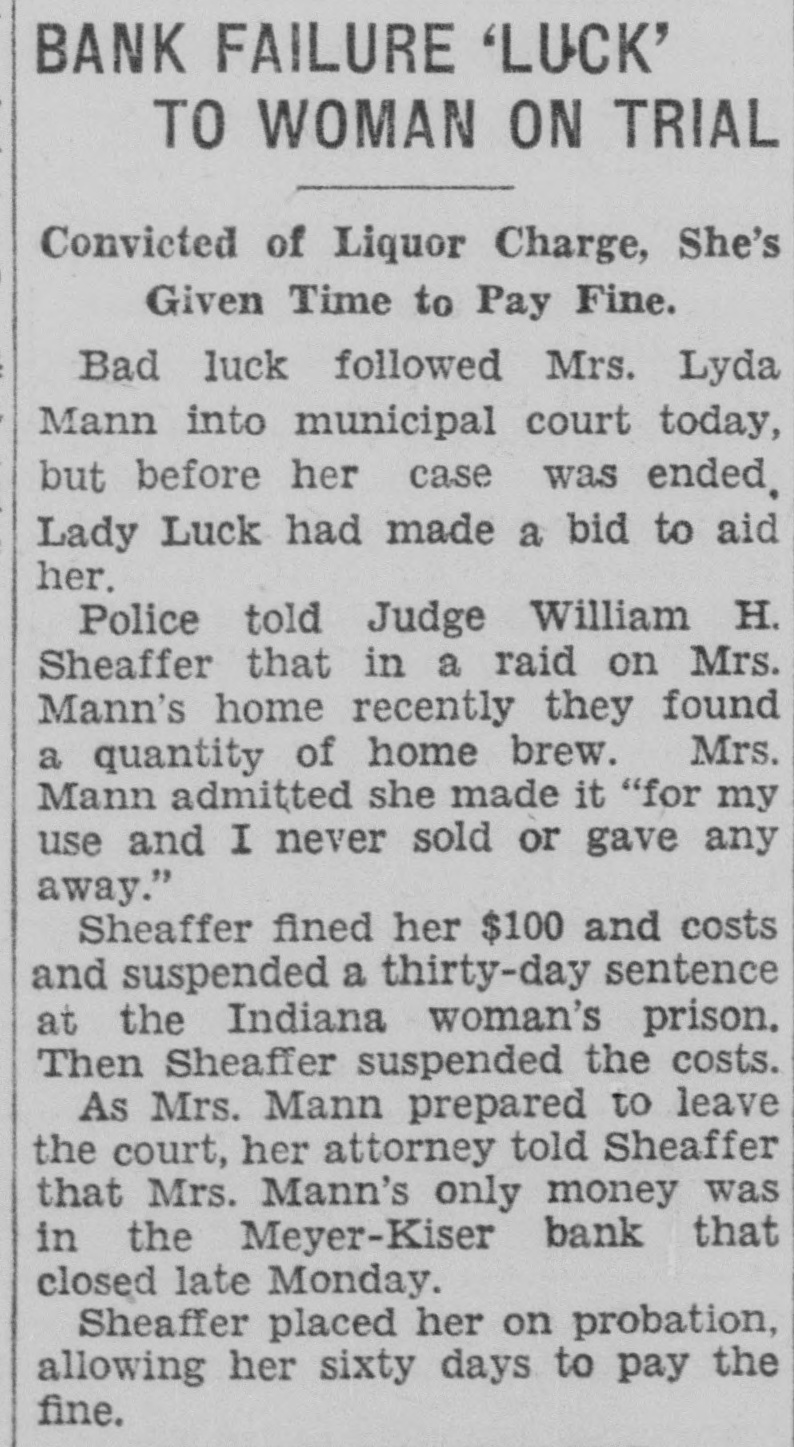
BANK FAILURE 'LUCK' TO WOMAN ON TRIAL Convicted of Liquor Charge, She's Given Time to Pay Fine. Bad luck followed Mrs. Lyda Mann into municipal court today, but before her case was ended. Lady Luck had made a bid to aid her. Police told Judge William H. Sheaffer that in a raid on Mrs. Mann's home recently they found a quantity of home brew. Mrs. Mann admitted she made it "for my use and I never sold or gave any away." Sheaffer fined her $100 and costs and suspended a thirty-day sentence at the Indiana woman's prison. Then Sheaffer suspended the costs. As Mrs. Mann prepared to leave the court, her attorney told Sheaffer that Mrs. Mann's only money was in the Meyer-Kiser bank that closed late Monday. Sheaffer placed her on probation, allowing her sixty days to pay the fine.


Article from Dayton Daily News, May 12, 1931

Click image to open full size in new tab

Article Text

BANK FAILS IN INDIANAPOLIS AMERICAN AGUE Batting White Runs INDIANAPOLIS. May Red Assets of the Meyer- Kiser bank Bluege were placed in the hands of the state banking department for liquidation today. Gehrig The had total capital and surplus of $600,000 with deposits of approximately $2,240,000. and SCRANTON. Pa., May Carbondale Mechanics' bank at Carbondale. ordered closed today. There had been run on the bank for several days. bu. basket Thorabay mostly steady standard TREASURY RECEIPTS receipts for BAR SILVER Bar


Article from The Kokomo Tribune, May 12, 1931

Click image to open full size in new tab

Article Text

MEYER-KISER BANK AT INDIANAPOLIS IS CLOSED sets of the Meyor-Kiser bank, one of the state's largest banking institutions, were placed the hands of the state banking department for liquidation today. The directors voted at meeting last night to close the bank "in order. as nearly as possible. is president o: the bank, organized in 1805. Thomas D. Barr. assistant state banking commissioner. will make the bank's an examination books preparatory to liquidation the assets. ^ statement issued by the directors indicated that their opinion "their assets exceed them liabilities to depositors and credThe closing of the bank. the di. rectors stated. "is result of long period of withdrawals of deposits which decreased liquid resources of the institution in riod three years by nearly $4.000,000, in of which. the remaining assets, while considcred perfectly good by the directors, were not of immediate conversion into cash with which to pay Estimates last night were that the bank total capital and surplus of $600,000. with deposits approximately $2,240,000 Sult for appointment of receiver for the Meyer-Kiser Corporation, holding company controlled stockholders the MeyerKiser Bank. was filed in superior court today. The suit was filed by Blessing Fischer, assistant the president of the bank. She represented herself as the holder of $1,000 an issue of $1,327,150 in collateral real estate mortgage bonds. One at ALiami, Also Miami Fla., May Bank of Miami, closed its doors this morning after rcmaining open little more than 311 William C. Chadwick vice president and manager the bank, said the closing was caused by remors that the closing of the bank in Indianapolis would affect the concern. He said run begin on the bank shortly after opening time this morning. Chadwick said statement of the condition of the bank would be isadded the comptroller in Tallahassee had been advised of the closing. The capitalized at $125,000 and had surplus of $25,000 Deposits. Mr. Chadwick said, were approximately $174,000.


Article from Washington Daily News, May 13, 1931

Click image to open full size in new tab

Article Text

MATCH TO BE IN CLEVELAND CLEVELAND, May 12.-(AP)Any doubt that the heavyweight championship fight between Max Schmeling and W. L. "Young" Stribling would not be held in Cleveland's new municipal stadium July 3 was removed today. The contract was signed last night by city officials and the Madison Square Garden Corporation of Ohio, organized by the promoters. Closiig of the deal came after the City Council passed a resolution accepting a flat guarantee of $5.000 for the boxing commission instead of the usual six per cent of the rΓ©ceipts. MIAMI BANK CLOSES MIAMI, Fla., May 12 (AP) The Meyer-Kiser Bank of Miami closed its doors this morning after remaining open little more than an hour. William C. Chadwick vice-president and manager of the bank, said the closing was caused by rumors that the closing of the Meyer-Kiser Bank in Indianapolis would affect the Miami concern. He said R run began on the bank shirtly after opening time this morning.


Article from The Indianapolis Times, June 5, 1931

Click image to open full size in new tab

Article Text

# COURT TO HEAR # BANK SQUABBLE Meyer-Kiser Receiver Suit Comes Up Saturday. Hearing on a suit for receiver for the Meyer-Kiser bank, filed by at- torneys for creditors and depositors, will be held before Judge Joseph R. Williams Saturday in superior court two. Creditors and depositors are protesting against liquidation of the bank's assets by its officials as outlined by Luther F. Symons, state banking commissioner, following closing of the bank May 12. Defendants are the bank, Julian J. Kiser, Melville S. Cohn and Ferd S. Meyer, vice-presidents and liquidating agents. Illegal conduct on the part of state banking officials in turning


Article from The Indianapolis Times, July 25, 1931

Click image to open full size in new tab

Article Text

# REFUSED BANK RECEIVERSHIP, DEPOSITORS SUE Seek to Make Meyer-Kiser Stockholders Liable for $300,000 Judgment. Charging assets of the bank will not cover the $2,000,000 deposits, two depositors of the Meyer-Kiser bank filed suit in superior court two Friday to hold the stockholders responsible under the stockholders' liability law. This followed closely a 3 to 2 decision of the supreme court prohibiting Special Judge Thomas D. McGee from proceeding with appointment of a receiver for the bank. The new suit demands that stockholders become responsible for judgment amounting to $300,000. A receiver for the fund also is asked. Symons Lauds Ruling Luther F. Symons, state bank examiner, who turned the bank back to its directors after its doors had been closed, heralded the supreme court decision as a "victory for depositors." It will save thousands of dollars by eliminating expensive receiverships, Symons declared. In the suit appealed to the supreme court, depositors were demanding a receiver because they feared their interests would not be guarded properly without one. Only the state bank commissioner has authorit yto petition for a receiver for a defunct bank, the supreme court ruled. Two Judges Dissent Judge Julius C. Travis and Judge Walter Treanor concurred in the opinion of Judge David A. Meyers, while Clarence R. Martin, chief justice and Justice Curtis Roll dissented, holding the writ should not have been issued against the court. In a dissenting opinion, written by Chief Justice Martin, it was pointed out that the law governing general receiverships of corporations still can be invoked in the case of banks since there is nothing in the law exempting bank corporations still can be invoked in the case of banks since there is nothing in the law exempting bank corporations. Under this interpretation bank creditors can ask a receivership in the same manner that creditors of any commercial corporation can do so.


Article from The Indianapolis Times, January 11, 1932

Click image to open full size in new tab

Article Text

# RECEIVER IS NAMED Schlosser Appointed for Meyer-Kiser Bank. First step to collect double liability from more than seventy-five stockholders of the defunct Meyer-Kiser bank was taken today with the appointment of Chalmers Schlosser, attorney, as the fund receiver. Schlosser, former law partner of Superior Judge Joseph R. Williams, was named receiver by Williams Saturday afternoon. Under Indiana law, shareholders in a defunct financial institution can be assessed twice the value of holdings to obtain assets for liquidation of the bank's finances. The appointment was made on petition of Marvin Markowitz, creditor of the bank, which closed last May 12. Attorneys say many of the shareholders will pay the double liability, while others have announced their intentions of resisting the assessment in courts.


Article from The Indianapolis Times, March 15, 1933

Click image to open full size in new tab

Article Text

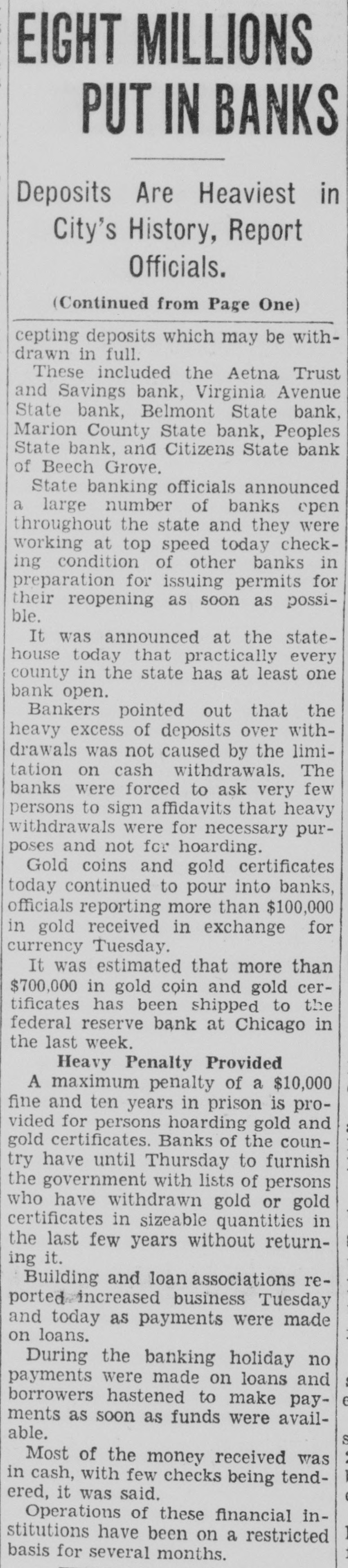
EIGHT MILLIONS PUT IN BANKS Deposits Are Heaviest in City's History, Report Officials. (Continued from Page One) cepting deposits which may be withdrawn in full. These included the Aetna Trust and Savings bank, Virginia Avenue State bank, Belmont State bank, Marion County State bank, Peoples State bank, and Citizens State bank of Beech Grove. State banking officials announced a large number of banks open throughout the state and they were working at top speed today checking condition of other banks in preparation for issuing permits for their reopening as soon as possible. It was announced at the statehouse today that practically every county in the state has at least one bank open. Bankers pointed out that the heavy excess of deposits over withdrawals was not caused by the limitation on cash withdrawals. The banks were forced to ask very few persons to sign affidavits that heavy withdrawals were for necessary purposes and not for hoarding. Gold coins and gold certificates today continued to pour into banks, officials reporting more than $100,000 in gold received in exchange for currency Tuesday. It was estimated that more than $700,000 in gold coin and gold certificates has been shipped to the federal reserve bank at Chicago in the last week. Heavy Penalty Provided A maximum penalty of a $10,000 fine and ten years in prison is provided for persons hoarding gold and gold certificates. Banks of the country have until Thursday to furnish the government with lists of persons who have withdrawn gold or gold certificates in sizeable quantities in the last few years without returning it. Building and loan associations reported increased business Tuesday and today as payments were made on loans. During the banking holiday no payments were made on loans and PA borrowers hastened to make paye ments as soon as funds were available. S Most of the money received was in cash, with few checks being tendered, it was said. Operations of these financial in] stitutions have been on a restricted basis for several months.


Article from The Indianapolis Times, April 25, 1933

Click image to open full size in new tab

Article Text

# GRAND JURY TO PROBE CLOSED BANK AFFAIRS Judge Cox Sends Letter to Prosecutor, Who Promises Action. (Continued From Page One) estate, mortgages, and personal loans of depreciated value. Oren S. Hack, appointed by Cox to succeed Curtis Rottger as receiver of the City Trust and Brandt C. Downey of the Washington institution, petitioned for permission to re-appraise the assets. Hack has expressed the belief that the records turned over to him did not represent an accurate picture of their condition, due to depreciation in market values. Permission was granted and the work is under way. # Audit Is Started At the same time, an audit of records of the Meyer-Kiser bank is being made by the state bank examiner's department, following a demand by depositors for information. A fight also is being conducted in circuit court to institute receivership proceedings against the Meyer-Kiser institution, on the ground that the bank is insolvent. Liquidating agents of the bank, through their attorneys, contend that the bank, because of its liquidation process, can not be thrown to receivership. Cox today overruled motion of attorneys for the Meyer-Kiser bank to strike out the receivership action. It is expected that additional motions will be filed today, in an effort to keep the bank's affairs out of circuit court. In a final report filed by Rottger last week, assets of the City Trust, from his appraisal, were listed at only $1,005,598.47, against liabilities of more than $2,000,000. Cash assets were given at $62,918.78, and nearly half of the remaining assets are contained in personal notes, stocks and bonds valued on a 1931 appraisal. # Little Cash Shown In a monthly report filed Monday, Hack declared that total pledged and unpledged cash of the Washington bank was $22,340.33 of which only $4,949.71 is available. Disbursements of $388.51 during the month has brought the total to $24,705.97, with receipts of $2,754.15. Harry Nicoli was appointed an appraiser in place of Alex Chambers, who declined to serve because of having had a part in the previous appraisal of the Washington assets. Final report of Eben Wolcott, due in court last Saturday, has not been received. A final report was submitted to Cox by Wolcott at the time that Homer Elliott was appointed receiver, but was not accepted by the court.


Article from Leader-Tribune, June 4, 1933

Click image to open full size in new tab

Article Text

JUDGE SELECTS NEW BONDHOLDER Wabash, Ind., June Acting on petition filed by Charles E. Cook of North Manchester. Judge Hurd J. Hurst today named the Indiana Lawrence and Trust Co. of North Manchester trustee to succeed the bankrupt Meyer-Kiser bank of Indianapolis bondholders for the Thomas R. Marshall grade school building North Manchester. The building was constructed eral years ago and the Meyer bank was named trustee and bond holder collect for and pay outstanding bonds. When the Indianapolis bank failed the receiver was asked to transfer the trust the North Manchester bank on the grounds that it would be handled better there. He approved the change and members of the town school board yesterday consented to the appointment and a petition was filed in court Friday afternoon asking that it be made.


Article from The Indianapolis Times, June 13, 1933

Click image to open full size in new tab

Article Text

# ASSETS OF NO VALUE FOUND IN DEFUNCT BANK Best Meyer-Kiser Securities Sold, Depositors Are Told at Meeting. Unsalable and, in some cases, worthless securities remain in the assets of the Meyer-Kiser bank after forced liquidation by officers to meet withdrawals, according to Thomas E. Garvin, receiver. Garvin's statement was made at a meeting of depositors in the bank building Monday night, at which a report of the first month's operation of the receivership was given. More than 200 depositors, headed by Charles D. Babcock, chairman, heard Garvin relate conditions under which the bank was operated by its former officers for five years prior to its close. From 1926 to May, 1931, when the bank closed, deposits of more than $4,000,000 were withdrawn, forcing officers to sell the best marketable securities to meet demands, Garvin said. Bulk in Florida Property As a result, 90 per cent of the present assets are in mortgage certificates and real estate bonds, the majority on Florida property, according to Garvin. J. J. Kiser, former vice-president of the defunct bank, told the depositors that former officials "feel a deep sense of responsibility to all of you." "We will do all in our power to help you get a maximum recovery in dividends," he said. "We have done our best and we have no apologies to offer." He repeated a previous statement from officials, in which it was declared that the two-year liquidating period, which culminated with the receivership, had shown a profit of approximately $30,000. Loss Is Claimed Report from the state banking department, which resulted in the appointment of a receiver, shows, however, that $36,000 was added to the receipts of the liquidation by the cash surrender value of an insurance policy on Sol Meyer, former president, making a net operating loss of $6,000. Depositors voted against a proposal by Garvin to form a corporation to take over the remaining assets and supplant the receivership in handling the bank's affairs. A resolution thanking Garvin for his information was adopted, with the declaration that depositors "have received, in one month, information that we could not get in two years when the former officers were serving as liquidating agents." Hope for Early Dividend Garvin previously had predicted that depositors would receive not more than "25 cents on the dollar." He promised depositors at the meeting that every effort would be made to declare an early dividend. Other information given by Garvin included the fact that $450,000 in securities is pledged with local banks as collateral on a $250,000 loan obtained shortly before the bank closed.


Article from The Indianapolis Times, June 14, 1933

Click image to open full size in new tab

Article Text

# Meyer-Kiser Bank 'Family Affair,' Run by Two Men Disclosure that the Meyer-Kiser bank was "a family affair," operated by a two-man partnership, was made from the witness stand in circuit court today by Sol Meyer, former president of the defunct institution. Under questioning by Thomas E. Garvin, bank receiver, and Walter Myers, his attorney, Meyer revealed that a partnership known as Meyer & Kiser paid all operating expenses of the bank. In a six-year period, from 1924 to 1930, more than $1,737,000 was drawn from the bank funds by the partnership to meet expenses of salaries and operation, Meyer said. The hearing was conducted before Circuit Judge Earl R. Cox, after Garvin had invoked a seldom-used state law requiring officials of defunct banks to give sworn statements of assets and liabilities. Other officers of the bank are expected to testify later in the hearing, which will continue this afternoon. From the witness stand, Meyer related a story of a crumbled financial structure similar to the disaster which other financial institutions met under depression conditions. He related how the partnership with his cousin, Sol Kiser, had been formed in 1897 and built up $500 capital to a surplus of $600,000. He testified that all income and profits from the partnership activities were turned into the Meyer-Kiser bank and that, as needed, funds were drawn for payment of officers' salaries, employes' wages, and operating expenses. Highest salary paid was to Meyer himself in 1923, an amount of $65,358. Sol Kiser in the same year was paid $21,345. J. J. Kiser and M. S. Cohn were paid their peak salaries of $20,221 in 1927, according to the records. Garvin elicited from Meyer the declaration that all assets of the partnership belonged to the bank. "The bank and the partnership practically were the same," Meyer said. "We regarded it a family affair."


Article from The Indianapolis Times, June 16, 1933

Click image to open full size in new tab

Article Text

# MEYER-KISER 'HUSH' LAID TO EX-BANK CHIEF Symons Advised Silence on Progress of Liquidation, Witness Says. EVIDENCE IN CONFLICT Former Vice-President and Other Officials Disagree on Profit Claim. Information regarding progress of liquidation of the defunct Meyer-Kiser bank was withheld from the public at suggestion of Luther Symons, former state banking commissioner, it was alleged in circuit court today. Ferd S. Meyer, former vice-president and liquidating agent, testified that it was his understanding that Symons suggested that announcements be withheld because of "general business conditions." The allegation was made during questioning of Meyer by William B. Miller, attorney for depositors, who is assisting Thomas E. Garvin, receiver, in obtaining information on the bank's affairs. Meyer also contradicted previous statements issued by J. J. Kiser and Mel Cohn, the other two liquidating agents, that the liquidation had been carried on at a profit. Says Cost Was High "Mark-off" of approximately $61,000 in security assets, and an actual operating loss of $7,000 brought the total cost of the liquidation to $68,000, Meyer admitted. Cash surrender value of a $100,000 insurance policy carried on the life of Sol Meyer, president, amounting to $36,000, was added to the income of the liquidation, to show an excess of income over expenditures, according to the records. Miller questioned Meyer regarding his willingness to pay liability on his stock in the bank. "Now is not the time to talk about that," the witness replied and refused to answer further without advice of counsel. Will Endeavor to Pay After a short recess, during which Meyer conferred with Paul Y. Davis, his attorney, he returned to the witness stand and declared: "After a judgment has been obtained legally, I will endeavor to pay, to the best of my ability." The charge against Symons was made when Miller asked Meyer's opinion regarding appraisal of assets made by the banking department, showing more than $1,000,000 in liabilities over assets. Meyer indicated that he differed with the banking examiners regarding certain assets. "Then you think the Meyer-Kiser bank still is solvent?" Miller asked. "Why don't you contest the receivership suit brought in this court by the banking department?" Blamed on Depositors "We decided it was not worth while to continue our efforts, in the face of the dissatisfaction expressed by a certain group of depositors," Meyer replied. The audit which resulted in the receivership was made after depositors organized in an attempt to get information which it was charged had been withheld for two years. Spurred on by discovery of $545,000 new assets in the defunct bank, attorneys will continue their investigations. Disclosure that a "secret reserve" of $500,000 was maintained in the bank without showing on any records except income tax reports was made by Meyer Thursday. A portion of the reserve fund and other assets to a total of $545,000 is the bank's share in a $902,000 corporation formed by members of the Meyer and Kiser families, the questioning revealed. Known as the Smetal Corporation, a name derived from the legal term Sol Meyer et al, the organization was formed to take title to real estate and other assets belonging to a trust created by the two families, principal stockholders, Meyer said. Assets Are Purchased When the institution began to totter under pressure of cash drainage from withdrawals, slow assets of the bank were purchased with cash produced from the private fortunes of the stockholders, Meyer testified. Present value of the new assets, represented by the bank's interest in the Smetal Corporation, have not been determined yet, according to Garvin, but an immediate appraisal will be made to ascertain the cash gain of the receivership funds. The "secret reserve" was created by Sol Meyer and Sol Kiser, members of the partnership which controlled the bank and paid its operating expenses, the younger Meyer said. "The fund was created for the exact purpose for which it later was usedβ€”that of providing cash when needed by the bank," he said. Possibility that Luther Symons and his son, Merwin Symons, who was employed in the bank for fifteen months by the liquidating agents, will be asked to testify at the hearing, was indicated by Garvin.


Article from The Indianapolis Times, June 17, 1933

Click image to open full size in new tab

Article Text

# JUDGE ORDERS # MEYER-KISER # BANK REPORT Cox Wants More Light on Handling of Funds by Liquidators. Detailed reports of funds handled by liquidating agents of the Meyer-Kiser bank is being prepared by order of Circuit Judge Earl R. Cox. Order for the report was issued by Cox at the close of Friday's hearing, conducted by attorneys for Thomas E. Garvin, receiver, and depositors. The court was informed that the information was not available readily, and that its preparation would "take a lot of time." "That's all we have left in this trust," Cox retorted. "There doesn't appear to be any money left for depositors." Quiz to Be Resumed Questioning of former bank officials and liquidating agents will be resumed Monday by William B. Miller, Saul Rabb, attorneys for depositors; Walter Myers, attorney for Garvin, and the receiver. Most important information uncovered since start of the hearing Wednesday was the disclosure by Fred S. Meyer, former vice-president and liquidating agent, that the receivership trust owns a $545,000 share in assets with a book value of $902,000, held in the Smetal Corporation. The corporation was formed by the bank's officers when slow assets were replaced by cash in a forced liquidation over a period of several years preceding the bank's close, May 11, 1931. Failure of other banks brought on heavy withdrawals, which ultimately drained $4,000,000 in deposits from the bank, Meyer said. Symons Is Involved Other testimony included the allegation that Luther Symons, former state banking commissioner, suggested withholding information regarding the progress of the liquidation, because "it would be better for general business conditions." The allegation was made by Ferd Meyer. Meyer also declared that a sworn statement by Symons regarding the cash surrender value of a $100,000 insurance policy on Sol Meyer, president, was incorrect. Proceeds of the policy added $36,500 to the bank's income during the liquidation, Ferd Meyer said, although Symons reported the amount at $37,771. Declaration also was made by Meyer that preferred claims amounting to between $6,000 and $7,000 had been paid "because the liquidating agents were sure, in their own minds, that the claims should be preferred." Mistake Is Conceded "If you have left only $100,000 to pay $150,000 of preferred claims, what would you say regarding the payment of the $6,000?" Cox asked. "Then I would say we had made a mistake," Meyer replied. Testimony also revealed that the liqudating agents, Ferd Meyer, J. J. Kiser and M. S. Cohn, received $500 monthly salaries each from the Lincoln Loan Company, one of their companies, during the period when they also were drawing $500 monthly salaries as liquidating agents.


Article from The Indianapolis Times, June 17, 1933

Click image to open full size in new tab

Article Text

# Meyer-Kiser Fund Report # Ordered by Circuit Judge Cox Wants More Light on Handling of Funds by Liquidators. Detailed reports of funds handled by liquidating agents of the Meyer-Kiser bank is being prepared by order of Circuit Judge Earl R. Cox. Order for the report was issued by Cox at the close of Friday's hearing, conducted by attorneys for Thomas E. Garvin, receiver, and depositors. stery Death Still Awaited then ran from the house. Taylor was found near death in the street several hours later. Dr. John E. Wyttenbach, deputy coroner, has conducted the county investigation of the case, but has not filed a verdict. Today he declined to comment on the status of the case. The police investigation apparent- The court was informed that the information was not available readily, and that its preparation would "take a lot of time." "That's all we have left in this trust," Cox retorted. "There doesn't appear to be any money left for depositors." Questioning of former bank officials and liquidating agents will be resumed Monday by William B. Miller, Saul Rabb, attorneys for depositors; Walter Myers, attorney for Garvin, and the receiver. Most important information uncovered since start of the hearing Wednesday was the disclosure by Ferd S. Meyer, fromer vice-president and liquidating agent, that the receivership trust owns a $545,000 share in assets with a book value of $902,000, held in the Smetal Corporation. The corporation was formed by the bank's officers when slow assets were replaced by cash in a forced liquidation over a period of several years preceding the bank's close, May 11, 1931. Failure of other banks brought on heavy withdrawals, which ultimately drained $4,000,000 in deposits from the bank, Meyer said.


Article from The Indianapolis Times, June 17, 1933

Click image to open full size in new tab

Article Text

ORDERS MEYER-KISER Cox Wants More Light on Handling of Funds by Liquidators. Detailed reports of funds handled liquidating agents of the MeyerKiser bank being prepared order of Circuit Judge Earl Cox. Order for the report issued of Friday's hearing, by attorneys for Thomas Garvin, receiver, The court was informed that the not available readily, and that its preparation would "That's all have left in this trust," Cox retorted. "There doesn't appear any money left for depositors." Quiz to Be Resumed Questioning of former bank offiand liquidating agents will be ler, Saul Rabb, attorneys for depositors; Walter Myers, attorney for Garvin, the receiver. Most uncovered since start the hearing Wednesday was the disclosure by Fred Meyer, liquidating agent, that the trust share book value $902,000, held in the Smetal Corporation. corporation was formed by the bank's officers when slow assets by cash forced period several years preceding the bank's close, 11, 1931. Failure of other banks brought on heavy withdrawals. which ultimatedrained $4,000,000 in deposits from the Meyer said. Symons Is Involved Other testimony included the allegation that Luther Symons, former banking commissioner, suggested withholding information regarding the the liquidation, would be for general business The allegation was made by Ferd Meyer. Meyer declared that sworn statement by Symons garding the cash surrender value $100,000 insurance policy Meyer, was the policy added $36.the income during the Ferd Meyer said, though Declaration also was made by Meyer that preferred claims amounting between $6,000 and been paid "because the liquidating agents were sure, their minds, that the claims should preferred.' Mistake Is Conceded you have left only $100.000 to pay claims, what would you say the payment the Cox asked. "Then would say we had made mistake,' Meyer replied. Testimony that the liqudating Ferd Meyer, Kiser Cohn, received $500 monthly each from the Lincoln Company, one their companies, during the period when they also drawing $500 monthsalaries as liquidating agents.


Article from The Indianapolis Times, June 22, 1933

Click image to open full size in new tab

Article Text

# GARVIN NAMED # TRUST RECEIVER Ex-Judge to Handle Assets in Meyer Fund; Bank to Get Share. Upon agreement between Thomas E. Garvin, Meyer-Kiser bank receiver, and stockholders of the Scl Meyer trust, Garvin was appointed receiver for the trust today by Circuit Judge Earl R. Cox. A recent hearing before Cox developed that the trust holds approximately $938,000 in assets created by the removal of slow assets from the bank. The bank's estimated share of this trust has a book value of approximately $545,000. Bank officials testified the trust assets were pledged as collateral to the Indiana Trust Company for cash loans which were obtained to meet withdrawal demands of Meyer-Kiser depositors, prior to the bank's closing. Included among the trust assets is the common stock of the Smetal Corporation, a company organized to hold title to the bank's Florida properties. Estimated return to the receiver-ship from the Smetal stock realization is approximately $50,000.


Article from The Indianapolis Star, November 8, 1933

Click image to open full size in new tab

Article Text

GARVIN PROBE BANK CASE TODAY Audit Shows Meyer-Kiser Institution Insolvent Long Before Close. When the hearing on activities of the bank resumed in Circuit court today Thomas A. Garreceiver will attempt obtain detailed relative bank and its subsidiaries in Florida real subpenaed testify in the hearing by the the last hearing in June an bank been pleted which disclose the bank was insolvent more before closed the banking Three Factors in View. The new hearing requested by Garvin determine three things he as follows determine much money taken from funds deposited the bank and placed companies and turn paid out Florida the money vested in Florida real estate positors money money the sale of preferred stock the subsidiary companies determine salaries drawn from bank by officials stock dividends the said can not declare dividends. Seldom Used Statute Invoked. Approximately $2,000,000 18 said to been taken from bank deposits Florida real the Floridian hotel Miami numerous apartment properties The Puritan Investment Corporation subsidiary comthe major part Florida Sol Meyer president the funct be first witness testify The hearing will conducted under seldom used Indiana statute that gives bank receiver the legal right question officials relative the financial of the institution The receiver also will inquire into financial of the Chase National bank of New York the diana and the former the bank at the time of its closing Grand Jury May Be Called The officials be questioned whether any committed that would warrant grand investiKiser Kiser presidents of the also testify hearing the receiver obtained considerable to operation of the reality Meyer and Sol Kiser Little however given on the Florida investments Garrecently returned from Florida where he defended merous behalf depositors of bank


Article from The Indianapolis Times, November 8, 1933

Click image to open full size in new tab

Article Text

FORMER BANK HEAD GRILLED BY JUDGE Foreclosure of Florida Property Probed in Court Session. SAYS RECORD IS WRONG Meyer Admits Speculation Funds Were Kept in Safety Box. Admitting specualtive account safety deposit box in the and the foreclosure of in which the are large bondholders, without notifying the ceiver. Sol Myer. former bank president. grilled today before Circuit Judge Earl Cox. The hearing today session held during and deeper affairs the defunct bank Mr the stand that he had kept safety the person account for purposes. Margin for Brokers trust your own bank? Why did have to put deposit vault that Walter attorney questioned the receiver. Thomas Garvin trusted the bank, but money for marpersonal Mr. Meyer said sipped glass water. admitted trustee Floridian Miami beach, which bank holds bonds, foreclosed without notifying Mr the allowed Sol and allowed for attorney's Foreclosure Set Aside In turn, pointed out by Mr Garvin that Meyer's fee trustee should have been under The has been set aside through the of Mr. Garvin Meyer admitted that was the hotel folforeclosure bank records that transferred stocks held the MeyerKiser bank to purchase interest the Blue Bay Corporation. holding and ownthe Floridian Meyer denied the accuracy of the bank records. Paid $33,000 for Interest bought and paid for the third interest Blue Jay Cormyself. That interest was not paid for by bank, through stock transfer. owns that stock queried deeded wife and death my daughter. the bank head Meyer entered denial whether Floridian hotel's casino parlor gambling place hotel French Mr. Meyer? questioned the attorney for the said Mr. Meyer Oh pinochle former head admitted lived suite two that rooms the Flordian for winter seasons paying room. the paid something for his rent. trustee stayed Floridian the money and agement keeping its you for lease hotel the didn't just attorney for the receiver. Spoke in Low Voice "No. We got higher offer than $27,000. the man who offered forced into liquidaMeyer replied Judge Cox terposed. Mr Meyer Flordian offered the coming you be Mr replied. the morning's examination. bank president complained resorted nearby glass as tones they could beyond the reporter's chair


Article from The Indianapolis News, November 14, 1933

Click image to open full size in new tab

Article Text

OF BONDS CLEARED Continued from Page of Mrs. Sol Meyer to be her personal which, said, customary ship Florida for her season. Melville Cohn recalled that the of bonds to York was in order that the might be protect surety bond posted for public deposits. Regular Incident. Meyer that shipment of by mail was regular cident the of department and that when such the bank on the department for an escort to the postoffice was by the bank's special policeman. employe the bank, questioned receiver concerning the recalled one shipment that said had been prepared by Sol Meyer and which he was addressed to Sol Meyer in Florida. He he was escorted to the detail tectives was Date Not Fixed. He could not, however, fix the exdate and he failed to find of insurance of the package that Judge Cox the recess in being the had reached him that large securities were from the MeyerKiser Bank closed. He instructed the to these stories, that they might either be discarded or ascertained to be based on fact. Barber Shop Item. The that Garvin, of the now has barber shop the building, conMonday hold item among the losses of the bank designated as "on the Glass. Sol Meyer explained that it purchase price fixtures the barber shop that was known as "the Looking Glass" and which charged the bankbooks said fixtures were the property of the bank. Other Bank Losses. Other of the bank from 1924 to the total to only about short of the capital. Meyer asked the receiver to take that the profit account of the bank that period greatly its losses. Among the losses item charged against James Goodrich, former Governor, who, Meyer said, supposed be very wealthy.' the transaction something to with the efforts WarMcCray. former Governor, from admitted McCray's debacle had cost the bank approximately $13,000. Purpose of Consolidation. The purpose, Meyer said, of consolidation several realty corporations into Pilgrim Properties, Inc., enable the Meyer and Kiser families place their holdings the down $300,000 profits in the transaction. Examined by Little. Over his objections, Meyer examination by Edward W. Little, which the torney both the Meyer and Kiser families. In course of the examination, Kiser got permission of the court explain cerning which Little was asking Kiser said Little had posted collateral for the Kiser bond and that the was changed from bonds to stock in plan which the of the holder the consented under court order. To Return Thursday. Little to that without notice had the he owned. Kiser the substituwith consent of the holder the collateral notice to Little not necessary. Meyer, anxious for Florida, where his son, in business, was ordered to court for examination with the that he would not be tained longer.


Article from The Indianapolis Times, July 18, 1934

Click image to open full size in new tab

Article Text

Mr. Kelly was on the stand as a state witness as the state continued its drive to prove charges that bank funds were used to pay dividends to stockholders of realty companies in receivership. In a letter dated April 8, 1929, Mr. Cohn stated that the bank had $99,140 tied up in the realty company and that the bank had paid $6,750 to real estate company stockholders as dividends. ### Tells of Receivership The realty company went into receivership in 1928 and according to Mr. Kelly's testimony, he was appointed receiver to look after the bank's interests. He testified that the Fralich company was insolvent during most of the time that the bank was paying dividends to stockholders. Mr. Kelly said that rent from an apartment building owned by the realty company was used to repay the bank, but that the funds were insufficient. A letter dated July 12, 1929, from Mr. Cohn stated that the bank had a delinquent balance of $8,050 on the realty company's account. Mr. Kelly said that in the time that he was receiver that he had never paid any dividends to stockholders or retired any stock. Cross-examination by defense attorney began shortly before noon recess. ### Lawyers Clash Frequently Yesterday's session was marked by frequent clashes between state and defense attorneys with the latter objecting to the procedure adopted by Mr. Mattice. State witnesses included Thomas E. Garvin, receiver for the bank; Miss Grace Jackson, a former bank vice-president; Albert Blue, 4550 North Illinois street, a preferred stockholder in the Fralich Realty Company, and Mr. Kelly. Miss Jackson declared she signed official Meyer-Kiser checks and other bond documents requiring signature of an officer. She identified her signature to a Fralich dividend check for $37.50 made out to Mr. Blue by the bank "in lieu of dividends of the Fralich Realty Company." "I had no specific authority to sign the check to Mr. Blue," Miss Jackson replied to questions by Mr. Mattice. ### Mr. Blue Identifies Check "Whatever was placed on my desk I signed," she added to the astonishment of the court. "Even though thousands of dollars of checks came to your desk you would not ask anybody about them?" Judge Cavins asked the witness. "No, I would not," Miss Jackson replied. "It was not my business to." Mr. Blue followed Miss Jackson to the stand and identified the check made out to him. He testified that he received the check and then deposited it to his account in another bank.