19958. Planters & Mechanics Bank (Charleston, SC)

Bank Information

Episode Type
Suspension → Reopening
Bank Type
state
Start Date
October 14, 1839
Location
Charleston, South Carolina (32.777, -79.931)

Metadata

Model
gpt-5-mini
Short Digest
0c7c6d5d

Response Measures

None

Description

The articles describe a coordinated decision by Charleston banks (including the Planters & Mechanics' Bank) to suspend specie payments on/around Oct 14, 1839 in reaction to the Philadelphia (and other cities') suspensions. Later articles report the Planters' & Mechanics' Bank resumed specie payments (resumption reported July 19, 1840). No contemporaneous article describes a depositor run specific to this bank; the suspension was prompted by broader banking failures (macro events).

Events (2)

1. October 14, 1839 Suspension
Cause
Macro News
Cause Details
Suspension adopted in response to the Philadelphia suspension and widespread bank suspensions in other cities (series of regional banking failures/contagion).
Newspaper Excerpt
At a meeting ... it was resolved to recommend to their several Boards to suspend Specie Payments forthwith ... with the concurrence of the above named Banks
Source
newspapers
2. July 19, 1840 Reopening
Newspaper Excerpt
the Planters' & Mechanics' Bank of Charleston resumed specie payments on the 19th inst.
Source
newspapers

Newspaper Articles (5)

Article from Morning Herald, October 19, 1839

Click image to open full size in new tab

Article Text

# MONEY MARKET. ## Friday, October 18-6 P.M. Wall street remains exceedingly quiet, and all idea of a sus- pension of our banks has vanished; at the Stock Exchange prices again fell; United States Bank opened at 78į and closed at 72, which is a decline of 10 per cent since the board yesterdy morn- ing-Delaware & Hudson declined 1 per cent-Kentucky 4 per cent-Harlem 1 per cent. In sterling exchange there is as much doing as the scarcity of money will permit. The bills selling by the banks at 9 per cent or $4 86 the £ sterling are taken freely and fully meet the object in drawing, viz: to stop the export of specie. We know of an eminent firm who had previously insured $14,000 to ship, but withdrew it and deposited the amount with the Bank of Commerce, taking bills in preference. There is there- fore, not the slightest call for specie, while the amounts in the banks are daily increasing; $200,000 arrived at New Orleans on the 9th instant, from St. Louis, and destined for this port. Exchange on the South is merely nominal and may be put at 16 to 20 for all south of Philadelphia; on that city sales have been made at 87, on Mobile 87į, Baltimore 89. Uncurrent money stands as follows: U. S. Bk. bills, 16 to 20 dis. Rhode Island, 10 to 12 dis. Eastern, 1 to 2 " Safety Fund, to 1 " Bills of new bks, 3 to 5 " Southern, 20 to 25 " The directors of the Yates County and the two Oswego Banks are now in the city endeavoring to make some arrange- ment for the redemption of the bills of those Banks. The bills of the Dutchess County Bank are received at par by the New York Banking Company, 14 Wall street. It is stated in a Buffalo paper that articles of association were filed last week for the Union Bank of Buffalo, which will com- mence operations immediately. J. Salter, President; S. J. Powers, Cashier. The bills of the Washington County Bank, at Calais, (Maine,) are not received at the Suffolk Bank. The Attorney General of Pennsylvania has sent a circular to each of the Philadelphia Banks, wherein he states that pro- ceedings wil be instituted against any Bank issuing bills of a less denomination than $5. It is stated that an Injunction has been issued by the Vice Chancellor, by which the discounts maturing in the United States Bank in New York are held for the benefit of the holders of post notes of the United States Bank, made payable in New-York. The specie which was recently drawn from the east in favor of our banks, has, it is stated, been returned in many instances. The eastern banks are perfectly quiet, although the mercantile classes are severely pressed. The merchants of Boston held a meeting on Tuesday evening, when it was resolved to call upon the banks to step forward and furnish some relief. We under- stand by letter, that the banks have, in consequence of the meet- ing and the encouragement afforded by the firm position of New York, resolved to discount to the extent of 8 per cent. on their capital, which will be to the extent of $500,000. The effect of the Philadelphia suspension is progressing south; each mail brings accounts of banks that have suspended. The following is a list of the bank suspensions so far as heard from: Banks of Philadelphia Baltimore, Harrisburg, Frederick, Maryland, York, Wilmington, Del. Chahambersburg, Washington, Gettysburg, Georgetown, Norfolk, Richmond, Charleston, S. C. Rhode Island, The news of the Philadelphia suspension reached Charleston on the 14th, and a meeting was held immediately, consisting of delegates from the Union Bank, State Bank, Bank of South Carolina, Louisville, and Charleston Rail Road Bank, and the Planters and Mechanics' Bank, when it was resolved to sus- pend forthwith. This will, probably, be the case throughout the south and west. We observe in the proceedings of the meetings of the southern banks a greater degree of unanimity and decision in suspending than in the more northerly institu- tions. At Charleston they were unanimous-at Richmond one or two of the banks voted against it-at Washington the Patriotic bank did not concur with the others in suspending.- Several of the Baltimore banks did not feel the necessity of the measure, and in Philadelphia nine of the banks, the names of which we gave yesterday, voted decidedly against it. The New York and eastern banks do not recognise the neces- sity or the convenience of the measure, with the ex- ception of Rhode Island, where the banks have shown a most unworthy subserviency to southern opinions, but even there six out of 20 banks voted against it. Rhode Island is pe- cularly situated; most of the bank loans amounting to $12,000,- 000, are directly or indirectly payable at the south. She has, therefore pursued the mistaken policy of depreciating her currency, in order to save the difference. From the west we have not not heard the effects of the explosion; but as it is the season when their greatest wealth is most available, it is pos- sible they may go through safely. All the banks south of Philadelphia to New Orleans, will doubtless stop. New Orleans is, however, strong, and her position, like New York, is such, that she will form a rallying point for the trade and healthy currency of that section, and the three points of New Orleans, New York and Boston will form the skeleton of the healthy trade which will rise out of the ruins of the unlimited credit system which reached its zenith in 1836, and has finally perished with the wasted energies of the United States bank, that thought to sustain and regene- rate it. Up to 1836 there was a regular increase of credit and busi- ness throughout the United States, fostered by a rapid increase of paper credits. This business far outrun the natural busi- ness of the country; that is, the soil and manufactures did not furnish produce and actual wealth so fast as the representatives of wealth increased. The consequence was that every class of dealers could command more money than their business required. That money was not allowed to remain idle, but sought new ob- jects of traffic. The most general object fixed upon was real estate, stocks, &c.; almost every class of society invested more or less in real estate, of a description which was actually worth nothing. The means to make these investments constitute the great mass of the increase of bank loans which took place in two years, from 1835 to 1837, amounting to $200,000,000. If a miller at the west drew on the city factor for $8,000, $6,000 of that was to buy corn, and $2,000 to invest in water lots. In the south, cotton was made the basis of similar operations. Large amounts of bills were drawn on England by banks having no funds there, and sold to dealers who gave their notes and raised the money on the bills, which money was spent in real estate.

Article from Richmond Enquirer, October 22, 1839

Click image to open full size in new tab

Article Text

and unquestionable drafts on Philadelphia were offered at the board to day at 12 per cent discount, and but small sales eculd be effected at that ruinous rate; 85 was the best bid for the lot -Ib. NEW YORK, Oct 18.-Stocks have all declined again to day: U.S. Bank six per cent, Bank of Kentucky one and a half, Delaware one half, Harlem one, North Ame- rican Trustone. American Exchange Bank one. $5,500 sight drafts on Philadelphia were sold a: 87; more of fered at 86 34: 86 téd. A draft for $20,000 was sold yesterday to John T. Smith, exchange broker, at 55, and oubsequently large amounts offered at 24 in the street, and refused The talk in Wall street is, that the U. S Bank stock rose a day or two since in consequence of the Bank con- senting to take its own stock at par, in payment for cer- tain suspended debts-and considerable purchases were made for that object. Be this as it may, the Bank will resort to every expedient to bolster up a rotten concern; but the time is not far distant when the Bank and its whole system of finance, will excite universal contempt and execration. Policies on specie for exportation, for a considerable amount, bave been cancelled, and a large amount in gold prepared for shipment was paid to one of our banks for Exchange The current of events, as well as public opinion, all tend to sustain our banks - Ev Post. PROVIDENCE BANKS-Bank Meeting -At an adjourn ed meeting of delegates from the several Banks in this city, held last evening at the Washington Insurance office, it was, we understand, agreed to suspend specie pay- ments, fourteen banks voting in favor of this measure, four against and two divided The banks oppoerd to suspending were the Merchants', Mechanics', Blackstone Canal, and Traders' The delegations from the Arcade and City banks were divided. SMALL NOTES We learn from the Attorney Gene- ral and his officers in Philadelphia, that the law against issuing and circulating notes of a less denomination than five dollars, will be rigidly enforced. The public seems not to be fully aware, that it is in the very teeth of this law, to receive and pay out the small notes of the neighboring States. Whoever does so, should be informed that they incur the penalty of five dollars for each and every offence. This evil nmust be wholly era- dicated, before the specie that is now hoarded up for speculation, will come out. Nothing is wanting but to carry the law faithfully into execution, to insure abun- dance of specie to the people, for the ordinary business of society. The Banks must pay small checks and five dollar notes The public deinand it, and will not be refused. The specie in their vaults and in the hands of the people, is amply sufficient for our wants. Why then should shinplasters be encouraged? Let the efforts of the Governor and Attorney General be seconded by the community; let a strenuous exertion be made to banish slunplasters, and to retain specie, and all will be well. Above all, keep cool-observe the laws, stand firm, and the difficulties that now encompass us, will vanish in another week. ### SHALL THE BANKS VIOLATE THE LAW The apparent impunity with which the Banks have been violating the law, and their disregard of the circular of the Go vernor and the Attorney General, in paying out notes under five dollars, has led to the ejaculation by the com munity, at the head of this paragraph Shall the Banks violate the law?" We are gratified to learn that Messrs. Barton and Brook, in pursuance with the in structions of the Attorney General, will strictly pursue their duty, and as far as in them lies, protect the laws from ary farther aggression by the Banks. This may be most rigidly relied upon by the Banks as well as the commu nity. Their course of conduct will be farther developed in the course of to-morrow. In the mean time we pre- diet that the Banks will cease the present illegal course of paying out small notes-Phil Spirit of the Times. EXCHANGE BANK OF VIRGINIA We regret to state that the Exchange Bank, of this place, has been com pelled to suspend specie payments, which it did at its session yesterday. The general bank law, in one of its sections. subject the parent bank and branches equally to forfeiture, in case any one branch shall suspend, and, as the branch of the Exchange Bank of Richmond had suspended, there was a subsequent forfeiture of the charters of the parent institution and its branches. This is another anti-commercial feature in the general bank law. The failure of a single branch to sustain itself, however isolated and exposed, works a forfeiture of the charters of the mother bank and branches. It is like hanging a mother for the sins of a daughter who is of full age and ought to know how to behave herself. We must state, however, that it reflects great credit upon the directors of the Exchange Bank of this place, that they held out as long as possible, and that they gave way from no fault of their own. The Portsmouth branch of the Bank of Virginia sus pended yesterday -Norfolk Beacon, Oct. 17. CHARLESTON, Oct. 15. Suspension in Charleston-We regret to perceive from their address in our columns, that inost of our Banks have been constrained to follow the example of the Phi- Ise pusa and Baltimore Banks and suspend specie pay- ments It is creditable, however, to our banking insti- tutions, that they have never taken the lead in such a measure, but hare dune all they could to uphold the cre- dit of the country, yielding only when compelled to do 80, on the principle of self defence, by the course of like institutions in other places. The Bank of the State of South Carolina, and the Bank of Charleston, have not yet united in the measure of suspension, and we trust that our community will, with one accord, sustain them in their present altitude - Courier City of Charleston, Oct. 14, 1839. At a meeting of the Committees from the Union Bank, State Bank, Bank of South Carolina, Louisville. Cincinnati and Charleston Railroad Bank, and Planters' and Mechanics' Bank, held this day, it was resolved to recommend to their several Boards to suspend Specie Payments forthwith, and that the following address to the Public, be published in the several papers of this city, with the concurrence of the above named Banks The several Boards having concurred in the recom- mendation of their Committees the Address is as fol lows: Fellow Citizens: An unexampled crisis has arisen- threatening, if not timely provided for, to bring upon this community the greatest distress-it therefore be comes the imperative, though painful duty, of those whose interest it is to watch over the monetary concerns and credit of this State, to adopt such measures as are called for by the present emergency. Your Committee feel the deep responsibility which has devolved upon them, and are anxious to justity to the State, and to the world, the course of proceeding which may be adopted on this occasion. They think it proper to observe, that the Banks of this city have in good faith, notwithstanding the extraordinary pressure of the times, punctually and cheerfully redeemed their paper; and, at the same time, afforded such accommo dation to a suffering community, as it was in their power to give: and they confidently believe, that but for events altogether beyond their control, would have continued to do so It is known to our fellow-citizens, that the Banks of Philadelphia, with the Bank of the U. States at their head, and the Banks of Baltimore, have sus pended specie payments, which must from necessity be followed by those of New York, and our other commer- cial cities. The effect would be, (if not prevented,) to draw for shipment abroad, every dollar from the Banks of this city, without the power on their part of replen ishing their coffers, except at the most ruinous sacrifices, involving for want of accommodation to the citizens, every man at all connected with the agricultural or com mercial concerns of the country in unparalleled distress. Your committee state the fact that by the last steamers since the suspension, in the cities before alluded to, large drafts and amounts have come on and are now waiting to know the result of the proceedings of this meeting. And your Committee believe that they will in a few days be followed by many others, whose obiect is reck- less speculation, regardless of the multiplied ills which they hring upon this country. With feelings, therefore, of great pain and die consider an irresistible necessity, your Committee are satisfied that the measure accompanying this address adopted by this meeting, is the only step which could have been taken at this extraordinary juncture.


Article from Edgefield Advertiser, October 24, 1839

Click image to open full size in new tab

Article Text

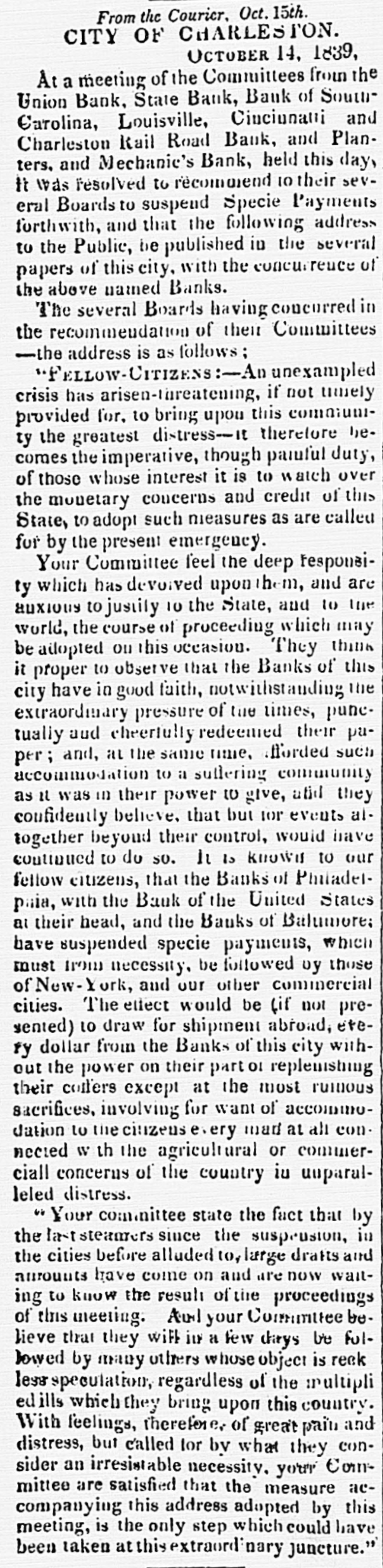
From the Courier. Oct. 15th. CITY OF CHARLES TON. OCTOBER 14, 1839, At a meeting of the Committees from the Union Bank, State Bank, Bauk of SouthCarolina, Louisville, Cinciunan and Charleston Rail Road Bank, and Planters. and Mechanic's Bank, held this day, It was resolved to recommend 10 their several Boards to suspend Specie Payments forthwith, and that the following address to the Public, be published in the several papers of this city, with the concurrence of the above named Banks. The several Boards having concurred in the recommendation of their Committees -the address is as follows: "FELLOW-CITIZENS:-A unexampled crisis has arisen-threatening, if not umely provided for, to bring upon this commiumty the greatest distress--it therefore becomes the imperative, though painful duty, of those whose interest it is to watch over the monetary concerns and credit of this State, to adopt such measures as are called for by the present emergency. Your Committee feel the deep responsity which has devolved uponthem, and are auxious to justily 10 the State, and to the world, the course of proceeding which may be adopted ou this occasion. They think it proper to observe that the Banks of this city have in good faith, notwithstanding the extraordinary pressure of the times, punetually aud cheerfully redeemed their puper; and, at the same name, afforded such accommodation to a sullering community as it was in their power to give, and they confidently believe. that but for events al. together beyond their control, would have continued to do so. It 10 known to our fellow citizens, that the Banks of Philadelpaia, with the Bank of the United States at their head, and the Banks of Balumore: have suspended specie payments, which must from necessity. be followed by those of New-York, and our other commercial cities. The effect would be (if not presented) to draw for shipment abroad, etcry dollar from the Banks of this city without the power on their part 01 replemshing their collers except at the most rumous sacrifices, involving for want of accommodation to the cinzeuse. ery mad at all con. nected W th the agricultural or commerciall concerns of the country iu unparulleled distress. "Your committee state the fact that by the last steamers since the suspension, in the cities before alluded to, large drafts and amounts have come on and are now waiting to know the result of the proceedings of this meeting. And your Committee be. lieve that they with in a few days be fullowed by many others whose object is reek less speculation, regardless of the :pultipli edills which they bring upon this country. With feelings, therefore. of great pain and distress, but called for by what they consider an irresistable necessity. your Committee are satisfied that the measure accompanying this address adopted by this meeting, is the only step which could have been taken at thisextraordinary Juncture."


Article from Morning Herald, July 23, 1840

Click image to open full size in new tab

Article Text

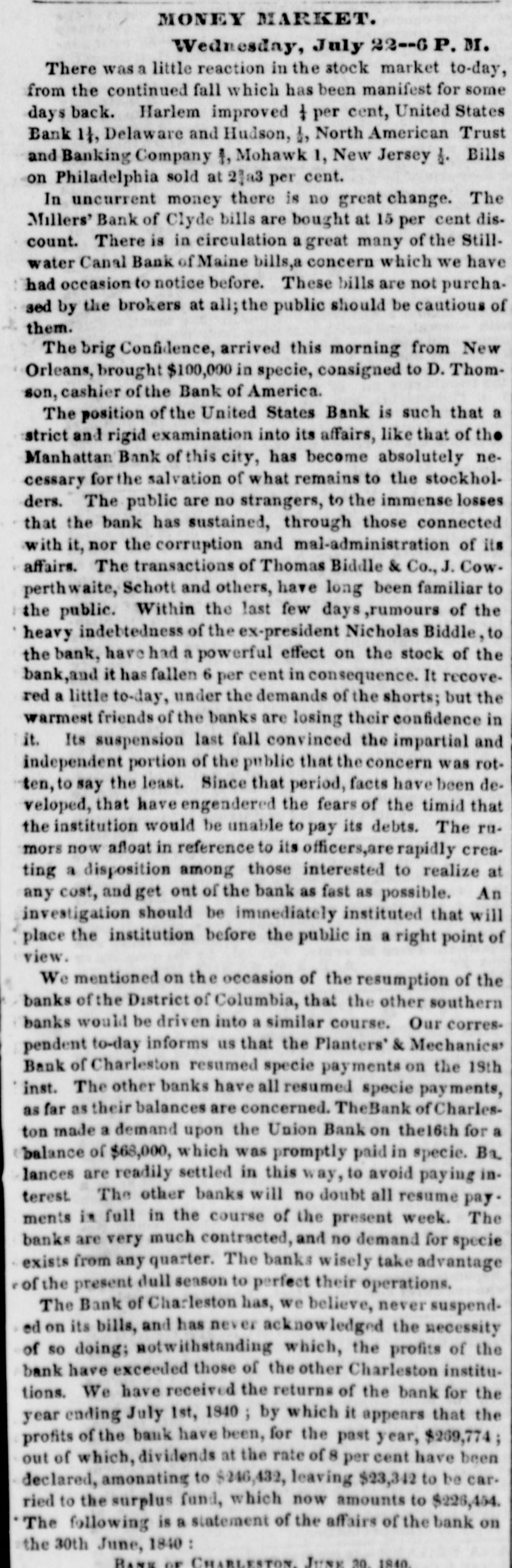
# MONEY MARKET. Wednesday, July 22--6 Р. М. There was a little reaction in the stock market to-day, from the continued fall which has been manifest for some days back. Harlem improved per cent, United States Bank 14, Delaware and Hudson, 1, North American Trust and Banking Company, Mohawk 1, New Jersey. Bills on Philadelphia sold at 2a3 per cent. In uncurrent money there is no great change. The Millers' Bank of Clyde bills are bought at 15 per cent discount. There is in circulation a great many of the Stillwater Canal Bank of Maine bills, a concern which we have had occasion to notice before. These bills are not purchased by the brokers at all; the public should be cautious of them. The brig Confidence, arrived this morning from New Orleans, brought $100,000 in specie, consigned to D. Thomson, cashier of the Bank of America. The position of the United States Bank is such that a strict and rigid examination into its affairs, like that of the Manhattan Bank of this city, has become absolutely necessary for the salvation of what remains to the stockholders. The public are no strangers, to the immense losses that the bank has sustained, through those connected with it, nor the corruption and mal-administration of its affairs. The transactions of Thomas Biddle & Co., J. Cowperthwaite, Schott and others, have long been familiar to the public. Within the last few days, rumours of the heavy indebtedness of the ex-president Nicholas Biddle, to the bank, have had a powerful effect on the stock of the bank, and it has fallen 6 per cent in consequence. It recovered a little to-day, under the demands of the shorts; but the warmest friends of the banks are losing their confidence in it. Its suspension last fall convinced the impartial and independent portion of the public that the concern was rotten, to say the least. Since that period, facts have been developed, that have engendered the fears of the timid that the institution would be unable to pay its debts. The rumors now afloat in reference to its officers, are rapidly creating a disposition among those interested to realize at any cost, and get out of the bank as fast as possible. An investigation should be immediately instituted that will place the institution before the public in a right point of view. We mentioned on the occasion of the resumption of the banks of the District of Columbia, that the other southern banks would be driven into a similar course. Our correspondent to-day informs us that the Planters' & Mechanics' Bank of Charleston resumed specie payments on the 19th inst. The other banks have all resumed specie payments, as far as their balances are concerned. The Bank of Charleston made a demand upon the Union Bank on the 16th for a balance of $68,000, which was promptly paid in specie. Balances are readily settled in this way, to avoid paying interest. The other banks will no doubt all resume payments in full in the course of the present week. The banks are very much contracted, and no demand for specie exists from any quarter. The banks wisely take advantage of the present dull season to perfect their operations. The Bank of Charleston has, we believe, never suspended on its bills, and has never acknowledged the necessity of so doing; notwithstanding which, the profits of the bank have exceeded those of the other Charleston institutions. We have received the returns of the bank for the year ending July 1st, 1940; by which it appears that the profits of the bank have been, for the past year, $269,774; out of which, dividends at the rate of 8 per cent have been declared, amonnting to $246,432, leaving $23,342 to be carried to the surplus fund, which now amounts to $226,454. The following is a statement of the affairs of the bank on the 30th June, 1840 : BANK OF CHARLESTON. JUNE 30. 1840.


Article from Southport Telegraph, August 25, 1840

Click image to open full size in new tab

Article Text

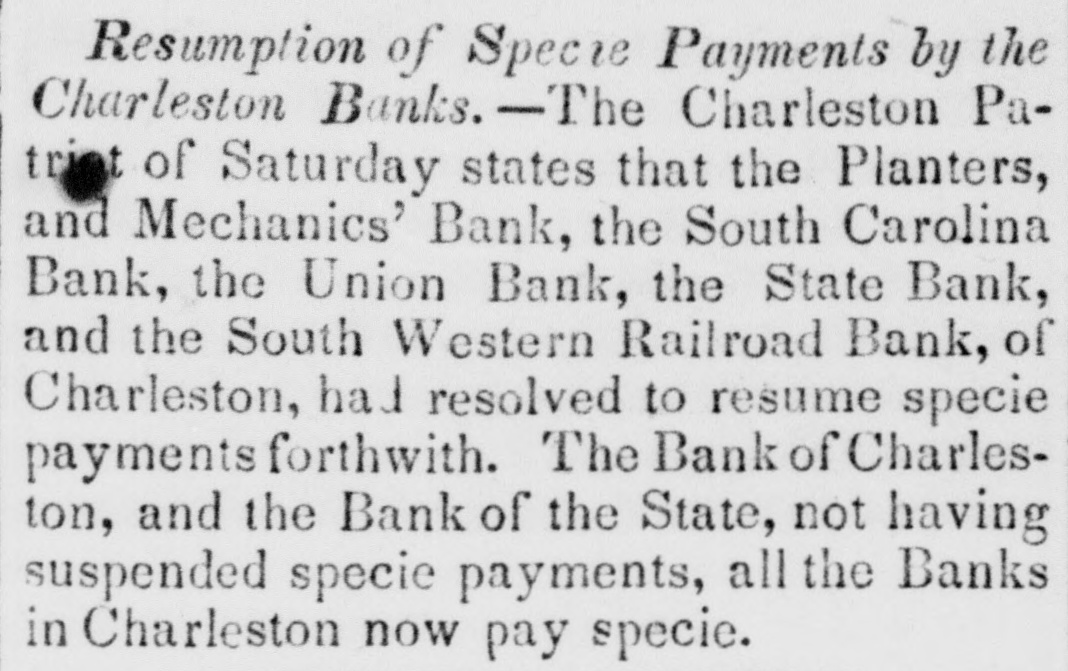
Resumption of Specre Payments by the Charleston Banks. - The Charleston Patrint of Saturday states that the Planters, and Mechanics' Bank, the South Carolina Bank, the Union Bank, the State Bank, and the South Western Railroad Bank, of Charleston, had resolved to resume specie payments forthwith. The Bank of Charleston, and the Bank of the State, not having suspended specie payments, all the Banks in Charleston now pay specie.