German American Savings Bank (Washington, DC)

Episode Information

Episode UID
1993350490946
Episode Type
Suspension β†’ Run β†’ Closure
Bank Type
savings
Bank ID
199335049 hash
Start Date
October 31, 1878
Location
Washington, District of Columbia (38.895, -77.036)

Metadata

Model
gemini-3-flash-preview (chosen from majority vote of a three-model LLM ensemble)
Short Digest
09cc6ad7d3645586

Response Measures

None

Description

The German American Savings Bank was a state-chartered institution closely linked with the German American National Bank; both suspended simultaneously due to the National bank's failure.

Events (3)

1. October 31, 1878 Other
Newspaper Excerpt
An excited crowd surrounds the building. ... When the fact became known a large crowd of depositors gathered in front of the bank and considerable excitement prevails at this hour. No explanation as to the cause of the closing has been given.
Source
newspapers
2. October 31, 1878 Suspension
Cause
Correspondent
Cause Details
Forced to close due to the suspension of its companion institution, the German American National Bank, which failed due to frozen real estate assets.
Newspaper Excerpt
The German American savings bank has also closed its doors and put up the following notice: Owing to the suspension of the German American national bank, this bank is forced to close.
Source
newspapers
3. November 1, 1878 Receivership
Newspaper Excerpt
One of the seemingly necessary evils, a Receiver, was appointed in the case of the German-American.
Source
newspapers

Newspaper Articles (12)

Article from Daily Press and Dakotaian, October 31, 1878

Click image to open full size in new tab

Article Text

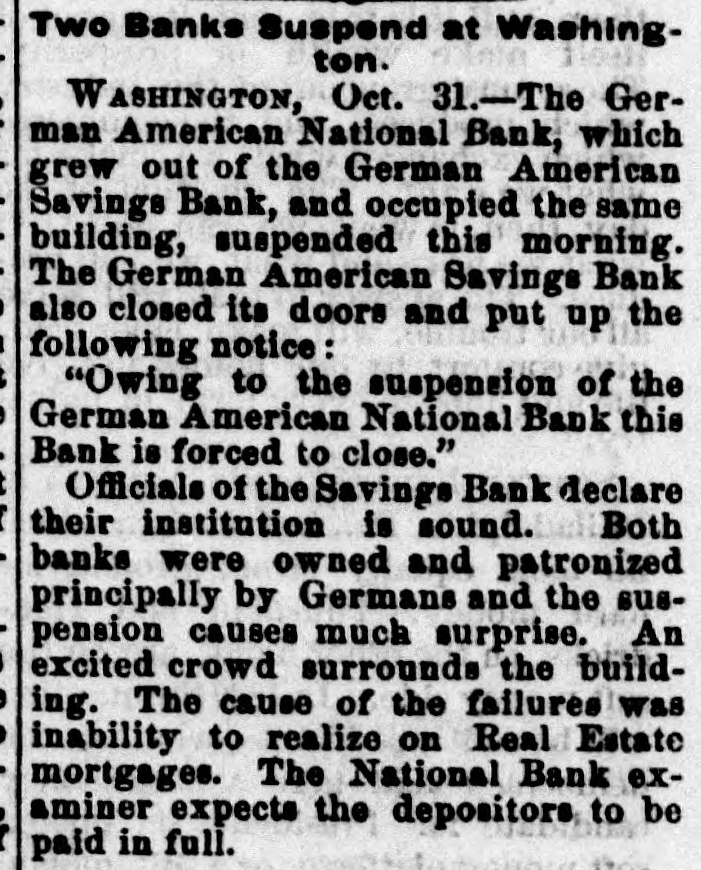
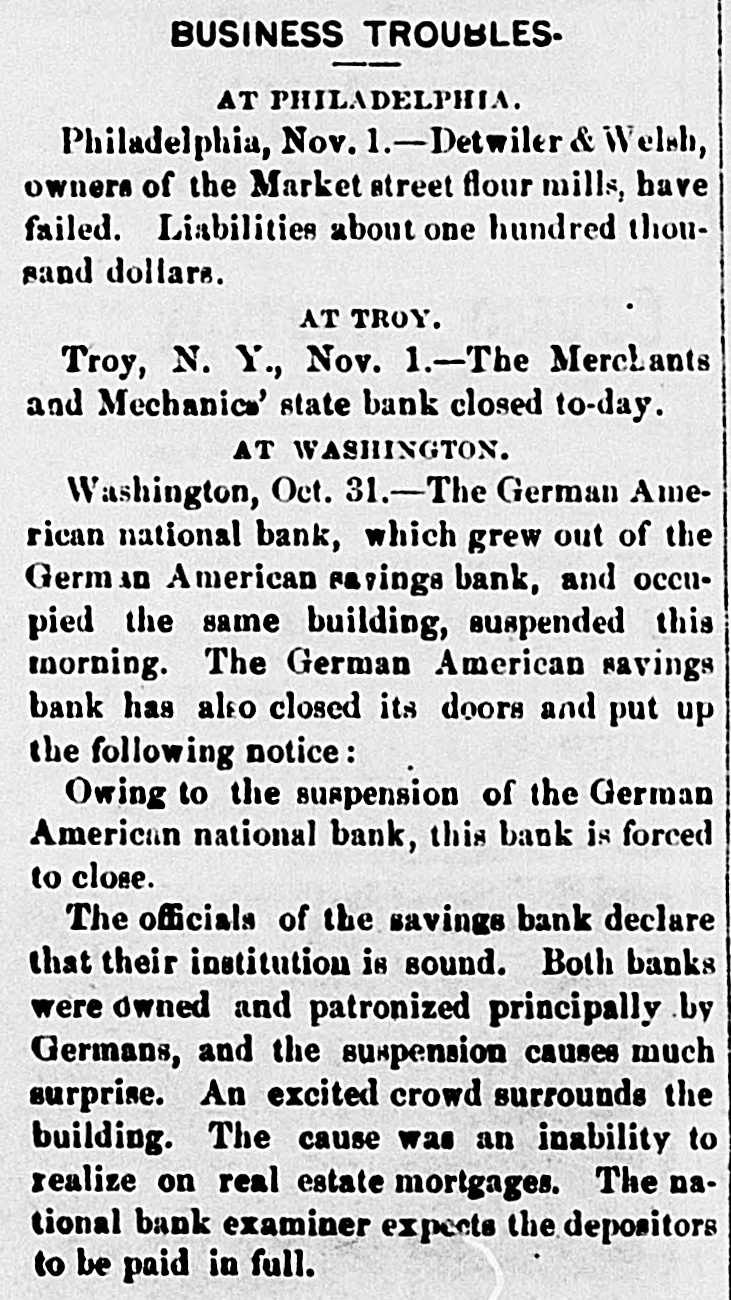
BUSINESS TROUBLES. AT PHILADELPHIA. Philadelphia, Nov. 1.-Detwiler & Welsh, owners of the Market street flour mills, have failed. Liabilities about one hundred thousand dollars. AT TROY. Troy, N. Y., Nov. 1.-The MercLants and Mechanics' state bank closed to-day. AT WASHINGTON. Washington, Oct. 31.-The German American national bank, which grew out of the German American ravings bank, and occupied the same building, suspended this morning. The German American savings bank has also closed its doors and put up the following notice: Owing to the suspension of the German American national bank, this bank is forced to close. The officials of the savings bank declare that their institution is sound. Both banks were owned and patronized principally by Germans, and the suspension causes much surprise. An excited crowd surrounds the building. The cause was an inability to realize on real estate mortgages. The national bank examiner expects the depositors to be paid in full.


Article from The Cincinnati Daily Star, October 31, 1878

Click image to open full size in new tab

Article Text

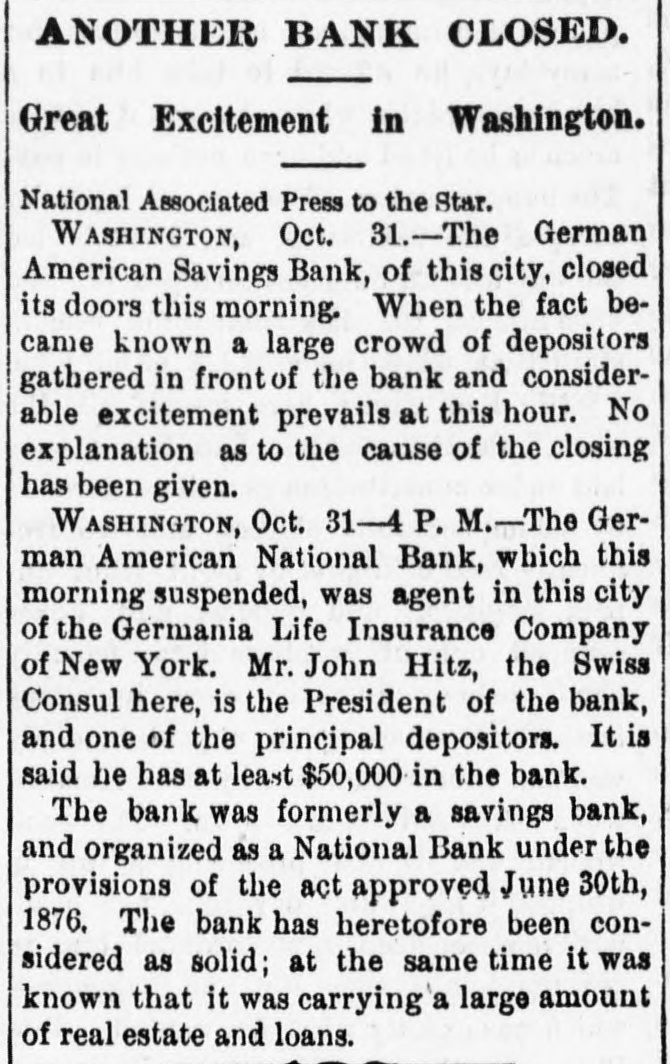
ANOTHER BANK CLOSED. Great Excitement in Washington. National Associated Press to the Star. WASHINGTON, Oct. 31.-The German American Savings Bank, of this city, closed its doors this morning. When the fact became known a large crowd of depositors gathered in front of the bank and considerable excitement prevails at this hour. No explanation as to the cause of the closing has been given. WASHINGTON, Oct. 31-4 P. M. .-The German American National Bank, which this morning suspended, was agent in this city of the Germania Life Insurance Company of New York. Mr. John Hitz, the Swiss Consul here, is the President of the bank, and one of the principal depositors. It is said he has at least $50,000 in the bank. The bank was formerly a savings bank, and organized as a National Bank under the provisions of the act approved June 30th, 1876, The bank has heretofore been considered as solid; at the same time it was known that it was carrying a large amount of real estate and loans.


Article from New-York Tribune, November 1, 1878

Click image to open full size in new tab

Article Text

THE CLOSING OF TWO BANKS. A SUSPENSION BY WHICH A NEW-YORK COMPANY AND MANY CLERKS IN WASHINGTON MAY LOSE. |GENERAL PRESS DISPATCH! WASHINGTON, Oct. 31.-The German-American National Bank, an institution which grew out of the German-American Savings Bank, suspended this morning. The German-American Savings Bank has also closed its doors and put up the following notice: 'Owing to the suspension of the German-American National Bank, this bank is forced to close." The German-American National Bank was organized May 14, 1877, with a capital of $130,000, and a circulation of $63,000. The president is John Hitz, the Swiss Consul-General in this city, and the cashier, Mr. C. E. Prentiss. The cause of the failure was the inability of the bank to realize upon mortgages upon real estate, in which it had a large amount of money invested. Controller Knox this morning detailed Examiner B. U. Keyser to investigate the affairs of the bank, and he is now in possession of the establishment. *After a hasty examination, he has stated that it is probable that the depositors will be paid in full. The German-American Savings Bank. which was run in connection with the National Bank, seems to have caused the trouble. It is said that if the National Bank had done its own legitimate business, it would have been solvent to-day; but the savings-bank loans on real es. tate, which the law forbids a National Bank to make, was the cause of the trouble. The National Bank was not a Government depository, and therefore DO United States funds were in it. Quite a number of Government clerks, however, had deposits there. The bank bas paid no dividend for the last eighteen months. "Jerry," the president's coachman, lost his savings, $450. The bank was the agent of the Germania Life Insurance Company, of New-York, and that company will lose heavily, it is thought about $30,000 or $35,000. The last statement of the bank made to the Controller of the Currency was on the 12th inst. It showed that the resources were $531,9170 The individual deposits at the time were $303,447 07. The officers of the banks promise to make a statement to-morrow covering the actual condition of both the National bank and the savings bank.


Article from The Cheyenne Daily Leader, November 1, 1878

Click image to open full size in new tab

Article Text

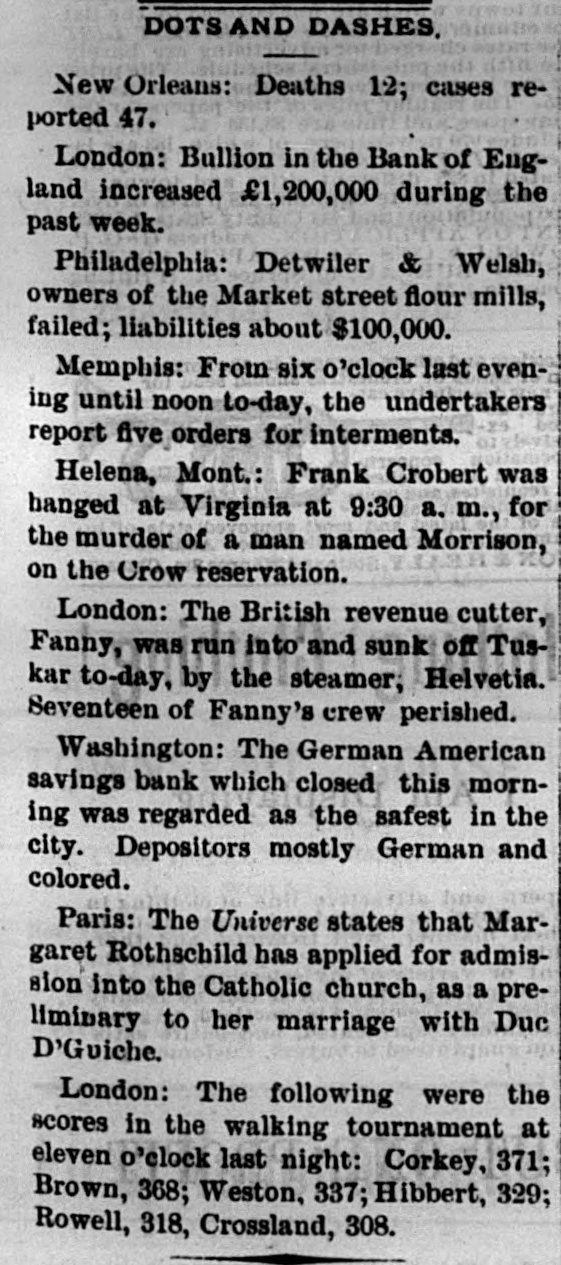
DOTS AND DASHES, New Orleans: Deaths 12; cases reported 47. London: Bullion in the Bank of Eugland increased Β£1,200,000 during the past week. Philadelphia: Detwiler & Welsh, owners of the Market street flour mills, failed; liabilities about $100,000. Memphis: From six o'clock last evening until noon to-day, the undertakers report five orders for interments. Helena, Mont.: Frank Crobert was banged at Virginia at 9:30 a. m., for the murder of a man named Morrison, on the Crow reservation. London: The British revenue cutter, Fanny, was run into and sunk off Tuskar to-day, by the steamer, Helvetia. Seventeen of Fanny's crew perished. Washington: The German American savings bank which closed this morning was regarded as the safest in the city. Depositors mostly German and colored. Paris: The Universe states that Margaret Rothschild has applied for admission into the Catholic church, as a preliminary to her marriage with Duc D'Guiche. London: The following were the scores in the walking tournament at eleven o'clock last night: Corkey, 371; Brown, 368; Weston, 337; Hibbert, 329; Rowell, 318, Crossland, 308.


Article from The Wheeling Daily Intelligencer, November 1, 1878

Click image to open full size in new tab

Article Text

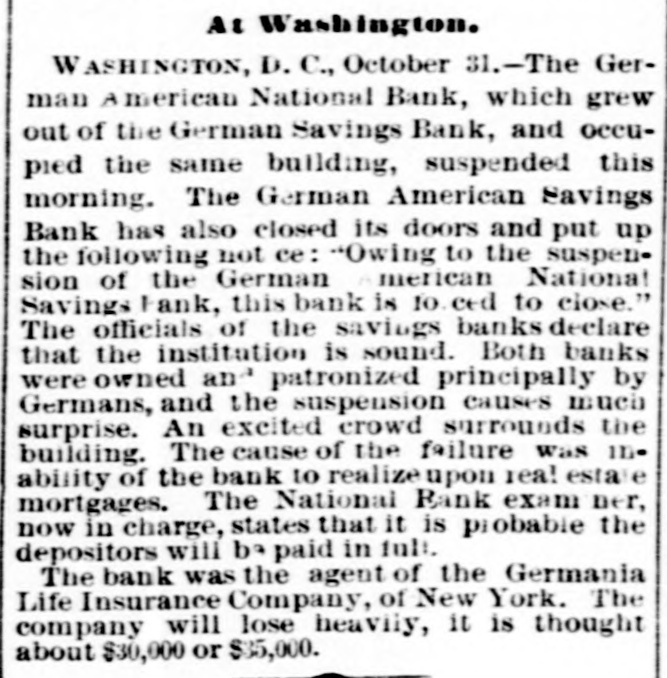
COMMERCIAL AND FINANCIAL BANK SURPENSION. WASHINGTON, October31.-The GermanAmerican National Bank, which grew out of the German Savings Bank, and occupied the same building, suspended this morning. The German-American Savings Bank has also closed its doors and put up the following notice: "Owing to the suspension of the German-American National Bank, this bank is forced to close." The officials of the Savings Bank declare that their institution is sound. Both banks were owned and patronized principally by Germans, and the suspension causes much surprise. An excited crowd surrounds the building. The cause of the failure was the inability of the bank to realize upon real estate mortgages. The National Bank Examiner, now in charge, states it is probable that the depositors will be paid in full. DETWILER & co. PHILADELPHIA, October 31.-Detwiler & Co., owners of the Market street flour mills, have failed. Liabilities $100,000. LONDON, October 31.-The liabilities of Thompson & Nephew, timber merchants, are Β£60,000. FAILURE OF J. A. HEMANN & CO. CINCINNATI, October 30.-The banking house of Jns. A. Hemann & Co. closed doors this afternoon. All demands upon the bank were paid over the counter up to S o'clock, but their accounts at the clearing house were not adjusted and at 5 P. M. a deputy from the sheriff's office served an attachment, issued at the instance of John Berger for $1,140. He attached the fixtures of the bank and also the household furniture of Hemann at his residence. It is said that Archbishop Purcell and his brother are not depositors, and have not been for several months. The report that the Volksfreund newspaper is any ways concerned is untrue; that concern losing nothing. Mr. Hemann has had no interest in that paper for fifteen years. The bank has been paying 6 per ct. interest on deposits, and has experienced some heavy losses. Last May the deposits amounted to $3,520,000. There was a run then, but the bank survived it. There has been a steady decline lately, and the suspension was inevitable. The firm decline to make a statement of the assets and liabilities. The latter are very heavy, and it is variously stated that they are about $75,000, or as high as $250,000.


Article from Knoxville Daily Chronicle, November 1, 1878

Click image to open full size in new tab

Article Text

WASHINGTON. ASHINGTON, Oct. 31.-The German-American National Bank of this city has failed, but it is thought depositors will be paid in full. Owing to the suspension of the German-American National Bank of this city, the German-American Savings Bank has also suspended. Both of these banks were owned and patronized principally by Germans. The suspension caused much surprise. The President of the German-American National Bank is John Hitz, the Swiss Consul General in this city. The shrinkage in real estate value in which both banks were largely interested caused the failure. The President has issued a proclamation appointing Thursday, the 28th of November as a day of thanksgiving and prayer. The State Department is advised that an International Exhibition will be held in Melbourne commencing Octoher, 1880. Parliament has voted $300,000 for the erection of the necessary buildings. The United States Consul at Tangier sends to the State Department an account of the fearful ravages of the cholera in the interior of Morocco. Business is almost completely paralyzed. The cholera is sweeping over the middle and Southern provinces. Hundreds are dying of starvation. Never before has Morocco passed through such a fearful ordeal.


Article from The Sun, November 1, 1878

Click image to open full size in new tab

Article Text

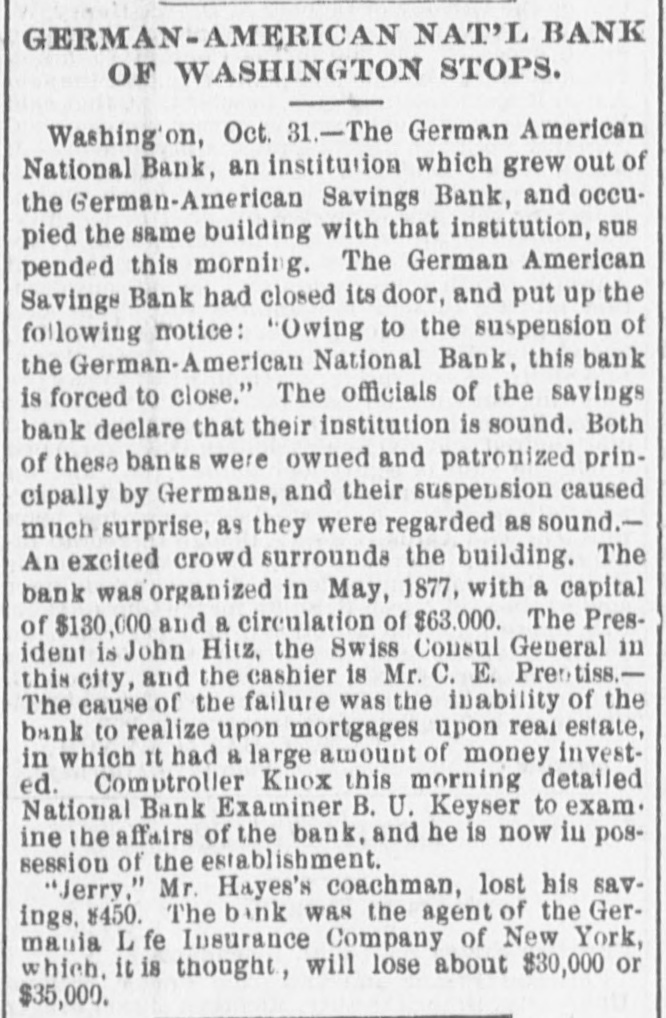
The German-Ameriean National Bank of Washington Closing its Doors. WASHINGTON, Oct. 31.-The German-American National Bank, an institution which grew out of the German American Savings Bank. and occupied the same building with that institution, suspended this morning. The German-American Savings Bank had also closed its door. and put up the following notice: Owing to the suspension of the German American National Bank, this bank is forced to close." The offi ials of the savings bank declare that their institution is sound. Both of these banks were owned and patronized principally by Germans, and their suspension caused much surprise, as they were regarded as sound. Anexcited crowd surr unds the building. The bank was organized in May, 1877. with a capital of $130,000 and a circulation of $63,000. The President is John Hitz. the Swiss ConsulGeneral in this city. and the cashier is Mr. C. E. Prentiss. The cause of the failure was the inability of the bank to realize upon mortgages upon real estate. in which it had 11. large amount of money invested. Comptroller Knox this morning detailed National Bank Examiner B. U. Keyser to examine the affairs of the bank, and he is now in possession of the establishment. "Jerry," Mr. Hayes's coachman. lost his savings, $450. The bank was the agent of the Germania Lite Insurance Company of New York, which, it is thought, will lose about $30,000 or $35,000.


Article from Eureka Daily Sentinel, November 1, 1878

Click image to open full size in new tab

Article Text

EASTERN NEWS. NIGHT DISPATCHES. |SPECIAL TO THE EUREKA DAILY SENTINEL.] Opinions in Regard to General Pope's Evasion of the Sammous to Testify. NEW YORK, October 31. The generally accepted view of fairminded military men, and civilians, condemn General Pope's evasion of the summons to testify in the Fitz-John Porter case. The "Herald" declares that he acted very unwisely for his own reputation, and intimates that Pope, as the instigator of the original trial, here confesses that it would be awkward for him to attempt to support his former testimony. The "World" also says his refusal has given very strong evidence against himself. The Board's emphatic decision admitting in evidence all the documentary statements affecting the Porter case, written by Pope and filed in the War Department. will establish a wide and important conflict between Pope's statements at different times. which his refusal to testify now debars him from the opportunity to reconcile. The decision giving Porter's counsel the closing argument in the case was based on the fact that Porter has the affirmative in the issue, as the onus rests upon him of showing that his former conviction was in error. A Woman Chloroformed and Robbed NEW YORK, October 31. Mrs. Clarence Ogden, of 299 Fifth Avenue, was discovered in her bed at 9 o'clock Monday morning. insensible. Her wrists were bound together with cords, and her mouth gagged. She had been chloroformed by two masked men, who succeeded in carrying off $800 in money, a clock and a quantity of jewelry. The diamond from one ring they cut from the settings, not being able to get it from the lady's finger. Mrs. Ogden did not recover consciousness until 11 o'clock in the day. There is no clue to the burglars. Mrs. Ogden keeps a boarding at the number in question, and her husband was not at home at the time of the burgiary. A Cattle Man Killed by Baldy Ford. DEADWOOD, D. T., October 31. A Texas cattle man, named Russell, was shot and instantly killed by "Baldy Ford," at Sturgis City, 14 miles from here, on Tuesday night. Russell was engaged in playing cards, when Ford entered the saloon, with the remark that he was the best man in the house. Russell took offense at this, and sprang to his feet with the intention of having a fist fight, but before he could close, Ford pulled a pistol and discharged the entire six shots at Russell, the first entering his left eye and the others taking effect in his body. Ford was subsequently arrested and is now in jail here. He bears a very bad reputation, having been frequently in difficulties. The Appointment of Dr. Gilvoly. NEW YORK, October 31. Pope Leo XIII. has appointed Doctor Gilvoly to the position of Apostolic Delegate from the Holy See to the United States and Canada. The statement that the Pontifical Secretary of State will consult the British Government before appointing Cardinal Cullen's successor, recalls the former report that an understanding has already been arrived at between Great Britain and the Vatican, with the view of suppressing Irish disaffection. The appointment therefore, is expected to have an important political significance. Suspension of the German-American Savings Bank. WASHINGTON, October 31. The German-American National Bank, which grew out of the German-American Savings Bank, and occupied the same building, suspended this morning. The German-American Savings Bank has also closed its doors, and put up the following notice: "Owing to the suspension of the German-American National Bank, this bank is forced to close." The officials of the Savings Bank declare that their institution is. sound. Both banks were owned and patronized principally by Germans, and the suspension causes much surprise. Excited crowds surround the building. The Epidemic at an End. NEW ORLEANS, October 31. It is probable that the Board of Health will declare the epidemic at an end tomorrow, as the deaths from other causes exceed those from the fever. Barnum for Butler. NEW YORK, October 31. a United States Senator Barnum, in speech at Hartford last night, said that if he was a citizen of Massachusetts, he should vote for Ben Butler.


Article from The Daily Dispatch, November 1, 1878

Click image to open full size in new tab

Article Text

Washington Items. W ASHINGTON, October 31.-The President has issued a proclamation appointing Thurs. day the 28th of November as a day of thanksgiving and prayer. Owing to the suspension of the GermanAmerican National Bank, of this city, the German-American Savings Bank has also suspended. Both banks were owned and patronized principally by Germans." The suspensions have caused much surprise. The president of the first-named bank is John Hitz, the Swiss consul-general in this city. The shrinkage in real estate value, in which both banks are largely interested, caused the failure. The State Department is advised that an international exhibition will be held in Melbourne, commencing in October, 1880. The Parliament bas voted $300,000 for the erection of the necessary buildings. The United States Consul at Tangiers sends to the State Department an account of the fearful ravages of the cholera in the interior of Morocco. Business is almost completely paralyzed. The disease is sweeping over the middle and southern provinces. Hundreds are dying of starvation. Never before has Morocco passed through such a fearful ordeal.


Article from National Republican, November 2, 1878

Click image to open full size in new tab

Article Text

THE GERMAN-AMERICAN BANKS. A Government Receiver Appointed-The Savings Bank Said to be Solvent. The doors of the German-American banks were closed yesterday and the curtains drawn so that the public could not see what was going on inside. Comptroller of the Currency Knox yesterday appointed Mr. B. U. Keyser receiver of the GermanAmerican National Bank. Mr. Keyser took charge yesterday E.S receiver, and began immediately the work of preparing a statement. It is expected that the statement, showing the actual condition of the affairs of the bank, will be made public in two or three days. The present indications are that the depositors will be paid in full. $ THE SAVINGS BANK. A meeting of the directors of the savings bank was held yesterday and a preliminary examination made. The assets were found perfectly good and sufficient to meet all liabilities. Mr. Mattingly, the secretary, was directed to prepare a statement of the affairs of the bank. The officers state positively that there is no need of alarm. They have a right to take advantage of the law requiring depositors togive sixty days n otige before drawing out their deposits, and it is probable that no more time than that will be required to settle the bank's affairs. The real-estate loans made by the bank were made on wide margins, and nothing will be lost. It does not seem probable now that the bank will resume business: but, judging from what is said by the officers, the affairs of the institution are in such a shape that business could be resumed immediately. provided public confidence was entirely restored. The bank was not obliged to close on account of any trouble in its own affairs, but the action was made necessary by the suspension of the national bank, the natural con equence of which would have been a run on the savings bank. The statement that the Germania Life Insurance Company loses heavily by the suspension of the national bank is incorrect. The bank was not the agent of the company, but simply its Washington depository. Its deposits at the time of the suspension amounted to but $342.41, instead of $80,000, as stated.


Article from The Redwood Gazette, November 14, 1878

Click image to open full size in new tab

Article Text

preparing for ultimate hostilities. A resolution was offered in the lower house of the Hungarian Diet, on the 30th -UIN the jo the Sujsodord "un = Artst A Copenhagen (Denmark) dispatch of the 30th ult. announces the formal bethrothal of Princess Thyra to the Duke of Cumberland. u The Philadelphia Press of the 31st ult. publishes a sworn statement of James E. "I 3 This Jo 4 Weber was bribed to testify before the Potter P JOJ mjy plud uns the that pus Committee '000'01$ SUM terminant have From the monthly statement of the Chief of the Bureau of Statistics to the Secretary of the United States Treasury the excess of exports over imports of merchandise appears to have been as follows: Month ending Sept. 30, 1877, $15,508,339; month ending Sept. 30, 1878, $20,525,267; nine months ending '8281 thin sures '22SI 'OR radag $309,130,487. The excess of imports over expus ) stiver pus plos jo strod were as follows: Month ending Sept. 30, 1877, $756,771; do, 1878, $923,703. The excess of exports over imports of gold and silver (coin and bullion) during the nine months ending je the SUM 12281 '08 das imports over exports ot the same commodities during the same time in 1878 amounted 01 A Washington telegram of the 31st ult. says Mr. Gibson declares that statements made by James E. Auderson in his recent affidavit affecting him (Gibson) are false; he never heard of the things of which Anderson speaks. Maddox and Sypher also pronounce the statement made by Anderson relating to them to be false. The Prophetic Conference, called in the interest of those of all religious denominations who believe in the pre-millennial coming of Christ, assembled at the Church of the Holy Trinity, in New York, on the 30th ult. William Reynolds, of Peoria, presided. Papers were read relative to the future advent of the Savior, by Stephen H. Tyng, Jr., Prof. Kellogg, of Allegheny, Pa., and from Rev. Dr. ug present eq 01 unable SUM oum "ug "Suil person, because of illness. In the evening the church was crowded to its utmost capacity. There was a large increase of delegates on the 31st. Several papers were read, and, in the evening, Rev. Dr. Goodwin, of Chicago, addressed a vast congregation, expressing his firm conviction that the pre-millennial coming of Christ was the clear and unmistakable teaching of the Word of God. A St. Petersburg dispatch of the 31st ult. says the Russian Army in Turkey is to be "use 000'00% 01 ] On the 31st ult., the British revenue cutter Fanny was run into off Tuskar and sunk by the steamer Helvetia. Seventeen of the Fanny's crew perished. The German-American National and the German-American Savings Banks of Washington, D. C., failed on the 31st ult. The Merchants' and Mechanics' State Bank of *pepuedens OS[E "X N 'fout that safe pg the JO Sinth V England's ultimatum required that the Ameer's reply should reach,Peshawur by Nov. 20. Otherwise the British forces would immediately invade Afghanistan. A Pesth (Hungary) telegram of the 2d says the British note, protesting against the Russian movement in Turkey, was presented at St. Petersburg, on the 24th ult. The note expresses the hope that Russia would soon be able to resume the withdrawal of her troops, and that they would not pass the line which date B your SE then pay would compel England to take precautions. The majority of the Reichsrath Committee, in reply to a speech of the Emperor, on the 1st, adopted an address, in which Count Andrassy is censured for not consulting the Reicherath on his Eastern policy. -sny safe 411 the JO telefance Paris V sia and Germany had consented to act as medistore between Greece and the Porte. the says 411 the JO Simila V British ultimatum was placed in the hands of the commander of the Ameer's forces, on the 2d. It was reported there that Shere All was at Jellalabad, determined to attack the British troops near the Khyber Pass and Quettah, unless the latter took the initiative. THE YELLOW-FEVER SCOURGE. The relief-boat Chambers arrived at St. Louis, on the 29th. The officers and crew were all well. Lieut. Hall, commander of the boat since the death of Lieut. Benner, says the suffering of the people in the little towns on the river bank, and a few miles back, was very great, and demanded immediate attention. In some places the people were almost starving, food being scarce and the crops there very scant. says "IIn 1818 the Jo Catiro V nearly all the absentees from that city had returned, and business was resuming its wonted activity. The epidemic was unquestionably up polluts the II" Incred 18 not Sujip the South, the weather continuing cool. There were eight yellow-fever deaths in Memphis, during the twenty-four hours ending at six o'clock, on the evening of the 3d, and five the day before. One of the vicbeen psq oq.n refunder returned 8 SEM things home only one week, and was sick only three days. Considerable uneasiness was felt by other refugees in the city. The deaths in New Orleans, on the 3d, numbered nine; cases reported, fortyseven; total cases to date, 13,212; deaths, 3,954. It was not yet deemed safe for absentees to return to the city. One death in Vicksburg and two in the country adjoining occurred on the 3d. There were several new cases in the city. It us 98 the that peounous SEM SUM business pus 'pue us 18 Deactically SEM being rapidly resumed. Five new cases were reported in Jackson, Miss., on the 3d. The Mobile (Ala.) Board of Health considered it safe for refugees to return to that city. Two new cases were reported at Cha ttanooga, Tenn., on the 2d. Refugees were rapidly returning. Up to the 2d, the total number of deaths from yellow fever during the recent these JO 219'81 18 ΠΈΠΌΠΎΡ€ 198 SEM expedite Ken 18 801'8 MeN 18 persured 216'8 18 THE 228 18 81111 :spqd Isjno'I ns 18 18 ) 18 68 :sMujidg AlloH 18 3" 91 pus Ohio, JROU 68 Four deaths, and one new case were thire pus 'q2t the no up reported deaths beyond the corporate limits. Two deaths occurred at Cairo, and there were six cases in the infected district; the weather was mild and unfavorable. Thirty cases and four deaths in New Orleans. Nine cases and two deaths in Jackson, Miss., and three deaths in Vicksburg, and three in the adjoining country.
Article from Virginia Free Press, November 16, 1878

Click image to open full size in new tab

Article Text

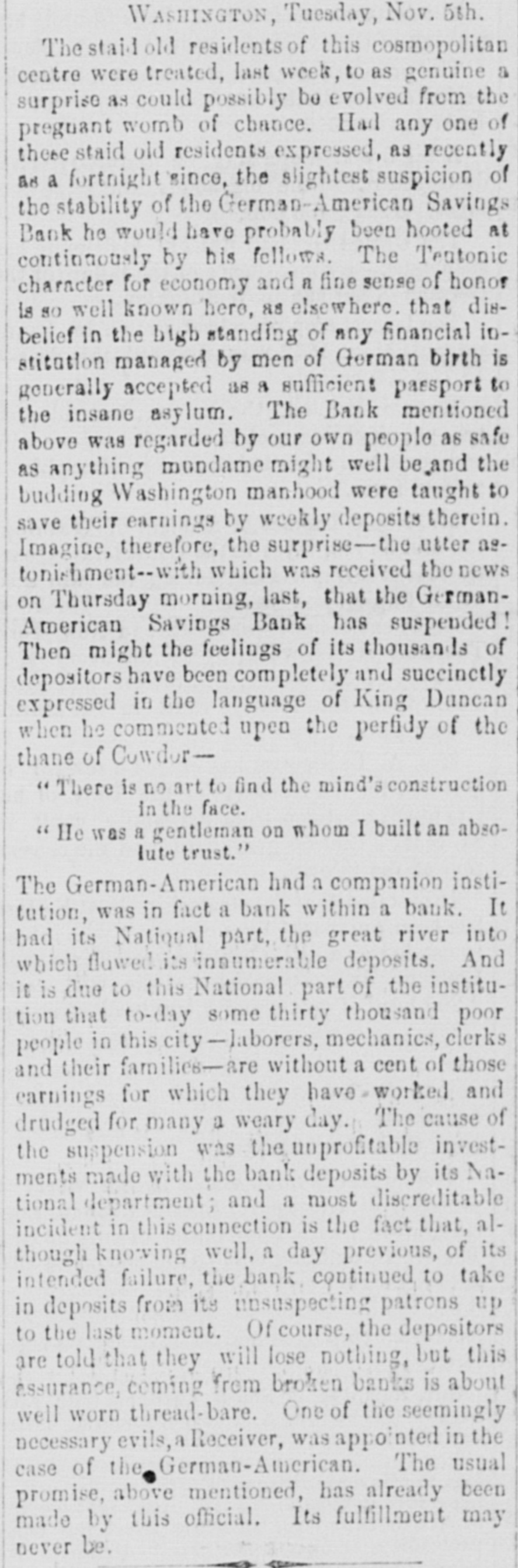
WASHINGTON, Tuesday, Nov. 5th. The staid old residents of this cosmopolitan centre were treated, last week, to as genuine a surprise as could possibly be evolved from the pregnant womb of chance. Had any one of these staid old residents expressed, as recently as a fortnight since, the slightest suspicion of the stability of the German-American Savings Bank he would have probably been hooted at continuously by his follows. The Teatonic character for economy and a fine sense of honor is so well known here, 88 elsewhere. that disbelief in the high standing of any financial institution managed by men of German birth is generally accepted as a sufficient passport to the insane asylum. The Bank mentioned above was regarded by our own people as safe as anything mondame might well be and the budding Washington manhood were taught to save their earnings by weekly deposits therein. Imagine, therefore, the surprise-t - the utter astonishment-with which was received the news on Thursday morning, last, that the GermanAmerican Savings Bank has suspended Then might the feelings of its thousands of depositors have been completely and succinctly expressed in the language of King Dancan when he commented upen the perfidy of the thane of CowderThere is no art to find the mind's construction in the face. " He was a gentleman on whom I built an absolute trust." The German-American had a companion institution, was in fact a bank within a bank. It had its National part, the great river into which flowed its innumerable deposits. And it is due to this National part of the institution that to-day some thirty thousand poor people in this city - -laborers, mechanics, clerks and their families-are without a cent of those earnings for which they have . worked and drudged for many a weary day. The cause of the suspension was the unprofitable investments made with the bank deposits by its National department; and a most discreditable incident in this connection is the fact that, although knowing well, a day previous, of its intended failure, the bank continued to take in deposits from its misuspecting patrons up to the last moment. Of course, the depositors are told that they will lose nothing, but this assurance coming from broken banks is about well word thread-bare. One of the seemingly necessary evils, a Receiver, was appointed in the case of the German-American. The usual promise, above mentioned, has already been made by this official. Its fulfillment may never be.