First National Bank (Attica, NY)

Episode Information

Episode UID
19900784
Episode Type
Suspension โ†’ Closure
Bank Type
national
Bank ID
1990 national
Charter Number
199
Start Date
April 1, 1865*
Location
Attica, New York (42.864, -78.280)

Metadata

Model
gpt-5-mini (chosen from majority vote of a three-model LLM ensemble)
Short Digest
c625d17b4e656d95

Response Measures

None

Receivership Details

Depositor recovery rate
58.0%
Date receivership started
1865-04-14
OCC cause of failure
Losses
Share of assets assessed as good
26.1%
Share of assets assessed as doubtful
14.4%
Share of assets assessed as worthless
59.4%

Description

Article of April 1865 reports a failure attributed to outside speculation; multiple June 1867 articles list the bank as in receivership.

Events (4)

1. January 14, 1864 Chartered
Source
historical_nic
2. April 1, 1865* Suspension
Cause
Bank Specific Adverse Info
Cause Details
Failure attributed in contemporaneous report to 'outside speculation' leading to collapse.
Newspaper Excerpt
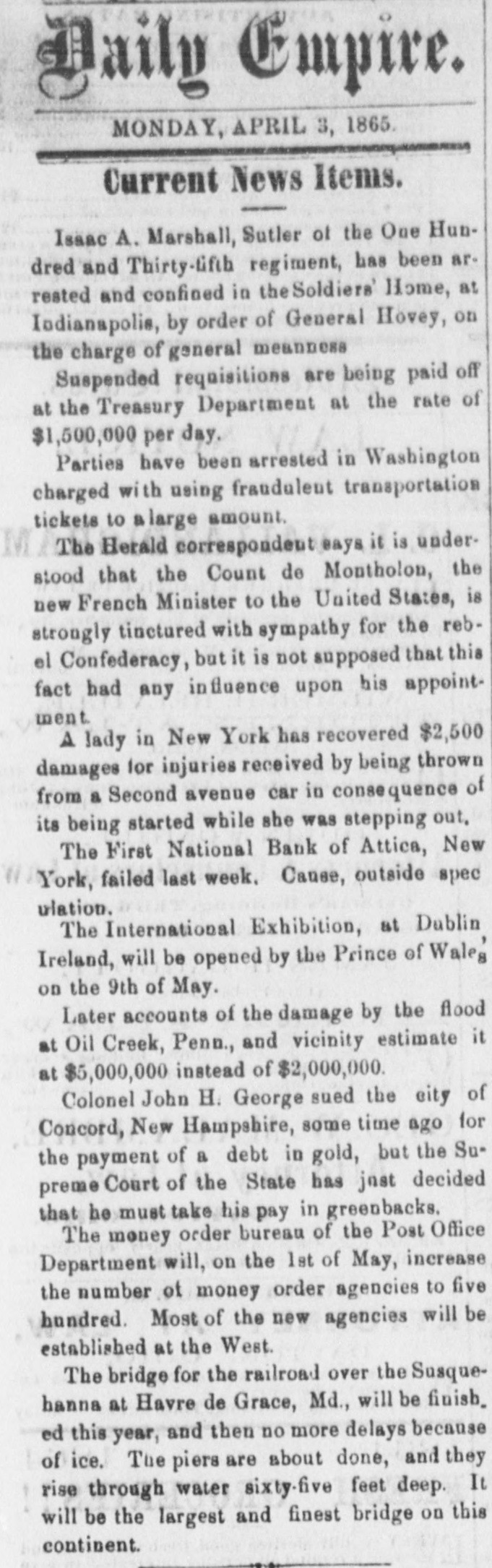
The First National Bank of Attica, New York, failed last week. Cause, outside spec ulation.
Source
newspapers
3. April 14, 1865 Receivership
Source
historical_nic
4. June 11, 1867 Receivership
Newspaper Excerpt
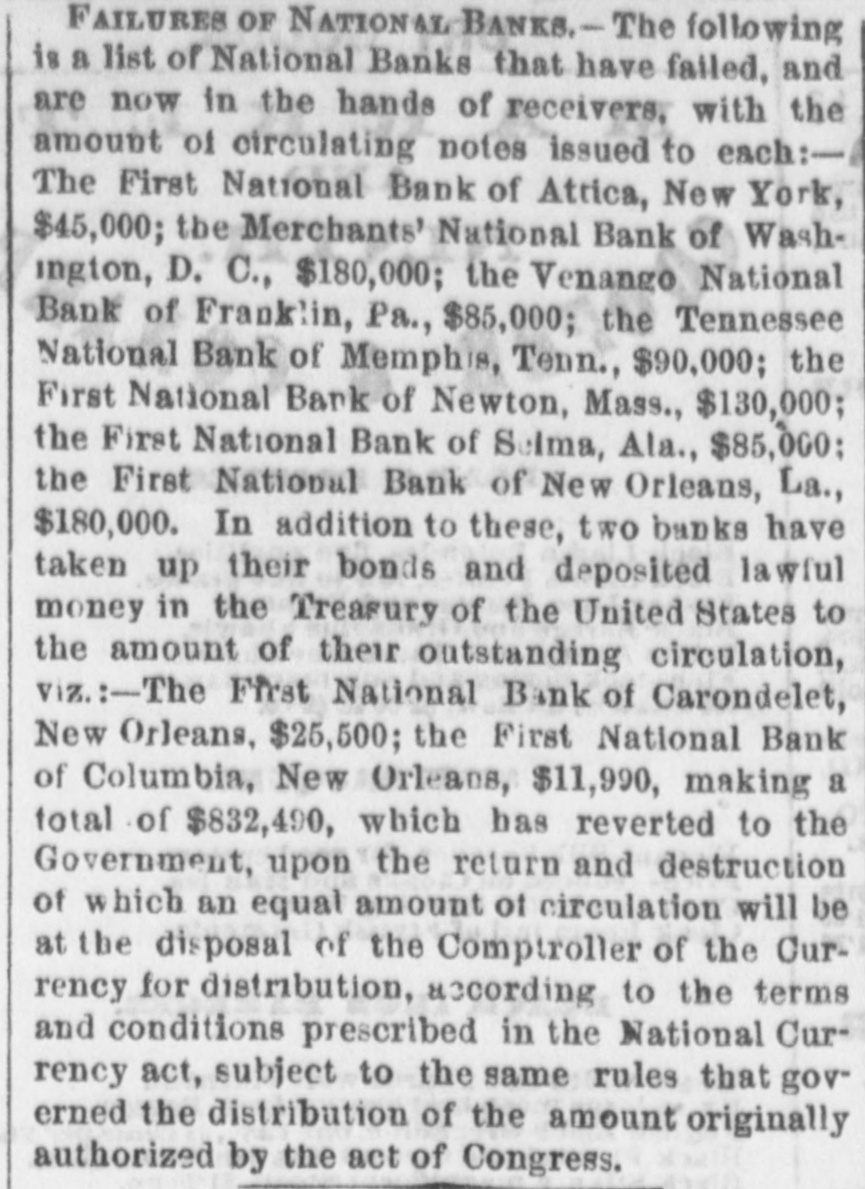
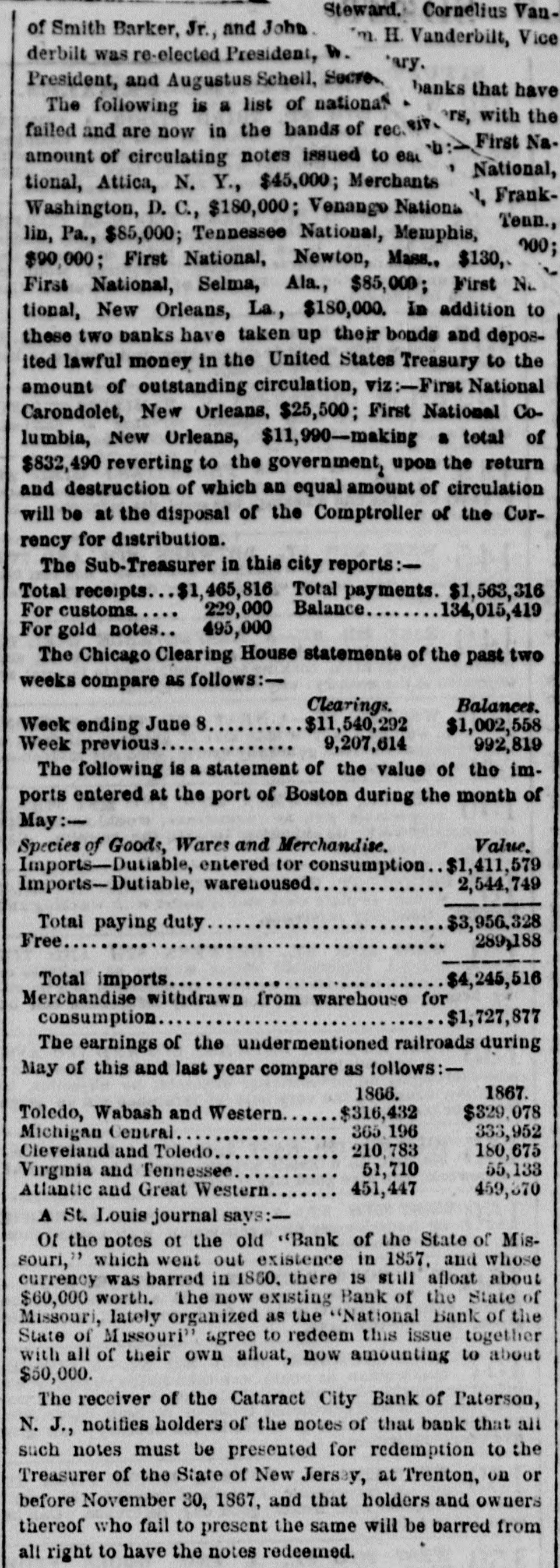
The following is a list of National Banks that have failed, and are now in the hands of receivers: The First National Bank of Attica, New York, $45,000; ...
Source
newspapers

Newspaper Articles (12)

Article from Dayton Daily Empire, April 3, 1865

Click image to open full size in new tab

Article Text

Daily Empire. MONDAY, APRIL 3, 1865. Current News Items. Issac A. Marshall, Sutler of the One Hundred and Thirty-fifth regiment, has been arrested and confined in the Soldiers' Home, at Indianapolis, by order of General Hovey, on the charge of general meanness Suspended requisitions are being paid off at the Treasury Department at the rate of $1,500,000 per day. Parties have been arrested in Washington charged with using fraudulent transportation tickets to alarge amount. The Herald correspondent says it is understood that the Count de Montholon, the new French Minister to the United States, is strongly tinctured with sympathy for the rebel Confederacy, but it is not supposed that this fact had any influence upon his appointment. A lady in New York has recovered $2,500 damages for injuries received by being thrown from a Second avenue car in consequence of its being started while she was stepping out, The First National Bank of Attica, New York, failed last week. Cause, outside spec ulation. The International Exhibition, at Dublin Ireland, will be opened by the Prince of Wale's on the 9th of May. Later accounts of the damage by the flood at Oil Creek, Penn., and vicinity estimate it at $5,000,000 instead of $2,000,000. Colonel John H. George sued the city of Concord, New Hampshire, some time ago for the payment of a debt in gold, but the Supreme Court of the State has just decided that he must take his pay in greenbacks. The money order bureau of the Post Office Department will, on the 1st of May, increase the number of money order agencies to five hundred. Most of the new agencies will be established at the West. The bridge for the railroad over the Susquehanna at Havre de Grace, Md., will be finish. ed this year, and then no more delays because of ice. The piers are about done, and they rise through water sixty-five feet deep. It will be the largest and finest bridge on this continent.


Article from The New York Herald, September 29, 1865

Click image to open full size in new tab

Article Text

FINANCIAL AND COMMERCIAL. THURSDAY, Sept. 28-6 P. M. The STOCK market showed signs of yielding at the commoncement of business this morning, and at the first board it was manifestly "top-heavy." Reading closed % lower than at the second board yesterday, Northwestern %, Rock Island 14. Fort Wayne ยฝ, Ohio and Mississippi certificates Hudson River was 1ยฝ higher, Michigan Southern 1/4, Cleveland and Pittsburg %, Cumberland %, Quicksilver %. Erie closed dull at 87% Pacific Mail scrip sold at 202. Government securities were heavy, partly in consequence of the anticipated issue of bonds for funding interest bearing notes and certificates of indebtedness. The board passed a resolution to call coupon five-twenties, ex the November coupon, on and after Monday, the 24 of October, which will have some effect in inducing holders to draw their interest. At the open board at one o'clock the market was lower on a portion of the list and steady on the remainder. At the second regular board it was dull, and New York Central closed ยฝ lower than at the first board, Erie % Michigan Southern %, Ohio and Mississippi certificates 1/2, Quicksilver 1/4, Cumberland %. Government securities were steady. Coupon ten-forties advanced 3/8. At the open board at half-past three the market was slightly irregular. Michigan Central advanced to 115, Ohio and Mississippi certificates to 28 1/2. New York Central sold at 95% (b. 3), Eric 87%, Hudson River (b. 3) 110%, Reading 113%, Michigan Southern 69 1/2, Cleve. land and Pittsburg (s. 3) 73, Cleveland and Toledo 108 ยฝ, Rock Island 1113/2, Northwestern preferred 62%, McGre: gor Western (s. 3) 19ยฝ, Ohio and Mississippi certificates 28%. Cumberland 461/2, Central Coal (b. 611/4. Government securites were dull on the street, and there was a fair business done over the counter in buying from outside parties. The buying quotations for compound interest notes were-June, 1053/4; July, 1041/2; August, 104; October, 103 December, 102. The brokers' speculation for a rise appears to have suffered a check, and the Indications favor lower prices. Nearly the whole "street" is "long" and overioaded, and it is evident that its capacity to carry more is limited. The market under such circumstances is likely to sink of its own weight. Added to this there is an uneasy feeling of apprehension prevailing as to what may be the effect of the action of the banks with regard to the interior national bank currency, combined with the expected funding of interest-bearing notes into five-twenty bonds. This is inducing increased caution among the banks, and there is more reluctance shown to accept commercial paper at sixty and ninety days. Short dates are much preferred at lower rates, and there is a still more decided preference of course for loans at call at a 6 per cent. The supply of funds for the latter purpose is abundant, but the discount line is active, and there is more paper of all kinds offering. The best grade passes at per cent, and the second at 9 10. It is not probable, however, that the decline in stocks will be very considerable, nor that it will be uncontested by the "bull" element, which includes nearly all the "rag, tag and bobtail" of the street and several influential houses, the prevailing disposition of the great majority being to speculate for: rise. The petroleum stock market partially recovered from the extreme dulness of yesterday. At the first board Webster sold at $1 27, or 7c. higher than at the same time yesterday; Buchanan Farm $1 06, or 2c. higher; Oil Creek 81 90, or 10c. lower. At the second board prices wore 3c. a 9c. higher, Oil Creek excepted, which declined 25c., closing at $1 90; Webster sold at $1 28, Montana $8 50, Buchanan Farm $1 17. Pithole Creek $8 15, Excelsior 68c., Germania 34c., First National 22c, United States $27 25. Gold was firm, but the supply was easier, owing the Sub-Treasury disbursements, and loans were made at 1-32 per day. The opening price was 144ยฝ, from which there was drop to 143%, between which and 144 the market vibrated during the rest of the day, closing at 144. The steamer Cuba, it is reported, brings ยฃ20,000 in specie-a rather anomalous importation at the present time, and probably designed for some special purpose. Foreign exchange was inactive and heavy. The leading drawers continue to ask 109% but there are no transactions for considerable sums above 109%. An argument is furnished in favor of the national currency redemption scheme now under consideration by the failure of the First National Bank of Attica, New York, and the American National Bank of Hallowell, Maine, each with a capital of fifty thousand dollars. The notes or these insolvent institutions are worthless for circulation, but the National Currency act provides for their payment at the Treasury when the bank issuing the same fails to redeem them in legal tender notes on presentation. The Comptroller of the Currency is required, within thirty days after he has received notice of a failure, to declare the bonds and securities pledged by the defaulting bank forfeited to the United States. "And," continues the act, "thereupon the Comptroller shall immediately give notice, in such manner as the Secretary of the Treasury shall by general rules or otherwise direct, to the holders of the circulating notes of such association to present them for payment at the Treasury of the United States, and the same shall be paid, as presented, in lawful money of the United States; whereupon said Comptroller may, in his discretion, cancel an amount of bonds pledged by such association equal at current market rates not exceeding par to the notes paid. And it shall be lawful for the Secretary of the Treasury from time,to time to make such regulations respecting the disposition to be made of such circulating notes after presentation thereof for payment as aforesaid, and respecting the perpetuation of the evidence of the payment thereof, as may seem to him proper but all such notes on being paid shall be cancelled. And for any deficiency in the proceeds of the bonds pledged by such association, when disposed of as hereinafter specified, to reimburse to the United States the amount SO expended in paying the circulating notes of such association, the United States shall have a first and paramount lion upon all the assets of such association, and such deficiency shall be made good out of such assets in preference to any and all other claims whatsoever, except the necessary costs and expenses of administering the same. It is, however, clear that in the interval between the failure of a bank and the payment of its notes by the Treasury the holders of the same would be saddled with So much unproductive property, and that more or less inconvenience and loss to themselves would be the result. But a bank accustomed to redeem its notes at some central point would be likely even in the event of failure to have a reserve sufficient to pay off its notes, however badly its depositors might fare, and the fact of its having to keep its notes in good credit at the financlal centres would prevent its affairs running without discovery to that extremity of hopeless insolvency which, in the absence of the redemption system, it might easily reach. The coupons of the second mortgage bonds of the Milwaukee and St. Paul Railway Company, due October 1, 1865, will be paid on and after that date at the office of the company, 25 William street. In our reference to the tax on promissory notes, in Wednesday's issue, we were made to state the tax at fifty cents per thousand, instead of ten thousand dollars. The business at the Sub-Treasury to-day was as follows:$362,000 Receipts for customs. 1,080,042 Total receipts 1,536,997 Payments 70,437,173 Balance. 204,000 Subscriptions to government loan The following table shows the amount of coal shipped by three different routes' this season compared with
Article from The Evening Telegraph, June 11, 1867

Click image to open full size in new tab

Article Text

FAILURES OF NATIONAL BANKS. - The following is a list of National Banks that have failed, and are now in the hands of receivers, with the amount of circulating notes issued to each:The First National Bank of Attica, New York, $45,000; the Merchants' National Bank of Washington, D. C., $180,000; the Venango National Bank of Franklin, Pa., $85,000; the Tennessee National Bank of Memphis, Tenn., $90,000; the First National Bark of Newton, Mass., $130,000; the First National Bank of Selma, Ala., $85,000; the First National Bank of New Orleans, La., $180,000. In addition to these, two banks have taken up their bonds and deposited lawful money in the Treasury of the United States to the amount of their outstanding circulation, viz. : - The First National Bank of Carondelet, New Orleans, $25,500; the First National Bank of Columbia, New Orleans, $11,990, making a total of $832,490, which has reverted to the Government, upon the return and destruction of which an equal amount of circulation will be at the disposal of the Comptroller of the Currency for distribution, according to the terms and conditions prescribed in the National Currency act, subject to the same rules that governed the distribution of the amount originally authorized by the act of Congress.


Article from The New York Herald, June 11, 1867

Click image to open full size in new tab

Article Text

Steward. Cornelius Vanof Smith Barker, Jr., and John H. Vanderbilt, Vice derbilt was re-elected President, W. ary. President, and Augustus Scheil, Secre banks that have The following is a list of national rs, with the Bive failed and are now in the bands of rec. First Na. amount of circulating notes issued to eac National, tional, Attica, N. Y., $45,000; Merchants FrankWashington, D. C., $180,000; Venango Nationa Tenn., lin, Pa., $85,000; Tennessee National, Memphis, 200; $90,000; First National, Newton, Mass., $130, First National, Selma, Ala., $85,000; First N tional, New Orleans, La, $180,000. In addition to these two banks have taken up their bonds and deposited lawful money in the United States Treasury to the amount of outstanding circulation, viz:-First National Carondolet, New Orleans, $25,500; First National Columbia, New Orleans, $11,990-making a total of $832,490 reverting to the government, upon the return and destruction of which an equal amount of circulation will be at the disposal of the Comptroller of the Currency for distribution. The Sub-Treasurer in this city reports:Total receipts $1,465,816 Total payments. $1,563,316 For customs. 229,000 Balance 134,015,419 495,000 For gold notes The Chicago Clearing House statements of the past two weeks compare as follows:Balances. Clearings. $11,540,292 Week ending June 8 $1,002,558 9,207,614 Week previous 992,819 The following is a statement of the value of the imports entered at the port of Boston during the month of May:Value. Species of Goods, Wares and Merchandise. Imports-Dutiable, entered tor consumption $1,411,579 2,544,749 Imports-Dutiable, warehoused $3,956,328 Total paying duty Free 289,188 Total imports $4,245,516 Merchandise withdrawn from warehouse for $1,727,877 consumption The earnings of the undermentioned railroads during May of this and last year compare as follows:1867. 1866. $329,078 $316,432 Toledo, Wabash and Western 365,196 333,952 Michigan Central Cleveland and Toledo 210,783 180,675 51,710 55,133 Virginia and Tennessee Atlantic and Great Western 451,447 459,370 A St. Louis journal says:or the notes of the old "Bank of the State of Missouri, " which went out existence in 1857, and whose currency was barred in 1860, there 18 still afloat about $60,000 worth. The now existing Bank of the State of Missouri, lately organized as the "National Bank of the State of Missouri" agree to redeem this issue together with all of their own afloat, now amounting to about $50,000. The receiver of the Cataract City Bank of Paterson, N. J., notifies holders of the notes of that bank that all such notes must be presented for redemption to the Treasurer of the State of New Jersey, at Trenton, on or before November 30, 1867, and that holders and owners thereof who fail to present the same will be barred from all right to have the notes redeemed.


Article from The Daily Dispatch, June 12, 1867

Click image to open full size in new tab

Article Text

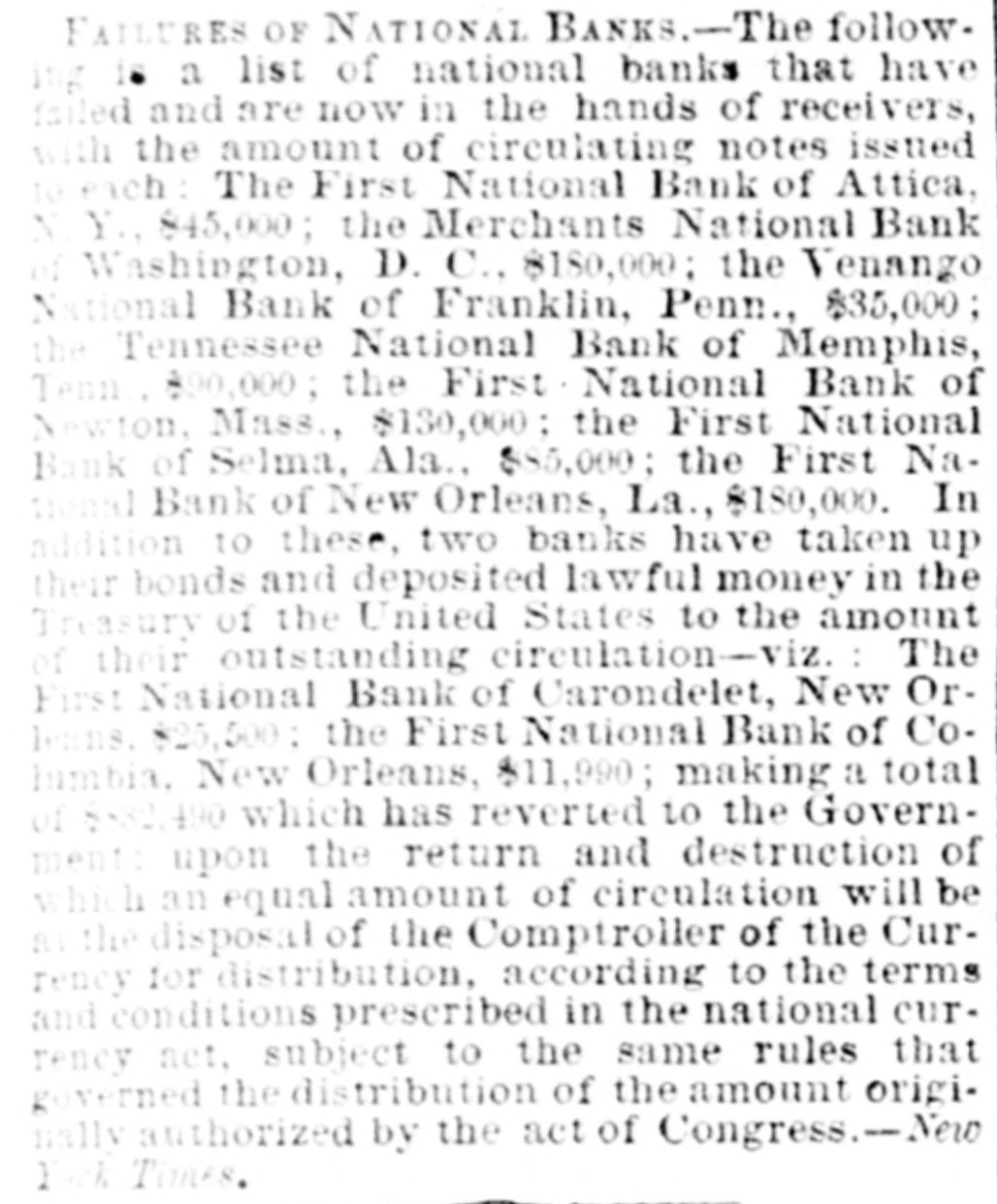
FAILURES OF NATIONAL BANKS.-The followis a list of national banks that have and are now in the hands of receivers, the amount of circulating notes issued each The First National Bank of Attica, Y., 845,000; the Merchants National Bank Washington, D. C. $180,000; the Venango National Bank of Franklin, Penn., $35,000; Tennessee National Bank of Memphis, Tenn $90,000; the First National Bank of Newton Mass., $130,000; the First National of Selma, Ala. $85,000; the First NaBank tional Bank of New Orleans, La., $180,000. In addition to these, two banks have taken up their bonds and deposited lawful money in the Treasury 01 the United States to the amount of their outstanding circulation-viz. : The First National Bank of Carondelet, New Orleans. $25,500 the First National Bank of Co. lumbia. New Orleans, $11,990; making a total $582,490 which has reverted to the Governupon the return and destruction of equal amount of circulation will be althe disposal of the Comptroller of the Currency for distribution, according to the terms and conditions prescribed in the national currency net. subject to the same rules that governed the distribution of the amount origimally authorized by the act of Congress.-New 1 to


Article from Rutland Weekly Herald, June 13, 1867

Click image to open full size in new tab

Article Text

NATIONAL BANK FAILURES.-' - The following is a list of National Banks that have failed, and are now in the hands of Receivers, with the amount of circulating notes issued to each The First National Bank of Attica, New York, $45,000; the Merchants' National Bank of Washington, D. C., $180,000; the Venango National Bank of Franklin, Penn., $85,000; the Tennessee National Bank of Memphis, Tenn., $90,000; the First National Bank of Newton, Mass., $130,000; the First National Bank of Selma, Ala., $85,000; the First National Bank of New Orleans, La., $180,000. In addition to these two banks have taken up their bonds and deposited lawful money in the Treasury of the United States to the amount of their outstanding circulation, viz : The First National Bank of Carondelet, New Orleans, $25,500; the First National Bank of Columbia, New Orleans, $11,990, making a total of $832,490 which has reverted to the Government, upon the return and destruction of which an equal amount of circulation will be at the disposal of the Comptroller of the Currency for distribution, according to the terms and conditions prescribed in the National Currency Act, subject to the same rules that governed the distribution of the amount originally authorized by the act of Congress.


Article from Daily Ohio Statesman, June 14, 1867

Click image to open full size in new tab

Article Text

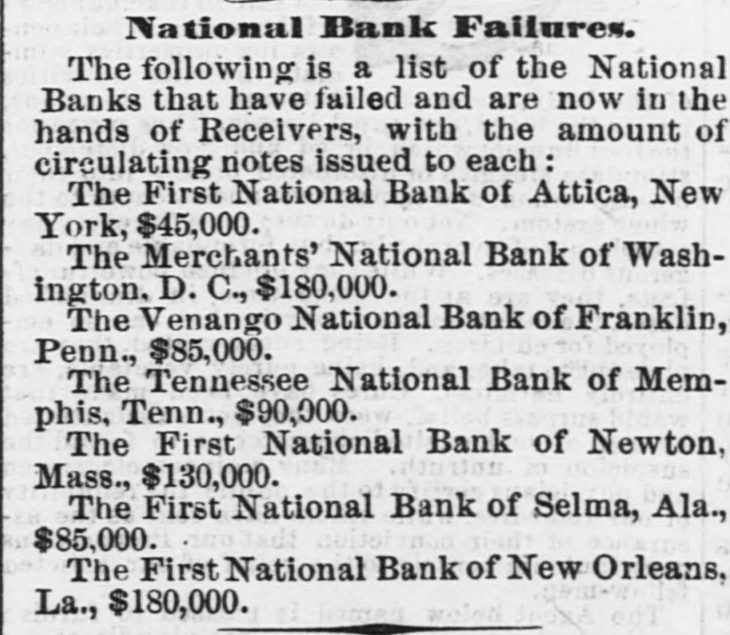
National Bank Failures. The following is a list of the National Banks that have failed and are now in the hands of Receivers, with the amount of circulating notes issued to each : The First National Bank of Attica, New York, $45,000. The Merchants' National Bank of Washington. D. C., $180,000. The Venango National Bank of Franklin, Penn., $85,000. The Tennessee National Bank of Memphis, Tenn., $90,000. The First National Bank of Newton, Mass., $130,000. The First National Bank of Selma, Ala., $85,000. The First National Bank of New Orleans, La., $180,000.


Article from The Tri-Weekly Standard, June 15, 1867

Click image to open full size in new tab

Article Text

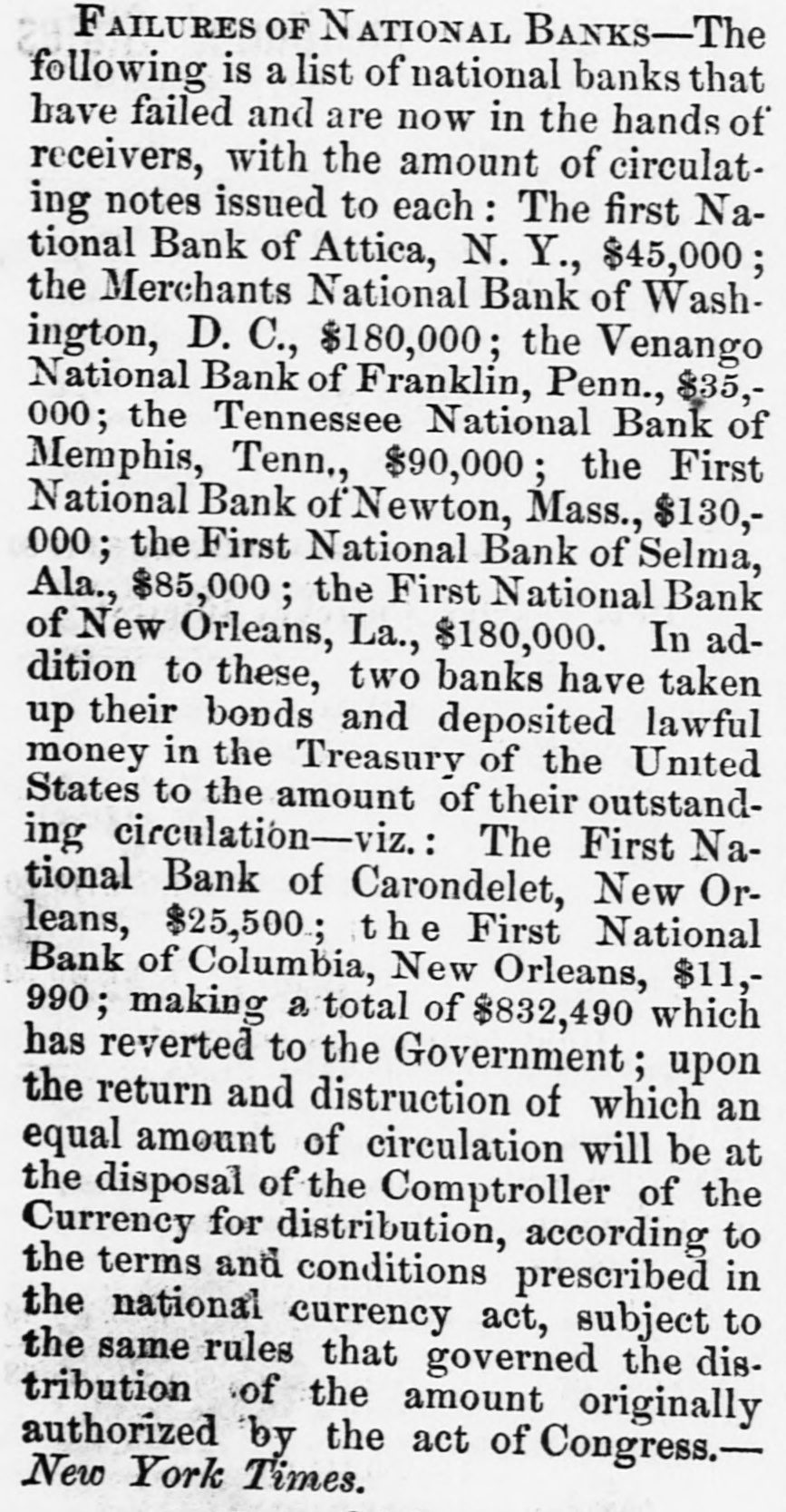
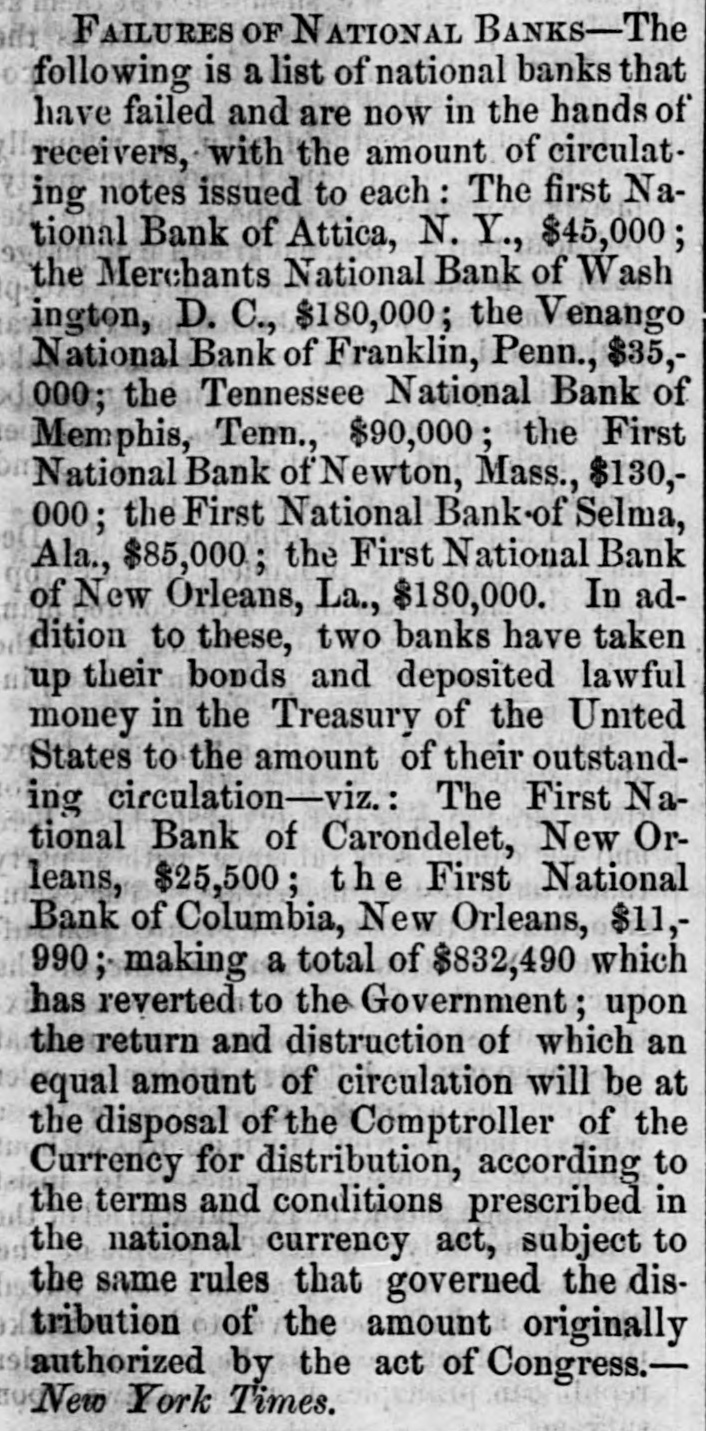
FAILURES OF NATIONAL BANKS-The following is a list of national banks that have failed and are now in the hands of receivers, with the amount of circulating notes issued to each : The first National Bank of Attica, N. Y., $45,000; the Merchants National Bank of Washington, D. C., $180,000; the Venango National Bank of Franklin, Penn., $35,000; the Tennessee National Bank of Memphis, Tenn., $90,000; the First National Bank of Newton, Mass., $130,000; the First National Bank of Selma, Ala., $85,000; the First National Bank of New Orleans, La., $180,000. In addition to these, two banks have taken up their bonds and deposited lawful money in the Treasury of the United States to the amount of their outstanding circulation-viz.: The First National Bank of Carondelet, New Orleans, $25,500; the First National Bank of Columbia, New Orleans, $11,990; making a total of $832,490 which has reverted to the Government; upon the return and distruction of which an equal amount of circulation will be at the disposal of the Comptroller of the Currency for distribution, according to the terms and conditions prescribed in the national currency act, subject to the same rules that governed the distribution of the amount originally authorized by the act of Congress.New York Times.


Article from Public Ledger, June 19, 1867

Click image to open full size in new tab

Article Text

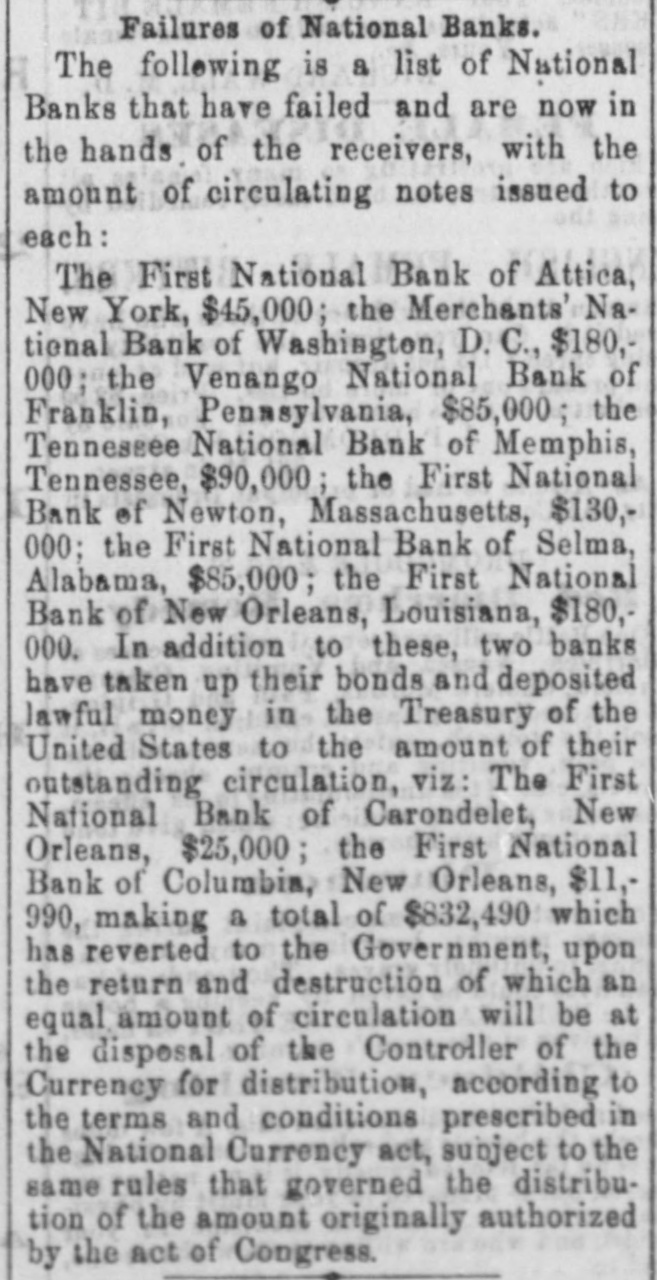
Failures of National Banks. The following is a list of National Banks that have failed and are now in the hands of the receivers, with the amount of circulating notes issued to each: The First National Bank of Attica, New York, $45,000; the Merchants' National Bank of Washington, D. C., $180,000: the Venango National Bank of Franklin, Penasylvania, $85,000; the Tennessee National Bank of Memphis, Tennessee, $90,000; the First National Bank of Newton, Massachusetts, $130,000; the First National Bank of Selma, Alabama, $85,000; the First National Bank of New Orleans, Louisiana, $180,000. In addition to these, two banks have taken up their bonds and deposited lawful money in the Treasury of the United States to the amount of their outstanding circulation, viz: The First National Bank of Carondelet, New Orleans, $25,000; the First National Bank of Columbia, New Orleans, $11,990, making a total of $832,490 which has reverted to the Government, upon the return and destruction of which an equal amount of circulation will be at the disposal of the Controller of the Currency for distribution, according to the terms and conditions prescribed in the National Currency act, subject to the same rules that governed the distribution of the amount originally authorized by the act of Congress.


Article from The Weekly North-Carolina Standard, June 19, 1867

Click image to open full size in new tab

Article Text

FAILURES OF NATIONAL BANKS- The following is a list of national banks that have failed and are now in the hands of receivers, with the amount of circulating notes issued to each : The first National Bank of Attica, N. Y., $45,000; the Merchants National Bank of Wash ington, D. C., $180,000; the Venango National Bank of Franklin, Penn., $35,000; the Tennessee National Bank of Memphis, Tenn., $90,000; the First National Bank of Newton, Mass., $130,000; the First National Bank of Selma, Ala., $85,000; the First National Bank of New Orleans, La., $180,000. In addition to these, two banks have taken up their bonds and deposited lawful money in the Treasury of the United States to the amount of their outstanding circulation-viz.: The First National Bank of Carondelet, New Orleans, $25,500; the First National Bank of Columbia, New Orleans, $11,990; making a total of $832,490 which has reverted to the Government; upon the return and distruction of which an equal amount of circulation will be at the disposal of the Comptroller of the Currency for distribution, according to the terms and conditions prescribed in the national currency act, subject to the same rules that governed the distribution of the amount originally authorized by the act of Congress.New York Times.


Article from Baton Rouge Tri-Weekly Gazette & Comet, June 20, 1867

Click image to open full size in new tab

Article Text

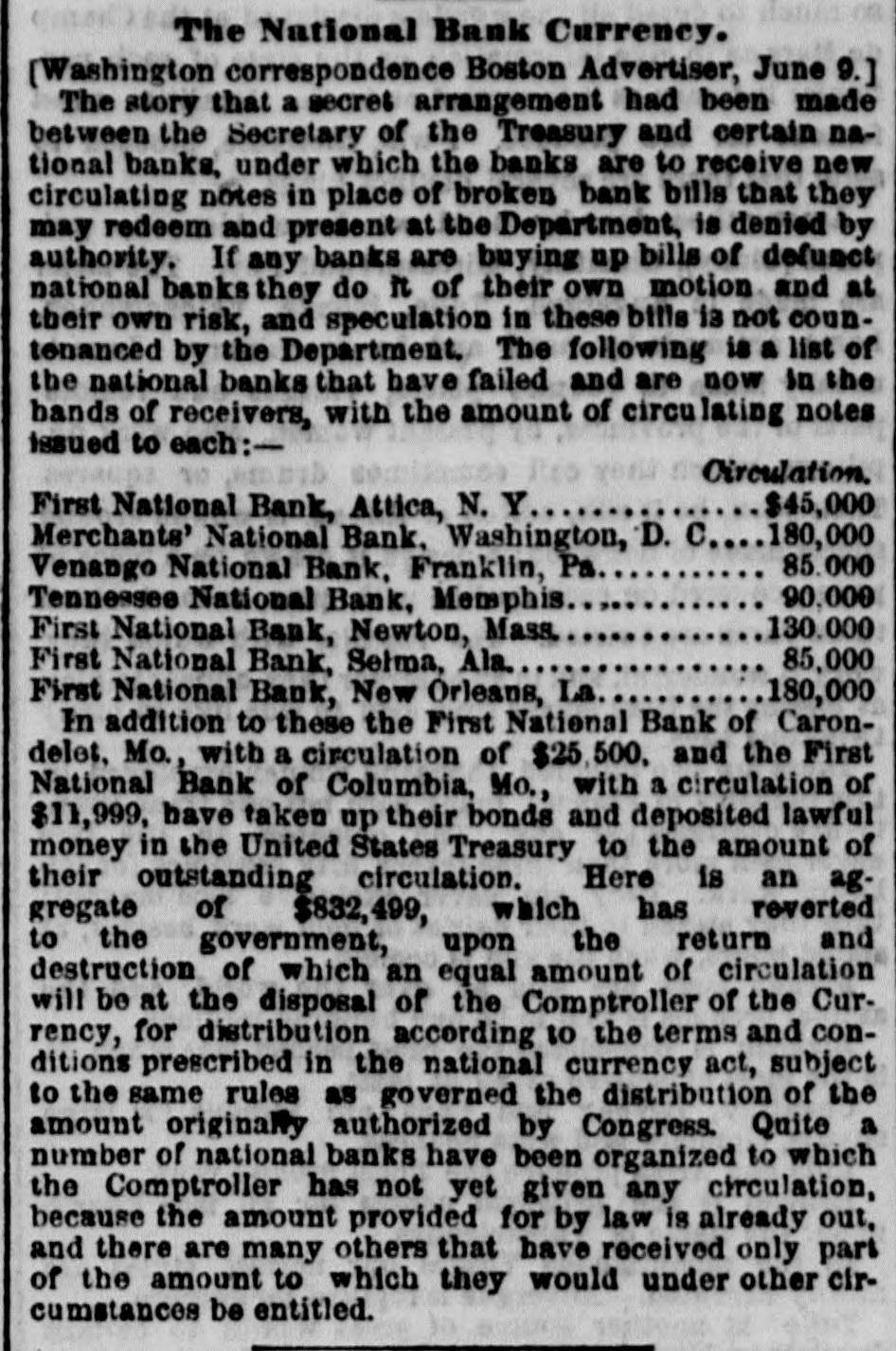
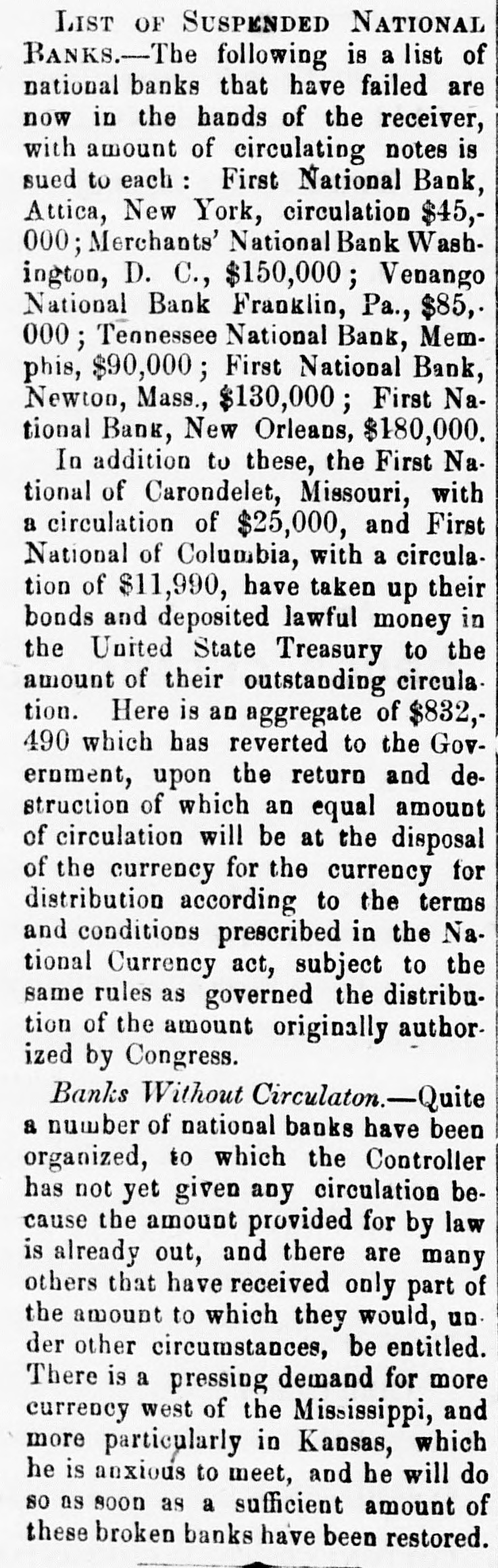
LIST OF SUSPENDED NATIONAL BANKS.-The following is a list of national banks that have failed are now in the hands of the receiver, with amount of circulating notes is sued to each : First National Bank, Attica, New York, circulation $45,000; Merchants' National Bank Washington, D. C., $150,000; Venango National Bank Franklin, Pa., $85, 000; Teonessee National Bank, Memphis, $90,000; First National Bank, Newton, Mass., $130,000; First National Bank, New Orleans, $180,000. In addition to these, the First Na. tional of Carondelet, Missouri, with a circulation of $25,000, and First National of Columbia, with a circulation of $11,990, have taken up their bonds and deposited lawful money in the United State Treasury to the amount of their outstanding circula tion. Here is an aggregate of $832,490 which has reverted to the Government, upon the return and destruction of which an equal amount of circulation will be at the disposal of the currency for the currency for distribution according to the terms and conditions prescribed in the National Currency act, subject to the same rules as governed the distribution of the amount originally authorized by Congress. Banks Without Circulation.-Quite a number of national banks have been organized, to which the Controller has not yet given any circulation because the amount provided for by law is already out, and there are many others that have received only part of the amount to which they would, un der other circumstances, be entitled. There is a pressing demand for more currency west of the Mississippi, and more particularly in Kansas, which he is anxious to meet, and he will do 80 as soon as a sufficient amount of these broken banks have been restored.


Article from Democratic Enquirer, July 11, 1867

Click image to open full size in new tab

Article Text

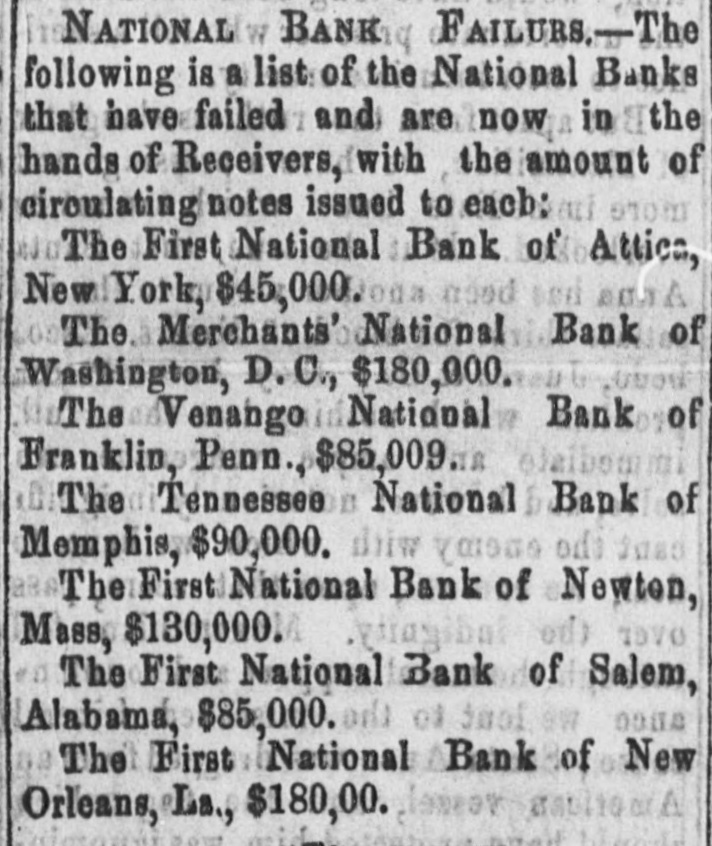
NATIONAL W BANK FAILURS.-The following is a list of the National Banks that have failed and are now in the hands of Receivers, with the amount of circulating notes issued to each: The First National Bank of Attics, New York, $45,000. The Merchants' National Bank of Washington, D.C., $180,000. The Venango National Bank of Franklin, Penn., $85,009 The Tennessee B National Bank of Memphis, $90,000. Karaas The First National Bank of Newten, 7070 Mass, $130,000. The First National Bank of Salem, 0000 Alabama, $85,000. The First National Bank of New Orleans, La., $180,00.