Article Text
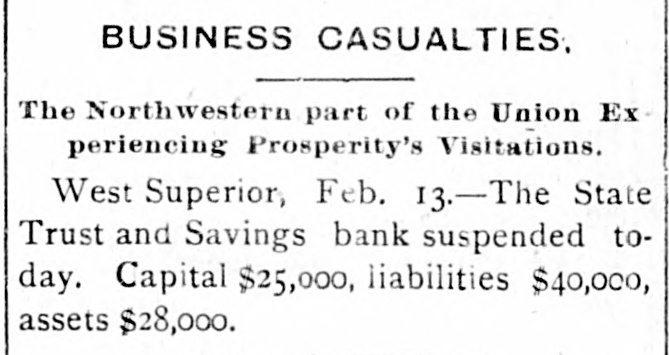
BUSINESS CASUALTIES, The Northwestern part of the Union Ex periencing Prosperity's Visitations. West Superior, Feb. 13.-The State Trust and Savings bank suspended today. Capital $25,000, liabilities $40,000, assets $28,000.
907b833a8cc33737None
Click image to open full size in new tab
BUSINESS CASUALTIES, The Northwestern part of the Union Ex periencing Prosperity's Visitations. West Superior, Feb. 13.-The State Trust and Savings bank suspended today. Capital $25,000, liabilities $40,000, assets $28,000.
Click image to open full size in new tab
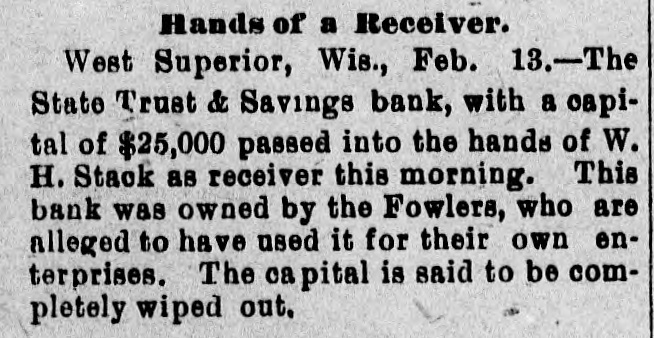
Hands of a Receiver. West Superior, Wis., Feb. 13.-The . State Trust & Savings bank, with a capital of $25,000 passed into the hands of W. H. Stack as receiver this morning. This bank was owned by the Fowlers, who are alleged to have used it for their own enterprises. The ca pital is said to be completely wiped out.
Click image to open full size in new tab
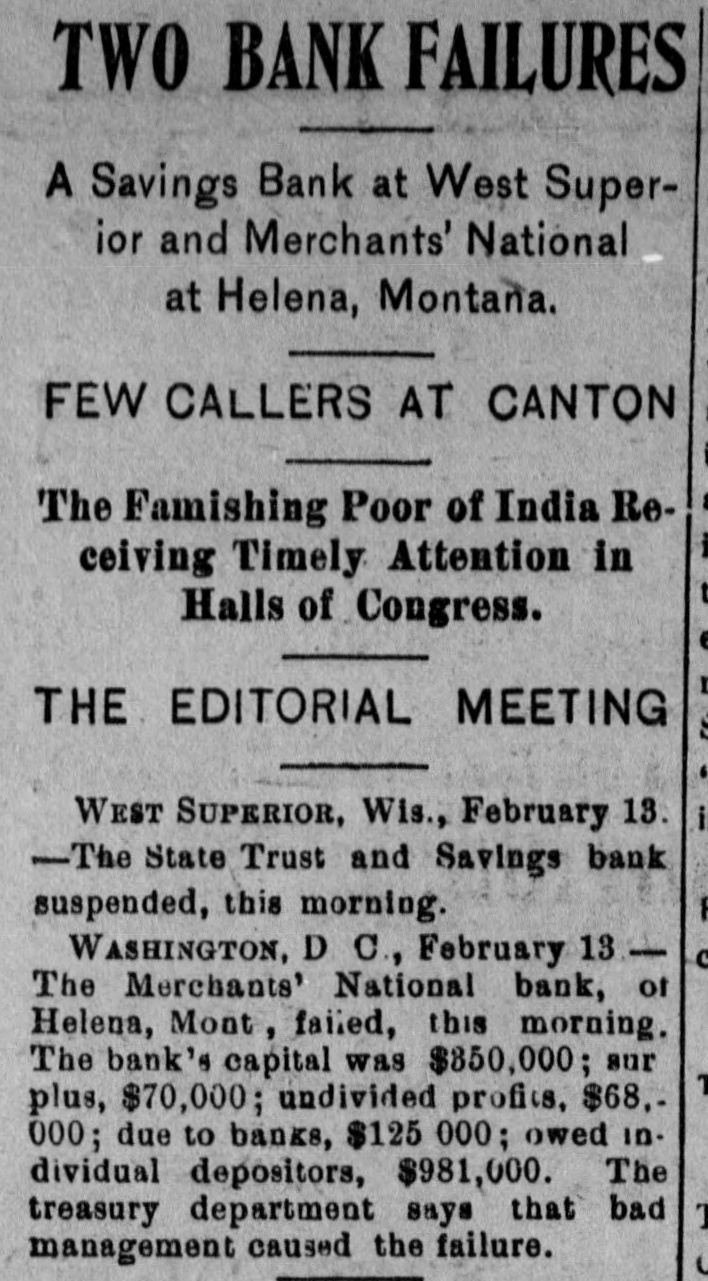
TWO BANK FAILURES A Savings Bank at West Superior and Merchants' National at Helena, Montana. FEW CALLERS AT CANTON The Famishing Poor of India Receiving Timely Attention in Halls of Congress. THE EDITORIAL MEETING WEST SUPERIOR, Wis., February 13. -The State Trust and Savings bank suspended, this morning. WASHINGTON, D C., February 13 The Merchants' National bank, of Helena, Mont, failed, this morning. The bank's capital was $850,000; sur plus, $70,000; undivided profits, $68.000; due to banks, $125 000 owed individual depositors, $981,000. The treasury department says that bad management caused the failure.
Click image to open full size in new tab
Bank Suspended WEST SUPERIOR, Wis., February 12. The State Trust and Savings bank suspended this morning.
Click image to open full size in new tab
W. SUPERIOR BANK FAILS. The Capital was Completely Wiped Out. West Superior, Wis., Feb. 13.-The State Trust and Savings bank, capital $25,000, passed into the hands of W. H. Stack as receiver this morning. This bank was owned by the Fowlers. who are alleged to have used it for their own enterprises. The condition of the bank was developed at a reecnt examination by State Examiner Kidd and National Examiner Thorne. who are here to examine the Northwestern National bank. The capital is said to be completely wiped out. The Northwestern National. it is said, will not be affected by the failure.
Click image to open full size in new tab
BANK HAS A RECEIVER. West Superior, Wis., Feb. 13.-The State Trust and Savings bank, capital $25,000, passed into the hands of : a receiver this morning.
Click image to open full size in new tab
Savings Bank Suspends. WEST SUPERIOR, WIS., February 13.The State Trust and Savings Band . suspended this morning,
Click image to open full size in new tab
TWO BANKS CLOSE THEIR DOORS. FAILURE OF INSTITUTIONS IN HELENA, MONT., AND WEST SUPERIOR, WIS. Washington, Feb. 13.-The Merchants' National Bank of Helena, Mont., failed this morning, and Bank Examiner J. S. Brown, now receiver of the First National Bank of Helena, has been placed in temporary charge. The Merchants' National had at the date of its last examination a capital of $350,000; surplus, $70,000; undivided profits, $68,000; due to other banks, $125,000; owed to individual depositors, $981,000; United States funds on deposit, $70,000; borrowed money owed, $200,000. It is said that the Government is secured. The failure of the bank is attributed in the Treasury Department to bad management and to local causes. West Superior, Wis., Feb. 13-The State Trust and Savings Bank, capital $25,000, suspended this morning, going into the hands of W. H. Slack as receiver on the application of the Northwestern National Bank, a creditor to the extent of $24,000. The State Trust and Savings Bank was owned by Homer T. and Walter Fowler, who have just been removed from the management of the big Northwestern National Bank, which is placed in other hands, and which immediately applied for a receiver. The liabilities are placed at $40,000 and assets at $25,000, but the bank's books show $78,000 liabilities and some assets in which the Northwestern National Bank is the only secured creditor. The bank had sustained a run for weeks. and had only $200 left. The New-York correspondent of the Merchants' National Bank of Helena was the Fourth National Bank, with which the Helena bank had a credit balance.
Click image to open full size in new tab
Receiver Has a Bank. WEST SUPERIOR, Wis., Feb. IS.-The State Trust and Savings bank, capital $25,000, passed into the hands of W. II. Stack as receiver here. This bank was owned by the Fowlers, who are alleged to have used it for their own enterprises.
Click image to open full size in new tab
Failure at West Superior. WEST SUPERIOR, Wis., Feb. 13.-The State Trust and Savings bank. capital $25,000, passed into the hands of W. H. Stack, as receiver, this morning. This bank was owned by the Fowlers, who are alleged to have used it for their own enterprises. The condition of the bank was developed at a recent examination by State Examiner Kidd and National Examiner Therne, who were here to examine the Northwestern National bank. The capital is said to be completely wiped out. The Northwestern National, it is said, will not be affected by the failure.
Click image to open full size in new tab
Its Capital Wiped Out. WEST SUPERIOR, Wis., Feb. 13.-The State Trust and Savings Bank, capital, $25,000, passed into the hands of W. H. Stack as receiver this morning. This bank was owned by the Fowlers, who are alleged to have used it for their own enterprises. The condition of the bank was developed at recent examinations by State Examiner Kidd and National Examiner Thorne, who was here to examine the Northwestern National Bank. The capital is said to be completely wiped out. The Northwestern National. it is said. will not be affected by the failure.
Click image to open full size in new tab
A Bank Closes, WEST. SUPERIOR, WIS,, Feb. 13.-The State Trust and Savings Bank suspended this morning.
Click image to open full size in new tab
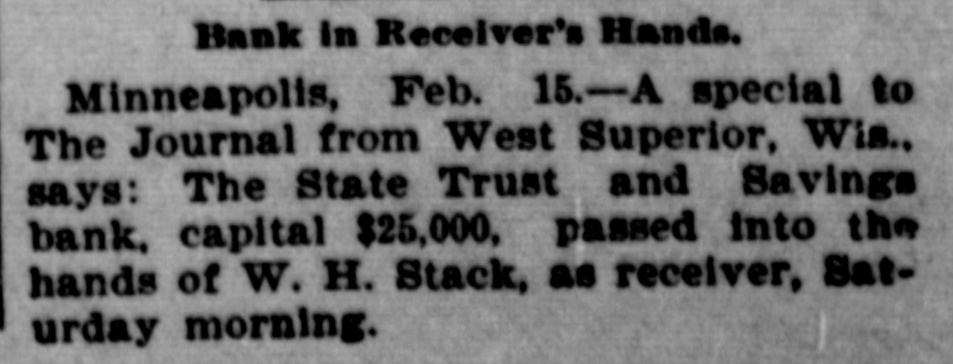
Bank in Receiver's Hands. Minneapolis, Feb. 15.-A special to The Journal from West Superior, Wis.. says: The State Trust and Savings bank, capital $25,000, passed into the hands of W. H. Stack, as receiver, Saturday morning.
Click image to open full size in new tab
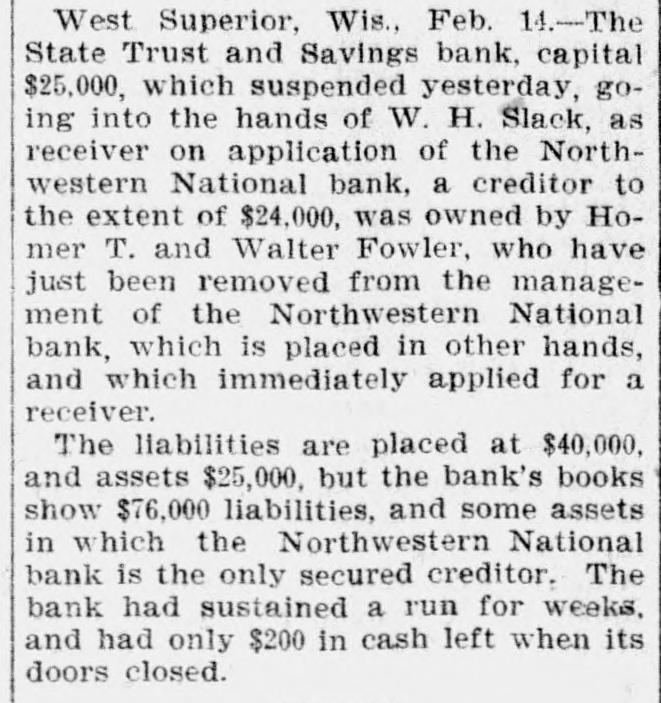
West Superior, Wis., Feb. 14.-The State Trust and Savings bank, capital $25,000, which suspended yesterday, going into the hands of W. H. Slack, as receiver on application of the Northwestern National bank, a creditor to the extent of $24,000, was owned by Homer T. and Walter Fowler, who have just been removed from the management of the Northwestern National bank, which is placed in other hands, and which immediately applied for a receiver. The liabilities are placed at $40,000, and assets $25,000, but the bank's books show $76,000 liabilities, and some assets in which the Northwestern National bank is the only secured creditor. The bank had sustained a run for weeks, and had only $200 in cash left when its doors closed.
Click image to open full size in new tab
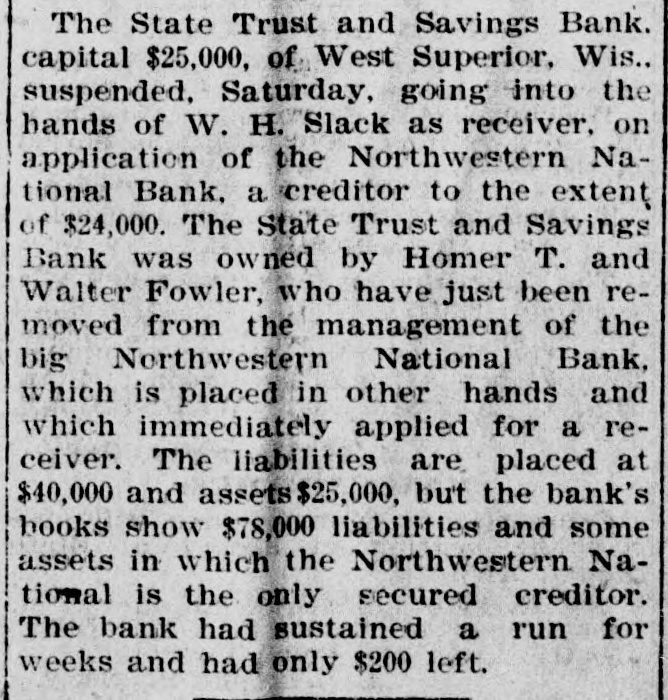
The State Trust and Savings Bank. capital $25,000, of West Superior, Wis., suspended. Saturday, going into the hands of W. H. Slack as receiver, on application of the Northwestern National Bank, a creditor to the extenţ of $24,000. The State Trust and Savings Bank was owned by Homer T. and Walter Fowler, who have just been removed from the management of the big Northwestern National Bank, which is placed in other hands and which immediately applied for a receiver. The liabilities are placed at $40,000 and assets $25,000, but the bank's books show $78,000 liabilities and some assets in which the Northwestern National is the only secured creditor. The bank had sustained a run for weeks and had only $200 left.
Click image to open full size in new tab
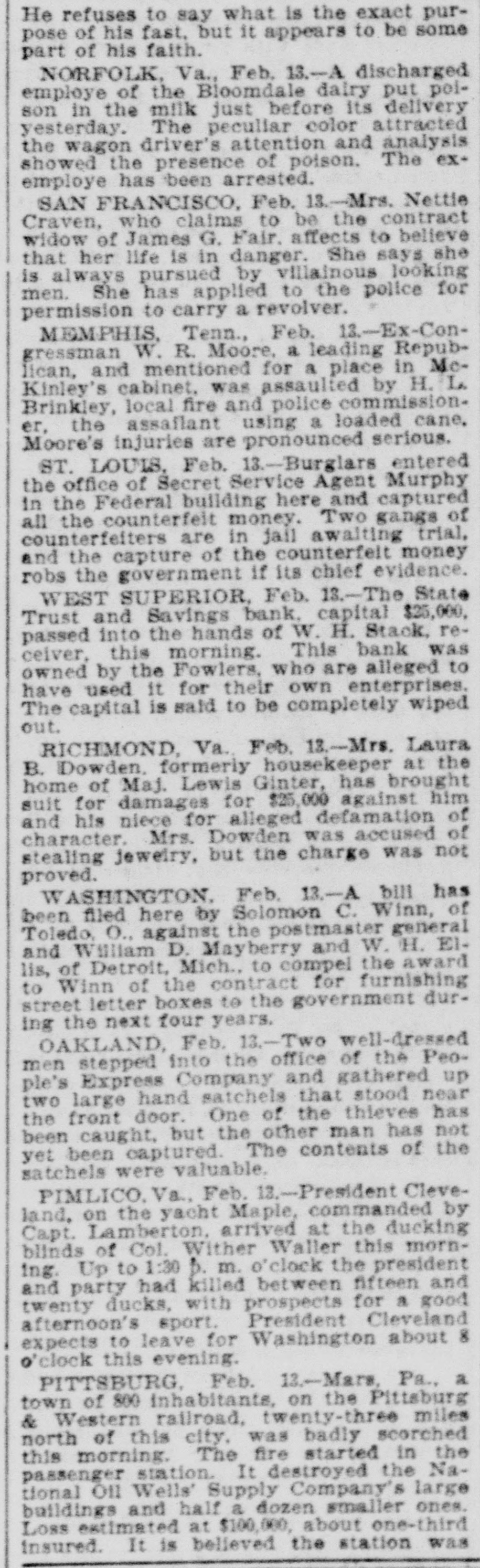
He refuses to say what is the exact purpose of his fast, but it appears to be some part of his faith. NORFOLK, Va., Feb. 13.-A discharged employe of the Bloomdale dairy put poison in the milk just before its delivery yesterday. The peculiar color attracted the wagon driver's attention and analysis showed the presence of poison. The exemploye has been arrested. SAN FRANCISCO, Feb. 18.-Mrs. Nettle Craven, who claims to be the contract widow of James G. Fair. affects to believe that her life is in danger. She says she is always pursued by villainous looking men. She has applied to the police for permission to carry a revolver. MEMPHIS, Tenn., Feb. 12.-Ex-Congressman W. R. Moore, a leading Republican, and mentioned for a place in McKinley's cabinet. was assaulted by H. L. Brinkley, local fire and police commissioner, the assailant using a loaded cane. Moore's injuries are pronounced serious. ST. LOUIS, Feb. 13.-Burglars entered the office of Secret Service Agent Murphy in the Federal building here and captured all the counterfeit money. Two gangs of counterfeiters are in jail awaiting trial, and the capture of the counterfeit money robs the government if its chief evidence. WEST SUPERIOR, Feb. 13.-The State Trust and Savings bank. capital $25,000, passed into the hands of W. H. Stack, receiver, this morning. This bank was owned by the Fowlers, who are alleged to have used it for their own enterprises. The capital is said to be completely wiped out. RICHMOND, Va. Feb. 18.-Mrs. Laura B. Dowden. formerly housekeeper at the home of Maj. Lewis Ginter, has brought suit for damages for $25,000 against him and his niece for alleged defamation of character. Mrs. Dowden was accused of stealing jeweiry, but the charge was not proved. WASHINGTON. Feb. 13.-A bill has been filed here by Solomon C. Winn, of Toledo, O., against the postmaster general and William D. Mayberry and W. H. Ellis, of Detroit, Mich., to compel the award to Winn of the contract for furnishing street letter boxes to the government during the next four years. OAKLAND, Feb. 13.-Two well-dressed men stepped into the office of the People's Express Company and gathered up two large hand satchels that stood near the front door. One of the thieves has been caught, but the other man has not yet been captured. The contents of the satchels were valuable. PIMLICO. Va., Feb. 13.-President Cleveland. on the yacht Maple, commanded by Capt. Lamberton, arrived at the ducking blinds of Col. Wither Waller this morning. Up to 1:30 D. m. o'clock the president and party had killed between fifteen and twenty ducks, with prospects for a good afternoon's sport. President Cleveland expects to leave for Washington about 8 o'clock this evening. PITTSBURG, Feb. 13.-Mars, Pa., a town of 800 inhabitants, on the Pittsburg & Western railroad, twenty-three miles north of this city, was badly scorched this morning. The fire started in the passenger station. It destroyed the National Oil Wells' Supply Company's large buildings and half a dozen smaller ones. Loss estimated at $100,000, about one-third insured. It is believed the station was

Click image to open full size in new tab
CONDENSED NEWS Gathered From All Parts of the Country By Telegraph. Herr Mitterwurzer, a comedian well known in America, is dead in Vienna. The State Trust and Savings bank, of West Superior, Wis., suspended Saturday morning. It is reported here that a blockade of Crete by the European powers will be established shortly. The business portion of the town of Malvern, Ark., was destroyed by fire Friday. The loss will aggregate $100,000. W. L. Frost has been appointed receiver for the Commercial Saving bank, a small institution at Leds, a suburb of Sioux City Ia. Mr. Woodman (rep., 111.) Friday addressed the house ways and means committee on support of his bill placing a tax of $50 per thousand on cigarettes. The Turkish porte has informed the powers that Turkey will attack Greece in Thessaly in the event of the powers failing to restrain hostile action on the part of Greece in Crete. In the Michigan legislature Friday Representative Goodell, of Wayne county, gave notice of a bill to prevent monopolies in articles of general necessity and providing a penalty therefor. The Merchants' national bank of Helena, Mont., failed Saturday morning, and Bank Examiner J. S. Brown. now receiver of the First national bank of Helena, leas been placed in temporary charge. : A semi-official note has been issued at Rome stating Italy will not oppose Greece in any action the latter country may take on the Cretan question. It is added that Italy does not wish to serve Turkey in any way. The White Star line steamer Brittanic from New York for Liverpool, arrived at Queenstown at 10:34 o'clock Saturday forenoon. She reports having experienced heavy northeasterly gales and high seas during five days of her passage. Capt Harry Brown, junior member of the firm of W. H. Brown's Sons, whose boats are known all along the Ohio and Mississippi rivers, has retired from the firm. Capt. Sam S. Brown will look after the interests of the company in the future. The Berlin Post Friday evening publishes an article in which it says that war between Greece and Turkey is almost inevitable. The paper adds that Turkey is entitled to allow her troops to cross the Thessalian frontier in view of the action of Greece. The Felloweraft club, which was founded by the newspaper men of Detroit, gave a reception to Gen. Russell A. Alger Friday night. The occasion was the opening of their new club house on Wilcox street, and was attended by a large number of Detroit's most prominent citizens. The London Morning Post Saturday publishes a news agency statement that the powers are unanimous in their condemnation of the attitude of Greece, and that they will not allow her to continue her present course. She must, it is added, abandon the idea of commencing war with Turkey. The fifth annual banquet of the Lincoln club was held in Sweet's hotel, Grand Rapids, Friday evening, and was of more than local interest from the fact that Gonzalez de Quesada, charge d'affaires of the Cuban repub. lic at Washington, was present and made one of the principal addresses. As has been the custom for many years on February 12, the base of the Lincoln statue in Statuary hall, at the national capital, was draped with an American flag, and entwining about the feet of the statue were garlands of
Click image to open full size in new tab
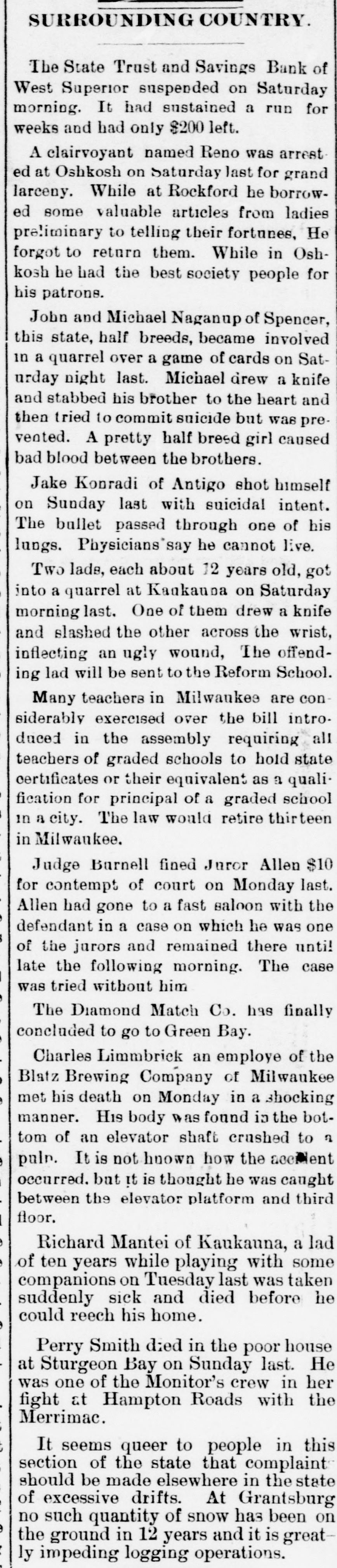
SURROUNDING COUNTRY. The State Trust and Savings Bank of West Superior suspended on Saturday morning. It had sustained a run for weeks and had only $200 left. A clairvoyant named Reno was arrest ed at Oshkosh on Saturday last for grand larceny. While at Rockford he borrowed some valuable articles from ladies preliminary to telling their fortunes, He forgot to return them. While in Oshkosh he had the best society people for his patrons. John and Michael Naganup of Spencer, this state, half breeds, became involved in a quarrel over a game of cards on Saturday night last. Michael drew a knife and stabbed his brother to the heart and then tried to commit suicide but was prevented. A pretty half bresd girl caused bad blood between the brothers. Jake Konradi of Antigo shot himself on Sunday last with suicidal intent. The bullet passed through one of his lungs. Physicians say he cannot live. Two lads, each about 12 years old, got into a quarrel at Kankanoa on Saturday morning last. One of them drew a knife and slashed the other across the wrist, inflecting an ugly wound, The offending lad will be sent to the Reform School. Many teachers in Milwankee are considerably exercised over the bill introduced in the assembly requiring all teachers of graded schools to hold state certificates or their equivalent as a qualification for principal of a graded school in a city. The law would retire thirteen in Milwaukee. Judge Burnell fined Juror Allen $10 for contempt of court on Monday last. Allen had gone to a fast saloon with the defendant in a case on which he was one of the jurors and remained there unti! late the following morning. The case was tried without him The Diamond Match Co. has finally concluded to go to Green Bay. Charles Limmbrick an employe of the Blatz Brewing Company of Milwaukee met his death on Monday in a shocking manner. His body was found in the bottom of an elevator shaft crushed to a puln. It is not hnown how the ace Nent occurred. but It is thought he was caught between the elevator platform and third floor. Richard Mantei of Kaukauna, a lad of ten years while playing with some companions on Tuesday last was taken suddenly sick and died before he could reech his home. Perry Smith died in the poor house at Sturgeon Bay on Sunday last. He was one of the Monitor's crew in her fight at Hampton Roads with the Merrimac. It seems queer to people in this section of the state that complaint should be made elsewhere in the state of excessive drifts. At Grantsburg no such quantity of snow has been on the ground in 12 years and it is greatly impeding logging operations.

Click image to open full size in new tab
The News Condensed. A railroad five miles long from Union Center, in Juneau county, to Hillsboro, Vernon county, is to be built. The A. Fuermann brewery made an assignment in Watertown to W. H. Woodwar with liabilities of $35,000. Paul Wagner, aged 45, and his wife Fredericka, aged 64, were suffocated by coal gas at their residence in Milwaukee. At West Superior the State trust and savings bank closed its doors with liabilities of $40,000. Hotel Malavey, at Itasca, was burned, the loss being $5,000; insurance, $1,000. Jacob Hirsch, a clothing dealer in Milwaukee, made an assignment to Philip Hirsch, who gave a bond for $15,000. The license of the National Mutual Life Insurance association of Minneapolis, in this state, was revoked Monday by Insurance Commissioner Fricke. Charles Lembrich was caught in the freight elevator shaft at the Blatz brewery in Milwaukee and his head was crushed. Therewas born to Mr. and Mrs Walker at Cataract a girl having two well'ormed front teeth in her lower jaw. Edgar C. Jennings, for more than 30 years cashier of the Northwestern Mutual Life Insurance company, died suddenly in Milwaukee of paralysis, aged 78 years. W. Peplinski, postmaster at Pulaski, was arrested, charged with abstracting money from a registered letter addressed to Armor & Co., Chicago. The Reedsburg woolen mills, the largest in that part of the state, have opened on full time. The flax and feed mill at Union Grove, owned by Henry Box, of Evanston. III., was burned, the loss being $10,000; no insurance. The sheriff attached the E. A. Ellinger & Co. cloak factory in Racine on claims of over $20,000. H. B. Hinckley, well known in football circles and captain of the Beloit team of 1896, was attacked by a savage dog in Beloit and badly bitten. Gen. Edward S. Bragg celebrated his 70th birthday at his home in Fond du Lac. Mike Neganup, a half-breed, in a drunken fit of jealousy stabbed his brother John through the heart with a hunting knife at Spooner. Christian Malschner, aged 60, an inmate of the poorfarm at Sheboygan, committed suicide. His home was at West Superior. The bequest of $10,000 left by Father Ritter, who died at St. Joseph's, has been received by St. Joseph's orphan usylum, his estate, amounting to $15,000, having just been settled. John Ebell, a farmer in the town of Marion, was accidentally shot and killed. Clem Lindke, a saloon keeper at Manston, was found guilty of having a rifle in his possession belonging to the state and was fined $45 and costs. Mrs. John Toomes, aged 94 years, was buried at Burlington. She was a native of England. Robert Wootton, one of the most prominent business men of Madison, died after a short illness. He was 65 years old and had lived in Madison for 37 years. The parishioners of St. John's Catholie church in Marshfield will erect a $12,000, eight-room, brick school here in the spring. Surveyors are now at work on a route for an electric railroad from Oshkosh, Winnebago county, through Waushara county to Stevens Point. By order of Receiver Stevens the Western Paper Bag company at Kaukauna has resumed operations. E. H. Brill, aged 53, one of Racine's oldest merchants, died suddenly of apoplexy at his store. Mrs. Marie Graf, over 90 years of age, died of the grippe at Ripon. She had been a resident of that city for a quarter of a century, and previously lived 20 years at Watertown. Warden Reynolds died in Green Bay, aged 84 years. For 25 years he was chairman of the committee of correspondence of the grand lodges of the old fellows of Wisconsin. Thomas R. Bently, a contractor in Milwaukee, made an assign ment to Henry Ferge, who gave bonds of $50,000. The Wiseonsin Odd Fellows' Mutual Life Insurance company, which was organized in Milwaukee in 1869, made an assignment. During the last year over 5,000 members dropped out. Peter Meyer, of Farmington, was struck on the head by the limb of a falling tree and killed. Mrs. William Mash, of Eau Claire, tried to start a fire with kerosene. Her face, arms and chest were terribly burned, but she might live.