First National Bank (Pittsburg, PA)

Episode Information

Episode Type
Run → Suspension → Reopening
Start Date
October 22, 1903
Location
Pittsburg, Pennsylvania (40.441, -79.996)
Registered Place
Allegheny
Bank Type
national
Charter Number
198
Alt. names
First National Bank of Allegheny

Metadata

Response Measures

Full suspension, Books examined

Receivership Details

Date receivership started
1903-10-22
Date receivership terminated
1903-12-07
OCC cause of failure
Run

Events (8)

1. January 14, 1864 Chartered
Source
historical_nic
2. October 22, 1903 Run
Cause
Local Banks
Cause Details
Heavy withdrawals triggered by (rumored) connection with the failure/suspension of the Federal National Bank of Pittsburg
Measures
Directors resolved to place the bank in voluntary liquidation and apply to the Comptroller of the Currency
Newspaper Excerpt
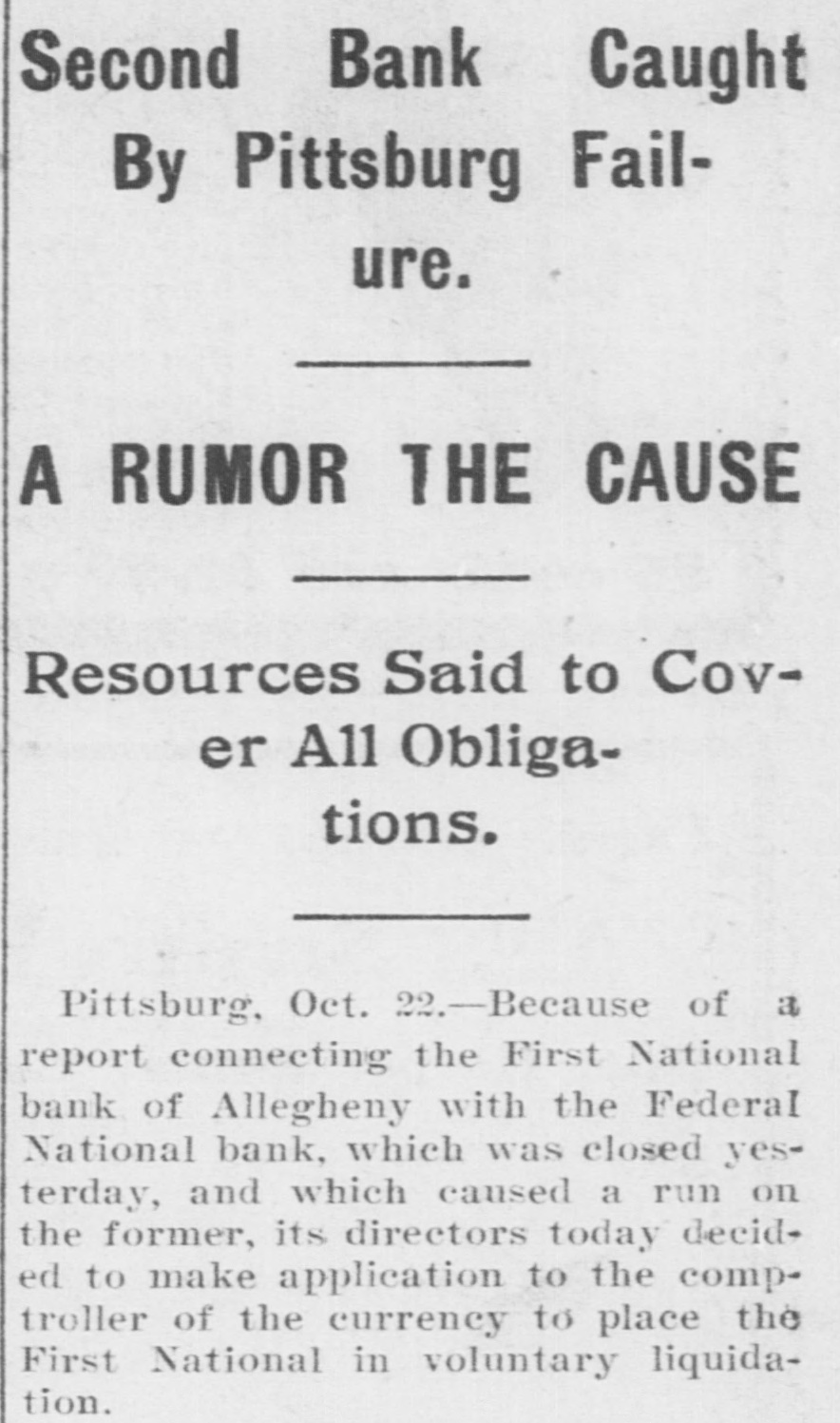
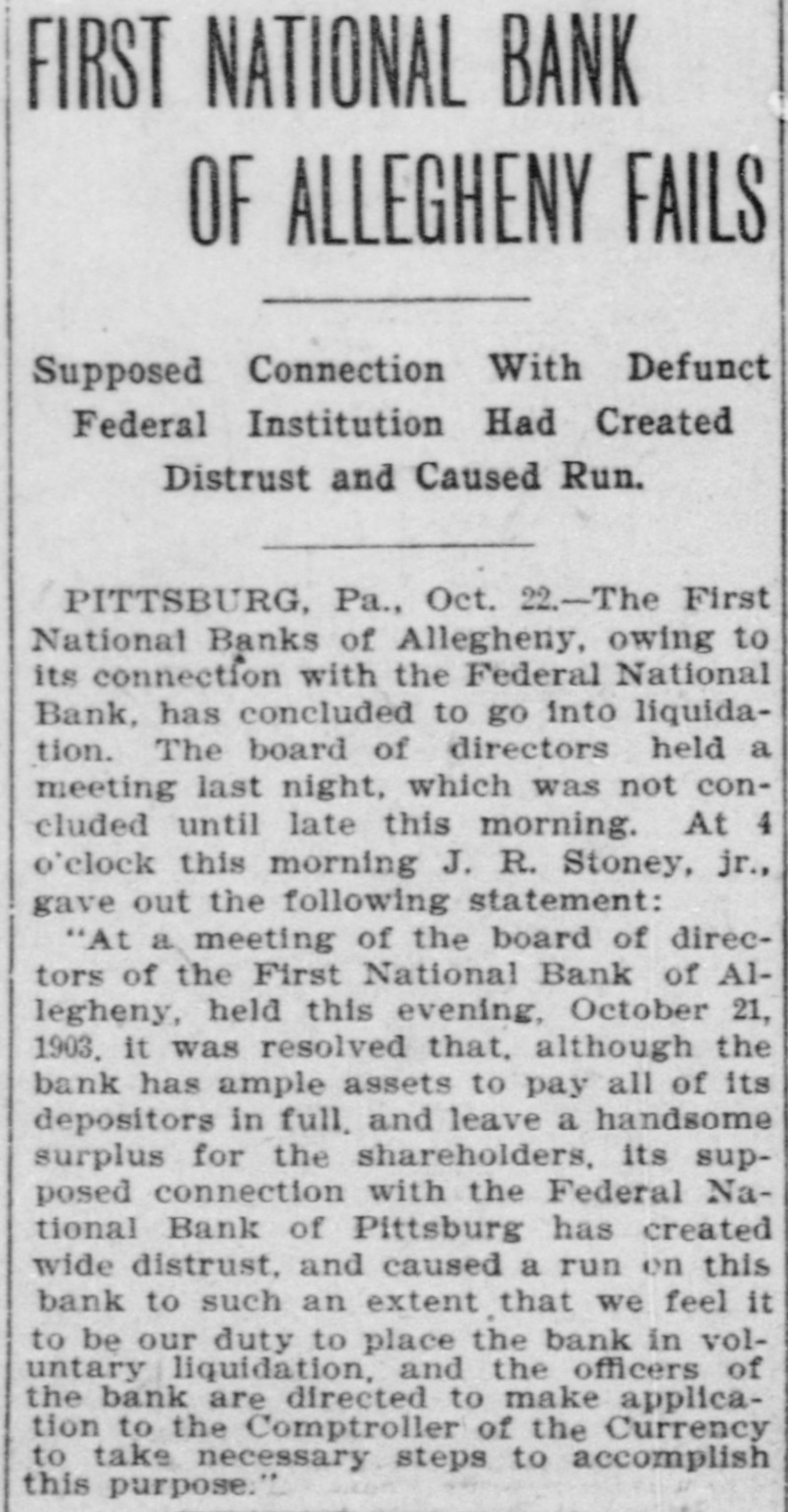
its supposed connection with the Federal National Bank of Pittsburg has created wide distrust, and caused a run on this bank
Source
newspapers
3. October 22, 1903 Suspension
Cause
Voluntary Liquidation
Cause Details
Directors applied to the Comptroller to place the bank in voluntary liquidation after the run; a receiver was appointed
Newspaper Excerpt
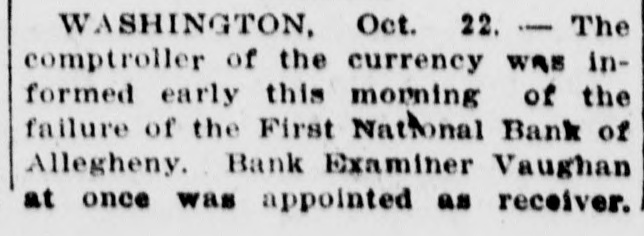
The comptroller of the currency was informed early this morning of the failure of the First National Bank of Allegheny. Bank Examiner Vaughn was at once appointed as receiver.
Source
newspapers
4. October 22, 1903 Receivership
Newspaper Excerpt
Bank Examiner Vaughn was at once appointed as receiver.
Source
newspapers
5. October 22, 1903 Receivership
Source
historical_nic
6. December 7, 1903 Reopening
Newspaper Excerpt
The First National Bank of Allegheny ... reopened today. The institution has been entirely reorganized.
Source
newspapers
7. December 7, 1903 Restored To Solvency
Source
historical_nic
8. January 11, 1915 Voluntary Liquidation
Source
historical_nic

Newspaper Articles (21)

Article from The Minneapolis Journal, October 22, 1903

Click image to open full size in new tab

Article Text

STOCK MARKET GOSSIP R. J. Stoney, Jr., vice president of the First National bank of Allegheny, gives out the following staement regarding the suspension of his bank: "At a meeting of directors held last night it was resolved that, altho the bank has ample assets to pay all depositors in full and leave a handsome surplus for the stockholders, its desupposed connection with the Federal bank has created distrust and caused a run to such an extent that we feel it our duty to place the bank in voluntary liquidation and officers are directed to apply to the controller of the currency to take the necessary steps to accomplish this purpose." The correspondents of the bank are: The National Park bank, New York; First National bank, Philadelphia; First National bank, Chicago; First National Bank of Redemption, Boston.


Article from The Evening Statesman, October 22, 1903

Click image to open full size in new tab

Article Text

Caused by Failure of Federal. Pittsburg, Oct. 22.-The First National bank of Allegheny, owing to connection with the Federal National bank of this city, concluded to enter into liquidation. The directors at 4 this morning after an all night conference, made an announcement in which it is stated that the bank is perfectly solvent, but its connection with the Federal had created such wide distrust and caused such a run that the bank voluntarily enters liquidation. They assert that after all obligations are paid there will be a handsome surplus and profits left for shareholders. The September statement shows a surplus and undivided profits of $150,000. The total resources are $1,750,000.


Article from The Evening Statesman, October 22, 1903

Click image to open full size in new tab

Article Text

Another National Bank Shuts Its Doors. COLD STORAGE CONCERN FAILS The Acme Harvester Company Is Under Investigation-Five Men in Control. Washington, Oct. 22.-The comptroller of the currency was informed early this morning of the failure of the First National bank of Allegheny. Bank Examiner Vaughn was at once appointed as receiver.


Article from The Spokane Press, October 22, 1903

Click image to open full size in new tab

Article Text

WASHINGTON, Oct. 22. - The comptroller of the currency WAS informed early this morning of the failure of the First National Bank of Allegheny. Bank Examiner Vaughan at once was appointed as receiver.


Article from Rock Island Argus, October 22, 1903

Click image to open full size in new tab

Article Text

Second Bank Caught By Pittsburg Failure. A RUMOR THE CAUSE Resources Said to Cover All Obligations. Pittsburg, Oct. 22.-Because of a report connecting the First National bank of Allegheny with the Federal National bank, which was closed yesterday, and which caused a run on the former, its directors today decided to make application to the comptroller of the currency to place the First National in voluntary liquidation.


Article from The Washington Times, October 22, 1903

Click image to open full size in new tab

Article Text

FIRST NATIONAL BANK OF ALLEGHENY FAILS Supposed Connection With Defunct Federal Institution Had Created Distrust and Caused Run. PITTSBURG, Pa., Oct. 22.-The First National Banks of Allegheny, owing to its connection with the Federal National Bank, has concluded to go into liquidation. The board of directors held a meeting last night, which was not concluded until late this morning. At 4 o'clock this morning J. R. Stoney, jr., gave out the following statement: "At a meeting of the board of directors of the First National Bank of Allegheny, held this evening, October 21, 1903. it was resolved that, although the bank has ample assets to pay all of its depositors in full, and leave a handsome surplus for the shareholders, its supposed connection with the Federal National Bank of Pittsburg has created wide distrust, and caused a run on this bank to such an extent that we feel it to be our duty to place the bank in voluntary liquidation, and the officers of the bank are directed to make application to the Comptroller of the Currency to take necessary steps to accomplish this purpose.'


Article from The Sun, October 23, 1903

Click image to open full size in new tab

Article Text

FINANCIAL AND COMMERCIAL THURSDAY, Oct. 22. The dominant feature of the stock market to-day was the demand for the investment issues. Evidences of a growing interest in securities of this grade have not been wanting of late and have been duly emphasized in this column. But to-day the dealings in bonds quite overshadowed operations in the stock market proper. All the established railway bonds were dealt in in good volume and at advancing prices, and, indeed, the prices of these bonds have already risen SO that the choice of bargains among them is by no means what it was even two weeks since. There is a natural order in operations of this kind which is almost invariably followed. The demand converges, at first, on issues of the very best character, first mortgage bonds of the well known railway lines yielding only a small return, but furnishing the very highest security, whose prices under almost all conditions fluctuate but little. It is obvious that a very small advance, comparatively, in the prices of bonds of this kind brings them to a point where their interest yield becomes sensibly diminished and where the prospective investor is inclined to turn from them to consideration of bonds which, although not quite SO well secured, are still thoroughly safe and afford a greater interest return. In time the supply of good bonds at suitable prices becomes exhausted and the buying spreads to preferred stocks, and so through the entire security list. Whether the investment of capital will proceed steadily along this path in the coming months cannot, of course, be said to be a settled question. It has, however, started on the journey after its accustomed fashion, and in the past its footsteps have rarely wavered from the beaten way. The combined strength and dulness of the stock market are, too, just what would naturally be expected under these circumstances. Bearish operators have discovered that there is no further liquidation by the general public upon the receipt of unfavorable news, a fact which usually indicates that these unfavorable developments were long ago foreseen and duly prepared for. Hence, while a "bull market" is by no means in order yet, and while any attempt of speculators to inaugurate such an affair would undoubtedly meet with disaster, prices of stocks stubbornly resist artificial attempts to depress them and in their own good time may be expected to display the effects of the general market convalescence. It seems to be clear that a very sharp line is now being drawn by all careful students and dispassionate observers of financial affairs between such events as the collapse of overboomed local enterprises in various cities, dragging down with them trust companies and other money lending institutions which have advanced funds upon forms of security for which there is little market, and the general business life of the whole country, especially that in the Western and Southwestern agricultural sections. It would be very singular if we had seen the last of suspensions, temporary or otherwise, of institutions of this character because of reasons like the foregoing. The important point for investors and speculators alike to remember is that such disasters as these-many of them of only small importance at best-are not of such a character as to involve sales of securities in Wall Street. While of course, they have a perceptibly greater bearing upon the general situation than the bursting of such incorporation bubbles in the industrial world as prevailed SO notably in 1899, the two phenomena are really kith and kin, and the wealth and prosperity of the country are such that far less harm to the business life of the country. as a whole, will be done by them than many people might suppose. Prices of stocks to-day closed very irregularly, most of the active issues, however, showing small advances. Among the railroad issues the Rock Island shares were especially strong, while in the industrial list a sharp break in Republic Iron and Steel preferred followed the announcement that a-number of the employees of the Republic Iron and Steel Company in Minnesota had been laid off. The decision of a local court in Montana awarding possession of the Minnie Healy mine to the Amalgamated Copper Company's chief antagonist, and restraining the Boston and Montana company from paying any dividends to the Amalgamated Company, but refusing to put the Boston and Montana company in the hands of a receiver, was really more favorable to the Amalgamated company than had been expected. Litigation over these matters, is of course merely in its preliminary stage and must pass through the higher courts before a final adjustment is reached. As the Amaigamated company has not been in receipt of the Boston and Montana dividends for some time, the preliminary decision to-day does not change the status of affairs in the least. The decision of the First National Bank of Allegheny, Pa., to go into voluntary liquidation, as a result of the suspension of the Federal National Bank of Pittsburg. with which it was allied, was considered as of little importance in Wall Street, because the solvent condition of the bank was perfectly realized. The one other important new development of the day was the declaration of an extra dividend of
Article from Windham County Reformer, October 23, 1903

Click image to open full size in new tab

Article Text

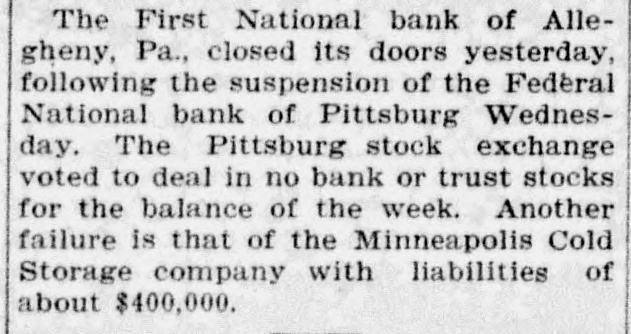
The First National bank of Allegheny, Pa., closed its doors yesterday, following the suspension of the Federal National bank of Pittsburg Wednesday. The Pittsburg stock exchange voted to deal in no bank or trust stocks for the balance of the week. Another failure is that of the Minneapolis Cold Storage company with liabilities of about $400,000.


Article from The Seattle Star, October 23, 1903

Click image to open full size in new tab

Article Text

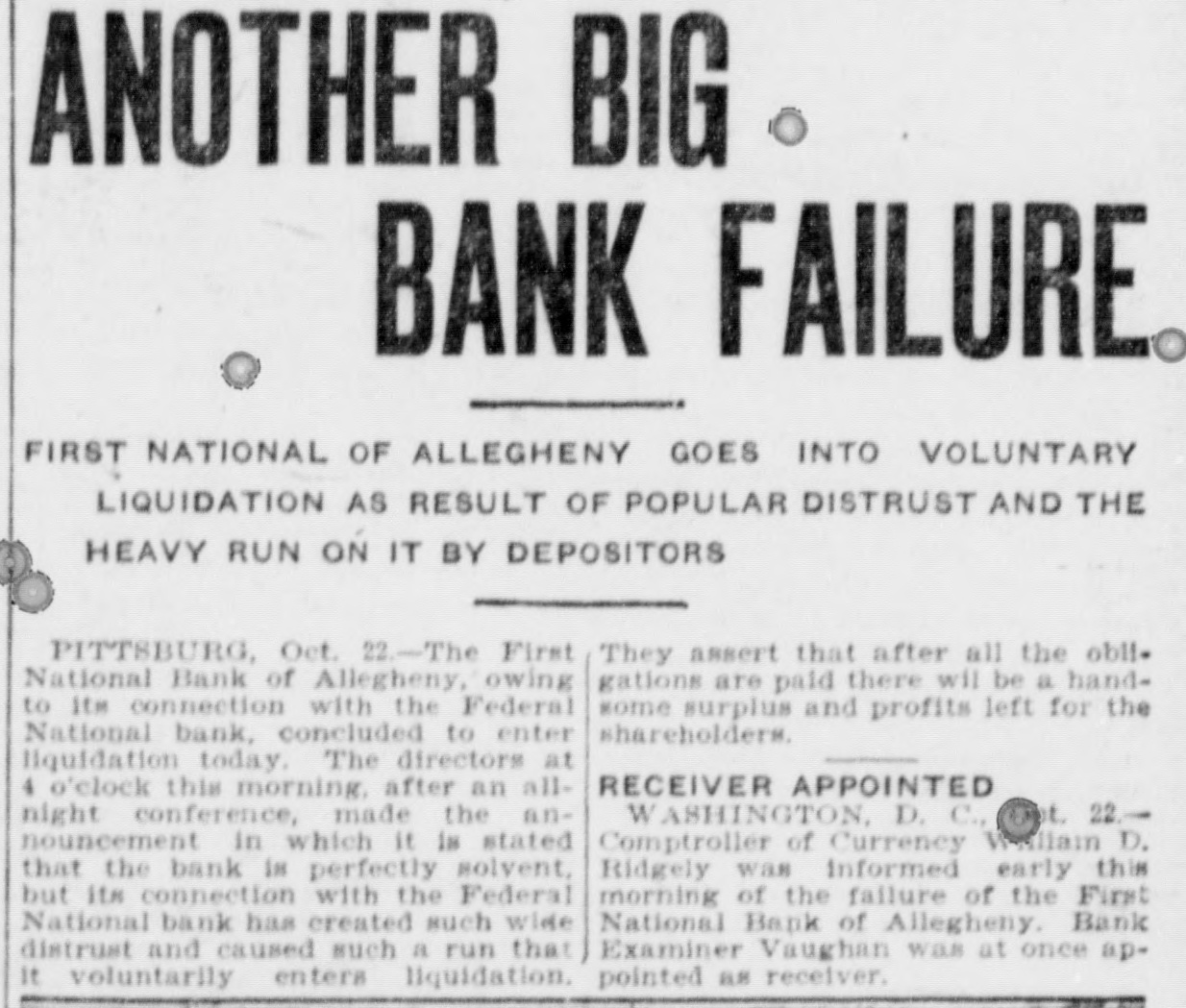
ANOTHER BIG BANK FAILURE FIRST NATIONAL OF ALLEGHENY GOES INTO VOLUNTARY LIQUIDATION AS RESULT OF POPULAR DISTRUST AND THE HEAVY RUN ON IT BY DEPOSITORS PITTSBURG, Oct. 22-The First They assert that after all the obilNational Bank of Allegheny, owing gations are paid there will be a handto Its connection with the Federal some surplus and profits left for the National bank, concluded to enter shareholders. liquidation today. The directors at RECEIVER APPOINTED 4 o'clock this morning, after an allnight conference, made the anWASHINGTON, D. C., Opt. t. 22.nouncement in which it is stated Comptroller of Currency William D. that the bank in perfectly solvent, Ridgely was informed early this but its connection with the Federal morning of the failure of the First National bank has created such wide National Bank of Allegheny. Bank distrust and caused such a run that Examiner Vaughan was at once apIt voluntarily enters liquidation. pointed BB receiver.


Article from Perth Amboy Evening News, October 24, 1903

Click image to open full size in new tab

Article Text

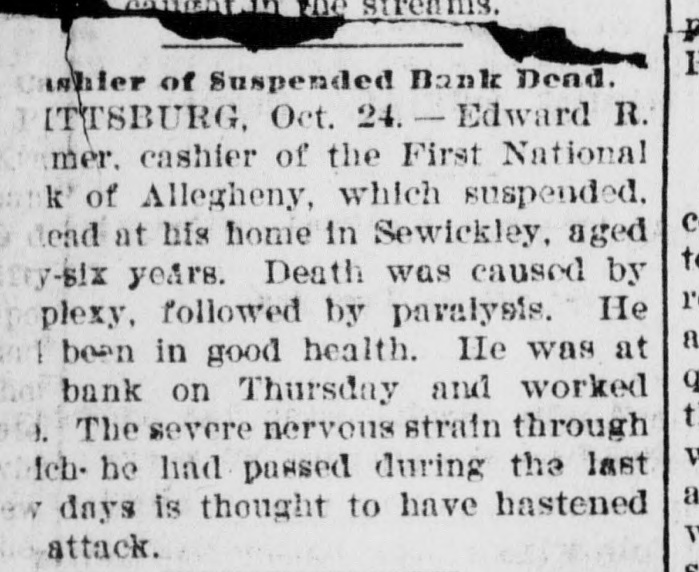
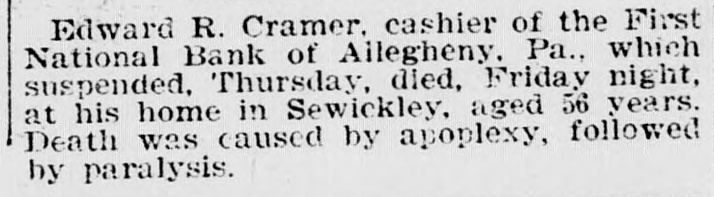
strenms. am whier of Suspended Bank Dead. ITTSBURG, Oct. 24. - Edward R. mer. cashier of the First National k of Allegheny, which suspended. end at his home in Sewickley, aged y-six years. Death was caused by plexy, followed by paralysis. He I been in good health. He was at bank on Thursday and worked The severe nervous strain through ). Ich- he had passed during the last days is thought to have hastened attack.


Article from Evening Journal, October 24, 1903

Click image to open full size in new tab

Article Text

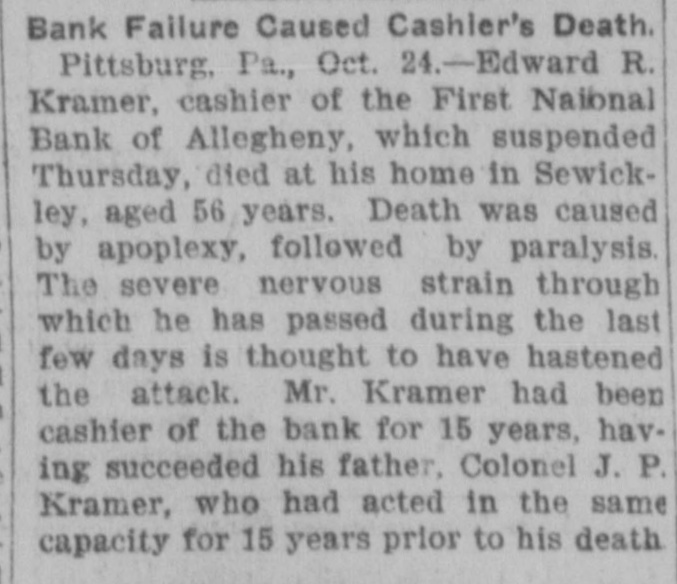
Bank Failure Caused Cashier's Death. Pittsburg, Pa., Oct. 24.-Edward R. Kramer, cashier of the First Naional Bank of Allegheny, which suspended Thursday, died at his home in Sewickley, aged 56 years. Death was caused by apoplexy, followed by paralysis. The severe nervous strain through which he has passed during the last few days is thought to have hastened the attack. Mr. Kramer had been cashier of the bank for 15 years, having succeeded his father, Colonel J. P. Kramer, who had acted in the same capacity for 15 years prior to his death


Article from The Savannah Morning News, October 24, 1903

Click image to open full size in new tab

Article Text

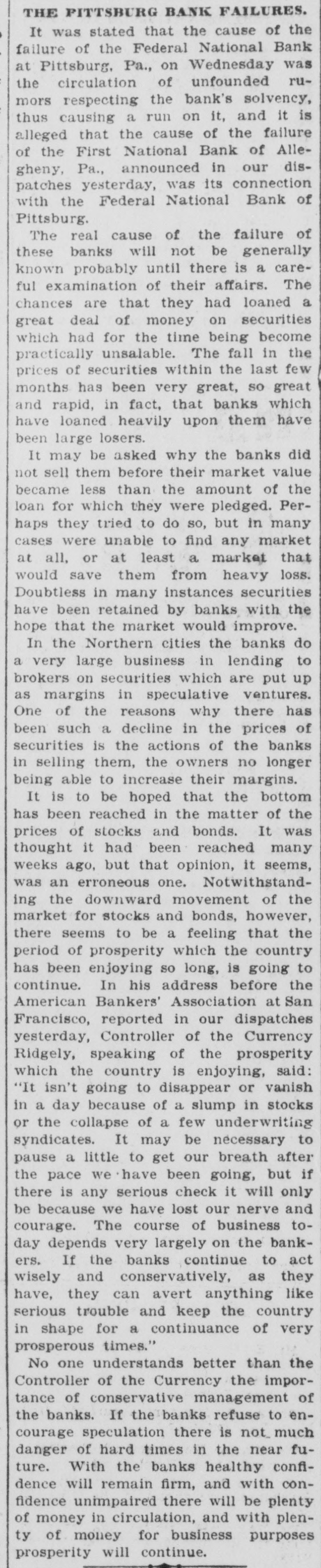
THE PITTSBURG BANK FAILURES. It was stated that the cause of the failure of the Federal National Bank at Pittsburg. Pa., on Wednesday was the circulation of unfounded rumors respecting the bank's solvency, thus causing a run on it, and it is alleged that the cause of the failure of the First National Bank of Allegheny, Pa., announced in our dispatches yesterday, was its connection with the Federal National Bank of Pittsburg. The real cause of the failure of these banks will not be generally known probably until there is a careful examination of their affairs. The chances are that they had loaned a great deal of money on securities which had for the time being become practically unsalable. The fall in the prices of securities within the last few months has been very great, so great and rapid, in fact, that banks which have loaned heavily upon them have been large losers. It may be asked why the banks did not sell them before their market value became less than the amount of the loan for which they were pledged. Perhaps they tried to do so, but in many cases were unable to find any market at all, or at least a market that would save them from heavy loss. Doubtless in many instances securities have been retained by banks with the hope that the market would improve. In the Northern cities the banks do a very large business in lending to brokers on securities which are put up as margins in speculative ventures. One of the reasons why there has been such a decline in the prices of securities is the actions of the banks in selling them, the owners no longer being able to increase their margins. It is to be hoped that the bottom has been reached in the matter of the prices of stocks and bonds. It was thought it had been reached many weeks ago, but that opinion, it seems, was an erroneous one. Notwithstanding the downward movement of the market for stocks and bonds, however, there seems to be a feeling that the period of prosperity which the country has been enjoying so long, is going to continue. In his address before the American Bankers' Association at San Francisco, reported in our dispatches yesterday, Controller of the Currency Ridgely, speaking of the prosperity which the country is enjoying, said: "It isn't going to disappear or vanish in a day because of a slump in stocks or the collapse of a few underwriting syndicates. It may be necessary to pause a little to get our breath after the pace we have been going, but if there is any serious check it will only be because we have lost our nerve and courage. The course of business today depends very largely on the bankers. If the banks continue to act wisely and conservatively, as they have, they can avert anything like serious trouble and keep the country in shape for a continuance of very prosperous times." No one understands better than the Controller of the Currency the importance of conservative management of the banks. If the banks refuse to encourage speculation there is not_ much danger of hard times in the near future. With the banks healthy confidence will remain firm, and with confidence unimpaired there will be plenty of money in circulation, and with plenty of money for business purposes prosperity will continue.


Article from Daily Kennebec Journal, October 24, 1903

Click image to open full size in new tab

Article Text

Edward R. Cramer. cashier of the First National Bank of Allegheny. Pa., which suspended, Thursday, died, Friday night, at his home in Sewickley, aged 56 years. Death was caused by apoplexy, followed by paralysis.


Article from Twice-A-Week Plain Dealer, October 27, 1903

Click image to open full size in new tab

Article Text

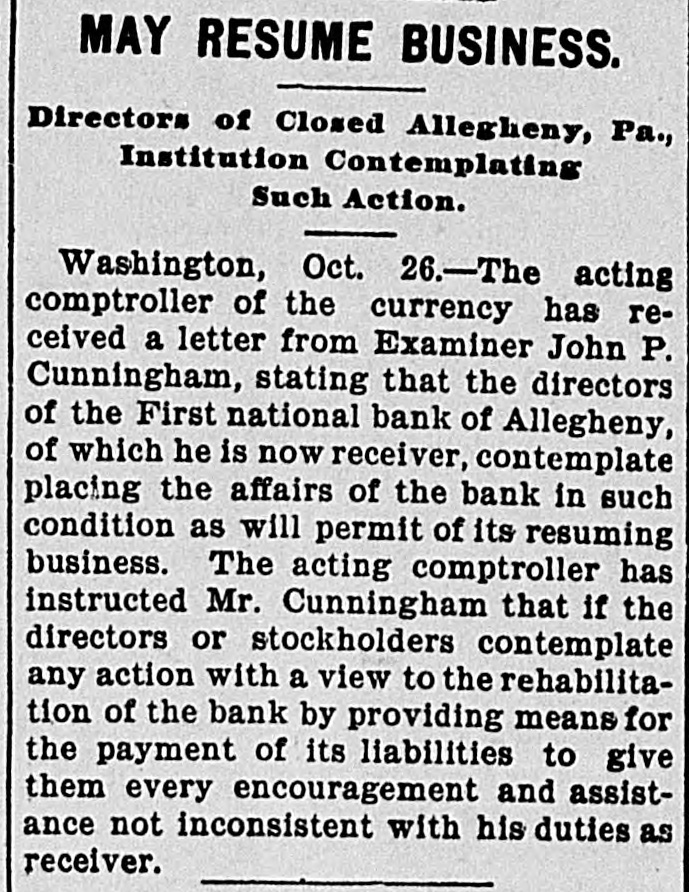
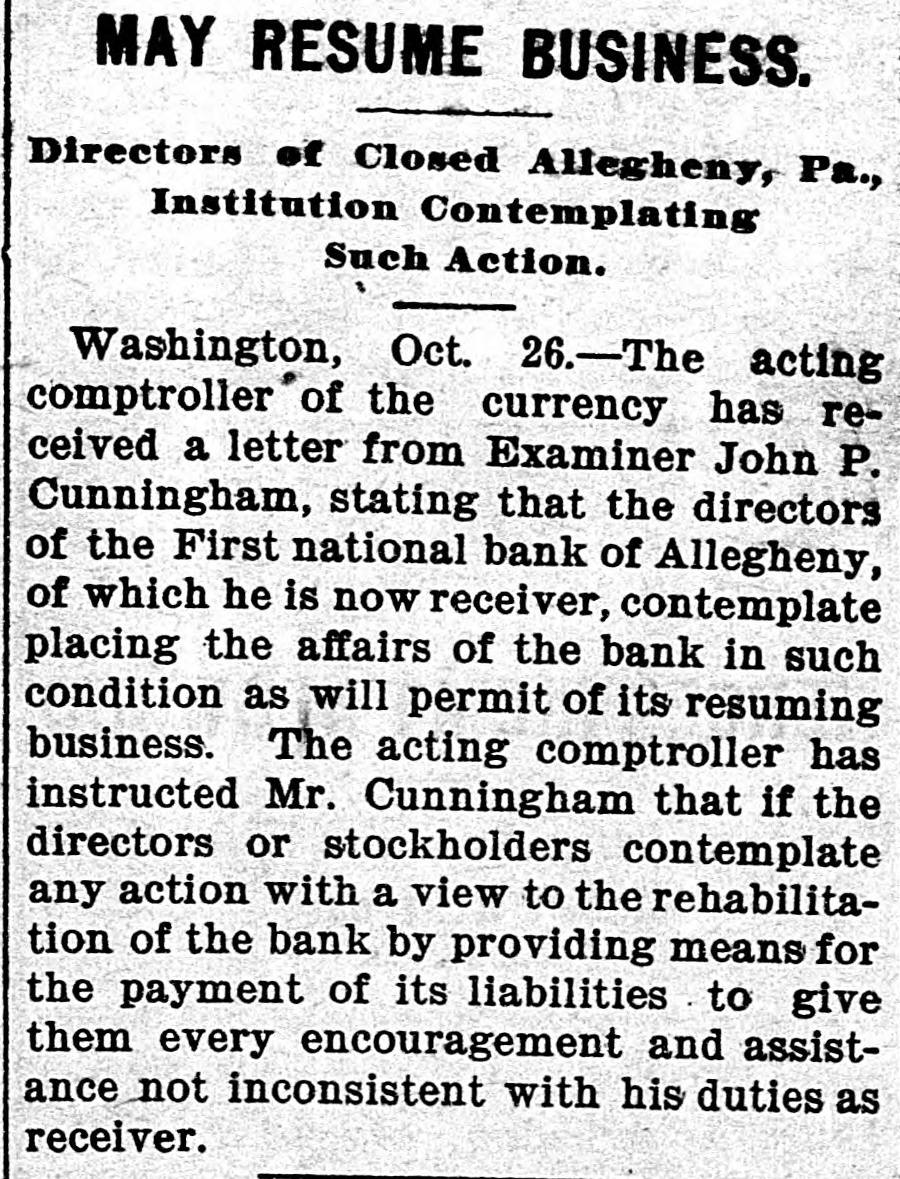
MAY RESUME BUSINESS. Directors of Closed Allegheny, Pa., Institution Contemplating Such Action. Washington, Oct. 26.-The acting comptroller of the currency has received a letter from Examiner John P. Cunningham, stating that the directors of the First national bank of Allegheny, of which he is now receiver, contemplate placing the affairs of the bank in such condition as will permit of its resuming business. The acting comptroller has instructed Mr. Cunningham that if the directors or stockholders contemplate any action with a view to the rehabilitation of the bank by providing means for the payment of its liabilities to give them every encouragement and assistance not inconsistent with his duties as receiver.


Article from New Ulm Review, October 28, 1903

Click image to open full size in new tab

Article Text

MAY RESUME BUSINESS. Directors of Closed Allegheny, Pa., Institution Contemplating Such Action. Washington, Oct. 26.-The acting comptroller of the currency has received a letter from Examiner John P. Cunningham, stating that the directors of the First national bank of Allegheny, of which he is now receiver, contemplate placing the affairs of the bank in such condition as will permit of its resuming business. The acting comptroller has instructed Mr. Cunningham that if the directors or stockholders contemplate any action with a view to the rehabilitation of the bank by providing means for the payment of its liabilities to give them every encouragement and assistance not inconsistent with his duties as receiver.


Article from The Bamberg Herald, October 29, 1903

Click image to open full size in new tab

Article Text

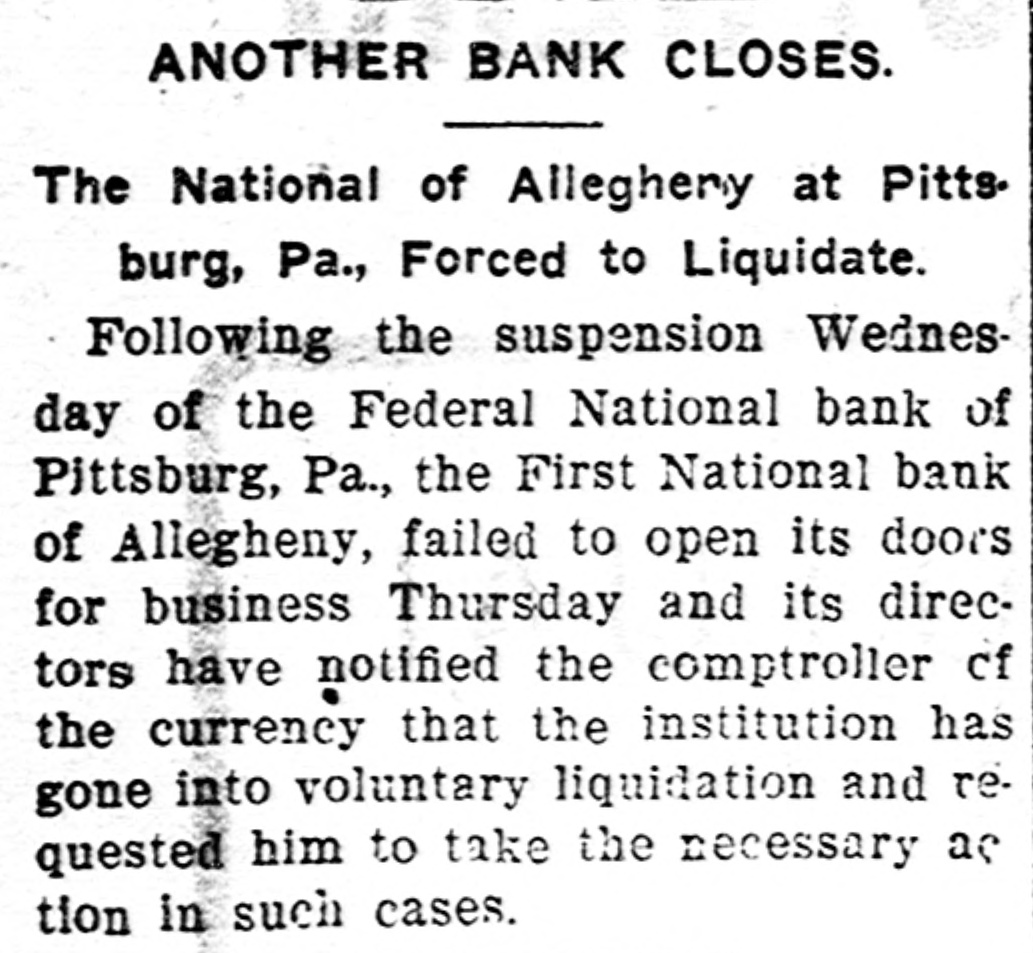
ANOTHER BANK CLOSES. The National of Alleghery at Pitts. burg, Pa., Forced to Liquidate. Following the suspension Wednesday of the Federal National bank of Pittsburg, Pa., the First National bank of Allegheny, failed to open its doors for business Thursday and its directors have notified the comptroller cf the currency that the institution has gone into voluntary liquidation and requested him to take the necessary as tion in such cases.


Article from The Spokane Press, December 5, 1903

Click image to open full size in new tab

Article Text

Will Resume. WASHINGTON, Dec. 5. - The comptroller of the currency has authorized the First National Bank of Allegheny to resume business Monday, it being found solvent despite the terrific run which caused the doors to close. It resumes with unimpaired capital.


Article from Daily Capital Journal, December 5, 1903

Click image to open full size in new tab

Article Text

The Bank Reopened. Washington, Dec. 5.-The comptroller of the currency has authorized the First National Bank of Allegheny to resume business Monday, it being solvent, despite the terrific run which recently caused its doors to close. It resumes with unimpaired capital.


Article from Evening Times-Republican, December 7, 1903

Click image to open full size in new tab

Article Text

Suspended Bank Reopens. Pittsburg, Dec. 7.-The First National Bank of Allegheny, which closed its doors shortly after suspension of the Federal National Bank of this city several weeks ago, reopened today. The institution has been entirely reorganized.


Article from The Seattle Star, December 7, 1903

Click image to open full size in new tab

Article Text

SOLVENT WASHINGTON, D. C Comptroller of the Currency Ridgely has authorized the First National Bank of Allegheny to resume busineas Monday, it being found to be solvent, despite the terrific run which recently caused its doors to close. The Institution resumes with unimpaired capital.


Article from The San Francisco Call, December 8, 1903

Click image to open full size in new tab

Article Text

PITTSBURG, Pa., Dec. 7.-The - First National Bank of Allegheny, which closed its doors shortly after the suspension of the Federal National Bank of this city. several weeks ago, reopened to-day.