Scandinavian National Bank (Chicago, IL)

Episode Information

Episode UID
197800876
Episode Type
Suspension β†’ Closure
Bank Type
national
Bank ID
19780 national
Charter Number
1978
Start Date
December 10, 1872
Location
Chicago, Illinois (41.850, -87.650)

Metadata

Model
gpt-5-mini (chosen from majority vote of a three-model LLM ensemble)
Short Digest
e923c61082e6d4b1

Response Measures

None

Receivership Details

Depositor recovery rate
57.5%
Date receivership started
1872-12-12
Date receivership terminated
1886-02-15
OCC cause of failure
Fraud
Share of assets assessed as good
27.2%
Share of assets assessed as doubtful
27.2%
Share of assets assessed as worthless
45.7%

Events (5)

1. May 7, 1872 Chartered
Source
historical_nic
2. December 10, 1872 Suspension
Cause
Bank Specific Adverse Info
Cause Details
President Ferdinand (Ferd.) S. Winslow alleged to have misapplied/absorbed assets in speculative railroad operations and fraudulent transactions, forcing suspension.
Newspaper Excerpt
the closing of the Scandinavian National Bank of this city, ... will be immediately placed in the hands of a receiver.
Source
newspapers
3. December 12, 1872 Receivership
Source
historical_nic
4. December 13, 1872 Receivership
Newspaper Excerpt
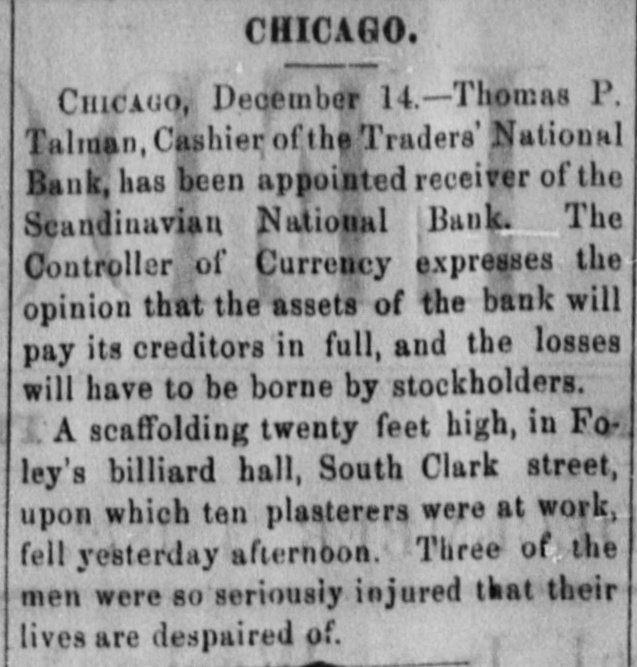
The Comptroller of Currency has appointed Thos. P. Tallman receiver of the Scandinavian National bank of Chicago. The comptroller is of the opinion that bank will pay its creditors in full, leaving the losses entirely upon the shareholders.
Source
newspapers
5. December 30, 1872 Receivership
Newspaper Excerpt
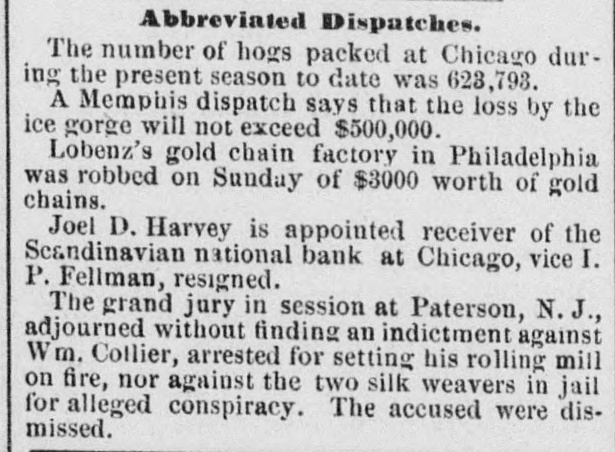
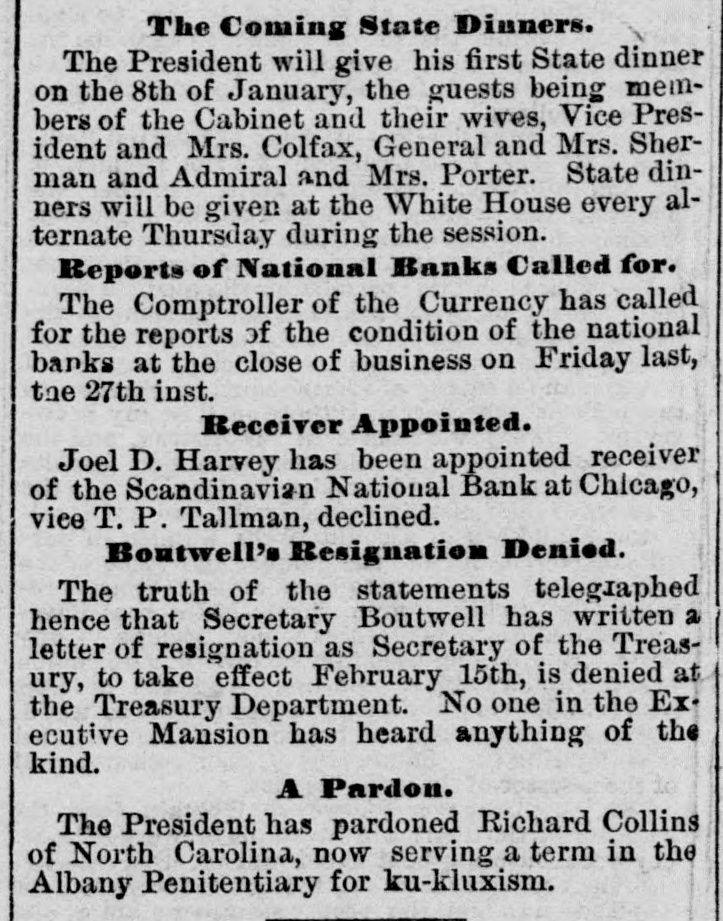
JOEL D. HARVEY has been appointed receiver of the Scandinavian national bank in Chicago, vice Thos. P. Tallman declined.
Source
newspapers

Newspaper Articles (20)

Article from New-York Tribune, December 2, 1872

Click image to open full size in new tab

Article Text

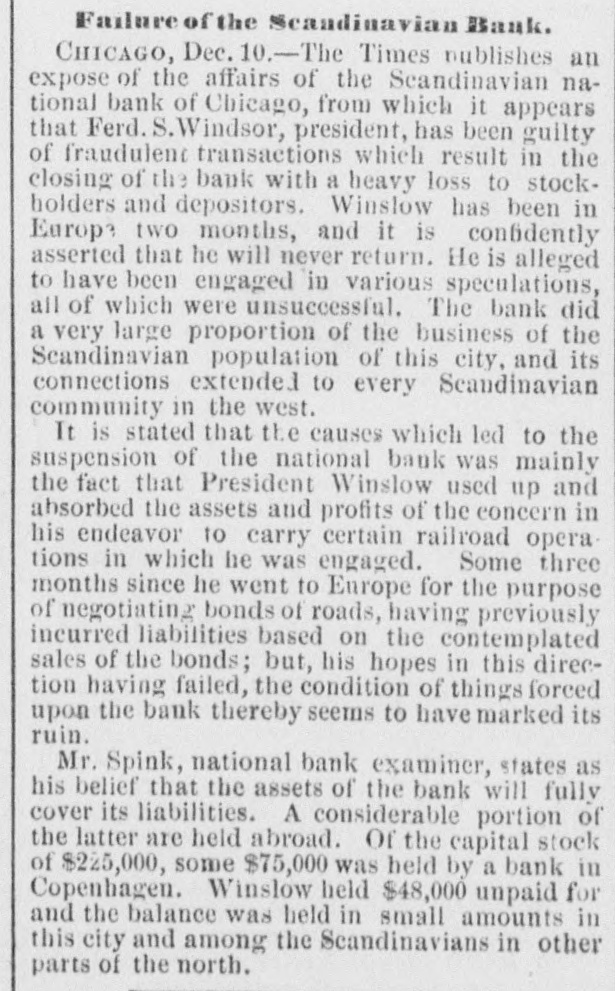
THE CURRENCY. We complete to-day our extracts from the annual report of the Controller of the Currency, of which we printed a portion on Saturday. The limit of the National Bank issues in each State and Territory is fixed on the basis of population. resources, businees, and bank capital, as ascertained by the census. The last census required a new apportionment, as it showed a total increase in the population of the Union of more than 7,000,000 persons, and in wealth of nearly $14,000,000,000. An act was accordingly passed providing for an additional issue of $54,000,000. Of this the largest sum, $8,400,000, apportioned to any State, went to Illinois; Ohio and Kentucky each got over $5,000,000; Indiana, $4,000,000; Michigan and Louisiana each over $3,000,000; the distribution being made one-half on the population and one-half on the wealth of the country. It will be noticed that the increase all goes to the South and West, and more is yet needed to give those sections their due apportionment; to accomplish this, $25,000,000 is to be withdrawn and redeemed from the circulation of banks in New-York and New-England, and a corresponding amount authorized to banks in States that have not now their quota. It is a commonly received but somewhat erroneous opinon that the amount of currency in the hands of each individual member of the community has been on the average largely increased by the National Bank system; but this report only gives it now as, for the whole United States, $9 18 per capita, against $7 59 before National Banks existed: but the circulation of U. S. Treasury notes should be added before any conclusion is reached from these figures. The State of Rhode Island has the largest per capita circulation: $61 56; Mississippi the least:-one centexcept Florida and California, which have none. New-York has but $14 08. The National Banks have paid in the last eight years some $40,000,000 taxes to the United States; their State and national taxes for four specified years together amount to $71,000,000. The bank dividends are not so large on the average as is generally supposed: they do not exceed in the aggregate those of the old State banks; for the whole Union they but slightly exceed five per cent on invested capital. The great question of the proper reserve to be held by the National Banks is discussed in this report, and the conclusion reached that it is only the smaller and weaker banks that want to go below the present limit. Their necessities arise from putting out their funds at interest on deposit with Eastern banks-a condition which has more than once given riso to the most serious financial convulsions, as in 1857 - and a remedy proposed by the Controller is the issue of a new security by Government which will afford these banks the needful investment at interest. Not the least interesting feature of this report is the announcement that the Chicago banks, 80 far from being crippled as was anticipated after the fire by losses on discounted paper and the withdrawal of their balances, in point of fact steadily increased in business and profit, after resuming without embarrassment as soon as their safes were cool. There is a similar prospect in Boston, where the aggregate losses since the fire on bills receivable are estimated at less than three millions of dollars, which the bank surpluses will cover without touching capital or reserve. The question of usury is discussed. It appears that the penalty for its practice by National Banks is not clearly defined, and the Controller therefore declines to institute proceedings concerning it. A general law for the establishment of Savings Banks in the District of Columbia seems desirable. Locking up greenbacks is reprehended, and the New-York Stock Board and Clearing House are asked to discourage it. A table of the specie kept on hand by the banks shows it as less in October last than in many years before; as $10,000,000 against a usual average of $25,000,000. In the few cases of failure among the National Banks, the unfortunate institutions seem to be wound up with less ruinous loss to depositors and stockholders than has ever been re-
Article from Daily Kennebec Journal, December 4, 1872

Click image to open full size in new tab

Article Text

# THE CURRENCY. The Report of the Comptroller of the Currency is an elaborate document. The topic of most interest referred to is that of a proposed increase of the national bank notes. The Comptroller recommends the repeal of the act of Congress which calls for the redistribution of twenty-five millions of national bank currency, by withdrawing that amount from the Middle and Eastern States and giving it to the South and West, and in lieu thereof to issue five millions a year additional circulation for the next five years, to meet the wants of those States which have not had their full proportion. It is a commonly received but somewhat erroneous opinion that the amount of currency in the hands of each individual member of the community has been on the average largely increased by the National Bank system; but this report only gives it now as, for the whole United States, $9,18 per capita, against $7,59 before National Banks existed; but the circulation of United States Treasury notes should be added before any conclusion is reached from these figures. The State of Rhode Island has the largest per capita circulation: $61,56; Missippi the least: one centβ€”except Florida and California, which have none. New York has but $14,08. The National banks have paid in the last eight years some $40,000,000 taxes to the United States; their State and national taxes for four specified years together amount to $71,000,000. The bank dividends are not so large on the average as is generally supposed; they do not exceed in the aggregate those of the old State banks; for the whole Union they but slightly exceed five per cent on invested capital. The great question of the proper reserve to be held by the National Banks is discussed in this report, and the conclusion reached that it is only the smaller and weaker banks that want to go below the present limit. Their necessities arise from putting out their funds at interest on deposit with Eastern banksβ€”a condition which has more than once given rise to the most serious financial convulsions, as in 1857β€”and a remedy proposed by the Controller is the issue of a new security by a Government which will afford these banks the needful investment at interest. Not the least interesting feature of this report is the announcement that the Chicago banks, so far from being crippled as was anticipated after the fire by losses on discounted paper and the withdrawal of their balances, in point of fact steadily increased in business and profit, after resuming without embarrassment as soon as their safes were cool. There is a similar prospect in Boston, where the aggregate losses since the fire on bills receivable are estimated at less than three millions of dollars, which the bank surpluses will cover without touching capital or reserve. The question of usury is discussed. It appears that the penalty for its practice by National Banks is not clearly defined, and the


Article from Worcester Daily Spy, December 11, 1872

Click image to open full size in new tab

Article Text

Failure of the Scandinavian Bank. CHICAGO, Dec. 10.-The Times publishes an expose of the affairs of the Scandinavian national bank of Chicago, from which it appears that Ferd. S. Windsor, president, has been guilty of fraudulenc transactions which result in the closing of the bank with a heavy loss to stockholders and depositors. Winslow has been in Europe two months, and it is confidently asserted that he will never return. He is alleged to have been engaged in various speculations, all of which were unsuccessful. The bank did a very large proportion of the business of the Scandinavian population of this city, and its connections extended to every Scandinavian community in the west. It is stated that the causes which led to the suspension of the national bank was mainly the fact that President Winslow used up and absorbed the assets and profits of the concern in his endeavor to carry certain railroad opera tions in which he was engaged. Some three months since he went to Europe for the purpose of negotiating bonds of roads, having previously incurred liabilities based on the contemplated sales of the bonds; but, his hopes in this direction having failed, the condition of things forced upon the bank thereby seems to have marked its ruin. Mr. Spink, national bank examiner, states as his belief that the assets of the bank will fully cover its liabilities. A considerable portion of the latter are held abroad. Of the capital stock of $225,000, some $75,000 was held by a bank in Copenhagen. Winslow held $48,000 unpaid for and the balance was held in small amounts in this city and among the Scandinavians in other parts of the north.


Article from New-York Tribune, December 11, 1872

Click image to open full size in new tab

Article Text

A CHICAGO BANK FRAUD. CHICAGO, Dec. 10.-The Times, to-day, publisbes an exposΓ© of the affairs of the Scandinavian National Bank of this city, from which it appears that Ferd. 9. Winslow, the President, has been guilty of frandulent transactions, which will result in the closing of the bank to-day, with a heavy loss to the stockholders and depositors. Winslow has been in Europe for the past two months, and it is confidently asserted that be will never return. He is alleged to have been engaged in various speculations, all of which appear to have proved unsuccessful. The bank did a very large proportion of the business of the Scandinavian population of this city, and its connections extended to every Scandinavian community in the West. It will be immed. ately placed in the hands of a receiver.


Article from Memphis Daily Appeal, December 11, 1872

Click image to open full size in new tab

Article Text

A HUGE SWINDLER. President Winslow an Expert at Bank Smashing-The Scandinavian Community Fearfully Swindled. CHICAGO, December 10.-The Times to-day publishes an extosse of the affairs of the Scandinavian National Bank, of this city, from which it appears that Ferd. S. Winslow, the President, has been guilty of fraudulent transactions, which will result in the closing of the bank this morning, with heavy loss to the stockholders and depositors. Winslow has been in Europe for the past two months, and it is confidently asserted that he will never return. He is alleged to have been engaged in various specuall of unsuccessful. a lations, proved which The appear bank to did have very large proportion of the business of the Scandinavian population of this city, and its connections extended to every Scandinavian community in the West. It is stated that the causes which led to the suspension of the Scandinavian National Bank of this city are mainly that President Winslow used up and absorbed the assets and profits of the concern in an endeavor to carry out certain railroad operations in which he was engaged. Some three months since be went to Europe for the purpose of negotiating the bonds of the roads having previously incurred liabilities based on the contemplated sale of those bonds, but his hopes in this direction having failed, the condition of things forced upon the bank thereby seems to have worked its ruin. Mr. Spink, National Bank Examiner, states it as his belief that the assets of the bank will fully cover its liabilities. A considerable portion of the latter are held abroad. Of the capital stock of $225,000, some $75,000 were held by the bank in Copenhagen. Winslow held $48,000 unpaid and the balance was held in small amounts in this city, and among the Scandinavians in other parts of the Northwest. The amount due depositors is stated at $225,000. Almost the entire business of the Scandinavian population in this in R city was done with this bank. The bank will be immediately placed 15 in the hands of a receiver. The entire la li assets, good, bad and indifferent, are I placed at $536,513; the liabilities are $422,000, aside from the capital stock.


Article from The Wheeling Daily Intelligencer, December 11, 1872

Click image to open full size in new tab

Article Text

CHICAGO. CHICAGO, December 10.-The Times to. day publishes an expose of the affairs of the Scandinavian National Bank of this city, from which it appears that Ford S. Winslow, the President has been guilty of fraudulent transactions, which will result in the closing of the bank this morning, with a heavy loss to the stockholders and depositors. Winslow has been in Europe for the past two months, and it is confidently asserted that he will neverreturn. He is alleged to have been engaged in various speculations, all of which appears to have proved unsuccessful. The bank did a very large proportion of the business of the Scandinavian's population of this city, andits connections extended to every Scandinavian community in the West. It is stated that the causes which led to the suspension of the Scandinavian National Bank of this city, are mainly that President Winslow used up and absorbed the assets and profits of the concern in an endeavor to carry certain railroad operations in which he was engaged to some three months since. He went Europe for the purpose of negotiating bonds of the roads, having previously incurred liabilities based on the contemplated sale of those bonds, but his hopes in this direction having failed, the condition of things forced upon the bank thereby seemd to have worked its ruin. Mr. Spinel, national bank examiner, states as his belief that the assets of the bank will fully cover its liabilities. A considerable portion of the latter are held abroad. Of the capital stock of $225,000, some $75,000 was held by a bank in Copenhagen; Winslow held $18,000 unpaid for, and the balance was held in small amounts in this city among Scandinavians and in other parts o! thre Northwest. The sum due the depositors is stated at $225,000. Almost the entire business of the Scandinavian population in this city was done with this bank. The bank will immediately be placed in the hands of a receiver. The entire assets, good, bad and indifierent, are placed at $536,516, and the liabilities at $422,000, aside from the capital stock. Ira T. Munn and Geo. W. Scott, of the elevator firm of Munn & Scott, were before the Criminal Court today on the charge of fraudulent dealing, and were held to bail in $10,000 each.


Article from The New York Herald, December 11, 1872

Click image to open full size in new tab

Article Text

BANK SUSPENSION. The National Scandinavian Bank of Chicago To Be Placed in the Hands of Receiver-The President Charged with Carrying on Transactions of a Rockless and Unproutable Character and Absorbing All the Profits. CHICAGO, Dec. 10, 1872. The Times to-day publishes an exposΓ© of the affairs of the Scandinavian National Bank of this city, from which it appears that Ferdinand S. Winslow, the President, has been guilty or fraudulons transactions, which will result in the closing of the bank to-day, with a heavy loss to the stockholders and depositors. Winslow has been in Europe for the past two months, and it is confidently asserted that he will never return. He is alleged to have been engaged in various speculations, all of which appear to have proved unsuccessful. The bank did a very large proportion of the business of the Scandinavian population of this city, and its connections extended to every Scandinavian community in the West. It 18 stated that the exact causes which led to the suspension of the bank was mainly the fact that Winslow used up and absorbed the assets and profits of the concern in an endeavor to carry certain railroad operations ID which he was engaged. When he went to Europe it was for the purpose of negotiating the bonds of the roads, having previously incurred liabilities based on the contemplated sales of those bonds. Bat his hopes in this direction having failed, the condition of things forced upon the bank thereby seems to have worked its ruin. Mr. Spink, National Bank ExamIner, states as his belief that the assets of the bank will fully cover its liabilities. A considerable portion of the latter are held abroad. or the capital stock of $225,000 some $75,000 was held by a -bank in Copenhagen, Winslow held $48,000 unpaid for, and the balance was held in small amounts in tnis city and among the Scandinavians in other parts or the Northwest. The amount due to depositors is stated at $225,000. The bank will be immediately placed in the hands of a receiver. The entire assets, good, bad and indifferent, are placed at $536,516, and the liabilities at $422,000, aside from the capital stock.


Article from Chicago Daily Tribune, December 11, 1872

Click image to open full size in new tab

Article Text

MONEY AND COMMERCE. MONETARY. TUESDAY EVENING, Dec. 10. The favorable change in the condition of the local money market, noted during the last few days, continues. Deposits are steadily increasing, and obligations falling due at the banks are being more promptly paid. Money is very tight yet, but collections in the country are improving, hogs and cattle are being marketed freely, and on the whole the financial situation is much better than it was a week ago. The supply of New York exchange is large, but the demand for it is also very large. There was considerable demand for currency to-day, that weakened the price of exchange, though sales were made between banks at 50c per $1,000 premium. THE FAILURE OF THE SCANDINAVIAN NATIONAL BANK, of this city, is an illustration of the evasions of the law in regard to paying up National Bank capital, to which pointed reference has been made in this column of THE TRIBUNE several times during the last few weeks. The causes of the failure are, however, of a special nature, and for that reason a detailed statement of them are necessary to show that they are not of any general character that might affect other banks. The Scandinavian Bank was originally a private bank, with a line of about $100,000 deposits (nearly all savings deposits) of Scandinavian laborers. The bank also did a considerable business in the sale of passage tickets to and from North Germany, Denmark, and Sweden. Last spring, Winslow being President, the bank was reorganized as a National Bank, and the majority of the stock, $225,000, taken by Winslow. Afewsmallamounts of stock were scattered around among reputabio people here, and their names temporarily used as Directors just long enough to give the bank a respectable standing, the bank making its 3. Est statement as a National Bank on Oct. 1. is not known how much of the $225,000 of stock was legitimately paid in at the start, but i. is alleged that, as Winslow did not have the cavital to pay in, the money to buy the $150,000 of bonds to secure its $135,000 of circulation 028 Joaned to him by a National Bank of this 0.00 until the $135,000 of circulation on the bonds and be got from the Treasury Department a Washington. It is also intimated that the President of the National Bank that made this advance got $1,000 of stock in the Scandinavian National Bank for the accommodation. Winslow subsequently sold $75,000 of the stock of the bank to parties in Copenhagen, and 850,000 to parties in Paris, who were all induced to take it on the recommendation of a respectablo Danish banker, a friend of Winslow's, in Copenhagen. The money for this stock was paid to Winslow in person. and, it is alleged, was never paid by him into the bank as capital, but only partly, and to*the credit of his own account. Meantime, the prestige of being a National Bank attracted the deposits of the Scandinavians of the city, its deposits increased, and, on these and some email payments of stock, probably €40,000 all told, the bank was carried along. About five months ago Winslow undertook to financier the Mississippi Valley & Western Railroad, which is in operation from Quincy to Keokuk, 40 miles, with 3 line in progress from Ileokuk to Brownsville, Nebraska, 352 miles. In pursuance of this plan, he sailed for Europe about the 1st of July, to negotiate the bonds to build the read In expectation of the sale of the bonds, he bought a considerable amount of railroad iron, at least one cargo of which has come forward. But failing to negotiate the bonds as anticipated, further purchases of iron were suspended. The iron that was bought was at a high figure, and the subsequent decline in the price of iron made, as is claimed, a loss of some $20,000 or $30,000. This is all the legitimate loss of which we can hear positively, and it seems that the $260,000 which Winslow is said to be indebted to the bank is almost entirely an illegal misappropriation of its funds, in the three following ways First, for money received from Copenhagen and Paris stockholders, and not paid in; second, for 848,500 of stock still in his name and third, for advances made by the bank on his purchases of iron and for other advances to the failroad on his behalf. These circumstances were not wholly developed until within the last week or ten days. But four weeks ago, when protested bills began to come back here from London and rumors began to circulate freely. the writer called on Mr. Alexander Siller, the Cashier of the Scandinavian National Bank, and asked him to refute them if possible, and at the eame time asked for 8 statement of the condition of the bank. Mr. Siller gave us the following, which we have every reason to believe was technically correct, showing the condition of the bank on the evening of Nov. 16: SATURDAY, OCT. 16, 1872.


Article from Pioche Daily Record, December 12, 1872

Click image to open full size in new tab

Article Text

San Francisco, Dec. 11.-Edward Savage for an on person a not 7 the is under examination of little girl outrage years of age. The testimony against him seems conclusive. Captains familiar with the reef on express cannot off fears which that the she Sacramento be got struck, safely. It is reported on good authority that faro and other games have been reinstated: the doorkeepers have been disof the club rooms are pensed with, furnished and frequenters with pass keys. San Francisco, Dec. 11.-John Stahl was sent to the Insane Asylum this afternoon. Schooner Lizzie Shea was wrecked last week near Petroda, Humboldt county. She sailed from Victoria November 13th. The dead body of a man was on board when she came ashore. The United States Grand Jury will meet next week when the case of Shipaccused of the the pingmasters, interfering Scott with and business Hunter, of United States Shipping Commissioner, will be investigated. J. W. Southwell, accused of raising drafts drawn on the National, Gold and other banks, protests his innocence. He is constantly attended by his wife and her sister. Salt Lake, Dec. 11 Judge O. F. Strickland, Associate Justice of the U. S. Supreme Court, has gone East with the intention of resigning. There is an immense freighting business from the end of the track of the Utah Southern road to Southeastern Nevada and the mining districts. Large amounts of bullion are still coming in daily from the Raymond & Ely mine, Pioche. The police made a raid to-day on the gambling houses. A large number of arrests were made. Vallejo, Cal., Dec. 11.-The U. S. steamer Saranac has been ordered to the relief of the steamer Sacramento. In at Mare consequence being in the of machine some of her shop machinery Island, it will be three or four days before she can proceed to sea. Franktown, Nev., Dec. 11.--- A cutting scrape on at Mill Station, occurred game the 9th, over a of cards. Andy Gussiere, a Spaniard, was badly cut by Wm. Maxey. Maxey delivered himself t up, but was released, and claimed to have acted in self defense. Gussiere is 3 3 badly hurt, but not considered fatally 2 injured. EASTERN. 3 New York, December -The steamer 5 Italy, from Liverpool, arrived yesterday, 32 bringing 882 emigrant passengers, of 36 whom 500 are Italians in extreme dis tress. The authorities at Castle Garden 34 are in a quandary about their possession, and say they are as a general 69 thing unable to earn anything after that at they If their without arrival, and Several present are means. have been il to sent to Ward's Island, to be supported by the City. Other vessels are now on pthe way with large numbers of Italians st. As near as can are a from he led to emigrate be by promises ascertained, they agents of The as is unItalian the Colonization Government Association. reported as pfavorable to the general exodus. ly Mayor Hall emphatically denies that in he wrote, instigated or dictated a line in editorially for the Herald, and says tha the story that he had become connected t, therewith is a hoax. ctWashington, Dec. 11.-In the case of he Kellogg vs. Warmouth, which came be es. fore the U. S. Supreme Court on Mon day, the Court to-day granted leave ly er file the petition ordering that the argu ment on the motion for a rule to show en cause against Judge Darrell be heard or Thursday. d, Chicago, Dec. 11.-The Scandinavian te Cause assets the F absorption National Bank of has by suspended. President, has been in for ry months, and is to elS. the Winslow, past three who Europe likely remain. The assets cover the liabilities The bank did nearly the entire business ur of the Scandinavian of the city be whom there it, is y, and considerable the Northwest, excitement. among people Winslow Ice for years, has done business for his ly; countrymen as a private broker. etIt Ira T. Munn and George W. Scott irs prominent grain merchants, and pro of prietors of several elevators, were held oif to bail in $10,000 each, in the Criminal 80 Court, charged with swindling by mean ou of false accounts and putting false bot ell toms in the elevators. rst ill Boston, Dec. 11.-Gaston has been re ow elected mayor by 352 majority over H. S rs Pierce. eet New York, Dec. 11.-Fire in the Fift) inou Avenue Hotel last night broke out short of ly after 11 o'clock, on the second floor


Article from Gold Hill Daily News, December 12, 1872

Click image to open full size in new tab

Article Text

# A Rich Fugitive. CHICAGO, December 12.-Dispatches received in this city yesterday state that Winslow, the fugitive President of the suspended Scandinavian Bank, of this city, is in China, where it is stated he went a month ago, taking with him some twenty thousand dollars.


Article from The Wheeling Daily Intelligencer, December 14, 1872

Click image to open full size in new tab

Article Text

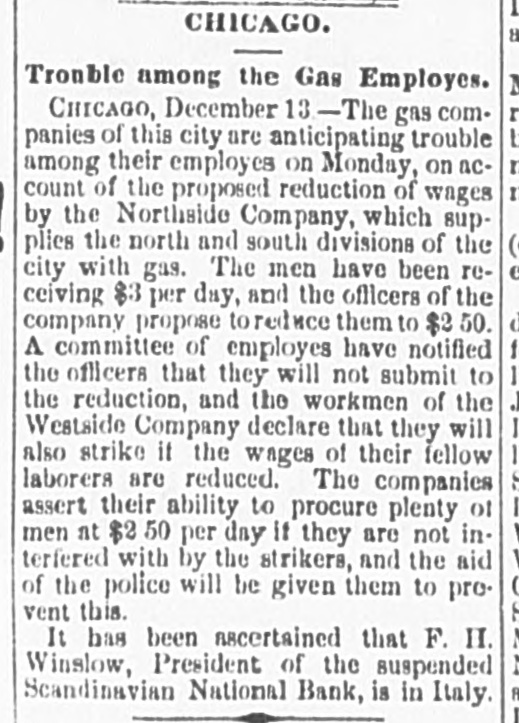
CHICAGO. a Tronble among the Gas Employes. CHICAGO, December -The - gas companies of this city are anticipating trouble among their employes on Monday, on account of the proposed reduction of wages by the Northside Company, which supplies the north and south divisions of the city with gas. The men have been rcceiving 83 per day, and the officers of the company propose to radace them to $21 50. A committee of employes have notified the officers that they will not submit to the reduction, and the workmen of the Westside Company declare that they will also strike it the wages of their fellow laborers are reduced. The companies assert their ability to procure plenty of men at $2 50 per day it they are not interfered with by the strikers, and the aid of the police will be given them to pro. vent this. It has been ascertained that F. II. Winslow, President of the suspended Scandinavian National Bank, is in Italy.


Article from Nashville Union and American, December 14, 1872

Click image to open full size in new tab

Article Text

WASHINGTON. Increasing Grant's Salary to $50,000. WASHINGTON, Dec. 13.-The Judiciary Committee have to-day agreed to report a bill to increase the President's pay to $50,000 per annum. Greeley's Successor? Vice-President Colfax left Washington last night for New York to meet to day the stockholders of the New York Tribune in connection with the offer made to him to become editor of that paper. Delano Departs. Secretary Delano departed for Cuba last night. The Interior Department was represented in the Cabinet meeting to -day by Gen. Cowan Assistant Secretary. Tennessee Postmasters. The Senate in Executive session to-day confirmed the following nominations among others: Chas. S. Moss, Franklin, Tenn.; Elkarrah H. Millard, Bristol, Tenn, and James Peacock, Gallatin, Tenn. The Scandinavian Swindle. The Comptroller of Currency has appointed Thos. P. Tallman receiver of the Scandinavian National bank of Chicago. The Comptroller is of opinion that the bank will pay its creditors in full, leaving the losses entirely upon the shareholders. The Virginia Canal-A Speech! A delegation composed of Senators and Representatives from the States and Virginia and West Virginia, called upon the President to-day to thank him for the recommendation in his message relative to the James river and Kanawha river canal, and to express their hope that he would further the measure as much as possible. The President replied as follows: I appreciate the great importance of this work to the commercial interests of the nation, and am glad the subject has been brought to the attention of Congress. nope Congress will give sufficient encouragement to insure its completion. The enormous productions of the Western and Southern States interested in this route demand an outlet to tide-water and the Atlantic coast, and these interests are so important that they must ultimately compel the completion of this work in some manner. Oklahama. The bill introduced to-day by Senator Pomeroy to organize the territory of Oklahama was prepared by him in accordance with the reccommendation of the President in his message. It is not intended to dispose of the lands or promote the settlement of the territory except by Indians. The sole purpose is to establish and execute the proper civil law and to prepare for the civilization of all the tribes. John Brown's Souls Go Marching On. The funeral of Osborne P. Anderson, colored, the last of John Brown's raiders, took place this evening. More Taxes for Farmers and a Fat Job for Somebody. The House Committee on foreign af fairs will on Tuesday report a bill appropriating a hundred thousand dollars toward defraying the expenses attending the exposition of United States productions at the Vienna World Fair. This amount is regarded as insufficient for the purpose, $240,000 having been appropriated for the Paris International Exposition, and a motion to amend the bill may be made in the Senate. @The Committee on Appropriations will on Monday next report an amendment to the deficiency bill, appropriating $20,000 for printing stock certificates for the contennial celebration. A Cloud of Cormorants. NEW York, Dec. 13.-A Washington dispatch says that over five thousand letters have been addressed to the Chief Justice concerning the place of Marshal of the supreme court resigned by R. C. Parsons. The leading candidates are Judge Schley, of Maryland; Robt. C. Kirk, of Ohio; Jno. G. Nicolay, of Illinois and G. W. Mallory, of Kentucky.


Article from The New North-West, December 14, 1872

Click image to open full size in new tab

Article Text

Telegraphic Brevities. New York, December 8.-The editorial and composing rooms of beevening Express were destroye by fire this evening. There is the best authority for contrudicting the report that A. Oakey Hall will become editor of the Herald. Sait Lake, December 9.-Artnugements are making to build a narrow-gauge ruil road from this place to Echo City, on the line of the Union Pacific, it distance of 43 miles. The chief projector is oneof the sons of Brigham Young. Chicago, December 9.-A Washington special of to-day says it is certain that Vice President Colfax has under consideration an offer from persons holding a controlling interest in the New York Tribune of an offer to accept no editorial position on that paper after the 4th of March next. Omaha. December 9.-The first train will cross the Platte bridge to-morrow, connect. ing this city with South Platte county. Baltimore, December 9.-Jesse Hunt a prominent citizen, died on the 8th inst. John A. Dix has resigned as uss Erie Di. rector. Henry N. Smith has resigned the Presidency of the Hannibal and St. Joseph rail. road. and E. Higgins has been appointed in his place. Jay Gould also resigns as Direc. tor of the same road. The President nominated Wm. Cary, of Galena, Ilis.. U.S. Attorney for Utah vice Geo. C. Bates. Chicago. December9.--The Scandinavian National Bank of this city has suspended. Columbia, S. C., December 10.-John J. Patterson was elected United States Senator on the first ballo: A resolution is up before the Massachu setts House condemning Summer's resolution in regard to erasing names of battles for the Union. The Viscountess Beaconsfield wife of D'lerach is fatally ill. The Credit Mobilier investigation is being held with closed doors. It is said a Syndicate of German Bankers are ready to take the entire 4. 41 and 5 per cent funded loan of the United States at 21 per cent commission. The Fifth Avenue Hotel loss is: On build. ing $10.000; on furniture $80,000. Very great blame is attached to the proprietors. The New York Herald heads its lending article. "The Fifth Avenue Holacaust.' "Was it Criminal? Was it Murder !" and thoroughly condemns the authorities of the Hotel. Henry McNulta is found guilty and sen. tenced to death at Peoria, Ilis., for the mur. der of his wife at Chillicothe. On Tuesday dreadtul gales occurred at Versailles and Paris. Great damage was done. The ship Franklin. from Hamburg to San Francisco, with many emigrants on board stranded and went to pieces in the North Sea. 80 persons perished. The.deficiency appropriation bill allows $1,639,000. J. H. Fairchild, is appointed Agent nt the Siletz Agency. Oregon. Sec. Robeson recommends the building of ten new war vessels. 430 Italian emigrants, arrived in New York Thurman 1,000 more are nwaiting transportation. The condemned war vennel Guerrierre was rold nt Breaklyn Navy Yard Thursday for $54,000. and the Alimny for $48,000. i The steamer St. Lamis. from New Orienns to New York, sunk at sen Dec. 9th. Crew and passengers all saved. F


Article from Public Ledger, December 14, 1872

Click image to open full size in new tab

Article Text

CHICAGO. CHICAGO, December 14.-Thomas P. Talman, Cashier of the Traders' National Bank, has been appointed receiver of the Seandinavian National Bank. The Controller of Currency expresses the opinion that the assets of the bank will pay its creditors in full, and the losses will have to be borne by stockholders. 1. A scaffolding twenty feet high, in Foley's billiard hall, South Clark street, upon which ten plasterers were at work, fell yesterday afternoon. Three of the men were so seriously injured that their lives are despaired of.


Article from Daily Kennebec Journal, December 14, 1872

Click image to open full size in new tab

Article Text

FROM WASHINGTON Washington, D. C., 13. The cabinet seson to-day was not of unusual interest. Affairs in New Orleans were spoken of, and the latest telegrams to the President and Attorney-General were read, not with a view of further official action, as the determination of the government has heretofore been manifested. The Attorney-General telegraphed Col. Emery that the visit to the President contemplated by the citizens of New Orleans, would avail nothing. Secretary Delano started for Cuba last night. The Interior Department was represented in the Cabinet meeting by General Cowan, Assistant Secretary. The President has nominated B. W. Brisbois for Consul at Veeviers, France, and W. J. Murtagh, W. Smith, H. M. Sweeney, C. H. Nichols and Jas. G. Barrett, for Police Commissioners of the District of Columbia. Vice President Colfax left Washington last night for New York, to meet to-day the stockholders of the New York Tribune. The Comptroller of Currency has appointed Thos. Tallman receiver of the Scandinavian National Bank of Chicago. The comptroller is of the opinion that bank will pay its creditors in full, leaving the losses entirely upon the shareholders. The President has consolidated the first and third internal revenue collection district under the act of July 14, 1870, and retained Joseph Seldon of the third district as collector, and Alphonzo C. Crosby of the first district as assessor of the consolidated district. A delegation from Virginia and Western Virginia called upon the President to-day to thank him for the recommendation in his message relating to Jas. River, and Kanawha canal, and expressing the hope that he would further the measure as much as pos sible. Minister Marsh will be directed by Secretary Fish to suggest to the Italian government, that all persons contemplating emigration to this country be counselled against taking such a step in the winter months upon the mere representation of interested agents in Italy, unless their circumstances be such that failing to get work suffering will not ensue. A delegation from Louisiana, representing the Warmouth faction, at an interview with Attorney-General Williams to-day, remonstrated against Federal interference, claiming that nothing has occurred to justify it. It is reported that some interesting disclosures crme out in the examination of Col. McComb by the Credit Mobilier Committee to-day. It is also reported and not denied that Speaker Blaine yesterday told the committee that he had been offered some of the stock by Oakes Ames as a matter of purchase, but that the offer was declined. The House committee on foreign affairs today, considered the bill making the distribution of the money under the Geneva award, but came to no conclusion. A committee representing the Young Men's Christian Association in the Eastern States is here, to urge upon Congress legislation preventing the transmission of obscene literature through the mails.


Article from The New York Herald, December 14, 1872

Click image to open full size in new tab

Article Text

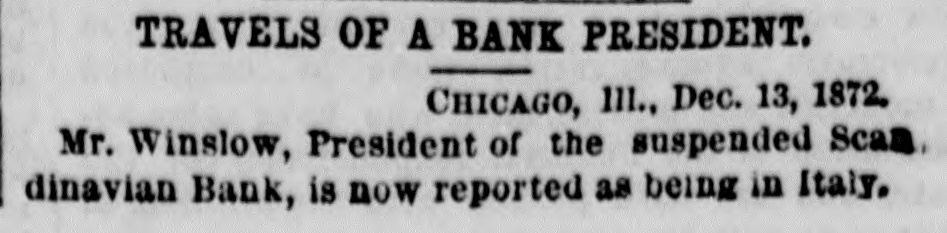
TRAVELS OF A BANK PRESIDENT. CHICAGO, III., Dec. 13, 1872. Mr. Winslow, President of the suspended Scan. dinavian Bank, is now reported as being in Italy.


Article from The Wheeling Daily Register, December 16, 1872

Click image to open full size in new tab

Article Text

BY TELEGRAPH. Exclusively for the Register. By the Pacific and Atlantic Line. Office, 110 Main Street. SUMMARY. The estimated Custom House receipts for the month of December are $130,000,000. The estimated receipts from the internal revenue for the month of Decemher are $9,500,000. Two steamships arrived yesterday at New York, bringing 800 emigrants, English and German. Advices from the Indian country state that Cochise is making every effort to preserve peace. A prize fight took place on Saturday at Flatbush, New York, between Peter Schully and Jack Croker The latter won i a wenty-eight rounds. John J. Nicholay, formerly President Lincoln's Private Secretary, has been appointed Marshal of the Supreme Court vice Parsons, resigned. The Army Disabling Board, which has been in Fession in Philadelphia, has been abolished and a new board ordered to convene at New York. Thomas P. Talman, cashier of the Traders' National Bank of Chicago, has been appointed receiver of the Scandiavaian Bank of that city. W. Phillips Weigan was stabbed at Trenton, New Jersey, yesterday, by James Price, a New York rowdy. Weigan is in a critical condition. Low mass was celebrated at the St. Francis' Xavain church, New York, Saturday morning, for the girls who ost their lives at the Firth Avenue Hotel fire. An excursion train, the first, over the Cairo and Vincennes railroad, will leave Vincennes, Indiana. this morning. The road is now completed and is said to be in splendid condition. The condition of affairs in New Orlearn, on Saturday, was unchanged, the Metropolitan police and the military occupying the same r lative positions. On Saturdav. at New Albany, Indiana, John and Peter Meyer, father and son, were arreated for the murder of Leopold Spindler committed in Septemberlast. The proprietors of the Fifth Avenue Hotel, New York, published a card on Saturday, announcing that they have made arrangements for the interment of the bodies of the victims of the late fire. The brig Meteor atranded and went ashore at Scituate, Massachusetts. on Saturday, in consequence of mistaking a light in a house for a light house. She filled and sunk in fifteen minutes. By order of the President the Army Reducing Board has been dissolved. A board to retire disabled officers will convene in New York on the 20th inst. Henry McNnita, the Peoria, Illinois, wi'e murderer. was, on Saturday. sen tenced to he hanged on the third day January, 1873, a motion for a new trial being retu-ed. Horace Blackwell was. on Saturday, at Hartford, Connecticut, sentenced to ten years' imprisonment for attempting to wreck the Boston and New York express train. The sale by auction of the stock and agricultural implements belonging to the farm of Horace Greeley, at Chappaqua, took place Saturday. A telegram from Montgomerv. Alabama, says the Legislature of that State will meet this week and organize in the manner proposed by Attorney General Williams. James Camp. twenty years old, was accidentally shot at Dresden. Ohio, Saterday, by David Frv The pun caught on some brueh and was diecharged. the ball entering the back and passing through the liver, causing death in three hours. An order has been received by Vice Admiral Rowan, commander of the Navy Yard at Brooklyn, to fit out the store shipe Supply and Guard to re ceive such goods as the American exhibitors may desire sending to the Vienna Exposition. Julia Smith, the girl shot at 61 Bayard street New York, is rapidly improving, and Dr. Amabile, at the Park Hospital, entertains hopes of her recovery. Harrington, her assailant, has not yet been captured. On last Thursday morning, near the town of Columbians, Columbiana county, Ohio, a man named Erhen Porter murdered his two children, aged respectively one and three years, by beating their braine out with a batchet. Three well known Chicago newspaper men, two of them city editors, were rested Friday evening, in a gambling den. They were brought into court Saturday under fictitious names, and claimed the were present for professional purposes. The Italian Coneul General, at New York, Saturday, acknowledged the re ceipt of $325.75 from Louisville for the the recentinun


Article from Delaware State Journal, December 21, 1872

Click image to open full size in new tab

Article Text

In General. The Government is going to re-establish the lighthouse at the month of Mispillion Creek. The Fusion, or Warmouth Legislature, of Louisiana, has adjourned until the first Monday in January. Four hundred and seventy-one horses have died from the epizooty in Cincinnati during the last four weeks. There were 279 deaths in Philadelphia last week-exactly the same number us during the week preceding. The pew owners of the Old South Church, in Boston, have voted, 28 to 22. to lease the church for a post-office. It is stated that Commodore Vanderbilt has abandoned at least temporarily his project for an underground railway in New York. John J. Nicolay, of Illinois, who was President Lincoln's private Secretary, has been appointed Marshal of the United States Supreme Court. Chief Justice Chase has received over 500 letters applying for the place of MarI shal of the Supreme Court, made vacant by the resignation of R. C. Parsons, ) The amount of wheat afloat in New t York 18 708,000 bu.; total in store and 1 afloat, 1,997,000 bu. Corn afloat, 473,000 r bu.; in store and afloat, 6,125,853 bu. Charges of fraud have been made in 8 connection with the recent election in Boston, and it is thought there will be a l' recount of the entire vote for Mayor. The Comptroller of the Currency has appointed a receiver for the Scandinavian f National Bank of Chicago. It is believed the losses will fall only upon the sharef holders of the bank. John T. Kensett, the distinguished landscape painter, died suddenly in New York, on Saturday. He was President of the y Artists' Fund Society, and a member of t the National Academy. r The First National Bank of Memphis has received several forged drafts which t have been cashed by banks in other cities. The forger is believed to be a man named Moore, of Philadelphia. e e The Board of Canvasaers of the Florida e election quished their count last week, giving Hart 1596 majority. The Republicans elect the Lieutenant Governor and 8 both Congressmen, and claim 2 majority f in the Senate and 6 in the House. 8 The Supreme Court of Virginia decided e last week that the act of the Legislature e of that State repealing the coupon feature e of the Funding law is unconstitutional. e This makes the coupon bonds issued a act receivable for d the The Funding New State taxes. under eYork Fire Marshal expresses the opinion that the Fifth Avenue Hotel o " in the room of tire Graves, originated and Mary Was carried by the elevator 8. to the dormitory. He thinks, also, that or the girls were sufflccated before the flames of reached them, e8 1. The New York Tammany Society Adre ceived a number of new member 8 pr fase p Tuesday evening, and installed d Sachems in place of Charles a 'Cor and incur 8 1. cur Oswald Ottenderfer, these gentler TORA 11 having appeared in the Society SINCANAN. election, P street, reference


Article from Evening Star, December 30, 1872

Click image to open full size in new tab

Article Text

JOEL D. HARVEY has been appointed receiver of the Scandinavian national bank in Chicago, vice Thos. P. Tallman declined. -


Article from Chicago Daily Tribune, December 30, 1872

Click image to open full size in new tab

Article Text

# THE LAW COURTS. NOTES OF INTEREST. Theodore Emory and Henry Ivey, survivors of G. W. Gashiere, partners, of Now York, on Saturday petitioned for the bankruptcy of Mary A. Higgins and George B. Brand, doing business as Higgins & Brand, claiming as creditors on an account of $12,937.71, for merchandise supplied. The affidavit of E. K. Crandell, representing the petitioners, states that he came here to arrange with the debtors, when they told him they had stock on hand worth $26,466.95, of which they owed $18,240.08; and that their sales were about $75 to $100 per day. Whereupon, they obtained an extension of a note then running, and failed to pay the one that soon after matured. Judge Drummond, on Saturday, disposed of such questious as are referred by the law to the United States Judges, in the matter of the Scandinavian Bank. The Comptroller having appointed a Receiver, the bank comes into court for authority to sell its fittings and personalty, and to make various economic changes in its personnel and management. His Honor granted the application for permission to sell the fittings and fixtures, and the question of the disposal of stock and other matters was referred to H. W. Bishop, Master in Chancery, to take proof and report. Those whom it may concern and who are interested in the claims held by the National Loan and Trust Company against the State Insurance Company, will find a complete list thereof published in Sunday's (yesterday's) TRIBUNE; as well as a completo inventory of the stocks, shares, lots, notes, and other securities given to the Lumberman and Germania Insurance Companies to secure the debts of those policyholders who, on Saturday, commenced suit for sets-off. The suit brought against the Highway Commissioners of Palatine by Timothy Deau, farmer, for damages claimed to have been sustained by the laying of a road on the north line of plaintiff's farm, namely, of Soctiou 21, in said town, in which the jury found for the acrendants no damages," was yesterday appealed to the Circuit Court. In the matter of the injunction granted by the Circuit Court, restraining Lonis Dampf further interfering with the manufacturing business agreed to be transferred to him by Barrett et al., as fully reported in THE TRIBUNE, Judge Farwell, yesterday, heard a moten to dissolve the injunction and appoint a Receiver, and set the hearing for Thursday. Anidavits to be filed by Tuesday. Suppressed caso No. 41,811, in the Superior Court, was a small action for assumpsit, brought by Mr. Lester Coffeen, the esteemed Deputy of the Court. The notes were made to Major Stevenson, and the only way to obtain service was by suppressing the names. Nellie Felker prays an injunction perpetually restraining the Chicago, Danville & Vincennes Railroad Company operating their branch line from Ada street casterly through Block 12, Carpenter's Addition, to Morgan street; and a temporary injunction was yesterday issued by the Circuit Court. A dividend of 12ΒΌ per cent in the estate of Philip Healey was declared on Saturday by the meeting of creditors held before Register Hibbard. The habeas corpus trial, for the possession of the body of Emma Thompson, Thomas Moore defendant, is set for Jan. 3. An order of dischargo was entered in the matter of Jacob Engel, a baukrupt, on Satuaday.