Article Text
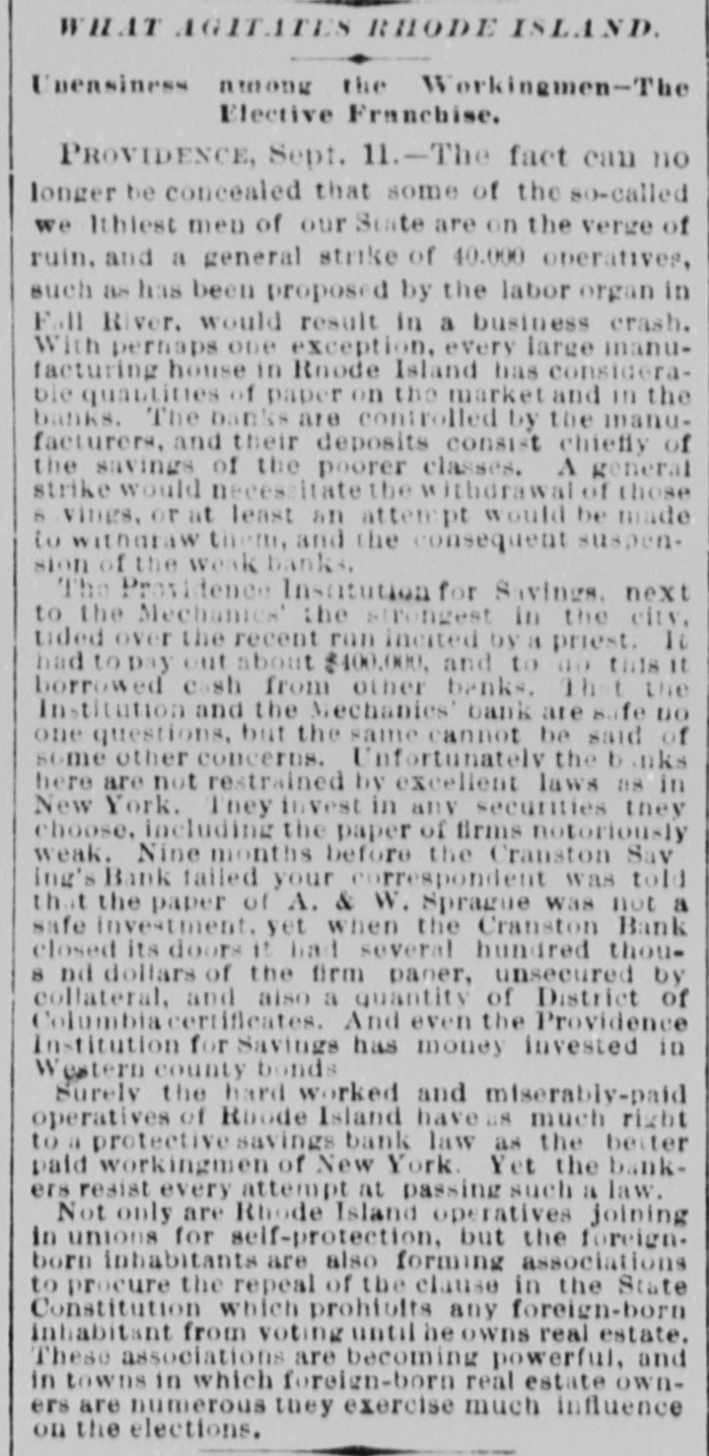
Uneasiness among the Workingmen-The Elective Franchise. PROVIDENCE, Sept. 11.-The fact can 110 longer be concealed that some of the so-called we 1thiest men of our State are on the verge of ruin, and a general strike of 40.000 operatives, such as has been proposed by the labor organ in Fall River, would result in a business crash. With perhaps one exception, every large manufacturing house in Rnode Island has considerabie qualtities of paper on the market and in the banks. The banks are controlled by the manufacturers, and their deposits consist chiefly of the savings of the poorer classes. A general strike would necessitate the withdrawal of those 8 vings, or at least an attempt would be made in withgraw them, and the consequent suspension of the weak banks, The Providence Institution for Savings. next to the Mechanics' the strongest in the city, tided over the recent run incited by a priest. It had to Day out about $400,000, and to do this it borrowed cash from other banks. Th t the Institution and the Mechanics' bank are safe DO one questions, but the same cannot be said of some other concerns. Unfortunately the b inks here are not restrained by excellent laws as in New York. They invest in any securities they choose, including the paper of firms notoriously weak. Nine months before the Cranston Sav ing's Bank failed your correspondent was told that the paper of A. & W. Sprague was not a safe investment. yet when the Cranston Bank closed its doors it had several hundred thou8 nd dollars of the firm paner, unsecured by collateral, and also a quantity of District of Columbia certificates. And even the Providence Institution for Savings has money invested in Western county bonds Surely the hard worked and miserably-paid operatives of Rhode Island have as much right to a protective savings bank law as the better paid workingmen of New York Yet the bankers resist every attempt at passing such a law. Not only are Rhode Island operatives joining in unions for self-protection, but the foreign. born inhabitants are also forming associations to procure the repeal of the clause in the State Constitution which prohiolts any foreign-born inhabitant from voting until he owns real estate. These associations are becoming powerful, and in towns in which foreign-born real estate owners are numerous they exercise much influence on the elections.