Click image to open full size in new tab
Article Text
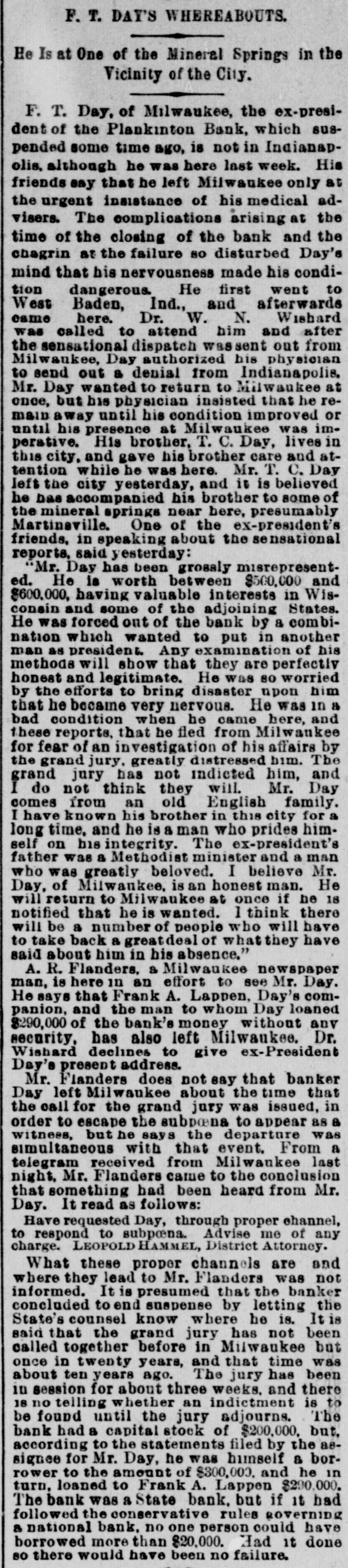
# F. T. DAY'S WHEREABOUTS.
He Is at One of the Mineral Springs in the
Vicinity of the City.
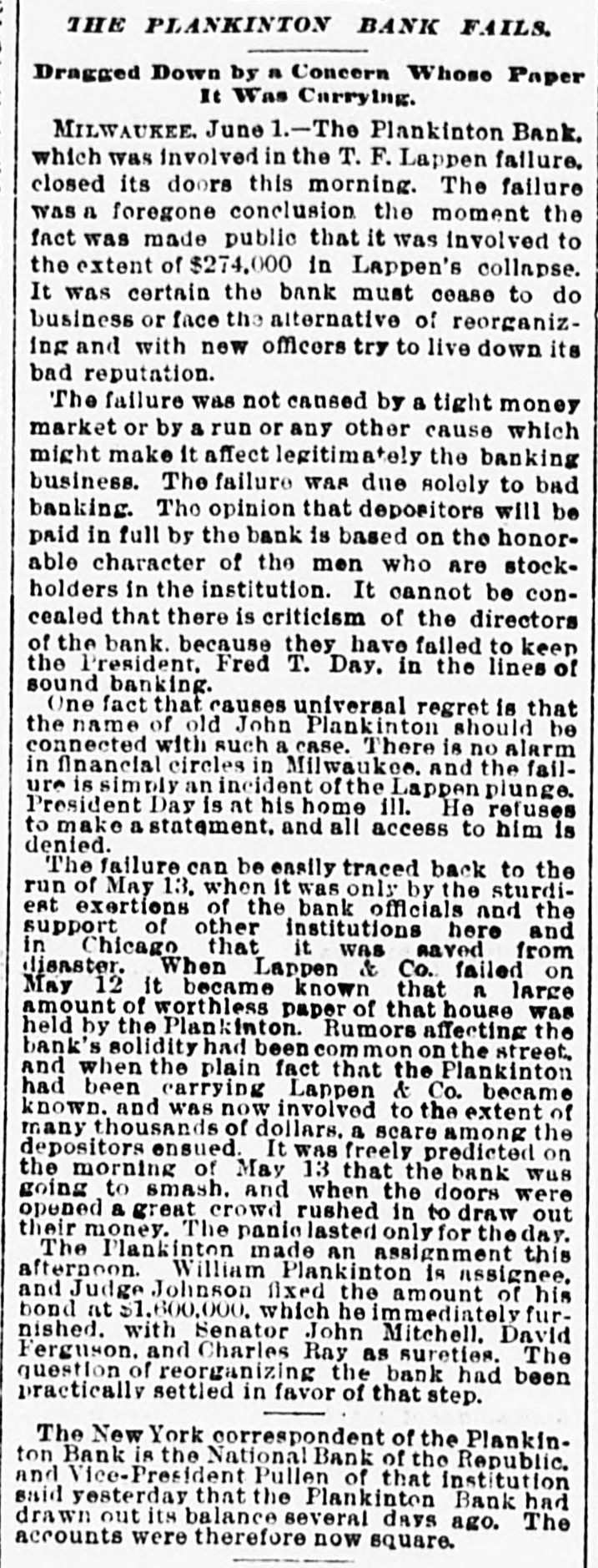
F. T. Day, of Milwaukee, the ex-president of the Plankinton Bank, which suspended some time ago, is not in Indianapolis, although he was here last week. His friends say that he left Milwaukee only at the urgent insistance of his medical advisers. The complications arising at the time of the closing of the bank and the chagrin at the failure so disturbed Day's mind that his nervousness made his condition dangerous. He first went to West Baden, Ind., and afterwards came here. Dr. W. N. Wishard was called to attend him and after the sensational dispatch was sent out from Milwaukee, Day authorized his physician to send out a denial from Indianapolis. Mr. Day wanted to return to Milwaukee at once, but his physician insisted that he remain away until his condition improved or until his presence at Milwaukee was imperative. His brother, T. C. Day, lives in this city, and gave his brother care and attention while he was here. Mr. T. C. Day left the city yesterday, and it is believed he has accompanied his brother to some of the mineral springs near here, presumably Martinsville. One of the ex-president's friends, in speaking about the sensational reports, said yesterday:
"Mr. Day has been grossly misrepresented. He is worth between $500,000 and $600,000, having valuable interests in Wisconsin and some of the adjoining States. He was forced out of the bank by a combination which wanted to put in another man as president. Any examination of his methods will show that they are perfectly honest and legitimate. He was so worried by the efforts to bring disaster upon him that he became very nervous. He was in a bad condition when he came here, and these reports, that he fled from Milwaukee for fear of an investigation of his affairs by the grand jury, greatly distressed him. The grand jury has not indicted him, and I do not think they will. Mr. Day comes from an old English family. I have known his brother in this city for a long time, and he is a man who prides himself on his integrity. The ex-president's father was a Methodist minister and a man who was greatly beloved. I believe Mr. Day, of Milwaukee, is an honest man. He will return to Milwaukee at once if he is notified that he is wanted. I think there will be a number of people who will have to take back a great deal of what they have said about him in his absence."
A. R. Flanders, a Milwaukee newspaper man, is here in an effort to see Mr. Day. He says that Frank A. Lappen, Day's companion, and the man to whom Day loaned $290,000 of the bank's money without any security, has also left Milwaukee. Dr. Wishard declines to give ex-President Day's present address.
Mr. Flanders does not say that banker Day left Milwaukee about the time that the call for the grand jury was issued, in order to escape the subpœna to appear as a witness, but he says the departure was simultaneous with that event. From a telegram received from Milwaukee last night, Mr. Flanders came to the conclusion that something had been heard from Mr. Day. It read as follows:
Have requested Day, through proper channel, to respond to subpœna. Advise me of any charge. LEOPOLD HAMMEL, District Attorney.
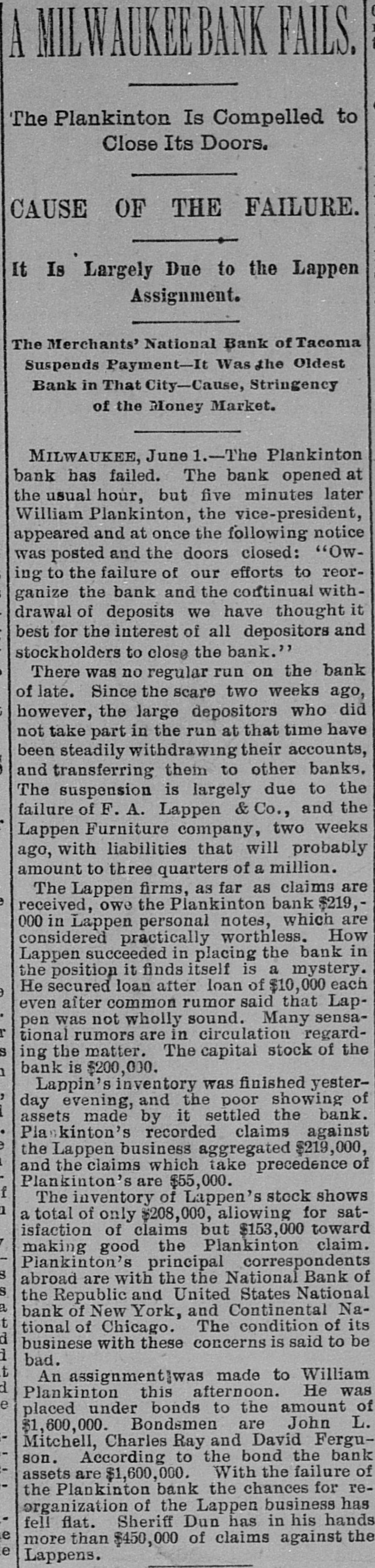
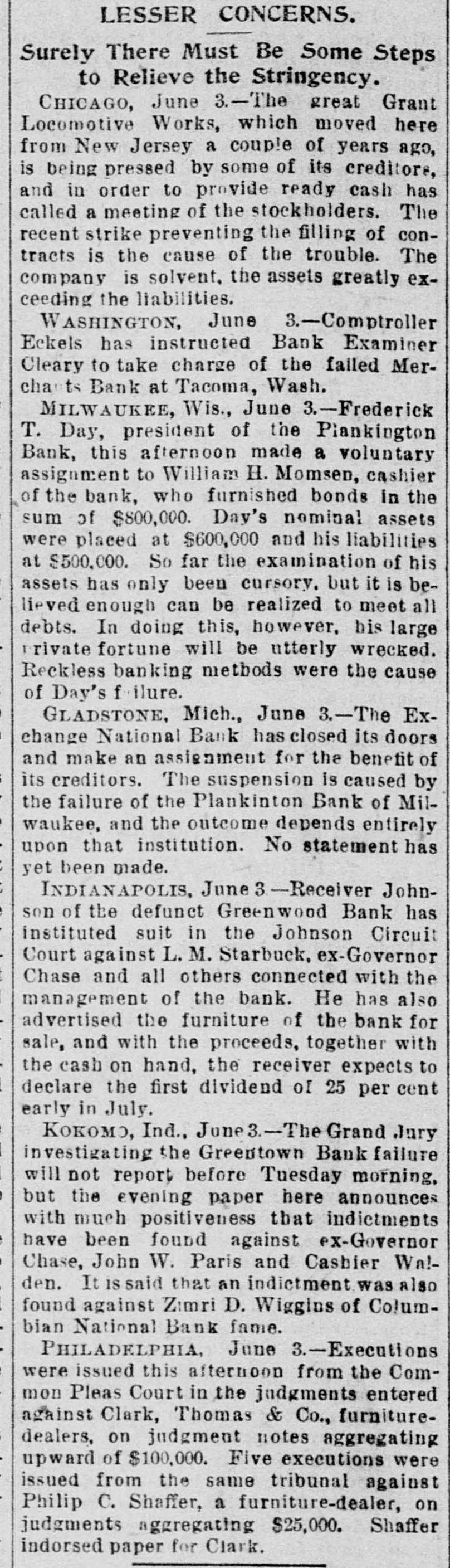
What these proper channels are and where they lead to Mr. Flanders was not informed. It is presumed that the banker concluded to end suspense by letting the State's counsel know where he is. It is said that the grand jury has not been called together before in Milwaukee but once in twenty years, and that time was about ten years ago. The jury has been in session for about three weeks, and there is no telling whether an indictment is to be found until the jury adjourns. The bank had a capital stock of $200,000, but, according to the statements filed by the assignee for Mr. Day, he was himself a borrower to the amount of $300,000, and he in turn, loaned to Frank A. Lappen $290,000. The bank was a State bank, but if it had followed the conservative rules governing a national bank, no one person could have borrowed more than $20,000. Had it done so there would have been no failure.