Click image to open full size in new tab
Article Text
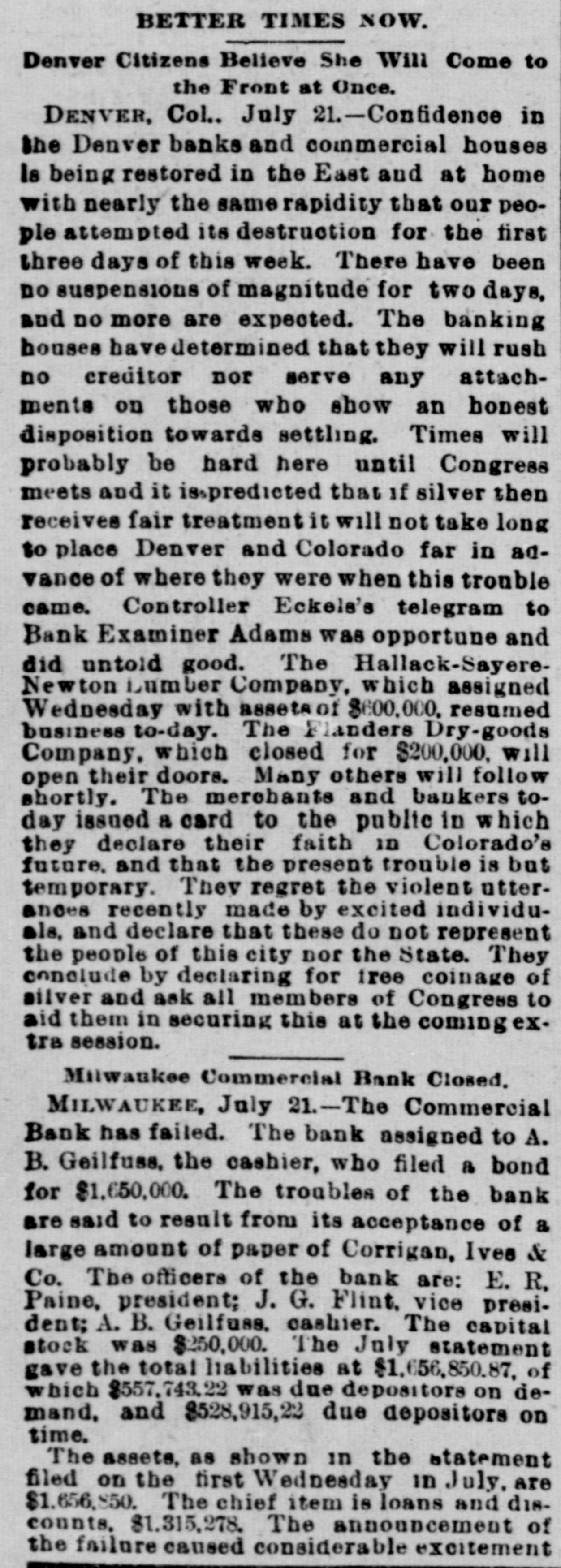
RAILROAD RATTLE. VARIOUS MATTERS OF INTEREST TO THE PUBLIC. Danger in Insecticldes-Several Perish by Drowning - Another Milwaukee Bank Forced to Suspend-Cleveland Alarmed Over Her Local Pork Supply. Told In a Few Words. -The attempts to whitewash cut-rate Eastern lines at the New York meeting has disgusted Chicago passenger officials. Reductions by Southern roads are not satisfactory and the outlook is for a still more extensive cut all along the line soon. Stockholders of the Galveston and Western Railroad will Increase the capital stock to $2,000,000 and make an Eastern extension Only three of the twelve members of the trans-Missouri freight rate committee attended the Lake Minnetonka meeting. -Cleveland health authorities have become convinced of the need of a microacopical Inspection of all pork killed for consumption In that city in order to detect triching, and Dr. G. F. Leick, health officer, is already taking steps toward organIzing a system of inspection. At present the United States Government inspects Dork for export, but refuses to look after the meat used by American citizens at home -Misses Elizabeth Walters and Mabel Hallet were drowned while bathing in the surf at Shell Bank. Long Island. -The Milwaukee (Wis.) Commercial Bank made a voluntary assignment. The assignee Is A. B. Gellfuss, the cashier of the bank, and bis bond is placed at $1,200,000, The entire fund of Milwaukee County, amounting to $310,624, was deposited In the Commercial Bank. Another big depositor was the newly organized Milwaukee Electric Railway Company, to the extent of $200,000. -Interest centers in the coming action of the Indiana board of tax equalization and what will be done with railroads. -Western lines came within one vote of making reduced World's Fair rates. A compromise is expected -By an explosion of dynamite to a shanty in Minneapolis Gus Olson was blown into fragments. -William Napler and family, of Columbus, Ohio, were badly poisoned by eating cabbage spread. on which paris green had been -William Crane, of Lakeside, Minn., was washed off a capsized boat in Lake age. Superior and drowned. He was 24 years of -The First National Bank of Anthony. Kan., has closed Its doors and posted is notice of suspension. -Secretary Carlisle. accompanied by his family. returned to Washington after an absence of three weeks at the World's Fair. The Exposition. Secretary was much pleased with the -A. M. Rogers, a traveling salesman for a Chicago shoe house, was flogged at Cooburn. Va., by a mob because he was atleged to have Insulted the daughter of the railroad agent at that place -The Royal Bohemian National Opera Company bas been engaged for a twenty weeks' tour of America. The season will open In New York In October, The company will produce but one opera. "Prodana Nevresta" (*The Sold Briden). by Emetana, a Bohemian composer. -A large consignment of tobacco was Deized at Philadelphia Importers had given an undervaluation. -A. J. Drexel's will has been probated. Fome of his $30,000,000 was given to charity and much more to heirs. collapsed. --The plate-glass trust has practically -One thousand boller-makers at St, Louis have struck for a nine-hour day at ten hours pay. -An incendiary fire almost wiped Ewing, Mich., out of existence The loss is between $150,000 and $250,000. It is reported that a man suspected of being the firebug was lynched. -Bogard. the St. Louis real estate man alleged to have defrauded the members of several building associations of which he was secretary. has been arrested and placed under $1,500 bail. --The village of St. Anne de la Perade, near Quebec, was completely destroyed by fire. Sixty families are made homeless and the money loss will reach several hundred thousand dollars. The First National Bank and the Kent Bank at Cheyenne, Wya. have failed. The First National has a paid-upcarital of $200,000, The liabilities are $502,000 and the assets $725,000. Both banks will probably reopen. -Obituary: Washington. General John G. Walker, aged 70 -At Worcester, Mass. Charles F. Washburn. head of the barbedwire manufacturing firm of Washburn & Moen, aged 66. -At Pittsburg Henry A. Hoffman, aged 32 years, committed suicide while standing in front at a looking-glass Hoffman spent all of his leisure time working on patents, many of which were successful. His last conception was a glass bottle to be used for patent medicines. which could not be refilled when once the original contents had been removed. For several weeks Hoffman had been melancholy. but at DO time bad his condition been considered serious. -Prizefighter Corbett threatens to sue the Chicago Evening Post for $100,000 for damages alleged to have been dore to his "reputation" by the publication of articles about himself and the exhibition in which he takes part in the Midway Plaisance -It is reported that a fight took place