Grayson County State Bank (Leitchfield, KY)

Episode Information

Episode UID
1967443391563
Episode Type
Suspension β†’ Closure
Bank Type
state
Bank ID
196744339 hash
Start Date
March 11, 1930
Location
Leitchfield, Kentucky (37.480, -86.294)

Metadata

Model
gpt-5-mini (chosen from majority vote of a three-model LLM ensemble)
Short Digest
9afe7dd2747baff3

Response Measures

None

Description

Closure was voluntary by directors and bank turned over to State Banking Department for audit and liquidation.

Events (1)

1. March 11, 1930 Suspension
Cause
Voluntary Liquidation
Cause Details
Directors voluntarily closed the bank and turned the organization over to the State Banking Department; audit begun and a liquidating agent to handle collections.
Newspaper Excerpt
The Grayson County State Bank ... closed its doors Tuesday morning, March 11, at the order of the board of directors
Source
newspapers

Newspaper Articles (2)

Article from The Leitchfield Gazette, March 14, 1930

Click image to open full size in new tab

Article Text

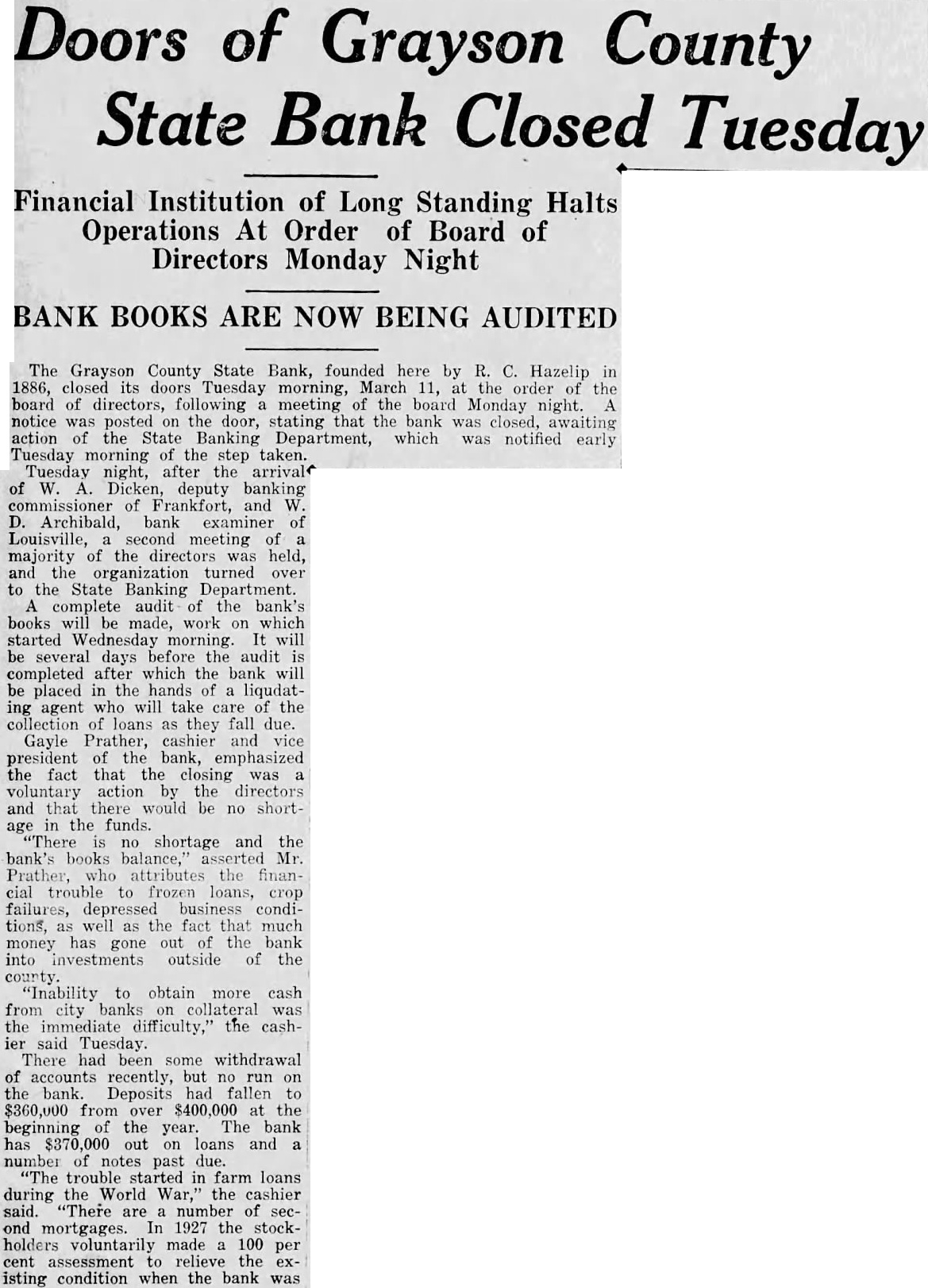
Doors of Grayson County State Bank Closed Tuesday Financial Institution of Long Standing Halts Operations At Order of Board of Directors Monday Night BANK BOOKS ARE NOW BEING AUDITED The Grayson County State Bank, founded here by R. C. Hazelip in 1886, closed its doors Tuesday morning, March 11, at the order of the board of directors, following meeting of the board Monday night. A notice posted on the door, stating that the bank was closed, awaiting action of the State Banking Department, which was notified early Tuesday morning of the step taken. Tuesday night, after the arrival of W. A. Dicken, deputy banking commissioner of Frankfort, and D. Archibald, bank examiner of Louisville, second meeting of majority of the directors was held, and the organization turned over to the State Banking Department. complete audit of the bank's books be made, work on which started Wednesday morning. It will be several days before the audit completed after which the bank will be placed in the hands of a liqudatagent who will take care of the collection of loans as they fall due. Gayle Prather, cashier and vice president of the bank, emphasized the fact that the closing was voluntary action by the directors and that there would be no shortin the funds. "There is no shortage and the bank's books balance,' asserted Mr. Prather, who attributes the finantrouble to frozen loans, crop failures, depressed business conditions, as well as the fact that much has out of the bank money gone into investments outside of the county "Inability to obtain more cash from city banks collateral was the immediate difficulty," the cashier said Tuesday. There had been some withdrawal of accounts recently, but no run on the bank. Deposits had fallen to $360,000 from over $400,000 at the beginning of the year. The bank has $370,000 out on loans and a number of notes past due. trouble started in farm loans during the World War," the cashier said. "There number of second mortgages. In 1927 the stockholders voluntarily made 100 per cent assessment to relieve the isting condition when the bank was

Article from The Kentuckian-Citizen, March 19, 1930

Click image to open full size in new tab

Article Text

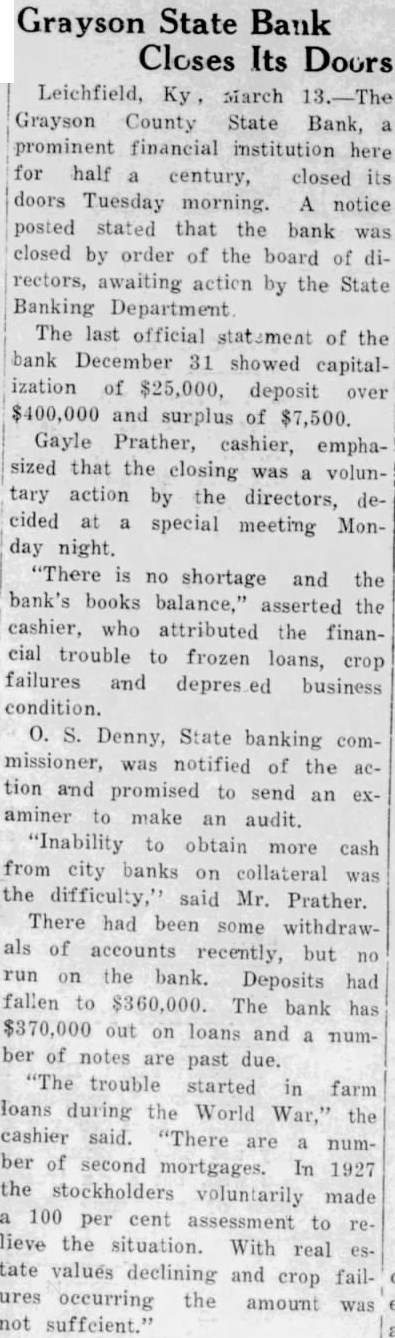
Grayson State Bank Closes Its Doors Leichfield, Ky, March 13.-The Grayson County State Bank, a prominent financial institution here for half a century, closed its doors Tuesday morning. A notice posted stated that the bank was closed by order of the board of directors, awaiting action by the State Banking Department The last official statement of the bank December 31 showed capitalization of $25,000, deposit over $400,000 and surplus of $7,500. Gayle Prather, cashier, emphasized that the closing was a voluntary action by the directors, decided at a special meeting Monday night. "There is no shortage and the bank's books balance." asserted the cashier, who attributed the financial trouble to frozen loans, crop failures and depres ed business condition. O. S. Denny, State banking commissioner, was notified of the action and promised to send an examiner to make an audit. "Inability to obtain more cash from city banks on collateral was the difficulty,' said Mr. Prather. There had been some withdrawals of accounts recently, but no run on the bank. Deposits had fallen to $360,000. The bank has $370,000 out on loans and a number of notes are past due. "The trouble started in farm loans during the World War," the cashier said. "There are a number of second mortgages. In 1927 the stockholders voluntarily made a 100 per cent assessment to relieve the situation. With real estate valuΓ©s declining and crop failures occurring the amount was not suffcient."