Article Text
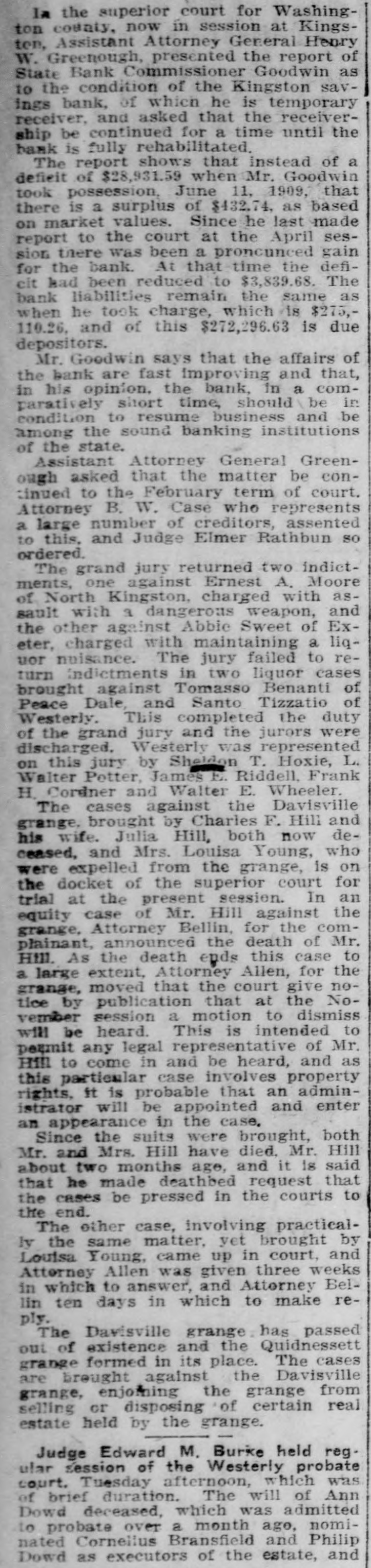
la the superior court for Washington county, now in session at Kingston, Assistant Attorney General Henry W. Greenough, presented the report of State Bank Commissioner Goodwin as to the condition of the Kingston savings bank, of which he is temporary receiver, and asked that the receivership be continued for a time until the bank is fully rehabilitated. The report shows that instead of a defieit of $28,931.59 when Mr. Goodwin took possession, June 11, 1909, that there is a surplus of $432.74, as based on market values. Since he last made report to the court at the April session there was been a proncunced gain for the bank. At that time the deficit had been reduced to $3,839.68. The bank liabilities remain the same as when he took charge, which is $275,110.26, and of this $272,296.63 is due depositors. Mr. Goodwin says that the affairs of the bank are fast improving and that, in his opinion. the bank, in a comparatively short time, should be in condition to resume business and be among the sound banking institutions of the state. Assistant Attorney General Greenough asked that the matter be continued to the February term of court. Attorney B. W. Case who represents a large number of creditors, assented to this, and Judge Elmer Rathbun so ordered. The grand jury returned two indictments, one against Ernest A. Moore of North Kingston, charged with assault with a dangerous weapon, and the other against Abbie Sweet of Exeter, charged with maintaining a liquor nuisance. The jury failed to return indictments in two liquor cases brought against Tomasso Benanti of Peace Dale, and Santo Tizzatio of Westerly. This completed the duty of the grand jury and the jurors were discharged. Westerly was represented on this jury by Sheldon T. Hoxie, L. Walter Potter, James E. Riddell. Frank H. Cordner and Walter E. Wheeler. The cases against the Davisville grange, brought by Charles F. Hill and his wife. Julia Hill, both now deceased, and Mrs. Louisa Young, who were expelled from the grange, is on the docket of the superior court for trial at the present session. In an equity case of Mr. Hill against the grange, Attorney Bellin, for the complainant, announced the death of Mr. Hill. As the death ends this case to a large extent, Attorney Allen, for the grange, moved that the court give notice by publication that at the November session a motion to dismiss will be heard. This is intended to permit any legal representative of Mr. Hill to come in and be heard, and as this particular case involves property rights, It is probable that an administrator will be appointed and enter an appearance in the case, Since the suits were brought, both Mr. and Mrs. Hill have died. Mr. Hill about two months age, and it is said that he made deathbed request that the cases be pressed in the courts to the end. The other case, involving practically the same matter, yet brought by Louisa Young, came up in court, and Attorney Allen was given three weeks in which to answer, and Attorney Bellin ten days in which to make reply. The Davisville grange has passed out of existence and the Quidnessett grange formed in its place. The cases are brought against the Davisville grange, enjoining the grange from selling or disposing of certain real estate held by the grange. Judge Edward M. Burke held reg. ular session of the Westerly probate court. Tuesday afternoon, which was of brief duration. The will of Ann Dowd deceased, which was admitted to probate over a month ago, nominated Cornellus Bransfield and Philip Dowd as executors of the estate, and