Article Text
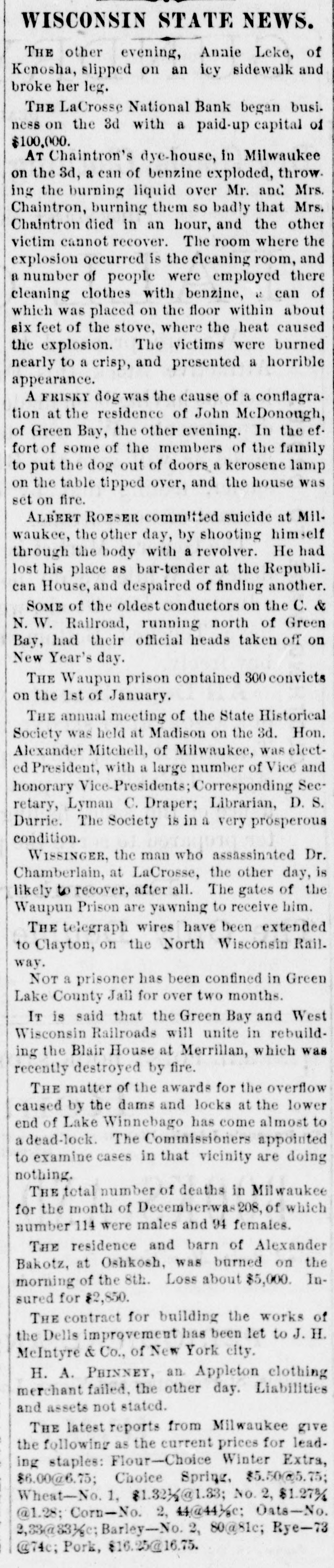
WISCONSIN STATE NEWS. THE other evening, Anaie Leke, of Kenosha, slipped on an icy sidewalk and broke her leg. THE LaCrosse National Bank began busi. ness on the 3d with a paid-up capital of $100,000. AT Chaintron's dye-house, in Milwaukee on the 3d, a can of benzine exploded, throw. ing the burning liquid over Mr. and Mrs. Chaintron, burning them so badly that Mrs. Chaintron died in an hour, and the other victim cannot recover. The room where the explosion occurred is the cleaning room, and a number of people were employed there cleaning clothes with benzine, is can of which was placed on the floor within about six feet of the stove, where the heat caused the explosion. The victims were burned nearly to a crisp, and presented a horrible appearance. A FRISKY dog was the cause of a conflagration at the residence of John McDonough, of Green Bay, the other evening. In the effort of some of the members of the family to put the dog out of doors a kerosene lamp on the table tipped over, and the house was set on fire. ALBERT ROESER committed suicide at Milwaukee, the other day, by shooting himself through the body with a revolver. He had lost his place as bar-tender at the Republican House, and despaired of finding another. SOME of the oldest conductors on the C. & N. W. Railroad, running north of Green Bay, had their official heads taken off on New Year's day. THE Waupun prison contained 300 convicts on the 1st of January. THE annual meeting of the State Historical Society was held at Madison on the 3d. Hon. Alexander Mitchell, of Milwaukee, was elected President, with a large number of Vice and honorary Vice-Presidents; Corresponding Sec retary, Lyman C. Draper; Librarian, D. S. Durrie. The Society is in a very prosperous condition. WISSINGER, the man who assassinated Dr. Chamberlain, at LaCrosse, the other day, is likely to recover, after all. The gates of the Waupun Prison are yawning to receive him. THE telegraph wires have been extended to Clayton, on the North Wisconsin Rail. way. NOT a prisoner has been confined in Green Lake County Jail for over two months. IT is said that the Green Bay and West Wisconsin Railroads will unite in rebuilding the Blair House at Merrillan, which was recently destroyed by fire. THE matter of the awards for the overflow caused by the dams and locks at the lower end of Lake Winnebago has come almost to a dead-lock. The Commissioners appointed to examine cases in that vicinity are doing nothing. THE total number of deaths in Milwaukee for the month of December-was 208, of which number 114 were males and 94 females. THE residence and barn of Alexander Bakotz, at Oshkosh, was burned on the morning of the 8th. Loss about $5,000. Insured for $2,850. THE contract for building the works of the Dells improvement has been let to J. H. MeIntyre & Co., of New York city. H. A. PHINNEY, an Appleton clothing merchant failed, the other day. Liabilities and assets not stated. THE latest reports from Milwaukee give the following as the current prices for leading staples: Flour-Choice Winter Extra, $6.00@6.75; Choice Spring, $5.50@5.75; Wheat-No. 1, $1.321/@1.33; No. 2, $1.27% @1.28; Corn-No. 2, 44@44}/c; Oats-No. 2,33@83}/c; Barley-No. 2, 80@81c; Rye-73 @74c; Pork, $16.25@16.75.