Click image to open full size in new tab
Article Text
"ROUND ABOUT"
Fort Crawford Chapter D. A. R. are employing various means of raising a fund for the restoration of Fort Crawford at Prairie du Chien.
The contract for building the bridge across the Mississippi river at Prairie du Chien has been let to the Austin Bridge company of Dallas, Texas, for $687,000. A Chicago bank has been found by the promoters to underwrite the bonds and sell a portion of the first mortgage bonds, issue of $500,000.
A monument agent of Dodgeville yawned, and his jaws locked SO tight that he was given an anaesthetic before the doctor could press them back in place. The only case on record!
The three men who robbed the Black Earth State Bank of $5,800 in cash and some securities, calmly locked the bankers and several customers in the vault, deliberately walked out to their car and made a clean get away. They were seen at Portage, but the policeman, whose attention was called to their presence, professed to believe the parties were not the right ones, and did not try to arrest them. We do not entirely blame a single man for finding an excuse to avoid death by trying to arrest three desperate bank bandits. The reason so many of these bandits escape is that people are loath to try to stop them. They are ready to shoot to kill, and this fact is generally well understood by the public.
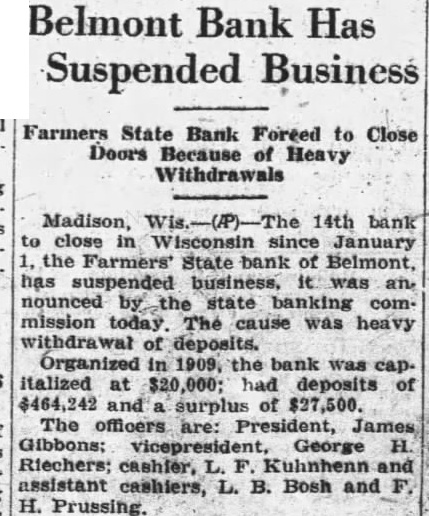
The Belmont State bank stockholders have reorganized and will start the bank running again soon. The bank was closed April 22, partly on account of the cashier's shortage and partly because of a run.
Fourteen establishments in the western district of Wisconsin, involved recently in liquor law violations, were ordered padlocked Wednesday by Judge Claude z. Luse in federal court. Owners of the places hit by the court's decree include Inga Halverson and George Hylock, town of Pleasant Springs; George Honnebaum, Potosi; Chester Tucker and Edward Lipska, Fennimore; George Weiderholt, Jr., and Bernard McGauhey, Cuba City; "Doc" Lucost and David Horsefall, Prairie du Chien; Frank Valant, Prairie du Chien; George Weideg and Fred Heiser, Platteville; Mike Young and Herman Uphone, Soldiers Grove; George Boashack and P. J. Flannigan, Tomahawk; Mrs. William Young and William Garritty, Prairie du Chien, and Robert Mueller and Frank Haser, Potosi.
The new C. M. St. P. & P. depot at Prairie du Chien has been completed, and passenger trains stopped there Sunday. The new building is neat, but not very large. However, railroad companies do not feel that they can furnish very large depots as business stands today.
Platteville Journal:-Mrs. Hester Schuster of Platteville recalls the time when she walked, barefooted, to Potosi from her home in the town of Harrison, a distance of several miles, with four dozen eggs, and traded them for package of pins and a bottle of blueing.
Judge and Mrs. Aldro Jenks and Mr. and Mrs. Thos. H. Hoskins of Dodgeville, who were married at a double ceremony at Highland fifty years ago, observed their fiftieth anniversary on Tuesday of last week at the home of the former. The witnesses of their wedding ceremony, John B. Hoskins and Mrs. Ella Ferguson, were present Tuesday. Mmes. Jenks and Hoskins are sisters, and also sisters of Judge Goodsell of Lancaster.
Lou. B. Ruka, formerly of the Ruka Bros. manufacturing Co., and later a prominent banker of Boscobel, died on Tuesday, June 3. He was the son of the later John Ruka Sr., who with his brother Louis Ruka Sr. founded the manufacturing plant in that city in pioneer days.
Lester F. Kuhneheen, formerly cashier of the Farmers' State bank of Belmont, was sentenced to from one to six years in the state prison at Waupun for appriating $31,400 of the bank's money. He confessed to the bank's directors and also to State Bank Examiner, C. F. Schwenker of Madison two months ago, and his relatives and a bonding company made complete restitution of the funds appropriated. His shortage and a run on the bank caused its suspension two months ago, and now the officers expect to start up again this week.
Jacob Miller, veteran of the Civil war, and sheriff of Grant county in 1893-94, died at Boscobel May 23, nine days after the demise of his wife. He formerly lived in Lancaster and Fennimore and moved to Boscobel in
Brig. Gen. Sam Hof, of Boscobel has been appointed by President Hoover to succeed Maj. Gen. C. C. Williams, retired, as chief of ordinance of the army. Gen. Hof will now receive the rank of major general. He was born in Boscobel October 24, 1870.
Tommie Tucker, son of Mr. and Mrs. Ralph Tucker of Cobb, was badly mutilated by hogs while he and his parents were visiting at the home of neighbors. The boy crawled into the hog pen and the hogs attacked him. His body was badly bruised, abdomen torn and scalp cut and gashed by the sharp tusks of the hogs. He was taken to the hospital for surgical attention. A report has been circulated that bonds for the proposed new bridge at Prairie du Chien have been sold by the promotor, Harry Bordy. If this is the case, work on the new structure will start soon.