19458. Union Savings Bank & Trust Company (Tacoma, WA)

Bank Information

Episode Type
Suspension โ†’ Closure
Bank Type
trust
Start Date
July 1, 1896*
Location
Tacoma, Washington (47.253, -122.444)

Metadata

Model
gpt-5-mini
Short Digest
ab15a48a8adddf70

Response Measures

None

Description

Newspapers describe the Union Trust/Savings/Union Savings Bank of Tacoma suspending operations in the summer of 1896 after litigation over city warrants; the bank went into the hands of a receiver (references in 1899 and 1905). No article describes a depositor run; instead suspension and receivership are reported. OCR variants of the bank name (Union Trust and Savings bank, Union Trust Savings bank, Union Savings Bank the Trust Company) appear in the sources but all refer to the Tacoma institution.

Events (3)

1. July 1, 1896* Suspension
Cause
Local Shock
Cause Details
Suspension followed the city's warrant litigation and threatened repudiation of reissued warrants; the bank had large holdings of city warrants and suspended when that litigation risk materialized.
Newspaper Excerpt
The Union Trust and Savings bank, which, pinning its faith to the city's financial honesty, had invested the major portion of its capital stock in city warrants at once suspended.
Source
newspapers
2. July 12, 1899 Receivership
Newspaper Excerpt
Among the prominent items in the list of liabilities is the judgment for $59,000 obtained against him by the receiver of the Union Trust Savings bank.
Source
newspapers
3. November 29, 1905 Other
Newspaper Excerpt
Title Guarantee ... in the hands of a receiver of the Union Savings Bank of Tacoma ... an $18,000 balance was paid to policyholders by New-York Life through the surplus.
Source
newspapers

Newspaper Articles (3)

Article from The Seattle Star, July 12, 1899

Click image to open full size in new tab

Article Text

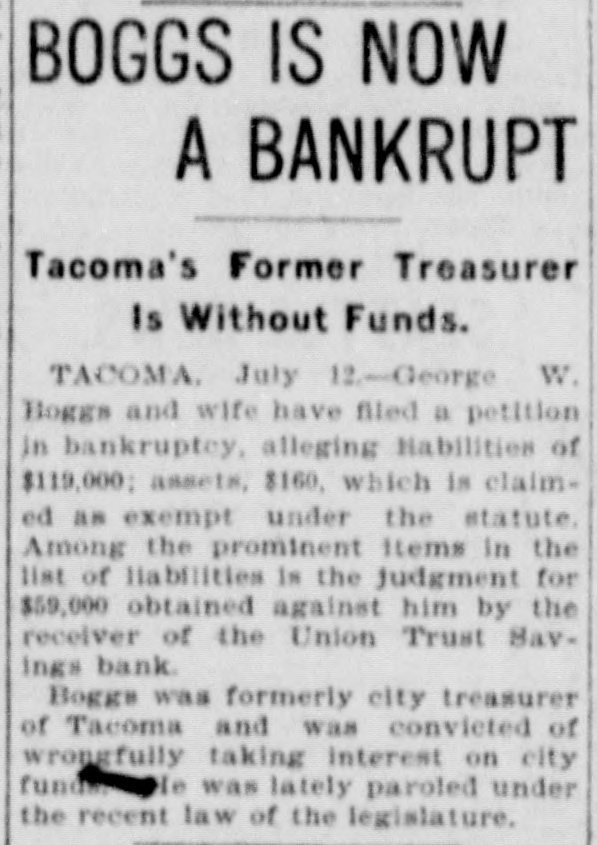
# BOGGS IS NOW # A BANKRUPT Tacoma's Former Treasurer Is Without Funds. TACOMA. July 12.-George W. Boggs and wife have filed a petition in bankruptcy, alleging liabilities of $119,000; assets, $160, which is claimed as exempt under the statute. Among the prominent items in the list of liabilities is the judgment for $59,000 obtained against him by the receiver of the Union Trust Savings bank. Boggs was formerly city treasurer of Tacoma and was convicted of wrongfully taking interest on city funds. He was lately paroled under the recent law of the legislature.


Article from The Seattle Post-Intelligencer, February 23, 1900

Click image to open full size in new tab

Article Text

COULD NOT SELL BONDS. Not a Single Cash Bid Made From Any Source for Tacoma's Proposed Bond Issue. Special Dispatch to the Post-Intelligencer. TACOMA. Feb. 22-The city of Tacoma finds itself in the embarrassing position of offering for sale a bond issue of $1,200,000 without a single cash bld being submitted from land. any of the financial centers in the The nearest to an offer yet made is the conditional proposition of Seymour Bros. & Co., New York brokers, who offer to take the bonds, providing they can arrange with the holders of the outstanding city warrants to exchange warrants for bonds. City officials and the public generally were considerably surprised when the several bond brokers who were here last week failed to submit a single cash bid. Inquiry develops the fact that the present situation is directly due to several causes. First, the unfortunate warrant litigation in which the city has been involved for several years, and which threatened at one time to result in the repudiation of at least the so-called "reissued" warrants of the Boggs treasury administration. In the summer of 1896 the crisis came in a court decision to the effect that the city need not pay these warrants. The Union Trust and Savings bank, which, pinning Its faith to the city's financial honesty, had invested the major portion of its capItal stock in city warrants at once suspended. On the basis of these warrants the bank had issued 6 per cent. debenture bonds, which were purchased and are still held by the New York Life Insurance Company This la one of the holders of the city warrants which refuses to exchange themf for the new issue of bonds. A. R. Nicol, organizer and manager of the Union Trust and Savings bank, who is now a salaried officer of the New York Life, arrived here today to assist in straightening out the warrant-bond tangle. A very interesting feature of the situation is the fact that, less than four years ago, Mr. Nicol offered, with the object of saving his bank, to throw off all interest on the $170,000 of warrants held by his bank, and to take 4 per cent. bonds in exchange for them. The city indignantly refused and Mr. Nicol was considered a bloated monopolist for making the proposition. Later the entire bond controversy was taken to the supreme court, which rendered a decision several months ago holding every warrant valid. In consequence, the warrant holders are held to be entitled to the city's present income, and through a restraining order even the payment of salaries and current expenses has been stopped. This condition brought about the bond issue. and the present attempt to sell them and then settle with the warrant holders. A little figuring shows that the city would have saved about $150,000 by accepting Mr. Nicol's proposition of four years ago, for the city must now pay 10 per cent. interest on these same warrants for seven years, and the present bonds will bear 5 per cent. interest, whereas his offer was to take 4 per cent. bonds. The outstanding warrants aggregate 8 about $800,000, which, with the interest at and 10 per cent., makes a total indebtedness of $1,200,000. A number of business men and others advocated the funding of these warrants as early as 1893 or 1894, but were laughed at by the short-sighted people who claimed the city would never have to pay them. The holders of all these warrants number between 200 and 300 banks, trust companies and estates, scattered through the Eastern states. The majority of these want their money, and are disposed to Insist that the city's finances remain tied up until they are paid. The only way out of the dilemma. so far as can now be seen, is the acceptance. of the offer of Seymour Bros. & Co. Their plan is to get all, or practically all, of the warrant holders to exchange their warrants for bonds, then giving Seymour Bros. & Co. an option on the bonds for six months, in which time they will endeavor to sell them. Seymour Bros. would profit by a charge of 1 per cent. for sellIng the bonds, to be borne by the warrant holders, and also by the possibility of getting a premium for some of the bonds A second cause of the city's unenviable reputation in financial centers grew out of the million dollar suit' of several years ago, whereby the city attempted to force B Wright to return a portion of the $1, paid for the light and water plant in 1893 Some of these bonds have been sold, and It la claimed that this suit attempted a virtual repudiation of these bonds. Previous to this the bond houses of New York had secured the passage of a law by the Connecticut legislature authorizing the purchase of the box of Tacoma, Seattle and Spokane as a legal Investment for savings banks and trust funds in that state. The 'million-dollar suit together with the warrant agitation, caused the repeal of this law thereby greatly limiting the market for the securities of Tacoma and other Washington cities It also transpires, though the fact is not generally known here. that Pierce county has defaulted in the payment of Its bond Interest to the extent of requiring the holders of county bonds to send their cou. pons to Tacoma for payment. instead of having them paid at the Chase National bank. of New York, the place of payment named in the bonds This results from County Treasurer Stephen Judson's refusal to pay the Chase National bank $16 as a fee for distributing the bond interest money. In this way and for these reasons the municipality of Tacoma is learning. as have many Western towns before her, that a dilly-dallying policy in financial matters is an expensive one in the end. The reputation of school district No. 10 remains first class The school board today sold to E. H Rollins & Sons, of Boston, an issue of $100 000 twenty year gold fund-


Article from New-York Tribune, November 29, 1905

Click image to open full size in new tab

Article Text

YELLOW DOG TRAIL LONG. NEW $18,000 PAYMENT. Schedule on Pool Profits Contradicts Hyde's Testimony. trail of the ubiquitous "yellow dog" Ham- and The the inevitable "Judge" Andrew inthat of shown yesterday by the insurance the contiIton was committee to lead across has across the ocean, and a pay- by nent as $18,000 of New-York Life restigating of it money fresh exposed. ment and perplexing means was from of the removal of city also The of the New-York Randevious mystery vaults Life stock was D. the but not explained. Edmund Life, identiprobed. treasurer of the New-York he had dolph, transaction as one to which before, not fied under orders, but that this been a was treasurer, and showed the he party abandoned while, of tax dodging had been The direction when he became and at his Reserve policies, with Mutual proceeding but "multiples treasurer. cost policywhich looked innocent, discussed. ratios" endless assessments, were holders W. Perkins's handiwork was several again bond unGeorge the accommodation of the covered of in sleight-of-hand variety. Finally regarddeals deposition of George H. Squire that have pathetic certain transactions in stocks apparing questioned was read. Mr. Squire His been remembered little regarding these. where he ently was taken at his house, testimony confined for some months. has schedule been submitted by Mr. Squire's counsel, of the A the disposition of the profits Company showing Title Insurance and Trust James Hazen Lawyers' indicated a payment to to the stock sale, $5,688 72. This adds another before the Hyde list of of direct contradictions the witness committee, long said as that Mr. he Hyde, had never when snared on in any of stand, of such a transaction. the profits D. Randolph, the first jugglery witness, es- by Edmund explain the remarkable Monday, sayed to Theodore M. Banta testified removed which, New-York as City stock had been Life at the vaults of the New-York of the Cen- tax from the time in 1901 and a check the stock, collecting National Bank for the amount of placed the tral substituted. Mr. Randolph had acted $700,000, 1900, and explained that he Possibly, date as whose he was not clear. under thought, orders, they were those of his time, predecessor, Mr. Ranhe who is dead. At this He did Mr. Gibbs, he was not treasurer. the dolph recall explained, what disposition was made into the of ennot knew the check was put that a restock. of He the stock in the vault, and was revelope was made when the stock Mr. Ransubstitution January 9. four days later. and recalled turned thought on the dates significant taken for dolph had been told the stock was Bank. that certain he clients of the Central National RANDOLPH STOPPED PRACTICE. this proceeding enable some belonging one to to "Didn't taxation by these securities Mr. escape New-York Life?' inquired Mr. Hughes. that the the conceded this, but explained when Randolph "repugnant" to him, and that thought thing he became was treasurer he stopped it. at He least one as well as that before this there had been one legitimate simliar When asked about the withdrawal. substitution, Peabody George W. & Perkins-Nylic deal through Kidder, of it, but Randolph said that he knew had merely Co., Mr. that the New-York Life Mexiunderstood loaned the money, taking the interest the on loan. Central stock as payment for to be an or other this loan managed Life Somehow in the records of the New-York witness as entered and Mr. Hughes and without the any a purchase, this point at great length knew of debated agreement. Mr. Randolph company no apparent in the books of the insurance substitution, entry the $700,000 city stock Life showing neither did he know whether the New-York stock. anything for its loan of the received Fanshawe, the next witness, explained under W. various S. bond deals in which, acting had handled the from George W. Perkins, he Life. In orders securities of the New-Yor stocks, in money or of the New-Orleans Traction handsome the case New-York Life made a Fanwhich the has been testified to before, Mr. end of loss, as said he took these over at the showshawe This saved the New-York Life from Superin1904. them on their report to the State involved ing of Insurance. The amount Nylic was tendent the $250,000 representing $1,250,000. Mr. Fanshawe's description of end the of steps last money. was as follows: At the the in the deal bought the stock for $937,500 delivered from to year he Life. The bonds were to Security and Trust this company carrying his the New-York account, New-York with Company the Perkins. bonds. Fanshawe's dealings were until JanMr. trust company carried the bonds them. To The 5. when Mr. Fanshawe paid for from the uary them he borrowed $937,500 were sold. pay for Life. Ultimately the bonds knowlIn New-York this transaction Mr. Fanshawe affair had no was onethat Nylic's interest in the the New-York edge that any one figured but explained fifth, or Perkins. Mr. Fanshawe bond Life and that he had been an independent for dealer further for twenty years and not Co. associated many years with J. P. Morgan & THE "YELLOW DOG" AGAIN. a new yelp from Andrew clerk Hamil- in ton's Then "yellow came dog." James C. Keeler, Company. a forthe Title Guarantee the Security and Trust and Trust cross-examina- Company, was merly put with on the stand, and under up of the affairs tion recalled that in the settling and Trust Company of the Union Savings Bank the hands of Wash., a company in was a of Tacoma, the trust company Newreceivers, for which held by the trustee under a mortgage indebtedafter all the company's a New-York Life was York ness to Life, the Instead subtracted, of turn$18,000 remained. the insurbalance of over to the policyholders of sum was ing this through the surplus, this witance promptly company paid to "Judge" Hamilton The