19436. Columbia National Bank (Tacoma, WA)

Bank Information

Episode Type
Suspension β†’ Closure
Bank Type
national
Bank ID
4623
Charter Number
4623
Start Date
October 17, 1895
Location
Tacoma, Washington (47.253, -122.444)

Metadata

Model
gpt-5-mini
Short Digest
faf3e9f76422d1fd

Response Measures

None

Receivership Details

Depositor recovery rate
75.2%
Date receivership started
1895-10-30
Date receivership terminated
1900-08-28
OCC cause of failure
Fraud
Share of assets assessed as good
1.4%
Share of assets assessed as doubtful
41.2%
Share of assets assessed as worthless
57.4%

Description

The Columbia National Bank of Tacoma was ordered closed by the Comptroller's examiner on 1895-10-24 and never resumed operations; a permanent receiver was later appointed (Philip Tillinghast, effective 1896-03-30). Coverage describes prior steady withdrawals and the bank's refusal to pay the city's check, but articles document an official suspension/closing by federal authorities and subsequent receivership and criminal proceedings. Dates corrected/standardized from newspaper reports.

Events (6)

1. September 2, 1891 Chartered
Source
historical_nic
2. October 17, 1895 Other
Newspaper Excerpt
Since the Bank of Tacoma Failed There Had Been Steady Withdrawals-The Columbia National and GermanAmerican Deny That the City Has Money on Deposit and Refuse to Pay Checks.
Source
newspapers
3. October 24, 1895 Suspension
Cause
Government Action
Cause Details
Closed by Bank Examiner Charles Clary under orders of Comptroller of the Currency James H. Eckels after the bank refused to pay the city's $104,000 check and following withdrawals and questions about city warrant deposits.
Newspaper Excerpt
The Columbia National bank was closed a little before 1 o'clock this afternoon by Bank Examiner Clary under orders of Controller Eckels.
Source
newspapers
4. October 30, 1895 Receivership
Source
historical_nic
5. November 7, 1895 Other
Newspaper Excerpt
Cashier Wm. G. Peters, of Columbia National, Arrested. THE BANK STATEMENT FIXED. In Order to Bring Cash Up to the Legal Requirement a Dummy Account Was Opened.
Source
newspapers
6. March 30, 1896 Receivership
Newspaper Excerpt
Philip Tillinghast has been appointed receiver of the National bank. The appointment ... will be effective ... Friday the bank. ... The new receiver ... was appointed by Comptroller Eckels.
Source
newspapers

Newspaper Articles (21)

Article from The Seattle Post-Intelligencer, October 17, 1895

Click image to open full size in new tab

Article Text

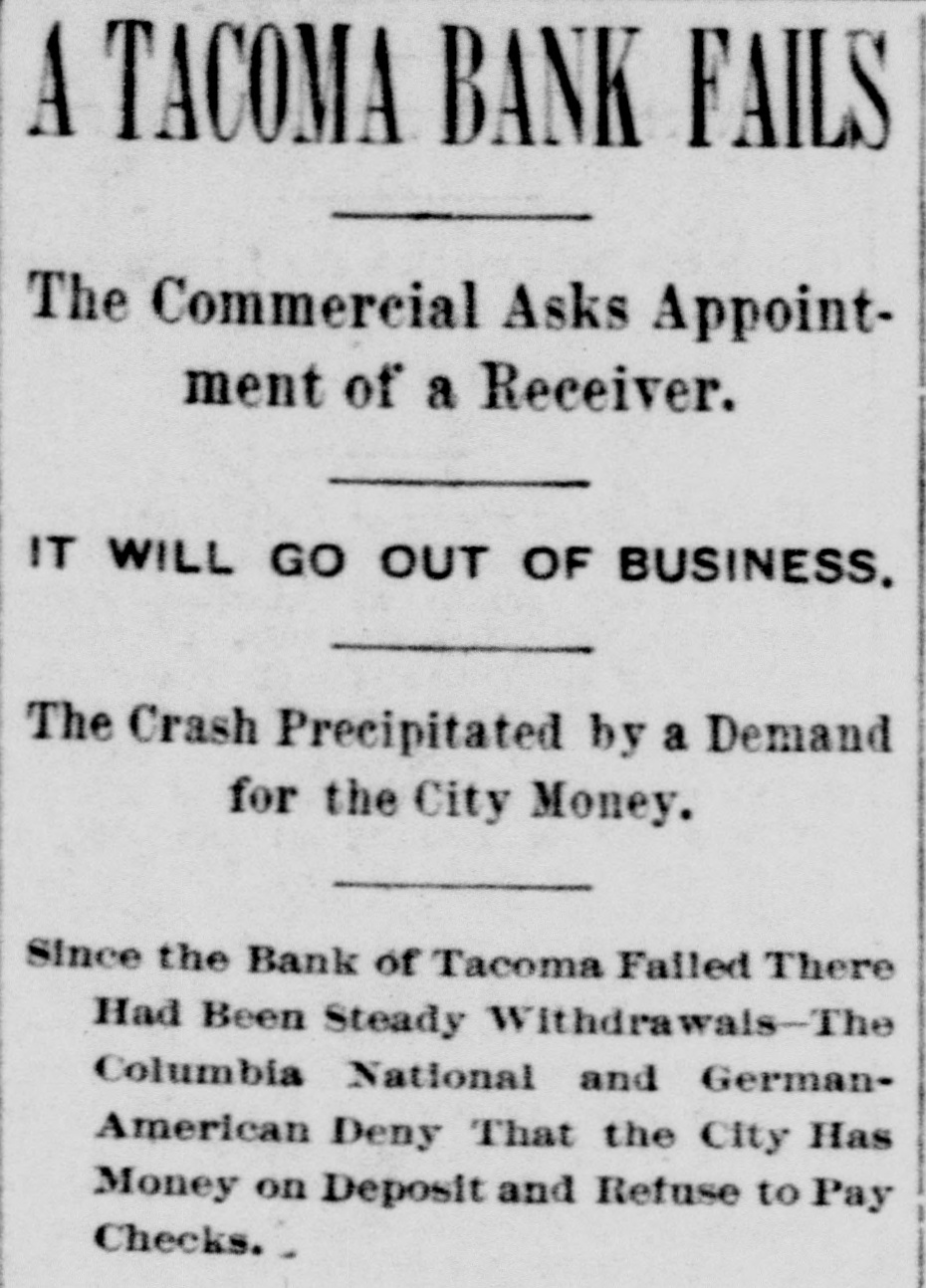
A TACOMA BANK FAILS The Commercial Asks Appointment of a Receiver. IT WILL GO OUT OF BUSINESS. The Crash Precipitated by a Demand for the City Money. Since the Bank of Tacoma Failed There Had Been Steady Withdrawals-The Columbia National and GermanAmerican Deny That the City Has Money on Deposit and Refuse to Pay Checks.


Article from The Seattle Post-Intelligencer, October 24, 1895

Click image to open full size in new tab

Article Text

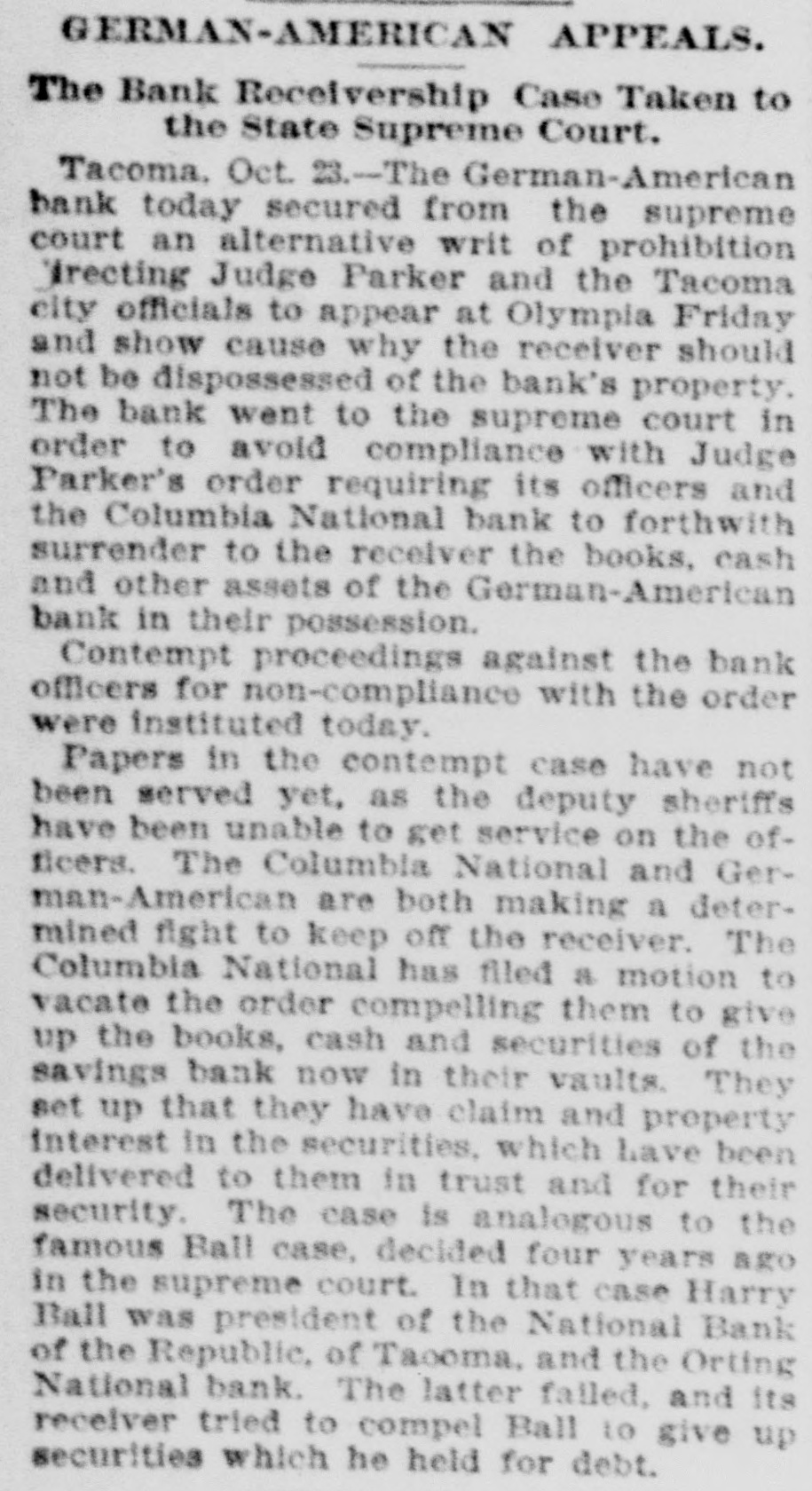
GERMAN-AMERICAN APPEALS. The Bank Receivership Case Taken to the State Supreme Court. Tacoma. Oct. 23.-The German-American bank today secured from the supreme court an alternative writ of prohibition "Irecting Judge Parker and the Tacoma city officials to appear at Olympia Friday and show cause why the receiver should not be dispossessed of the bank's property. The bank went to the supreme court in order to avoid compliance with Judge Parker's order requiring its officers and the Columbia National bank to forthwith surrender to the receiver the books, cash and other assets of the German-American bank in their possession. Contempt proceedings against the bank officers for non-compliance with the order were instituted today. Papers in the contempt case have not been served yet, as the deputy sheriffs have been unable to get service on the officers. The Columbia National and German-American are both making a determined fight to keep off the receiver. The Columbia National has filed a motion to vacate the order compelling them to give up the books, cash and securities of the savings bank now in their vaults. They set up that they have claim and property interest in the securities, which have been delivered to them in trust and for their security. The case is analogous to the famous Ball case, decided four years ago in the supreme court. In that case Harry Ball was president of the National Bank of the Republic, of Taooma, and the Orting National bank. The latter failed, and its receiver tried to compel Ball to give up securities which he held for debt.


Article from The Seattle Post-Intelligencer, October 24, 1895

Click image to open full size in new tab

Article Text

MIGHT BE WORSE OFF. City of Tacoma Hasn't Lost Any Money Recently. THE BOGGS WARRANTS ARE PAID the Banks Win Their Suit and Return the Warrants the City Will Burn Them. Tacoma, Oct. 22-Special.-Popular feeling. which has been running high during a week past, caused by the disciosures in the Bank of Tacoma case, the failure of the Commercial bank and the suits against the city brought by the Columbia National and German-American banks, is beginning to subside, and the talk upon the streets has been considerably modified. The clear head and sober judgment among the substantial citizens and tax payers is being asserted and the assertion is being made that the municipality is not so badly off as has seemed and as has been made to appear. During the excitement of the past few days popular rumor has been kept busy circulating all kinds of stories, and the main facts regarding the city's condition seem to have been lost sight of. The statement has been frequently made in the newspapers that the city treasury has been looted to the extent of $400,000. and that the water extension fund of $530,000 has been dissipated and wholly lost. Sober minded citizens are beginning to realize now how seriously these statements injure the city's financial standing, far more, It is claixied, than the circumstances warrant. Said a well-known city official today: "The city has not been hurt as hadly as people say. We are no worse off than we were eighteen months ago, when Boggs went out of office. The mischief was done then, and we are just learning of it now. If, as the courts have held, the $370,000 of Boggs warrants, for which the last city treasurer gave public coin, were paid and redeemed at that time by the transaction, then the city can never be made to pay them again. In other words. the treasurer unlawfully redeemed general fund warrants out of the order of their issuance. To say that the city has lost nearly $400,000 by the failure of the Bank of Tacoma and the refusal of the Columbia National and German-American to honor the city's checks, when it is known that Boggs deposited the illegal warrants with these banks and that the city's credit did not represent cash, is absurd on its face, and wholly untrue. To be sure, $212,000 of the water extension fund has been invested in outstanding warrants, but the city has saved the difference between the 5 per cent. Interest on the bonds and the 10 per eent. which the warrants drew." Acting on the suggestion conveyed in the above, the Post-Intelligencer correspondent interviewed a number of prominent attorneys, who have no interest in the litigation pending in the courts and whose knowledge of the law entitles their views to the highest respect. Said one: "A city warrant is not like A negotiable note. It is subject to defense in the hands of any person who acquires it, even for value, and without notice. A warrant must stand upon its merit, and is at all times subject to any defense that may ex1st against it. The city can be compelled to pay only valid warrants, and if It can be shown, as has been claimed, that there are records of the warrants bought by Treasurer Boggs, then I see no reason why the city should lose anything by what are known as the Boggs warrants. It appears to me that a proper settlement would be to allow the banks to return what they received from the city, or to charge the city's balance with the amount of valueless paper they can show they received." Matters at the city hall are unchanged. City Treasurer McCauley is rustling for his new bondsmen, and has until a week from Saturday to obtain them. Mr. MoCauley's friends claim that the finance committee has done much to damage his case in advance by preparing and publicly submitting their report to the council last Saturday, in which severe charges are made against the treasurer. They say that in the face of the report It will be wellnigh Impossible for Mr. McCauley to give


Article from The Seattle Post-Intelligencer, October 25, 1895

Click image to open full size in new tab

Article Text

For Refusing to Pay the Check of the City of Tacoma. BY ORDER OF MR. ECKELS. The Stockholders Live in Twenty Other States Beside Washington. In Anticipation of the Closing of the Bank Twenty Persons Had Applied For the Receivership-Their Names Are on Mr. Eckels' List of Ineligibles. Tacoma, Oct. 24.-The Columbia National bank was closed a little before 1 o'clock this afternoon by Bank Examiner Clary under orders of Controller Eckels, This action results from the bank's fallure to meet the city's demand for cash early last week. when money was wanted to meet an Interest payment in New York. The bank refused to pay the city's deposit of $104,000. on the ground that exTreasurer Boggs had deposited warrants which are now found to be illegal until validated. and the bank therefore brought suit to have the city's deposit offset with the warrant account. The city promptly protested the checks which the bank refused to pay, and notified the controller of the currency. A conference of the directors was held last night. Director Charles P. Corbit, of New York city, was then in Washington City conferring with Controller Eckels. From telegrams received last night from Mr. Corbit the directors expected today to get the controller's authorization to have the capital stock certified at $350,000. and to make an assessment at once to put the bank on its feet. They knew nothing to the contrary until Examiner Clary stepped in today and took charge. The bank was organized in 1891, and had a nominal capital of $200,000. though $350,000 has been subscribed and paid for, and the authorized capital is $500,000. The stockholders reside in twenty-one states, including Washington much of the stock being held in Clacinnati, where President Oliver formerly lived. The officers are: President, Henry Oliver: vice president, J. H. Wills: cashier, W. G. Peters. The other directors are: George L. Dickinson. B. A. Eckhart, W. H. Pritchard and Charles P. Corbit. The statement of September 28 showed: Loans and discounts. $424,904; bonds and warrants, $41,693; banking house. furniture and fixtures, $68,000; checks and other cash items. $5,338; lawful money reserve, $20,930. The liabilities included: Undivided profits, $2,594 surplus fund. $12,000; individual deposits subject to check, $154.684: demand certificates of deposit, $76.133: time certificates and deposits, $8,761; bills payable, $20,000. The total of resources and liabilities footed to $677,216. Pierce county two weeks ago withdrew $27,000 in cash from the bank, which is supposed to have been one of the causes of its failing to honor the city's check. No doubt is felt here that the bank will pay all depositors in full. Bank Examiner Clary received the telegram ordering him to take charge of the bank at 12:30 o'clock. He at once assumed charge, and has been busy all afternoon taking account of the assets and liabillties of the Institution. Before Controller Eckels appoints a receiver he will receive a written report form the bank examiner on the condition of the bank. It is understood that when Judge Parker closed the German-American bank not less than twenty applications for the receivership of the Columbia National had been telegraphed to the controller. Those in a position to know say the controller will completely disregard any applications made to him prior to the closing of the bank. Secretary Weisbach eluded the service of the court's order citing him to turn over the books and assets until late this evening, when he promised to appear in court tomorrow. The contempt proceeding were continued to Saturday.


Article from The Seattle Post-Intelligencer, October 27, 1895

Click image to open full size in new tab

Article Text

Rush of Tacomans for the Col. umbia National Place. THE COMPTROLLER BESIEGED. Thomas Riggs, One of the Candidates, Has an Eastern Pull. A New Receiver Appointed for the Commercial Bank-A Tacoma Bank That Was Designated as a City Des pository Declines the Honor. Washington City, Oct. 26.-Special.-The closing of the doors of the Columbia National bank of Tacoma, upon order of the comptroller of the currency, was the signal for a rush of applicants for the ree celvership. Seven telegrams were ree ceived the same night before the comp+ troller went to bed, and by next morning the number had been increased to difteen. Each telegram is a personal application for the receivership, and in each case it is stated that a letter will follow. As yet it is too early to know who, of all the ape plicants, is most highly indorsed by the other residents of Tacoma. One of the would-be receivers is Thomas Riggs, for. merly of this city, son of a well-known banker here. His father's friends have already called upon the comptroller on his behalf. Stuart Rice, who is already receiver of one bank in Tacoma, realizes that his present trust is drawing to a close, and would like to have It renewed. Consequently he was among the first ape plicants. The Associated Press carried the news of the closing of the bank all over the country, and immediately a response came from George R Burnett, of St. Louis, who he would like very much to of Tacoma, and a says resident thinks he become could make it convenient to accept the receiver. ship. Other applicants. all from Tacoma, are Fred Watson, W. C. Hakey, James J. Anderson. F. M. Wade, Richard A. Kel. ner. S. P. Balkwill, William W. Archer, Charles Richardson. George S. Brown and W. A. Sternberg. The litter is a brother of Surgeon General Sternberg, of the United States army. Tacoma, Oct. 26.-Special.-There is speculation here over the coming by the Columbia appointment much receiver for Comptroller National Eckles bank. of . The applicants for the job are numerous and active. Stuart Rice, receiver of the National, who was two ago and who about Washington years has appointed nearly be+ completed his task, is looked upon as ing a very formidable candidate. Frederick Watson, who ran Receiver Philip Anderson a hot race for the receivership of the Tacoma National, is likely to stand a good show, as his credentials and the testimonials of his friends have been in the comptroller's hands for some months. George S. Brown, formerly of Everett, is an applicant. Bank Examiner Charles Clary today re. telegram from Comptroller Eck. him to consult in to the les, inghast celved instructing a regard legal Tillinghast matters Philip Till. was relating to the bank. Mr. formerly the Democratic national committeeman from Idaho, and It is believed he will he made attorney for the receiver of the Columbia National, whoever he may be. Tacoma, Oct. 26. Special.,-Judge Parker decided the motion for the removal of S. M. Nolan as receiver of the Commercial Bank yesterday, holding that Mr. Nolan was ineligible to hold the office for the reason that he was a stockholder and director in the bank, and also a creditor, and that a corporation in which he was actively Interested was a creditor of the bank. This, Judge Parker held, under the statute, disqualified him. Almon Wood. worth was then named as receiver, and his bond fixed at the same amount as Mr. Nolan gave.


Article from The Seattle Post-Intelligencer, October 30, 1895

Click image to open full size in new tab

Article Text

AFTER THE RECEIVERSHIP. Telegrams From Tacoma Stacking Up on Mr. Eckels' Desk. Washington City, Oct. 29.-Special.-Applications by telegraph for the receivership of the Columbia National bank still continue to arrive. In addition to those names already published are the following: A. F. Albertson, T. O. Abbott, Thomas Carroll, Charles S. Fogg. Frank B. Cole, Stephen Holbrook, John R. Palmer and Robert Wingate, of Tacoma: James B. Gill, of Seattle, and James E. Wadhams. of San Diego. Mr. Fogg is not an applicant personally, but banking firms of the city suggest that he would be a good man to be appointed. Carroll makes his one application cover two positions. He states that he would accept either the receivership or be attorney for the bank. Wingate, who is now receiver for the Merchants' National bank of Tacoma, and whose trust is about wound up, is strongly indorsed by Senator Squire. It is not an uncommon thing for the comptroller to appoint a receiver of one bank whose trust has nearly expired to take charge of the affairs of another whose doors have just been closed.


Article from The Seattle Post-Intelligencer, November 7, 1895

Click image to open full size in new tab

Article Text

MADE FALSE ENTRIES Cashier Wm. G. Peters, of Columbia National, Arrested. THE BANK STATEMENT FIXED. In Order to Bring Cash Up to the Legal Requirement a Dummy Account Was Opened. Tacoma. Nov. 6.-Special.-William G. Peters, cashier of the Columbia National bank, was arrested shortly before 4 o'clock this afternoon on a warrant served by Deputy United States Marshal Bridges, charged with falsifying the books of the bank. The criminal complaint was sworn to by Bank Examiner Charles Clary, who has been in charge of the bank since it closed 1ts doors on October 24, before United States Commissioner Warren A. Worden, at the latter's office in the Fidelity building. Deputy Marshal Bridges received the warrant at 2 o'clock, and immediately went in search of his man. The police were notified to look out for Mr. Peters. and at 2:45 Detective George Ashley met him on Pacific avenue and took him to the police station. where Deputy Marshal Bridges served the warrant. The offense charged against Mr. Peters is in violation of section 5,200 of the Revised Statutes. The complaint reads as follows: "The said William G. Peters. at Tacoma, in the county of Pierce, state of Washingtion, did then and there, on said third day of October. 1895, by the hand of one D. A. Young. who acted under the direction and at the request of said William G. Peters. and in his presence, enter upon said individual, depositors' ledger, being a book of Columbia National hank. of Tacoma, Wash., a false entry. and did credit to J. W. McCauley 'Special' in said book. the sum of $10,000, whereby and by which said false entry. It was made to appear and was intended by said William G. Peters to appear, that said J. W. McCauley 'Special' had, upon the 26th day of September, 1895, deposited to the credit of said J. W. McCauley Special in said Columbia National bank, of Tacoma, Wash., the sum of $10,000, while in truth and in fact, said J. W. McCauley 'Speclal' had not deposited said sum or any sum whatever in said bank on said day or at any other time, and said William G. Peters well knew at said time, and place that said entry 80 made upon said book was false and fictitious, and said William G. Peters 80 made at said time said false and fictitious entry in said book. with the intent then and there, to deceive James H. Eckels. comptroller of the currency of the United States, contrary to the statute in such cases made and provided." Mr. Peters was taken before Commissioner Wordon, with A. B. Hammond, his attorney. It was decided to postpone the examination until United States Prosecuting Attorney Brinker could reach the city from Walla Walla, where he is attending the Federal court. Commisioner Clifford fixed ball at $10,000. Mr. Peters quickly furnished two sureties in the persons of J. M. Lawrence, of the hardware firm of Lawrence Bros., and R. B. Mullen, member of the board of public works. The examination into the financial responsibility of these gentlemen consumed the time till 6:30 o'clock, when adjournment was taken till 8. Mr. Lawrence was allowed to go on for $1,500, and Mr. Mullen for $2,500. All national banks are required to publish a statement of their condition five times a year. Late in September Comptroller Eckels notified the banks to publish a statement by October 4 of their condition on September 28. The statement of the Columbia bank was published in the West Coast Trade of October 4. It showed: Loans and discounts. $424,904: bonds and warrants, $41.693; banking house, furniture and fixtures, $68,000: checks and other cash items, $5,338; lawful money reserve, $21,190.10. The liabilities included Undivided profits, $2,594: surplus fund, $12.000: individual deposits subject to check, $154,684; demand certificates of deposit, $76,133; time certificates of deposit, $8,761; bills payable, $20,000. While It is not known absolutely what the alleged false entry was meant to show, there is strong ground for belief that the Intention was to make the amount of cash on hand equal 25 per cent. of the amount of deposits, as required by law. Following this theory, $10,000 must have been entered in the cash account to balance the books. Ever since the failure of the GermanAmerican and Columbia National banks the officials have watched Cashier Peter's movements closely. Several times detectives have guarded his residence at night, and It was expected that sooner or later something criminal would be dug up against him in the closed banks Mr. Peters was asked by the Post-Intelligencer correspondent to make a statement for publication. but he said he did not wish to talk at this time. For more than a week past Bank Examiner Clary has been receiver as well. The appointment is only temporary. however. It is often the custom to place an bank for


Article from The Seattle Post-Intelligencer, November 8, 1895

Click image to open full size in new tab

Article Text

ROTTEN TO THE CORE. How the Columbia National Bank of Tacoma Was Looted. Tacoma, Nov. 7.-Special.-Although no great amount of publicity has been given to the inside workings of the Columbia National Bank, owing to the fact that Comptroller Eckels has not appointed a receiver, it is known that the bank was used as a clearing house for politicians of all degrees and for political schemes extending three years back. The Post-Intelligencer has long been aware that when the books of the defunct "bank" are made public through the medium of the courts, the people of Tacoma will be astonished at the condition of Its affairs. For two years past the bank has been known to be "rotten" to the core by~those on the inside, and that it has been shamefully blackmailed and bled on account of the large amount of deposits of city and county funds it carried Examiner and Acting Receiver Clary has steadfastly refused to give out particulars regarding transactions in which the bank was concerned, except in the two cases where the matter has been placed before the prosecuting attorney's office. That the bank was interested in seeing County Treasurer Hedges nominated and elected has been long a well-known fact. How much it expended for political influence can only be conjectured. At the last statement published before the bank closed its doors, the expense account footed up more than $20,000. The account is made up of all sorts of Items, and it is almost impossible to tell for what purpose a large part of the money was spent, or who got it, from the slips and entries on the books. The officials in charge of the bank have acquainted Prosecuting Attorney Coiner with the facts, as well as Mayor Orr and City Attorney Wickersham President M. M. Taylor, of the board of public works, has been mentioned as one of those to whom the bank paid money It is charged that Mr. Taylor received $500 in two payments, and that his son, Leroy Taylor. was paid a salary for several months, amounting to $325, when he was not employed by the bank, as far as is known. Mayor Orr has been investigating the matter, but today declined to say what action would be taken. It is believed Mr. Taylor will he asked by the mayor to resign his office. If he does not do this. some members of the council say they will institute proceedings next Saturday looking to his impeachment. Mr. Taylor was asked today to give his side of the story. He said the transaction was between himself and the bank and was of a private nature, in which the publie had no concern He said he had explained the matter fully to Mayor Orr and his associates on the board of public works He said further that he did not feel called on to resign on account of the matter. The president of the board is known to be of a determined nature, and if the counell attempts to impeach him there will probably be a suit in the courts Cashier Peters is out on bail. John Murray and wife were accepted today for $1,000, making up the required amount.


Article from The Seattle Post-Intelligencer, November 11, 1895

Click image to open full size in new tab

Article Text

Tacoma, Nov. 10.-Special.-Secretary H. L. Votaw, of the Tacoma school board, was a witness before the Lexow committee of the Chamber of Commerce last tight. He was requested to give the committee information relative to the Columbia National bank, and the city deposits therein. Mr. Votaw was a member of the finance committee of the council in 1894, which accepted a settlement with the Bank of Tacoma by which the latter was granted a year's time to pay up the city's deposit of $250,000. The committee also had supervision of Treasurer McCauley's deposits in other banks, and Votaw obtained his election as secretary of the school board through the influence of Maj. Oliver, who is president of the school board and of the Columbia bank. President M. M. Taylor also worked with President Oliver in Mr. Votaw's interest, and the latter was asked to throw light on Taylor's relation with the bank. The Investigating committee is still camping on the trail of dishonest officials in and out of office. It has made a strong effort to get information relative to the wrecking of the Bank of Tacoma on which to base criminal proceedings, but owing to the loss of the books of the Tacoma Trust and Savings bank, its predecessor, the committee as yet has been unable to prosecute the guilty parties. One member of the committee tonight offered to pay a large sum for the recovery of the missing books. It is believed that a large amount of city warrants deposited by Boggs, and which made up the city's credit in the Bank of Tacoma, are held by officials of the bank, or their agents, who have so far failed to dispose of them. The stolen books would thrown light on this matter. Another difficulty confronting the committee is the rΓ©luctance of witnesses to swear to information which they give, owing to the fact that many prominent men here might be implicated. Special Examiner A. D. Lynch, who is here by order of Comptroller Eckels to make a special report on the Columbia bank fallure, is expected to advise his chief as to the latitude the receiver should be allowed in giving information to the Taxpayers' league, which the Lexow committee can use in prosecuting criminals. The committee hopes to get at these matters soon.


Article from The Seattle Post-Intelligencer, November 14, 1895

Click image to open full size in new tab

Article Text

FIGHT FOR BANK ASSETS Between Receivers of German-American and Columbia National. Tacoma, Nov. 13.-Special.-There is likely to be a lively contest between the receivers of the German-American Savings bank and the receivers of the Columbia National over the possession of the south half of the building in which the banks are located, at Twelfth street and Pacific avenue. Up to the time the banks failed, and for several days thereafter the south half of the building and ground stood in the name of Cashier Peters, the other half in the name of the Columbia National. The property. which consists of two lots and a three-story brick building. was purchased by the Columbia bank from the Chamber of Commerce in 1892. One lot was deeded to the bank. A few days after the bank closed Cashier Peters, at the request of Examiner Clary, executed a deed to the bank for the other lot, and Receiver Balkwill will try and have this transfer set aside, claiming that one-half of the property belonged to the savings bank. If he is successful, It will make quite a difference in the value of the assets of his trust.


Article from The Seattle Post-Intelligencer, November 16, 1895

Click image to open full size in new tab

Article Text

THE TACOMA SCANDAL Evidence That County Treasarer Hedges Got Interest ON COUNTY MONEY IN BANK Loans of the Bennett National Bank, Whatcom, to Nelson Bennett and Paul Schulze Not Well Secured. Tacoma, Nov. 15.-Special.-The preliminary hearing of County Treasurer John B. Hedges on the charge of receiving interest from the Columbia National bank on counfunds deposited by him, was begun tobefore Justice of the Peace J. L. McThay. An imposing array of counsel anwesent when the session was begun, prive court room as well as the justice's spectinflice was filled by a crowd of conduc. Prosecuting Attorney Coiner sisted byne case for the state, being asford, and-hief deputy, John H. Shackleis counsel rney Philip Tillinghast, who the bank. Receiver Charles Clary, of assisted the sney R. G. Hudson also witnesses. He in the examination of Taxpayers' Leagh been retained by the cution of official m help It in its proseably represented thactors, and, presumCharles E., Claypool ady in the hearing. W. Cushman, appearedis partner, Frank torneys Hammond and Mr. Hedges. Atfor Cashier Peters, weremater, counsel was Sam Milligan, who he present, as by ex-City Treasurer McCaeen retained The principal testimony intre state was that of Mr. Clary and by the L. Andrus, of the bank. Mr. "eller A. how he had taken charge of they told the order of Comptroller Eckels anak on possession of Its books, accounts as in sets. The witness produced severalsfieit slips of the bank. some of them in's profit and loss account and the others the expense account. They were marked "Int. acct., J. B. H.," and "Acc. Int." and "Int. on dep., H.," and are drawn for various amounts. There were introduced in evidence one for $276.66, another for $199 and another for $16.79. Deposit slips to the credit of Mr. Hedges' personal account were produced corresponding to the slips showing the payments to the treasurer. The witness was cross-examined by Attorney Cushman as to the condition of the books and correctness of the balances. Mr. Clary said he had found discrepancies in the books. but when the attorney tried to get Mr. Clary to testify as to any false entries he had discovered Mr. Tillinghast, the latter's counsel, objected, and was sustained after an argument. Teller Andrus swore to the entries on the books of the bank, and said the slips were in Cashier Peters' handwriting. At Mr. Peters' request he had figured the interest on the county's average daily balances once a month, at 5 per cent. per annum. He also testified to having paid Mr. Hedges checks on his personal account, as they were presented. When the bank failed Mr. Hedges' balance was reduced to a small sum. County Auditor Gloyd, Bookkeeper Young and Collector Duenkel, of the bank, were also examined, Mr. Gloyd testifying to the fact that Mr. Hedges was the duly elected and acting county treasurer, and that he had deposited county funds In the Columbia bank. The evidence of Young and Duenkel was largely corroborative of that of Teller Andrus. At 5 o'clock the state requested adjournment, saying they were not prepared at the time to put on any other witnesses. The defense urged that the hearing proceed and argued that If the state was through It should rest. Mr. Cushman said be didn't


Article from The San Francisco Call, November 24, 1895

Click image to open full size in new tab

Article Text

McCauley assumed oince, checked against Boggs' bank accounts, got money out of them when he could and when he couldn't used the current revenues. He followed naturally enough his predecessor's lead. He got $1000 into Harry Lombard's State Savings Bank a day or two before it failed, and Harry went to the Japanese village. The failure of that house put Whitehouse in as receiver and resulted in Boggs' arrest and prosecution, though he was acquitted, and revealed that Boggs had deposited not only warrants, but notes of his own and others as city funds, and that the bank had subscribed by thousands to the campaign fund under the head of "election expenses." Boggs was acquitted because the evidence against him was wholly that of another's making-i. e., the books of the bank, which, the court held, were conclusive as against the man who made the entries, but as against no one else, and so Boggs escaped without a verdict from the jury, went to Oregon and bought a gold mine, which he was operating when arrested again, a few days ago. McCauley assumed office in April, 1894, and almost immediately built an elegant residence, furnishing it resplendently with the costliest of goods. Grattan H. Wheeler went to New York as the agent of the Mutual Investment Company. W. B. Allen, president of the Bank of Tacoma, took hundreds of thousands of city warrants and went to Chicago to attempt to dispose of them. A deal was engineered through the City Council whereby bonds and securities were demanded of every bank having city money on deposit, and a contract was made with the Bank of Tacoma permitting it to remain undisturbed for one year. It was the approach of the close of this year of grace, together with the appointment of a new finance committee that brought suddenly to a close the career of the Bank of Tacoma, with some $228,000 of city money ostensibly on deposit there. An assignment was made to a friend of the president, but the court appointed Tilton receiver. The books were stolen before the receiver could get possession, but enough was left behind to show that Boggs had been borrower to the extent of over $50,000 that he had overdrawn; that he had had $18,000 for "election expenses"; that Wheeler was sent remittances monthly of hundreds of dollars and that Boggs' deposits had consisted of cash, notes, warrants or "any old thing." Now, then, had come a time for the banks and brokers from whom Boggs had cut loose to get their revenge. The Columbia National was the next largest depository of city funds. At one time over $210,000 had appeared to the city's credit. It was also the depository for large amounts of county funds. A job was set up whereby the Commissioners should demand a count of the county's funds. It was done. Every bank having county funds was required to "dig up" the full amount in coin. The Columbia National was forced to take its best securities to a rival to procure funds to carry on business and at the same time meet the county's demand. It was met, however, the bank's officers apparently expecting to get their gold back next day and go on with business. The Commissioners, having once well housed their treasure, put a guard about it and would not allow it to go back. The scheme had worked. The Columbia Bank had then pending in the Controller's office an application for a stock assessment, whereby it claimed it would be able to meet all demands. It owed the city over $100,000, while its side issue, the German-American, owed some $58,000. The city, at the same time, had pending a demand on the Columbia for $16,500, to meet the semi-annual interest on City Hall and funding funds at New York City. Now began in earnest a fight for life on the one hand the Columbia and German-American struggling for a respite, and on the other all the banks of the city to force them out. In order to gain time a suit by the twin banks was begun to cancel all their obligations to the city on the ground that its deposits with the banks consisted of warrants, the validity of which the city denied, and that therefore the banks owed the city nothing. The city then brought suit for a receiver for the German-American and it was hotly contested. The court granted a receiver. An appeal was taken and denied and the receiver put in possession through force. The books, securities, cash and vouchers were not there, having been taken into the Columbia National's vaults. Political strings began to be pulled on the Controller of the Currency to compel him to appoint a receiver for the Columbia. The bank, however, had strong alliances East and a counter pressure was being exerted. However, Bank Examiner Clary was enlisted and he telegraphed his superior, with the result that he was ordered to take possession. No receiver has yet been appointed. Thus ended a most remarkable fight for existence, the inside history of which would make a romance of itcelf, the contending interests being shown-a cashier fighting away from prison gates; a set of stockholders at the East strongly desirous of preventing a failure, many of whom had voluntarily come to the rescue with large sums of money; a lot of warrants somewhere, either sold or unsold, liability on which was the same whether void or valid; the best securities tied up to procure a supposedly temporary loan. The receiver of the German-American having gained possession, the cashier of that institution gave up hope and made a clean breast of all its operations, telling of how both Boggs and McCauley had been in receipt of regular salaries from the bank and implicating the officers of the Columbia National in extensive frauds upon the city and county. Notes of Boggs for $11,300 were also found among the securities supposed to belong to this bank in the vaults of the Columbia. The result of these exposures was the arrest of Boggs, the removal of McCauley from office and his subsequent arrest, the arrest of Peters, the cashier, and of the County Treasurer. Public clamor now is for the arrest of all in any wise concerned in the encouragement of Boggs in his evil practices-those who paid him commissions and aided him in covering up his deficit with fictitious bank deposits and all whom the law can in any wise reach. My judgment of the situation is, however, tha. so many and so prominent are the persons implicated, and so multifarious are the ramifications of the city warrant, bond and bank plot, that all engaged in it will never be brought to punishment. A few scapegoats may be made samples of, but the real culprits-those even worse

Article from The Seattle Post-Intelligencer, February 19, 1896

Click image to open full size in new tab

Article Text

THE TRIAL OF M'CAULEY. What the Prosecution Expects to Prove Against theex-Treasurer. Tacoma, Feb. 18.-Special.-The trial of ex-City Treasurer J. W. McCauley is progressing slowly. A jury was secured this morning and in the afternoon Prosecuting Attorney B. W. Coiner made his opening address to the jury. The witnesses examined today were City Clerk Smyth, Who testified to Mr. McCauley's election to office; ex-Deputy Treasurer Utter, who identified the books kept by him while in the treasurer's office, showing deposits to have been made in the Columbia National: Receiver Charles Clary and Bookkeeper Andrews, of the bank. The evidence given today was formal and in the nature of a foundation to the state's case. The jury consists of: C. C. McMillan, Puyallup: Arthur Semple, Tacoma; David Dowden, W. N. Morrill and E. F. Dwyer, Tacoma: Charles Hawkins, Buckley: Frank Noble, G. L. Frier, Alex Reith, Charles Whitelock, J. R. Anderson and C. N. Hale, all of Tacoma. In his address to the jury Col. Coiner said the state expected to show that Mr. McCauley had, during his term of office, accepted and drawn out of the Columbia National bank nearly $7,000. The state would produce the deposit slips in his favor for this interest, and would show he had withdrawn the money transferred to his credit by the bank. The state would show that every month's interest was computed by Mr. Peters on the city's average balances and placed to Mr. McCauley's credit, and that, during all the time the latter held office, he seldom deposited any money himself, but at the beginning of the month would come in and say: "Mr. Peters, you have not given me credit this month," and then Peters would foot up the interest on the average balances.


Article from The Seattle Post-Intelligencer, February 25, 1896

Click image to open full size in new tab

Article Text

Tacoma Bank Suit C impromised. Tacoma, Feb. 24.-Special.-Comptroller of the Currency James H. Eckels has authorized a settlement by Receiver Clary of the Columbia National bank of the suit brought against him by Receiver S. R. Balkwill of the German-American Safe Deposit and Savings bank. Receiver Balkwill brought suit against Receiver Clary several weeks ago to obtain possession of a package of notes and $78 in cash which were left in a metal box in 3. typewriter desk in the Columbia National bank on the day when Judge Parker appointed Mr. Balkwill receiver, by the officials of the savings bank. Receiver Balkwill claimed possession of the notes and cash, and in addition demanded about $10,000 worth of good notes and $15,000 damages. After considerable negotiation between Attorney Brown, representing Receiver Balkwill, and Attorney Tillinghast, representing Receiver Clary, a proposition was made by the former to settle the suit on return of the $78 in cash and the package of notes left in the typewriter desk. Mr. Tillinghast recommended the acceptance of this proposition to the comptroller, and the latter today notified Mr. Tillinghast by wire of his approval. The case was set for trial in the Federal court tomorrow, and it was generally expected that much of the inside history of the twin banks would be brought out. Receiver Clary's claim to the notes, which were considered valuable, is based on the fact that the German-American Savings bank had an overdraft in the Columbia bank for about $14,000. Mr. Clary remains in possession of the notes.


Article from The Seattle Post-Intelligencer, March 10, 1896

Click image to open full size in new tab

Article Text

Brie: Tacoma News. Tacoma, March 9.-Special.-Philip Tillinghast, attorney for Receiver Clary, of the Columbia National bank, left for the East this afternoon, to be gone three weeks. He will call on Comptroller Eckels regarding the business of the Columbia National and will visit Philadelphia before returning. Mr. Tillinghast has been prominently mentioned in connection with the permanent receivership of the Columbia bank. H. L. Bunting. a well-known resident of Tacoma, died at 4 o'clock this morning, of fever and pneumonia.


Article from The Seattle Post-Intelligencer, March 31, 1896

Click image to open full size in new tab

Article Text

COLUMBIA NATIONAL RECEIVER. Philip Tillinghamf, of Tacoma, Gets the Appointment. Tacoma, March 30.-Special.-Philip Tillinghast has been appointed receiver of the National bank. The appointment last week at Tillinghast went to Columbia was made Mr. Washington consult City, with Eckels regarding It will be effective of reaches this city, or Saturday next. The new Comptroiler where Tillinghast Friday the bank. which the when receiv- will affairs last Mr. be er left the national capital Saturday for Tacoma. Comptroller Eckels' latest appointee has acting as attorney for Bank Examiner been and Acting Receiver Charles Clary ever the bank closed its doors. Receiver since Tillinghast came to Tacoma from Moscow, in 1894. He entered into the pr. the Idaho, of law with D. K. Stevens, and tice later joined by Judge T. L. Stiles, just left the supreme firm who was had bench. with Mr. the Tillinghast severed his connection when his duties as Receiver Clary's his firm attorney became so heavy as to occupy entire time. news that Comptroller Eckels of has the The Mr. Tillinghast as receiver surColumbia appointed bank will cause considerable in this city, particularly to the The numer- list prise applicants for the position. with ous those who filed their applications in of Comptroller Eckets has been published meft Post-Intelligencer. It comprises polit:the all occupations and of different of creeds. But those who have been posted cal the affairs of the bank and the strength candion City of the various not be at all at dates Washington will surprised has at long the appointment. Among a few it had by known that Mr. Tillinghast he been far the best of It and that in due time would receive the appointment. Tillinghast went East a little few over of Yr. weeks ago. When he left, a call three close friends knew that hei was to City, h's Comptroller Eckels at Washington settled. on the matter would then be and that long delay of the comptroller because in apThe a permanent receiver was busipointing tangleu condition of the bank's and of the and particularly the complications the ness, discrepancies that were discovered on have The comptroller wanted to staff officials go of the bank, and If the counts one books. of his through before law the had the acviolated. to lay the matter was been States authorities here. President This United by Examiner Clary, and arrested done and Cashier Peters were grand Oliver later indicted by the Federal and charging them with embezzlement. making jury, cashier was also accused of were The entries in his books. Both cases court. continued false until the July term of with which Mr. Tillinghast here disThe pole the persimmon. he brought was lodged New York The new receiver from the metropolis in 1843, and and for many memborn in was a Wall street broker Tillinghaet years stock exchange Mr. the ber life-long friends men of New York and financial made of the many among these receiver- conenabled him to land the alnections without much difficulty Although keen intership Democrat and taking a joined ways a politics, Mr. Tillinghast never from Coest in Hall. He graduated West Tammary college at 21. In 1890 he came where he lumbia settled at Moscow Idaho, law. He was , and engaged in the practice of committeenational Democratic resides with chosen Mr. Tillinghast this at 723 North J In family Tillinghast is a leader city most exclusive set. Miss also a favorite in is National bank was October his man coma's hast in Columbia Mrs. 1892 society. street, Tilling- in closed TaThe of Comptroller Eckels, placed in by order Examiner Clary was a credit 21. 1896. the bank. There was bank closed. charge of to the city when the Treasof $106,000 had been deposited before by the Part of McCauley this A few Treasurer weeks Hedges urer failed County the county had on drea bank out what money on the order of the in the bank The bank had a deposit commissioners had only county $950.000 of which $137 000 when it capital been certified of by the comptroller was closed


Article from The Seattle Post-Intelligencer, May 2, 1896

Click image to open full size in new tab

Article Text

# THE LOST WARRANTS Tacoma May Get Them Back From Columbia Bank. # RECEIVER FOR TACOMA HOTEL # WILL Be Sold by the Sheriff-Prominent Portianders Arrested for Chinese Frauds. Tacoma, May 1.-Special-One way for the city to realize a large amount of cash on the evidences of credit represented by deposit slips in the suspended banks has been discovered within the last two days. If it is carried into effect immediately the cash that can be raised will materially relieve the situation. When the Columbia National bank closed last October the city had on deposit in the institution approximately $104,000. A large part of this balance had been made by deposits of general fund warrants made by Treasurer Boggs shortly before he went out of office. Many of these warrants were placed in the East as security for loans obtained by the bank, and they are still held by those who advanced the cash to the bank. A proposition will likely be made by the city to Comptroller of Currency Eckels to recover the warrants by paying the loans for which they are held out of the proceeds of an assessment levied against the stockholders, and turn them over to the city to be canceled, lowering the balance to the city's credit on the bank books and at the same time reducing the amount of floating indebtedness. This would put the city in a position to issue warrants to an amount equal to those canceled. But the best phase of such an arrangement is that, if carried out, it would net the city between $40,000 and $50,000, which would very nearly pay the interest on the water bonds due June 1. In the present state of the matter there is no way in sight to raise the interest due the first of next month if the ordinance calling the election to vote the bonds were already passed the election would have to be advertised thirty days, and this would bring it up to the first of June. In the ordinary course of business, the bonds would have to be sold and the warrants redeemed with the cash proceeds before the city could take advantage, through the Milroy bill, of its current tax levy. How much time it would take to transact this business can only be conjectured. The city officials are contemplating a proposition to the comptroller of the currency similar to that above outlined. The city has set up a preferred claim to the assets of the bank on the ground that the money deposited by its treasurer was trust funds and the deposit a special one. It would be necessary to abandon this claim in order to carry into effect the adjustment of accounts between the bank and the city. As the city is practically the sole creditor of the bank, the abandonment of claim to preference would not cut much figure. It would also be necessary for the city to accept its warrants back as part payment of the bank's debt. An assessment by the comptroller on the stockholders is a part of the plan. Many of the stockholders are known to be wealthy men in the East, who would willingly pay their assessments as soon as they were made. Within thirty days of the acceptance of the proposition by Comptroller Eckels it is estimated the cash would be on hand. Philip Tillinghast, attorney for Receiver Clary, was asked about the plan as outlined. He would not discuss the matter except to say that the offer would have to be made direct to Comptroller Eckels by the city.


Article from The Seattle Post-Intelligencer, May 8, 1896

Click image to open full size in new tab

Article Text

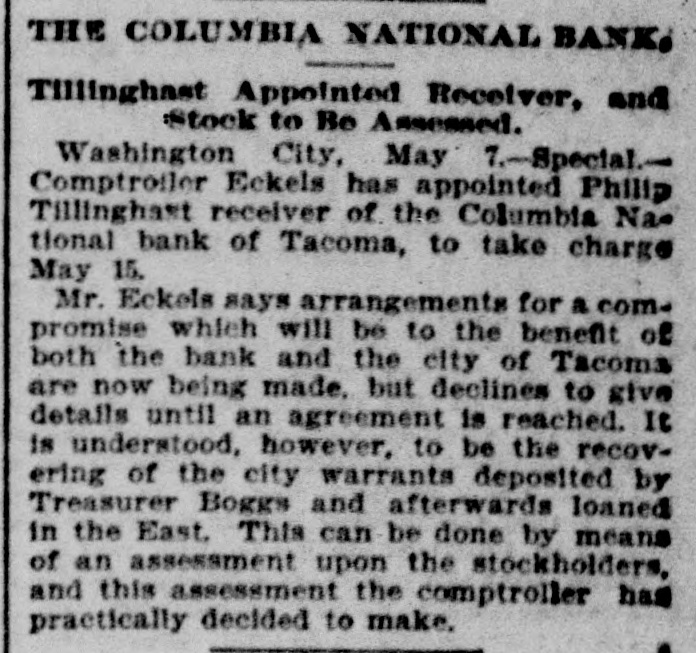
THE COLUMBIA NATIONAL BANK, Tillinghast Appointed Receiver, and Stock to Be Assessed. Washington City, May 7.-Special.Comptrollor Eckels has appointed Philip Tillinghast receiver of the Columbia Na. tional bank of Tacoma, to take charge May 15. Mr. Eckels says arrangements for a compromise which will be to the benefit of both the bank and the city of Tacoma are now being made, but declines to give details until an agreement is reached. It is understood, however, to be the recovering of the city warrants deposited by Treasurer Boggs and afterwards loaned in the East. This can be done by means of an assessment upon the stockholders, and this assessment the comptroller has practically decided to make.


Article from The Seattle Post-Intelligencer, August 12, 1896

Click image to open full size in new tab

Article Text

Convicted of Falsifying Columbia National Books. TAKEN TO THE COUNTY JAIL He Was Charged With Directing Un. true Entries to Be Made. A Sheepherder Murdered by Unknown Persons at Walls Walla-An Aged Rancher Murdered by a Neighbor at Sequim Bay-A Jefferson County Homicide Acquitted. Tacoma, Aug. 11.-Special--William G. Peters, cashier of the Columbia National bank, was today found guilty of the crime of falsifying the books of the bank with the intent of deceiving the comptroller of currency as to the the inthe stitution. condition was returned of The verdlet by a Jury in the Federal court this afternoon at Mr. placed 5 o'clock. in Peters was immediately the custody of United States Marshal James C. later the county senconfined in Drake. jail, He pending was tence by Judge Gilbert. the was read. He of cashier the jury scarcely paled when received The convicted verdict It with stolcal Indifference. The punishment as provided by the Federal statutes is not less than five years in the penitentlary or more than fifteen. The Peters case is remarkable in one sense. three banks in since the of in have failed Although panic the 1893, city which there were criminalon part of the the convietion is ity of the Peters the indications first officers, on record. of The arguments of the attorneys in the case were begun this morning. Judge Brinker opened for the government, makIng a strong and fully case the He into the argument against defendant. going said that in view of the evidence of Bookand Teller the jury one in a verkeeper could do Young but thing-bring Andrus He dwelt on the ness evidence introduced the dediet of of guilty. by meagerfense, and declared that the material charges In the indictment and been proved beyond a doubt. Attorheys Bogle and Hammond replied to the Arguments of the government prosecutor. They claimed that the government had not made out a case against the defendant and that it had not been proven that he had committed any of the crimes charged in the indictment. Judge Gilbert's charge to the jury followed. charge was couched in and was language, The against the defendant plain GD many of the issues 1. the case, The judge instructed the jurv that where it was proven that false entries were made under the direction of Mr. Peters it must find the defendant guilty. The question of fraud was gone into thoroughly by the court, and the jury was instructed that If it were proven that the defendant had purposely deceived the comptroller of the currency the verdict should be guilty. The jury occupied three hours in their deliberations. At 5 o'clock the jury filed into the court room and the verdict was read. The customary notice of a motion for a new trial was offered by the defendant's counsel. At o'clock Mr. Peters, who had been placed in the custody of the marshal, was taken to the county jall. where he will remain until sentenced. Ball was fixed at $10,000. The Columbia National bank was organized in 1591 by Peters and N. B. Dolson. Its capital stock was $200,000. It did a fair business until the hard times set in. Treasurer Boggs was a stockholder In the bank, and the city's deposit ran over $100.000 when he went out of office In 1894. Treasurer Hedges, who was at one time director in the bank. made heavy deposits of county money in the bank until a short time before It was placed In the charge of Bank Examiner Charles Clary. At the time of its failure. In October of last year, the bank owed the city $107,000. In local banking circles It was always a mystery how the Columbia bank was enabled to keep its doors open after the agl. tation in the council was begun last September over the city funds in the charge of Treasurer McCanley. A few days before the Columbia bank falled, the German-American Savings bank. which was allied to the former institution, was placed In the hands of a receiver by the superior court. This led to the failure of the national bank. and when Examiner Clary took charge evidence of criminal acts on the part of the president and cashier as well as Treasurer McCauley, was discovered and placed in the possession of the state and government.


Article from The Seattle Post-Intelligencer, September 9, 1896

Click image to open full size in new tab

Article Text

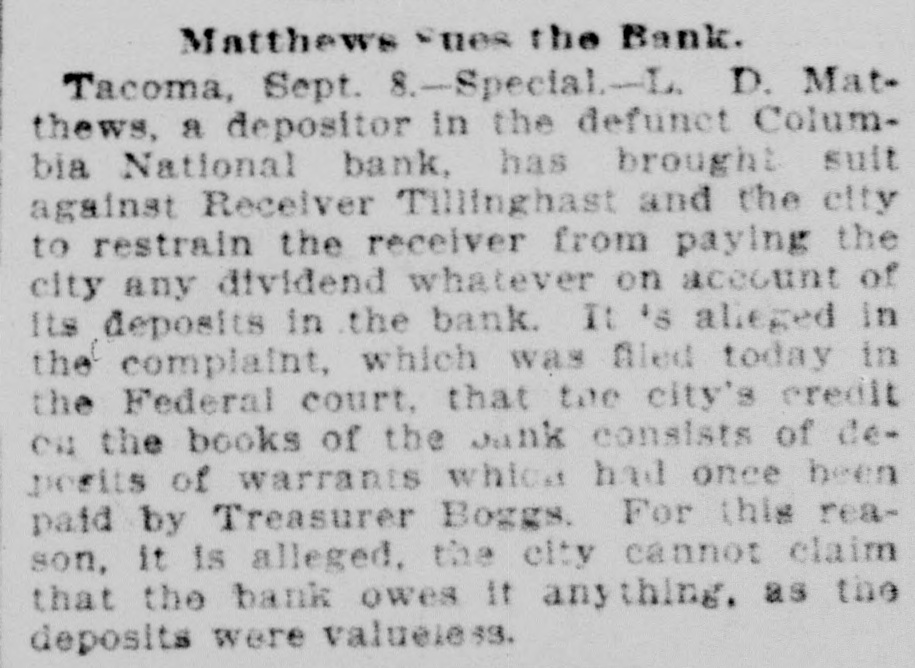
Matthews "ues the Bank. Tacoma, Sept. 8.-Special.-L. D. Matthews, a depositor in the defunct Columbia National bank, has brought suit against Receiver Tillinghast and the city to restrain the receiver from paying the city any dividend whatever on account of Its deposits in the bank. It 's alleged in the complaint, which was filed today in the Federal court, that the city's credit CAL the books of the wank consists of deposits of warrants which had once been paid by Treasurer Boggs. For this reason, it is alleged, the city cannot claim that the bank owes It anything. as the deposits were valueless.


Article from The Pioche Weekly Record, January 20, 1897

Click image to open full size in new tab

Article Text

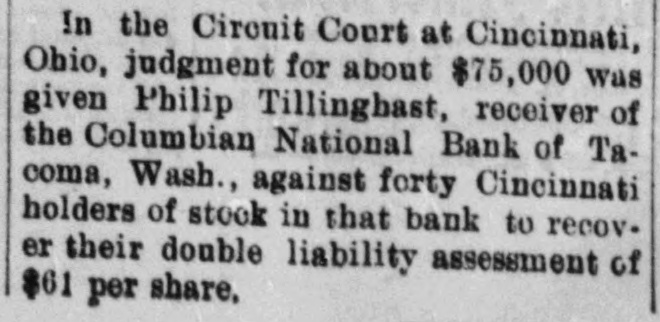
In the Circuit Court at Cincinnati, Ohio, judgment for about $75,000 was given Philip Tillinghast, receiver of the Columbian National Bank of Tacoma, Wash., against forty Cincinnati holders of stock in that bank to recover their double liability assessment of $61 per share.