The bank suspended payment on/about Sept 18–19, 1893 citing inability to realize on securities and the suspension of Portland correspondent banks. Although directors initially announced intentions to resume in 30 days, the Comptroller appointed a receiver on Oct 4, 1893, indicating permanent closure/receivership. No contemporaneous article describes a depositor run on this bank.
Events (4)
1.April 18, 1890Chartered
Source
historical_nic
2.September 18, 1893Suspension
Cause
Correspondent
Cause Details
Suspension announced as result of the suspension of the Commercial National and Portland Savings Bank of Portland and inability to realize on securities amid outside demands.
Newspaper Excerpt
The Port Townsend National bank ... did not open its doors this morning, but posted a notice stating that on account of inability to realize on securities in the face of pressing demands from outside, it was forced to temporarily suspend payment.
Source
newspapers
3.October 3, 1893Receivership
Source
historical_nic
4.October 4, 1893Receivership
Newspaper Excerpt
Comptroller Eckels has appointed Marcus A. Sawtelle receiver of the Port Townsend National Bank of Port Townsend, Washington.
Source
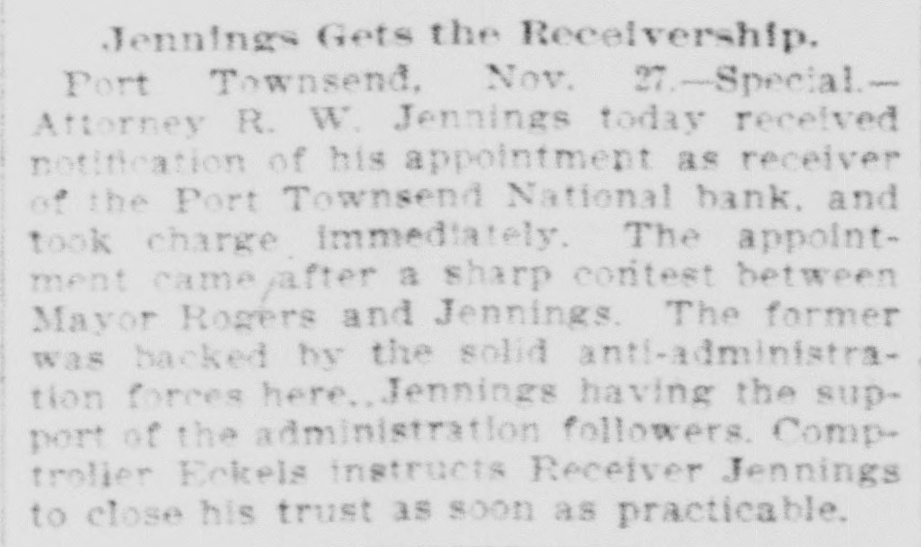
newspapers
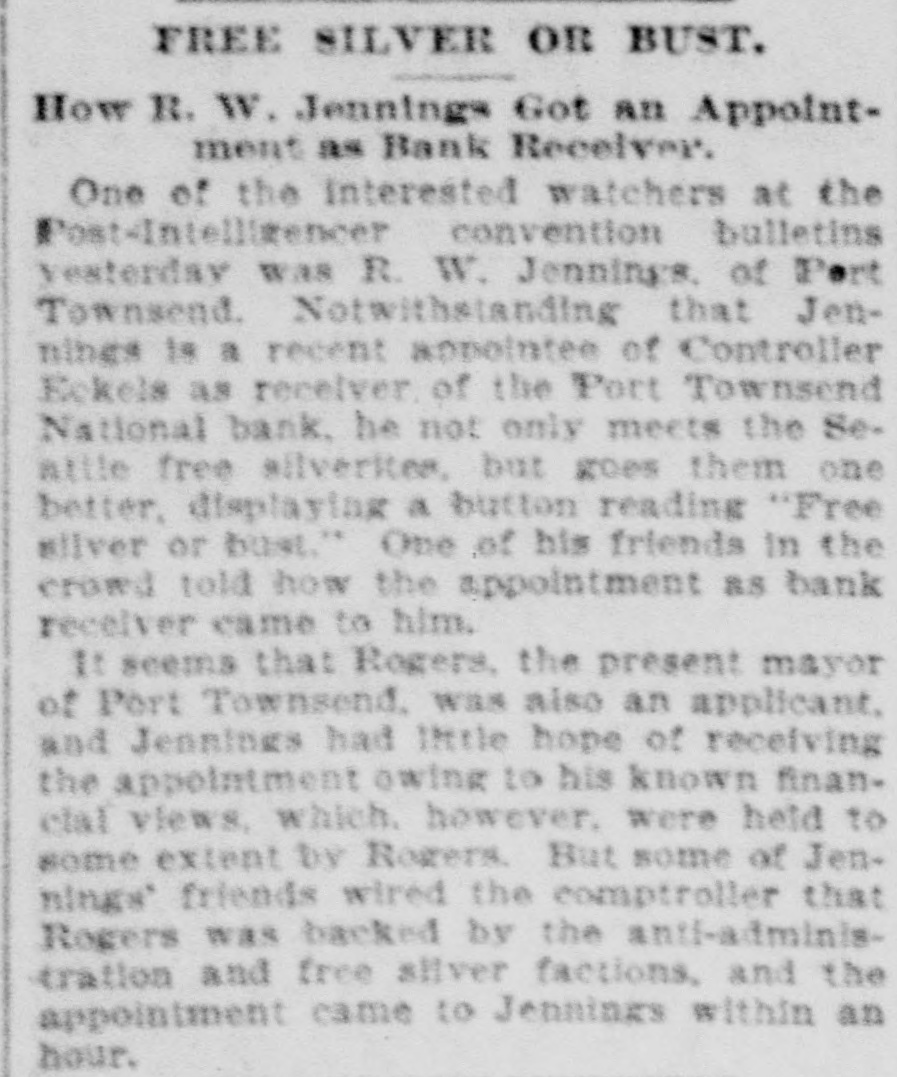
Newspaper Articles (22)
1.September 19, 1893The Evening WorldNew York, NY
Click image to open full size in new tab
Article Text
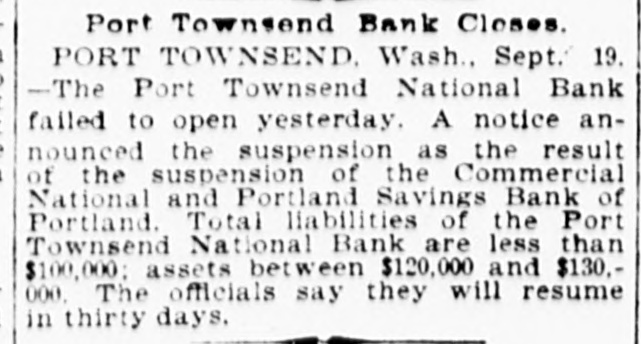
Port Townsend Bank Closes. PORT TOWNSEND. Wash., Sept. 19. -The Port Townsend National Bank failed to open yesterday. A notice announced the suspension as the result of the suspension of the Commercial National and Portland Savings Bank of Portland. Total liabilities of the Port Townsend National Bank are less than $100,000; assets between $120,000 and $130,000. The officials say they will resume in thirty days.
2.September 19, 1893The Seattle Post-IntelligencerSeattle, WA
Click image to open full size in new tab
Article Text
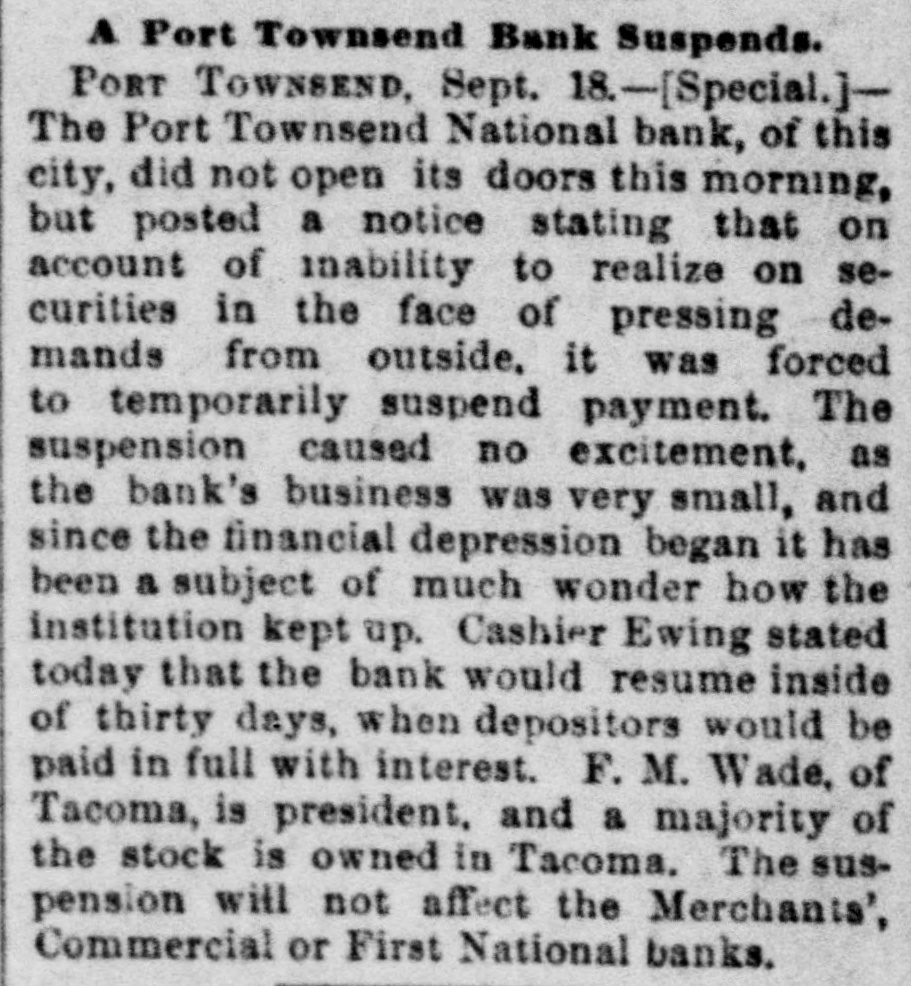
A Port Townsend Bank Suspends. PORT TOWNSEND, Sept. 18.-[Special.]The Port Townsend National bank, of this city, did not open its doors this morning, but posted a notice stating that on account of inability to realize on securities in the face of pressing demands from outside. it was forced to temporarily suspend payment. The suspension caused no excitement, as the bank's business was very small, and since the financial depression began it has been a subject of much wonder how the institution kept up. Cashier Ewing stated today that the bank would resume inside of thirty days, when depositors would be paid in full with interest. F. M. Wade, of Tacoma, is president, and a majority of the stock is owned in Tacoma. The suspension will not affect the Merchants', Commercial or First National banks.
3.September 20, 1893Daily Kennebec JournalAugusta, ME
Click image to open full size in new tab
Article Text
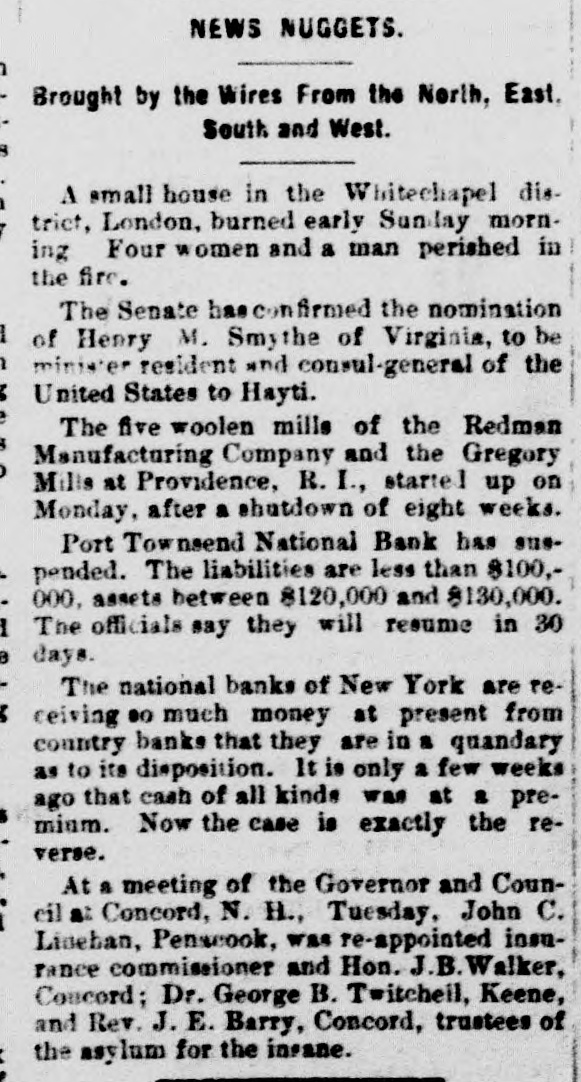
NEWS NUGGETS. Brought by the Wires From the North, East. South and West. A small house in the Whitechapel district, London, burned early Sunday morning Four women and a man perished in the fire. The Senate has confirmed the nomination of Henry M. Smythe of Virginia, to be minister resident and consul-general of the United States to Hayti. The five woolen mills of the Redman Manufacturing Company and the Gregory Mills at Providence, R.I., started up on Monday, after a shutdown of eight weeks. Port Townsend National Bank has suepended. The liabilities are less than $100,000, assets between 8120,000 and $130,000. 1 The officials say they will resume in 30 days. The national banks of New York are receiving so much money at present from country banks that they are in a quandary as to its disposition. It is only a few weeks ago that cash of all kinds was at a premium. Now the case is exactly the reverse. At a meeting of the Governor and Couneil at Concord, N. H., Tuesday, John C. Linehan, Penscook, was re-appointed inonPance commissioner and Hon. J.B.Walker, Concord; Dr. George B. Twitcheil, Keene, and Rev. J. E. Barry, Concord, trustees of the asylum for the inrane.
4.September 20, 1893The Morning NewsSavannah, GA
Click image to open full size in new tab
Article Text
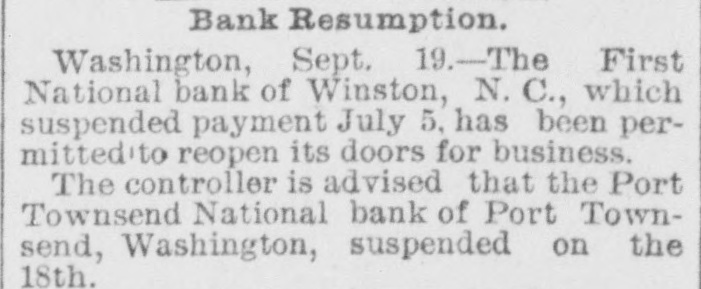
Bank Resumption. Washington, Sept. 19.-The First National bank of Winston, N. C., which suspended payment July 5, has been permitted to reopen its doors for business. The controller is advised that the Port Townsend National bank of Port Townsend, Washington, suspended on the 18th.
5.September 20, 1893New-York TribuneNew York, NY
Click image to open full size in new tab
Article Text
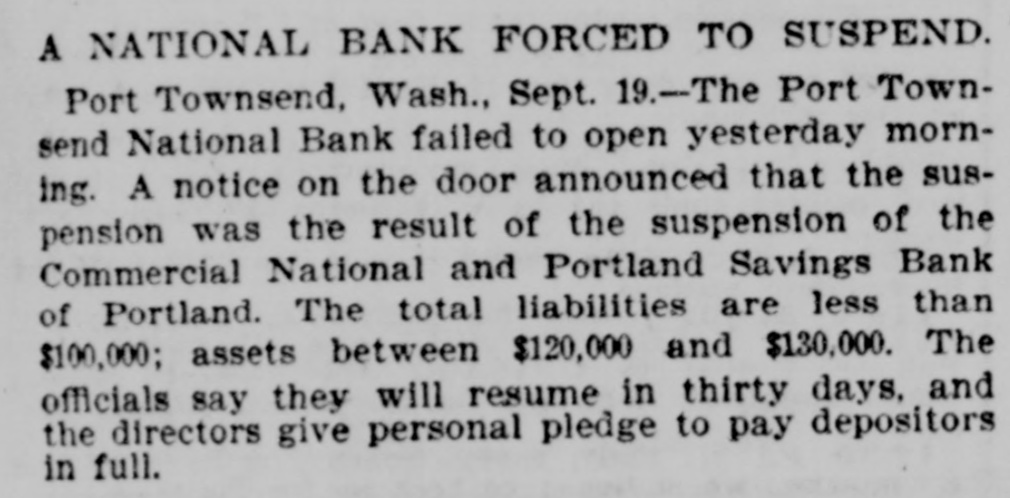
A NATIONAL BANK FORCED TO SUSPEND. Port Townsend, Wash., Sept. 19.-The Port Townsend National Bank failed to open yesterday mornIng. A notice on the door announced that the suspension was the result of the suspension of the Commercial National and Portland Savings Bank of Portland. The total liabilities are less than $100,000; assets between $120,000 and $130,000. The officials say they will resume in thirty days, and the directors give personal pledge to pay depositors in full.
Washington Bank Suspends. W ASHINGTON, Sept. 20. -The comptroller is advised that the Port Townsend National bank of Port Townsend, Wash., has suspended payment.
7.September 21, 1893The Daily Morning AstorianAstoria, OR
Click image to open full size in new tab
Article Text
AN UNFOUNDED RUMOP Portland, Sept. 20.-The Come relal National bank, of this city, den) $ the published statement that it. sponno Port sible for the suspension of Townsend National bank. Tney state the Commercial made no demand upon the bank, and furthermore, that the Port Townsend bank is not indebted to the Portland Savings Bank.
8.September 21, 1893The Seattle Post-IntelligencerSeattle, WA
Click image to open full size in new tab
Article Text
# NORTHWEST NEWS.
Dr. Henry C. Reno died at Spokane Saturday night. He was 54 years old, a Grand Army man, and crippled by wounds received during the war.
Shingle mills all over the state are resuming. The Willapa Cedar Lumber Company's plant at South Bend started up a week ago, and has orders far ahead. The tannin works and the two sawmills at South Bend are also running.
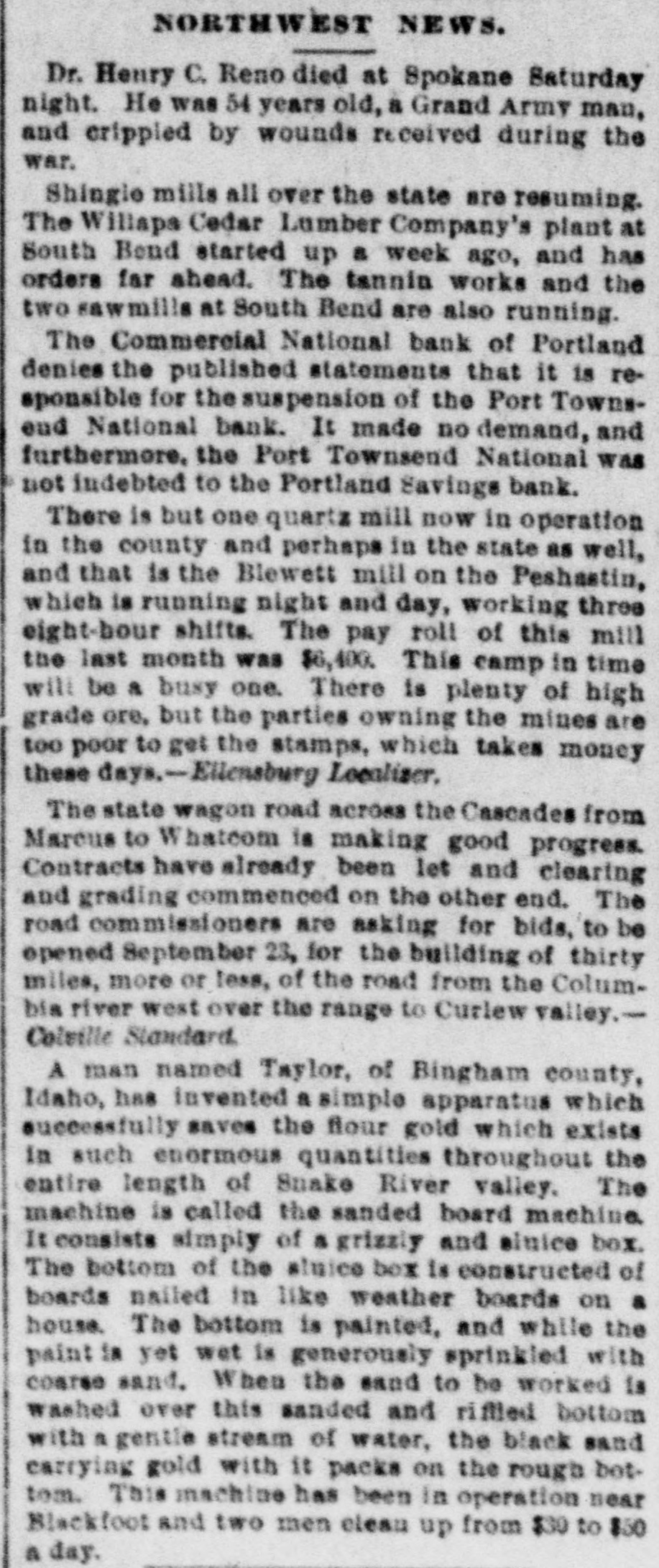
The Commercial National bank of Portland denies the published statements that it is responsible for the suspension of the Port Townsend National bank. It made no demand, and furthermore, the Port Townsend National was not indebted to the Portland Savings bank.
There is but one quartz mill now in operation in the county and perhaps in the state as well, and that is the Blewett mill on the Peshastin, which is running night and day, working three eight-hour shifts. The pay roll of this mill the last month was $6,400. This camp in time will be a busy one. There is plenty of high grade ore, but the parties owning the mines are too poor to get the stamps, which takes money these days.—Ellensburg Localizer.
The state wagon road across the Cascades from Marcus to Whatcom is making good progress. Contracts have already been let and clearing and grading commenced on the other end. The road commissioners are asking for bids, to be opened September 23, for the building of thirty miles, more or less, of the road from the Columbia river west over the range to Curlew valley.—Colville Standard.
A man named Taylor, of Bingham county, Idaho, has invented a simple apparatus which successfully saves the flour gold which exists In such enormous quantities throughout the entire length of Snake River valley. The machine is called the sanded board machine. It consists simply of a grizzly and sluice box. The bottom of the sluice box is constructed of boards nailed in like weather boards on a house. The bottom is painted, and while the paint is yet wet is generously sprinkled with coarse sand. When the sand to be worked is washed over this sanded and riffled bottom with a gentle stream of water, the black sand carrying gold with it packs on the rough bottom. This machine has been in operation near Blackfoot and two men clean up from $30 to $50 a day.
9.September 21, 1893The Stark County DemocratCanton, OH
Click image to open full size in new tab
Article Text
A Bank Suspends Payment. WASHINGTON, Sept. 20.-The comptroller is advised that the Port Town. send National bank of Port Townsend, Wash., has suspended.
10.September 22, 1893Washington StandardOlympia, WA
Click image to open full size in new tab
Article Text
The Henry Snowden Lumber Co. of Philadelphia has assigned owing $30,000, with ample assets. The Port Townsend National bank, of Port Townsend, has suspended temporarily, with ten times the amount of assets as liabilitles. The directors expect to resume within 30 days. Mast, Bufford & Burwell, one of the largest firms in wagons and carriages in the Northwest, with a factory at Gladstone, Minn., and connected with the big P. P. Mast & Co. works at Springfield, o., failed Tuesday. The report of the assignment at Denver of Crippen, Lawrence & Co. causes great surprise to the citizens of Concord, N. H., where the Eastern office of the firm is located. The firm's assets will exceed $1,350,000, and the liabilities, including all contingent liabilities, will probably not exceed $900,000.
11.September 29, 1893Washington StandardOlympia, WA
Click image to open full size in new tab
Article Text
The Port Townsend National bank, which has just suspended, organized in the fall of 1889, with a capital stock of $100,000. During the present year it absorbed the State bank of Washington, and took some of the accounts of the Marine Savings bank. Its present officers are: F. M. Wade, of Portland, president; William F. Irving, cashier; directors, F. M. Wade, L. H. Pontius, H. C. Stratton, of Portland; A. C. Hamilton, W. F. Irving, James Searey, C. S. Pink.
12.September 29, 1893Iowa County DemocratMineral Point, WI
Click image to open full size in new tab
Article Text
A FEW FAILURES. The Stringency Still Strewing the Way With Wrecks. Tacoma, Wash., Sept. 21.-The Port Townsend National bank of Port Townsend failed to open this morning, the result of the suspension of the Commercial National and Portland Savings bank of Portland. The total liabilities of the Port Townsend National are less than $10,000; assets between $120,000 and $130,000. The officials say they will resume in thirty days. Grand Rapids, Mich., Sept. 20.-The Michigan Trust company, assignee of Nelson, Matter & Co., has reported assets of $497,033, and liabilities of $508,862. Napierville, Ill., Sept. 20.-The Chicago & Napierville Brewing and Malting company, organized early in the spring, has been placed in a receiver's hands. Topeka, Kan., Sept. 20.-An action was begun in the United States circuit court Monday to have a receiver appointed for the Union Trust company of Sioux City, Iowa. The suit is brought by T. C. Brown. The petition for a receiver, as filed in the circuit court, states that E. M. Donaldson is a fugitive from justice.
13.October 4, 1893Evening StarWashington, DC
Click image to open full size in new tab
Article Text
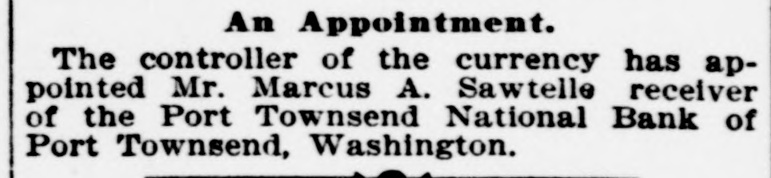
An Appointment. The controller of the currency has appointed Mr. Marcus A. Sawtelle receiver of the Port Townsend National Bank of Port Townsend, Washington.
14.October 4, 1893Deseret Evening NewsSalt Lake City, UT
Click image to open full size in new tab
Article Text
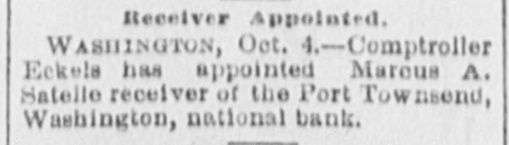
Receiver Appointed. WASHINGTON, Oct. 4.-Comptroller Eckels has appointed Marcus A. Satelle receiver of the Port Townsend, Washington, national bank.
15.October 5, 1893The Morning CallSan Francisco, CA
Click image to open full size in new tab
Article Text
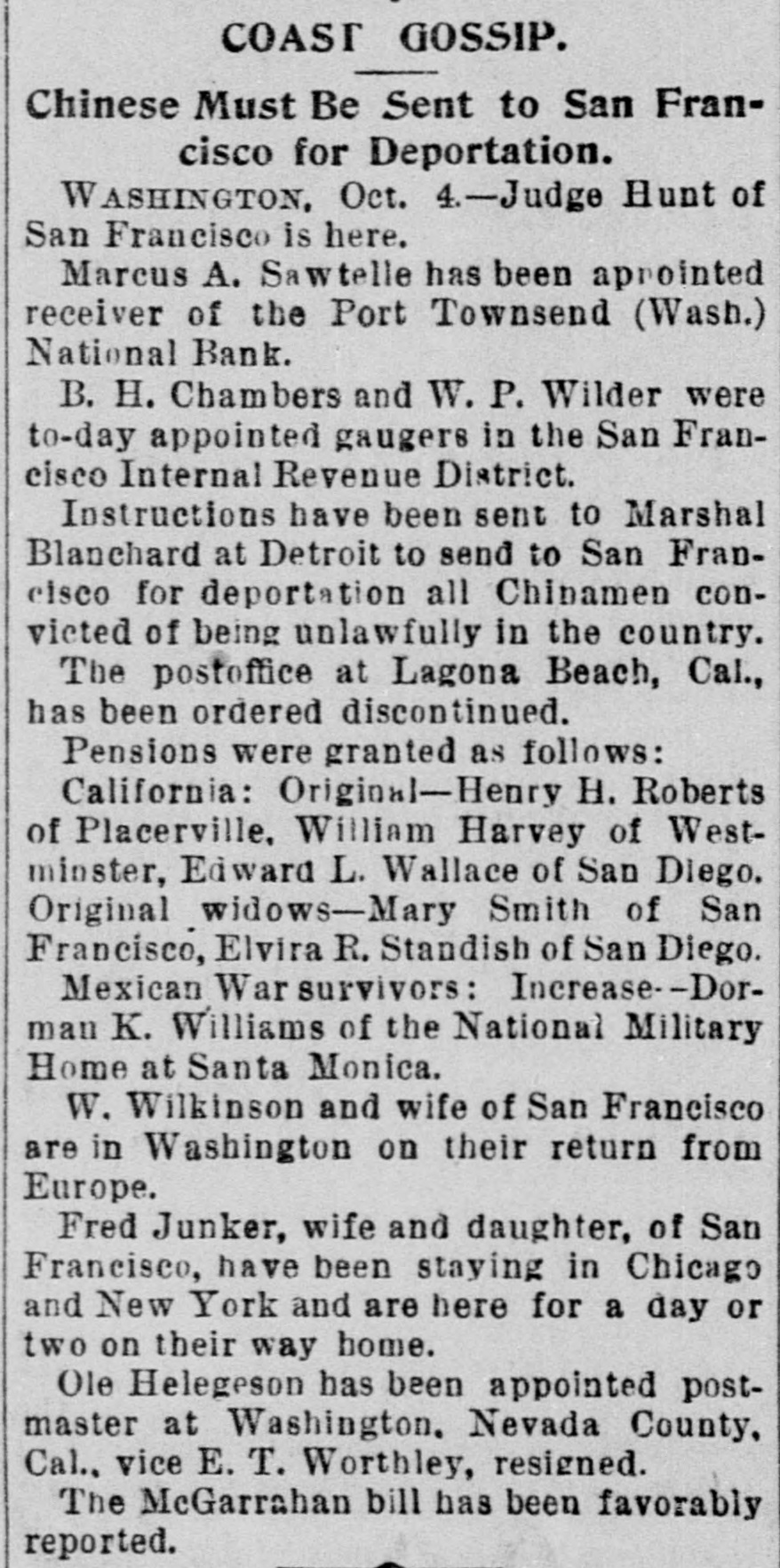
COAST GOSSIP. Chinese Must Be Sent to San Francisco for Deportation. WASHINGTON, Oct. 4.-Judge Hunt of San Francisco is here. Marcus A. Sawtelle has been aprointed receiver of the Port Townsend (Wash.) National Bank. B. H. Chambers and W. P. Wilder were to-day appointed gaugers in the San Francisco Internal Revenue District. Instructions have been sent to Marshal Blanchard at Detroit to send to San Francisco for deportation all Chinamen convicted of being unlawfully in the country. The postoffice at Lagona Beach, Cal., has been ordered discontinued. Pensions were granted as follows: California: Original-Henry H. Roberts of Placerville, William Harvey of Westminster, Edward L. Wallace of San Diego. Original widows-Mary Smith of San Francisco, Elvira R. Standish of San Diego. Mexican War survivors: Increase--Dorman K. Williams of the National Military Home at Santa Monica. W. Wilkinson and wife of San Francisco are in Washington on their return from Europe. Fred Junker, wife and daughter, of San Francisco, have been staying in Chicago and New York and are here for a day or two on their way home. Ole Helegeson has been appointed postmaster at Washington. Nevada County, Cal., vice E. T. Worthley, resigned. The McGarrahan bill has been favorably reported.
16.October 5, 1893The Salt Lake HeraldSalt Lake City, UT
Click image to open full size in new tab
Article Text
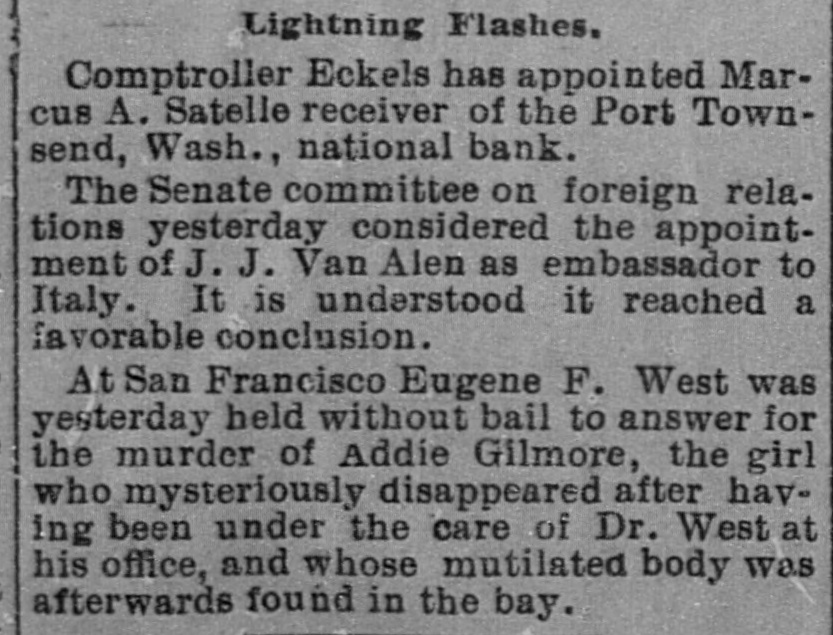
Lightning Flashes. Comptroller Eckels has appointed Marcus A. Satelle receiver of the Port Townsend, Wash., national bank. The Senate committee on foreign relations yesterday considered the appointment of J. J. Van Alen as embassador to Italy. It is understood it reached a favorable conclusion. At San Francisco Eugene F. West was yesterday held without bail to answer for the murder of Addie Gilmore, the girl who mysteriously disappeared after having been under the care of Dr. West at his office, and whose mutilated body was afterwards found in the bay.
17.October 6, 1893Washington StandardOlympia, WA
Click image to open full size in new tab
Article Text
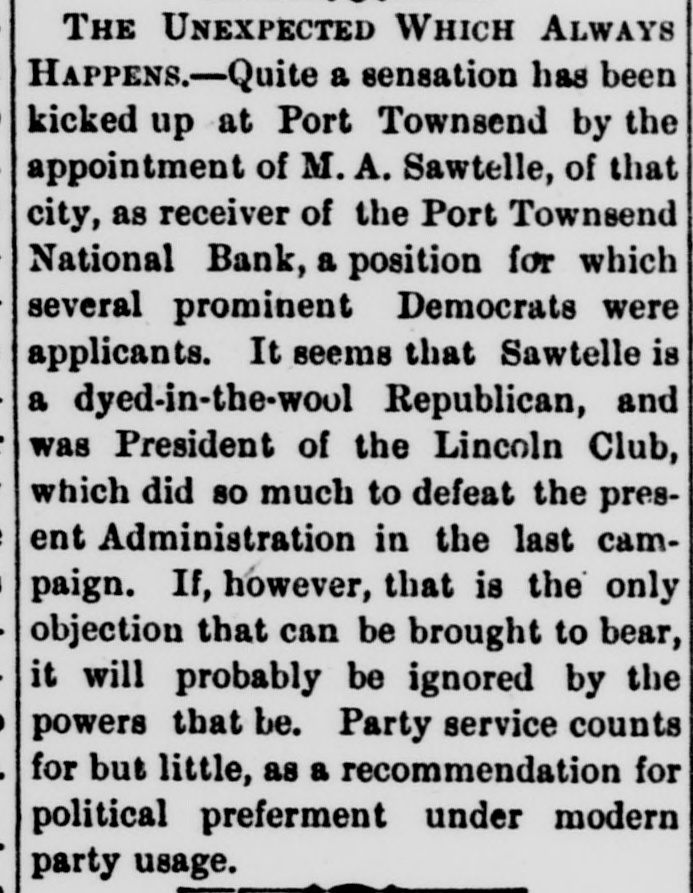
THE UNEXPECTED WHICH ALWAYS HAPPENS.-Quite a sensation has been kicked up at Port Townsend by the appointment of M. A. Sawtelle, of that city, as receiver of the Port Townsend National Bank, a position for which several prominent Democrats were applicants. It seems that Sawtelle is a dyed-in-the-wool Republican, and was President of the Lincoln Club, which did so much to defeat the present Administration in the last campaign. If, however, that is the only objection that can be brought to bear, it will probably be ignored by the powers that be. Party service counts for but little, as a recommendation for political preferment under modern party usage.
18.June 8, 1894Pullman HeraldPullman, WA
Click image to open full size in new tab
Article Text
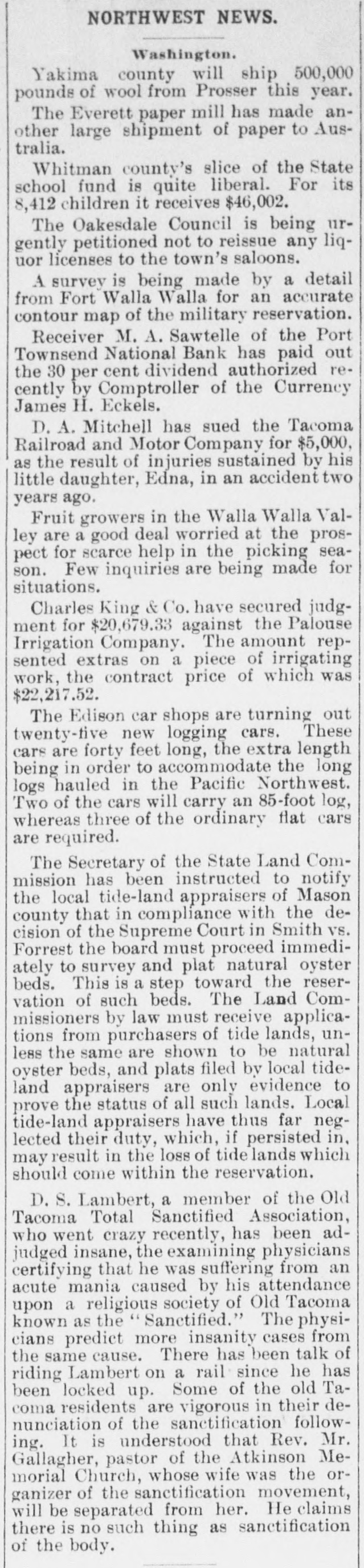
NORTHWEST NEWS. Washington. Yakima county will ship 500,000 pounds of wool from Prosser this year. The Everett paper mill has made another large shipment of paper to Australia. Whitman county's slice of the State school fund is quite liberal. For its 8,412 children it receives $46,002. The Oakesdale Council is being urgently petitioned not to reissue any liquor licenses to the town's saloons. A survey is being made by a detail from Fort Walla Walla for an accurate contour map of the military reservation. Receiver M. A. Sawtelle of the Port Townsend National Bank has paid out the 30 per cent dividend authorized recently by Comptroller of the Currency James H. Eckels. D. A. Mitchell has sued the Tacoma Railroad and Motor Company for $5,000, as the result of injuries sustained by his little daughter, Edna, in an accident two years ago. Fruit growers in the Walla Walla Valley are a good deal worried at the prospect for scarce help in the picking season. Few inquiries are being made for situations. Charles King & Co. have secured judgment for $20,679.33 against the Palouse Irrigation Company. The amount repsented extras on a piece of irrigating work, the contract price of which was $22,217.52. The Edison car shops are turning out twenty-five new logging cars. These cars are forty feet long, the extra length being in order to accommodate the long logs hauled in the Pacific Northwest. Two of the cars will carry an 85-foot log, whereas three of the ordinary flat cars are required. The Secretary of the State Land Commission has been instructed to notify the local tide-land appraisers of Mason county that in compliance with the decision of the Supreme Court in Smith vs. Forrest the board must proceed immediately to survey and plat natural oyster beds. This is a step toward the reservation of such beds. The Land Commissioners by law must receive applications from purchasers of tide lands, unless the same are shown to be natural oyster beds, and plats filed by local tideland appraisers are only evidence to prove the status of all such lands. Local tide-land appraisers have thus far neglected their duty, which, if persisted in, may result in the loss of tide lands which should come within the reservation. D. S. Lambert, a member of the Old Tacoma Total Sanctified Association, who went crazy recently, has been adjudged insane, the examining physicians certifying that he was suffering from an acute mania caused by his attendance upon a religious society of Old Tacoma known as the Sanctified." The physicians predict more insanity cases from the same cause. There has been talk of riding Lambert on a rail since he has been locked up. Some of the old Tacoma residents are vigorous in their denunciation of the sanctification following. It is understood that Rev. Mr. Gallagher, pastor of the Atkinson Memorial Church, whose wife was the organizer of the sanctification movement, will be separated from her. He claims there is no such thing as sanctification of the body.
19.March 12, 1895The Seattle Post-IntelligencerSeattle, WA
Click image to open full size in new tab
Article Text
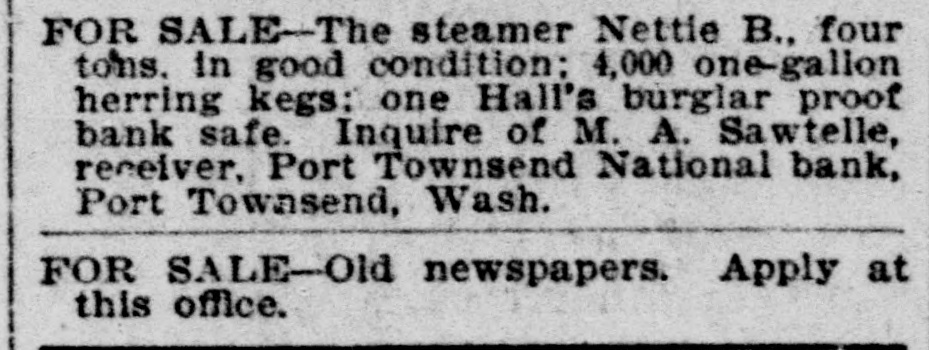
FOR SALE-The steamer Nettle B., four tons. in good condition: 4,000 one-gallon herring kegs: one Hall's burglar proof bank safe. Inquire of M. A. Sawtelle, receiver, Port Townsend National bank, Port Townsend, Wash. FOR SALE-Old newspapers. Apply at this office.
20.November 15, 1895The Seattle Post-IntelligencerSeattle, WA
Click image to open full size in new tab
Article Text
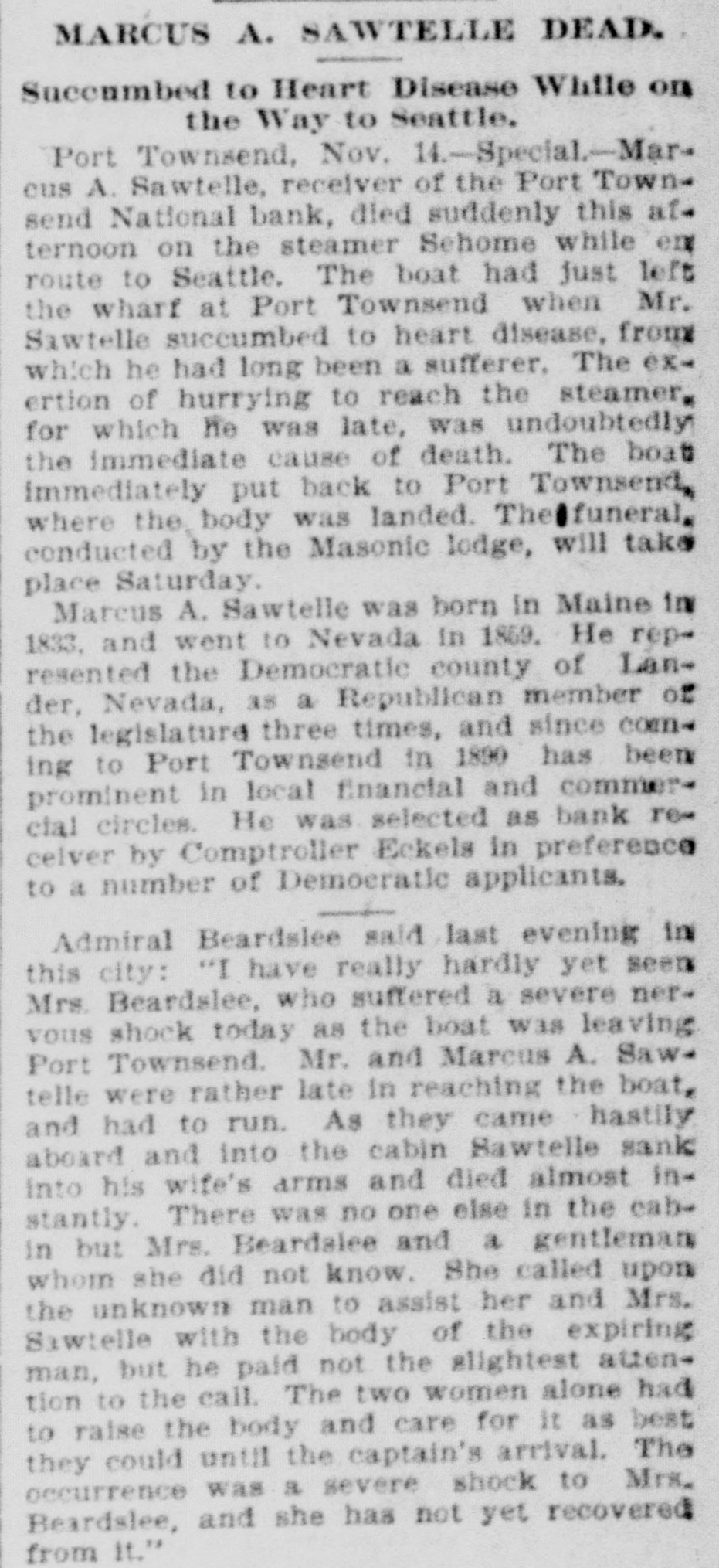
MARCUS A. SAWTELLE DEAD. Succumbed to Heart Disease While on the Way to Seattle. Port Townsend, Nov. 14.-Special.-Marcus A. Sawtelle, receiver of the Port Townsend National bank, died suddenly this atternoon on the steamer Schome while em route to Seattle. The boat had just left the wharf at Port Townsend when Mr. Sawtelle succumbed to heart disease, from which he had long been a sufferer, The exertion of hurrying to reach the steamer. for which he was late, was undoubtedly the immediate cause of death. The boat immediately put back to Port Townsend, where the body was landed. The funeral. conducted by the Masonic lodge, will take place Saturday. Marcus A. Sawtelle was born in Maine in 1833, and went to Nevada in 1859. He represented the Democratic county of Lander, Nevada, as a Republican member or the legislature three times, and since coming to Port Townsend in 1890 has been prominent in local financial and commercial circles. He was selected as bank recelver by Comptroller Eckels in preference to a number of Democratic applicants. Admiral Beardslee said last evening in this city: "I have really hardly yet seen Mrs. Beardslee, who suffered a severe nervous shock today as the boat was leaving Port Townsend. Mr. and Marcus A. Sawtelle were rather late in reaching the boat, and had to run. As they came hastily aboard and into the cabin Sawtelle sank into his wife's arms and died almost instantly. There was no one else in the cabin but Mrs. Beardalee and a gentleman whom she did not know. She called upon the unknown man to assist her and Mrs. Sawtelle with the body of the expiring man, but he paid not the slightest attention to the call. The two women alone had to raise the body and care for it as best they could until the captain's arrival. The occurrence was a severe shock to Mrs. Beardslee, and she has not yet recovered from It."
21.November 28, 1895The Seattle Post-IntelligencerSeattle, WA
Click image to open full size in new tab
Article Text
Jennings Gets the Receivership. Port Townsend, Nov. 27.-Special.Attorney R. W Jennings today received notification of his appointment as receiver of the Port Townsend National bank and took charge immediately. The appointment came after a sharp contest between Mayor Rogers and Jennings. The former was backed by the solid anti-administration forces here. Jennings having the support of the administration followers. Comptroller Eckels instructs Receiver Jennings to close his trust as soon as practicable.
22.July 25, 1896The Seattle Post-IntelligencerSeattle, WA
Click image to open full size in new tab
Article Text
FREE SILVER OR BUST. How R. W. Jennings Got an Appointment as Bank Receiver. One of the interested watchers at the Post-Intelligencer convention bulletins yesterday was R. W. Jennings. of Port Townsend. Notwithstanding that Jennings is a recent appointee of Controller Eckels as receiver. of the Port Townsend National bank, he not only meets the Seattle free silverites, but goes them one better, displaying a button reading "Free silver or bust." One of his friends in the crowd told how the appointment as bank receiver came to him. It seems that Rogers, the present mayor of Port Townsend. was also an applicant. and Jennings had little hope of receiving the appointment owing to his known finanetal views, which. however. were held to some extent by Rogers. But some of Jenhings' friends wired the comptroller that Rogers was backed by the anti-administration and free silver factions, and the appointment came to Jennings within an hour.