19205. Union Loan & Trust Company (Centralia, WA)

Bank Information

Episode Type
Suspension โ†’ Closure
Bank Type
trust
Start Date
September 21, 1914
Location
Centralia, Washington (46.716, -122.954)

Metadata

Model
gpt-5-mini
Short Digest
5d72f976c1c3e715

Response Measures

None

Description

The Union Loan & Trust Co. of Centralia was inspected and ordered not to open on Sept 21, 1914; no run is reported. A receiver was appointed Dec 22, 1914 and the bank's assets were handled for sale/reorganization; a new state bank took over the premises in January 1915. Cause was overextension in commercial paper and financing mill/logging interests (bank-specific adverse information).

Events (2)

1. September 21, 1914 Suspension
Cause
Bank Specific Adverse Info
Cause Details
Over-extended lending in commercial paper and financing mill and logging properties; unable to realize commercial paper when stress came; Union Trust carried balances with the National so was included in suspension. Examiner took charge for readjustment; suspension ordered due to insufficient cash to transact business satisfactorily.
Newspaper Excerpt
The United States National Bank with deposits of over $1,000,000 and the Union Loan & Thust Company, with deposits of over $250,000, failed to open their doors today following an inspection of the institutions' books by Bank Examiner Lloyd L. Mulit.
Source
newspapers
2. December 22, 1914 Receivership
Newspaper Excerpt
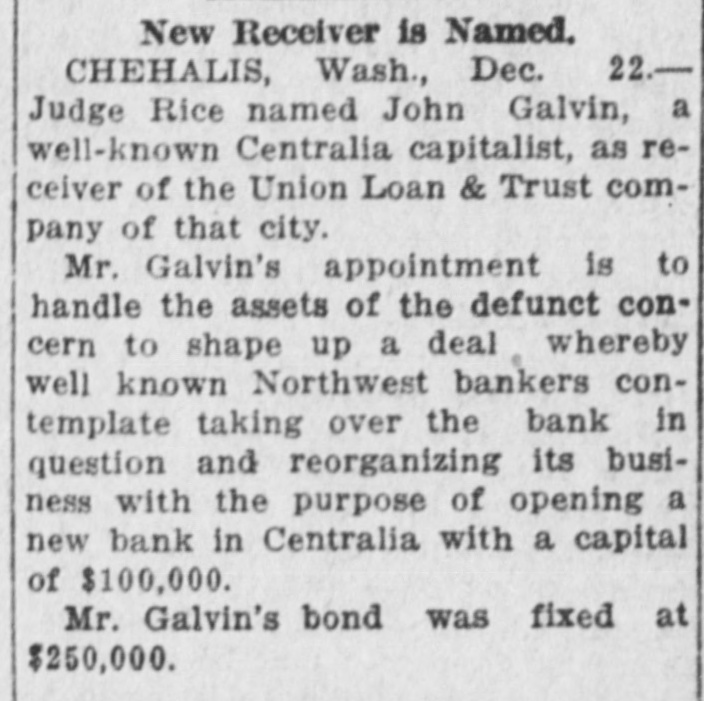
Judge Rice named John Galvin, a well-known Centralia capitalist, as receiver of the Union Loan & Trust company of that city. Mr. Galvin's appointment is to handle the assets of the defunct concern ... Mr. Galvin's bond was fixed at $250,000. (Dec. 22, 1914).
Source
newspapers

Newspaper Articles (6)

Article from Daily Capital Journal, September 21, 1914

Click image to open full size in new tab

Article Text

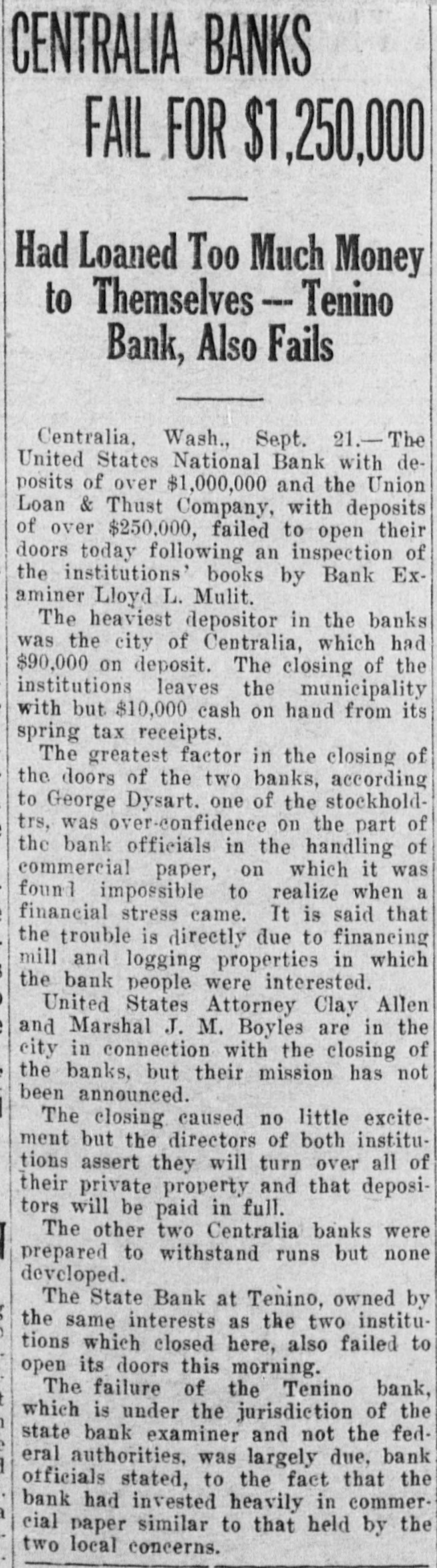
CENTRALIA BANKS FAIL FOR $1,250,000 Had Loaned Too Much Money to Themselves --- Tenino Bank, Also Fails Centralia, Wash., Sept. 21.-The United States National Bank with deposits of over $1,000,000 and the Union Loan & Thust Company, with deposits of over $250,000, failed to open their doors today following an inspection of the institutions' books by Bank Examiner Lloyd L. Mulit. The heaviest depositor in the banks was the city of Centralia, which had $90,000 on deposit. The closing of the institutions leaves the municipality with but $10,000 cash on hand from its spring tax receipts. The greatest factor in the closing of the doors of the two banks, according to George Dysart. one of the stockholdtrs, was over-confidence on the part of the bank officials in the handling of commercial paper, on which it was found impossible to realize when a financial stress came. It is said that the trouble is directly due to financing mill and logging properties in which the bank people were interested. United States Attorney Clay Allen and Marshal J. M. Boyles are in the city in connection with the closing of the banks, but their mission has not been announced. The closing caused no little excitement but the directors of both institutions assert they will turn over all of their private property and that depositors will be paid in full. The other two Centralia banks were prepared to withstand runs but none developed. The State Bank at Tenino, owned by the same interests as the two institutions which closed here, also failed to open its doors this morning. The failure of the Tenino bank, which is under the jurisdiction of the state bank examiner and not the federal authorities, was largely due, bank officials stated, to the fact that the bank had invested heavily in commercial paper similar to that held by the two local concerns.


Article from The Tacoma Times, September 21, 1914

Click image to open full size in new tab

Article Text

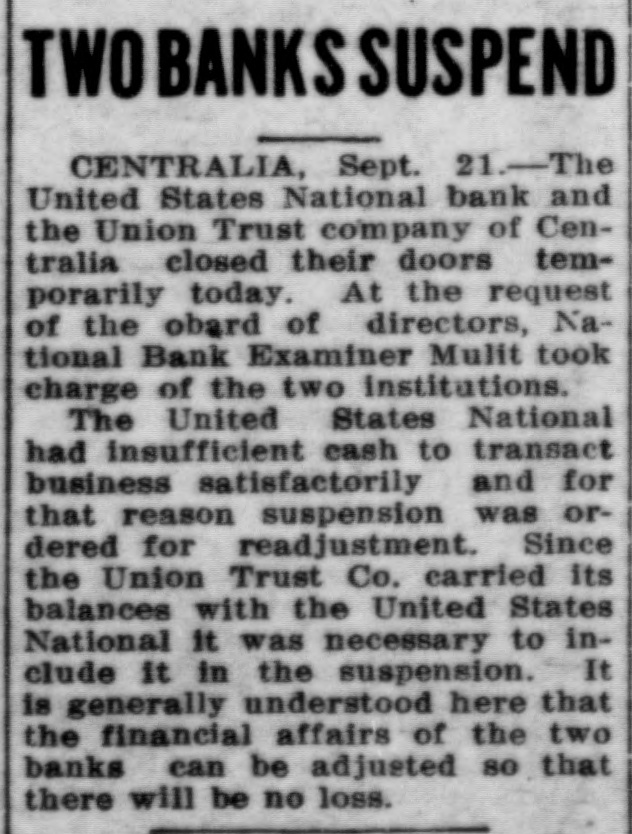
TWO BANKS SUSPEND CENTRALIA, Sept. 21.-The United States National bank and the Union Trust company of Centralia closed their doors temporarily today. At the request of the obard of directors, National Bank Examiner Mulit took charge of the two institutions. The United States National had insufficient cash to transact business satisfactorily and for that reason suspension was ordered for readjustment. Since the Union Trust Co. carried its balances with the United States National It was necessary to include It in the suspension. It is generally understood here that the financial affairs of the two banks can be adjusted 80 that there will be no loss.


Article from The Meridian Times, October 2, 1914

Click image to open full size in new tab

Article Text

RECORD OF THE IMPORTANT EVENTS TOLD IN BRIEFEST MANNER POSSIBLE. Happenings That Are Making History -Information Gathered from All Quarters of the Globe and Given in a Few Lines. INTERMOUNTAIN. E. W. Swanbrough, a veteran automobile racer, was killed in a race at the Overland track at Denver. His machine plunged through a fence and a timber struck Swanbrough on the head. Unless the farmers east of Sandy, around Midvale, Crescent and Riverton, Utah, take drastic measures in fighting the hog cholera epidemic in those sections, the plague will spread throughout the state and become a serious menace, it is believed. Utah banks are not affected by the statement of the secretary of the treasury that he would withdraw federal deposits and federal emergency issued to banks which have high reserves and are charging high rates of interest, it was learned. None of the national banks in Utah made a request for emergency currency. Following a checking in by the United States bank examiner and the state bank examiner, the United States National bank at Centralia and the Union Loan & Trust company of Centralia, Wash., were forbidden to open their doors. The Twentieth infantry, which is now encamped at Fort Bliss, Texas, and at Fort Wingate, N. M., will return to Fort Douglas, Utah, when the troops are ordered away from the Mexican border. DOMESTIC. New rates filed by practically all the railways west of the Mississippi river and east of the Rocky mountains, withdrawing the privilege of shippers to concentrate into carload shipments at certain points less than carload shipments of butter, eggs, cheese and poultry, have been suspended by the interstate commerce commission until January 21, 1915. Theodore Roosevelt's youngest daughter, Ethel, wife of Dr. Richard Derby, will nurse the wounded in the hospitals of Paris and her husband will be a surgeon in the French city. William S. Evans, Philadelphia, f was elected president and San Francisco was chosen as the 1915 meeting place by the American Institute of Banking at the closing session of its twelfth annual convention at Dallas, Texas. a Thousands of customers attended the opening of Chicago's first municipal market on Thursday. Cabbage a sold at 2 cents, loose grapes, 5 cents, tomatoes, 2 cents, and noodles at 6 cents a pound. Radishes brought 0 3 cents and lettuce 5 cents a bunch. 7 Belated reports from missions esr tablished throughout the world by the Presbyterian church made public at New York tell of world-wide conditions unparalleled in the history of the church. There is no spot under I the sun, according to these reports, h where the European war has failed to strike a blow at commerce. 1The illness of Mrs. Helen Schuler at New Orleans was diagnosed as bubonic plague. This is the twentye eighth case reported since the malady was discovered June 27. The sovereign grand lodge of the Independent Order of Odd Fellows, in session at Atlantic City, N. J., reit fused to reduce the age limit of ade mission into the order. 0 Edward Teesdale, chief of staff of "General" Charles Kelley, who led an army of 1,400 unemployed men to Sacramento last winter, en route to Washington, D. C., has been released from the county jail at Sacramento after serving six months. S Two new cases of bubonic plague have been discovered at New Orleans. Henry A. Kolbe, high constable of Doylestown, Pa., was shot through the heart and killed by William Miller, 18 years old, as he was taking the young man to jail on a charge of having forged a check. Three men robbed the Baxter Springs, Kans., National bank of $8,000 and escaped. Hope that the United States would aid in bringing about the independence of their native land at the end of the great war was expressed in a telegram sent by the convention of Lithuanians at Chicago to President Wilson. The message also expressed a desire for a world-wide movement for general peace. Six persons were injured when a
Article from East Oregonian : E.O, December 23, 1914

Click image to open full size in new tab

Article Text

New Receiver is Named. CHEHALIS, Wash., Dec. 22.Judge Rice named John Galvin, a well-known Centralia capitalist, as receiver of the Union Loan & Trust company of that city. Mr. Galvin's appointment is to handle the assets of the defunct concern to shape up a deal whereby well known Northwest bankers contemplate taking over the bank in question and reorganizing its business with the purpose of opening a new bank in Centralia with a capital of $100,000. Mr. Galvin's bond was fixed at $250,000.


Article from The Seattle Star, December 24, 1914

Click image to open full size in new tab

Article Text

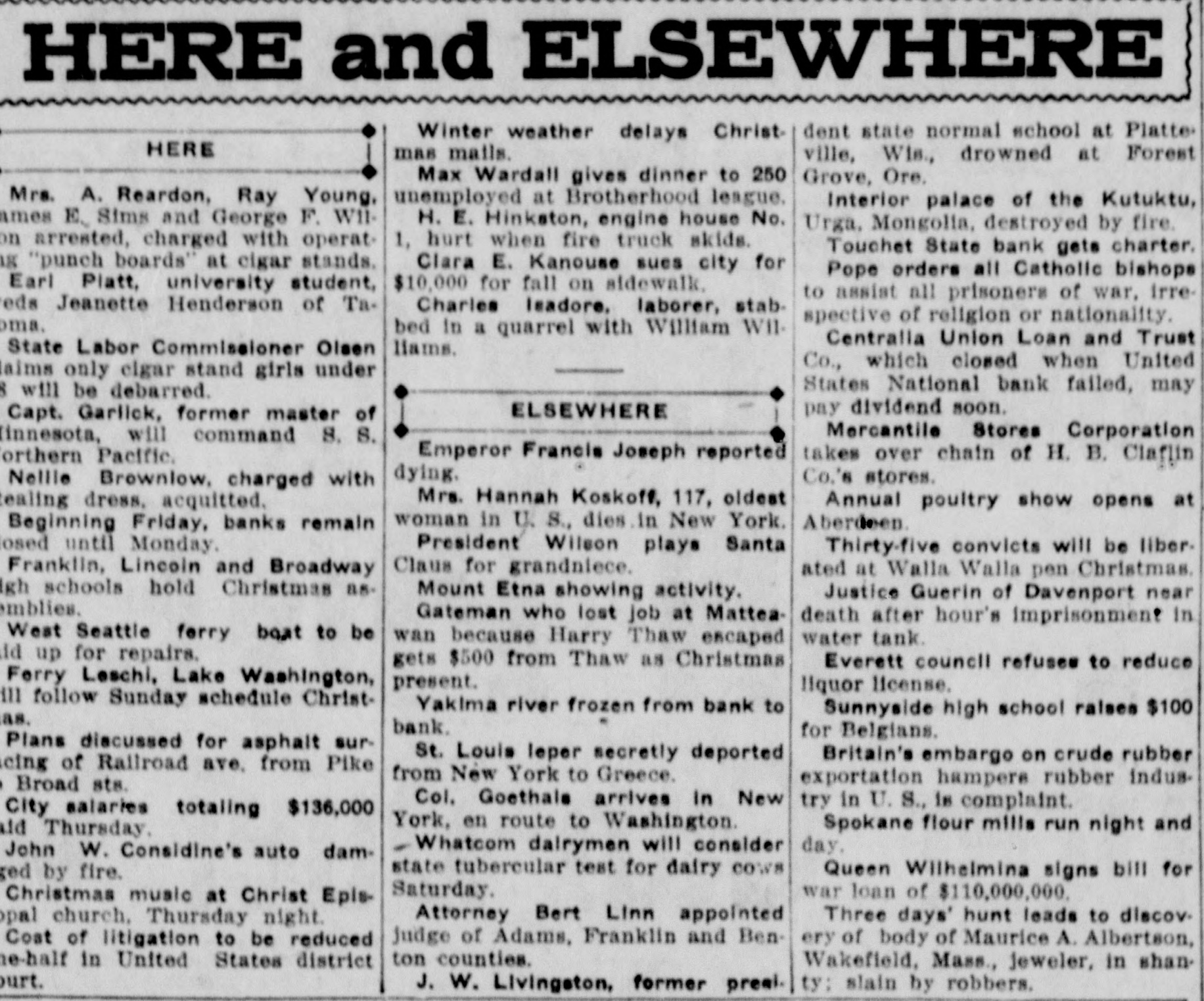
HERE and ELSEWHERE HERE Mrs. A. Reardon, Ray Young, James E. Sims and George F. Wilson arrested, charged with operat-ing "punch boards" at cigar stands. Earl Platt, university student, weds Jeanette Henderson of Ta-coma. State Labor Commissioner Olsen claims only cigar stand girls under 18 will be debarred. Capt. Garlick, former master of Minnesota, will command S. S. Northern Pacific. Nellie Brownlow, charged with stealing dress, acquitted. Beginning Friday, banks remain closed until Monday. Franklin, Lincoln and Broadway high schools hold Christmas as-semblies. West Seattle ferry boat to be laid up for repairs. Ferry Leschi, Lake Washington, will follow Sunday schedule Christ-mas. Plans discussed for asphalt sur-facing of Railroad ave, from Pike to Broad sts. City salaries totaling $136,000 paid Thursday. John W. Considine's auto dam-aged by fire. Christmas music at Christ Epis-copal church, Thursday night. Cost of litigation to be reduced one-half in United States district court. Winter weather delays Christ-mas mails. Max Wardall gives dinner to 250 unemployed at Brotherhood league. H. E. Hinkston, engine house No. 1, hurt when fire truck skids. Clara E. Kanouse sues city for $10,000 for fall on sidewalk. Charles Isadore, laborer, stab-bed in a quarrel with William Wil-liams. ELSEWHERE Emperor Francis Joseph reported dying. Mrs. Hannah Koskoff, 117, oldest woman in U. S., dies in New York. President Wilson plays Santa Claus for grandniece. Mount Etna showing activity. Gateman who lost job at Mattea-wan because Harry Thaw escaped gets $500 from Thaw as Christmas present. Yakima river frozen from bank to bank. St. Louis leper secretly deported from New York to Greece. Col. Goethals arrives in New York, en route to Washington. Whatcom dairymen will consider state tubercular test for dairy cows Saturday. Attorney Bert Linn appointed judge of Adams, Franklin and Ben-ton counties. J. W. Livingston, former preal-dent state normal school at Platteville, Wis., drowned at Forest Grove, Ore. Interior palace of the Kutuktu, Urga, Mongolia, destroyed by fire. Touchet State bank gets charter. Pope orders all Catholic bishops to assist all prisoners of war, irrespective of religion or nationality. Centralia Union Loan and Trust Co., which closed when United States National bank failed, may pay dividend soon. Mercantile Stores Corporation takes over chain of H. B. Claflin Co.'s stores. Annual poultry show opens at Aberdeen. Thirty-five convicts will be liber-ated at Walla Walla pen Christmas. Justice Guerin of Davenport near death after hour's imprisonment in water tank. Everett council refuses to reduce liquor license. Sunnyside high school raises $100 for Belgians. Britain's embargo on crude rubber exportation hampers rubber indus-try in U. S., is complaint. Spokane flour mills run night and day. Queen Wilhelmina signs bill for war loan of $110,000,000. Three days' hunt leads to discov-ery of body of Maurice A. Albertson, Wakefield, Mass., jeweler, in shan-ty; slain by robbers.


Article from Aberdeen Herald, December 24, 1914

Click image to open full size in new tab

Article Text

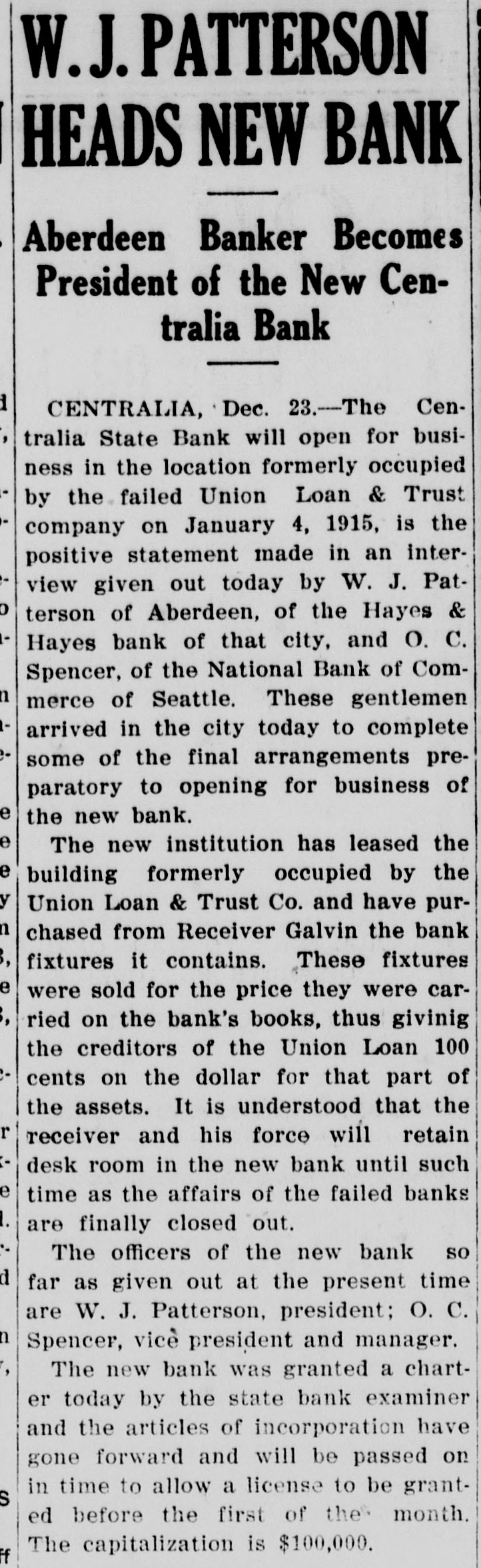
.J.PATTERSON HEADS NEW BANK Aberdeen Banker Becomes President of the New Centralia Bank CENTRALIA, Dec. 23.-The Centralia State Bank will open for business in the location formerly occupied by the failed Union Loan & Trust company on January 4, 1915, is the positive statement made in an interview given out today by W. J. Patterson of Aberdeen, of the Hayes & Hayes bank of that city, and O. C. Spencer, of the National Bank of Commerce of Seattle. These gentlemen arrived in the city today to complete some of the final arrangements preparatory to opening for business of e the new bank. e The new institution has leased the e building formerly occupied by the y Union Loan & Trust Co. and have purchased from Receiver Galvin the bank fixtures it contains. These fixtures e were sold for the price they were carried on the bank's books, thus givinig the creditors of the Union Loan 100 cents on the dollar for that part of the assets. It is understood that the r receiver and his force will retain desk room in the new bank until such time as the affairs of the failed banks are finally closed out. The officers of the new bank so far as given out at the present time are W. J. Patterson, president; O. C. Spencer, vice president and manager. The new bank was granted a charter today by the state bank examiner and the articles of incorporation have gone forward and will be passed on in time to allow a license to be granted before the first of the month. The capitalization is $100,000. ff