19203. Tradesmens Trust Company (Philadelphia, PA)

Bank Information

Episode Type
Suspension → Closure
Bank Type
trust company
Start Date
September 18, 1911
Location
Philadelphia, Pennsylvania (39.952, -75.164)

Metadata

Model
gpt-5-mini
Short Digest
50999a2c

Response Measures

None

Description

The Tradesmen's (Tradesmens) Trust Company closed/suspended on Sept 18, 1911; the state banking commissioner ordered closure and an examiner placed in charge. Depositors gathered but no clear independent run caused the suspension. The institution later went into receivership (reported in December 1911). OCR variants of the name (Tradesmen's/Tradesmens) noted.

Events (2)

1. September 18, 1911 Suspension
Cause
Government Action
Cause Details
Closed by order of the State Banking Commissioner and placed in charge of a bank examiner; directors posted notice saying they closed to protect depositors while assets (real-estate mortgages) are illiquid.
Newspaper Excerpt
The Tradesmen's Trust Co., ... has closed its doors. ... The bank was closed by order of State Banking Commissioner William H. Smith, and its funds placed in charge of Bank Examiner Frank S. Taber.
Source
newspapers
2. November 1, 1911* Receivership
Newspaper Excerpt
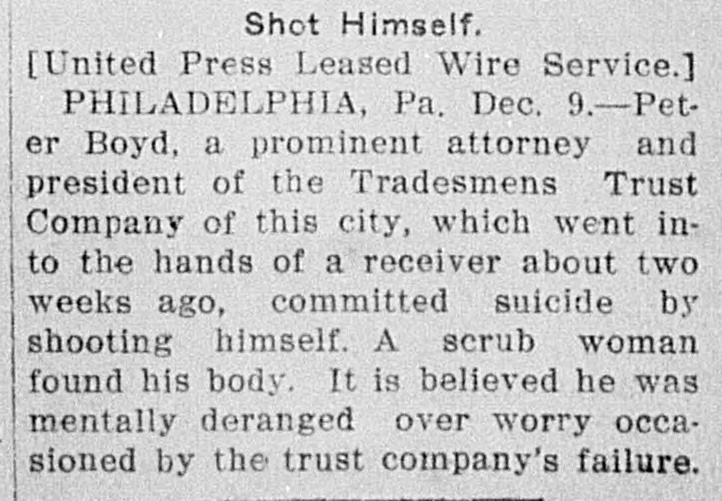
Peter Boyd, ... president of the Tradesmens Trust Company of this city, which went into the hands of a receiver about two weeks ago, committed suicide by shooting himself. (Dec. 9, 1911 report).
Source
newspapers

Newspaper Articles (14)

Article from The Detroit Times, September 18, 1911

Click image to open full size in new tab

Article Text

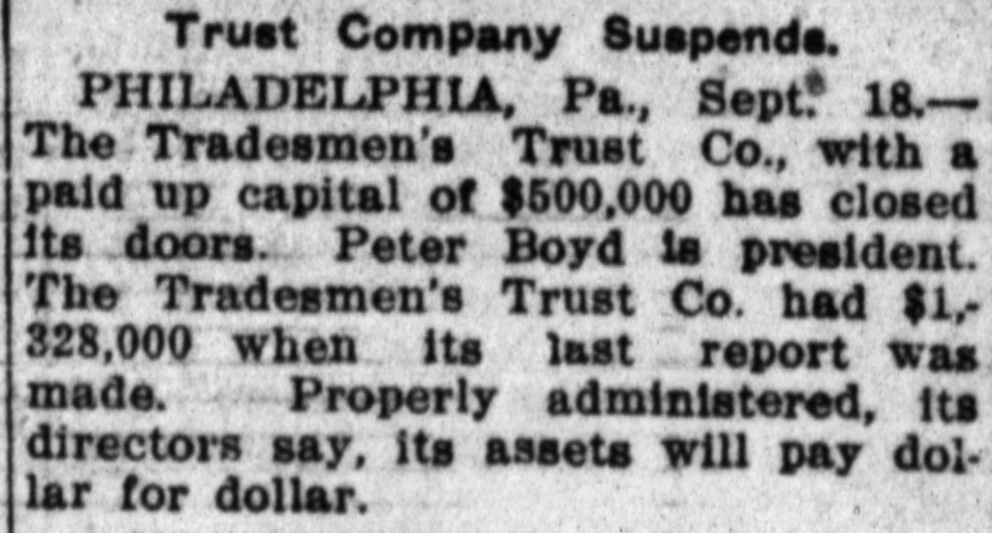
Trust Company Suspends. PHILADELPHIA, Pa., Sept. 18.The Tradesmen's Trust Co., with a paid up capital of $500,000 has closed its doors. Peter Boyd is president. The Tradesmen's Trust Co. had $1, 328,000 when its last report was made. Properly administered, its directors say, its assets will pay dollar for dollar.


Article from Evening Journal, September 18, 1911

Click image to open full size in new tab

Article Text

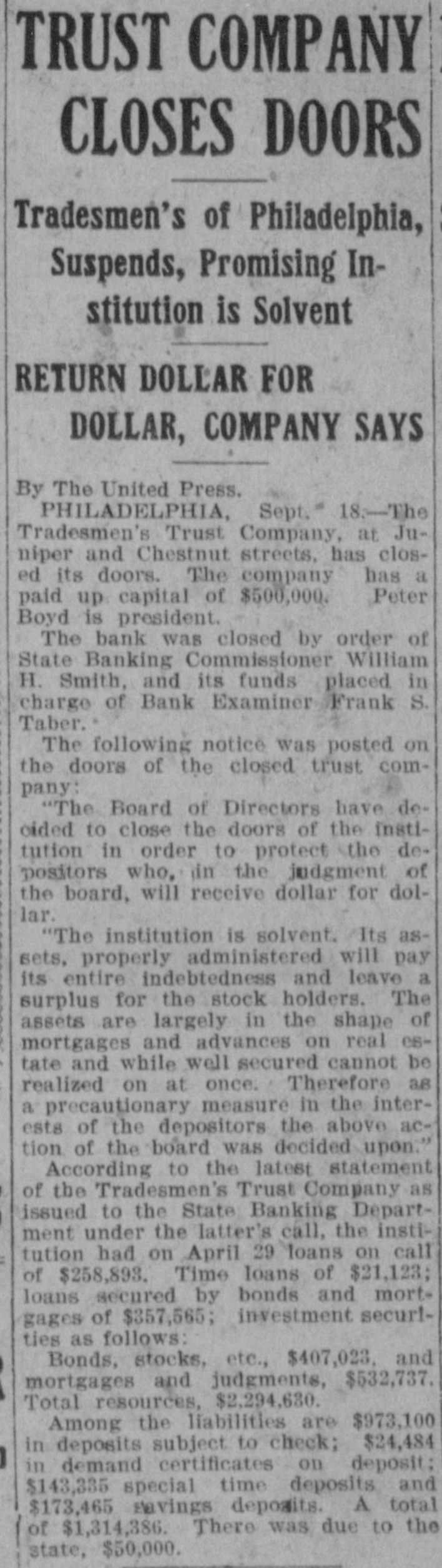
TRUST COMPANY CLOSES DOORS Tradesmen's of Philadelphia, Suspends, Promising Institution is Solvent RETURN DOLLAR FOR DOLLAR, COMPANY SAYS By The United Press. PHILADELPHIA, Sept. 18.-The Tradesmen's Trust Company, at Juniper and Chestnut streets, has closed its doors. The company has a paid up capital of $500,000. Peter Boyd is president. The bank was closed by order of State Banking Commissioner William H. Smith, and its funds placed in charge of Bank Examiner Frank S. Taber, The following notice was posted on the doors of the closed trust company: "The Board of Directors have deoided to close the doors of the institution in order to protect the depositors who, in the judgment of the board, will receive dollar for dollar. "The institution is solvent. Its assets, properly administered will pay its entire indebtedness and leave a surplus for the stock holders. The assets are largely in the shape of mortgages and advances on real estate and while well secured cannot be realized on at once. Therefore 38 a precautionary measure in the interests of the depositors the above action of the board was decided upon." According to the latest statement of the Tradesmen's Trust Company as issued to the State Banking Department under the latter's call, the institution had on April 29 loans on call of $258,893. Time loans of $21,123; loans secured by bonds and mortgages of $357,565; investment securities as follows: Bonds, stocks, etc., $407,023. and mortgages and judgments, $532,737. Total resources, $2,294,680. Among the liabilities are $973,100 in deposits subject to check; $24,484 in demand certificates on deposit; $143,335 special time deposits and $173,465 Havings deposits. A total of $1,314,386. There was due to the state, $50,000.


Article from The Washington Times, September 18, 1911

Click image to open full size in new tab

Article Text

BIG PHILADELPHIA TRUST COMPANY IS FORCED TO CLOSE The Tradesmen's, With Resources of Over Two Millions, Suspends Payment. PHILADELPHIA, Pa., Sept. 18.-With its doors closed and placarded with promises that the depositors will receive dollar for dollar, the Tradesmen's Trust Company of this city, at the corner of Juniper and Chestnut streets, suspended this morning. Crowds thronged about the doors. The company was regarded as one of the most substantial in the city. According to the State banking department the institution had on April 29 loans on call of $258,893; time loans of $21,123: loans secured by bonds and mortgages of $357,565; investment securities as follows: Bonds, stocks, etc., $407,023, and mortgages and judgments, $582,737. Total resources, $2,294,630. Among its liabilities are $973,100 in deposits subject to check; $24,480 in demand certificates of deposit; $143,335 special time deposits, and $173,465 savings deposits, a total of $1,314,386. There are due to the State $50,000. Depositors Arrive. Half an hour after the notice was posted the vanguard of the depositors arrived. To these were added throngs of the idly curious, and before long the bystanders persisted in crowding up to the huge glass front, and trying the locked doors. Others joined the throngs from curiosity until traffic was stopped. Many of the crowd showed anger, others were excited and inclined toward hysterics. The Tradesmen's Trust Company was organized in 1890, with Peter Boyd as president, L. K. Brooks as vice president and treasurer, and L. B. Harvey as secretary. Early this morning the following notice was posted on the closed doors: The board of directors have decided to close the doors of the institution in order to protect the depositors, who, in the judgment of the board, will receive dollar for dollar. According to the officials of the institution, it is solvent. They declare that the assets of the bank, properly administered, will pay the liabilities of the company, and leave a surplus for the stockholders. The assets are largely in the shape of mortgages and advances on real estate, and while well secured, cannot be realized on at once. Announcement Unexpected. The announcement was entirely unexpected. Depositers had felt secure in the safety of their savings. No explanation beyond the posting of the notice was given to the public and the persons who pressed around the bank building were unable to gain any information to allay their fears. Peter Boyd, president of the company, is a well-known lawyer. The decision of the directors to close the bank was reached, it was understood, after an allday conference on Sunday, when it became apparent that a longer continuation in business would be damaging to the interests of the depositors. The conference was resumed today before the hour for opening, and at 10 o'elock word was sent out that a fuller statement probably would be made before noon. The bank opened at 9 o'clock and remained opened just long enough for clerks to appear and affix the notice. Then the doors were swung to and locked. In the minutes that the building was open an aged woman, apparently intent upon a shopping tour and drawing cash from the bank, entered. One of the attaches is said to have taken her quietly by the arm and led ] her out, saying that the institution was about to close. The Tradesmen's Trust Company was o originally a small concern on South I street. Following the retirement of the late Mayor Ashbridge from office he M took an interest in the concern, became its president and was instrumental in t having it brought to the center of the city.


Article from The Richmond Virginian, September 19, 1911

Click image to open full size in new tab

Article Text

TRUST COMPANY FORCED TO WALL THE TRADESMEN'S, WITH RESOURCES OVER TWO MILLIONS, SUSPENDS. PHILADELPHIA, PA., Sept. 18.With its doors closed and placarded with promises that the depositors will receive dollar for dollar, the Tradesmen's Trust Company of this city, at the corner of Juniper and Chestnut streets, suspended this morning. Crowds thronged about the doors. The company was regarded as one of the most substantial in the city. According to the State banking department the institution had on April 29 loans on call of $258,893; time loans of $21,123; loans secured by bonds and mortgages of $357,565: investment securities as follows: Bonds, stocks, etc., $407,023, and mortgages and judgments, $532,737. Total resources, $2,294,630. Among its liabilities are $973,100 in deposits subject to check; $24,480 in demand certificates of deposit: $143,335 special time deposits, and $173,465 savings deposits, a total of $1,314,386. There are due to the State, $50,000. Half an hour after the notice was posted the vanguard of the depositors arrived. To these were added throngs of the idly curious, and before long the bystanders persisted in crowding up to the huge glass front, and trying the locked doors. Others joined the throngs from curiosity until traffic was stopped. Many of the crowd showed anger, others were excited and inclined toward hysteries. The Tradesmen's Trust Company was organized in 1890, with Peter Boyd as president, L. K. Brooks as vicepresident and treasurer, and L. B. Harvey as secretary. Early this morning the following notice was posted on the closed doors: "The board of directors have decided to close the doors of the institution in order to protect the depositors, who in the judgment of the board, will receive dollar for dollar." According to the officials of the institution. It is solvent. They declare that the assets of the bank, properly administered, will pay the liabilities of the company, and leave a surplus for the stockholders. The assets are largely in the shape of mortgages and advances on real estate, and while well secured, cannot be realized on at once. The announcement was entirely unexpected. Depositors had felt secure in the safety of their savings. No explanation beyond the posting of the notice was given to the public and the persons who pressed around the bank building were unable to gain any information to allay their fears. Peter Boyd, president of the company, is a well-known lawyer. The decision of the directors to close the bank was reached, it was understood, after an all day conference on Sunday, when it became apparent that a longer continuation in business It would be damaging to the interests 1of the depositors. The conference was resumed to-day before the hour for opening. and at


Article from The Pioche Record, September 23, 1911

Click image to open full size in new tab

Article Text

News Story of a Week A COMPLETE HISTORY OF WHAT HAS BEEN HAPPENING THROUGHOUT THE WORLD INTERMOUNTAIN Mrs. D. W. Garrett, forty-four years old and wife of a ranchman, near Canon City, Colo., shot and killed her six-year-old son, D. W. Garrett, jr., and her four-year-old daughter Juanita and then turned the gun on herself. All three died instantly. Mrs. Thomas of Coalville, Utah. died of dropsy after a lingering illness. She was a pioneer of the section and was 69 years old. A new plan for financing the Moffat road will be presented to the stockholders, in October, at Denver, Colo. The road WITH possibly be extended to Salt Lake. Fred Caski, Andrew Perle and Nat Jacobson, the miners who were imprisoned in the Morning Star mine at Leadville, Colo., for sixty hours, were rescued Monday, As the result of a rifle and shotgun duel two miles from Thornton Wyo., M. Whiteman is dead and Edward Koster is dying. Both men were ranchers and they became involved in a quarrel over fence lines. Former Governor Brady of Idaho, and Reilly Atkins, secretary or the Boise Commercial club, announce that plans have been perfected for the running of the Governors' special to eastern cities and land shows this fall. Because the Cheyenne (Wyo.) Street Railway company ses fit to charge a 10-cent fare from Cheyenne to Fort D. A. Russell, three miles distant, 700 soldiers from that military post one day last week chartered a special train and went to Denver to do their monthly shopping. All southern Idaho is bubbling over with enthusiasm as a result of the assurances given by Secretary of the Interior Walter L. Fisher that he proposes to construe the reclamation laws and the rules O2 this department in favor of the settler, ad that where it is found that the laws work hardship on the settler he will do all in his power to have the laws modified. DOMESTIC The Rev. Dr. John J. Carson, moderator of the general assembly of the Presbyterian church. will leave New York October 5 for a visit to the Presbyterian centers throughout the country. The mileage of the entire trip will be over 11,000 miles, The crew of the wrecked fourmasted schooner Stella B. Koplan, bound for Savannah, Ga., from Washington, D. C., reached Norfolk without loss of life. Nick M. Ellis, former cashier of the Merchants' and Mechanics' bank, of Oklahoma City, returned from New York and surrendered to the authorities. The burning of the 2-year-old child of E. G. Friday, a farmer of Irodell, S. C., by her brother 4 years old, came to light Monday. The older child deliberately ignited the clothing of his baby sister. Two persons were killed and a third probably fataaly injured when a street car leaped from the tracks and plunged over a 100-foot hill at Fifth and Bluff streets Kansas City. President Taft at Detroit on Mouday plunged into the political phase of his long trip through the west and delivered one of his set S peeches which may have a determining etfect upon his future. Mr. Taft chose the "trusts" for his speech and outlined his position regarding this issue. In a second speech, he an swered the charge that he has used patronage to further his own ends. Eleanor Gladys Price, whose abduction and thirty hours of captivity in the woods last week resulted in a manhunt lasting several days and the subsequent arrest of Ed Davis, alleged to be an escaped Californi prisoner, on Monday was married to Frank Patterson at the latter's home near Snowflake, Man. Frank Mulkern, promoter of the recent attempt at a bout between Packey McFarland and Ad Wolgas in Milwaukee, has offered the princi pals a bout in San Francisco with the same conditions as the ones scheduled for Milwaukee. Henry Siebert, 61 years old, a Ger man writer and editor, took his life by shooting at Reading, Pa., while standing at the grave of his first wife. He was married a second time a year ago. The Tradesmen's Trust .company of Philadelphia, with a capital O $500,000 and deposits when the las repotr was made of $1,328,000, close its doors Monday morning. Nine persons were killed and four teen injured, some of them seriously as the result of an accident during th closing miles of a fifty-mite automobil race at the state fair track at Syra cuse, N. Y., on Saturday, when Le Oldfield's racing car left the track an plunged through the crowd. Two persons were killed, twent others injured and a property dam

Article from Willmar Tribune, September 27, 1911

Click image to open full size in new tab

Article Text

Domestic The New York senate unanimously adopted a resolution requesting New York's representatives in congress to use their best endeavors to secure the adoption of a resolution to submit to the legislatures of the several states an amendment to the federal Constitution delegating to congress power to establish uniform divorce laws. The Tradesmen's Trust company of Philadelphia, with a capital of $500,000, and deposits, when the last report was made, of $1,328,000, has closed Its doors. Melville Braderick was shot and killed; his brother Robert was wounded and his cousin, Charles Braderick, is in a serious condition from being tied to a tree and left in the woods near Crescent City, III., at the time of the killing. The BraderIcks, who are farmers, were the victims of three men, believed to be fugitives from justice, who stole two chickens from their farm. The Metropolitan Bank and Trust company of Cincinnati closed its doors on order of the state banking department. The bank, which was organized six years ago, has capital stock amounting to $110,000. A new crusade to evangelize the American continent, financed by men whose combined wealth runs into ten figures, was launched in New York. J. P. Morgan is the head of the financial department. The Tradesmen's Trust company of Philadelphia, with a capital of $500,000 and deposits when the last report was made of $1,328,000, closed its doors. It is said to be solvent. An international municipal congress and exposition and an international good roads congress opened in Chicago. Nine persons were killed and fourteen injured, some of them probably fatally, in an automobile accident at the state fair at Syracuse, N. Y. A Knox car, driven by Lee Oldfield in the 50-mile race, left the track and crashed through the fence on the turn after leaving the stretch in front of the stand. It plowed for some distance into the crowd. The blowing out of a tire was responsible for the accident. At the age of twenty-seven years, the mother of twelve children, Mrs. Alfred Paquette was taken in charge by the county commissioners at Nashua, N. H. When the twelfth baby was born the husband and father is alleged to have disappeared, leaving no provision for his family. Every union coal miner in Iowa may be called out on strike within the next few weeks as a result of the differences in dispute at the Excelsior mine at Pekin. Clawed and bitten by a huge lion in a side show at the state fair at Syracuse, N. Y., Laura Burns, seven years old, of Morrisville, is hovering between life and death at a hospital. Beer in square paper boxes, like those used for oysters, ice cream and sauerkraut, is the latest market innovation for the benefit of fastidious New Yorkers. The box holds a pint and will retain its shape and remain beer-tight several hours. Criticism of the religion advocated by Charles W. Eliot, president emeritus of Harvard, was made at Berkeley, Cal., in a lecture by Prof. Benjamin Wisner Bacon of the chair of new testament criticism and exegesis at Yale. Terror stricken by the discharge of a shotgun in the hands of a Windham (Me.) farmer in whose orchard he was trespassing, Angelo Delmonico, aged nineteen, is believed to have met death by bolting blindly into a river that runs through the farm. Martin Costello of Tombstone, Ariz., prominent for more than a quarter of a century in the development of mines in the southwest and reputed to be a multi-millionaire, committed suicide at Los Angeles, Cal., in a cheap lodging house.


Article from The Enterprise, September 28, 1911

Click image to open full size in new tab

Article Text

Domestic The bodies of six persons were discovered in two neighboring houses in Colorado Springs, Colo. All had been murdered with an ax. The victims were slain in their own homes. Three were found in each house. The victims were Mrs. Alice May Burnham and her two small children and Henry F. Wayne, his wife and their one-yearold girl. The slayer has not been discovered. The International Harvester company will be allowed by the government to change its corporate form so as to comply with the Sherman antitrust law as recently interpreted by the Supreme court of the United States. A threatened dissolution suit is being delayed pending conferences by Attorney General Wickersham and counsel for the company on this readjustment. Chief of Police Charles E. Unsted, Policeman Stanley Howe, Richard Tucker, an insurance agent, and Wallace Markward, all residents of Coatesville, Pa., were arrested as the result of indictments returned by a grand jury that investigated the burning to death of Zack Walker, a negro murderer, on August 13. Upon the order of F. E. Baxter, superintendent of banks, Chief Examiner Charles B. Dodge, whose offices are in Cleveland, closed the Orangeville Savings bank, at Orangeville, Ohio. An appeal for immediate contributions to a fund for the relief of famine sufferers in China was sent broadcast in New York by the Red Cross. The New York senate unanimously adopted a resolution requesting New York's representatives in congress to use their best endeavors to secure the adoption of a resolution to submit to the legislatures of the several states an amendment to the federal Constitution delegating to congress power to establish uniform divorce laws. The Tradesmen's Trust company of Philadelphia, with a capital of $500,000, and deposits, when the last report was made, of $1,328,000, has closed Its doors. Melyille Braderick was shot and killed; his brother Robert was wounded and his cousin, Charles Braderick, is in a serious condition from being tied to a tree and left in the woods near Crescent City, III., at the time of the killing. The Bradericks, who are farmers, were the victims of three men, believed to be fugitives from justice, who stole two chickens from their farm. The Metropolitan Bank and Trust company of Cincinnati closed its doors on order of the state banking department. The bank, which was organized six years ago, has capital stock amounting to $110,000. A new crusade to evangelize the American continent, financed by men whose combined wealth runs into ten figures, was launched in New York. J. P. Morgan is the head of the financial department. An international municipal congress and exposition and an international good roads congress opened in Chicago. Harry Ahrens of Gilman, Ill., and Miss Kate Jerkins, whose home was six miles southeast of Del Rey, III., were killed when the buggy in which they were riding was struck by an Illinois Central passenger train near Paxton. Jacob Oppenheimer, under sentence for murder, killed Francisco Quijada, also condemned to die, with a piece of iron bar, in the corridor of the prison at Folsom, Cal. The killing was the result of ill feeling be-


Article from The L'anse Sentinel, September 30, 1911

Click image to open full size in new tab

Article Text

Domestic The bodies of six persons were discovered in two neighboring houses in Colorado Springs, Colo. All had been murdered with an ax. The victims were slain in their own homes. Three were found in each house. The victims were Mrs. Alice May Burnham and her two small children and Henry F. Wayne, his wife and their one-yearold girl. The slayer has not been discovered. The International Harvester company will be allowed by the government to change its corporate form so as to comply with the Sherman antitrust law as recently interpreted by the Supreme court of the United States. A threatened dissolution suit is being delayed pending conferences by Attorney General Wickersham and counsel for the company on this readjustment. Chief of Police Charles E. Unsted, Policeman Stanley Howe, Richard Tucker, an insurance agent, and Wallace Markward, all residents of Coatesville, Pa., were arrested as the result of indictments returned by a grand jury that investigated the burning to death of Zack Walker, a negro murderer, on August 13. Upon the order of F. E. Baxter, superintendent of banks, Chief Examiner Charles B. Dodge, whose offices are in Cleveland, closed the Orangeville Savings bank, at Orangeville, Ohio. An appeal for immediate contributions to a fund for the relief of famine sufferers in China was sent broadcast in New York by the Red Cross. The New York senate unanimously adopted a resolution requesting New York's representatives in congress to use their best endeavors to secure the adoption of a resolution to submit to the legislatures of the several states an amendment to the federal Constitution delegating to congress power to establish uniform divorce laws. The Tradesmen's Trust company of Philadelphia, with a capital of $500,000, and deposits, when the last report was made, of $1,328,000, has closed its doors. Melville Braderick was shot and killed: his brother Robert was wounded and his cousin, Charles Braderick, is in a serious condition from being tied to a tree and left in the woods near Crescent City, III., at the time of the killing. The Bradericks, who are farmers, were the victims of three men, believed to be fugitives from justice, who stole two chickens from their farm. The Metropolitan Bank and Trust company of Cincinnati closed its doors on order of the state banking department. The bank, which was organized six years ago, has capital stock amounting to $110,000. A new crusade to evangelize the American continent, financed by men whose combined wealth runs into ten figures, was launched in New York. J. P. Morgan is the head of the financial department. An international municipal congress and exposition and an international good roads congress opened in Chicago. Harry Ahrens of Gilman, III., and Miss Kate Jerkins, whose home was six miles southeast of Del Rey, III., were killed when the buggy in which they were riding was struck by an IIIInois Central passenger train near Paxton. Jacob Oppenheimer, under sentence for murder, killed Francisco Quijada, also condemned to die, with a piece of iron bar, in the corridor of the prison at Folsom, Cal. The killing was the result of ill feeling betwen the two men.


Article from The Daily Gate City, December 10, 1911

Click image to open full size in new tab

Article Text

Shot Himself. [United Press Leased Wire Service.] PHILADELPHIA, Pa. Dec. 9.-Peter Boyd, a prominent attorney and president of the Tradesmens Trust Company of this city, which went into the hands of a receiver about two weeks ago, committed suicide by shooting himself. A scrub woman found his body. It is believed he was mentally deranged over worry occasioned by the trust company's failure.


Article from New-York Tribune, December 10, 1911

Click image to open full size in new tab

Article Text

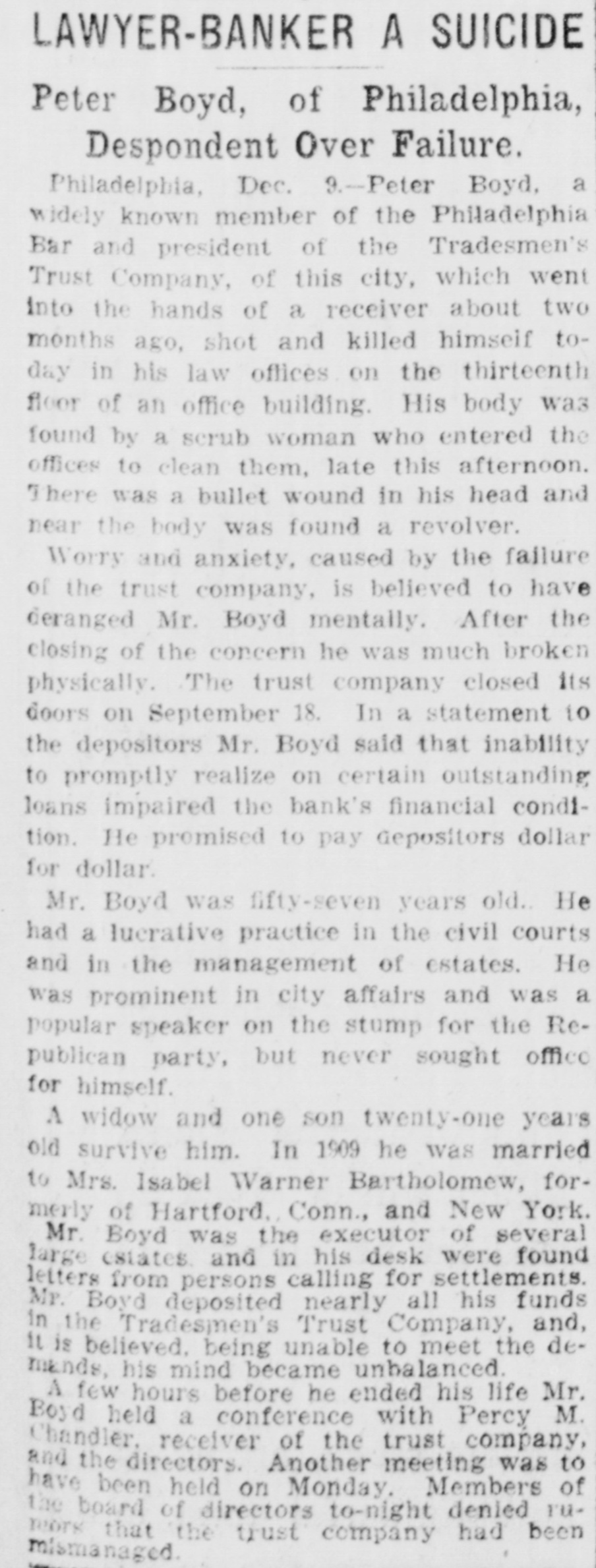
LAWYER-BANKER A SUICIDE Peter Boyd, of Philadelphia, Despondent Over Failure. Philadelphia, Dec. 9.-Peter Boyd, a widely known member of the Philadelphia Bar and president of the Tradesmen's Trust Company, of this city, which went into the hands of a receiver about two months ago, shot and killed himself today in his law offices on the thirteenth floor of an office building His body was found by a scrub woman who entered the offices to clean them, late this afternoon. There was a bullet wound in his head and near the body was found a revolver. Worry and anxiety, caused by the failure of the trust company, is believed to have deranged Mr. Boyd mentally. After the closing of the concern he was much broken physically. The trust company closed its doors on September 18. In a statement to the depositors Mr. Boyd said that inability to promptly realize on certain outstanding loans impaired the bank's financial condition. He promised to pay depositors dollar for dollar Mr. Boyd was fifty-seven years old. He had a lucrative practice in the civil courts and in the management of estates. He was prominent in city affairs and was a popular speaker on the stump for the Republican party, but never sought office for himself. A widow and one son twenty-one years old survive him. In 1909 he was married to Mrs. Isabel Warner Bartholomew, formerly of Hartford Conn., and New York. Mr. Boyd was the executor of several large estates and in his desk were found letters from persons calling for settlements. Mr. Boyd deposited nearly all his funds in the Tradesmen's Trust Company, and, It is believed. being unable to meet the deminds, his mind became unbalanced. A few hours before he ended his life Mr. Boyd held a conference with Percy M. Chandler. receiver of the trust company, and the directors. Another meeting was to have been held on Monday. Members of the board of directors to-night denied I'llmore that the trust company had been mismanaged


Article from Daily Kennebec Journal, December 11, 1911

Click image to open full size in new tab

Article Text

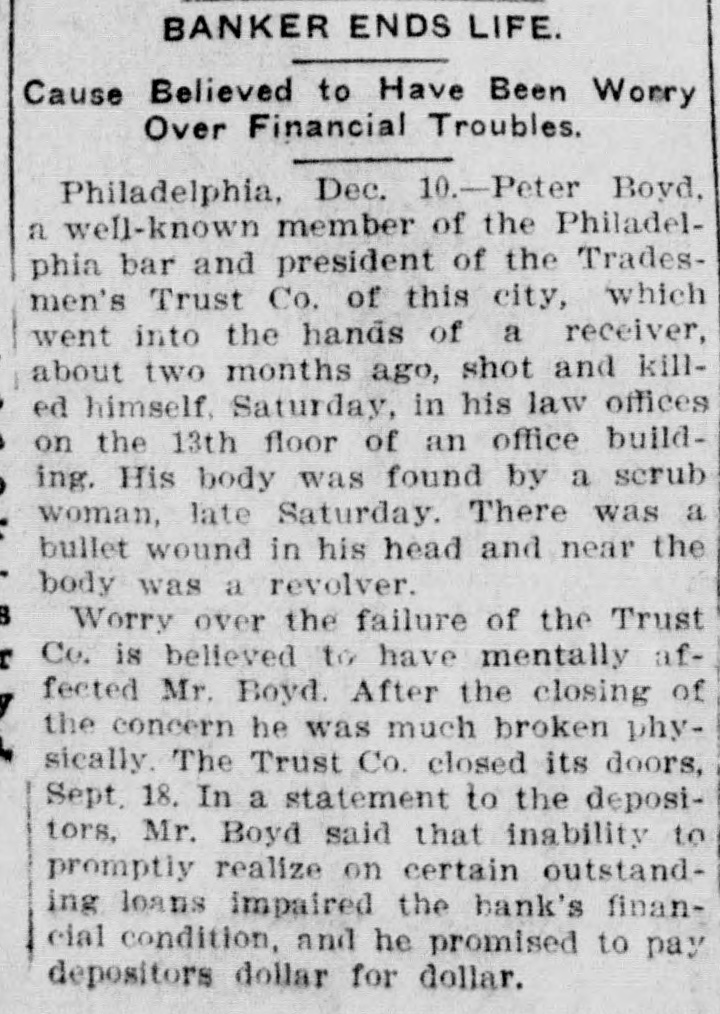
BANKER ENDS LIFE. Cause Believed to Have Been Worry Over Financial Troubles. Philadelphia, Dec. 10.-Peter Boyd, a well-known member of the Philadelphia bar and president of the Tradesmen's Trust Co. of this city, which went into the hands of a receiver, about two months ago, shot and killed himself, Saturday, in his law offices on the 13th floor of an office building. His body was found by a scrub woman, late Saturday. There was a bullet wound in his head and near the body was a revolver. Worry over the failure of the Trust Co. is believed to have mentally affected Mr. Boyd. After the closing of the concern he was much broken physically. The Trust Co. closed its doors, Sept. 18. In a statement to the depositors, Mr. Boyd said that inability to promptly realize on certain outstanding loans impaired the bank's financial condition, and he promised to pay depositors dollar for dollar.


Article from The Barre Daily Times, December 11, 1911

Click image to open full size in new tab

Article Text

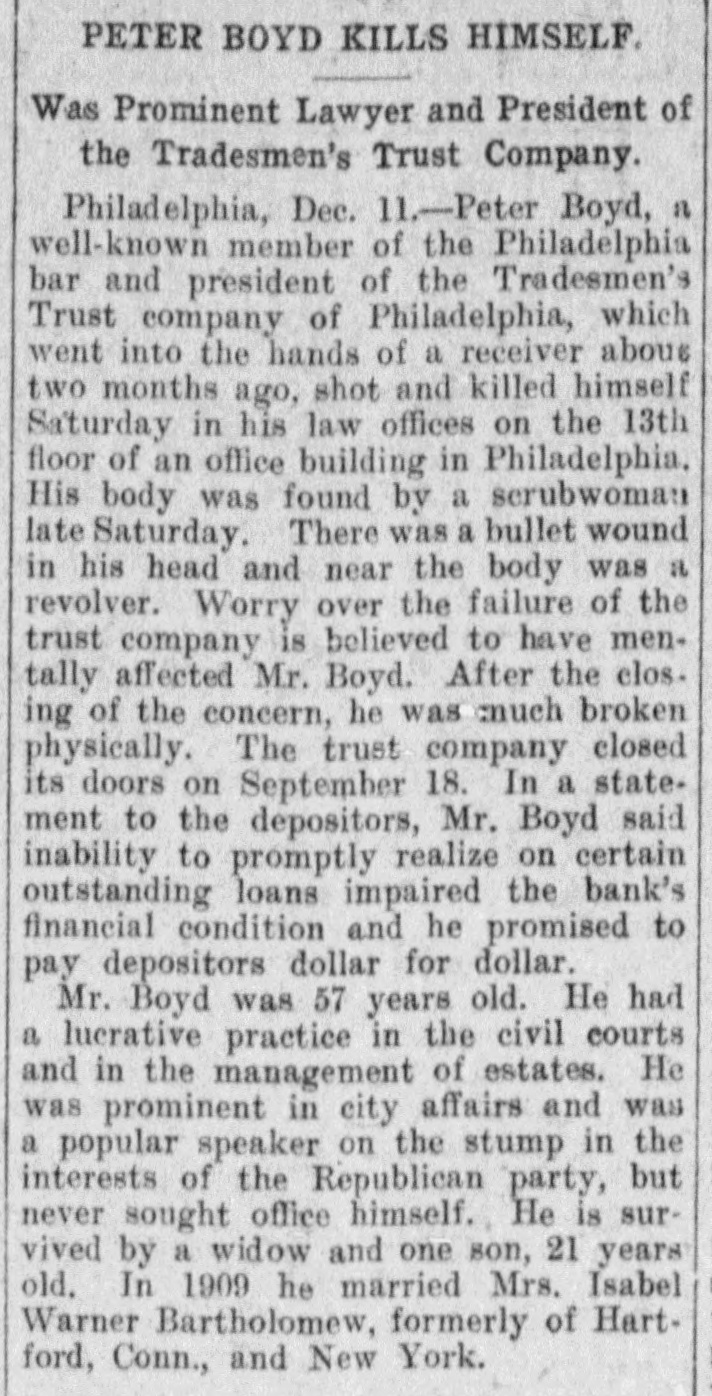
PETER BOYD KILLS HIMSELF. Was Prominent Lawyer and President of the Tradesmen's Trust Company. Philadelphia, Dec. 11.-Peter Boyd, a well-known member of the Philadelphia bar and president of the Tradesmen's Trust company of Philadelphia, which went into the hands of a receiver about two months ago, shot and killed himself Saturday in his law offices on the 13th floor of an office building in Philadelphia. His body was found by a serubwoman late Saturday. There was a bullet wound in his head and near the body was a revolver. Worry over the failure of the trust company is believed to have mentally affected Mr. Boyd. After the closing of the concern, he was much broken physically. The trust company closed its doors on September 18. In a statement to the depositors, Mr. Boyd said inability to promptly realize on certain outstanding loans impaired the bank's financial condition and he promised to pay depositors dollar for dollar. Mr. Boyd was 57 years old. He had a lucrative practice in the civil courts and in the management of estates. He was prominent in city affairs and was a popular speaker on the stump in the interests of the Republican party, but never sought office himself. He is survived by a widow and one son, 21 years old. In 1909 he married Mrs. Isabel Warner Bartholomew, formerly of Hartford, Conn., and New York.


Article from Sisseton Posten, December 14, 1911

Click image to open full size in new tab

Article Text

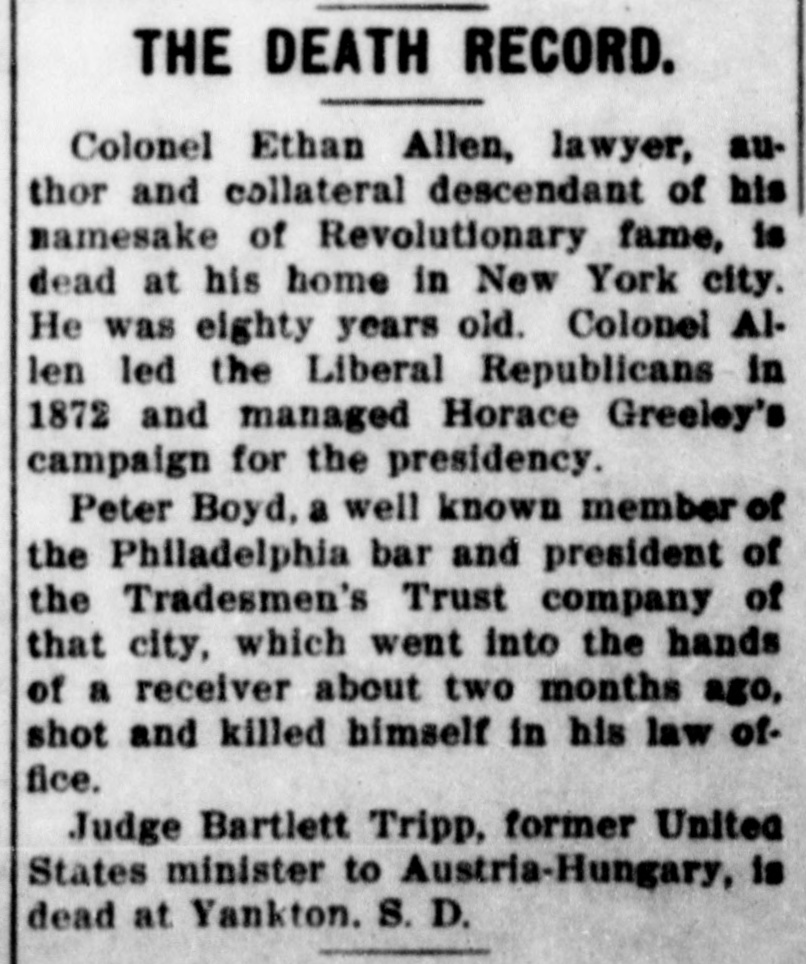
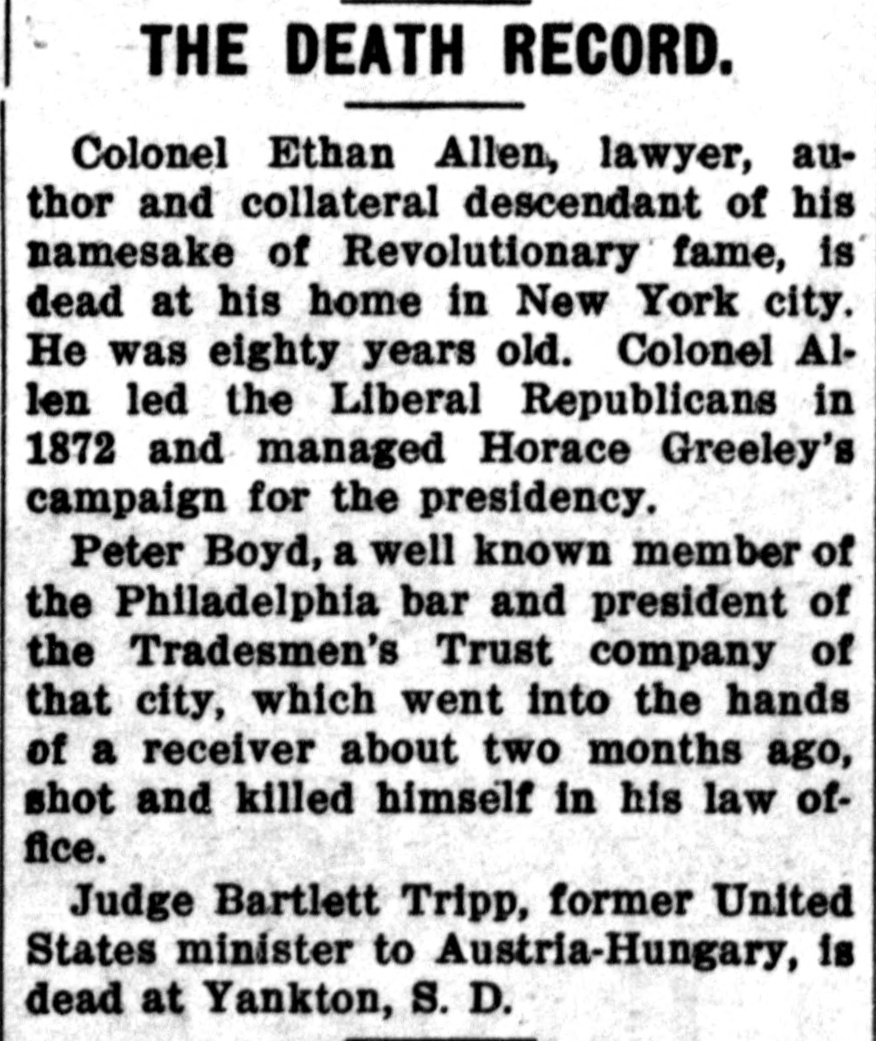
THE DEATH RECORD. Colonel Ethan Allen, lawyer, author and collateral descendant of his namesake of Revolutionary fame, is dead at his home in New York city. He was eighty years old. Colonel Allen led the Liberal Republicans in 1872 and managed Horace Greeley's campaign for the presidency. Peter Boyd, a well known member of the Philadelphia bar and president of the Tradesmen's Trust company of that city, which went into the hands of a receiver about two months ago, shot and killed himself in his law office. Judge Bartlett Tripp, former Unitea States minister to Austria-Hungary, is dead at Yankton. S. D.


Article from The Twin City Star, December 16, 1911

Click image to open full size in new tab

Article Text

THE DEATH RECORD. Colonel Ethan Allen, lawyer, author and collateral descendant of his namesake of Revolutionary fame, is dead at his home in New York city. He was eighty years old. Colonel Allen led the Liberal Republicans in 1872 and managed Horace Greeley's campaign for the presidency. Peter Boyd, a well known member of the Philadelphia bar and president of the Tradesmen's Trust company of that city, which went into the hands of a receiver about two months ago, shot and killed himself in his law office. Judge Bartlett Tripp, former United States minister to Austria-Hungary, is dead at Yankton, S. D.