Click image to open full size in new tab
Article Text
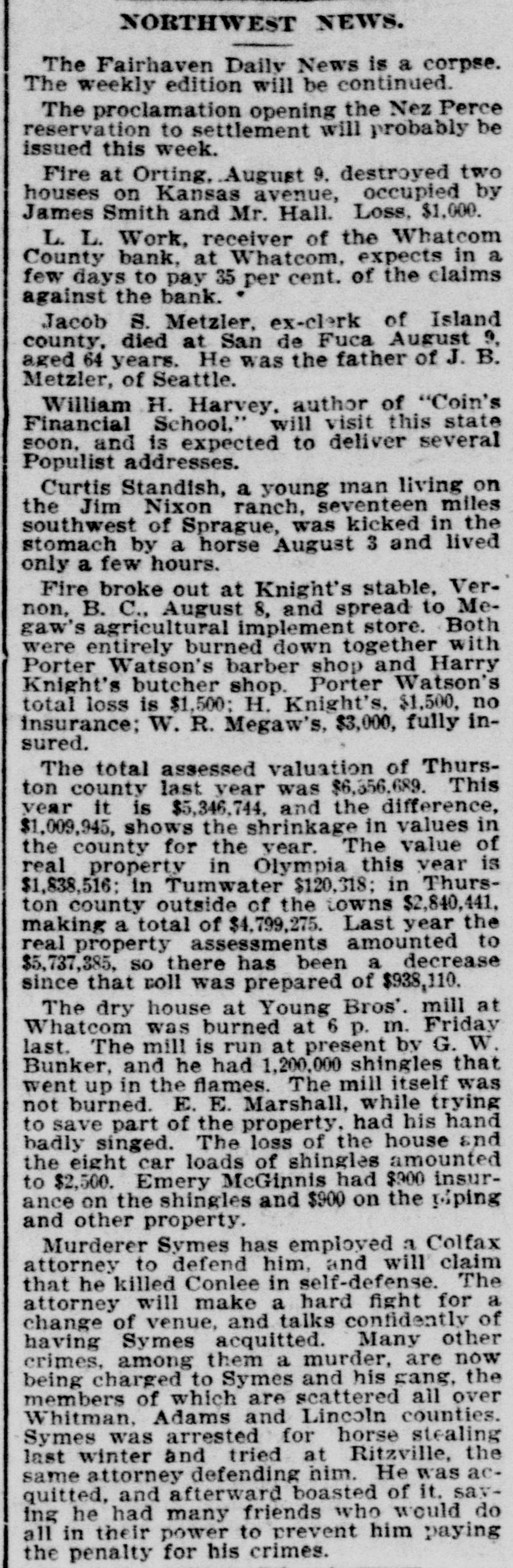
NORTHWEST NEWS. The Fairhaven Daily News is a corpse. The weekly edition will be continued. The proclamation opening the Nez Perce reservation to settlement will probably be issued this week. Fire at Orting, August 9. destroyed two houses on Kansas avenue, occupied by James Smith and Mr. Hall. Loss, $1,000. L. L. Work, receiver of the Whatcom County bank, at Whatcom, expects in a few days to pay 35 per cent. of the claims against the bank. Jacob S. Metzler, ex-clerk of Island county, died at San de Fuca August 9, aged 64 years. He was the father of J. B. Metzler, of Seattle. William H. Harvey. author of "Coin's Financial School," will visit this state soon, and is expected to deliver several Populist addresses. Curtis Standish, a young man living on the Jim Nixon ranch, seventeen miles southwest of Sprague, was kicked in the stomach by a horse August 3 and lived only a few hours. Fire broke out at Knight's stable, Vernon, B. C., August 8, and spread to Megaw's agricultural implement store. Both were entirely burned down together with Porter Watson's barber shop and Harry Knight's butcher shop. Porter Watson's total loss is $1,500; H. Knight's, $1,500, no insurance; W. R. Megaw's, $3,000, fully insured. The total assessed valuation of Thurston county last year was $6,356,689. This year it is $5,346,744, and the difference, $1,009,945, shows the shrinkage in values in the county for the year. The value of real property in Olympia this year is $1,838,516: in Tumwater $120,318; in Thurston county outside of the towns $2,840,441. making a total of $4,799,275. Last year the real property assessments amounted to $5,737,385, so there has been a decrease since that roll was prepared of $938,110. The dry house at Young Bros'. mill at Whatcom was burned at 6 p. m. Friday last. The mill is run at present by G. W. Bunker, and he had 1,200,000 shingles that went up in the flames. The mill itself was not burned. E. E. Marshall, while trying to save part of the property, had his hand badly singed. The loss of the house and the eight car loads of shingles amounted to $2,500. Emery McGinnis had $900 insurance on the shingles and $900 on the piping and other property. Murderer Symes has employed a Colfax attorney to defend him, and will claim that he killed Conlee in self-defense. The attorney will make a hard fight for a change of venue, and talks confidently of having Symes acquitted. Many other crimes, among them a murder, are now being charged to Symes and his gang, the members of which are scattered all over Whitman, Adams and Lincoln counties. Symes was arrested for horse stealing last winter and tried at Ritzville, the same attorney defending him. He was acquitted, and afterward boasted of it. saying he had many friends who would do all in their power to prevent him paying the penalty for his crimes.