19191. Spring Garden Bank (Philadelphia, PA)

Bank Information

Episode Type
Run → Suspension → Closure
Bank Type
state
Start Date
May 8, 1891
Location
Philadelphia, Pennsylvania (39.952, -75.164)

Metadata

Model
gpt-5-mini
Short Digest
583359e6

Response Measures

Full suspension, Books examined

Other: Extensive criminal investigations, arrests, and receiver appointed; indictments and later guilty pleas and sentences.

Description

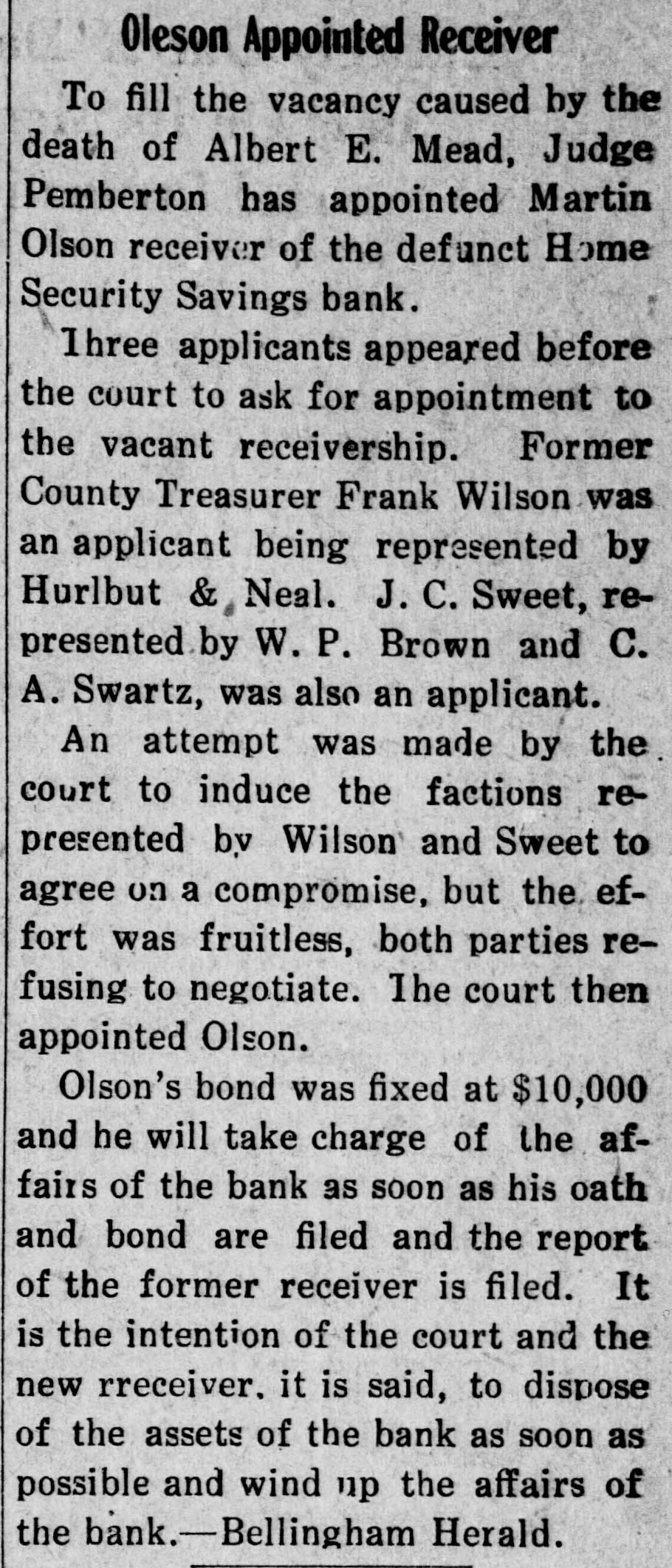
Contemporary articles describe the bank as having been hard run for several months and then failed/suspended. Officers were arrested for embezzlement and the Comptroller of the Currency appointed a receiver; sentences and assessments followed. This indicates a run preceded a suspension and permanent closure with a receiver.

Events (4)

1. May 8, 1891 Run
Cause
Bank Specific Adverse Info
Cause Details
Bank was 'hard run for several months' amid revelations of looting, false entries and dubious collateral (embezzlement/mismanagement).
Newspaper Excerpt
The failure of the Spring Garden Bank in Philadelphia caused some talk, but ... the bank having been hard run for several months.
Source
newspapers
2. May 9, 1891 Suspension
Cause
Bank Specific Adverse Info
Cause Details
Suspension followed discovery of falsified returns, misapplication of funds and loss of depositor confidence after runs and allegations of embezzlement.
Newspaper Excerpt
The Spring Garden and Penn Trust banks at Philadelphia have been forced to suspend.
Source
newspapers
3. May 22, 1891 Receivership
Newspaper Excerpt
The comptroller of the currency has appointed General Benjamin F. Fisher receiver of the bank.
Source
newspapers
4. August 18, 1891 Other
Newspaper Excerpt
Francis W. Kennedy, president of the suspended Spring Garden bank, and Henry H. Kennedy, cashier, were also arraigned ... Both entered pleas of guilty.
Source
newspapers

Newspaper Articles (24)

Article from Pittsburg Dispatch, May 9, 1891

Click image to open full size in new tab

Article Text

HOME SECURITIES. A Good Volame of Business Transacted and Higher Prices Recorded-The First Movement in Duquesne Traction Stock-Current Gossip. The local stock market yesterday maintained the strong features, for the most part, so frequently noted of late, while business was about the best of the week, 699 shares changing hands. Price changes, as compared with those of the previous day, show gains in Ohio Valley, Manufacturers' aud Wheeling Gas, Citizens' and Pittsburg Tractions and Airbrake. Central Traction and Philadelphia Gas opened and closed the same. Luster was the only thing on the active list that submitted to a concession, and its loss was only a small fraction. Electric sold up early on activity and scalping fluctuations in Boston, but in the afternoon that stimulus was withdrawn and the price dropped at both places. It closed here a fraction below the opening, and ½ under the top of the day. There was no news to affect the stock, the regular gossip appearing to have been worked for all there was in it. A gentleman who met Mr. Westinghouse in New York said he had reason for believing a full statement would be made at the next meeting. He seemed to take stock in the consolidation theory. Scrip was offered at 60, and later at 59. The most interesting event of the day was the sale of a 100-share lot of Duquesne Traciion stock by A. J. Lawrence & Co. to Kuhn Bros, at 15. this being the first transaction in this security. There is a strong inquiry for the stock. Manchester Traction was also in demand. The failure of the Spring Garden Bank in Philadelphia caused some talk, but as it involves nothing here, it had no effect upon prices. The failure, it seems, was not unex. pected, the bank having been hard run for several months. It had a capital of $750,000 and a surplus of $130,000. Sales were: First call-15 Citizens' Traction at 67. After call-100 Duquesne Traction at 15. Second call-200 Electric at 150/A, 100 at 15%, 100 at 155/8. 20 at 155/8. 10 Wheeling Gas at 17, 25 Luster at 14. 25 at 14. Third call-100 Electric at 155/8. 4 Airbrake at 913/2. Bids and offers at each of the three calls are appended:


Article from The Evening World, May 9, 1891

Click image to open full size in new tab

Article Text

The queer thing about the Spring Garden Bank failure in Philadelphia is that three days before the suspension it paid a dividend.


Article from The Morning Call, May 10, 1891

Click image to open full size in new tab

Article Text

BUSINESS FAILURES. Assignments of a Philadelphia Builder and a New York Firm. PHILADELPHIA, May 9.-John I. McDuffee, the extensive builder, is the first business man to be pulled down by the Spring Garden Bank failure. He made an a signment, judgments aggregating $32,000 being entered against him. NEW YORK, May 9.-McBride Bros. & Co., doing business as the Union Pacific Tea Company, having branches in the States of New York, Massachusetts, Maine, New Hampshire, Vermont, Rhode Island, New Jersey, Ohio, Pennsylvania, Indiana, Kan-as, Nebraska, Minuesota and Missouri, made an assignment to-day without preferences. The firm did business in teas, coffees and other groceries, and had headquarters in this city. The assignment is said to have been caused by the inadequaey of the firm's capital to keep running an extensive and complicated business. The firm has been doing a business of a million and half dollars a year, and has been in existence more than ten years. At the office of the company one of the four brothers comprising the firm said the company is solvent and only wanted an extension. The company would, he said, pay 100 cents on the dollar. On account of the complicated character of the business, no figures could be given at present.


Article from Barton County Democrat, May 14, 1891

Click image to open full size in new tab

Article Text

decided to strike in all the shops in New York, Brooklyn and Jersey City unless certain demands are complied with. The strike involves 7,000 men. IN a collision between the limited mail westbound and a passenger train on the Panhandle road near Denison, o., Baggagemaster Daniel Longenecker was killed, several persons were injured, both engines were wrecked and four cars demolished. IN an explosion in a mine near Clarksburg, W. Va., four men were killed and several injured. THE Moline Plow, the Deere & Mansur Implement and the Deere & Co. Harvester Cos., of Moline, Ill., are to be consolidated, with $3,500,000 capital. MUCH excitement was caused at Valparaiso, Chili, by an attempt to assassinate the leading members of the cabinet by means of a bomb thrown at them in the street. No one was hurt. DURING. April there were 3,430 deaths in Chicago-more than double the number in April, 1890. NINETEEN horses perished in the burning of August Hunzman's barn in Mason, Ia, the other night. LOCKE EZELL, a United States deputy marshal, was waylaid and killed south of Russellville, Ky., recently. ALL the printers of Vienna are on a strike for nine hours as a work day and no overtime. HUNGARIANS and Italians made a combined raid on the ruins of the recent fire in Pittsburgh, Pa., and boldly carried away large quantities of lard, hams, condiments and coffee. SPECIAL dispatches from Sherman, Evart, Lakeview, Wheeler and a dozen other towns in Michigan report heavy damage to pine and hard wood timber by forest fires. THE expulsion of Jews from Russia continues. Harsher measures are expected. Neither baptism nor appeal to foreign consuls avails to secure escape. THE Massachusetts state board of health reports that there were seventeen deaths from hydrophobia during the past year. This is the highest number of deaths from this disease that has ever been recorded in the state. THE state bonded warehouse at Rotterdam, Holland, and the greater part of its contents was destroyed by fire. The loss is estimated at $1,250,000, THE supposed assault on an American in Florence, Italy, has been explained. Mr. Jacques was out driving and happened to get in a turbulent mob where arrests were being made and received a portion of the missiles being thrown. THE next international Y. M. C. A. is to be held at Indianapolis, Ind. THE Portuguese government has authorized the Bank of Portugal to coin and issue $2,500,000 in silver and to exchange notes for three months owing to the scarcity of gold. ACTING GOVERNOR BULKLEY, of Connecticut, has promised to supply the funds for the state insane asylum until the legislature makes an appropriation. BUSINESS failures (Dun's report) for the seven days ended May 7 numbered 242, compared with 255 the previous week and 209 the corresponding week of last year. THE Spring Garden and Penn Trust banks at Philadelphia have been forced to suspend. THE journeymen plumbers of Pittsburgh, Pa., have struck against obnoxious rules. The carpenters' strike is unchanged. THE strike of stonecutters of Milwaukee has been settled by mutual concessions. Other settlements are expected to follow. BECAUSE her father was recently sent to prison Minnie Whittaker, of Indianapolis, Ind., a girl of 15 years, committed suicide by taking morphine. THE houses of French residents of Topsham, Me., have been stoned by masked men and one woman was frightened into miscarriage. The rioters are of the best families. FIFTEEN two story dwellings in the southwestern part of Chicago were destroyed by fire, boys having set a barn on fire. THE street railway stables of Austin, Tex., and twenty-two cars and thirty. four mules were destroyed by fire. Loss, $20,000. NEWTON KLINE, a prominent merchant of Cleveland, O., committed suicide by shooting himself.


Article from Evening Journal, May 22, 1891

Click image to open full size in new tab

Article Text

The Spring Garden Ba nk Failure. PHILADELPHIA, May 22. - -The hearing of Francis W. Kennedy and Harvey H. Kennedy, president and cashier respectively of the suspended Spring Garden bank, was continued until Saturday next owing to the absence of important witnesses. Bail in $5,000 was furnished for their appearance. The comptroller of the currency has appointed General Benjamin F. Fisher receiver of the bank. He resides at Valley Forge, Pa., is a lawyer of high standing, and has recently acted as trustee of the German-American Title and Trust company. He served through the entire war with distinction, and was one of the party who escaped from Libby prison under the leadership of Colonel Rose. He was register in bankruptcy for this city from 1867 until the repeal of the national bankruptey act.


Article from Deseret Evening News, May 29, 1891

Click image to open full size in new tab

Article Text

was arrested this morning on a warrant charging him with making false re- turns to the comptroller of the currency and embezzlement of the bank's fonds. Henry W. Kennedy, cashier of the bank and a brother of the president, was also arrested, charged with conspiracy. They were held under heavy bonds to appear at a preliminary hearing on Wednesday. From the few developments that took place in the affairs of the Spring Garden bank it is evident that when the full story of the bank's management is told it will fairly rival that of the looted Keystone bank. Receiver Fisher said today that the further he looked into the affairs of the bank the more dubious it looked for depositors. A member of the depositor's investigating committee investigating the bank affairs, said that among the collateral of the bank were two notes, one for $50,000 and another for $60,000, drawn by a person who has no existence. The suspension of the Spring Garden bank has been far-reaching in its effects, and many business houses have been seriously crippled. Yesterday the American Machine company was forced to assign by reason of the bank failure, and today the Milward Cliff Cracker company made an assignment from the same cause. The assets are thought to exceed the liabilities. During the expose of the business methods of the Keystone bank and City Treasurer Bardsley the Third National bank was given unpleasant connection with them, and in consequence has since lost a million dollars of deposits. Today President Lewis and Vice-President Myeas resigned.


Article from Pittsburg Dispatch, May 29, 1891

Click image to open full size in new tab

Article Text

DRAWING THE LINES. The Question of Bardsley's Successor Will Go Into Court. TO BE CARRIED THERE DIRECTLY. Spring Garden Bank Officials Arrested and Held in Bail. TWO MORE FAILURES FOLLOW THE REST [SPECIAL TELEGRAM TO THE DISPATCH.] PHILADELPHIA, May 28.-Select and Common Councils this morning approved the sureties of Richard G. Oellers, whom they elected yesterday to be City Treasurer during the unexpired term of John Bardsley. This was not accomplished without overcoming obstacles by the Democratic members, who sought to delay action. The ordinance approving the surities has been signed by the Mayor. Mr. Oellers has now qualified, but the main question remains to be settled, and that is whether or not he is legally elected. W. Redwood Wright, the selection of the Governor, has accepted the office and the dispute will be carried into the courts at once. The next move in the matter of succession is expected to bean injunction asked for by the State to keep Oellers from taking charge of the Treasurer's office. This would probably be the first move to draw the lines of legal battle. Wright'sattorneys are now making their case, and will be ready soon. John Bardsley still continues under the watchful care of two of the city's detectives, and now that he is able to move about his room extra precautions have been taken to prevent any attempt to escape. The detectives keep him under constant surveillance, and several policemen are on duty on the outside of the house to prevent any move which might aid him to escape. A Preliminary Hearing To-Day. It is expected that Mr. Bardsley will be able to appear at the hearing before Magistrate Pole at the City Hall to-morrow. No sensational developments are expected at this hearing. The three charges against the dishonest official will be briefly outlined by the city and State authorities, and Bardsley's counsel will made no defense. The bail will then be fixed at $25,000 in each case, and before to-morrow night "Honest" John will be safely immured in Moyamensing Prison. Frank W. Kennedy, President, and Harry H. Kennedy, Cashier, of the Spring Garden Bank, were arrested this morning on a warrant sworn out by Bank Examiner Drew. the President Kennedy was charged with embezzlement of $100,000 and conspiracy to cheat and defraud. Cashier Kennedy was charged with falsifying the reports the Controller of the Currency. to The Kennedys presented themselves before United States Commissioner Bell shortly before noon for a hearing. Both Dalwere accompanied by counsel. Messrs. W. las and Crawford appeared for Francis W. Kennedy and R. P. White and Thomas Barlow represented Henry H. Kennedy. The warrants for their. arrest were issued the late last night by Commissioner Bell at direction of United States District Attorney John B. Read. Both warrants were issued : upon the affidavits of Bank Examiner Drew and were placed in the hands of Deputy Marshal Maple last night. Held in Heavy Bonds. The defendants were not taken into custody, but were notified through their counsel that warrants had been issued for their arrest and appearance this morning before United States Commissioner Bell. Their hearing was a brief one and resulted in H. H. Kennedy being held in $15,000 bail and F. I W. Kennedy in $20,000. Samuel W. Rowley, President of the Hero Fruit Jar Company, which both the Kennedys are said to be in interested, entered security for H. H. Ken- for nedy. No one was present to go bail Francis W. Kennedy and he was locked up. From the few developments that took place to-day in the affairs of the Spring the Garden Bank, it is evident that when full story of the bank's management is told, it will fairly rival that of the looted Keystone Bank. Receiver Fishersaid to-day that the further he examined into the bank's affairs, the blacker the outlook became for the depositors. It is said that much is of the collatteral held by the institution of a most dubious character, being one-name T the stock of companies that are more paper, less embarrassed, and such like. A memor ber of the depositors' investigating committhat is investigating the bank's affairs, of tee, said to-night that among the collateral the bank were two notes, one for $50,000 and the other for $20,000, that are drawn by a person who has no existence. Forced Into an Assignment. The suspension of the Spring Garden Bank has been far reaching in its effects, and many business houses have been seriously crippled by it. Yesterday the American Machine Company was forced to assign by of the bank failure, and to-day the Millward-Cliff reason Cracker Company made an assignment from the same cause. S I 1 The Millward-Cliff Company is a stock companv. and in an investigation of its


Article from The Delta Independent, June 3, 1891

Click image to open full size in new tab

Article Text

BY TELEGRAPH. Two Iowa ministers have been rested for counterfeiting. The Illinois Senate has passed the World's Fair bill appropriating $1,000,000. A cyclone passed near Boise City, Idaho, last week, doing damage to the extent of $10,000. The Pennsylvania Legislature has passed a bill providing for a State Constitutional convention. Steady-going Maine is excited by a recent attempt to rob a train. The bandits were unsuccessful. The St. Louis police have caught several very clever thieves, one of whom they believe to be the robber of Moffatt, at Deaver. The striking stage drivers of Paris have won their fight, the government having used its influence to bring the companies to terms. Clark W Hatch, who has had so much trouble of late, has been acquitted at Worcester, Massachusetts, of the charge of passing a forged check. An attempt was made in Cincinnati to play baseball last Sunday despite the orders of the mayor to the country, and the two nines were promptly arrested. The Mexican government ordered the Chilian vessel Esmarelda to leave Acapulco, but was obliged to furnish with coal in order to enable it to do so. A bicycle race from Bordeaux to Paris, a distance of 358 miles, was won by the Englishman. Milis, in 26 hours and 35 minutes. The Frenchmen were no where. The will of the late millionaire John T. Farish has been filed for probate in New York. It donates $280,000 to missions, hospitals and other charitable purposes. An additional $2,500,000 is to be raised by subscription among wealthy people in Chicago for the World's Fair. The ways and means committee wants $3,000,000 more money raised. Grover Cleveland as referee in a suit against New York City has rendered a second decision awarding 8600 per foot damages. His first award was $100 per foot. Both sides will appeal. Seventeen Florida senators hid in the woods to prevent Senator Call's reelection, but fifty-one out of 100 members were present and elected Call. The antiCall men threaten to contest. The city of Ogden, Utah. is stirred up because of charges of various kinds made against it and the new Methodist university by Sam Small, who has been president of the university. A dissipated Austrian baron fought a duel in Jackson Park, Chicago, with Southener the other day. The cause was an opera singer, the weapons rapiers, and the result a serious wound in the baron's neck. At Washington. Indiana, 100 German miners abandoned the strikers and went to work last Monday. A fight ensued between them and the Irish miners and a German named Stoll was fatally injured. The intercollegiate running broad s jump record was broken at the intercola legiate contests at St. Louis, when C. S. Reber jumped 22 feet 71/2 inches, thus t smashing the 22 foot 6-inch of A. Sherman of Yale. 0 The cruiser Charleston has reached a Peruvian port and is reported not to have seen the Itala It will join the Chilian squadron, and it is believed that the Itata will be surrendered to the United States without a fight. The affairs of the Spring Garden o Bank of Philadelphia are in much worse condition than at first believed. Much of the assets are worthless notes, and among the collateral are two notes aggregating $70,000 drawn by a fictitious person. The Nashville & Chattanooga rail: road, which was seized by the government during the war and redeemed by the company for $1,000,000, payable in twenty years, announces its readiness to pay its last payment of $500,000 to the government on June 1. The Newfoundland Legislature has passed a coercion bill on Saturday night, with closed doors. The people disregard the governor's proclamation of the queen's birthday. The British flax halyards were cut down and an attempt made to burn down the royal standard on the government house. The reports from French commanders stopping the sale of bait to Americans in Newfoundland are confirmed. Steam launches from the French war ships drove the boats from the sides of the American schooners. They also took up the nots of ) Newfoundland fishermen, putting then: ashore. The outrage is a great loss to the inhabitants and to American fishermen. Dispatches received at Paris from Grand Passam, a French settlement of Upper Guiana. on the gold coast of Africa near the mouth of the Passam river, say that the French expedition sent into the central interior to avenge the death of the French travelers, has fought a battle with a force of about 800 natives, killing many of them and subduing the surround ing country. There is likely to be serious trouble between the Navajo Indiana and Colorado prospectors. The miners claim they have a right to drive stakes wherever they please, whether is be om the property of man or an Indian, so logs as the


Article from The Wheeling Daily Intelligencer, June 5, 1891

Click image to open full size in new tab

Article Text

Without a Head Because He is in Jail-The Story of Bardsley's Peculations. PHILADELPHIA, June 4.-Who is the next man marked for jail? What firm will be the next to go to smash How many names will the day see added to the list of politically and financially dead ducks? Day after day these questions have been naked in Philadelphia for more than a month, when public clamor uncovered the wickedness of "Honest" John Bardsley as City Treasurer and began the work of sending him to jail; when banks and business houses began to totter and fall, and bank presidents to run away and financiers to go to Europe. There was another failure yesterday; two or three more are expected by tomorrow. There was another arrest yesterday, and more are sure to follow. Bank directors are going around with special agents of the Treasury Department as shadows at their heels. A City Treasurer who for years absolutely dominated legislation in the town was carried yesterday from a prison hospital to a prison cell, like an ordinary felon. Men who have made Presidents and Governors and United States Senators, are shaking in their boots. All that is left of one bank which has somehow weathered the storm, are a few thousands of dollars of deposits where there was a million. Y. M. c. A. HAS NO PRESIDENT. The Young Men's Christian Association is without a president or a vice president, the one being in jail and the other blasted in reputation and kicked out of a position of trust, not being allowed to enter. the hall where for years he sang and prayed under the cloak of religion. There is a feeling of financial distrust like that which followed the great Jay Cooke panic in '73, and there 18 an impending political revolution like that which followed the nomination of Delamater for Governor of this State just a year ago. These are only a few things which have followed as the direct result of "Honest John's" crookedness, duplicity and innocence. Men are going to jail every day. There have already been failures in three States, and there are ruined reputations enough to satisfy all the social and political weeklies of New York for a year. As to the magnitude of this thing, measured in dollars, these figures beat imagination out of sight: WHAT IT AMOUNTS TO. The public money lost or imperiled through John Bardsley will be 5,000,000 The depositors' money lost through the 2,000,000 looted Keystone Bank will be The depositors' money lost through the 1,700,000 looted Spring Garden Bank will be The depositors' money lost through the assigned and looted Penn Trust Com250,000 be will The pany amount of liabilities in excess of assets of the twelve firms and corporations in Pennsy vania and New Jersey which have so far failed will 3,000,000 probably reach $11,950,000 Total lost or stolen Here are figures before which the Bank of America rottenness pales into insignificance, and it is not all. Much is being concealed. Political influence is at work. The fact that the Attorney General of the United States interfered to delay the prosecutions in the looted Keystone Bank has been open scandal here for a month. So notorious were the elements which contributed to the flight of Marsh that the Cftizens' Committee of Fifty, an organization similar to the famous old Committee of One Hundred, yesterday sent to President Harrison, Secretary Foster and Attorney General Miller a telegram demanding that the Government find and bring back the fugitive Marsh. Marsh is gone; money was put up to aid his flight, and so long as he is absent the thieves who are still under cover may feel reasonably safe. Enough has leaked out about the inside history of this shameful business of Bardsley and the banks to show that Bardsley was first and always a knave, but for a certain period a dupe. A TOWN OF SYNDICATES. This has always been a town of syndicates. There was the Reading syndicate, which transferred from the pockets of those on the outside to those on the inside several million dollars. There was the old gas works syndicate, which Bardsley got $100,000 shares of Traction bonds for endeavoring to engineer through. There was the water works syndicate and the United Gas Improvement Company syndicate, and senside resort and street railway syndicates galore. Bardsley began to go into them. He wanted to get rich. His greed and selfishness had been proverbial. He began to loan the city money to the banks. Even Drexels gave him a bribe of 3 per cent. So did the bank of which Gov. Pattison was president. An evidence of his rapacity is here given for the first time. The City Treasurer is the collector of mercantile taxes due to the State. Thousands of small merchants never pay. Certain magistrates are designated to bring snit, and if possible collect. The suits are brought, the State pays the costs, and it'is'a fat thing. When Bardsley went in he was expected to appoint four magistrates to do this. Instead he designated nine. People couldn't understand this until to-day, when it leaked that he had exacted as a price for the appointment $350 from each magistrate. TL


Article from The Wilmington Daily Republican, June 8, 1891

Click image to open full size in new tab

Article Text

Director Young under Arrest. PHILADELPHIA, June 8. - Ephraim Young, a director of the Spring Garden bank and junior partner of the bankrupt marble firm of Van Gunden & Young, was arrested, charged with conspiring to defraud the Millward-Cliff cracker company. Receiver Fisher, of the looted bank, had as an assistant in unraveling the complex accounts of the institution Henry H. Kennedy, its disgraced cashier, who succeeded in bringing to light an unknown asset worth $50,000. The receiver had decided that the money deposited by the receiver of taxes the day before the bank closed must be counted among the general assets. He also predicts that the depositors will get about 50 per cent. The Rosine home is crippled because its funds are tied up in the bank.


Article from The Seattle Post-Intelligencer, June 9, 1891

Click image to open full size in new tab

Article Text

what was valueless to him but might possibly help the bank and save others. Being a collateral holder, under the law he could not be assessed upon the stock. hence any supposition that he could have parted with the stock to avoid assessment was without foundation in fact. Last autumn Marsh claimed that the bank had strained itself to help its customers and wanted help, and the firm paid off all discounts so fast as they fell due. Later, when the run came, Marsh used to come to the firm, saying that he had no one to go to, and assuring them that everything was right, precisely as he did at the clearing-house. He pressed Wanamaker to buy the Lucas building and seashore property and to loan paper for use at the clearing-house to recover other collateral, all of which Wanamaker declined. About 8 o'clock the night before the failure, Marsh called on Wanamaker in Washington to say that he had been to the comptroller and informed him of his doubts about the issued stock, and asked Wanamaker whether he could in any way help the bank. Wanamaker said "No," and the interview ended. In conclusion, Wanamaker said that instead of the bank losing a penny by him, he had been its only profitable customer. Responding to questions by Elting, Wanamaker said that he borrowed money on the stock Lucas gave him until there was a question about its verity, and then he gathered it up and held it. Elting said he had been told that $200,000 or upward of money was obtained at one time from Bardsley by Marsh and loaned to Wanamaker. The latter responded that he never heard of it. He had never had a cent from Bardsley as an individual or as treasurer, directly oe indirectly, through Marsh or Jones or anybody else. Councilman Smith said: "You now have no other choice except to regard the possession of the Reading stock as fully equivalent for the return of the bank stock." "I make no claim against the Lucas estate," answered Wanamaker. Drew, in his testimony today, said that he still thought that the assets of the bank would be able to pay the deposits dollar for dollar. When asked if he included $900,000 in due bills held by Bardsley, he said that he did not, as there were no traces of the money ever having been paid into the bank. Frank Brenten, ex-treasurer of the Millward Cliff Cracker Company, a warrant for whose arrest on a charge of conspiracy with President Kennedy, of the Spring Garden bank, to defraud the cracker company, is out, has disappeared and cannot be found. The grand jury this afternoon returned a true bill of indictment against John Bardsley, ex-city treasurer, charged with appropriating funds belonging to the city. A meeting of the depositors of the suspended Spring Garden bank tonight condemned Bank Examiner Drew and called upon the proper authorities to ask for his resignation. WASHINGTON CITY, June 8.-The president had a conference today with Secretary Foster and Comptroller Lacey in regard to the case of the Keystone National bank, of Philadelphia, as a result of which he dictated a letter to Mayor Stuart, acknowledging receipt of the resolutions of the council calling for governmental investigation of the bank, and saying he will facilitate a thorough examination of the affairs of the bank to the full extent of his powers, and will see that any officer of the government found guilty of wrong-doing in that connection is held to strict accountability for his action.


Article from Sturgis Advertiser, June 11, 1891

Click image to open full size in new tab

Article Text

IN THE EAST. INCORPORATION papers were filed at Columbus, o., of the Consolidated Oatmeal company, with a capital stock of $350,000. All the oatmeal mills of the country are thus brought under one management. Ex- SENATOR MILLER, of New York, president of the Nicaraugua Canal company, expresses himself more than satisfied with the condition of affairs in the canal work and confidently expects it to be open to business in 1897. THE directors of the American Sugar Refining company have decided to declare a full semi-annual dividend on preferred stock and set aside enough to provide for the dividend on preferred stock for the rest of the year. THE application of Mr. O'Neil to enjoin Eugene Kelly, the treasurer of the fund raised at the Dillon and O'Brien meeting in New York from sending the money to Justin McCarthy, was denied by Judge Bartlett in the Kings county supreme court. THE Indianapolis fast train ran into a tornado near Crothersville. The engine and train swayed fearfully and the passengers were panic stricken. The train was running nearly fifty miles an hour and it is believed its speed alone saved it from being wrecked. PRESIDENT KENNEDY and Cashier Kennedy, of the Spring Garden bank, Philadelphia, which failed recently. have been held in bonds of $20,000 and $15.000, respectively, to answer to the charge of making false returns, false entries and for embezzlement. THE presidential train, in its trip ended last week, was on portions of twenty-two different railroads, and the average speed of the train when running was scheduled at thirty-three miles an hour, but often when time had been lost between terminals of roads sixtysix miles an hour was run. SECRETARY TRACY says the next step will be to send the Etata back to the United States to stand trial. There is no expectation the officers and crew have jeopardized their liberty by surrendering. It is believed in official circles the Etata is not likely to suffer heavily as a result of her escapade. ASSISTANT SECRETARY NETTLETON directed the return to their native countries of two Italians and one Swedish immigrant who, since their arrival in January have become paupers. Under the new law they can be returned at the expense of the company bringing them. This is the first order of the kind issued by the treasury department and indicates the vigor with which the new law is to be enforced. THE arguments in the famous contest over the will of Samuel J. Tilden has been argued at great length before the New York court of appeals. The judge will take it under advisement and give


Article from Wessington Springs Herald, June 12, 1891

Click image to open full size in new tab

Article Text

PRESIDENT HARRISON has finally determined not to appoint the nine new circuit court judges until December. He says that no members have yet been selected. INCORPORATION papers were filed at Columbus, O., of the Consolidated Oatmeal company, with a capital stock of $350,000. All the oatmeal mills of the country are thus brought under one management. EX- SENATOR MILLER, of New York, president of the Nicaraugua Canal company, expresses himself more than satisfied with the condition of affairs in the canal work and confidently expects it to be open to business in 1897. THE directors of the American Sugar Refining company have decided to declare a full semi-annual dividend on preferred stock and set aside enough to provide for the dividend on preferred stock for the rest of the year. THE rumor comes from Washington that Secretary Noble is soon retire from the cabinet and accept a prominent diplomatic position abroad. Political gossip connects Ex-Congressman Carter prominently with the vacant cabinet chair. A DARING and almost successful attempt to steal the body of P. T. Barnum, the dead showman, was made at Bridgeport, Conn. An excavation in the ground several feet deep had been made, when the ghouls were discovered by the watchman. THE Indianapolis fast train ran into a tornado near Crothersville. The engine and train swayed fearfully and the passengers were panic stricken. The train was running nearly fifty miles an hour and it is believed its speed alone saved it from being wrecked. PRESIDENT KENNEDY and Cashier Kennedy, of the Spring Garden bank, Philadelphia, which failed recently, have been held in bonds of $20,000 and $15,000, respectively, to answer to the charge of making false returns, false entries and for embezzlement. THE May debt statement just issued shows an apparent increase of $600,000 in the debt since the 1st inst. This is


Article from Wheeling Register, June 13, 1891

Click image to open full size in new tab

Article Text

Council Investigation. PHILADELPHIA, June 12.-The investigating committee of Councils met this afternoon. Rufus E. Shapley appeared and stated that he represented the Attorney-General of the State. Mr. Shapley said that owing to the prospective litigation between the State and city of Philadelphia, over the deficit in the State funds caused by the defalcation of Bardsley, the Auditor General, by the advice of the Attorney General, must refuse to answer any questions. He made the same objections when State Treasurer Boyer was called. The Auditor General then read a statement, in which It was shown that there was still due the State from licenses, municipal loans and State taxes on personal property collected by John Bardsley for the year 1890, a total of $815,701.02. The money owing the State for the year 1891, from these sources are not yet due. Harry C. Jones, Assistant Bank Examiner, testified that Comptroller of the Currency Lacey, was shown a statement of the condition of the bank February 13, including the falsification of ledger, the padding of the New York bank accounts and the carrying of due bills as assets. Gen. Wagner, ex-Director of Public Works, was a candidate for the Receivership of the Spring Garden Bank. He testified that he said to Bank Examiner Drew that he understood Mr. Wanamaker was backing Mr. Evans for the position. In reply, Mr. Drew said, "Mr. Wanamaker has nothing to do with it. Now that explains something Idid not understand. Assistant Secretary Nettleton is a great friend of Evans, and he is probably backing him for the position. It also explains some accounts at the Spring Garden, I did not understand where Nettleton appears as a large borrower." Gen. Wagner said that he had since looked in the papers for the name of Assistant Secretary Nettleton as one of the debtors of the bank, but had not seen it. Several other witnesses were called, but practically nothing new was developed. The committee at 5:30 adjourned until Monday.


Article from Telegram-Herald, July 2, 1891

Click image to open full size in new tab

Article Text

To Probe the Reystone Seandal. PHILADELPHIA, July 1.-Comptroller Lacey, through Receiver Yardley, of the Keystone bank, has sent a communication to Mayor Steart saying that the government desires to see the persons who wrecked the Keystone and Spring Garden banks prosecuted and asking the mayor to recommend two experts to represent the government in the investigation.


Article from The Helena Independent, August 18, 1891

Click image to open full size in new tab

Article Text

Pleading Guilty. PHILADELPHIA, Pa., Aug. 17.-Charles T. Lawrence, cashier of the Keystone National bank, who was indicted with President Marsh for conspiracy in the misapplication of the bank's funds, this afternoon pleaded guilty in the United States court. Argument on a motion for stay of sentence will be heard to-morrow. Francis W. Kennedy, president of the suspended Spring Garden bank, and Henry H. Kennedy, cashier, were also arraigned this afternoon on the charge of misapplication of the funds of that institution. Both entered pleas of guilty. Application for the postponement of sentence was made for both prisoners, and the court's decision will be given to morrow.


Article from Los Angeles Herald, August 19, 1891

Click image to open full size in new tab

Article Text

LAWRENCE'S SENTENCE. The Assistant Cashier of the Keystone Bank Given Seven Years. PHILADELPHIA, August 18. - Charles Lawrence, ex-assistant cashier of the Keystone bank, who pleaded guilty to indictments charging him with making false entries in the bank's books, was this morning sentenced to eight years' imprisonment in the penitentiary, and to pay a fine of $1000 and costs. In the cases of Francis W. Kennedy, president and Henry W. Kennedy, cashier of the suspended Spring Garden bank, sentence was postponed until September 8th. The judge subsequently reconsidered Lawrence's sentence, and reduced it to seven years.


Article from Los Angeles Herald, August 20, 1891

Click image to open full size in new tab

Article Text

Borrowed Assets. PHILADELPHIA, August 19.-The government experts examining the assets of the Keystone bank today found in a tin box a due bill and draft of the Spring Garden bank (also failed) amounting to $50,000. While it is probable that they were loaned to President Marsh by President Kennedy to swell the assets at the time of the examiner's visit, the receiver hopes to realize on them.


Article from The Morning Call, August 20, 1891

Click image to open full size in new tab

Article Text

Due Bill and Draft Discovered. PHILADELPHIA, Aug. 19.-Government experts who were examining the assets of the Keystone Bank to-day found in a tin box a due bill and draft of the Spring Garden Bank (also failed) amounting to $50,000. While it is probable they were loaned to President Marsh by President Kennedy to swell the assets at the time of the examiner's visit, the receiver hopes to realize on them.


Article from The Washburn Leader, September 19, 1891

Click image to open full size in new tab

Article Text

Elmer E. Cole, a Chicago real estate dealer, was arrested for perpetrating a fraud of $30,000 on a St. Louis man. There is an apparent deficit of $30,000 in the accounts of Treasurer O'Brien of the Catholic Knight's of America. A broken trestle at Lebanon, Pa., killed Henry Smith and probably fatally injured William Shiver and an Italian. Percival Steele was made receiver of the United States Publishing Co., at Chicago, the liabilities being $60,000 Bob Omesby is missing at Chattanooga and foul play is feared by the telegraph company, whose money he had. The Italian steamer Taormina was sunk in a collision off the most southern point of Attica, and over forty were drowned. The democrats won the first election for years at Newport, R. I., getting a mayor and a majority of the council and aldermen. President Kennedy and Michael Kennedy, of the wrecked Philadelphia Spring Garden Bank, were sentenced to ten years each. John Dow and Henry Merriam attempted to seize $800,000 in bullion secreted by Balmaceda at Santiago, and Dow was killed. The Mytilene war scare reported has been caused by a picnic which some British officers had on the Island, leaving the same day.


Article from The Redwood Gazette, September 24, 1891

Click image to open full size in new tab

Article Text

Epitome of the Week. INTERESTING NEWS COMPILATION. FROM WAS 'GTON. THE president and family have reurned to Washington. IN August the United States exported $28,853,510 worth of breadstuffs and E7,602,050 worth of beef and hog prodnets. A BULLETIN from the census office says the increase in the consumption of malt liquors which require hops in their manufacture in the United States was from 344,605,485 gallons in 1879 to 779,897,426 gallons in 1889. IN the first sixteen days of September the United States paid $5,555,000 to old soldiers for pensions. at the ance in IT was headquarters claimed Washington Farmers' Alli- that members of of fifty-five the next congress would the lower vote for house all the measures of the alliance, and at least four in the senate. THE president has appointed Senator Francis Hendricks collector of the port of New York, to succeed J. Sloat Fassett, resigned. THE president has signed the proclamation to homestead the opening entry settlement newly ceded and Indian lands in the eastern part of Oklahoma. THE business failures in the United States during the seven days ended on the 18th numbered 239, against 214 the preceding week and 190 for the corresponding week last year. THE EAST. IN Philadelphia the president and of the wrecked cashier Spring years' Garden imbank were sentenced to ten prisonment. FLAMES at the corner of Fulton and Nassau street in New York caused a loss of $500,000. THE republicans of Massachusetts in Boston convention Allen, at Lowell, for nominated `harles H. of governor. The platform eulogizes President Harrison's administration; calls for he enforcement of civil and political ights in every quarter and purity of elections; opposes unlimited coinage of silver; declares that the McKinley bill and reciprocity have done enormous to the the evits of good country; favors the liquor legislation traffic; restricting also all proper legislation in the interests of the laboring classes. people's party was at Greensburg, organized THE Pennsylvania the and abolition the platform adopted demands of national banks; condemns alien of land; demands free silver governownership and unlimited coinage; and direct ment control of railroads, a vote of the people for president, vice president and United States senators. said W. the treasurer IT was of that Montgomery F. Slingluff, Trust Company of Norristown, Pa., had einbezzled $180,000. democrats of New York in conat P. Flower for governor. vention Roswell THE Saratoga Springs nominated The reaffirms the trines set forth in the of platform as democratic the platforms free coinage doc1884 and 1888; opposes of silver dollars not of the intrinsic value of any other dollar of the United States: denounces the Sherman silver bill. the McKinley tariff and the Blaine reciprocity treaties, and indorses the administration of Gov. Hill. THOMAS L. SHIELDS, secretary and treasurer of the Allegheny Heating Company at Pittsburgh, Pa., was said to be short over $100,000 in his accounts. FLAMES destroyed the buildings and stocks in C. Baker & Co.'s lumber yard in Worcester. Mass. Loss, $100,000. ON the 17th Boston celebrated its as a 69th as a city. popu261st anniversary anniversary The town city's and lation is about 450,000, the legal voters number 90,000 and the valuation is over $800,000,000. THE James Vick Company, dealers in seeds at Rochester, N. Y., made application for a receiver. The liabilities were said to be between $175,000 and $200,000. IT was said that James E. Ostrander, treasurer of the Ulster county savings institution at Kingston, N. Y., was a defaulter to the amount of $60,000.


Article from The Helena Independent, December 10, 1891

Click image to open full size in new tab

Article Text

# SPARKS FROM THE WIRES. The Fort Worth, Tex., Iron works have failed for $100,000. Secretary Foster's physician says he is still improving and his gradual recovery is confidently expected. The Western Union directors have declared the regular quarterly dividend of one and one-fourth per cent. Forest Thomas, colored, was hanged at Greenville, Miss., for the murder of Hayward Bryant, colored, in November, 1890. Tommy Ryan, of Chicago, has accepted Dan Needham's challenge for a welterweight fight, and the contest takes place in January or February. Ned Hanlon has asked for an investigation of the charge that he purposely lost the boat race to McLean on Sunday at San Francisco, and an inquiry will be had. S. A. Sterrs, a piano tuner of Elgin, Ill., was killed, and H. True, fireman, of Baraboo, Wis., was badly injured by a collision between two trains on the Northwestern road near Merrimac, Wis. The comptroller of the currency has made a demand on the stockholders of the Spring Garden bank of Philadelphia, for 100 per cent. assessment on each share held by them at the time of the failure. The assessments, aggregating $750,000, are to be used in payment of the debts of the bank. Suit has been brought in Cleveland to have a receiver appointed for the Canadian Copper company and the Anglo-American Iron company. These companies own the famous Canadian nickle mines, from which the United States government purchases its supply of nickel for armor plates used in the navy.


Article from Los Angeles Herald, December 10, 1891

Click image to open full size in new tab

Article Text

Stockholders Cinched. PHILADELPHIA, Dec. 9.-Comptroller of the Currency Lacey has sent the receiver of the Spring Garden bank a demand on the stockholders for a 100 per cent assessment on each share of capital stock held by them at the time of the bank's failure. The assessment, aggregating $750,000, is to be used to pay the debts of the bank.


Article from Mexico Weekly Ledger, October 20, 1904

Click image to open full size in new tab

Article Text

SURPLUS AND DEFICIT. Comparison by Bryan to the Credit of Cleveland's Administration Speaking of the panic of 1893. William J. Bryan says in the current is. sue of the Commoner: "The first indication of its coming appeared November 11, 1890, when the New York Clearing House Association voted its certificates to banks in need of assistance. November 17 the Boston Clearing House did likewise. Barker Bros. & Co., bankers, of Philadelphia, failed with liabilities of $5,000,000. Mr. Bryan then gives a long list of failures, beginning with the United Rolling Stock Company, of Chicago, November 22, 1890, and end. ing with that of the Spring Garden Bank, of Philadelphia, May 8, 1891. Then came the Homestead and other great labor troubles. followed by the election of Cleveland to the Presidency. In May, 1893, there were more failures, and finally the raids on the United States Treasury. January 17, 1894, the Administration ordered a $50,000,000 bond issue. August 1, 1894, the Wilson tariff went into ef. fect." Continuing with his most interesting and timely retrospect, Mr. Bryan says: "It will be observed that the Cleveland Administration ordered the $50.000,000 bond issue January 17. 1894. That was seven months before the Wilson bill became a law. Perhaps it is not significant, but in view of Mr. Roosevelt's claim, it is at least interesting, that the first indications of the panic occurred November 11. 1890, a little more than thirty days after the McKinley tariff bill became a law. From that date the panic raged and while its effects were felt for it reached in 1893 and during stage several years, which its the worst early time days of 1894, during all of the McKinley tariff law was in effect. "It may not be out of place to point out that when the Democratic Adminthe 1889, there was ernment, istration surrendered Mar h 4, reins of gov- in the Federal Treasury the largest surWhen the of plus party in went history. out power, Republican March 4, 1893, there was a large deficit and the incoming Administration was finally persuaded to make the bond 18. to sues had at which one it's time Republican thought predecessor be necessary, but had skillfully avoided"