1919. First National Bank (Clearwater, FL)

Bank Information

Episode Type
Suspension โ†’ Closure
Bank Type
national
Bank ID
12905
Charter Number
12905
Start Date
March 25, 1931
Location
Clearwater, Florida (27.966, -82.800)

Metadata

Model
gpt-5-mini
Short Digest
42747f60433386c7

Response Measures

None

Description

Articles (Mar 1931) refer to A.M. Anderson as receiver of the First National Bank and to the bank's 'suspension of business.' No article describes a depositor run. Litigation by the receiver to set aside conveyances indicates the bank remained closed and in receivership (permanent closure). Exact suspension date not given in the excerpts.

Events (3)

1. March 24, 1926 Chartered
Source
historical_nic
2. March 25, 1931 Receivership
Newspaper Excerpt
A. M. Anderson, receiver the First National bank. ... at the time of the suspension of business by the First National bank, the defendant ... was indebted to the bank ... (Tampa Bay Times, 1931-03-25).
Source
newspapers
3. * Suspension
Cause Details
Article mentions suspension of business but does not state a cause in the excerpt; likely bank failure leading to appointment of a receiver.
Newspaper Excerpt
at the time of the suspension of business by the First National bank
Source
newspapers

Newspaper Articles (2)

Article from Tampa Bay Times, March 25, 1931

Click image to open full size in new tab

Article Text

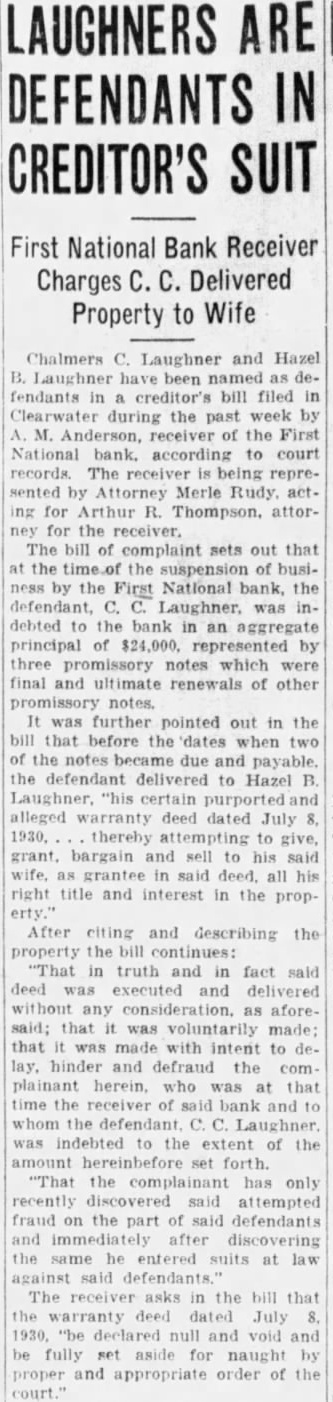
LAUGHNERS ARE DEFENDANTS IN CREDITOR'S SUIT First National Bank Receiver Charges C. C. Delivered Property to Wife Chalmers C. Laughner and Hazel B. Laughner have been as defendants in creditor's bill filed in Clearwater during the past week by A. M. Anderson, receiver the First National bank. according to court records. The is being represented by Attorney Merle Rudy. acting for Arthur R. Thompson. attorney for the The bill of complaint sets out that at the of the suspension of business by the First National bank, the defendant, Laughner, was indebted to the bank in an aggregate principal of $24,000. represented by three promissory notes which were final and ultimate renewals of other notes. It was further pointed out in the bill that before the dates when two of the notes due and payable. the defendant delivered to Hazel B. Laughner, "his certain purported and alleged warranty deed dated July 8, 1930. thereby attempting to give, grant. bargain and sell to his said wife, grantee in said deed. all his right title and interest in the property." After citing and describing the property the bill continues: "That in truth and in fact said deed was executed and delivered without any consideration, as aforesaid; that it was voluntarily made: that was with intent to delay, hinder and defraud the complainant herein, who was at that time the receiver of said and to whom the defendant. C. C. Laughner. was indebted to the extent of the amount hereinbefore set forth. "That the complainant has only recently discovered said attempted fraud on the part of said defendants and immediately after discovering the same he entered suits at law against said defendants. The receiver asks in the bill that the warranty deed dated July 8. 1930. "be declared null and void and be fully set aside for naught by proper and appropriate order of the court."

Article from Tampa Bay Times, September 3, 1931

Click image to open full size in new tab

Article Text

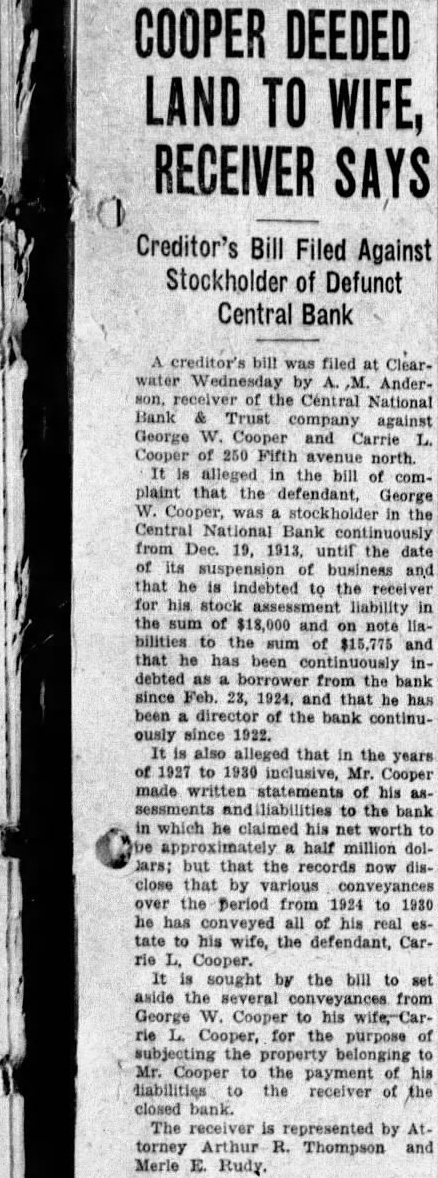
COOPER DEEDED LAND TO WIFE, RECEIVER SAYS Creditor's Bill Filed Against Stockholder of Defunct Central Bank A creditor's bill was filed at Clearwater Wednesday by A. .M. Anderson, receiver of the Central National Bank & Trust company against George W. Cooper and Carrie L. Cooper of 250 Fifth avenue north. is alleged in the bill of complaint that the defendant, George W. Cooper, was stockholder in the Central National Bank continuously from Dec. 19, 1913, untif the date of its suspension of business and that he is indebted to the receiver for his stock assessment liability in the sum of $18,000 and on note liabilities to the sum of $15,775 and that he has been continuously indebted as borrower from the bank since Feb. 23, 1924. and that he has been a director of the bank continuously since 1922. It is also alleged that in the years of 1927 to 1930 inclusive, Mr. Cooper made written statements of his assessments andiliabilities to the bank in which he claimed his net worth to be approximately a half million dollars; but that the records now disclose that by various conveyances over the Deriod from 1924 to 1930 he has conveyed all of his real estate to his wife, the defendant, Carrie L. Cooper. It is sought by the bill to set aside the several conveyances from George W. Cooper to his wife,-Carrie L. Cooper, for the purpose of subjecting the property belonging to Mr. Cooper to the payment of his diabilities to the receiver of the closed bank. The receiver is represented by Attorney Arthur R. Thompson and Merie E. Rudy.