19170. Schuylkill Bank (Philadelphia, PA)

Bank Information

Episode Type
Suspension → Closure
Bank Type
state
Start Date
May 11, 1848
Location
Philadelphia, Pennsylvania (39.952, -75.164)

Metadata

Model
gpt-5-mini
Short Digest
bcf11208

Response Measures

None

Description

Contemporary articles describe the Schuylkill Bank as having funds in the hands of a receiver (Job R. Tyson) and litigation with the Bank of Kentucky that the court decree would 'sweep away the entire assets' held for the bank. No newspaper account describes a depositor run; instead the bank is in receivership and effectively broken up. I therefore classify this as a suspension followed by closure/receivership. OCR errors in articles corrected (e.g., 'Schuyikill' -> Schuylkill).

Events (3)

1. May 11, 1848 Receivership
Newspaper Excerpt
Job R. Tyson, receiver of the funds arising from sales of property and debts collected, belonging to the assets of the Schuylkill Bank, made application to the Court of Common Pleas this morning, for power to invest $49,000 now in his hands, in City o's ... the Schuylkill Bank.
Source
newspapers
2. March 31, 1849 Other
Newspaper Excerpt
The suit ... between the Bank of Kentucky and the Schuylkill Bank ... this decision will sweep away the entire assets of the Schuylkill Bank, amounting to about $450,000, which have been in the hands of receivers appointed to hold the funds ... The whole claim of the Bank of Kentucky amounts to $1,345,000.
Source
newspapers
3. June 28, 1849 Other
Newspaper Excerpt
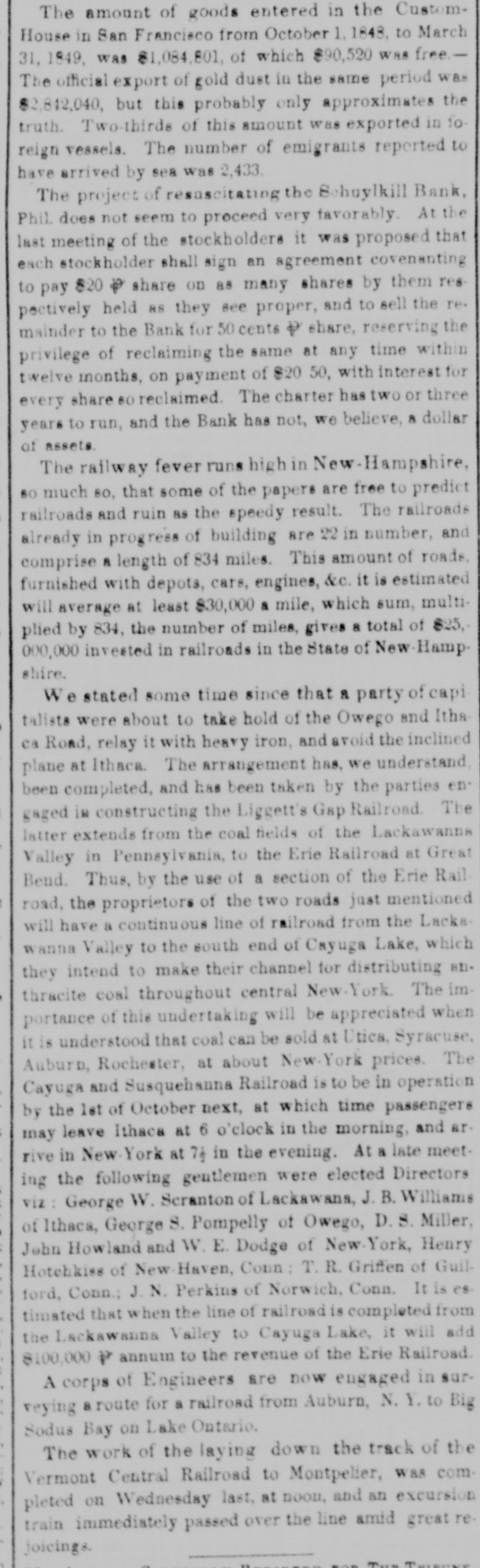
The project of resuscitating the Schuylkill Bank, Phil. does not seem to proceed very favorably. At the last meeting of the stockholders it was proposed that each stockholder shall sign an agreement covenanting to pay $20 a share ... The charter has two or three years to run, and the Bank has not, we believe, a dollar of assets.
Source
newspapers

Newspaper Articles (5)

Article from New-York Daily Tribune, May 12, 1848

Click image to open full size in new tab

Article Text

Correspondence of The Tribune. PHILADELPHIA, Thursday, May 11. A large four-story brick building in the rear of as Race-st. was burned down about midnight last night.It belonged to E. & D. Ford, who occupied the fourth story as ivory turners. Hall & Boardman, Britannia ware manufacturera; Mr. Jackson, Turuer; Mr. Stewart, saw miller, and Mr. Cook, tosaw blind state, occupied the other parta. All the stock and machinery, with the building was destroyed, except the engine in the basement. William Bechtel, in prison for the marder of his wife, is suffering under a famil malady of insanity, and is 80 violent that be has been ironed. There will be a large parade of our volunteers to receive Gen. CADWALADER, upon his return house. Job R. Tyson, receiver of the funds arising from sales of property and debts collected, belonging to the assets of the Schuylkill Bank, made application to the Court of Common Pleas this morning, for power to invest $49,000 now in his hands, in City o's, the stock to be held in hype* theration, wish Mr. M' Allister's addisional security rof line repryment of the money, with an interest of 5 per cooc. the Schuylkill Bank. and Caleb Cope, special agent of the Back of Kentucky, agreeing to the same A dog la a rabid state was killed this morning in the upper part of Viae-st. Six hundred and revealy-si Immigrants arrived at this port yesterday. The son of . poor woman restored this morning to Harrisen, Brothers & Co. the 8250, comprised in five notes of 850 each, lost on Monday by a lad in their employ The boy picked up the notes from the pavement on Monday, is Frost-at. near Market-at. where the lad had dropped them. Floor more active to-day; sales 1,000 bble at 85 94 for fair Penas. and 200 at $6 for good. Cotton in better in. quiry, with sales at about 1 as. advance on fice grades. Sales 1,500 bbie Corn Meal as 225; holders asked 237 at close, which was givea for some lots. Rye Flour 87. Sales Red Wheat at 142, the supply still small. Corn has advanced, with sales 3,000 bushels good Yellow South at 61 Mess Pork held at $10 25 Bacon in fair request Western cured selling at St to St for shoulders; 4 to 43 for sides, and 5f to 7is for Hame. Sales 500 kege Laid as 7 CE# 4 mos. Groceries ionnimate. Whisky in bole 23 eta SALES OF STOCKS.-- Board-200 U. d. 5a, '51. 91; 50 Reasing Rd, 16th 100 do, b5, 161; 20 U.S. Bank, S; 595 Lehigh Scrip b5, 79 109 Treasury Notes. 1014, 500 U.S. 6a. . FF. 102}; 300 Lenigh Mt. Loss. 84; 200 U. S. 6s, '67, 1043, 500 Lehigh 6a. 60; 500 State 5a, 8it Second Board-500 City 6s. '76. 99$; 44,925 Peam5s, (lota) 75; 1,000 do 6s, 87f; 200 N. Y. War Bounty Scrip, 97 : 300 N. J. Cop. 4 18 Reading 161; 415 Lehigh Canal Scrip, 79; 5,000 N. Y. 6s, '67, 1041.
Article from The New York Herald, March 27, 1849

Click image to open full size in new tab

Article Text

LLICENCE BY THE MAILS. PHILADELPHIA, March 3,1849. The Kentucky and Schuylkill Banks-The Robber of the Government Jewels-A Murder-Killed by an Omnibus-Parade of Firemen-The Steam. ship Columbus-The Bark Warsaw, Sc. A compromise between the Bank of Kentucky and the Schuyikill Bank is understood to be in progress, and will probably be concluded in a day or wo, which will put an end to the vexatious litigation that has been 80 long existing, and enable the Schuylkill Bank to resurre operations for the remainder of the time for which the charter has to run. The Kentucky Bank is to surrender some of the advantages acquired by the recent decision in its favor. The officers of the Schuylkill Bank, by placing certain property agreed upon in the hands of the victor, gracefully terminate the controversy. A bill 18 now pending before our Legislature, to enable the Kentucky Bank to hold, in its corporate capacity, the property that is so delivered up. A further hearing in the case et Jacob Shuster, alias Tom Hand, was had this morning before Judge Kane, when, after some additional evidence, the prisoner was ordered to be conveyed to Washington, to take his trial for the robbery of the government jewels. The letter sent to the late President was compared with the hand-writing of the prisoner, and identified as being very similar. George Righter, who was stabbed last week in Moyamensing, by some unknown person, died last night at the Hospital. An investigation 18 now in progress by the Coroner. Robert Robinson, a machinist, was killed on Saturday night, by an omnibus running over him while in the act of crossing Second street. The driver drove off at full speed, without waiting to see what injury had been committed through his carelessness. He has not yet been arrested. The unfortunate deceased leaves a wife and eight children. Our firemen are making the most extensive arrangements for their triennial parade to-morrow. They have brought from Bethlehem an ancient engine, built in London in 1686, which was the first engine used in this city, one hundred and thirty years since. It is to be placed on an elevated platform on wheels, and will form a feature in the procession. The steamship Columbus arrived this morning, from Charleston. She spoke the steamer Osprey, hence for Charleston, at eight o'clock yesterday morning. The Columbus put into the Breakwater, and placed on board a vessel bound to Charleston a runaway slave who had concealed himself on board. He made his appearance too soon to effect his escape to the free soil of Pennsylvania. The brig America, Captain Treadwell, arrived this morning from Salem, having on board Captain Taylor and the crew of the bark Warsaw, which vessel took fire on the 19th instant, off Cape Henlopen, and was burned to the water's edge. They took to their boats, and were picked up during the succee ding night by Capt. Treadwell. The Warsaw was from New York, bound for Panama. MARKETS. The flour market continues dull; some of the holders demand $4 for common brands for export, but others have made rales stashadelower. Extra brands, for city consumption, command $5 to $525. There is but little inquiry for corn made. Rye flour is quoted $8 0614 to $3121. Grain is coming into market plentifully. Prime Pennsylvania red wheat sells at $1 03, and n lot of good quality sold at $1. Rye is dull at 62 to 63c. The request for corn is moderate, and no sales of cats are reported. Whiskey, in hbds., sells at 21c., and in bbls., at 22c. STOCK SALES. First Board.- Wilm'n RR b5 2734; 50 do 271; 109 do 2714; $5900 City 6's '79 101/1; $700 U. S. 6's '67 110; $1000 do 110; $1000 do 110; $1000 do 110; $3000 do 110; $1000 do $1000 do 110; $8000 Reading Bds 82 581/2; 25 Girard 121/2; 50 Girard Bk 121/2; 100 do 121/2; $250 Lehigh CI Sep 77; 60 Girard Bk b5 123/2; 50 do 123; 50 do 121/2; 100 do 121/2; 50 do 121/2; $300 Lehigh Int 57; 100 U S Bank 31/; $3000 Treas'y 1081/; 100 Coal Scrip c 77. Second Board and af ter-50 Reading RR 16; 100 NJ Copper 1/2: 5 N A Bk cash 1243; $30,000 Read'g Bds #5 541/2; $1000 Nav 6s 461/2; 50 Reading RR 16; 50 do 16; $500 Penna 5s 79%


Article from The New York Herald, March 31, 1849

Click image to open full size in new tab

Article Text

The movement of this institution has largely increased, and the increase has been confined to the circula-tion and the exchange department. Without any ad-dition of consequence to the supply of specie on hand, the issues of the bank have increased, since last July, $430.555. The aggregate movement, and the move-ment in the principal departments, compare more fa-vorably with those for the same time-January, 1848-last year, than with any previous period. It will be perceived by the above comparative state-ment, that the Bank of Kentucky and branches have purchased nearly all the over-issue of stock by the Schuylkill Bank, and it will hereafter be able to de-clare better dividends, without making any reserva-tion to carry to the stock fund. The suit which has so long been going on between the Bank of Kentucky and the Schuylkill Bank, for the recovery of this over-issue of stock, has at last been finally settled, the de-cision being in favor of the Bank of Kentucky. The following is the decree of the Supreme Court of Penn-sylvania:- This cause came on to be heard at this term, (viz. September term, 1845,) and was argued by counsel, and therefore upon consideration thereof it was ordered, adjudged and decreed, that the Schuyikill Bank, in the city of Philadelphia, and Hosea J. Levis, pay unto the said complainants, the president, directors and com-pany of the Bank of Kentucky, one million one hun-ared and eighty-four thousand seven hundred and thirty eight dollars, ($1.184.738) as a just indemnity for the loss, detriment and damage to which they, the said complainants, and the holders of the stock herein-after mentioned, have been put or have suffered by reason of the fraudulent issue of thirteen thousand one hundred and eighty five (13,185) shares of the stock of the said president, directors and company of the Bank of Kentucky, by the said the Schuytkill Bank, in the city of Philadelphia while transfer agent of the said president directors and company of the Bauk of Kentucky, by, with and through the pro-curement, knowledge and assistance of the said Hosea J. Levis, and which said shares of the said stock the said president, directors and company of the Bank of Kentucky have either assumed or are entitled to rep-resent by the act of Assembly in such case made and provided. and that the said defendants, the Schuylkill Bank in the city of Philadelphia, and Hosea J Levis, do further pay unto the said president, directors and company of the Bank of Kentucky the costs of this suit. This decision will sweep away the entire assets of he Schuylkill Bank, amounting to about $450,000, which have been in the hands of receivers appointed to hold the funds when the Schuylkill Bank appealed from the decree of the Court of Common Pleas. The whole claim of the Bank of Kentucky amounts to $1.345.000, so that its loss will be at least nine hundred thousand dollars. Since the recent decision, the stock of the Schuylkill Bank has been much depreciated, sales having been made at ½ a 1 per cent.


Article from New-York Daily Tribune, June 28, 1849

Click image to open full size in new tab

Article Text

The amount of goods entered in the CustomHouse in San Francisco from October 1. 1848, to March 31, 1849, was $1,084,801, of which $90,520 was free.The official export of gold dust in the same period was $2,812,040, but this probably only approximates the truth. Two-thirds of this amount was exported in fo reign vessels. The number of emigrants reported to have arrived by sea was 2,433. The project of resuscitating the Schuylkill Bank, Phil. does not seem to proceed very favorably At the last meeting of the stockholders it was proposed that each stockholder shall sign an agreement covenanting to pay $20 & share on as many shares by them res pectively held as they see proper, and to sell the re. mainder to the Bank for 50 cents P share, reserving the privilege of reclaiming the same at any time within twelve months, on payment of $20 with interest for every share 80 reclaimed The charter has two or three years to run, and the Bank has not, we believe, a dollar of assets The railway fever runs high in New-Hampshire, 50 much so, that some of the papers are free to predict railroads and ruin as the speedy result. The railroads already in progress of building are 22 in number, and comprise a length of 834 miles. This amount of roads furnished with depota, cars, engines, &c. it is estimated will average at least $30,000 & mile, which sum, multiplied by 834, the number of miles, gives & total of 825, 000,000 invested in railroads in the State of New-Hampshire. We stated some time since that a party of capi talists were about to take hold of the Owego and Itha ca Road, relay it with heavy iron, and avoid the inclined plane at Ithaca. The arrangement has, we understand been completed, and has been taken by the parties en gaged in constructing the Liggett's Gap Railroad The latter extends from the coal fields of the Lackawanna Valley in Pennsylvania, to the Erie Railroad at Great Bend. Thus, by the use of a section of the Erie Rail road, the proprietors of the two roads just mentioned will have a continuous line of railroad from the Lacka wanna Valley to the south end of Cayuga Lake, which they intend to make their channel for distributing 811 thracite coal throughout central New-York The importance of this undertaking will be appreciated when it is understood that coal can be sold at Utica, Syracuse, Auburn, Rochester, at about New-York prices. The Cayuga and Susquehanna Railroad is to be in operation by the 1st of October next, at which time passengers may leave Ithaca at 6 o'clock in the morning, and ar. rive in New-York at 74 in the evening. At a late meeting the following gentlemen were elected Directors viz George W. Scranton of Lackawans, J. B. Williams of Ithaca, George S. Pompelly of Owego, D. Miller, John Howland and W. E. Dodge of New-York, Henry Hotebkiss of New-Haven, Conn : T. R. Griffen of Guilford, Conn.; J. N. Perkins of Norwich, Conn. It is es timated that when the line of railroad is completed from the Lackawanna Valley to Cayuga Lake, it will add $100,000 ₽ annum to the revenue of the Erie Railroad A corps of Engineers are now engaged in surveying 8 route for a railroad from Auburn, N. Y. to Big Sodus Bay on Lake Ontario. The work of the laying down the track of the Vermont Central Railroad to Montpelier, was completed on Wednesday last, at noon, and an excursion train immediately passed over the line amid great rejoicings.


Article from The New York Herald, October 13, 1849

Click image to open full size in new tab

Article Text

# A NEW FISCAL AGENCY-WALL STREET AND BUNCOMBE IN THE F. E. D. Who does not recollect the glorious times of the old United States Bank, when Wall street was but a stipendiary of Nick Biddle, and jobbers, editors, currency, commerce, and the elections, were ruled and directed by the monster? Who does not remember the fierce, savage and protracted war which it made against Old Hickory and the people, and the universal panic, ruin and distress which followed its ignominious defeat? What became, then, of the pensioners? They crept into holes and corners-they denied their master as bluntly as St. Peter, and admitted that a bank was an "obsolete idea," and a nuisance. But with the election of Harrison, the leeches of the old bank were on the ground-the dried skeleton of the monster was galvanized, and wanted but the scrape of a pen to return it to full vigor. But they could "not head Captain Tyler;" and bank, whigs, jobbers, pensioners, and hucksters, all fell together. This time the monster was believed to be dead and damned, soul and body, forever and ever. And so it is. But as half a loaf is better than no bread, a substitute has been proposed. Wall street and Buncombe are in the field. The Hon. Thomas L. Clingman, of North Carolina, in a letter first published in a paper without a circulation, proposes a new "scheme of a national currency." Reduced to its simplest form, he proposes to establish a free system of banking throughout the United States, on the faith of the public stocks. Mr. Clingman is from the Buncombe district, famous for rocks of the secondary formation, its mineral springs, pine shingles, and buckwheat cakes. Having secured his re-election to the House, and having the leisure of the summer upon his hands, Mr. Clingman, emerging from the woods of Buncombe, has been for some months engaged in the inspection of the factories of cotton and politics in the North. He has been initiated into the mysteries of the Albany junto-the secrets of the money changers-the science of stock-jobbing-and Buncombe is in the field. Mr. Draper, chief of the forlorn hope in behalf of Col. Webb at Washington, has found his man; and the topic of a conversation over a bottle of wine, has become a great national measure. Everybody is wondering that the wiseacres of Congress did not think of it before. But the scheme of Mr. Clingman looks suspicious. It has the sulphurous odor of Wall street all over it. The hoofs of the old monster stick out, though his tail is coiled up in his breeches. Feasting, feting and lionizing, a juicy dinner at the Astor House, and the tour of our public institutions in an Alderman's carriage to the Penitentiary, are hard to be resist-ed, though all for Buncombe. There is something of a plot at the bottom. The pensioners of the old bank, who, after betraying and murdering their master and benefactor, have pined away to skin and bone, cannot stand it any longer. Twelve years fast is long enough. It was the father of our present Secretary of the Treasury who was President of the Schuylkill Bank when it broke down; it was Mr. Meredith's collector at Philadelphia who broke up with the Girard concern; it was this last appointment, and others like it, that contributed to the late whig defeat in that city. But still this does not prevent the conspiracy. We may expect all these men, and all those who fattened on the old bank-all who were bought or sold, whether for five, ten, or twenty thousand, or for $52,765 37½-to go for the new scheme. Mr. Chhogman only lifts the curtain. The scene shifters are behind. The treasury is an old cow, whose milk is too rich to be lost. The scheme of Mr. Chngman is but the first movement. Pass it, and a bank comes next in order. Somehow or other the stock-jobbing brotherhood must get into the treasury. Let us have, then, the bill of Buncombe. Then the purlieus of Wall street will become the valleys of the Sacramento and San Josquin; the very side-walks will be richer in gold than the mines of the desert; bank paper will increase by millions; everything will go up, up, until the explosion, when a bankrupt law will wind up the FELLOW FEELINGS-RAILROADS AND CURRENCY.