19167. Schuylkill Bank (Philadelphia, PA)

Bank Information

Episode Type
Run → Suspension → Reopening
Bank Type
state
Start Date
October 10, 1839
Location
Philadelphia, Pennsylvania (39.952, -75.164)

Metadata

Model
gpt-5-mini
Short Digest
947cb8a8

Response Measures

Accommodated withdrawals, Full suspension, Books examined

Other: Receivers appointed after injunction; fraud by cashier (false Kentucky stock certificates) discovered.

Description

A severe run on the Schuylkill Bank in October 1839 precipitated wider bank suspensions in Philadelphia. In December 1839 discovery of large frauds by the cashier H. J. Levis and an injunction (suit by the Bank of Kentucky) led the Schuylkill Bank to suspend and place affairs in receivers' hands. By Feb 1841 the Schuylkill (described as 'broken') paid balances in full and resumption occurred. I corrected OCR typos (e.g., 'Levis', 'Schuylkill').

Events (3)

1. October 10, 1839 Run
Cause
Rumor Or Misinformation
Cause Details
Severe run in October 1839 blamed on press reports in a 'small paper' that precipitated deposit withdrawals.
Measures
General suspension by Philadelphia banks followed (banks suspended specie payments).
Newspaper Excerpt
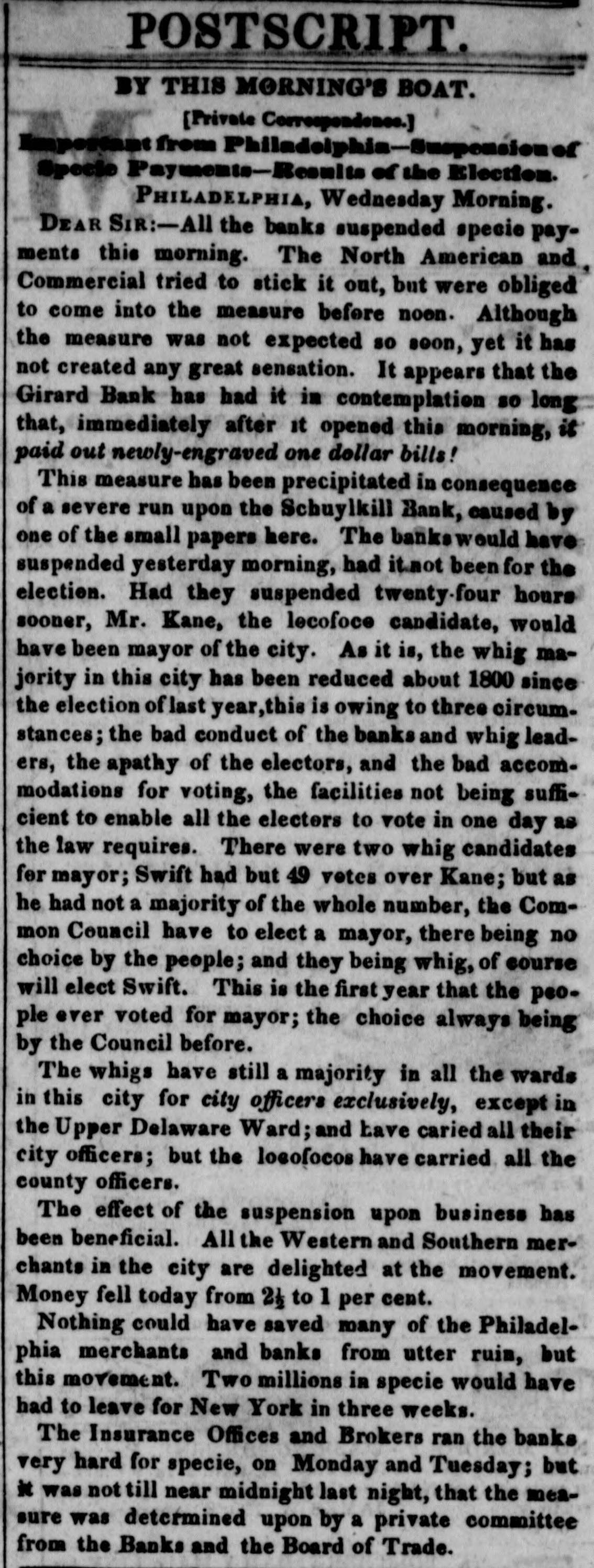
This measure has been precipitated in consequence of a severe run upon the Schuylkill Bank, caused by one of the small papers here.
Source
newspapers
2. December 18, 1839 Suspension
Cause
Bank Specific Adverse Info
Cause Details
Discovery of extensive fraud by cashier H. J. Levis (false certificates issued, large overdrafts) and an injunction at the suit of the Bank of Kentucky stopped payments and led to receivership.
Newspaper Excerpt
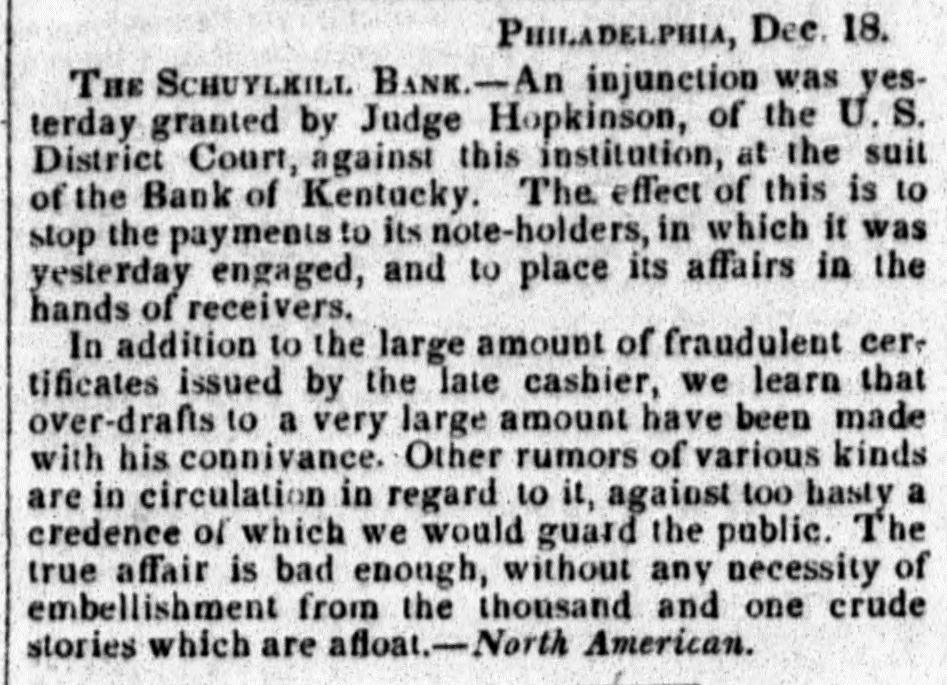
An injunction was yesterday granted by Judge Hopkinson ... The effect of this is to stop the payments to its note-holders ... and to place its affairs in the hands of receivers.
Source
newspapers
3. February 5, 1841 Reopening
Newspaper Excerpt
The broken Schuylkill Bank to-day paid all her balances in full in United States Bank Bills--SO that the resumption is complete in Philadelphia.
Source
newspapers

Newspaper Articles (16)

Article from Edgefield Advertiser, July 19, 1838

Click image to open full size in new tab

Article Text

Miscellaneous. From the Augusta Constitutionalist July 12. We rceived no express slips yesterday by either northern or western mails. -A-lip of the Journal of Commerce of the 7th inst. Jated 2 P. M., came directed to the People's Press, but it contains nothing new. - The sales of cotton for the week are put down at 2,500 bales, at steady prices-whole run of sales 9¼ a 14 ets. Sales of U. Bank Stock at 120, 120¼, 121. We also extract the following in relation to Philadelphia Banks: # PHILADELPHIA BANKS. A meeting of the Philadelphia Banks was held on Thursday evening. to hear the report of the committee to whom the subject of fixing a day for the resumption of specie payments, had been referred at a previous meeting. The result is stated in a letter below. The same facts are communicated in many other letters. Mr. Biddle, it seems, though himself determined on non-resumption, has lost the majority, and out of fourteen banks in all, is brought into a minority of four. To all these banks in the aggregate, the U. S. Bank, in the month of April last, stood indebted $5,086,000 and there is a good reason to believe that the amount has not since been lessened. - What the great Regulator will do in its new position, remains to be seen. The Philadelphia newspapers make no announcement of the result of the meeting, although they announced its approach, and cannot be ignorant, or forgetful, of the deep interest whien is felt by the whole country in such news. We prophecy that Philadelphia will be a specie-paying City before long: but what will be the standing of any parucutar mstutation, we are not certain. - The dynasty of non-resumption draws near to its end. Piladelpnia funds are one pr cent. discount. Extract of a letter, dated Philadelphia, July 6th. At the Bank meeting last tight, the Committee recommended the 1st of August for restiamption. The bank of United States, Lank of rennsylvania, Bank of N. America, and denuylkill bank voted against it A mmority of numbers, though a majority of capitat."


Article from Morning Herald, October 10, 1839

Click image to open full size in new tab

Article Text

POSTSCRIPT. BY THIS MORNING'S BOAT. [Private Correspondence.] Important from Philadelphia-Suspension of Specio Payments-Resuita of the Election. PHILADELPHIA, Wednesday Morning. DEAR SIR:-All the banks suspended specie payments this morning. The North American and Commercial tried to stick it out, but were obliged to come into the measure before noon. Although the measure was not expected so soon, yet it has not created any great sensation. It appears that the Girard Bank has had it in contemplation so long that, immediately after it opened this morning, it paid out newly-engraved one dollar bills! This measure has been precipitated in consequence of a severe run upon the Schuylkill Bank, caused by one of the small papers here. The banks would have suspended yesterday morning, had it not been for the election. Had they suspended twenty-four hours sooner, Mr. Kane, the lecofoce candidate, would have been mayor of the city. As it is, the whig majority in this city has been reduced about 1800 since the election of last year, this is owing to three circumstances; the bad conduct of the banks and whig leaders, the apathy of the electors, and the bad accommodations for voting, the facilities not being sufficient to enable all the electors to vote in one day as the law requires. There were two whig candidates for mayor; Swift had but 49 votes over Kane; but as he had not a majority of the whole number, the Common Council have to elect a mayor, there being no choice by the people; and they being whig, of course will elect Swift. This is the first year that the people ever voted for mayor; the choice always being by the Council before. The whigs have still a majority in all the wards in this city for city officers exclusively, except in the Upper Delaware Ward; and have caried all their city officers; but the locofocos have carried all the county officers. The effect of the suspension upon business has been beneficial. All the Western and Southern merchants in the city are delighted at the movement. Money fell today from 21 to 1 per cent. Nothing could have saved many of the Philadelphia merchants and banks from utter ruin, but this movement. Two millions in specie would have had to leave for New York in three weeks. The Insurance Offices and Brokers ran the banks very hard for specie, on Monday and Tuesday; but it was not till near midnight last night, that the measure was determined upon by a private committee from the Banks and the Board of Trade.


Article from Morning Herald, October 15, 1839

Click image to open full size in new tab

Article Text

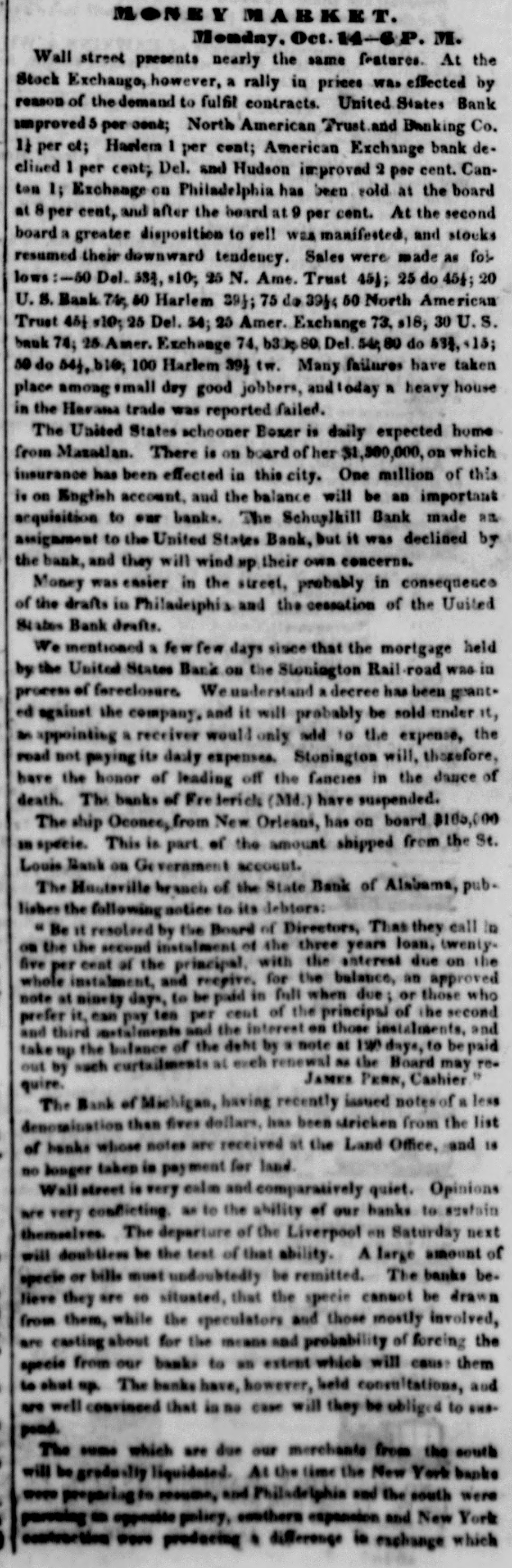
# MONEY MARKET. Monday, Oct. 14-6 P. М. Wall street presents nearly the same features. At the Stock Exchange, however, a rally in prices was effected by reason of the demand to fulfil contracts. United States Bank improved 5 per send; North American Trust and Banking Co. It per et; Harlem 1 per cent; American Exchange bank declined 1 per cent; Del. and Hudson improved 2 per cent. Canton 1; Exchange on Philadelphia has been sold at the board at 8 per cent, and after the board at 9 per cent. At the second board a greater disposition to sell was manifested, and stocks resumed their downward tendency. Sales were made as follows:-50 Del. 584, 810; 25 N. Ame. Trust 45); 25 do 454; 20 U. S. Bank. 765, 60 Harlem 395; 75 do 3944 50 North American Trust 46 510; 25 Del. 54; 25 Amer. Exchange 73, s18; 30 U. S. bauk 74; 25. Amer. Exchange 74, 633 80, Del. 54; 80 do 530, $15; 50 do 544, 616; 100 Harlem 394 tw. Many failures have taken place among small dry good jobbers, and today a heavy house in the Havana trade was reported failed. The United States schooner Boxer is daily expected home from Mazatlan. There is on board of her $1,300,000, on which insurance has been effected in this city. One million of this is on English account, and the balance will be an important acquisition to our banks. The Schuylkill Bank made an assigament to the United States Bank, but it was declined by the bank, and they will wind up their own concerns. Money was easier in the street, probably in consequenes of the drafts in Philadelphia and the cessation of the United Status Bank drafts. We mentioned a few few days since that the mortgage held by the United States Bank on the Stonington Rail-road was in process of foreclosure. We understand a decree has been geanted against the company, and it will probably be sold under it, as appointing a receiver would only add to the expense, the road not paying its daily expenses. Stonington will, therefore, have the honor of leading off the fancies in the dance of death. The banks of Frederick (Md.) have suspended. The ship Ocones, from New Orleans, has on board $165,000 in specie. This is part of the amount shipped from the St. Louis Bank on Government account. The Hauteville branch of the State Bank of Alabama, publishes the following notice to its debtors: "Be it resolved by the Board of Directors, Thas they call in on the the second instalment of the three years loan, twenty-five per cent of the principal, with the anterest due on the whole instalment, and reegive, for the balanco, an approved note at ninety days, to be paid in full when due; or those who prefer it, can pay ten per cent of the principal of the second and third nstalments and the interest on those instalments, and take up the balance of the deht by a note at 1320 days, to be paid out by such curtailments at ezch renewal as the Board may require. JAMES PERN, Cashier" The Bank of Michigan, having recently issued notes of a less denomination than fives dollars, has been stricken from the list of banks whose notes are received at the Land Office, and is no longer taken in payment for land. Wall street is very calm and comparatively quiet. Opinions are very conficting, as to the ability of our banks to sustain themselves. The departure of the Liverpool on Saturday next will doubtless be the test of that ability. A large amount of specie or bills must undoubtedly be remitted. The banks believe they are so situated, that the specie cannot be drawn from them, while the speculators and those mostly involved, are casting about for the means and probability of forcing the specie from our banks to an extent which will caus: them to shut up. The banks have, however, held consultations, and are well convinced that in no case will they be obliged to suspend. The sume which are due our merchants from the south will be gradually liquidated. At the time the New York banke were preparing to resume, and Philadelphia and the south were parsuing in opposite policy, oauthern expansion and New York contraction pore producing differenge in exchange which


Article from Richmond Enquirer, November 12, 1839

Click image to open full size in new tab

Article Text

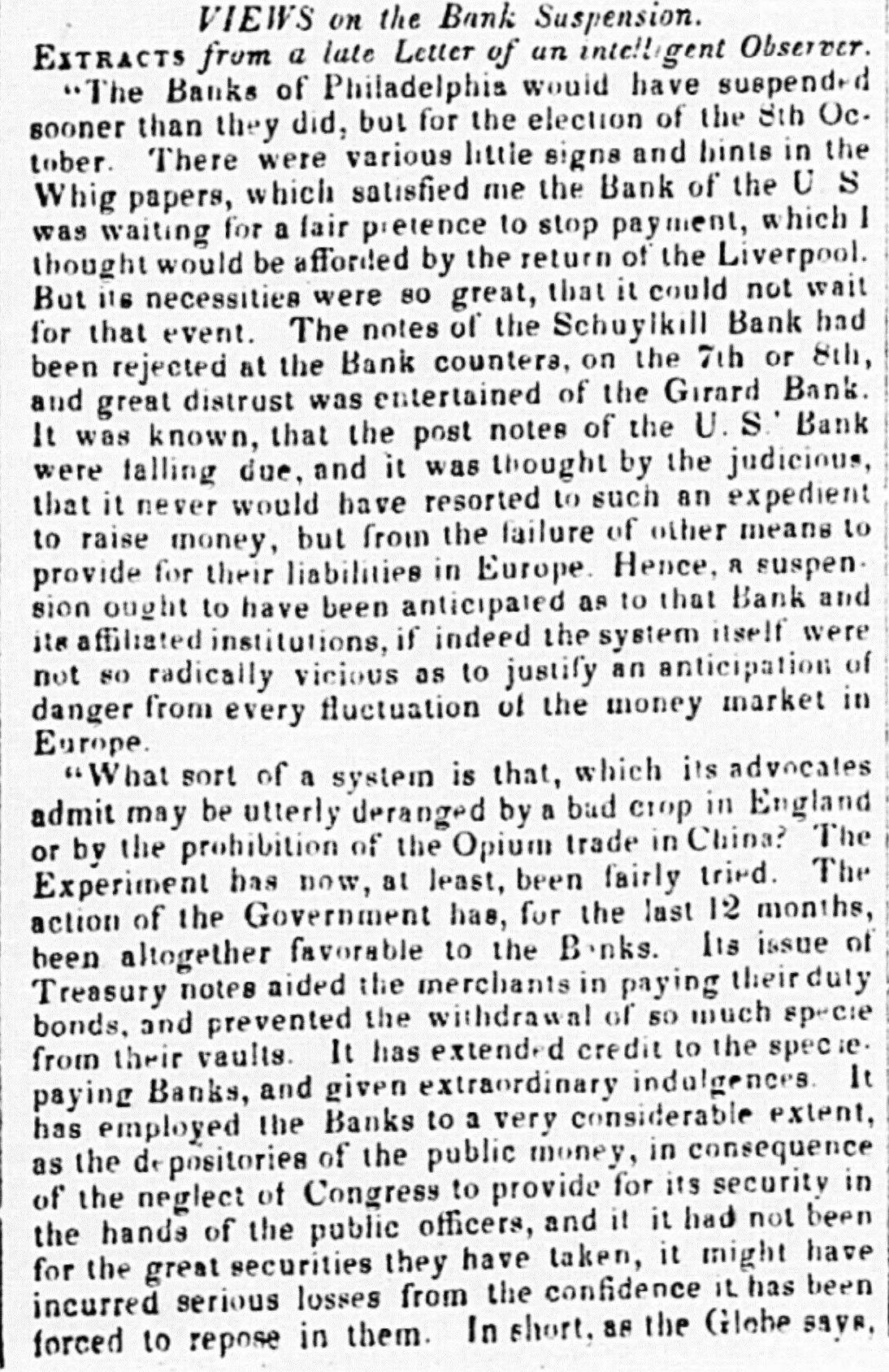
VIEWS on the Bank Suspension. EXTRACTS from a late Letter of an intelligent Observer. "The Banks of Philadelphia would have suspended sooner than they did, but for the election of the 8th Oc. tober. There were various little signs and hints in the Whig papers, which satisfied me the Bank of the U S was waiting for a fair pretence to stop payment, which I thought would be afforded by the return of the Liverpool. But its necessities were so great, that it could not wait for that event. The notes of the Schuylkill Bank had been rejected at the Bank counters, on the 7th or 8th, and great distrust was entertained of the Girard Bank. It was known, that the post notes of the U. S. Bank were falling due, and it was thought by the judicious, that it never would have resorted to such an expedient to raise money, but from the failure of other means to provide for their liabilities in Europe. Hence, R suspen. sion ought to have been anticipated as to that Bank and its affiliated institutions, if indeed the system itself were not so radically vicious as to justify an anticipation of danger from every fluctuation of the money market in Europe. "What sort of a system is that, which its advocates admit may be utterly deranged by a bad crop in England or by the prohibition of the Opium trade in China? The Experiment has now, at least, been fairly tried. The action of the Government has, for the last 12 months, been altogether favorable to the Banks. Its issue of Treasury notes aided the merchants in paying their duty bonds, and prevented the withdrawal of so much specie from their vaults. It has extended credit to the spec ie. paying Banks, and given extraordinary indulgences. It has employed the Banks to a very considerable extent, as the depositories of the public money, in consequence of the neglect of Congress to provide for its security in the hands of the public officers, and it it had not been for the great securities they have taken, it might have incurred serious losses from the confidence it has been forced to repose in them. In short. 88 the Globe save,


Article from The Madisonian, December 21, 1839

Click image to open full size in new tab

Article Text

PHILADELPHIA, Dec. 18. THE SCHUYLKILL BANK.-An injunction was yesterday granted by Judge Hopkinson, of the U. S. District Court, against this institution, at the suit of the Bank of Kentucky. The effect of this is to stop the payments to its note-holders, in which it was yesterday engaged, and to place its affairs in the hands of receivers. In addition to the large amount of fraudulent certificates issued by the late cashier, we learn that over-drafts to a very large amount have been made with his connivance. Other rumors of various kinds are in circulation in regard to it, against too hasty a credence of which we would guard the public. The true affair is bad enough, without any necessity of embellishment from the thousand and one crude stories which are afloat.-North American.


Article from Morning Herald, December 23, 1839

Click image to open full size in new tab

Article Text

The Schnylkill Bank Fraud in Philadelphin. The excitement on this subject seems to increase -not diminish. Even those degraded and demoral ising presses of Philadelphia, which justified their fraudulent suspension, seem to be aware of the enor. mity of this gross fraud of Philadelphia financiers. Of Levis, the cashier, who is now rated soundly, we learn that he has assigned his property to certain faverite creditors, as follows:NOTICE Is hereby given, that HOSEA J. LEVIS has assigned all his estate, real and personal, to the subscribers in trust for his creditors, giving certain preferences. All persons having any property of the assignor in their possession are hereby requested to deliver up the same to the subscribers-and all persons indebted to him will please make payment to them without de. JOHN MILES. Jay. W. YARDLEY, Jr. HENRY TOLAND. Pailadelphia, Dec. 20, 1839. This is only another step in the demoralizing sys. tem of Philadelphia banking. Favorite creditorsperchance confederates. are protected, while the innocent public suffer. It is said that Levis has made his escape. If the stories told of him are true, he is right. We have been informed that he was quite a fashionable financier; supported two or three mistresses, with their establishments, besides his own legitimate family-that he would give his favorite sultana, at a sitting, a thousand dollars, and take a receipt from her rosy lips, or any other return she could give. In short, he was a splendid fellow, and a great favorite in Philadelphia society. Is it not time that the people of Pailadelphia should visit the vengeance of their laws, if they have any, upon the perpetrators of all these frauds ? Are not the directors of the Schuylkill Bank indictable for a a conspiracy to cheat ? Why is Dyott permitted to linger in prison-to weave cotton, while their banks and loan companies and Savings Institutions are teeming with supereminent scoundrels-most refined regues-highly educated rascals ? It is only a short month since that these directors investigated the Schuylkill Bank, and pronouneed it all right. Have they any police in Philadelphia? any courts of justice! any forms of civilized society? Or have the banks destroyed their morals-their sense of justice-their first principles of right and wrong Does the corrupt press there imagine that they can lead the public mind astray from their own frauds and conspiracies by talking trash about the conspiracies of the Barings of London? Yet here in New York, we ought not, perhaps, to rate poor, degraded, demoralized Philadeiphia too much. We ought to have the pity of a fellow suf ferer. At this very moment, some of the respectable people of this city have committed detestable forgeries and from every intimation, we have every reason to believe that they will escape by the gross corruption et our police system. The principle on which Sparks, the late Police officer. acted, is still in full operation, and because scoundreis have rich and high connections, they will be permitted to es. cape that justice which the beggarly felon receives without a word


Article from Staunton Spectator, and General Advertiser, December 26, 1839

Click image to open full size in new tab

Article Text

EXTENSIVE FRAUD. Great excitement was produced in Philadelphia, Monday last, by the discovery that false certificates of stock of the Bank of KenJacky to the amount of more than ten thousand shares, or upwards of $1,000,000, had been issued by H. J. Levis, cashier of the Schuylkill Bank, which was the agency of the Bank of Kentucky in Philadelphia. The affair it appeared had been of long standing; but only then disclosed. The Cashier said the fraud was perpetrated to sustain the Schuylkill Bank and that all the proceeds arising from it had been applied to the use of the Bank; the Directors affirm entire ignorance of the matter. Tuesday morning it was announced that the Bank would pay in the notes of other Banks, all sums under $100; and throughout the morning a large crowd of persons attended for the purpose of exchanging their notes. At 2 o'clock, however, the Bank was closed under an injunction issued at the instance of the Bank of Kentucky. The following advertisement appeared in U. S. Gazette of Tuesday evening: "SCHUYLKILL BANK.--The Directors of the Schuylkill Bank announce to the public, that in consequence of the unfortunate circumstances in which the Bank suddenly finds itself placed by the unauthorized acts of the late Cashier, they have found themselves compelled to suspend their payments for the present. The Board think it proper further to state, that the acts of the late Cashier above referred to, were done without the knowledge of the former President or any of the Directors of the Bank; and were for the first time discovered yesterday. The Directors believe that the assets of the Bank are amply sufficient to meet its circulation and deposits, and therefore caution the public against making undue sacrifices."


Article from Lynchburg Virginian, December 26, 1839

Click image to open full size in new tab

Article Text

DEFERRED ARTICLES. EXTENSIVE FRAUD. Great excitement was produced in Philadelphia. Monday last, by the discovery that false certificates of stock of the Bank of Kentticky to the amount of more than Ten thousand shares, or upwards of 1. 000.000 had been issued by 11. J. Levis, cashier of be Schuvikill Bank, which was the agency of the Bank of Kentucky 144 Phi'adelphia. The affair it appeared had been of long standing but only then disclosed. The Cashier said the fraud was perpe trated to sustain the Schuylki Bank and that all the proceeds arising from it had been at plied to the use of the Bank: the direct is affirm entire ignoranca of the matter. Tuesday morning it was announced that the Bank would pay in the notes of other Books. al. sums under $100; and throu hour the worning a large crowd of persons attended for the purpose of ex hanging their notes. A1 2 o'clock however, the Bank was closed underan injunction issued at the instace of the Bank of Kentucky, The following advertisement appeared in the U. S. Gazette of Tuesday evening : "SCHUYLKILL BANK.-The mine Directors of the Schoylkill Bank ansounce to the I ublie, that in consegnesce of the unfortunate circunstances in which the Bank saddenly finds itself placed by the unauthorsed acts of the late Cashier, they have found themselves con pelled to suspend their payments for the present. The Board think it proper further to state, that the acts of the late Cashier above referred to were done without the knowledge of the former President or any of the Directors of the Bank; the assets of the Bank are amply eufficient to ment its circulation and deposites, and therefore causion the public a gainst making undute sacrifices."


Article from Vermont Phœnix, December 27, 1839

Click image to open full size in new tab

Article Text

The Schuylkill Bank.-A letter from Philadelphia, published in the N. Y. Com. says: "Yesterday we had a sad exposure of misdoings by the cashier of the Schuylkill Bank. Surmises were current in the morning, but the facts did not come out until about 3 o'clock, The enshier acknowled. ges that he has issued 10,800 shares of stock in the Bank of Kentucky, and appropriated the whole to the use of the Schuylkill Bank. The president and directors disclaim all knowledge of the proceeding The Schuylkill bank has suspended payment in consequence, but this morning it is exchanging all its notes for less than $100.


Article from The Ohio Democrat and Dover Advertiser, December 27, 1839

Click image to open full size in new tab

Article Text

The following. from the Batimo Sun, showy the progress of Bank wh gery throughout the country Who n the lusera? Who are the sufferers? A innocent, but defrauded community, course. Can whigs, who have en' sciences, longer look an indignant pub. lic in the face? More Bank Fraud-Great excitement prevailed in Philadelphia on Monday, it consequence of the discovery of an ex tensive system of fraud which has beer carried on for some time by the cashie of the Schuylkill B nk. which was th agent for the Bank of Kentucky in the' city. 11 18 stated that he has issues upwards of a million of dollars in false certificates of stock, of which no acroun has been given, and for which the Bank in liable. The rumors of this fraud having reached New York, the stark of Kentucky Bank feti from 70 to 55. The cash er alleges that this ISSUE was , sustain the Schuylkill Bank, but the di W rectors repudiate all participation in the transaction. The Bank has entirely suspended pavmd it, ih ugh the directore g assert that the assets will Cc ver the res a ponsibilities.-Statesma


Article from Morning Herald, January 4, 1840

Click image to open full size in new tab

Article Text

that some grand humbug should be got up to prevent any investigation of their concerns, and to conceal the defalcations and frauds, which are, as yet, only whispered among the rogues themselves. As one of the plans to cheat the legislature, a ridiculous story of a conspiracy" by the Barings, of London, and Prime & Ward of this city, has been manufactured and published, first in the "Courier & Enquirer" here, of $52,000 noteriety, and afterwards in the other Wall st. papers, every one of which have been paid for the service. These ridiculous cheats,-for Prime & Co. have not brains enough, to say nothing of capital, to conspire against a fat hen and well fed chickens-have been carefully reprinted in the Penn sylvania papers, and are intended to produce an effect on the governor and legislature of Pennsylvania, so as to conceal the bank defalcations. As part of the same game, the silly bank-bought press of Philadelphia is constantly filled with such tirades, as that which we have given from the "Commercial Herald"-but their very laughable violence and ridiculous bluster defeat their own purpose So far as this journal is concerned, we belong to no " New York system," that is opposed to Philadelphia-and the people of Philadelphia-the honest people-acknowledge, in the most substantial form, the truth of this assertion. When their banks suspended fraudulently a second time in August last, our circulation in the city of Philadelphia was hardly fifty. As soon as that suspension became certain, although we bave had, and still have, the most friendly personal relations with Mr. Biddle, Mr. Jaudon, and Mr. Humphreys. of Liverpool, yet we never permitted the friendship and personal esteem for these amiable men for one moment to cloud our mind as to the character of the movement of which the United States Bank became the instigator and patron. We have expressed the sense of an honest and upright heart upon all the bank movements of Philadelphia, from the first suspension, up to the recent exposé of the Schuylkil Bank-and what is the fact ? From a circulation of fifty Heralds in August last, we now count a circulation of nearly 1000 copies in the city of Philadelphia, without any solicitation, expectation, or effort on our part. This curious fact has satisfied us that in spite of the villanies of these banks, and the corruption of her newspapers, there now exists in Philadelphia, and throughout Pennsylvania, a vein of honesty, as pure and as inexhaustible as her eternal beds of anthracite; and however sh may be tied up in the meshes of a swindling system, she will vet burst her bonds and come forth honest and free. Hostility to Pennsylvania or to Philadelphia, as such, never crossed our mind for a moment. We are only hostile to dishonesty and and fraud whether it be generated in New York or Philadelphia. We have treated the bank frauds of New York with the same severity that we have ever treated those of Philadelphia In every instance, in this State, we have been the first to sound the alarm of bank mismanagement, and for this watchfulness and industry in the cause of public morals, we have received a support and a patro. nage, unparalleled in the annals of the New York press. Let not, therefore, the honest community of Penn sylvania be deceived by the tricks of their great financiers and great felons. The erisis of the bankingsstem has come in good ea rnest-and the legis latures of Pennsylvania and New York may be bough and bribed for the approaching session, but that will not do long. In this state the free bank system will be thoroughly examined, and in Penn. sylvania the real condition of the whole array of banks must undergo a like search. The fruit is ripening fast. And now to close, we put it to the people of Philadelphia themselves, to say, which of the two Heralds is the most " crazy," the most 'defamatory," the most libellous"-whether it is the New York Herald or the Philadelphia HeraldDromio of Epheses or Dromio of Syracuse? Don't laugh-decide.


Article from Morning Herald, January 16, 1840

Click image to open full size in new tab

Article Text

By this it appears that the Comptroller holds scarcely sufficient security to cover the legitimate bills issued by him, in the constantly falling state of the markets. The return is very imperfect, however. The item," bonds, &c," probably represents the amount of post notes and certificates of deposite issued by the concern, for which they show bonds and mortgages, of the real value of which it is impossible to judge, but they are worth nothing as a banking capital. One of the directors of the Schuylkill Bank has stopped payment, under circumstances that excite much indignation. It is stated thet he purchased a large quantity of molasses in Rhode Island, giving Mr. Levis as endorser, and the sellers grasp a shadow. It is rumored that upwards of $50,000 in the post notes of the Schuylkill Bank hare arrived in Philadel phia for collection from Kentucky, and not the slightest notice of their issue is found on the books of the Bank. The position of affairs in the Pennsylvania Legislature, with regard to the banks, is now a subject of much interest in financial circles, both here and in Philadelphia. Many enter. tain the opinion that Mr. Penniman's resolution, compelling the backs to resume on the 1st February next, will pass. Taking into view the strong anti bank feeling in the lower house, and the fate of the election for printer, it is not improbable. The printer, who was the editor of a papir, lost his election because he had advocated Governor Porter's views in regard to the banks; he is also a canal commissioner, and as such approved by the Gevernor. This indicates the state of affairs in the House; but in the Senate, a change of three votes will defeat the measure, and the Governor's influence will undsubtedly be exerted in favor of the banks. The tone of the Governor's message, united with his recent acts, fully prove that he is inclined towards the United States Bank. Although it IS notorieus to all that the influence of the United States and Girard Banks was the cause of the suspension of the other banks; yet the message contains not one word of allusion to the affairs of those concerns, but recommends the sale of the stock owned by the state in the Farmers' and Mechanics', Phi. ladelphia, and Pennsylvania Banks, which institutions are amply able to meet their liabilities. Again, it will be recollected, that, in November last, the treasurer addressed a note to one of the banks, declining to receive the dividend in any thing bat specie; at the same time, they received from the United States Bank, in payment of a loan made in Angust, three months previous, and remitted to Mr. Jaudon in London, the bills of that bank, which were depreciated ten per cent. This transaction is not alluded to at all in the message; the governor being desirous, DO doubt, of cloaking over the mismanagement by which he delivered $2,000,000 of the state stock to sustain the credit of an institution which stopped payment before settling for it These facts are daily increasing the opposition to the Go. vernor's recommendations, and also the anti-bank feeling. The explosion of the Vicksburg Bank has increased the distrust; of this stock and the Stonington the Girard Bank has $3,000,000, her own capital being $5,000,000; they are also creditors to the Vicksburg for $400.000. The Vicksburg owes the United States Bank $1,200,000, in addition to which the United States Bank holds 9,000 shares of their stock. on which she advanced at $75 at a time when the stock was selling at 80 a 85. The amount of the indebtedness of the bank to the two institutions is near $4,275,000. The investigating committee recently valued the Vicksburg stock held by the Girard at $20, and should the failure be confirmed, the loss will be immense. The debts owing by the following companies to the United States Bank :Morris Canal & Banking Co. Georgia Bank New Orleans Gas Bank, Mobile sufferers, Natchez Bank, Stonington, Danville & Pottsville RR Vicksburgh, Elmyra R R, Little Susquehanna, Tide Water Canal Company, Mississippi Bonds, -amounting to nearly $17,000,000. The great depreciation which has taken place in these securities, and the fate of the Vicksburg Bank, has by no means tended to increase confidence in the solvency of these concerns. The other Banks of PhiladelphiaFarmers' & Mechanics' The Commercial Bank, Philadelphia do North America, Northern Liberties, Kensington, Moyamensing, Southwark Pena Township, Mechanics', Germantown, -enjoy, in a great degre the confidence of the public in their ability to resume specie payments, and the fact that the influence of the United States Bank and Girard Bank prevents them from so doing, increases the odium at. tached to those institutions. As some index to the great depreciation in funded property during the past year, we have compiled the following table of stock sales at the New York board of brokers, during the past year :PRICES OF THE LEADING STOCKS IN THE NEW YORK MAR. YEAR KET THROUGHOUT THE


Article from Morning Herald, February 8, 1840

Click image to open full size in new tab

Article Text

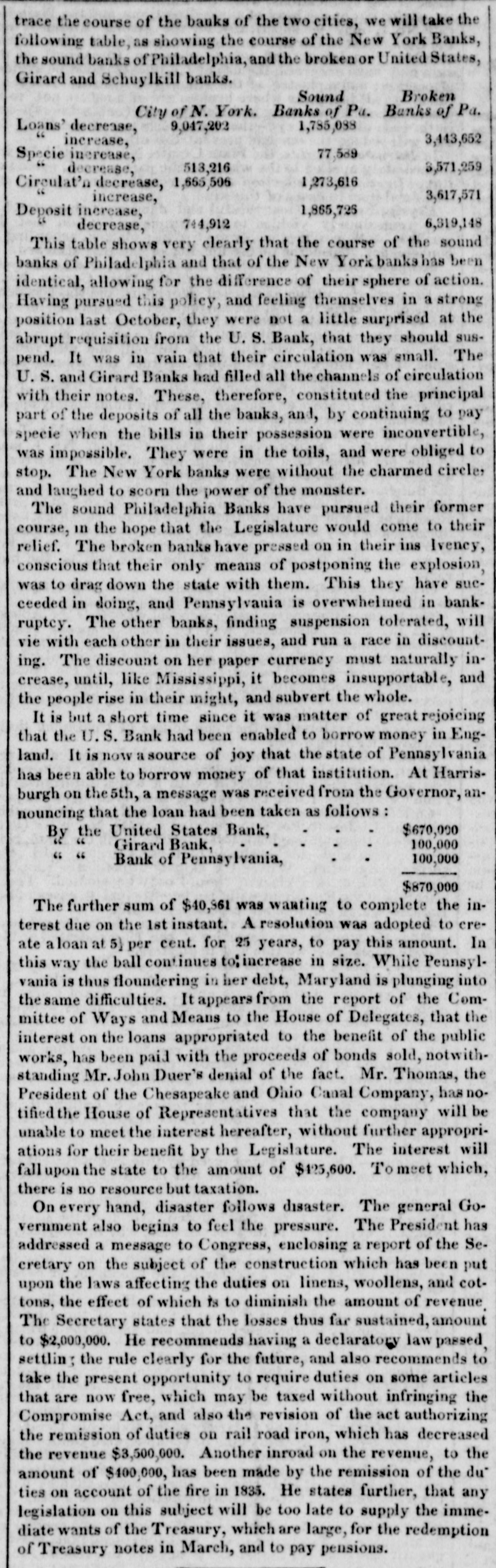
trace the course of the banks of the two cities, we will take the following table, as showing the course of the New York Banks, the sound banks of Philadelphia, and the broken or United States, Girard and Schuylkill banks. Broken Sound City of N. York. Banks of Pá. Banks of Pa. Loans' decrease, 9,047,202 1,785,088 3,443,652 increase, 77,589 Specie increase, 513,216 3,571,259 decrease, 1,273,616 Circulat's decrease, 1,655,506 3,617,571 increase, 1,865,725 Deposit increase, 744,912 6,319,148 decrease, This table shows very clearly that the course of the sound banks of Philad Iphia and that of the New York banks has been identical, allowing for the difference of their sphere of action. Having pursued this policy, and feeling themselves in a strong position last October, they were not a little surprised at the abrupt requisition from the U. S. Bank, that they should suspend. It was in vain that their circulation was small. The U.S. and Girard Banks had filled all the channels of circulation with their notes. These, therefore, constituted the principal part of the deposits of all the banks, and, by continuing to pay specie when the bills in their possession were inconvertible, was impossible. They were in the toils, and were obliged to stop. The New York banks were without the charmed circle, and laughed to scorn the power of the monster. The sound Philadelphia Banks have pursued their former course, in the hope that the Legislature would come to their relief. The broken banks have pressed on in their ins Ivency, conscious that their only means of postponing the explosion was to drag down the state with them. This they have sueceeded in doing, and Pennsylvania is overwhelmed in bankruptcy. The other banks, finding suspension tolerated, will vie with each other in their issues, and run a race in discounting. The discount on her paper currency must naturally increase, until, like Mississippi, it becomes insupportable, and the people rise in their might, and subvert the whole. It is but a short time since it was matter of great rejoicing that the U.S Bank had been enabled to borrow money in England. It is now a source of joy that the state of Pennsylvania has been able to borrow money of that institution. At Harrisburgh on 5th, a message was received from the Governor, announcing that the loan had been taken as follows $670,000 By the United States Bank, " 100,000 Girard Bank, " " 100,000 Bank of Pennsylvania, $870,000 The further sum of $40,361 was wanting to complete the interest due on the 1st instant. A resolution was adopted to create aloan at 5) per cent. for 25 years, to pay this amount. In this way the ball continues to: increase in size. While Pennsylvania is thus floundering in her debt, Maryland is plunging into the same difficulties. It appears from the report of the Committee of Ways and Means to the House of Delegates, that the interest on the loans appropriated to the benefit of the public works, has been paid with the proceeds of bonds sold, notwithstanding Mr. John Duer's denial of the fact. Mr. Thomas, the President of the Chesapeake and Ohio Canal Company, has notified the House of Representatives that the company will be unable to meet the interest hereafter, without further appropriations for their benefit by the Legislature. The interest will fall upon the state to the amount of $125,600. To meet which, there is no resource but taxation. On every hand, disaster follows disaster. The general Government also begins to feel the pressure. The President has addressed a message to Congress, enclosing a report of the Secretary on the subject of the construction which has been put upon the laws affecting the duties on linens, woollens, and cottons, the effect of which is to diminish the amount of revenue The Secretary states that the losses thus far sustained, amount to $2,000,000. He recommends having a declaratory law passed settlin; the rule clearly for the future, and also recommends to take the present opportunity to require duties on some articles that are now free, which may be taxed without infringing the Compromise Act, and also the revision of the act authorizing the remission of duties on rail road iron, which has decreased the revenue $3,500,000. Another inroad on the revenue, to the amount of $400,000, has been made by the remission of the du ties on account of the fire in 1835. He states further, that any legislation on this subject will be too late to supply the immediate wants of the Treasury, which are large, for the redemption of Treasury notes in March, and to pay pensions.


Article from Morning Herald, December 29, 1840

Click image to open full size in new tab

Article Text

on the 1st of February. From the Virginia banks we hav the following returns:- # BANK OF VIRGINIA DEC. 15th, 1840, AB COMPARED WITH DEC. 2, 1839. Resources 1839 1540 Inc. De Loans, 5,664.374 5,3 8,749 355,60 Rea' estate, 26,642 359.492 32,950 Stocks, 675 331 695,035 18.754 Specie 701,796 891,494 189 658 Bank notes, 178,765 508,229 29.444 Tellers deficieney, 539,584 539,554 Due from banks, 167,035 530,285 3:3,249 Expenses 13,754 13.754 Old balances at Pichmond, 60.178 60,175 Deficiency at Richmond, 28 825 24,825 Due from branches, 38,589 28,588 Sterling bilis, 18,999 18,239 $7,783,255 8 674 258 Liabilities. Capital. 3,637,490 3,642 100 4,701 Profit and loss. 143,25 122,952 20,30 Discount, "belonging to slockh. 492.236 492 236 111 832 111.832 Circulation, 2,513,412 3 065.478 553,066 Due banks, 292,031 273.994 18 437 Dividends, 10 514 10. 514 Deposites, 923,501 954 150 30,316 Sarplus, 222,343 222,319 $7,733 255 8,774,255 # FARMER BANK OF VIRGINIA DEC. 1840, AS COMPARED JAN IsT. 1839 Jan. 1839. Dec.1940. Inc'se. Decse. Loads, 5.566 941 4,929,042 657,790 Sterling bills, 18,056 8,605 9,451 Stocks, 4900 203,282 198.382 Specie, 759,937 63 444 29,493 Notes of banks, 148,225 224 805 76.699 Balance due from banks, 207,456 257 80 406 Real estate, 214,242 266/ 5.408 N $6.939,670 6,516 Capital, 2,500 000 2,653 653,150 Immediate Liabilities. Circulation, 123,204 Circulation, 2724,425 2326 402,074 Deposits, 1,014 506 1,0-9,563 4.857 Contingent, 411,907 310.741 71,166 Surplus, 82 932 8.932 Profits, 133,306 63,535 70.271 Due U. S. Bank, 109,026 109,026 State loan, 505,000 505,000 $6,932 670 6,516,073 # BANK OF THE VALLEY OF VIRGINIA. Available Means. Specie, 266 819 Due banks, 25.719 Bark notes, 151,897 Depositors, 179,876 Due from banks, 197,540 Total, $1,028,799 Total, $516,657 Excess of liabilities. $412,141 The Bank of Virginia appears to be a good deal shat- tered by the defalcations of its officers, and has increased its liabilities with diminished resources, and, so far, pro- mises but little for resumption. In the returns appears a curious item, that of profit and loss, belonging to the stockholders, as distinguished from the regular profit and loss account. This requires a little explanation. If the bank caa pay its debts, we apprehend all the surplus be- longs to the stockholders. If it cannot, they merely can- not claim any. The Farmers' Bank appears to be in a better condition than at the period of the former resump- tion. The Illinois Bank has resumed. The Indiana Bank states its ability to do so soon. In Tennessee and Kem- tucky the same profession is not backed by the bank re- turns, as compared with their condition at the time of sus- pension. In every state the ability to pay specie assumes a different phase, while all centres in the movements of the U.S. Bank at Philadelphia. It is avowed that that institution will resume on the 15th January next, according to law. On the 6th of January, however, the annual election of offi cers takes place, and will this year be attended with great excitement, and many developments will undoubt- edly take place, particularly in regard to the old specu- lations of Mr. Biddle and the family. It is well under- stood that all the profits on old speculations were pock- eted by a few individuals, and all losses were saddled upon the bank in the manner of the Whites with the Manhat- tan Bank of this city. It is expected that similar deve- lopments will take place. The New York American and other papers harp now the examination had by the other banks into its affairs, with a view to create confidence. Such examinations are not worth a rush. They are made with the intention to de- ceive. The public mind has still before it the report of the examining committee of the Schuylkill Bank, and the examining committee of the Manhattan Bank, a few weeks before developments, in each case, of the most dishonor- able character. Events may transpire at the election which will give a new face to the question of specie pay- monts. The United States Bank, it appears, is drawing sterling bills on Morrison, Cryder, & Co., of London. This is one means of getting its paper circulation out of the market here, at the moment of resumption, and the bille will be provided for in London by an arrangement be- tween Mr. Jaudon and Morrison & Co., on pledge of the securities carried out by him. By this means an indebt- edness, in the shape of $2,000,000 of bills payable on de- mand here will be transformed into a loan in London, on pledge of stocks. This continued staving off debts must come to an end at last. Those who have had renewals from the bank, must somehow or other pay up, and the longer it is postponed, the more likely those debts are to come within the sweep of a bankrupt law, if such a law should be passed, like that now before Congress, for the sole purpose of releasing the desperate speculators of past years from the results of their folly. A large class of persons, by means of a bloated credit system, got possession of a great amount of property the proceeds of the labor of industry. This they wasted in mad speculations, and now sue to be released from la- boring in return to restore that property. This they call "laboring for others," which they do not want to do. The moral effect of a bankrupt law will be to speculators, what suspension laws are to the banks. It removes re- straint, diminishes the exercise even of common prudence. in the ordinary dealings between man and man, and en- courages hazardous undertakings. The projector argues that if a proposed hazardous undertaking fails, the loss, al- though heavy, will not fall upon him, as the law will re- lease him from future responsibility, and he may then, un- incumbered, again go on in his business, bestowing not a thought upon the ruin he has brought upon some third person whose funds he hazarded. This will be the opera- tion of the insolvent portion of the bankrupt law, while that portion which arms the creditor with new powers to proceed against debtors, cannot but be productive of great mischief among that class, whose debts grow out of the or- dinary losses in trade, and who might, unmolested, work through, and pay all. # Sales at the Stock Exchange $100 Indiana Ronds 660 74 50 do 20 20 shas Manhattan Bk 96 75 do Vick borg Bk 10 25 do D Dook Bk 60 60 50 do do 204 10 50 do do 60 63 100 do do 910 19 35) do do 60 61 50 do do 830 10 10 d 7th Ward Bk 96 50 do do b12m 112 25 do NO Canal 70 50 do do 10 2.0 do Del & Hudson 84 50 do do 3310

Article from The Illinois Free Trader, February 5, 1841

Click image to open full size in new tab

Article Text

Resumption of Specie Payments The Banks of Pennsylvania have at length resumed specie payment, in conformity with the law of that State passed at the last session of the Legislature. A correspondent of the New York Herald, dated on the 15th ult. at Philadelphia, says: "This was resumption day, and has been passed through to the present time, by all our banks, with good order, good humor, and what is more important, good faith. There was no bustle or throng about any of them but the Girard and United States, and very little about the former of these. The latter was pretty well run. There were four men behind the counter, two of them with their coats off and sleeves rolled up, who were actively engaged from the opening to the close, in answering the demand for specie. At the opening of the doors, about 200 persons of all grades and occupations, principally those holding small amounts of bills, entered, and forming into line, they extended into the street, which was kept up for several hours by some new comers. The broken Schuylkill Bank to-day paid all her balances in full in United States Bank Bills--SO that the resumption is complete in Philadelphia." It is to be regretted that the banks of Baltimore have refused to co-operate with those of Philadelphia, as without their aid the resumption in the South-west will not take place. The Baltimore Patriot of the 13th ult. says: We learn that at a meeting of the Presidents of the several Banks in the city of Baltimore, on Monday evening, the question of the resumption of specie payments came up-when a resolution was adopted by a decided vote, that it was inexpedient for the Banks of this city to resume, unless there was a simultaneous act of resumption on the part of the Banks of Virginia." This course by the Baltimore Banks renders it certain that there will be no resumption south of Pennsylvania, and should the report be true that the banks of Baltimore are secretly drawing on the banks of Philadelphia for specie, it may lead to a third suspension there!


Article from Southport Telegraph, March 2, 1841

Click image to open full size in new tab

Article Text

MISCELLANEOUS. From the New Yorker. # Money Matters. 'After a storm comes a calm.' The general excitement and panic caused by the suspension at Philadelphia and its consequences appears to be subsiding, and matters already assume a brighter aspect. There is no probability of a Suspension in this State or New England. New-York is a creditor to nine-tenths of the Union; New England owes no other section. Between these two sections the utmost harmony with mutual confidence exists; and a firm resolution to maintain Specie Payments. It cannot be overcome by any contingency now probable. Our City banks were never so strong as now. They have over five millions in specie, while their entire circulation hardly exceeds that amount. They have at least one million more than on the first of January, and the influx is quite equal to the exportation. They cannot be shaken except by their depositors. Money is of couse not so easily procured as it was a month since. The approach of the Business Season accounts in part for this; the difficulties south of us cause the residue. Aside from all apprehension and precaution on the part of capitalists and Banks, the derangement of exchanges, and the reluctance of merchants to part with their Southern demands at current rates, would naturally create a temporary tightness in the market. We believe our banks are not curtailing their discounts. At Philadelphia, all is yet chaos, though meetings are daily held to devise measures for overcoming the existing difficulties. Party feelings seems also entirely excluded. The prevalent opinion is that the Legislature will legalize the suspension of the Banks, excepting the United States the Girard, and the Schuylkill. These are marked for destruction by a general consent. It is stated that Gov. Porter will veto any bill which favors the United States Bank.