19162. Real Estate Trust Company (Philadelphia, PA)

Bank Information

Episode Type
Suspension → Closure
Bank Type
trust company
Start Date
August 28, 1911
Location
Philadelphia, Pennsylvania (39.952, -75.164)

Metadata

Model
gpt-5-mini
Short Digest
dcc34fb8

Response Measures

None

Description

The articles describe the Real Estate Trust Company as having been wrecked and placed in receivership with George H. Earle, Jr. acting as receiver. Coverage centers on alleged improper loans by the late president, suicide of the president, and linkage to the Pennsylvania Sugar Refining Company/American Sugar interests; there is no description of a depositor run prior to suspension or reopening. Date of receivership is referenced as when Earle became receiver on August 28 (derived from the Nov 24, 1911 article); I use that date (1911-08-28) since the reporting year is 1911.

Events (1)

1. August 28, 1911 Receivership
Newspaper Excerpt
When Mr. Earle was made receiver of the Real Estate Trust Company ... it was found that the late President Frank K. Hipple had, without the knowledge of his directors, lent large sums of money ... Mr. Earle, receiver for the Real Estate Trust Company of Philadelphia, said ... the failure of the trust company and the suicide of its president ... were direct results of a conspiracy ... American Sugar Refining Company
Source
newspapers

Newspaper Articles (5)

Article from The Daily Ardmoreite, June 29, 1911

Click image to open full size in new tab

Article Text

TRUST PIRACY TALE TOLD REVEALING SOME UNWRITTEN HISTORY ON SUGAR to the supreme bench and could not Washington, June 28.-That former undertåke the case. He had seen AsPresident Theodore Roosevelt had sistant Attorney General Purcy, exlost "his preference for large game" plained the case to him and thought because of the failure of the governthe government was going to press ment to prosecute former heads of the the case. American Sugar Refining company Attorney Beck Favored. for the wrecking of the Real Estate "Purdy told me," said Mr. Earle, Trust company of Philadelphia in the "that he wanted all the details. I Pennsylvania Sugar Refining deal in gave them to him. After he heard 1906, was asserted today before the them, he jumped up and said: "We'll house sugar investigating committee send them all to jail.' He said they by George H. Earle, Jr., receiver for wanted to get the best man in the the trust company. The Pennsylvania United States as special counsel in refinery was acquired by the Amerithe case and asked me how James M. can company and promptly closed. Beck former nacistent et men
Article from New-York Tribune, June 30, 1911

Click image to open full size in new tab

Article Text

Ex-President Roosevelt Defended by Representative Madison. LIVELY SUGAR HEARING Adolph Segal Tells Committee He Was Ruined by Kissel's Exactions. [From The Tribune Bureau.] Washington, June 29.-The failure of President Roosevelt to take the advice of George H. Earle, jr., receiver for the Real Estate Trust Company of Philadelphia. who insisted that proceedings should be instituted against the American Sugar Refining Company in 1906, led Mr. Earle to indulge in further criticism of the ex-President before the House investigating committee to-day. Mr. Earle had just warmed up in expressing his opinion of Mr. Roosevelt when adjournment came yesterday. and he resumed operations to-day without missing a stroke. "I used to think Mr. Roosevelt the greatest man in the universe. and the people of Kansas still do," said Mr. Earle, looking straight in the direction of Representative Madison. who a little later defended the ex-President. Mr. Earle then reviewed his efforts to obtain prosecution of the Sugar Trust on the theory that It had wrecked the Real Estate Trust Company and the Pennsylvania Sugar Refining Company, which were linked together financially. Every few minutes Mr. Earle would take a slap at ex-Attorney General Bonaparte, who, he said, had declined to proceed against the trust because he thought the decision in the Knight case made such proceedings impossible. Finally Representative Madison read Attorney General Bonaparte's views, as set forth in a Senate document. "You will never have an administration of law if you try to find excuses for officlals who fail to do their duty," interposed Mr. Earle. "I am not making excuses for anybody, sir." retorted Mr. Madison. "but I admit that I am from Kansas, and that I, like numerous others. still have faith in the sincerity and faith of Theodore Roosevelt. The President relied upon his chief law officer for advice, and there is no evidence before this committee that he had improper motives. I do not agree with the Attorney General's interpretation, but It is not fair to criticise Mr. Roosevelt for accepting the advice of his chief law officer." Mr. Earle amused the committee by saying that he had had only one-personal conversation with the ex-President since the two left college, and then Mr. Roosevelt slapped him on the back and talked Latin to him. "Mr. Roosevelt said. 'I see you understand me,' but I did not understand him, and it made me feel silly to have the President of the United States talk Latin to me," said Mr. Earle. Mr. Earle said he had offered to debate the issue with Mr. Roosevelt in New York last fall but the ex-President declined the opportunity to "overwhelm" him.


Article from The Sun, July 8, 1911

Click image to open full size in new tab

Article Text

# TO QUESTION JUDGE PURDY. Sugar Probe Committee Wants to know Why He Dropped Case. WASHINGTON, July 7. Judge Milton D. Purdy, trust buster of the Roosevelt administration and now a District Judge at Minneapolis, has been requested to appear before the special committee of the House which is investigating the American Sugar Refining Company and the sugar industry generally. Judge Purdy was acting Attorney-General in the interim between the promotion of Justice Moody to the Supreme Court bench and the appointment of Attorney-General Bonaparte. Judge Purdy when he appears before the committee next Tuesday will be asked about statements made recently before the committee by George H. Earle, Jr., receiver of the Real Estate Trust Company of Philadelphia, that Earle laid before Judge Purdy when the latter was Attorney-General evidence that showed that the failure of the trust company and the suicide of its president and the closing of the Pennsylvania Sugar Refinery were direct results of a conspiracy in violation of the anti-trust law for which the American Sugar Refining Company's officials were responsible. Mr. Earle said that when he gave this evidence to Attorney-General Purdy the latter exclaimed: "That is just the kind of a case the Government wants. We will put the in jail" Earle told the committee that Attorney-General Purdy afterward became lukewarm and dropped the case. Attorney-General Bonaparte later refused to rake the matter up and advised President Roosevelt that there was no cause for action The committee wants to know the reasons why Judge Purdy changed his mind and what influences, if any, were brought to bear upon him.


Article from The Guthrie Daily Leader, July 14, 1911

Click image to open full size in new tab

Article Text

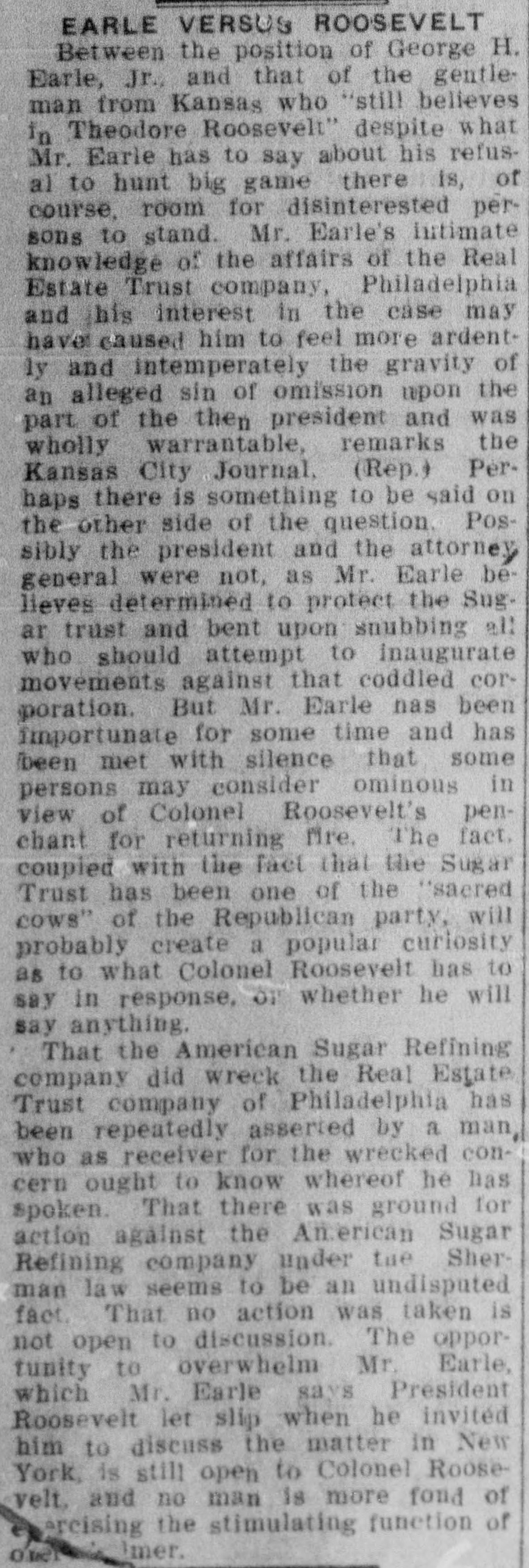
# EARLE VERSUS ROOSEVELT Between the position of George H. Earle, Jr., and that of the gentle-man from Kansas who "still believes in Theodore Roosevelt" despite what Mr. Earle has to say about his refusal to hunt big game there is, of course, room for disinterested persons to stand. Mr. Earle's intimate knowledge of the affairs of the Real Estate Trust company, Philadelphia and his interest in the case may have caused him to feel more ardent-ly and intemperately the gravity of an alleged sin of omission upon the part of the then president and was wholly warrantable, remarks the Kansas City Journal. (Rep.) Perhaps there is something to be said on the other side of the question. Possibly the president and the attorney general were not, as Mr. Earle believes determined to protect the Sugar trust and bent upon snubbing all who should attempt to inaugurate movements against that coddled corporation. But Mr. Earle nas been importunate for some time and has been met with silence that some persons may consider ominous in view of Colonel Roosevelt's penchant for returning fire. The fact, coupled with the fact that the Sugar Trust has been one of the "sacred cows" of the Republican party, will probably create a popular curiosity as to what Colonel Roosevelt has to say in response, or whether he will say anything. That the American Sugar Refining company did wreck the Real Estate Trust company of Philadelphia has been repeatedly asserted by a man, who as receiver for the wrecked concern ought to know whereof he has spoken. That there was ground for action against the American Sugar Refining company under the Sherman law seems to be an undisputed fact. That no action was taken is not open to discussion. The opportunity to overwhelm Mr. Earle, which Mr. Earle says President Roosevelt let slip when he invited him to discuss the matter in New York, is still open to Colonel Roosevelt, and no man is more fond of ercising the stimulating function of one mer.


Article from New-York Tribune, November 24, 1911

Click image to open full size in new tab

Article Text

# The Reorganization Plan. Briefly the plan is this: The helders of the $2,875,000 in outstanding bonds accept their pro rata allotment of $2,500,000 in commen stock. In addition to this stock, $1,500,000 in income bonds will be issued. These bonds are preferred claims on the whole plant, both as to their principal and interest. The interest on the bonds has been fixed at 6 per cent, and it is cumulative in this way—that payment of interest may be deferred until any time up to the close of the ten-year period for which they are issued, at the discretion of the company's directors, An attractive feature of the proposition is that $1,000,000 in common stock will be distributed pro rata at the end of the ten-year period as a bonus on the income bonds. Samuel F. Houston, who is president of The Pennsylvania Sugar Refining Company, was asked to-night about the negotiations in connection with the opening of the plant. He said; In order that you may understand the difficulties that have had to be overcome before the refinery at the Schakamaxon street wharf could he opened, it may be necessary to remind you of certain facts. When Mr. Earle was made receiver of the Real Estate Trust Company, it was found that the late President Frank K. Hipple had, without the knowledge of his directors, lent large sums of money, receiving as security bonds of the Pennsylvania Sugar Refining Company. Further developments showed that a loan had been negotiated through the promoters of the sugar refinery by means of which $1,250,000 was borrowed from certain undisclosed parties in New York, one of the terms of the loan being that representatives of the lenders should compose a majority of the board of the sugar refining company. These representatives had at their first meeting voted that the refinery should not open. This was the condition of affairs when Mr. Earle became receiver of the Real Estate Trust Company on August 28,