19161. Real Estate Trust Company (Philadelphia, PA)

Bank Information

Episode Type
Suspension → Reopening
Bank Type
trust company
Start Date
August 1, 1906*
Location
Philadelphia, Pennsylvania (39.952, -75.164)

Metadata

Model
gpt-5-mini
Short Digest
fa50bce3

Response Measures

None

Description

Articles describe the Real Estate Trust Company of Philadelphia becoming 'involved hopelessly' and suspending (president Hipple committed suicide), George H. Earle was appointed receiver (Aug 28, 1906) and later reorganized and 'put the Real Estate Trust Company ... on its feet' (reports by 1909). No explicit contemporaneous bank run is described; sequence is suspension → receivership/reorganization → reopening.

Events (4)

1. August 1, 1906* Suspension
Cause
Bank Specific Adverse Info
Cause Details
Heavy exposure to Adolph Segal's loans and securities tied up as collateral for the 'sugar trust' loan; pressure from American Sugar Refining Company's handling of Segal's affairs led to insolvency and suspension.
Newspaper Excerpt
The trust company became involved hopelessly and suspended. President Hipple committed suicide.
Source
newspapers
2. August 28, 1906 Receivership
Newspaper Excerpt
After George H. Earle had been made receiver for the Real Estate Trust Company, August 28, 1906, he claimed that the difficulties of the trust company were due to the pressure brought by the American Sugar Refining Company upon Segal ... .
Source
newspapers
3. July 1, 1909 Other
Newspaper Excerpt
He has put the Real Estate Trust Company of Philadelphia on its feet, thus saving the money of thousands of innocent depositors, ... For his services to the trust company he was unanimously elected its president.
Source
newspapers
4. July 1, 1909 Reopening
Newspaper Excerpt
He has put the Real Estate Trust Company of Philadelphia on its feet, thus saving the money of thousands of innocent depositors, and ... For his services to the trust company he was unanimously elected its president.
Source
newspapers

Newspaper Articles (19)

Article from New-York Tribune, January 23, 1909

Click image to open full size in new tab

Article Text

# SEEK A TRUST SUIT. # Senate Adopts Resolution Inquiring Into American Refining Co.'s Action. [From The Tribune Bureau.] Washington, Jan. 22.-Senator Culberson's resolution calling on the Attorney General for the correspondence in connection with a proposed suit against the American Sugar Refining Company for the absorption of the Pennsylvania Sugar Refining Company, which the Senate adopted to-day, grows out of a request made several years ago by George H. Earle, jr., of Philadelphia, that the government join with him in such a suit. Mr. Earle, as receiver for the Real Estate Trust Company, of Philadelphia, proposed to sue the sugar company for its absorption of the Pennsylvania concern, alleging that the interests of the creditors of the trust company were involved, and that their security, consisting of stock of the Pennsylvania company, had been ruined by the decision of the Sugar Trust not to operate the expensive and extensive plant of the Philadelphia concern, a majority of the stock in which had passed to the control of the trust through its having been deposited as collateral for a loan. Attorney General Moody decided that the government could not become party to a private suit, and Attorney General Bonaparte is said to have rendered a similar opinion. It is now alleged by the receiver for the trust company that, according to a recent decision of the Circuit Court, the opinions of the Attorney General have been reversed, and at the instance of friends Senator Culberson has undertaken to ascertain why the Department of Justice will not undertake the prosecution.


Article from Gloucester County Democrat, February 25, 1909

Click image to open full size in new tab

Article Text

It makes us wonder where we are at when we read the testimony before the Senate committee investigating the swallowing of the Tennessee Coal and Iron Company by the Steel Corporation, showing that the president agreed to that violation of the Sherman anti-trust law, and when we read the correspondence which passed between George H. Earle, of Philadelphia, the receiver of the wrecked Real Estate Trust Company, and the Attorney General and the President of the United States. This testimony and this correspondence show us how hollow was the demand of Roosevelt that something be done to the "malefactors of great wealth" for they show that he helped such rich malefactors as Morgan and Frick of the Steel Trust and Havemayer of the Sugar Trust to do as they pleased in spite of the laws.


Article from The Sun, June 3, 1909

Click image to open full size in new tab

Article Text

# BEGGED TO RUN REFINERY TO WHICH MR. PARSONS SAID "I'LL ASK HAVEMEYER," Testimony of John Sparhawk, Jr.. at the Trial of the Pennsylvania Sugar Company's Suit-Earle Justifies the $1,000,000 Loan on Plaintiff's Plant. George H. Earle, Jr., receiver of the Pennsylvania Sugar Refining Company, resumed the witness stand yesterday in the trial of the latter's $30,000,000 suit against the American Sugar Refining Company. John G. Milburn, chief counsel for the defendant, consumed nearly the entire day's session in the cross- examination of the witness. He wanted to know especially if Mr. Earle considered that a refinery without money, a first mortgage for $72,000, a $3,000,000 bond issue mortgage and a plant that had never been in operation would have credit enough to justify the loan of $1,000,000 he had proffered conditionally. The witness thought he had been fully justified in view of the conditions he had made. These provided that he should have abso- lute control of the entire plant until the loan was repaid. The profits accruing from the refinery of sugar in a new, up to date and unusually economical refinery such as the plant of the plaintiff company made the loan a profitable one, he added. Mr. Milburn asked the witness if he did not hold as receiver of the Real Estate Trust Company of Philadelphia an assign- ment made by the Pennsylvania Sugar Refining Company of $2,600,000 worth of its stock now in the hands of the trust as collateral security for the latter's $1.250,000 loan. "We do," replied Mr. Earle. "In fact we hold assignments of all the stocks and bonds of the plaintiff held as security by the American Sugar Refining Company either from Segal or the Pennsylvania Sugar Refining Company." The total assignments of the Pennsyl- vania company thus held by the trust company of which Mr. Earle is president amount to $1,520,000 in bonds and $2,600,000 in stocks, according to Mr. Milburn's calculations. The next witness called was John Spar- hawk, Jr., who as counsel for Adolf Segal told of an interview between John E. Parsons, Samuel Untermyer and him- self in Mr. Parsons's office. The sugar trust was considering selling the plaintiff's refinery, he said, but Mr. Untermyer told Mr. Parsons, according to the witness, that he would enjoin any such sale. Mr. Sparhawk said that Mr. Untermyer told Mr. Parsons that the latter was prevent- ing the plaintiff from repaying the loan by keeping its plant closed. Mr. Untermyer then asked on behalf of the company he represented that it be permitted to put out 1,000 barrels a day. "I'll have to put that up to Havemeyer," Mr. Parsons is reported to have said. "There's no secret as to whom I represent. It is the American Sugar Refining Com- pany."


Article from Evening Star, July 1, 1909

Click image to open full size in new tab

Article Text

FEDERAL GRAND JURY INDICTS SUGAR MEN American Refining Company and Six Directors Charged With Conspiracy. ACCUSED OF VIOLATING THE ANTI-TRUST LAW Fourteen Counts in the Indictment Alleging Restraint of Trade. SEGAL ATTORNEYS ACCUSED Corporation and Eight Individual Defendants Cited to Answer in Court Next Tuesday-Brief History of the Case. NEW YORK. July 1.-The American Sugar Refining Company. six of its directors and two other individuals were indicted by a federal grand jury today on a charge of conspiracy in restraint of trade. The individuals indicted are Washington B. Thomas. president of the American Sugar Refining Company: Arthur Donner and Charles H. Senff and John E. Parsons of New York: John Mayer of Morristown. N. J., and George H. Frazier of Philadelphia. all of whom are directors of the company. Indictments also were found against Gustav E. Kissel and Thomas B. Harnett. counsel for Adolph Segal. There were fourteen counts In the indictment. The indictments charge the corporation, the American Sugar Refining Company and the persons accused of conspiracy in restraint of trade in violation of the Sherman anti-trust law The defendants will answer to the indictments in court next Tuesday. Dates Back to 1896. The thread of events leading up to today's indictments may be traced back to 1896. when Adolph Segal of Philadelphia sold to the American Sugar Refining Company a sugar refinery which he had built and for a time operated, at Camden, N. J. Some years later Segal took over the old Pennsylvania Sugar Refining Company of Philadelphia, which had suspended business in 1898. By 1903 Segal had a new plant nearly completed and was ready to compete in sugar refining. Meantime, however, he had engaged extensively in other real estate promotions and became pressed for funds. Just at this time Gustave Kissel a Wall street broker turned up with an offer to secure for Segal a loan of $1,125,000. which was accepted. It afterward developed that the loan came from the treasury of the American Refining Company. but Segel claims that at the time he did not know this. Shares Turned Over. To secure the loan for his real estate operations Segal entered into a bond with Kissel by which the borrower turned over, along with other security, 26,000 of the 50,000 shares of the Pennsylvania Refining Company, and agreed that the sugar securities should be put in a voting trust, which gave Kissel or whoever he represented control of Segal's sugar company The new controlling interests in the Pennsylvania Sugar Refining Company forthwith elected a new board of directors, and th's board soon afterward passed a resolution that the Segal refinery should net be operated at that time Segal also borrowed heavily from the Real Estate Trust Company of Philadelphia, with which was deposited the securities for the so-called sugar trust loan. President Hipple of the Real Estate Trust Company had been made custodian of these securities The trust company became involved hopelessly and suspended. President Hipple committed suicide. After George H. Earle had been made receiver for the Real Estate Trust Company, August 28, 1906, he claimed that the difficulties of the trust company were due to the pressure brought by the American Sugar Refining Company upon Segal for the discharge of his obligations. while at the same time Segal. not being permitted to operate his refinery. was helpless to pay. Appeal to Department. Mr. Earle appealed to the Department of Justice. alleging. among other things, that the minority interests associated with Segal in his sugar refinery were being defrauded. and that the "trust." in keeping the refinery closed. was acting in restraint of trade. and in violation of the Sherman anti-trust law. Representations made by Earle to Justice Moody, then Attorney General, and subsequently to Attorney General Bonaparte continued. but without the relief sought. It is understood that the att!tude of the Department of Justice was that so far as representations had been made the facts did not differ in theory from the Knight case, in which the federal courts had held that the acquisition of four competing refineries by the American Sugar Refining Company did not constitute a violation of the Sherman anti-trust law. Sult was then brought in the United States district court at New York. the Pennsylvania Sugar Refining Company seeking damages of $30,000,000 from the American Sugar Refining Company. After a trial of two weeks a compromise Was effected on June 8. The exact terms of the settlement have not been made public, but it is understood that the 'sugar trust" canceled the Kissel note of $1,125,000. paid up Segal $2,000,000 in cash in lieu of losses which no claimed he had sustained through the idleness of his refinery and returned to him the 26,000 shares of the Pennsylvania company which had been deposited as security for the loan of 1903. It was this victory over the American Sugar Refining Company which seemed to open the way for a federal suit against that corporation along the lines drawn by Mr. Earle three years ago. Attorney General's Comments. With respect to the indictment found by the grand jury In the New York Sugar Refining Company cases, Attorney General Wickersham said today that the indictment spoke for itself, and he had


Article from Evening Times-Republican, July 1, 1909

Click image to open full size in new tab

Article Text

FEDERAL GRAND JURY CHARGES VIOLATION OF SHERMAN ANTI-TRUST LAW. TRUST FROZE OUT SEGAL WRECKED LOAN COMPANY Interesting Story of American Sugar Refining Company's Unprincipled Measures to Stifle Competition-Indicted Men to Answer in Court Next Tuesday. New York, July 1.-The American Sugar Refining Company, Washington B. Thomas, president, Arthur, Donner, Charles H. Senff, John E. Parsons, John Mayer, George H. Frazier, directors, and Gustav E. Kissel and Thomas B. Harnett, counsel for Adolph Segal, were, today indioted by the federal grand jury on a charge of conspiracy in restraint of trade in violation of the Sherman anti-trust law. Defendants will answer the indictments in court here next Tuesday. The thread of events leading up to today's indictments may be traced back to 1896, when Adolph Segal, of Philadelphia, sold to the American Sugar Refining Company a sugar refinery which he had built and for a time operated at Camden, N. J. Some years later Segal took over the old Pennsylvania Sugar Refining Company, of Philadelphia, which had suspended busIness in 1898. By 1903 Segal had a new plant nearly complete and was ready to compete in sugar refining. Trust's Fine Work. Meantime, however, he had engaged extensively in other real estate promotions and became pressed for funds. Just at this time Gustave Kissel, a Wall street broker, turned up with an offer to secure for Segal a loan of a million and a quarter, which was accepted. It afterwards developed the loan came from the treasury of the American Sugar Refining Company, but Segal claims that at the time he did not know this. To secure the loan for his real estate operations Segal entered Into a bond with Kissel by which the borrower turned over, along with other security, 26,000 of 50,000 shares of the Pennsylvania Refining Company and agreed that the sugar securities should be put in the voting trust, which gave Kissel, or whoever he represented, control of Segal's sugar Company. Wreeked a Trust Company. New controlling interests in Pennsylvania Sugar Reflining Company forthwith elected a new board of directors, and this board soon afterwards passed a resolution that the Segal refinery should not be operated at that from the Real Estate Trust Company, of Philaedlphia, with whom was deposited the securities of the so-called sugar trust loan. President Hipple, of the Real Estate Trust Company, had been made custodian of these securities. The trust company became involved helplessly and suspended. President Hipple committed suicide. After George H. Earle had been made receiver for the Real Estate Trust Company in August, 1906, he claimed the difficulties of the trust company were due to pressure brought by the American Sugar Refiining Company upon Segal for the discharge of his obligations, while at the same time Segal, not being permitted to operate his refinery, was helpless to pay. Earle appealed to the department of justice, alleging among other things that the minority interests associated with Segal in his sugar refinery were being defrauded and that the "trust," in keeping the refinery closed, was acting in restraint of trade and in violation of the Sherman anti-trust law. Justice Department Failed to Act. The representations made by Earle to Justice Moody, then attorney general, and subsequently to Attorney General Bonaparte were continued, but without the relief sought. It is understood the attitude of the department of justice was that so far as the representations had been made the facts did not differ in theory from the Knight


Article from The Princeton Union, July 1, 1909

Click image to open full size in new tab

Article Text

ence the conduct of an honorable man or the suspicions of one of like character. # H. W. Taft Appears In New York. Lawyers and financial men in New York who have followed the sugar trust matter are recalling this corre- spondence with not a little interest. The firm of attorneys "with Washing- ton connections" was Strong & Cad- walader, of which, at the time Mr. Earle wrote, 'both Henry W. Taft, a leading counsel for the sugar trust in all the litigation growing out of the Segal loan, and George W. Wicker- sham, the present attorney general, were members. The fact that Henry W. Taft is an attorney of the sugar trust in this identical Segal case, thus involving the law firm of which Attorney General Wickersham was a member, raises an interesting question as to what the present administration will do toward prosecuting the trust. Judging by the vigor with which Collector Loeb pro- ceeded against the same trust in the matter of the short weight frauds, the law business of Henry W. Taft and of the firm of Strong & Cadwalader will have little or no influence on President Taft, and the prosecution will go for- ward with the same vim that marked Receiver Earle's case. If a private in- dividual could accomplish what he did, what could not the United States gov- ernment accomplish if it proceeded against the trust with all its great power? One of the most remarkable interviews that have appeared in years grew out of this identical suit. It was from no less a man than Sam- ☐☐uel Untermyer, the famous corporation lawyer of New York, who was re- tained by Segal. Mr. Untermyer stated in effect that the government, if it were in earnest, could not only suc- cessfully prosecute the sugar trust, but many other gigantic corporations that pursue the same methods. That inter- view took the lid off. Whatever the government does, how- ■ever, George H. Earle has given the sugar trust a staggering blow. He has not alone wrested from it many mil- lions of dollars, but has shown the country what can be done in curbing criminal combinations by any man who means business. That perhaps is the greatest service of all. Moreover, he has put the Real Estate Trust Com- pany of Philadelphia on its feet, thus saving the money of thousands of in- nocent depositors, and has made it possible for the Pennsylvania Sugar Refining company to open its Camden plant and resume business. For his services to the trust company he was unanimously elected its president. # Other Concerns Saved by Earle. This is but one of a long series of tottering or wrecked institutions that George H. Earle, Jr., has successfully reorganized. Among the others are the Pennsylvania Warehousing and Safe Deposit company, which he took when its stock was down to $5 per share and by cutting out the dead wood, ju- dicious buying of wharfs and busi- ness principles brought it up until its stock is in the neighborhood of $100 per share; the Finance Company of Pennsylvania, which needed a strong bracing and in Earle's hands got it; the Tradesman's National bank, which got into deep water with its stock down to 50, called on Earle, a was set on its feet and now is above par; the Market Street National bank, which was floundering, sent out a hail for Earle and is now selling at a pre- mium of 60; the Reading railroad, which the last time it failed was put back on its feet by Earle and Freder- ick P. Olcott of New York; the Choc- taw, Oklahoma and Gulf railroad, which struck a slump and went under, but with Earle as chairman of its com- mittee of reorganization has been made a paying property, and the Chestnut Street National Bank and Trust company, involving the owner- ship of the great newspaper, the Phila- delphia Record, all three of which Mr. Earle, with the help of one other re- ceiver, put back into flourishing con- dition, although the bank and trust company had actually failed and the paper was heavily involved. This noteworthy triple success was perhaps Earle's greatest achievement up to the time that he reinstated the Real Estate Trust company and the Pennsylvania Sugar Refining company and forced the sugar trust to disgorge several millions of money, credits, stocks and bonds. And now, after the famous street car strike in Philadel- phia, Mr. Earle has been asked by the mayor and councils to take charge of this situation and in a letter that boldly outlines his views and cuts to the heart of the question has consent- ed to do so. The regard with which he is held in Philadelphia is shown by the fact that since his appointment public confidence that the traction question is at last in the hands of a -man who will solve it has been gener- ally expressed. The same trust in his ability and integrity was displayed several years ago when he took charge


Article from Evening Times-Republican, July 1, 1909

Click image to open full size in new tab

Article Text

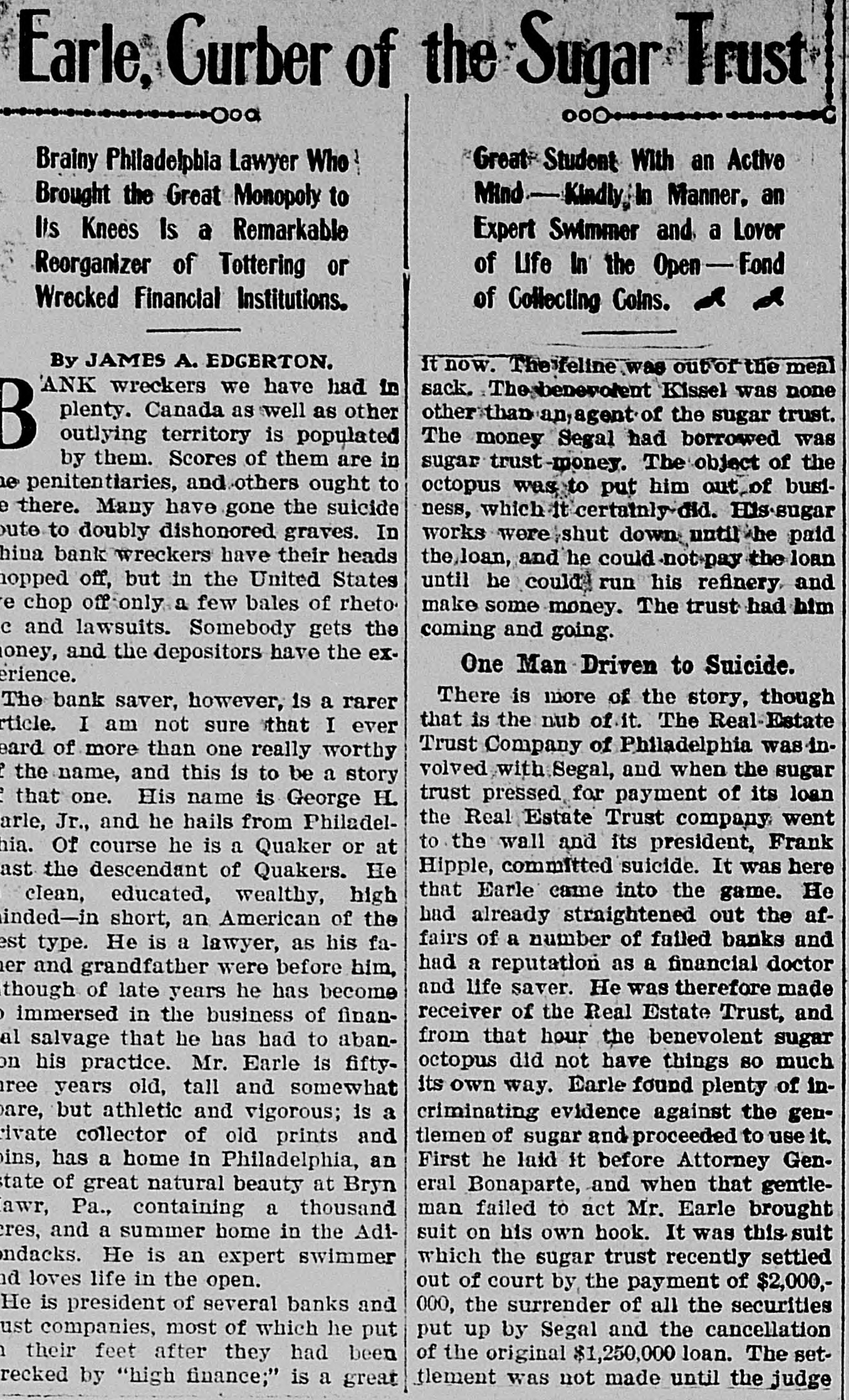
# Earle, Curber of the Sugar Trust Brainy Philadelphia Lawyer Who Brought the Great Monopoly to Its Knees Is a Remarkable Reorganizer of Tottering or Wrecked Financial Institutions. By JAMES A. EDGERTON. BANK wreckers we have had in plenty. Canada as well as other outlying territory is populated by them. Scores of them are in the penitentiaries, and others ought to be there. Many have gone the suicide route to doubly dishonored graves. In China bank wreckers have their heads chopped off, but in the United States we chop off only a few bales of rhetoric and lawsuits. Somebody gets the money, and the depositors have the ex-perience. The bank saver, however, is a rarer article. I am not sure that I ever heard of more than one really worthy of the name, and this is to be a story of that one. His name is George H. Earle, Jr., and he hails from Philadelphia. Of course he is a Quaker or at least the descendant of Quakers. He is clean, educated, wealthy, high minded—in short, an American of the best type. He is a lawyer, as his father and grandfather were before him, though of late years he has become so immersed in the business of finan-cial salvage that he has had to abandon his practice. Mr. Earle is fifty-three years old, tall and somewhat spare, but athletic and vigorous; is a private collector of old prints and coins, has a home in Philadelphia, an estate of great natural beauty at Bryn Mawr, Pa., containing a thousand acres, and a summer home in the Adi-rondacks. He is an expert swimmer and loves life in the open. He is president of several banks and trust companies, most of which he put on their feet after they had been wrecked by "high finance;" is a great # Great Student With an Active Mind—Kindly In Manner, an Expert Swimmer and, a Lover of Life In the Open—Fond of Collecting Coins. It now. The feline was out of the meal sack. The benevolent Kissel was none other than an agent of the sugar trust. The money Segal had borrowed was sugar trust-money. The object of the octopus was to put him out of busi-ness, which it certainly did. His sugar works were shut down until he paid the loan, and he could not pay the loan until he could run his refinery and make some money. The trust had him coming and going. # One Man Driven to Suicide. There is more of the story, though that is the nub of it. The Real Estate Trust Company of Philadelphia was in-volved with Segal, and when the sugar trust pressed for payment of its loan the Real Estate Trust company went to the wall and its president, Frank Hipple, committed suicide. It was here that Earle came into the game. He had already straightened out the af-fairs of a number of failed banks and had a reputation as a financial doctor and life saver. He was therefore made receiver of the Real Estate Trust, and from that hour the benevolent sugar octopus did not have things so much its own way. Earle found plenty of in-criminating evidence against the gen-tlemen of sugar and proceeded to use it. First he laid it before Attorney General Bonaparte, and when that gentle-man failed to act Mr. Earle brought suit on his own hook. It was this suit which the sugar trust recently settled out of court by the payment of $2,000,000, the surrender of all the securities put up by Segal and the cancellation of the original $1,250,000 loan. The set-tlement was not made until the judge


Article from Atlanta Semi-Weekly Journal, July 2, 1909

Click image to open full size in new tab

Article Text

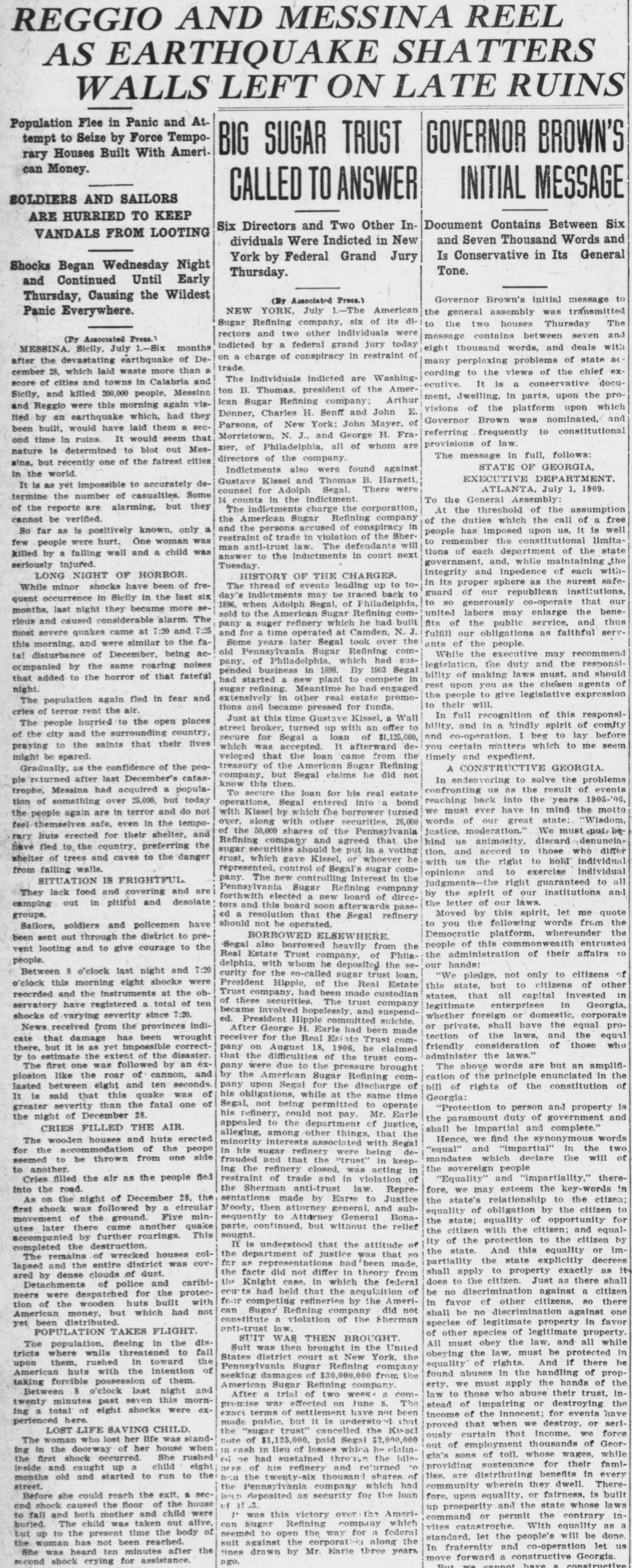
REGGIO AND MESSINA REEL AS EARTHQUAKE SHATTERS WALLS LEFT ON LATE RUINS Population Flee in Panic and Attempt to Seize by Force TempoGOVERNOR BROWN'S BIG SUGAR TRUST rary Houses Built With American Money. INITIAL MESSAGE CALLED TO ANSWER SOLDIERS AND SAILORS ARE HURRIED TO KEEP Document Contains Between Six Six Directors and Two Other InVANDALS FROM LOOTING and Seven Thousand Words and dividuals Were Indicted in New Is Conservative in Its General York by Federal Grand Jury Shocks Began Wednesday Night Tone. Thursday. and Continued Until Early Thursday, Causing the Wildest Governor Brown's initial message to (By Associated Press.) NEW YORK, July 1.-The American the general assembly was transmitted Panic Everywhere. Sugar Refining company, six of its dito the two houses Thursday The rectors and two other individuals were message contains between seven and (Py Associated Press.) indicted by a federal grand jury today eight thousand words, and deals with MESSINA. Sicily, July 1.-Six months on a charge of conspiracy in restraint of after the devastating earthquake of Demany perplexing problems of state actrade. cember 28, which laid waste more than a cording to the views of the chief exThe individuals indicted are Washingscore of cities and towns in Calabria and ecutive. It is a conservative docuton B. Thomas, president of the AmerSicily, and killed 200,000 people, Messina ment, dwelling, in parts, upon the proIcan Sugar Refining company; Arthur and Reggio were this morning again visvisions of the platform upon which Donner, Charles H. Senff and John E. ited by an earthquake which, had they Governor Brown was nominated, and Parsons, of New York: John Mayer, of been built, would have laid them a secreferring frequently to constitutional Morristown, N. J., and George H. Fraond time in ruins. It would seem that provisions of law. zier, of Philadelphia, all of whom are nature is determined to blot out MesThe message in full, follows: directors of the company. sina, but recently one of the fairest cities STATE OF GEORGIA, Indictments also were found against in the world. EXECUTIVE DEPARTMENT. Gustave Kissel and Thomas B. Harnett, It is as yet impossible to accurately deATLANTA, July 1, 1909. counsel for Adolph Segal. There were termine the number of casualties. Some 14 counts in the indictment. To the General Assembly: of the reports are alarming, but they The indictments charge the corporation, At the threshold of the assumption the American Sugar Refining company cannot be verified. of the duties which the call of a free and the persons accused of conspiracy in So far as is positively known. only a people has imposed upon us, it is well restraint of trade in violation of the Sherto remember the constitutional limitafew people were hurt, One woman was man anti-trust law. The defendants will tions of each department of the state killed by a falling wall and a child was answer to the indictments in court next government, and, while maintaining the seriously injured. Tuesday. integrity and inpedence of each withLONG NIGHT OF HORROR. HISTORY OF THE CHARGES. in its proper sphere as the surest safeThe thread of events leading up to toWhile minor shocks have been of freguard of our republican institutions, day's indictments may be traced back to quent occurrence in Sicily in the last six to so generously co-operate that our 1896, when Adolph Segal, of Philadelphia, months, last night they became more seunited labors may enlarge the benesold to the American Sugar Refining comrious and caused considerable alarm. The fits of the public service, and thus pany a suger refinery which he had built most severe quakes came at 7:20 and 7:25 and for a time operated at Camden, N. J. fulfill our obligations as faithful servSome years later Segal took over the this morning, and were similar to the faants of the people. old Pennsylvania Sugar Refining comWhile the executive may recommend tal disturbance of December, being acpany, of Philadelphia, which had suslegislation, the duty and the responsicompanied by the same roaring noises pended business in 1898. By 1903 Segal bility of making laws must. and should that added to the horror of that fateful had started a new plant to compete in rest upon you as the chosen agents of sugar refining. Meantime he had engaged night. the people to give legislative expression extensively in other real estate promoThe population again fled in fear and to their will. tions and became pressed for funds. cries of terror rent the air. In full recognition of this responsiJust at this time Gustave Kissel, a Wall The people hurried to the open places bility. and in a kindly spirit of comity street broker, turned up with an offer to of the city and the surrounding country, and co-operation. I beg to lay before secure for Segal a loan of $1,125,000, you certain matters which to me seem praying to the saints that their lives which was accepted. It afterward developed that the loan came from the might be spared. timely and expedient. treasury of the American Sugar Refining A CONSTRUCTIVE GEORGIA. Gradually, as the confidence of the peocompany, but Segal claims he did not ple returned after last December's catasIn endeavoring to solve the problems know this then. confronting us as the result of events trophe, Messina had acquired a populaTo secure the loan for his real estate reaching back into the years 1905-'06, tion of something over 25,000, but today operations, Segal entered into a bond we must ever have in mind the motto with Kissel by which the borrower turned the people again are in terror and do not words of our great state: "Wisdom, over, along with other securities, 26,000 el-themselves safe, even in the tempojustice, moderation." We must "put, beof the 50,000 shares of the Pennsylvania rary huts erected for their shelter, and Refining company and agreed that the hind us animosity, discard -denunciahave fled to, the country, preferring the sugar securities should be put in a voting tion, and accord to those who differ shelter of trees and caves to the danger trust, which gave Kissel, or whoever he with us the right to hold individual represented, control of Segal's sugar comfrom falling walls. opinions and to exercise individual pany. The new controlling Interest in the SITUATION IS FRIGHTFUL judgments-the right guaranteed to all Pennsylvania Sugar Refining company They lack food and covering and are by the spirit of our institutions and forthwith elected a new board of directhe letter of our laws. camping out in pitiful and desolate tors and this board soon afterwards passMoved by this spirit, let me quote groups. ed a resolution that the Segal refinery to you the following words from the should not be operated. Sailors, soldiers and policemen have Democratic platform, whereunder the BORROWED ELSEWHERE been sent out through the district to prepeople of this commonwealth entrusted Segal also borrowed heavily from the vent looting and to give courage to the the administration of their affairs TO Real Estate Trust company, of Philapeople. our hands: delphia. with whom he deposited the seBetween 8 o'clock last night and 7:20 curity for the so-called sugar trust loan. "We pledge, not only to citizens of o'clock this morning eight shocks were President Hipple, of the Real Estate this state, but to citizens of other Trust company, had been made custodian recorded and the instruments at the obstates, that all capital invested in of these securities. The trust company servatory have registered a total of ten legitimate enterprises in Georgia, became involved hopelessly, and suspendwhether foreign or domestic, corporate shocks of varying severity since 7:20. ed. President Hipple committed suicide. or private, shall have the equal proNews received from the provinces indiAfter George H. Earle had been made tection of the laws, and the equal cate that damage has been wrought receiver for the Real Estate Trust comfriendly consideration of those who there, but it is as yet impossible correctpany on August 18, 1906, he claimed administer the laws." ly to estimate the extent of the disaster. that the difficulties of the trust comThe first one was followed by an éxThe above words are but an amplifipany were due to the pressure brought cation of the principle enunciated in the plosion like the roar of cannon, and by the American Sugar Refining comlasted between eight and ten seconds. pany upon Segal for the discharge of bill of rights of the constitution of his obligations, while at the same time It is said that this quake was of Georgia: Segal, not being permitted to operate greater severity than the fatal one of "Protection to person and property is his refinery, could not pay. Mr. Earle the night of December 28. the paramount duty of government and appealed to the department of justice, CRIES FILLED THE AIR. shall be impartial and complete." alleging, among other things, that the Hence, we find the synonymous words The wooden houses and huts erected minority interests associated with Segal "equal" and "impartial" in the two for the accommodation of the peope in his sugar refinery were being demandates which declare the will of seemed to be thrown from one side frauded and that the "trust" in keepthe sovereign people another. to ing the refinery closed, was acting in restraint of trade and in violation of Cries filled the air as the people fied "Equality" and "impartiality," thereinto the road. fore, we may esteem the key-words in the Sherman anti-trust law. Representations made by Earge to Justice As on the night of December 28, the the state's relationship to the ctizen: Moody, then attorney general. and subfirst shock was followed by a circular equality of obligation by the citizen to sequently to Attorney General Bonamovement of the ground. Five minthe state; equality of opportunity for parte, continued, but without the relief utes later there came another quake the citizen with the citizen; and equalsought. accompanied by further roarings. This ity of the protection to the citizen by It is understood that the attitude of completed the destruction. the state. And this equality or imthe department of justice was that SO The remains of wrecked houses colpartiality the state explicitly decrees for as representations had been made, lapsed and the entire district was covshall apply to property exactly as it the facts did not differ in theory from sred by dense clouds of dust. does to the citizen. Just as there shall the Knight case. in which the federal Detachments of police and caribibe no discrimination against a citizen cour ts had held that the acquisition of neers were despatched for the protecfour competing refineries by the Ameriin favor of other citizens, SO there tion of the wooden huts built with can Sugar Refining company did not shall be no discrimination against one American money, but which had not constitute a violation of the Sherman yet been distributed. species of legitimate property in favor anti-trust law. POPULATION TAKES FLIGHT. of other species of legitimate property. SUIT WAS THEN BROUGHT. All must obey the law, and all while The population, fleeing in the disSuit was then brought in the United tricts where walls threatened to fall obeying the law, must be protected in States district court at New York. the upon them, rushed in toward the equality of rights. And if there he Pennsylvania Sugar Refining company American huts with the intention of found abuses in the handling of propseeking damages of $30,000,000 from the taking forcible possession of them. erty, we must apply the hands of the American Sugar Refining company. Between 8 o'clock last night and law to those who abuse their trust, inAfter a trial of two weeks a comtwenty minutes past seven this mornpromise was effected on June 8. The stead of impairing or destroying the ing a total of eight shocks were exexact terms of settlement have not been income of the innocent; for events have perienced here. made public. but it is understond that proved that when we destroy, or seriLOST LIFE SAVING CHILD. the "sugar trust" cancelled the Kissel ously curtain that income, we force The woman who lost her life was standnote of $1,125,000, paid Segal $2,000,000 out of employment thousands of Georin cash in lieu of losses which he claiming in the doorway of her house when gia's sons of toil. whose wages, while the first shock occurred. She rushed cii ne had sustained through the idleproviding sustenance for their famiDOFS of his refinery and returned to inside and caught up a child eight lies. are distributing benefits in every months old and started to run to the han the twenty-six thousand shares of community wherein they dwell. Therestreet. the Pennsylvania company which had Before she could reach the exit, a secfore. upon equality. or fairness, is built been deposited as security for the loan If 3. of end shock caused the floor of the house up prosperity and the state whose laws to fall and both mother and child were 1' was this victory over the Americommand or permit the contrary incan Sugar Refining company which burled. The child was taken out alive, vites catastrophe. With equality as a seemed to open the way for a federal but up to the present time the body of standard. let the people's will be done suit against the corporat along the the woman has not been reached. In fraternity and co-operation let us She was heard ten minutes after the lines drawn by Mr Earle three years move forward a constructive Georgia ago. second shock crying for assistance. constructive
Article from The Bemidji Daily Pioneer, July 2, 1909

Click image to open full size in new tab

Article Text

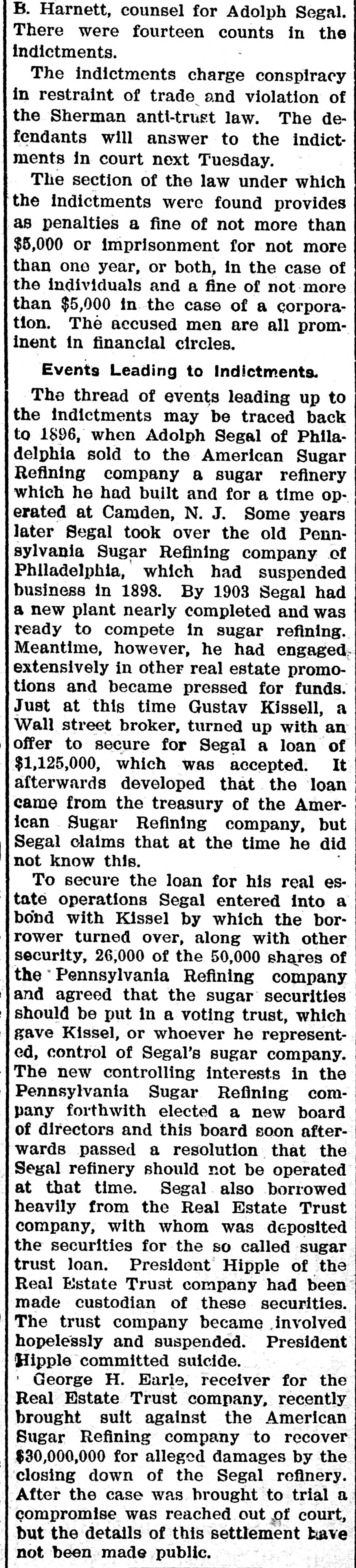
B. Harnett, counsel for Adolph Segal. There were fourteen counts in the indictments. The indictments charge conspiracy in restraint of trade and violation of the Sherman anti-trust law. The defendants will answer to the indictments in court next Tuesday. The section of the law under which the indictments were found provides as penalties a fine of not more than $5,000 or imprisonment for not more than one year, or both, in the case of the individuals and a fine of not more than $5,000 in the case of a corporation. The accused men are all prominent in financial circles. Events Leading to Indictments. The thread of events leading up to the indictments may be traced back to 1896, when Adolph Segal of Philadelphia sold to the American Sugar Refining company a sugar refinery which he had built and for a time operated at Camden, N. J. Some years later Segal took over the old Pennsylvania Sugar Refining company of Philadelphia, which had suspended business in 1898. By 1903 Segal had a new plant nearly completed and was ready to compete in sugar refining. Meantime, however, he had engaged extensively in other real estate promotions and became pressed for funds. Just at this time Gustav Kissell, a Wall street broker, turned up with an offer to secure for Segal a loan of $1,125,000, which was accepted. It afterwards developed that the loan came from the treasury of the American Sugar Refining company, but Segal claims that at the time he did not know this. To secure the loan for his real estate operations Segal entered into a bond with Kissel by which the borrower turned over, along with other security, 26,000 of the 50,000 shares of the Pennsylvania Refining company and agreed that the sugar securities should be put in a voting trust, which gave Kissel, or whoever he represented, control of Segal's sugar company. The new controlling interests in the Pennsylvania Sugar Refining company forthwith elected a new board of directors and this board soon afterwards passed a resolution that the Segal refinery should not be operated at that time. Segal also borrowed heavily from the Real Estate Trust company, with whom was deposited the securities for the so called sugar trust loan. President Hipple of the Real Estate Trust company had been made custodian of these securities. The trust company became involved hopelessly and suspended. President Hipple committed suicide. George H. Earle, receiver for the Real Estate Trust company, recently brought suit against the American Sugar Refining company to recover $30,000,000 for alleged damages by the closing down of the Segal refinery. After the case was brought to trial a compromise was reached out of court, but the details of this settlement have not been made public.


Article from Los Angeles Herald, July 2, 1909

Click image to open full size in new tab

Article Text

HEAD OF SUGAR TRUST INDICTED PRESIDENT AND SEVEN OTHER MEN ACCUSED SIX DIRECTORS INVOLVED IN CONSPIRACY CHARGES Officers of American Refining Company Are Declared Guilty of Plot to Restrain Trade of Product (By Associated Press.) NEW YORK, July 1.-The American Sugar Refining company, six of its directors and two other individuals were indicted by the federal grand jury today on a charge of conspiracy in restraint of trade. The individuals indicted are Washington P. Thomas, president of the American Sugar Refining company; Arthur Dojer, Charles H. Sneff and John E. Parsons of New York; John Mayer of Morristown, N. J., and George H. Frazier of Pennsylvania, all of whom are directors of the company. Indictments also were found against Gustave Kissel and Thomas B. Harnett, counsel for Adolph Segal. There are fourteen counts in the indictment. The indictments charge the corporation, the American Sugar Refining company, and the persons accused of conspiracy in restraint of trade in violation of the Sherman anti-trust law. The defendants will answer to the indictments in court next Tuesday. When Case Started The events leading up to today's indictments may be traced back to 1896, when Adolph Segal of Philadelphia sold to the American Sugar Refining company a refinery which he had built and for a time operated at Camden, N. J. Years later Segal took over the old Pennsylvania Sugar Refining company of Philadelphia, which had suspended business in 1898. By 1903 Segal had a new plant nearly completed. Meantime, however, he had engaged extensively in real estate promotions and became pressed for funds. Just at this time Gustave Kissel, a broker, turned up with an offer to obtain for Segal a loan of $1,125,000, which was accepted. The loan came from the treasury of the American Sugar Refining company, but Segal claims that he did not know this. To secure the loan Segal entered into a bond with Kissel by which the borrower turned over, along with other securities, 26,000 of the 50,000 shares of the Pennsylvania refining company, and agreed that the sugar securities should be put in a voting trust, which gave Kissel or whoever he represented control of Segal's company. Elect New Directors The new controlling interest in the Pennsylvania Sugar Refining company forthwith elected a new board of directors, and this board soon afterward ruled that the Segal refinerv should not then be operated. Segal also borrowed heavily from the Real Estate Trust company of Philadelphis, with which he deposited the secur.ties of the so-called sugar trust loan. President Hipple of the Real Estate Trust company had been made custodian of these securities. The trust company became hopelessly involved and suspended. President Hipple committed suicide. After George H. Earle had been made receiver for the Real Estate Trust company on August 28, 1906, he claimed the difficulties were due to the pressure brought by the American Sugar Refining company upon Segal for the discharge of his obligations, while Segal, not being permitted to operate his refinery, was helpless to pay. Mr. Earle appealed to the department of justice, alleging among other things that the minority interests associated with Segal were being defrauded and that the "trust" was acting in violation of the Sherman antitrust law. This appeal brought no result. Suit Then Resulted Suit was then brought in the United States district court at New York, the Pennsylvania Sugar company seeking damages of $30,000,000 from the American Sugar Refining company. After a trial of two weeks a compromise was effected. The exact terms of the settlement have not been made public, but it is understood that the sugar trust cancelled the Kissel note of $1.125.000, paid Segal $2,000,000 in cash in lieu of losses which he claimed he had sustained through the idleness of his refinery and returned to him the 26,000 shares of the Pennsylvania company which had been deposited as security for the loan of 1903. The section of the law under which the indictments were found provides as penalties a fine of not more than $5000 or imprisonment for not more than one year or both, in the case of individuals, and a fine of not more than $5000 in the cases of a corporation. The indictments charged that "for six years prior to the finding of this indictment and continuously since" the defendants have been engaged in the restraint of trade. The indicted men are all prominent in financial circles.


Article from The Salt Lake Herald, July 2, 1909

Click image to open full size in new tab

Article Text

SUGAR TRUST INDICTED BY FEDERAL JURY District Attorney's View of the Uselessness of Prosecution Not Conceded. MEN AT THE TOP WILL HAVE TO STAND TRIAL PENITENTIARY IF CONVICTION IS SECURED IN THE CASE OF THE PRESIDENT AND OFFICERS. New York, July 1.-The American Sugar Refining company, six of its directors and two other individuals, were indicted by a federal grand jury today on a charge of conspiracy in restraint of trade. The individuals indicted are Washington B. Thomas, president of the American Sugar Refining company Arthur Dojer and Charles H. Sneff and John E. Parsons of New York John Mayer of Morristown. N J., and George H. Frazier of Philadelphia. all of whom are directors of the company Indictments also were found against Gustave Kissel and Thomas B. Halsett. counsel for Adolph Segal. There are fourteen counts in the indictments. The indictments charge the corporation, the American Sugar company and the accused of conspiracy in restraint of trade in violation of the Sherman anti-trust law. The defendants will answer to the indictments in court next Tuesday. History of the Case. The events leading up to today's indictments may be traced back to 1896, when Adolph Segal of Philadelphia sold to the American Sugar Refining company a refinery which he had built and for a time operated at Camden, N L Some years later Segal took over the old Pennsylvania Sugar Refining company of Philadelphia, which had suspended business in 1898. By 1903 Segal had a new plant nearly con pleted and was ready to compete in sugar refining Meantime however. he had engaged extensively in other real estate promotions and became pressed for funds. Just at this time Gustave Kissel, a Wall street broker, turned up with an offer to obtain for Segal a loan of $1,125,000. which was accepted. It afterward developed that the loan came from the treasury of the American Sugar Refining company, but Segal claims that at the time he did not know this. Contract Secured. To secure the loan for his real estate operations Segal entered into a bond with Kissel by which the borrower turned over, along with other security, 26,000 of the 50,000 shares of the Ponnisylvania Refining company and agreed that the sugar securities should be put in a voting trust which gave Kissel or whoever he represented control of Segal's company The new controlling interest in the Pennsylvania Sugar Refining company forthwith elected a new board of directors and this board soon afterward adopted a resolution that the Segal refinery should not be operated at that time. Segal also borrowed heavily from the Real Estate Trust company of Philadelphit, with which he deposited the securities of the so-called sugar trust loan. President Hipple of the Real Estate Trust company, had been made custodian of these securities. The trust company became involved hopelessly and suspended. President Hipple committed suicide. No Relief at Washington. After George H. Earle had been made receiver for the Real Estate Trust company on Aug. 28, 1906, he claimed the difficulties of the trust company were due to the pressure brought by the American Sugar Refining company upon Segal for the discharge of his obligations, while at the same time Segal, not being permitted to operate his refinery was helpless to pay Mr. Earle appealed to the department of justice, alleging among other things that the minority interests assoclated with Segal in his sugar refinery were being defrauded and that the "trust, in keeping the refineryclosed. was acting in restraint of trade and in violation of the Sherman anti-trust law Representations made by Earle to Justice Moody, then attorney general, and subsequently to Attorney General Bonaparte continued, but without the relief sought. It is understood the attitude of the department of justice was that so far as representa tions had been made the facts did not differ in theory from the Knight case, in which the federal courts had held that the acquisition of four competing refineries by the American Sugar Refining company did not constitute a violation of the Sherman anti-trust law. Suit Finally Brought. Suit was then brought in the United States district court at New York, the Pennsylvania Sugar company seeking damages of $20,000,000 from the American Sugar Refining company After a trial of two weeks a compromise was effected on June 8. The exact terms of the settlement have not been made public, but it is understood the sugar trust cancelled the Kissel note of $1,125,000. paid Segal $2,000,000 in cash in Heu of losses which he claimed he had sustained through the idleness of his refinery and returned to him the 26,000 shares of the Pennsylvania company. which had been deposited as security for the loan of 1903. It was this victory over the American Continued on Page 2.


Article from The Salt Lake Tribune, July 2, 1909

Click image to open full size in new tab

Article Text

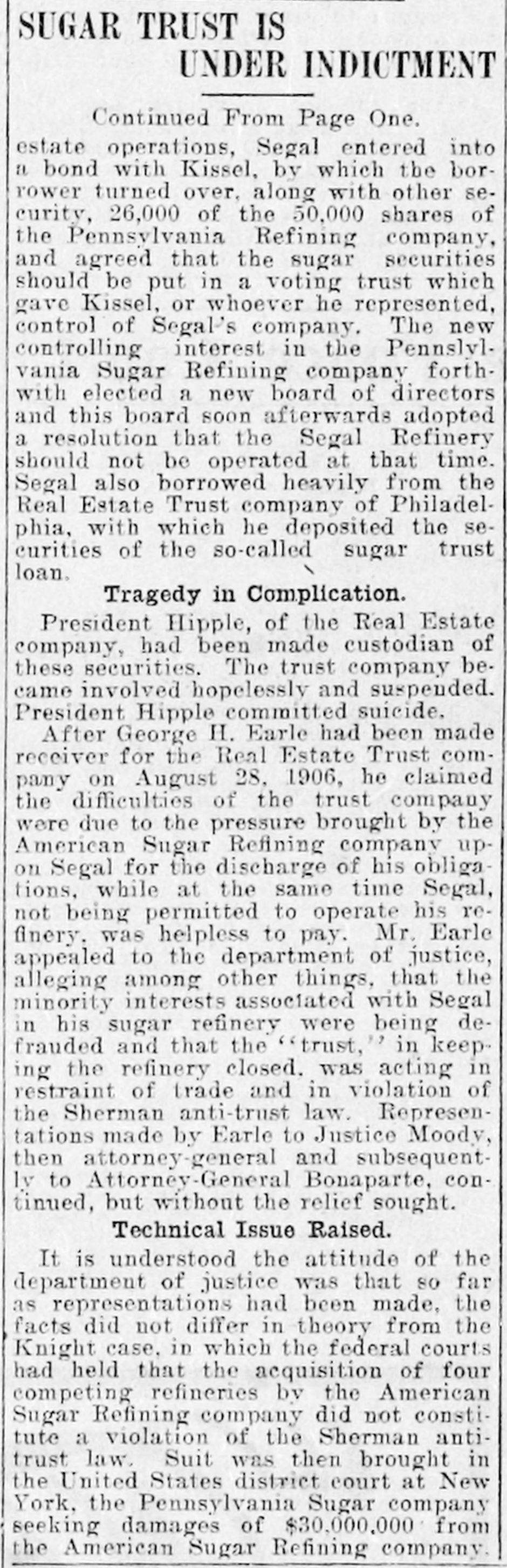
SUGAR TRUST IS UNDER INDICTMENT Continued From Page One. estate operations, Segal entered into a bond with Kissel, by which the borrower turned over, along with other security, 26,000 of the 50,000 shares of the Pennsylvania Refining company, and agreed that the sugar securities should be put in a voting trust which gave Kissel, or whoever he represented, control of Segal's company. The new controlling interest in the Pennslylvania Sugar Refining company forthwith elected a new board of directors and this board soon afterwards adopted a resolution that the Segal Refinery should not be operated at that time. Segal also borrowed heavily from the Real Estate Trust company of Philadelphia, with which he deposited the securities of the so-called sugar trust loan. Tragedy in Complication. President Hipple, of the Real Estate company, had been made custodian of these securities. The trust company became involved hopelessly and suspended. President Hipple committed suicide. After George H. Earle had been made receiver for the Real Estate Trust company on August 28, 1906, he claimed the difficulties of the trust company were due to the pressure brought by the American Sugar Refining company upon Segal for the discharge of his obligations, while at the same time Segal, not being permitted to operate his refinery, was helpless to pay. Mr. Earle appealed to the department of justice, alleging among other things, that the minority interests associated with Segal in his sugar refinery were being defrauded and that the "trust," in keeping the refinery closed. was acting in restraint of trade and in violation of the Sherman anti-trust law. Representations made by Earle to Justice Moody, then attorney-general and subsequently to Attorney-General Bonaparte, continued, but without the relief sought. Technical Issue Raised. It is understood the attitude of the department of justice was that 80 far as representations had been made, the facts did not differ in theory from the Knight case, in which the federal courts had held that the acquisition of four competing refineries by the American Sugar Refining company did not constitute a violation of the Sherman antitrust law. Suit was then brought in the United States district court at New York, the Pennsylvania Sugar company seeking damages of $30,000,000 from the American Sugar Refining company.


Article from Rock Island Argus, July 7, 1909

Click image to open full size in new tab

Article Text

# H. W. Taft Appears In New York. Lawyers and financial men in New York who have followed the sugar trust matter are recalling this correspondence with not a little interest. The firm of attorneys "with Washington connections" was Strong & Cadwalader, of which, at the time Mr. Earle wrote, both Henry W. Taft, a leading counsel for the sugar trust in all the litigation growing out of the Segal loan, and George W. Wickersham, the present attorney general, were members. The fact that Henry W. Taft is an attorney of the sugar trust in this identical Segal case, thus involving the law firm of which Attorney General Wickersham was a member, raises an interesting question as to what the present administration will do toward prosecuting the trust. Judging by the vigor with which Collector Loeb proceeded against the same trust in the matter of the short weight frauds, the law business of Henry W. Taft and of the firm of Strong & Cadwalader will have little or no influence on President Taft, and the prosecution will go forward with the same vim that marked Receiver Earle's case. If a private individual could accomplish what he did, what could not the United States government accomplish if it proceeded against the trust with all its great power? One of the most remarkable interviews that have appeared in years grew out of this identical suit. It was from no less a man than Samuel Untermyer, the famous corporation lawyer of New York, who was retained by Segal. Mr. Untermyer stated in effect that the government, if it were in earnest, could not only successfully prosecute the sugar trust, but many other gigantic corporations that pursue the same methods. That interview took the lid off. Whatever the government does, however, George H. Earle has given the sugar trust a staggering blow. He has not alone wrested from it many millions of dollars, but has shown the country what can be done in curbing criminal combinations by any man who means business. That perhaps is the greatest service of all. Moreover, he has put the Real Estate Trust Company of Philadelphia on its feet, thus saving the money of thousands of innocent depositors, and has made it possible for the Pennsylvania Sugar Refining company to open its Camden plant and resume business. For his services to the trust company he was unanimously elected its president. # Other Concerns Saved by Earle. This is but one of a long series of tottering or wrecked institutions that George H. Earle, Jr., has successfully reorganized. Among the others are the Pennsylvania Warehousing and Safe Deposit company, which he took when its stock was down to $5 per share and by cutting out the dead wood, judicious buying of wharfs and business principles brought it up until its stock is in the neighborhood of $100 per share; the Finance Company of Pennsylvania, which needed a strong bracing and in Earle's hands got it; the Tradesman's National bank, which got into deep water with its stock down to 50, called on Earle, was set on its feet and now is above par; the Market Street National bank, which was floundering, sent out a hail for Earle and is now selling at a premium of 60; the Reading railroad, which the last time it failed was put back on its feet by Earle and Frederick P. Olcott of New York; the Choctaw, Oklahoma and Gulf railroad, which struck a slump and went under, but with Earle as chairman of its committee of reorganization has been made a paying property, and the Chestnut Street National Bank and Trust company, involving the ownership of the great newspaper, the Philadelphia Record, all three of which Mr. Earle, with the help of one other receiver, put back into flourishing condition, although the bank and trust company had actually failed and the paper was heavily involved. This noteworthy triple success was perhaps Earle's greatest achievement up to the time that he reinstated the Real Estate Trust company and the Pennsylvania Sugar Refining company and forced the sugar trust to disgorge several millions of money, credits, stocks and bonds. And now, after the famous street car strike in Philadelphia, Mr. Earle has been asked by the mayor and councils to take charge of this situation and in a letter that boldly outlines his views and cuts to the heart of the question has consented to do so. The regard with which he is held in Philadelphia is shown by the fact that since his appointment public confidence that the traction question is at last in the hands of a man who will solve it has been generally expressed. The same trust in his ability and integrity was displayed several years ago when he took charge of a failed trust company. The manner in which this particular failure had been brought about had enraged the depositors, large numbers of whom entered suit. On Mr. Earle's mere appeal these suits were all withdrawn, he was given complete voting power


Article from Rock Island Argus, July 7, 1909

Click image to open full size in new tab

Article Text

One Man Driven to Suicide. There is more of the story, though that is the nub of it. The Real Estate Trust Company of Philadelphia was involved with Segal, and when the sugar trust pressed for payment of its loan the Real Estate Trust company went to the wall and its president, Frank Hipple, committed suicide. It was here that Earle came into the game. He had already straightened out the affairs of a number of failed banks and had a reputation as a financial doctor and life saver. He was therefore made receiver of the Real Estate Trust, and from that hour the benevolent sugar octopus did not have things SO much its own way. Earle found plenty of in-


Article from Yellowstone Monitor, July 8, 1909

Click image to open full size in new tab

Article Text

pany. The new controlling interest in the Pennsylvania Sugar Refining company forthwith elected a new board of directors, and this board soon afterward adopted a resolution that the Segal refinery should not be operated at that time. Segal also borrowed heavily from the Real Estate Trust company of Philadelphia, with which he deposited the securities of the sold sugar trust loan. President Hipple, of the Real Estate Trust company, had been made custodian of these securities. The trust company became involved hopelessly and suspended. President Hipple committed suicide. Capt. Schultz of Kansas City, chief engineer of rivers and harbors improvements from Kansas City to Helena, was here Tuesday in consultation with Messrs. Hagan, Mead and Hollecker in reference to the improvement of the Yellowstone, and the placing of a lock in the government dam at the Head Gates. Messrs. Mead and Hollecker made a trip down to the Head Gates with Capt. Schultz in an auto and had dinner with the captain on the U. S. boat, Mandan. Prospects seem bright for the improvements mentioned.


Article from The Hawaiian Star, July 17, 1909

Click image to open full size in new tab

Article Text

the corporation, the American Sugar Refining Company and the persons accused of conspiracy in restraint of trade in violation of the Sherman antitrust law. The defendants will answer to the indictments in court next Tuesday. DATES BACK TO 1896. The thread of events leading up to today's indictments may be traced back to 1896, when Adolph Segal of Philadelphia sold to the American Sugar Refining Company a sugar refinery which he had built and for a time operated, at Camden, N. J. Some years later Segal took over the old Pennsylvania Sugar Refining Company of Philadelphia, which had suspended business in 1898. By 1903 Segal had a new plant nearly completed and was ready to compete in sugar refining. Meantime, however, he had engaged extensively in other real estate promotions and became pressed for funds. Just at this time Gustave Kissel, a Wall street broker, turned up with an offer to secure for Segal a loan of $1,125,000, which was accepted. It afterward developed that the loan came from the treasury of the American Refining Co. but Segal claims that at the time ne did not know this. SHARES TURNED OVER. To secure the loan for his real estate operations Segal entered into a bond with Kissel by which the borrower turned over, along with other se.. curity, 26,000 of the 50,000 shares of the Pennsylvania Refining Company, and agreed that the sugar securities should be put in a voting trust, which gave Kissel or whoever he represented control of Segal's sugar company. The new controlling interests in the 1 Pennsylvania Sugar Refining Company forthwith elected a new board of directors, and this board soon afterwards passed a resolution that the Segal refinery should not be operated at that time. Segal also borrowed heavily from the Real Estate Trust Company of Philadelphia, with which was deposited the securities for the socalled sugar trust loan. President Hipple of the Real Estate Trust Company became involved hopelessly and suspended. President Hipple committed suicide. After George H. Earle had been S made receiver for the Real Estate Trust Company, August 28, 1906, he e claimed that the difficulties of the trust company were due to the pressure brought by the American Sugar Refining Company upon Segal for the 1 discharge of his obligations, while at Serel the


Article from The Marion Daily Mirror, July 24, 1909

Click image to open full size in new tab

Article Text

TWO men of the moment are George H. Earle, Jr., and Henry A. Wise. If there are any such things left in this country as geographical lines as applied to individuals, these two men may be properly described as antipodal. The former comes down from the list of voyagers who put Plymouth on the map of Massachusetts. The latter is from a notable and remarkable family in southern history-a family of pride, ancestry and political distinction. Both are lawyers, the former of Philadelphia, the latter of New York city by adoption. Earle is a lawyer by profession and inheritance. His father and grandfather won distinction at the bar. Earle has gone further in his experience of fifty-three years. He is president of several banks and trust companies. He is a man of wealth. One home is in Philadelphia. He has an estate of a thousand acres near Bryn Mawr. He has a summer home in the Adirondacks. He was in the quiet pursuit of his profession when Adolf Segal, an Austrian promoter, came over here and commenced building sugar refineries. Whenever one of these refineries threatened to invade the domain of the sugar trust the latter bought out the newcomer or by a sort of legerdemain peculiar to itself caused the new refinery to shut its doors. At one stage of his adventure the Austrian needed $1,250,600 to help him carry out a scheme to put in operation a big refinery in New Jersey. Gustav H. Kissel of New York came along in the guise of angel-a term applied to the individual who furnishes the necessary capital in the hour of need-and the Austrian promoter was happy for a little while. Segal owned a big hotel. The New York "angel" took it in as security. The time came all too soon for the promoter when the New York helper clamped the lid down good and hard on the new refinery in New Jersey which the Austrian had expected to operate. It didn't take the Austrian long to learn that his New York friend was simply an agent of the trust. But the knowledge came when all opportunities to save himself had vamoosed. The Real Estate Trust Company of Philadelphia was involved in the game, and when the sugar trust turned upon it and gave it the death squeeze its president, Frank Hipple, killed himself. This gave Earle something more to do. He was appointed receiver of the Philadelphia company and the trust got the shivers. The sugar trust settled the


Article from The Emmett Index, August 5, 1909

Click image to open full size in new tab

Article Text

ence the conduct of an honorable man or the suspicions of one of like character. # H. W. Taft Appears In New York. Lawyers and financial men in New York who have followed the sugar trust matter are recalling this corre- spondence with not a little interest. The firm of attorneys "with Washing- ton connections" was Strong & Cad- walader, of which, at the time Mr. Earle wrote, both Henry W. Tart, a leading counsel for the sugar trust in all the litigation growing out of the Segal loan, and George W. Wicker- sham, the present attorney general, were members. The fact that Henry W. Taft is an attorney of the sugar trust in this identical Segal case, thus involving the law firm of which Attorney General Wickersham was a member, raises an interesting question as to what the present administration will do toward prosecuting the trust. Judging by the vigor with which Collector Loeb pro- ceeded against the same trust in the matter of the short weight frauds, the law business of Henry W. Taft and of the firm of Strong & Cadwalader will have little or no influence on President Taft, and the prosecution will go for- ward with the same vim that marked a Receiver Earle's case. If a private in- dividual could accomplish what he did, what could not the United States gov- ernment accomplish if it proceeded against the trust with all its great power? One of the most remarkable interviews that have appeared in years grew out of this identical suit. It was from no less a man than Sam- uel Untermyer, the famous corporation lawyer of New York, who was re- tained by Segal. Mr. Untermyer stated in effect that the government, if it were in earnest, could not only suc- cessfully prosecute the sugar trust, but many other gigantic corporations that pursue the same methods. That inter- view took the lid off. Whatever the government does, how- ever, George H. Earle has given the sugar trust a staggering blow. He has not alone wrested from it many mil- lions of dollars, but has shown the country what can be done in curbing criminal combinations by any man who means business. That perhaps is the greatest service of all. Moreover, he has put the Real Estate Trust Com- pany of Philadelphia on its feet, thus saving the money of thousands of in- nocent depositors, and has made it possible for the Pennsylvania Sugar Refining company to open its Camden plant and resume business. For his services to the trust company he was unanimously elected Its president. # Other Concerns Saved by Earle. This is but one of a long series of tottering or wrecked institutions that George H. Earle, Jr., has successfully reorganized. Among the others are the Pennsylvania Warehousing and Safe Deposit company, which he took when its stock was down to $5 per share and by cutting out the dead wood, ju- dicious buying of wharfs and busi- ness principles brought it up until its stock is in the neighborhood of $100 per share; the Finance Company as of Pennsylvania, which needed a strong bracing and in Earle's hands got it; the Tradesman's National bank, which got into deep water with its stock down to 50, called on Earle, was set on its feet and now is above par; the Market Street National bank, which was floundering, sent out a hail for Earle and is now selling at a pre- mium of 60: the Reading railroad, which the last time it failed was put back on its feet by Earle and Freder- ick P. Olcott of New York; the Choc- taw, Oklahoma and Gulf railroad, which struck a slump and went under, but with Earle as chairman of its com- mittee of reorganization has been made a paying property, and the Chestnut Street National Bank and Trust company, involving the owner- ship of the great newspaper, the Phila- lelphia Record, all three of which Mr. Earle, with the help of one other re- ceiver, put back into flourishing con- dition, although the bank and trust company had actually falled and the paper was heavily involved. This noteworthy triple success was perhaps Earle's greatest achievement up to the time that he reinstated the Real Estate Trust company and the Pennsylvania Sugar Refining company and forced the sugar trust to disgorge several millions of money, credits, stocks and bonds. And now, after the famous street car strike in Philadel- phia, Mr. Earle has been asked by the mayor and councils to take charge of this situation and in a letter that boldly outlines his views and cuts to the heart of the question has consent- ed to do so. The regard with which he is held in Philadelphia is shown by the fact that since his appointment public confidence that the traction question is at last in the hands of a man who will solve it has been gener- lly expressed. The same trust in his ability and integrity was displayed several years ago when he took charge of a failed trust company. The man- ner in which this particular failure had been brought about had enraged the depositors, large numbers of whom entered suit. On Mr. Earle's mere ap- peal these suits were all withdrawn. He was given complete voting power for the depositors, and he finally paid them every cent with interest.


Article from The Emmett Index, August 5, 1909

Click image to open full size in new tab

Article Text

# One Man Driven to Suicide. There is more of the story, though that is the nub of it. The Real Estate Trust Company of Philadelphia was involved with Segal, and when the sugar trust pressed for payment of its loan the Real Estate Trust company went to the wall and its president, Frank Hipple, committed suicide. It was here that Earle came into the game. He had already straightened out the affairs of a number of failed banks and had a reputation as a financial doctor and life saver. He was therefore made receiver of the Real Estate Trust, and from that hour the benevolent sugar octopus did not have things so much its own way. Earle found plenty of in-