
19154. West Fairlee Savings Bank (West Fairlee, VT)

Bank Information

Episode Type
Suspension → Closure
Bank Type
savings bank
Start Date
October 6, 1886
Location
West Fairlee, Vermont (43.909, -72.263)

Metadata

Model
gpt-5-mini
Short Digest
e3a557571ba5b4d3

Response Measures

None

Description

Contemporary inspector reports (Oct 1886 and Nov 1887) state the West Fairlee Savings Bank is going out of business / practically wound up and making little progress closing affairs. No run or suspension event is described; the institution is being wound up (permanent closure / liquidation). Classified as suspension_closure with cause voluntary_liquidation because the bank is closing and will not continue operations.

Events (2)

1. October 6, 1886 Suspension
Cause
Voluntary Liquidation
Cause Details
Inspector reports state the bank is 'going out of business' and 'practically wound up' and is winding up its affairs rather than suspending for liquidity reasons.
Newspaper Excerpt
The West Fairlee Savings Bank ... are going out of business.
Source
newspapers
2. November 30, 1887 Other
Newspaper Excerpt
The West Fairlee Savings Bank has made no progress in closing its affairs. Its entire deposits are only $9,546.81, to pay which it has between $2,000 and $3,000 in good assets and some $15,000 in bonds of the Vermont Copper Company.
Source
newspapers

Newspaper Articles (3)

Article from The Vermont Watchman, October 6, 1886

Click image to open full size in new tab

Article Text

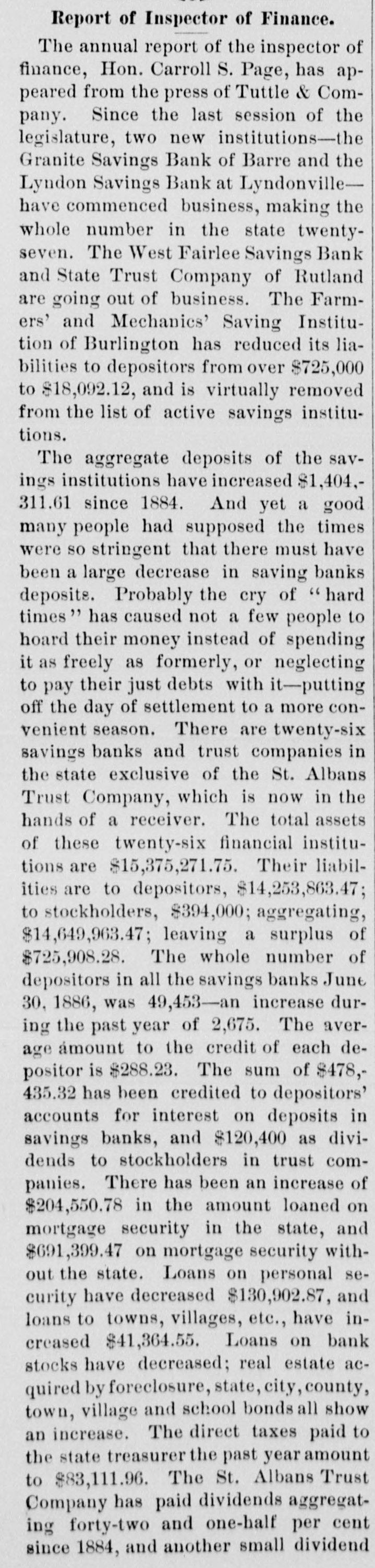
Report of Inspector of Finance. The annual report of the inspector of finance, Hon. Carroll S. Page, has appeared from the press of Tuttle & Company. Since the last session of the legislature, two new institutions-the Granite Savings Bank of Barre and the Lyndon Savings Bank at Lyndonvillehave commenced business, making the whole number in the state twentyseven. The West Fairlee Savings Bank and State Trust Company of Rutland are going out of business. The Farmers' and Mechanics' Saving Institution of Burlington has reduced its liabilities to depositors from over $725,000 to $18,092.12, and is virtually removed from the list of active savings institutions. The aggregate deposits of the savings institutions have increased $1,404,311.61 since 1884. And yet a good many people had supposed the times were so stringent that there must have been a large decrease in saving banks deposits. Probably the cry of hard times" has caused not a few people to hoard their money instead of spending it as freely as formerly, or neglecting to pay their just debts with it-putting off the day of settlement to a more convenient season. There are twenty-six savings banks and trust companies in the state exclusive of the St. Albans Trust Company, which is now in the hands of a receiver. The total assets of these twenty-six financial institutions are $15,375,271.75. Their liabilities are to depositors, $14,253,863.47; to stockholders, $394,000; aggregating, $14,649,963.47; leaving a surplus of $725,908.28. The whole number of depositors in all the savings banks June 30, 1886, was 49,453-an increase during the past year of 2,675. The average ámount to the credit of each depositor is $288.23. The sum of $478,435.32 has been credited to depositors' accounts for interest on deposits in savings banks, and $120,400 as dividends to stockholders in trust companies. There has been an increase of $204,550.78 in the amount loaned on mortgage security in the state, and $691,399.47 on mortgage security without the state. Loans on personal security have decreased $130,902.87, and loans to towns, villages, etc., have increased $41,364.55. Loans on bank stocks have decreased; real estate acquired by foreclosure, state, city, county, town, village and school bonds all show an increase. The direct taxes paid to the state treasurer the past year amount to $83,111.96. The St. Albans Trust Company has paid dividends aggregating forty-two and one-half per cent since 1884, and another small dividend


Article from Vermont Phœnix, October 8, 1886

Click image to open full size in new tab

Article Text

CURRENT AFFAIRS. Our Savings Banks and Trust Companies. The annual report of Carroll S. Page, State Inspector of Finances, on the condition of our Vermont trust companies and savings banks, states that two institutions-a savings bank and trust company at Barre, and a savings bank at Lyndonville have organized and begun business during the past biennial term. The St. Albans trust company is still in the hands of the receiver. The West Fairlee savings bank has been practically wound up, and the Farmers' and Mechanics' savings bank and trust company of Burlington and the State trust company of Rutland are proceeding with a view to winding up their business. The whole number of depositors In the State June 30th last was 49,453, an increase in the two years of 3,616. The total amount of deposits was $14,253,963.47, an increase of $529,671.94 in two years; $11,899,956.69 belonged to depositors living in the state, an increase of $599,594.16 in the past year, and of $572,855,91 as compared with 1884 $2,354,006.78 belonged to non-resident depositors, a decrease of $44,862.32 in the past year, and of $40,211.97 as compared with 1884. The average amount to the credit of each depositor was $288.23, a decrease of $4.63 as compared with 1885, and of $11.12 as compared with 1884. Three savings banks have paid 5 per cent dividends, one 4% eight 41, and five 4 per cent. The total amount of the guaranty or surplus fund has been increased by a little more than $89,000 during the two years, and amounted on June 30 to $300,332 11. The Inspector believes that many of the banks are paying too large dividends and would have dividends limited by law to 4 per cent per annum until a net reserve of at least six per cent. has been accumulated. Safety, he very properly says, must always be the "first and strongest consideration" in savings bank management. "The chief reason urged by trustees who advocate high dividends is that they believe it to be their duty to divide to depositors the actual earnings of each semi-annual period, but in my judgment they are quite as liable to wrong future depositors, who may have to suffer the losses sustained when these loans mature, they are to wrong present depositors by providing now for losses growing out of loans which are at present abnormally profitable, and of which pres. ent depositors are reaping all the benefits without incurring any of the risks which experience teaches are the almost universal accompaniment of excessive rates of interest." Mr. Page deprecates the extent to which the banks are tending to invest their deposits in western farm mortgages. From less than four millions in amount in 1883 these invest ments have now grown to almost five and one-half millions. "Under the present law 58 1-3 per cent. of all the assets of our savings banks may be invested in these western mortgages. I am fully convinced that the limit should be reduced to 40 per cent., believing that such a limit is only in accordance with the dictates of safety and conservatism. That they have proved desirable investment in the past is not questioned, but that there are indications that the business is being overdone in this line of securities and that the results may be disastrous, very few cautious financiers profess to doubt." It is well for the Inspector to caution the bank managers against rash investments in this or any other direction, but it is always to be remembered that a good western farm loan is better than a poor loan at home or elsewhere, and that the security and desirability of the western farm mortgages depends very largely on the ability, character and experi. ence of the agents who place them. In the hands of good men they are undoubtedly among the best securities of the present day, and are as safe, at least, as the western county or municipal bonds of which Mr. Pagespeaks favorably. The tables which the report contains show that our Vermont savings bank of Brattle. boro still continues to lead the savings banks of the state in the amount of deposits, its to. tal deposits on June 30 being $2,051,504.34 against $1,689,285.27 for the Rutland savings bank and $1,486,053.83 for the Burlington savings bank, which come next in amount of deposits. The Brattleboro savings bank has the handsome sum of $929,539.66 in depos. its. The amounts in the other Windham county savings banks are-Jamaica, $172,171.41; Wilmington, $298,498.88; Windham County, at Newfane, $447,992.62. The two Brattleboro banks have paid 4 ≥ per cent. div. idends, the Jamaica bank 4% and the banks at Newfane and Wilmington 5 per cent. each. As only one other strictly savings institution in the state than those here named pays SO high a rate of dividend as 5 per cent., it would seem that the Inspector's remarks about daugerously bigh rates of interest are aimed especially at our Windham county banks, but we should be surprised if a thor. ough investigation did not develop the fact that the investments of our local banks have be made 80 carefully and that their western loans have been placed through such responsible agents, that their securities, whatever rate of interest they pay, are as absolutely 86cure as those of any bank in the state.

Article from The Vermont Watchman, November 30, 1887

Click image to open full size in new tab

Article Text

Report of Inspector of Finance. The annual report of Hon. Carroll S. Page, inspector of finance, for the year ending June 30, 1887, has just been published. It presents some interesting facts, but the inspector reserves his recommendations for the next annual report. The savings banks of Vermont June 30, 1887, showed 53,810 depositors, credited with $15,587,050, an increase of 4,357 depositors and $1,333,087 over last year. The average amount to the credit of one individual was $289.67, an increase of $1.44 over 1886. The inspector says: "It is due to the managers of the several institutions to say that the conditions of the savings banks and trust companies in Vermont is exceptionally satisfactory." Three savings banks paid five per cent dividends to depositors; two, four and three-fourths; eight, four and one-half; and four, four per cent. Of the ten trust companies two have passed dividends to stockholders; one has paid fourteen, two eight, three six, one five, and one three per cent. The total accumulations, including the surplus, undivided earnings and interest, amount to $106,665.43 more than last year. There has been an increase of $265,amount loaned on mortin this state 420.95 gage security in the and of $759,631.46 on mortgage security out of the state. Loans on personal security increased $87,034.01, while loans to towns, villages, etc., were $56,527.82 less. The item of real estate owned has increased $42,599.25 for the year. A large increase is also shown in state, city, county, town, village and school bonds and of national bank stock. The direct taxes paid by savings banks and trust companies to the state treasurer aggregate $3,348.95 more than last New trust at St. Albans year. ganized companies and St. have Johns- orbury and a savings bank at White River Junction. In regard to the affairs of the unfortunate St. Albans Trust Company Receiver Rich says: "There is little additional to report this year. The judgment of the court in regard to the liabilities of the directors has not yet been rendered, nor has the question of preference of certain creditors been argued before the supreme court. Furthermore, it is not known what will be realized from the deposits in the I two other failed banks in this place. have sold about twelve thousand acres of the timber lands during the past year and about twenty thousand are yet unsold. The lumber market is improving, and I hope to get a fair price for the lands within a short time." Because of the restrictive legislation in regard to investments the Farmers' and Mechanics' Savings Institution of Burlington is receiving no new deposits and the State Trust Company of Rutland has reduced its liability to depositors. The West Fairlee Savings Bank has made no progress in closing its affairs. Its entire deposits are only ) $9,546.81, to pay which it has between 1 $2,000 and $3,000 in good assets and e some $15,000 in bonds of the Vermont Copper Company. . y An Englishman's Impressions. a Rev. Dr. Parker of London, who