Article Text
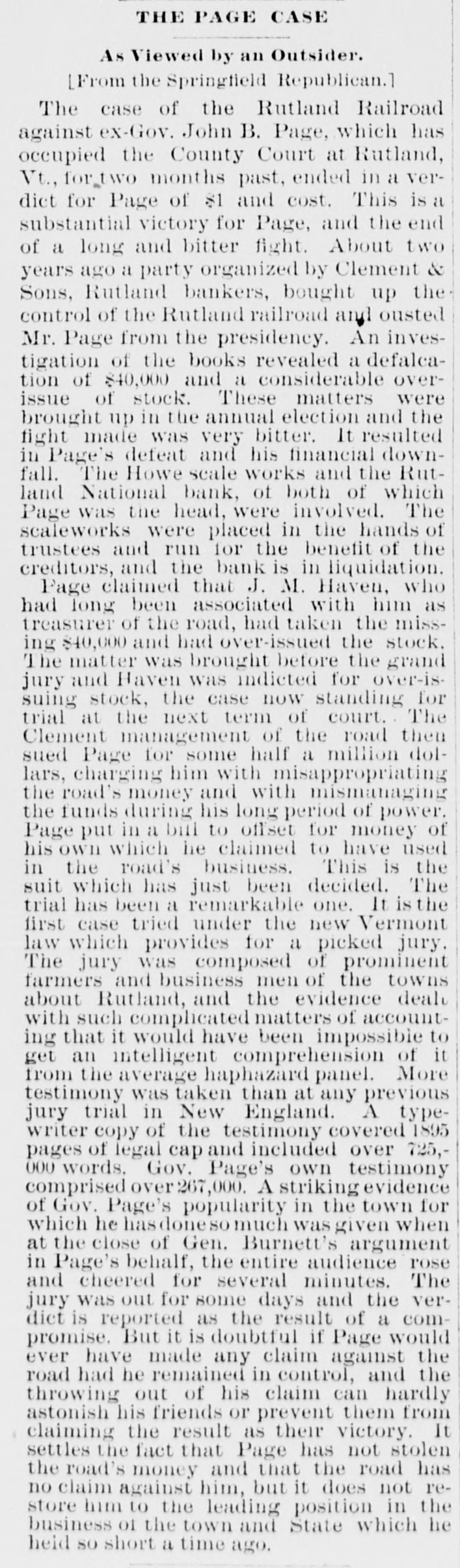
STATE AFFAIRS. TRAGIC END OF A WEDDING JOURNEY. -The death of one of the oldest residents of Morrisville occurred on Thursday of last week in a peculiarly sad way. Salmon Niles, aged 79 years, lost a second wife several months since. Being in need of someone to care for him he learned of the whereabouts of a maiden lady to whom he paid court several years ago, and Tuesday, December, 30, he drove 50 miles from Morrisville to Chelsea, where he was married New Year's eve to Miss Pauline Jones, his friend of younger days. Monday morning Mr. Niles and bride left Chelsea with a horse and sleigh for the return journey. On account of recent thaws the roads were very bad and the trip proved very tiresome. At Montpelier the couple stopped for dinner. The roads continuing bad, Mr. Niles proposed staying over night in a farm. house in Elmore about five miles from Mor. risville. When within a half mile from the farm-house Mr. and Mrs. Niles left their seats in the sleigh and walked while going up A bill. Mr. Niles suddenly fell backward, dead in the road. The wife got help at a neighboring house, and the dead man and his bride were carrie to Morrisville. -A St. Albans farmer surprised himself by catching 100 bullheads at a stroke. He cut a hole in the ice to water bis cattle, and the water overflowed, bringing up these fish and as many more that got away. -A Burlington dentist-fireman is one customer short. He got a woman's mouth all fixed up with tooth filling apparatus recently and then ran off to answer a fire alarm, leav. ing the woman unable to speak for half an hour. -In the last three months of 1884 the Sun. day schools of the state contributed over $600 as a "thank offering" for the Bible. In acknowledging the receipt of this money the secretary of the Vermont Bible society suggests that a similar offering be made in 1885 on the first Sunday in September, and that that day be called the "Children's Bible Sunday.' -E. L. Smith of Barre was struck in the eye with a piece of steel which flew from a drill he was holding for another to strike, and the sight was destroyed. - Jonas J. Snow, who was convicted of murder in the second degree at St. Johnsbury for shooting a pedlar, and sentenced to prison for life nearly 11 years ago, was released on a conditional pardon by Gov. Pingree, New Year's day. -The directors of the Rutland national bank, which proposes to go into liquidation, state that the institution is solvent and that the stockholders will eventually be fully paid for their stock at par, and have a surplus for a final dividend. -The chair factory of the Arlington manufacturing company, occup ied by D. G. Barney in brush-block manufacturing, was burned with its contents Friday. Loss $10,000. -Chas. E Huntington of Montpelier committed suicide by taking morphine last Friday evening. After he took the dose be sent for bis father, L. B Huntington, but be was be. yond help. He was about 27 years old and leaves a wife and child. He was of morose, despondent temperament, and addicted to ex cesses. -Eben Kemp of Royalton was killed last Saturday in the woods by a falling tree. -Herbert B. Pierce of Jericho, aged 17, committed suicide on New Year's day by shooting while under the effects of liquor. -A 20-months old grandebild of George Bates of Essex recently tipped a dish of hot water on itself and died from the effects. -A third soap-stone quarry has been discovered upon George L. Fletcher's lands in Chester in a straight line with the soap stone quarries in Perkinsville, the Davis quarry in Chester, near Grafton line, the quarry in Grafton and the one in Townshend. -The grocery of Preston & Clayton at West Pawlet was destroyed by fire on Sunday morning. The building was owned by L. Johnson. Loss $2000. -Mrs. L. G. Waite, matron of the Mary Fletcher hospital, with which she had been connected from its start, died on Monday of last week, after a long illness, from cancer. -Gen. Wm. Wells of Burlington has been appointed by Gov. Pingree as an aide-decamp on the staff of Lieut.-Gen. Sheridan, marshal of the day for the dedication of the Washington monument. Gen. Sheridan has requested that a similar appointment be made from each state and territory. -Geo. B. French, the member from Woodstock in the present legislature, is soon to relinquish the position of clerk of Windsor county, which he has held since 1867, and will move to Fremont, Neb., to engage in banking there. Jay Read Pember of Woodstock, official reporter of Windsor county court since May, 1870, and of Windham and Chittenden county courts for several years, will be appointed in place of Mr. French. -Elmer Granger, a Bethel school teacher, fell dead from heart disease in the school room while correcting a pupil Monday afternoon. -Chelsea proposes to have a railway built there as soon as possible. A narrow-gauge road running to South Royalton, 13 miles away, is talked of, but the majority of the people favor the offer of some sum of money to the Central Vermont road to build from Barre to Chelsea.