19058. Girard Bank (Philadelphia, PA)

Bank Information

Episode Type
Run → Suspension → Closure
Bank Type
state
Start Date
January 27, 1842
Location
Philadelphia, Pennsylvania (39.952, -75.164)

Metadata

Model
gpt-5-mini
Short Digest
1b458b7d

Response Measures

Accommodated withdrawals, Full suspension

Other: Directors issued explanatory card; banks agreed on mutual arrangements and safety fund; assignees made a formal assignment of assets to trustees (receivership/assignment).

Description

Contemporary reports (Jan 27–Feb 1842) describe a run on Girard Bank after other Philadelphia banks refused its notes, the bank suspended/closed (did not open) on Jan 27, 1842 and subsequently made an assignment (March 16, 1842) to assignees. Some later summaries (secondary mentions) state the bank later paid debts and was allowed to resume, but primary articles show a suspension followed by assignment/closure; classification chosen as run -> suspension -> closure. Cause of run/suspension attributed to refusal of other local banks to receive Girard notes (information about other banks). Dates taken from articles (newspaper dates and internal statements).

Events (3)

1. January 27, 1842 Run
Cause
Local Banks
Cause Details
Other Philadelphia banks (beginning with the Bank of Northern Liberties) refused to receive Girard notes in deposit, spreading news and triggering heavy withdrawals and crowding at Girard's counters.
Measures
Committees of other banks met to try to 'set the Girard Bank on its legs again'; Girard directors issued a public card promising best efforts to discharge liabilities and cautioning holders against selling notes at a sacrifice.
Newspaper Excerpt
the run upon the Girard Bank increased... from eleven to three o'clock the crowd at the counter was so dense...
Source
newspapers
2. January 27, 1842 Suspension
Cause
Local Banks
Cause Details
Following the run induced by other banks' refusal to accept its notes, the directors 'found themselves under the painful necessity of closing the Bank for the present.'
Newspaper Excerpt
GIRARD BANK, Jan. 27, 1842... closing the Bank for the present. The Bank did not open this morning.
Source
newspapers
3. March 16, 1842 Other
Newspaper Excerpt
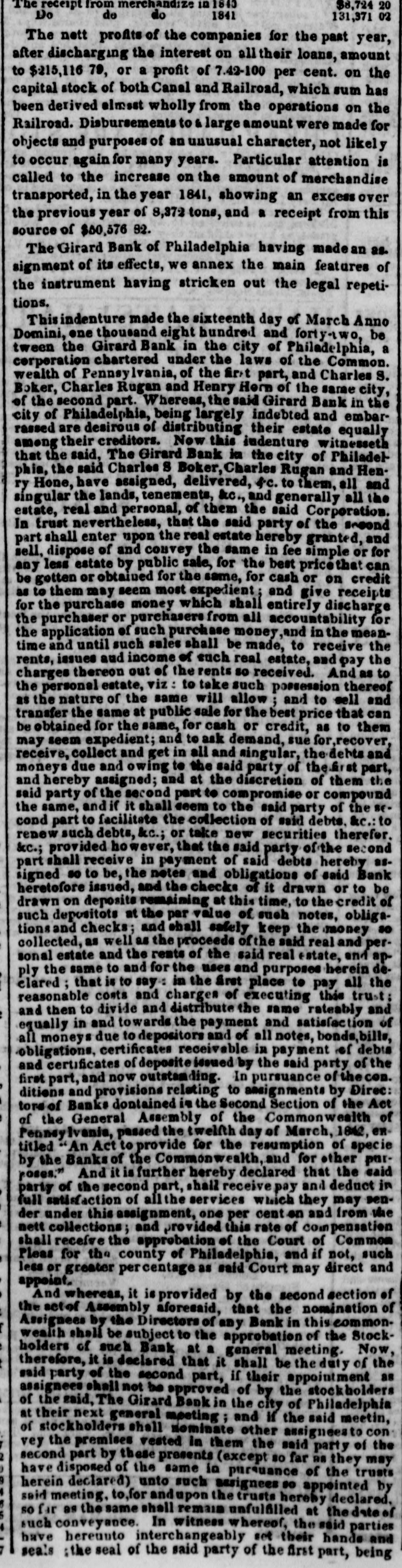
This indenture made the sixteenth day of March... the Girard Bank... made an assignment... delivered to them... the real and personal estate assigned in trust for the payment and satisfaction of notes, bonds, debts, bills, moneys due, certificates, depositors, &c.; the assignees to sell and convert assets and distribute proceeds to creditors (assignment instrument).
Source
newspapers

Newspaper Articles (22)

Article from Morning Herald, February 5, 1840

Click image to open full size in new tab

Article Text

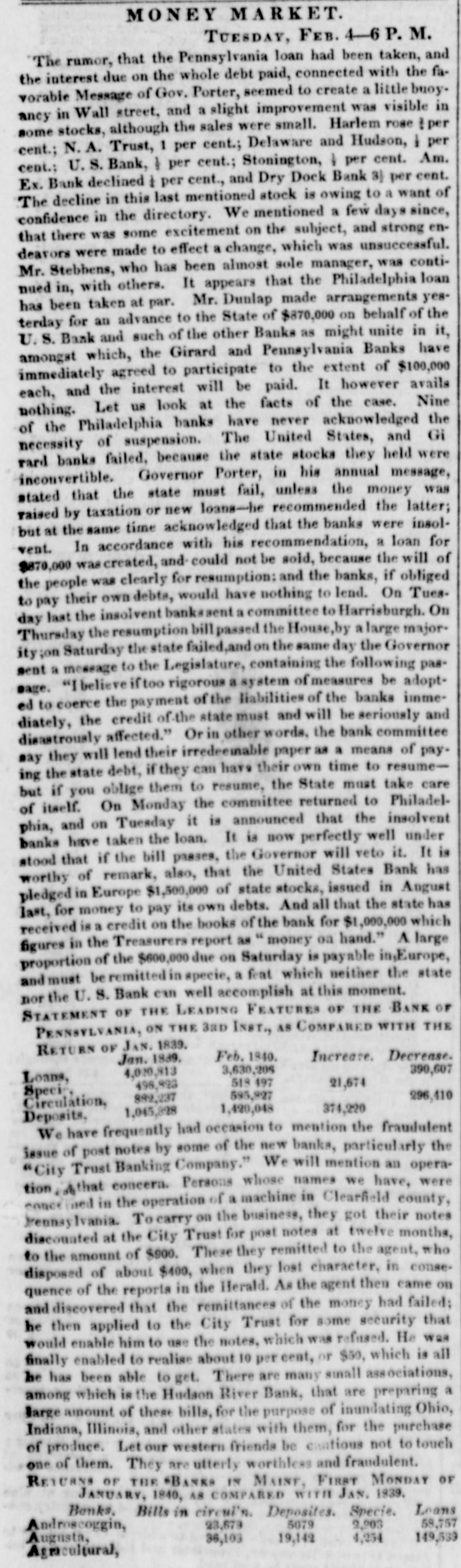
MONEY MARKET. TUESDAY, FEB. 4-6P. M. The rumor, that the Pennsylvania loan had been taken, and the interest due on the whole debt paid, connected with the favorable Message of Gov. Porter, seemed to create a little buoyancy in Wall street, and a slight improvement was visible in some stocks, although the sales were small. Harlem rose per cent.; N.A. Trust, 1 per cent.; Delaware and Hudson, 1 per U.S. I per cent.; Stonington, 1 per cent. Am. t per cent., and Dry per in this last mentioned a The Ex. cent.; Bank decline declined Bank, mentioned stock Dock is owing Bank few to 3) days want since, cent. of confidence in the directory. We a that there was some excitement on the subject, and strong endeavors were made to effect a change, which was unsuccessful. Mr. Stebbens, who has been almost sole manager, was continued in, with others. It appears that the Philadelphia loan has been taken at par. Mr. Dunlap made arrangements yesterday for an advance to the State of $870,000 on behalf of the U.S. Bank and such of the other Banks as might unite in it, the Girard and Pennsylvania Banks agreed to participate to extent and the interest will be paid. immediately each, amongst which, the of It the however of $100,000 avails Nine have nothing. Let us look at the facts case. of the Philadelphia banks have never acknowledged the necessity of suspension. The United States, and Gi rard banks failed, because the state stocks they held were inconvertible. Governor Porter, in his annual message, stated that the state must fail, unless the money was raised by taxation or new loans-the recommended the latter; the same time acknowledged that the banks were insolIn accordance with his a was created, and could not be was clearly for resumption: the people $870,000 vent. but at recommendation, and sold, the because banks, lend. the On if loan obliged will Tues. for of o pay their n debts, would have nothing to day last the insolvent banksant a committee to Harrisburgh. On Thursday the resumption bill passed the House,by a large majority;on Saturday the state failed, and on the same day the Governor to the Legislature, containing the following pasrigorous a system measures the payment of the sent eage. ed to a coerce "Ibelieve iftoo message liabilities and of will of the be banks seriously be imme- adopt- and diately, the credit of the state must affected." Or in other will lend their irredeemable paper as a means state debt, if they can have own say disastrously ing the they their words. the State the time bank must to committee take resume- of pay- care but if you oblige them to resume, of itself. On Monday the committee returned to Philadelphia, and on Tuesday it is announced that the insolvent banks have taken the loan. It is now perfectly well under if the bill passes, the Governor of remark, also, that the United in Europe $1,500,000 of state pledged stood worthy that stocks, all will issued States that veto the in Bank state it. August It has has is last, for money to pay its own debts. And received is a credit on the books of the bank for $1,000,000 which figures in the Treasurers report as money oa hand." A large proportion of the $600,000 due on Saturday is payable in,Europe, and must be remitted specie, a feat which neither the state nor the U. S. Bank can well accomplish at this moment. STATEMENT OF THE LEADING FEATURES OF THE BANK OF PENNSYLVANIA, ON THE 3RD INST., AS COMPARED WITH THE RETURN OF JAN. 1839. Feb. 1840. Increase Decrease. Jan. 1839. 3,630,205 390,607 4,020,913 Loans, 518 497 21,674 498,823 Specify 595,827 296,410 Circulation, 882,237 374,220 1,420,048 1,045,828 Deposits, We have frequently had occasion to mention the fraudulent issue of post notes by some of the new banks, particularly the "City Trust Banking Company." We will mention an operation, that concera. Persons whose names we have, were cance Fined in the operation of a machine in Clearfield county, ) l' c a carry on the business, they got their notes at the City Trust for post of $900. These they of about $400, when they disposed to discounted the amount remitted lost notes character. at to twelve the agent, in months, conse- who quence of the reports in the Herald. As the agent then came on and discovered that the remittances of the money had failed: he then applied to the City Trust for some security that would enable him to use the notes, which was refused. He was finally enabled to realise about 10 per cent, or $50. which is all he has been able to get. There are many small associations, among which is the Hudaon River Bank, that are preparing a large amount of these bills, for the purpose of inundating Ohio, Indiana, Illinois, and other states with them, for the purchase of produce. Letour western friends be cantious not to touch one of them. They are utterly worthless and fraudulent. RETURNS OF THE *BANKS IN MAINT, FIRST MONDAY OF JANUARY. 1840, AS COMPARED WITH JAN. 1939. Banks, Bills in circui's Deposites. Specie. Loans 5079 58,757 2,003 23,679 Androscoggin, 149,539 Augusta, 4,254 19,142 36,103 Agricultural,
Article from Jeffersonian Republican, January 22, 1841

Click image to open full size in new tab

Article Text

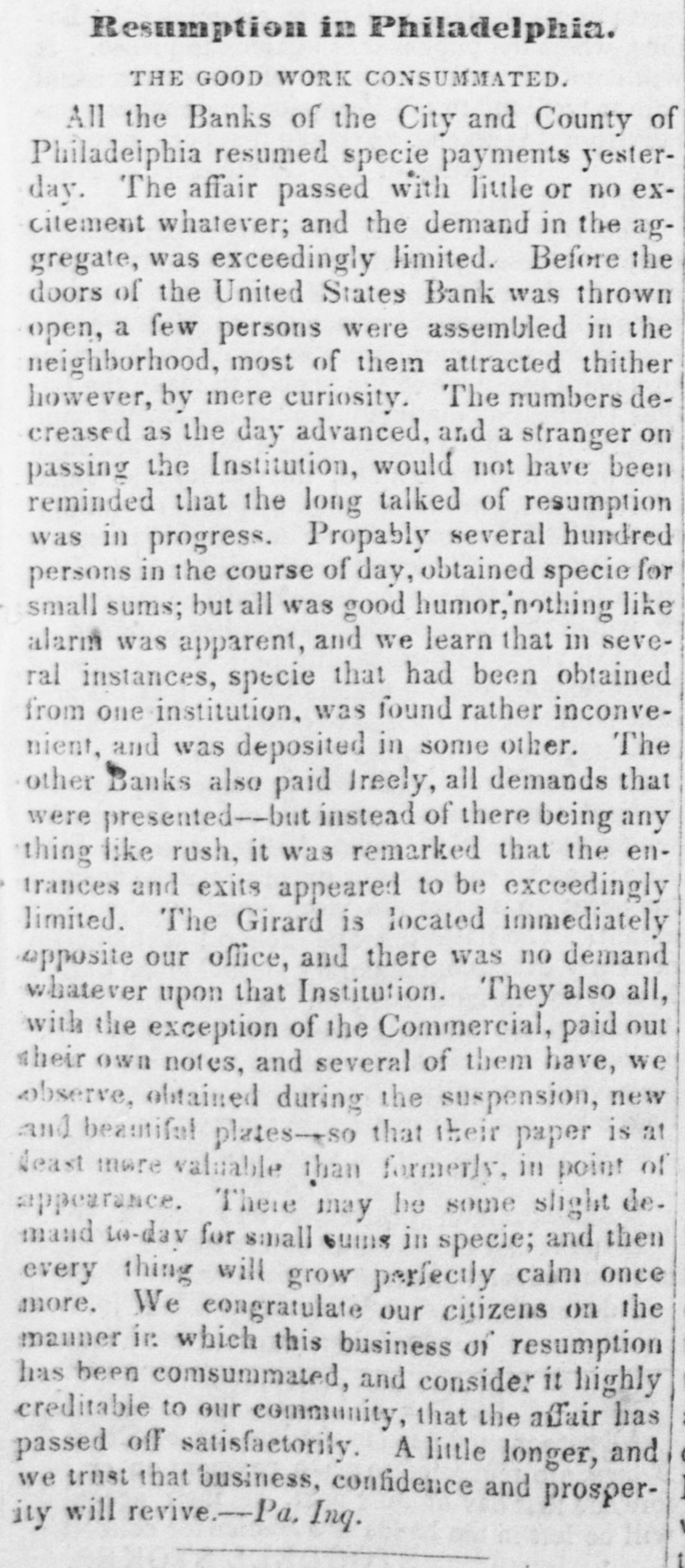
Resumption in Philadelphia. THE GOOD WORK CONSUMMATED. All the Banks of the City and County of Philadeiphia resumed specie payments yesterday. The affair passed with litle or no excitement whatever; and the demand in the aggregate, was exceedingly limited. Before the doors of the United States Bank was thrown open, a few persons were assembled in the neighborhood, most of them attracted thither however, by mere curiosity. The numbers decreased as the day advanced, and a stranger on passing the Institution, would not have been reminded that the long talked of resumption was in progress. Propably several hundred persons in the course of day, obtained specie for small sums; but all was good humor,nothing like alarm was apparent, and we learn that in several instances, specie that had been obtained from one institution, was found rather inconvemient, and was deposited in some other. The other Banks also paid treely, all demands that were presented- instead of there being any thing like rush, it was remarked that the entrances and exits appeared to be exceedingly limited. The Girard is located immediately opposite our office, and there was no demand whatever upon that Institution. They also all, with the exception of the Commercial, paid out their own notes, and several of them have, we observe, obtained during the suspension, new and beautiful plates-so that their paper is at least more valuable than formerly, in point of appearance. There may he some slight demand Lis-day for small sums in specie; and then every thing will grow perfectly calm once more. We congratulate our citizens on the manner in which this business of resumption has been comsummated, and consider it highly creditable to our community, that the affair has passed off satisfactorily. A little longer, and we trust that business, confidence and prosperity will revive.--Par Inq.


Article from Herald of the Times, February 11, 1841

Click image to open full size in new tab

Article Text

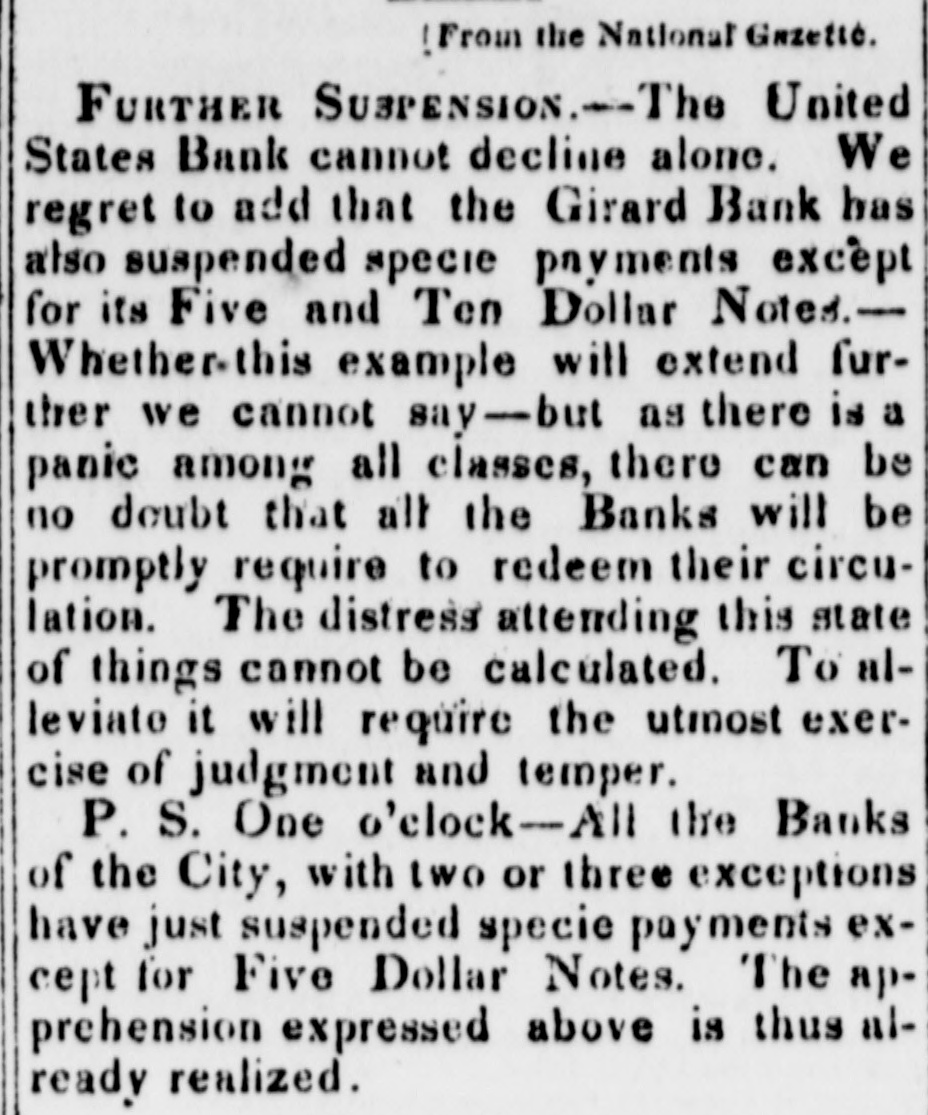
From the National Gazetic. FURTHER SUSPENSION. The United States Bank cannot decline alone. We regret to add that the Girard Bank has also suspended specie payments except for its Five and Ten Dollar Notes.Whether-this example will extend further we cannot say-but as there is a panic among all classes, there can be no doubt that all the Banks will be promptly require to redeem their circulation. The distress attending this state of things cannot be calculated. To alleviate it will require the utmost exercise of judgment and temper. P. S. One o'clock--A - the Banks of the City, with two or three exceptions have just suspended specie payments except for Five Dollar Notes. The A/prehension expressed above is thus 11/ready realized.


Article from The New York Herald, January 27, 1842

Click image to open full size in new tab

Article Text

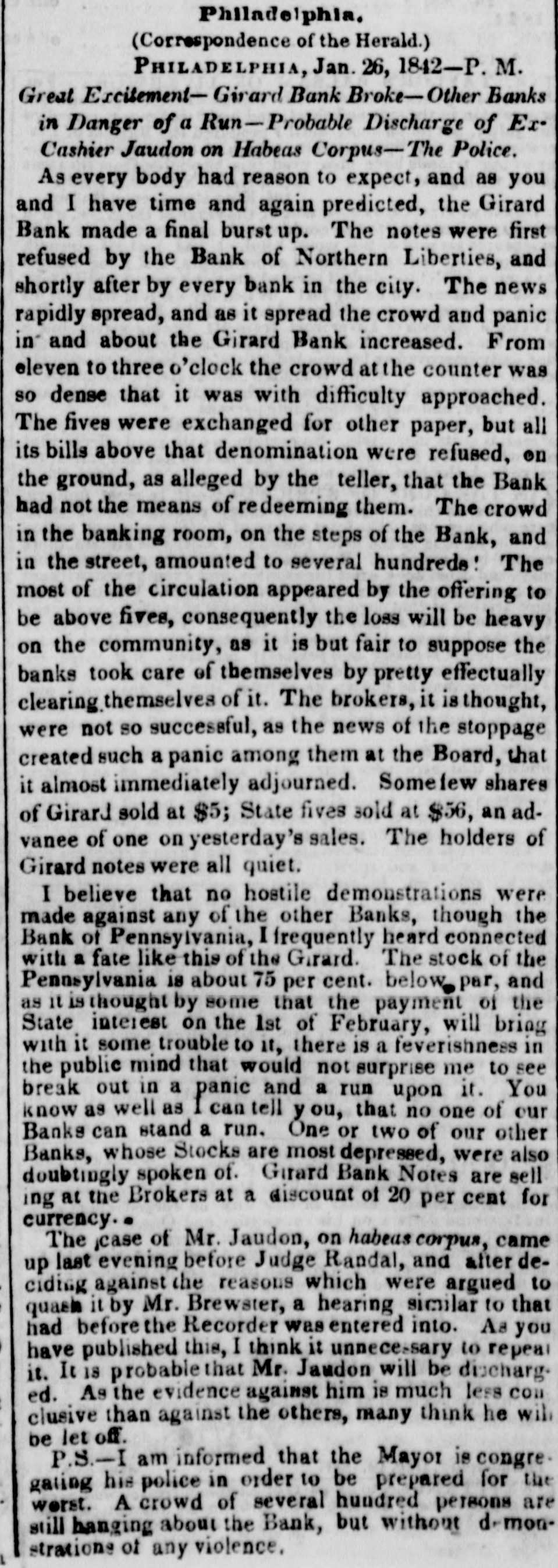
Philadelphia. (Correspondence of the Herald.) PHILADELPHIA, Jan. 26, 1842-P. M. Great Excitement-Girard Bank Broke-Other Banks in Danger of a Run - -Probable Discharge of ExCashier Jaudon on Habeas Corpus- The Police. As every body had reason to expect, and as you and I have time and again predicted, the Girard Bank made a final burst up. The notes were first refused by the Bank of Northern Liberties, and shortly after by every bank in the city. The news rapidly spread, and as it spread the crowd and panic in and about the Girard Bank increased. From eleven to three o'clock the crowd at the counter was so dense that it was with difficulty approached. The fives were exchanged for other paper, but all its bills above that denomination were refused, on the ground, as alleged by the teller, that the Bank had not the means of redeeming them. The crowd in the banking room, on the steps of the Bank, and in the street, amounted to several hundreds! The most of the circulation appeared by the offering to be above fives, consequently the loss will be heavy on the community, as it is but fair to suppose the banks took care of themselves by pretty effectually clearing themselves of it. The brokers, it is thought, were not so successful, as the news of the stoppage created such a panic among them at the Board, that it almost immediately adjourned. Somefew shares of Girard sold at $5; State fives sold at $56, an advanee of one on yesterday's sales. The holders of Girard notes were all quiet. I believe that no hostile demonstrations were made against any of the other Banks, though the Bank of Pennsylvania, I frequently heard connected with a fate like this of the Girard. The stock of the Pennsylvania is about 75 per cent. below par, and as It is thought by some that the payment of the State interest on the 1st of February, will bring with it some trouble to it, there is a feverishness in the public mind that would not surprise me to see break out in a panic and a run upon it. You know as well as I can tell you, that no one of our Banks can stand a run. One or two of our other Banks, whose Stocks are most depressed, were also doubtingly spoken of. Guard Bank Notes are sell ing at the Brokers at a discount of 20 per cent for currency. The case of Mr. Jaudon, on habeas corpus, came up last evening before Judge Randal, and after deciding against the reasons which were argued to quash it by Mr. Brewster, a hearing similar to that had before the Recorder was entered into. As you have published this, I think it unnece-sary to repea it. It IS probable that Mr. Jaudon will be discharged. As the evidence against him is much less con clusive than against the others, many think he will be let off. P.S.-I am informed that the Mayor is congre gating his police in order to be prepared for the worst. A crowd of several hundred persons are still hanging about the Bank, but without d-monstrations of any violence.


Article from New-York Tribune, January 28, 1842

Click image to open full size in new tab

Article Text

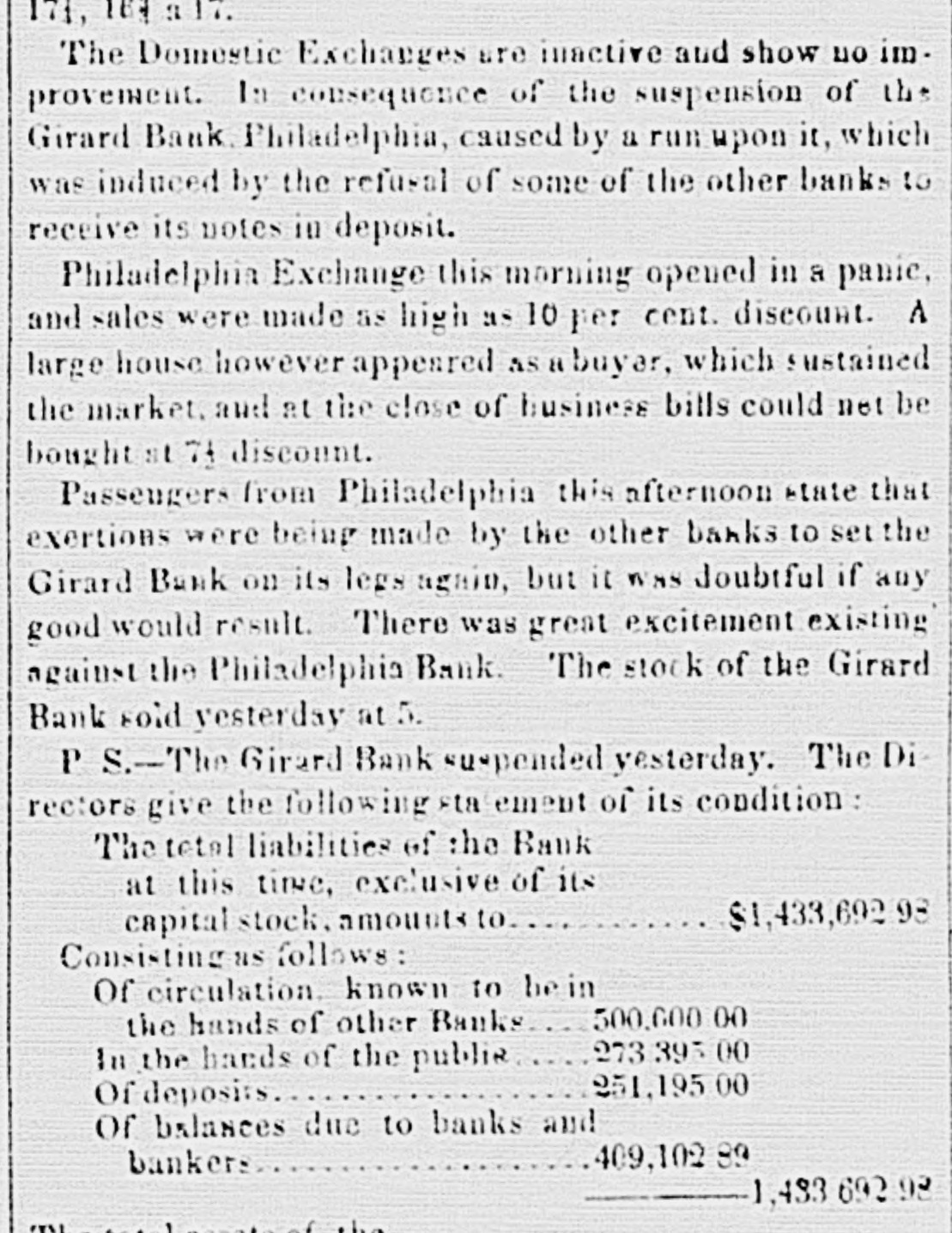
171, The Domestic Exchanges are inactive and show uo im. provement. In consequence of the suspension of th Girard Bank Philadelphia, caused by a run upon it, which was induced by the refusal of some of the other banks to receive its notes in deposit. Philadelphia Exchange this morning opened in a panic, and sales were made as high as 10 per cent. discount. A large house however appeared as a buyar, which sustained the market. and at the close of business bills could net be bought at 71 discount. Passengers from Philadelphia this afternoon state that exertions were being made by the other banks to set the Girard Bank on its legs again, but it was Joubtful if any good would result. There was great excitement existing against the Philadelphia Bank. The stock of the Girard Bank sold yesterday at 5. P S. - The Girard Bank suspended yesterday. The Di rectors give the following sta ement of its condition The total liabilities of the Bank at this time, exclusive of its $1,433,692 98 capitalstock amounts to Consisting as follows: Of circulation. known to be in 500,000.00 the hands of other Banks 273.395.00 In the hands of the public 251,195.00 or deposits Of balances due to banks and 409,102 89 bankers 1,433 692.92


Article from The New York Herald, January 28, 1842

Click image to open full size in new tab

Article Text

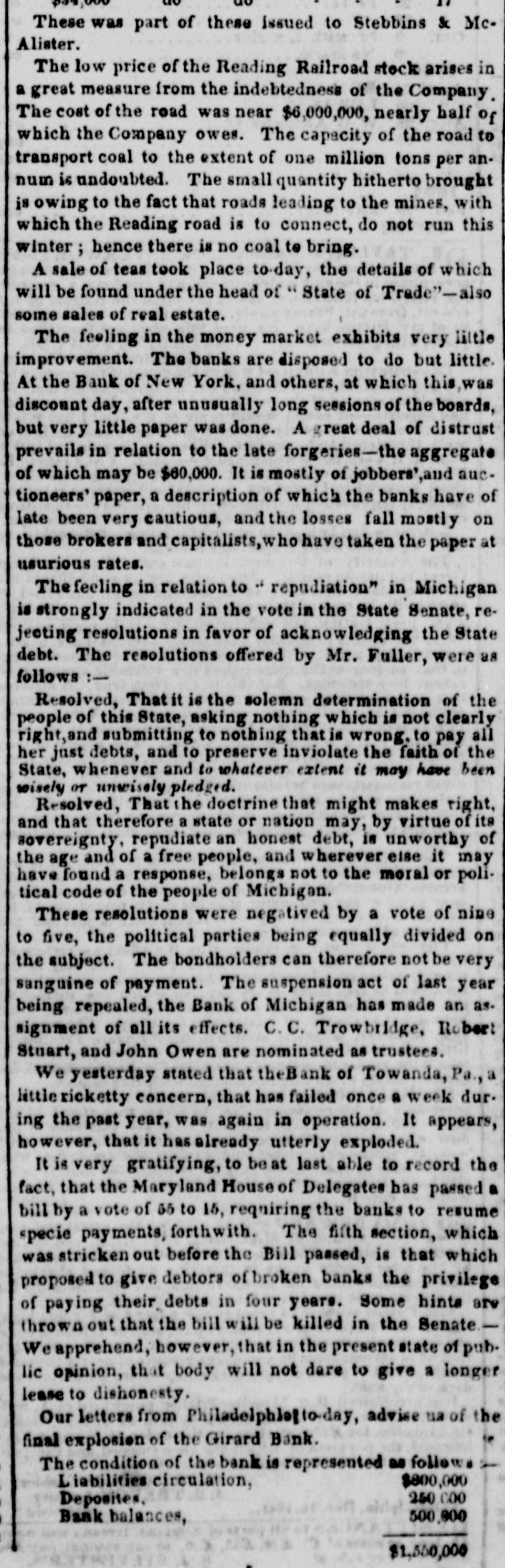
to These was part of these issued to Stebbins & Mc. Alister. The low price of the Reading Railroad stock arises in a great measure from the indebtedness of the Company The cost of the road was near $6,000,000, nearly half of which the Company owes. The capacity of the road to transport coal to the extent of one million tons per annum is undoubted. The small quantity hitherto brought is owing to the fact that roads leading to the mines, with which the Reading road is to connect, do not run this winter; hence there is no coal to bring. A sale of teas took place to-day, the details of which will be found under the head of "State of Trade"-also some sales of real estate. The feeling in the money market exhibits very little improvement. The banks are disposed to do but little. At the Bank of New York, and others, at which this was discount day, after unusually long sessions of the boards, but very little paper was done. A great deal of distrust prevails in relation to the late forgeries-the aggregate of which may be $60,000. It is mostly of jobbers' ,and auctioneers' paper, a description of which the banks have of late been very cautious, and the losses fall mostly on those brokers and capitalists, who have taken the paper at usurious rates. The feeling in relation to at repudiation" in Michigan is strongly indicated in the vote in the State Senate, rejeeting resolutions in favor of acknowledging the State debt. The resolutions offered by Mr. Fuller, were as follows :Resolved, That it is the solemn determination of the people of this State, asking nothing which is not clearly right,and submitting to nothing that is wrong. to pay all her just debts, and to preserve inviolate the faith of the State, whenever and to whatever extent it may have been wisely or unwisely pledged. Resolved, That the doctrine that might makes right, and that therefore a state or nation may, by virtue of its sovereignty, repudiate an honest debt, is unworthy of the age and of a free people, and wherever else it may have found a response, belongs not to the moral or political code of the people of Michigan. These resolutions were negatived by a vote of nine to five, the political parties being equally divided on the subject. The bondholders can therefore not be very sanguine of payment. The suspension act of last year being repealed, the Bank of Michigan has made an assignment of all its effects. C.C. Trowbridge, Robert Stuart, and John Owen are nominated as trustees. We yesterday stated that theBank of Towanda, Pa., a littlericketty concern, that has failed once a week dur. ing the past year, was again in operation. It appears, however, that it has already utterly exploded. It is very gratifying, to beat last able to record the fact, that the Maryland House of Delegates has passed a bill by a vote of 85 to 15, requiring the banks to resume specie payments, forthwith. The fifth section, which was stricken out before the Bill passed, is that which proposed to give debtors of broken banks the privilege of paying their debts in four years. Some hinta are thrown out that the bill will be killed in the Senate We apprehend, however, that in the present state of public opinion, that body will not dare to give a longer lease to dishonesty. Our letters from Philadelphlefto-day, advise ua of the in final explosion of the Girard Bank. The condition of the bank is represented as follow $800,000 L liabilities circulation, 250 000 Deposites. 500,000 Bank balances, $1,550,000


Article from The New York Herald, January 28, 1842

Click image to open full size in new tab

Article Text

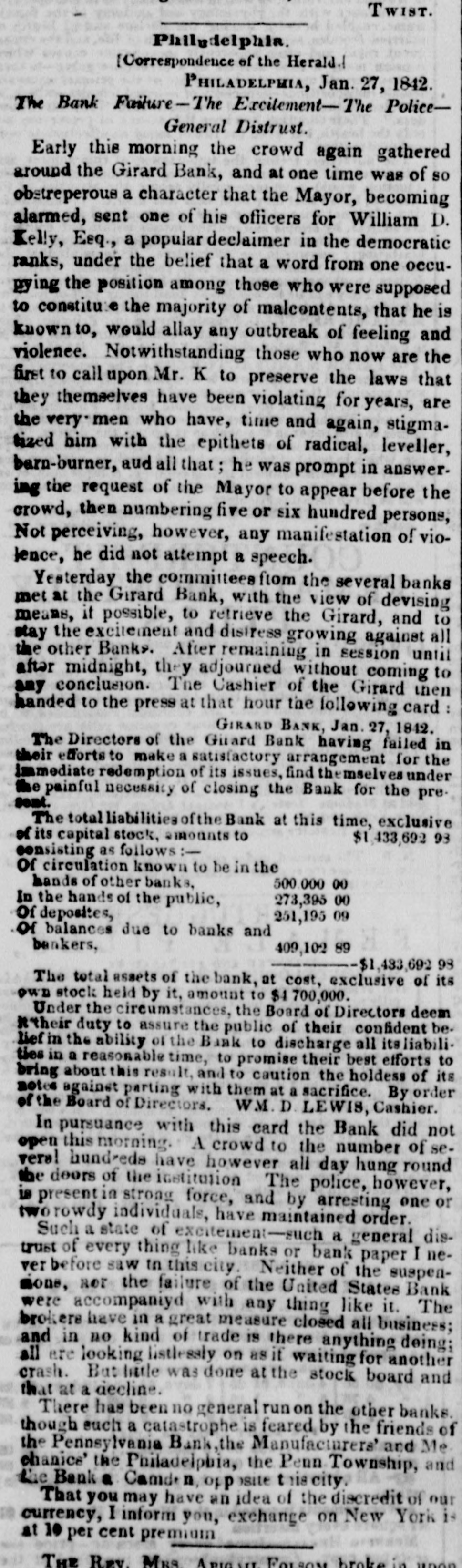
Philadelphia. [Correspondence of the Herald.! PHILADELPHIA, Jan. 27, 1842. # The Bank Failure-The Excitement-The Police-General Distrust. Early this morning the crowd again gathered around the Girard Bank, and at one time was of so obstreperous a character that the Mayor, becoming alarmed, sent one of his officers for William D. Kelly, Eeq., a popular declaimer in the democratic ranks, under the belief that a word from one occupying the position among those who were supposed to constitute the majority of malcontents, that he is known to, would allay any outbreak of feeling and violence. Notwithstanding those who now are the first to call upon Mr. K to preserve the laws that they themselves have been violating for years, are the very men who have, time and again, stigmatized him with the epithets of radical, leveller, barn-burner, aud all that; he was prompt in answering the request of the Mayor to appear before the crowd, then numbering five or six hundred persons, Not perceiving, however, any manifestation of violence, he did not attempt a speech. Yesterday the committees from the several banks met at the Girard Bank, with the view of devising means, it possible, to retrieve the Girard, and to stay the excitement and distress growing against all the other Banks. After remaining in session until after midnight, they adjourned without coming to any conclusion. The Cashier of the Girard then handed to the press at that hour the following card: GIRARD BANK, Jan. 27, 1842. The Directors of the Guard Bank having failed in their efforts to make a satisfactory arrangement for the immediate redemption of its issues, find themselves under the painful necessity of closing the Bank for the present. The total liabilities of the Bank at this time, exclusive of its capital stock, amounts to $1,433,692 93 consisting as follows:- Of circulation known to be in the hands of other banks, 500.000 00 In the hands of the public, 273,395 00 Of deposites, 251,195 09 of balances due to banks and bankers, 409,102 89 --$1,433,692 93 The total assets of the bank, at cost, exclusive of its own stock held by it, amount to $4 700,000. Under the circumstances, the Board of Directors deem their duty to assure the public of their confident belief in the ability of the Bank to discharge all its liabilities in a reasonable time, to promise their best efforts to bring about this result, and to caution the holdess of its notes against parting with them at a sacrifice. By order of the Board of Directors. WM. D. LEWIS, Cashier. In pursuance with this card the Bank did not open this morning. A crowd to the number of several hundreds have however all day hung round the doors of the institution The police, however, is present in strong force, and by arresting one or two rowdy individuals, have maintained order. Such a state of excitement-such a general distrust of every thing like banks or bank paper I never before saw in this city. Neither of the suspensions, nor the failure of the United States Bank were accompanyd with any thing like it. The brokers have in a great measure closed all business; and in no kind of trade is there anything doing; all are looking listlessly on as if waiting for another crash. But little was done at the stock board and that at a decline. There has been no general run on the other banks. though such a catastrophe is feared by the friends of the Pennsylvania Bank, the Manufacturers' and Mechanics' the Philadelphia, the Penn Township, and The Bank & Camden, opposite this city. That you may have an idea of the discredit of our currency, I inform you, exchange on New York is at 10 per cent premium THE REV. MBS. ARIGMI FOLSOM broke in upon


Article from The Daily Madisonian, January 29, 1842

Click image to open full size in new tab

Article Text

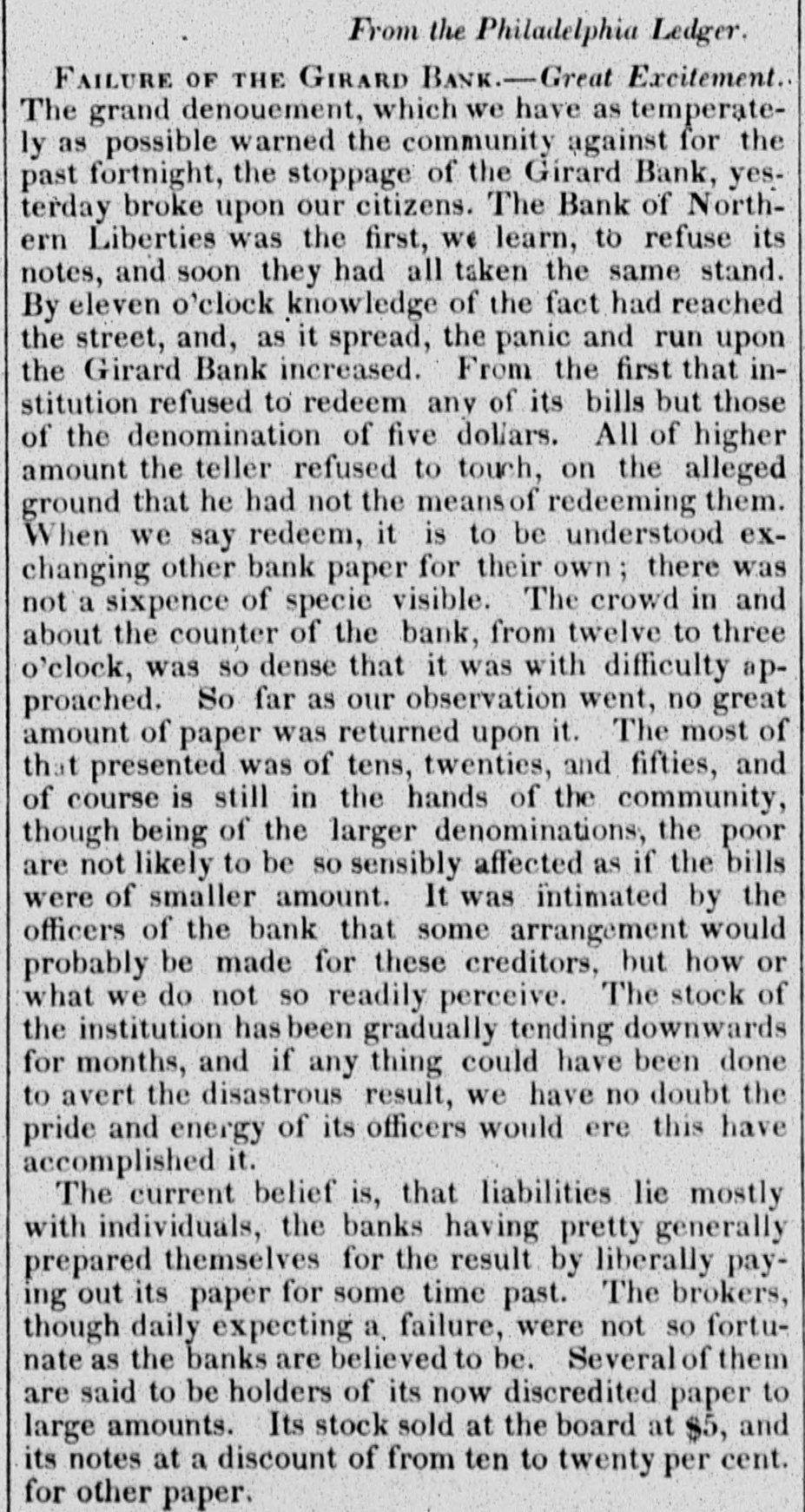
From the Philadelphia Ledger. FAILURE OF THE GIRARD BANK.-Great Excitement. The grand denouement, which we have as temperately as possible warned the community against for the past fortnight, the stoppage of the Girard Bank, yesterday broke upon our citizens. The Bank of Northern Liberties was the first, we learn, to refuse its notes, and soon they had all taken the same stand. By eleven o'clock knowledge of the fact had reached the street, and, as it spread, the panic and run upon the Girard Bank increased. From the first that institution refused to redeem any of its bills but those of the denomination of five dollars. All of higher amount the teller refused to touch, on the alleged ground that he had not the means of redeeming them. When we say redeem, it is to be understood exchanging other bank paper for their own; there was not a sixpence of specie visible. The crowd in and about the counter of the bank, from twelve to three o'clock, was so dense that it was with difficulty approached. So far as our observation went, no great amount of paper was returned upon it. The most of that presented was of tens, twenties, and fifties, and of course is still in the hands of the community, though being of the larger denominations, the poor are not likely to be SO sensibly affected as if the bills were of smaller amount. It was intimated by the officers of the bank that some arrangement would probably be made for these creditors, but how or what we do not so readily perceive. The stock of the institution has been gradually tending downwards for months, and if any thing could have been done to avert the disastrous result, we have no doubt the pride and energy of its officers would ere this have accomplished it. The current belief is, that liabilities lie mostly with individuals, the banks having pretty generally prepared themselves for the result by liberally paying out its paper for some time past. The brokers, though daily expecting a. failure, were not so fortunate as the banks are believed to be. Several of them are said to be holders of its now discredited paper to large amounts. Its stock sold at the board at $5, and its notes at a discount of from ten to twenty per cent. for other paper.


Article from The Ohio Democrat, February 3, 1842

Click image to open full size in new tab

Article Text

From the PhiladelpHia Spirit of the Times. RUN ON THE GIRARD BANKTerrible excliment-threatened mob-Graphic picture of the thrilling scene. For several weeks we have ever and anon the public against placing 100 much faith of the cautioned reasons ID the stability believing Girard it Bank. We had for that was very far from a solvent institution; we to those reasons, were-unable being publish and although the truth from in our State the greater the the is the of a sense of duty to the the greater fact that law, libel," prevailing compelled maxim us WATN reader of the presence and bid man, woman, to every every and of child, danger, "touch not-handle not" its faithless prom1809. no.Monday, Tuesday, & yesterday, apof the close to aloud and spare in prehensive continued 'cry proximity of not' crisis,we the We our immense circulasion would have the sure premises. thought requisite-effect, became and alarmed the public in in the a tremenwas made upon the enough dous reality. run yesterday Early morning. Girard Bank, as well as a one upon the the former had before noon, slight well nigh others, closed and its doors, while the later were filled with fear and agitation. The Girard Bank was soon compelled to any of its notes except stop exchanging street front, fives. The in and the pavement oppo~ as the bank itself was filled with a erewd of excited persons in the most energetic terms ing site dense as well of all the npeak- insol of the institution-cureing own in the vency s'upidity following advice of the their Times and its notes--and anathametising the had conduct genhad their corruption eschewing of hands banks full in in the and individual of notes that a crewd, eral. etslightened Pickpuckels many-an but few hed his moments pock had tried in vain to get the to No great loss, exchange. before he thai! Bank Banks refused about 11 o'clock to Girard notes on deposit. All the receive other The check Bank of North America refused to pay a for hoider would take Mechanics even to $900 notes! unless The the Bank refused it in which Girard back the notes of the Girard it had an hour receive paid out only before! similar Most precaution. of the other Banks acted with a A was held in the one in the at the a meeting afternoon Girard, morning of and committee from the other banks, but we did not learn the result. It was admitted on all sides that the Girard was "a case." Its stock sold at for a half share for fifty the per Board yeaterday gone dollars five dollars paid, while and stock defunct Bank sold for even dollare share. unneof the per Schuylkill Comment is ecessary. 4 lt is impossible to picture the consternation which this sudden 'blow up' has occasioned our citizens: many. is To great among irreparable. all To the loss force is the its lose for-immense were taken to paper-into circulation. are general pains The brokers told in for it this time, too, since we are they amount of Girard notes on purchased the it had large under impression that would hand hold few more! One poor woman whom we front of the bank crying bitterly, up saw days in had sold said Saturday last she one dollars in to a for in that she 105 50 hundred that on paper, gold had received broker Girard paper. and now that the bank was broken, she was ruined. This only one of a hundred similar of them On or three was scenes. two was Some occasions, defied there description. manion the of the crowd a disposition and the as fested, to rush in 'gut' part banks, they termed it. "Let us tear it down, and strew sait on its ruine!" cried a voice. 'Let break into iis vaults!' echoed another. "Pshaw! you'll find them like your head," ancered director. How is thalf' inquired a dozen directly. (Empty!' was the response. The arrival of the Mayor of the city on the dissipated the idea of spot. for the time any outrage on the institution. About half two o'clock we wended our way into the and found occubank, paet of the all place ranks pied a crowd of people and Some were groups of two or the a classes. by three, along scattered floor; here in and there hard mechanic stood the valueless notes in fingering working teller's which silent counter he and held alone was his hand; and the paying blocked a dense mass for arm a their rights up by Taking.the of of applicants friend whose filled with the we and to the pocket-wae strolled around the room, worthless listened notes, conversation of the various groups Yonder stands Mayor Scott, looking thro' between those two pillars, and to the is the lietening spaces by gallant Colonel Observe Lee, how who standing those scales. earhe is to that in a coarse blue a nestly talking overcoat, and mechanic with Let dressed bundle hear of'greasy notes in his hands. us what the parties have to say." .Now, air," said Col. Lee, speaking to the 'it would be better you lenve this rest till mechanie, matter to (morrow for morning. to Tumult will not-better this calamity'


Article from Litchfield Enquirer, February 3, 1842

Click image to open full size in new tab

Article Text

THE ENQUIRER. LITCHFIELD FEB'Y 3, 1842. CONGRESS.-The House of Representatives, during almost the whole of the past week. has been kept in a feverish state of excitement by Mr. John Q. Adams. He seems to throw more fire-brands into the House than all the other members. The Southern braggarte are constantly throwing out threats of a dissolution of the Union," but the moment a northern a a petition for the a man and purpose, suggests Feries the such of "treachery" whole thing, south and presents is thrown raised.- into blaze, at once Though we are by no means in favor of a dissolution -and would deplore it as a great evil to the nationwe do hope that hereafter when the Southern members talk about and threaten such an event, that the Northern members will meet them with the same cry, and Fee how the South will cower under it.-Men of the most courage are not often great boasters. Bankrupt Bill not Repealed.-We are glad the Senate have put this question to rest for the present. On Friday the final vote was taken in the Senate, and the question upon repeal decided by the following vote Yeas.-Messrs. Allen, Archer. Bayard, Benton. Buchanan, Calhoun, Fulton, Graham, King, Linn, MeRoberts, Morehead, Pierce, Prentiss, Rives, Sevier, Smith of Ct., Sturgeon, Tappan, Woodbury, Wright, Young-22. Whigs in italics-six. Nays. Messrs. Barrow, Bates, Berrien, Choate, Clay of Kv. Clayton. Evans, Henderson. Hunting. ton. Kerr, Mangum, Merrick, Miller. Phelp Porter, Simmons, Smith of In Southard, Tallmadge, Walk er, White, Williams, Woodbridge-23. Locos in italies-two. Absent.-Preston (whig) and Mouton (loco) paired off. Mesars. Dixon (whig) and Bagby and Cuthbert (locos) were also absent. License Question.- - the called Town Meeting of this town, on Saturday last, more than 500 freemen being in attendance, some of whom however did not vote, the question whether 'all electors should be allowed to retail ardent spirits and wine" the present year, was decided in the negative, as follows: Yeas 31-Nays256-mmjority against a universal license 25. This is in accordance with the vote on the sec. ond Monday of January and our Town Records now show the singular fact of two votes for the samie purpose in the same month. Middletown, last week, passed a general license by the vote of 299 to 297. New Haven and Hartford, by very small votes, licensed all electors to retail. Brigade Courl Martial.-During the past week. commencing on Tuesday and closing on Saturday, one of these august assemblages has been in session in this village. It was convoked by the Brigadier General of the 6th Brigade, for the trial of sundry offi13th regiment for disorderly conduct and of orders at the fall. The a very apdisobedience cers of Court the presented certainly officers' review imposing last pearance-composed as it was of some dozen fine looking officers in full uniform. But the proceedings were any thing but interesting to looker on.' The questions of the Judge Advocate, and the answers thereto by the witnesses, having to be taken in writing, verbatim, the progress was necesearily very slow and tedious. What the result of the various trials is will not be known until transmitted to the Captain General for his approval or disapproval.Col. Wm. N. Reid was President of the Court, and E. C. Bacon, Esq. Judge Advocate. Trial and Conviction of Colt.-The trial of John C. Colt for the murder of Samuel Adams commenced in New-York on it e 18th of January, and continued till Saturday last, when at 6 'clock P. M. it was committed to the jury. The jury remained out until o'clock on Sunday morning, when they again re. turned into Court with a verdict of Guilty of Murder Ten of the jury were agreed immediately-the other of the night. The trial excited unCourt room and to it the usual interest-the being the crowded course during whole all time the of avenues the trial, which was indeed augmented towards the close.After the examination of witnesses was closed, and the counsel began to sum up the case, Mr. Emmett, of for Colt. came out a statefrom which could not as ment counsel Colt, effect with be detailed considered the jury, testimony, but intended for upon confessing as to the killing of Adoms, and all the details to it, as proved before the Court, but conidea that it was The thought it veying subsequent jury, the however, done otherwise, in self-defence.- but that was a deliberate murder-and so thought the great mass of listeners to the trial, and those who have read the evidence. The Girard Bank, of Philadelphia, another of Gen. Jackson's pets, bursted last week. It had a large capital. The stock has been very much depreciated for some time, and its bills are now at a large discount. The Bank of Pennsylvania has also had a run, but so far has met all its liabilities. or We understand that the Rev. CHARLES WADS WORTH, recently of this town, well known to many of the readers of the Enquires for his poetical contributions under the signature of Sedley," has received and accepted a call to the pastoral charge of the second Presbyterian Church date Dr. Tucker's) in Troy, N.Y. A letter writer in one of the New York papers, under date of the 25th January. gives the following statement of a circumstance in which one of our congressmen figured conspieuously took place on the avenue this morning two members of B. of Tennessee, and Conwas a matter, and necticut. Campbell, A between rencontre The difficulty Mr. Congress; Herald; small Boardman, but Mr. of W. hardly worthy of notice in the as there will b various and probably contradictory versions of the circumstances published, it may be well to state the facts as they actually occurred Yesterday, in the House, Mr Campbell, in conversation with Mr. Ridgway of Ohio, remarked in substance, that the conduct of the northern whige on the subject of abolition was ungenerous and unjust


Article from Lynchburg Virginian, February 7, 1842

Click image to open full size in new tab

Article Text

The names or Mossts. Chapman and were with drawn, and that of Thomas Miller, of Powhatan, was added to the nomination. Lauson. Miller. Guerrant. 76 50 3d ballot 29 4th 90 59 00 There were 4 scattering votes on the 2d ballot, 2 on the 3d, and 5 on the 4th. So that Fabius M. Lawson duly elected Treasurer of the Commonwealth. To-day, the business of the House was confined to the progress of the bills through their several stages. The Democratic Convention assembled at 10 o'clock this morning, and by way of preliminary organization, Maj. Charles Yancey, of Buckingham, was called to the chair, and Messrs. Thomas Ritchie and Richard B. Gooch were appointed secretaries. After calling the roll,-the adoption of a resolution, appointing the delegates and Senators in the Legislature to represent Democratic counties from which no special delegates have been appointed,-and the appointment of a committee to percentmend permanent officers, the Convention adjournwill 4 o'clock this afternoon. Samuel C. Anderson, of P. Edward, strongly remonstrated against the resolution appointing members of the Legislature members of the Convention. He contended that no person had a right to sit in the body, who was not specially delegated by the people. But he was over-ruled. Mr. A. is somewhat a novice in Democracy, and does not quite understand its rules. Among the members of the Convention is Mr. Theophilus Fisk, theeditor of the AntiBank Democrat ic paper here-1 do not know what county he represents; but he is not a city member-a proposition to appoint him a delegate, at the meeting held in this place having been rejected a sort of leftMr. F. will handed blow. find that by the Richmond Democrats are generally bank-men-for the very good reason that many of them are pretty deeply in the books and shudder at the idea of of the Banks, curtailn ents, resumption or liquidation-while he is for destroying those institutions, without regard to the interests of their debtore, root and branch. Should I have time before the mail closes. I will give you an outline of the afternoon's proceedings. The Convention is well but cui boraise "new issues" for the elections, no? It may attended; Spring and create a factitious excitement in the but to their and do not suffer themselves to be by principles, if the dirision, Whigs remain true themselves public and destroyed mind; to our oppouents will hardly gain any thing by the convocation. Sterling C. Anderson, Esq. is, I believe, the only delegate present from Campbell. We have not much of interest from Washington, ex cept the passage of the Treasury Note Bill, as it came from the Senate, by the casting vote of the Speaker, the vote being 100 to 100, on Saturday last. On Monday, the case of Mr. Adams was about to come up. when the annunciation of the death of Nathan F. Dixon, one of the Senators from Rhode Island, caused a suspension of further proceedings. and both Houses adjourned. The distrust occasioned by the failure of the Girard Bank, in Philadelphia, led to a run, on Saturday last, upon the Bank of Pennsylvania, in which the State had deposited $800,000 for the purpose of paying the interon the 1st of It met all until the hour of was that the Bank was to after were made. The est on mands notice any claims its upon debt, given it, however. Bank hours, February. but none prepared closing--and meet deother Banks have adopted a plan of operations, in the existing emergency, which it is hoped will enable them to weather the storm. which some the lower branch Maryland the Banks of of Thebill the Legislature. days ago coercing passed that to resume within of the it is amended the to resume on a SO distant however as State ter be Banks the materially passage specie act, day payments by will, named. Senate-requiring confidently twenty asserted, days the af penable-them and their debtors to prepare for it, but IC


Article from The Middlebury People's Press, February 8, 1842

Click image to open full size in new tab

Article Text

THE GIRARD BANK of Philadelphia has closed its doors. This has caused great excitement. It was the largest Bank in the city, and one of the greatest in the Union. The next day in consequence of a rumorathat the directors were carrying the property out of the back door, a mob assembled in the alley in the rear. The mayor was present and prevented it by his mild interferance. `Philadelphia is now almost without a currency. The Bank of Pennsylvania has been closed by an injnnction, and all the other banks are hard run. The brokers, and all men of business stand aghast.


Article from Edgefield Advertiser, February 9, 1842

Click image to open full size in new tab

Article Text

excitement in Princepara, The Girard Bank -Yesterday was day of unusual exeitementthroughoutour community. The doors of the Girard Bank were not opened, and the failure of this Institution seemed to create a pause in business of almost every description. Even the principal brokers were quite inactive, although some few purchased Girard Bank notes in small quantities, at a discount of 15 per cent. All was uncertainly. however, and nothing seemed settled as to rates. appeared pazzled to know of 10 take. many of Shopkeepers whatkin money and and indisposed them were panic stricken. to sell their goods at all. A variety of im probable rumors were in circulation. cal culated to make bad worse. and to scare the timid from their propriety. The Gi. rard Bank is located in Third Street, be low Chesnut, and directly opposit. this of fice. It is a splendid marble building in front, and has a fine yard, It was occu pied for many years 25 a banking house by the late Stephen Girard, and closed HE it was yesterday. with hundreds of curious lookers on about it. the speetacle was indeed a melancholy one. As early as 9 o'clock in the morning, from 100 10 200 had assembled, and the crowd continued to vary in number thro outine day. A few minutes before 9. a gentleman, supposed to be an officer. arrived 10 a cab. The crowd immediately gathered round the vehicle. some harsh exclamations were aftered, and the cab driver very prudently turned his horse's head. and made 11 retreat with his passen. ger. This was the only incident that occurrenduring the morning. having the least appearmice of violence. Occasionally 13 group would become unusually excited at the tale of some peculiar case of hardship: but the indignant feelings of the momen were vented 18 warm and strong language. and this the excitement was calmed. A one time an effort was in progress to enter the yard of the bank in the rear, but it was speedily abandoned on the appearance of the Mayor with a body of police. It was also rumored that the Directors were car rying out the property of the Bank by the back way-incorrectly as we have reason to believe-but this rumor added not a Iii. He to the excrement. The weather was raw and gusty. which had some effect. no doubt. in thinning the number of the crowd. On the whole, however, the feeling was quite as pacific as could be anticipated under the circuitistance. The other Banks pursued the even tenor of their way in quiet. and : is 10 be hoped that this disaster will not extend further. The day. we repeat. was one of unusual excitement, although it was of a suppressed and subdued charactetThe topic in all circles was the failure of the Bank. with its attendant consequences. Bitter curses were occasionally poured forth, and sometimes a was would mingle his voice with the Babel-sounders around him, and by some well-timed willieism. change magnets into north. Bill the subject was found of too painful a character to jest for any considerable period. Resuits like these are calculated to affect the character, and injure the prosperity of our city, and we chronicle them with feelings of the deepest regret.-Philadelphia Inq.


Article from Jeffersonian Republican, February 9, 1842

Click image to open full size in new tab

Article Text

# Philadelphia Banks. The Philadelphia Banks (the Girard and Pennsylvania) have agreed upon the following arrangements in order the more effectually to meet the present pressure-- 1. The Banks to issue their own notes exclusively of the denomination of $20 and upwards. 2. The Banks to make daily exchanges with each other. 3. Balances to be settled weekly, or oftener, at the option of the creditor; bank; to be paid in specie, or up to the 1st of March, in commercial bills, not having more than 45 days to run; -after the 1st of March, not exceeding 30 days to run; to be approved by the creditor bank, and guaranteed by the debtor bank. 4. A safety fund is also to be created thus:- the banks of largest capital are to deposite $100,000 each, and those of a smaller capital, $50,000 each, in the hands of Trustees, each Bank to choose one trustee, and the whole to form a board. The above sums to be in specie, Treasury notes, or equally satisfactory. On the default of any bank the Trustees to have power to convert the securities to such an extent as to pay the defalcation; and the defaulting bank to be hereafter excluded from the arrangement. 5. To restime specie payment on the 1st of August. After the adoption of a few further resolutions, not of general interest, the delegates adjourned.


Article from The New York Herald, February 16, 1842

Click image to open full size in new tab

Article Text

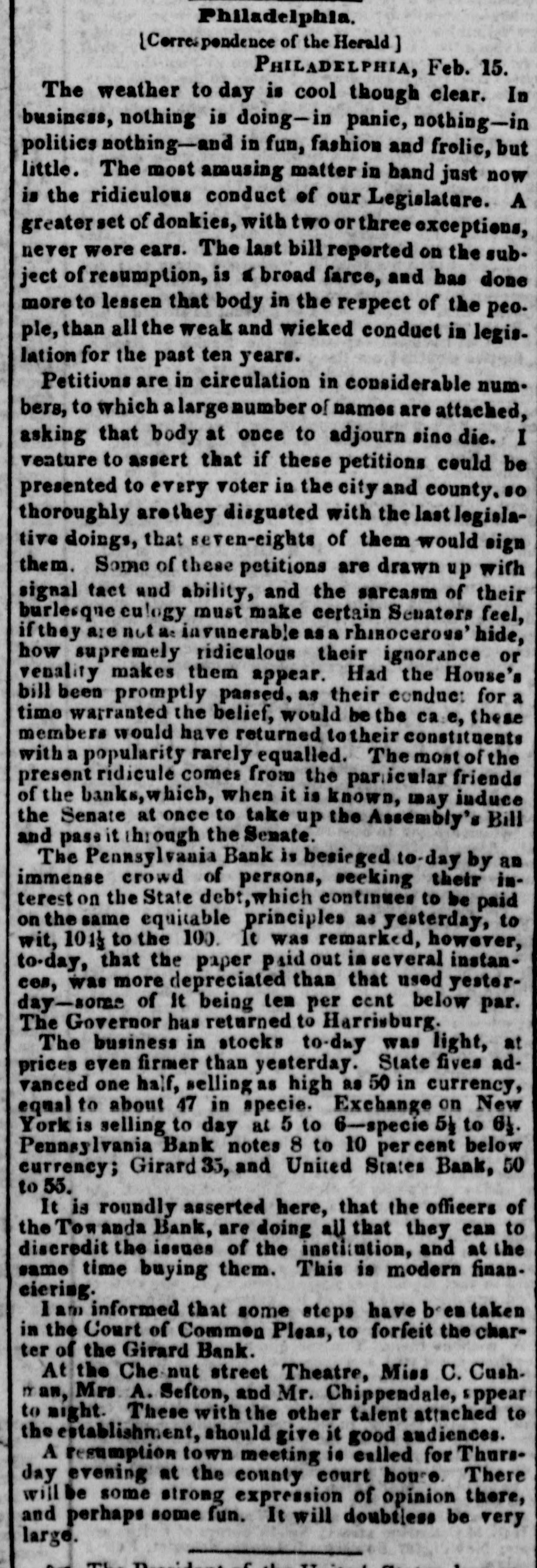
Philadelphia. [Cerrespendence of the Herald] PHILADELPHIA, Feb. 15. The weather to day is cool though clear. In business, nothing is doing-in panic, nothing-in politics nothing-and in fun, fashion and frolic, but little. The most amusing matter in hand just now is the ridiculous conduct of our Legislature. A greaterset of donkies, with two or three exceptions, never were ears. The last bill reported on the sub. ject of resumption, is u broad farce, and has done more to lessen that body in the respect of the peo. ple, than all the weak and wicked conduct in legislation for the past ten years. Petitions are in circulation in considerable numbers, to which a large number of names are attached, asking that body at once to adjourn sinc die. I venture to assert that if these petitions could be presented to every voter in the city and county. so thoroughly arothey disgusted with the last legislative doings, that seven-eights of them would sign them. Some of these petitions are drawn up with signal tact and ability, and the sarcasm of their burlesque eulogy must make certain Senators feel, if they are not as invunerable as a rhinocerous' hide, how supremely ridiculous their ignorance or venality makes them appear. Had the House's bill been promptly passed, as their conduc: for a time warranted the belief, would be the ca e, these members would have returned to their constituents with a popularity rarely equalled. The most of the present ridicule comes from the particular friends of the banks, which, when it is known, may induce the Senate at once to take up the Assembly's Bill and passit through the Senate. The Pennsylvania Bank is besieged to day by an immense crowd of persons, seeking their interest on the State debt, which continues to be paid on the same equitable principles as yesterday, to wit, 1013 to the 100. It was remarked, however, to-day, that the paper paid out in several instances, was more depreciated than that used yesterday-some of It being ten per ccnt below par. The Governor has returned to Harrisburg. The business in stocks to-day was light, at prices even firmer than yesterday. State fives advanced one half, selling as high as 50 in currency, equal to about 47 in specie. Exchange on New York is selling to day at 5 to 6-specie 51 to 6}. Pennsylvania Bank notes 8 to 10 percent below currency; Girard 35, and United States Bank, 50 to 55. It is roundly asserted here, that the officers of the Tow anda Bank, are doing all that they can to discredit the issues of the institution, and at the same time buying them. This is modern finan. ciering. am informed that some steps have b en taken in the Court of Common Pleas, to forfeit the charter of the Girard Bank. At the Che nut street Theatre, Miss C. CushIX an, Mrs A. Selton, and Mr. Chippendale, spear to night. These with the other talent attached to the establishment, should give it good audiences. A resumption town meeting is called for Thursday evening at the county court house. There will be some strong expression of opinion there, and perhaps some fun. It will doubtless be very large. - the -


Article from New-York Tribune, February 21, 1842

Click image to open full size in new tab

Article Text

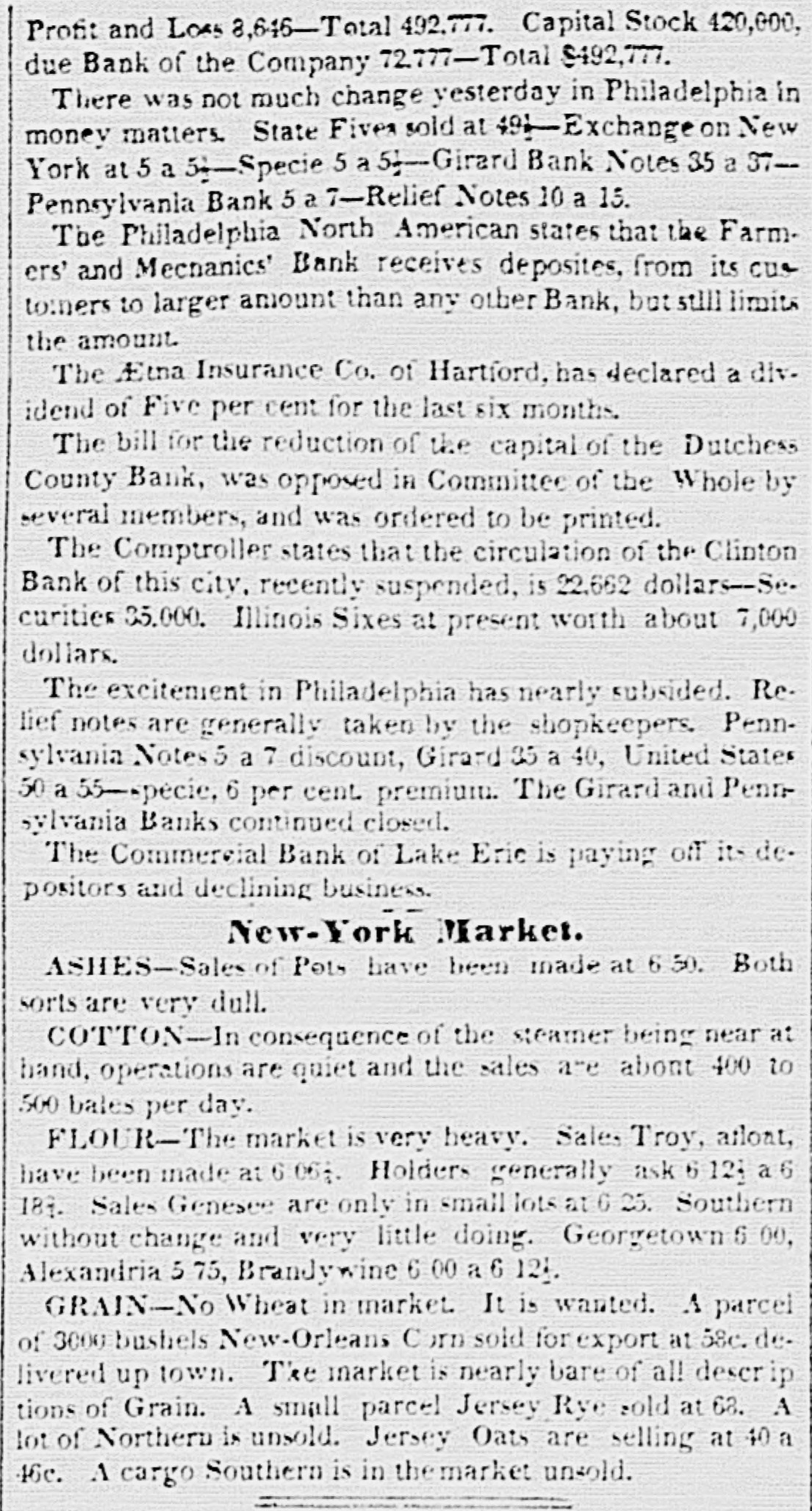
Profit and Loss 8,646-Total 492,777. Capital Stock 420,000, due Bank of the Company 72.777-Total $492,777. There was not much change yesterday in Philadelphia in money matters. State Fives sold at #-Exchange on New York at 5 a 5:-Specie 5 a -Girard Bank Notes 35 a 37-Pennsylvania Bank 5 a 7-Relief Notes 10 a 15. The Philadelphia North American states that the Farmers' and Mecnanics' Bank receives deposites, from its cus tomers to larger amount than any other Bank, but still limits the amount. The Etna Insurance Co. of Hartford, has declared a dividend of Five per cent for the last six months. The bill for the reduction of the capital of the Dutchess County Bank, was opposed in Committee of the Whole by several members, and was ordered to be printed. The Comptroller states that the circulation of the Clinton Bank of this city, recently suspended, is 22,662 dollars- Se curities 35.000. Illinois Sixes at present worth about 7,000 dollars. The excitement in Philadelphia has nearly subsided. Re. lief notes are generally taken by the shopkeepers. Pennevenia Notes 5 a 7 discount, Girard 35 a 40, United States 50 a -specie, 6 per cent premium. The Girard and Pennvivania Banks continued closed. The Commercial Bank of Lake Eric is paying off its depositors and declining business. New-York Market. ASHES-Sales - of Pets have been made at 6.50. Both sorts are very dull. COTTON-In consequence of the steamer being near at hand, operations are quiet and the sales are about 400 to 500 bates per day. FLOUR-The market is very heavy. Sales Troy, afloat, have been made at 6:06: Holders generally ask 6123 a 6 189. Sales Genesee are only in small lots at 6 25. Southern without change and very little doing. Georgetown 5.00, Alexandria 5 75, Brandy wine 6.00 a 6 12 GRAIN-No Wheat in market. It is wanted. A parcel of 3000 bushels New-Orleans Corn sold for export at 58c. delivered up town. The market is nearly bare of all descr ip tions of Grain. A small parcel Jersey Rye sold at 68. A lot of Northern is unsold. Jersey Oats are selling at 40 a 46c. A cargo Southern is in the market unsold.


Article from The New York Herald, March 12, 1842

Click image to open full size in new tab

Article Text

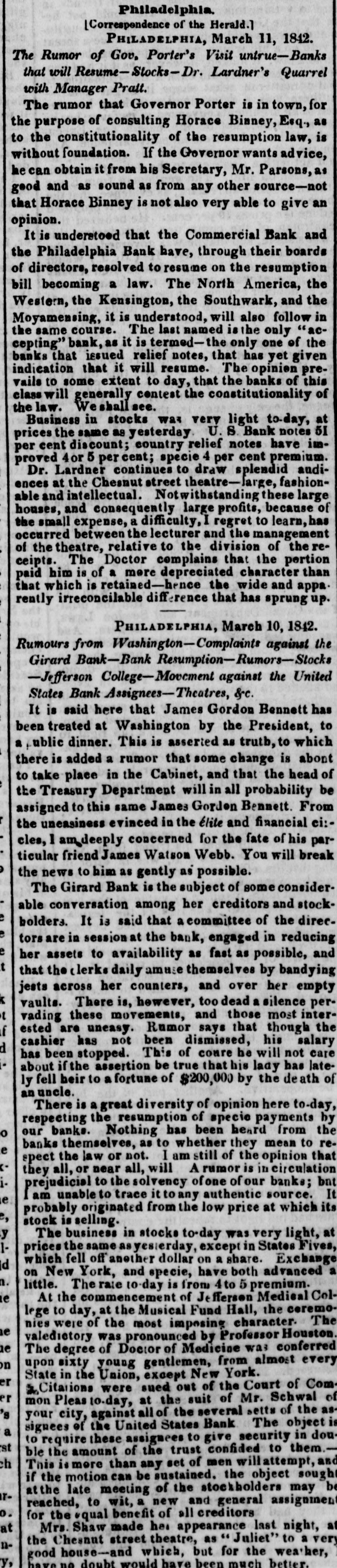
Philadelphia. [Correspondence of the Herald.] PHILADELPHIA, March 11, 1842. The Rumor of Gov, Porter's Visit untrue-Banks that will Resume-Stocks-Dr. Lardner's Quarrel with Manager Pratt. The rumor that Governor Porter is in town, for the purpose of consulting Horace Binney, Esq., as to the constitutionality of the resumption law, is without foundation. If the Governor wants advice, he can obtain it from his Secretary, Mr. Parsons, good and as sound as from any other source-not that Horace Binney is not also very able to give an opinion. It is understood that the Commercial Bank and the Philadelphia Bank have, through their boards of directors, resolved to resume on the resumption bill becoming a law. The North America, the Western, the Kensington, the Southwark, and the Moyamensing, it is understood, will also follow in the same course. The last named is the only "accepting" bank, as it is termed-the only one of the banks that issued relief notes, that has yet given indication that it will resume. The opinion prevails to some extent to day, that the banks of this class will generally contest the constitutionality of the law. Weshallsee. Business in stocks was very light today, at prices the same as yesterday. U. S. Bank notes 51 per cent discount; country relief notes have improved 4or 5 per cent; specie 4 per cent premium. Dr. Lardner continues to draw splendid audiences at the Chesnut street theatre-Jarge, fashionable and intellectual. Notwithstanding these large houses, and consequently large profits, because of the small expense, a difficulty, I regret to learn, has occurred between the lecturer and the management of the theatre, relative to the division of the receipts. The Doctor complains that the portion paid him is of a more depreciated character than that which is retained-hence the wide and apparently irreconcilable difference that has sprung up. PHILADELPHIA, March 10, 1842. Rumours from Washington-Complaints against the Girard Bank-Bank Resumption-Rumors-Stocks -Jefferson College-Movement against the United States Bank Assignees-Theatres, &c. It is said here that James Gordon Bennett has been treated at Washington by the President, to ublic dinner. This is asserted as truth, to which there is added a rumor that some change is about to take place in the Cabinet, and that the head of the Treasury Department will in all probability be assigned to this same James Gordon Bennett. From the uneasiness evinced in the elite and financial ci:cles, 1 am deeply concerned for the fate of his particular friend James Watson Webb. You will break the news to him as gently as possible. The Girard Bank is the subject of some considerable conversation among her creditors and stockbolders. It is said that a committee of the direc. torsarein sessionat the bank, engaged in reducing e her assets to availability as fast as possible, and t that the lerks daily amuse themselves by bandying jests across her counters, and over her empty k vaults. There is, however, too dead a silence pert vading these movements, and those most interested are uneasy. Rumor says that though the If cashier has not been dismissed, his salary d has been stopped. This of coure he will not care about if the assertion be true that his laay has lately fell heir to a fortune of $200,000 by the death of an uncle. There is a great diversity of opinion here to-day, respecting the resumption of specie payments by O our banks. Nothing has been heard from the banks themselves, as to whether they mean to ree spect the law or not. I am still of the opinion that kthey all, or near all, will A rumor is in circulation i. prejudicial to the solvency of one of our banks; bnt am unable to trace it to any authentic source. It e probably originated from the low price at which its e, stock is selling. y The business in stocks to-day was very light, at 1prices the same as yesterday, except in States Fives, which fell off another dollar on a share. Exchange d on New York, and specie, have both advanced h. little. The rate day is from to 5 premium. e At the commencement of Jeffersen Medical Cel lege to day, at the Musical Fund Hall, the ceremonies were of the most imposing character. The e valedictory was pronounced by Professor Houston he The degree of Doctor of Medicine was conferred upon sixty young gentlemen, from almost every on State in the Union, except New York. er Citations were sued out of the Court of Com er mon Pleas to-day, at the suit of Mr. Schwal of 's your city, against all of the several setts of the assignees of the United States Bank The object a to require these assignees to give security in doust ble the amount of the trust confided to them. ch This is more than any set of men will attempt, and if the motion can be sustained. the object sought at the late meeting of the stockholders may be rreached, to wit, a new and general assignment 0. for the equal benefit of all creditors at Mrs. Shaw made her appearance last night, the Chesnut street theatre, as Juliet" to a very ngood house--and which, but for the weather, y, haver doubt would have been much better.


Article from The New York Herald, March 20, 1842

Click image to open full size in new tab

Article Text

$8,724 do Do do The merchandize in 1840 1841 131,371 0 The nett profits of the companies for the past year, after discharging the interest on all their loans, amount to $215,116 79, or a profit of 7.42-100 per cent. on the capital stock of both Canal and Railroad, which sum has been derived elmest wholly from the operations on the Railroad. Disbursements to large amount were made for objects and purposes of an unusual character, not likely to occur again for many years. Particular attention is called to the increase on the amount of merchandise transported, in the year 1841, showing an excess over this the previous year of 8,372 tons, and a receipt from source of $50,576 82. The Girard Bank of Philadelphia having made an 22. of its effects, we annex the main features of signment the instrument having stricken out the legal repetitions. Thisindenture made the sixteenth day of March Anno be thousand eight hundred and forty-two, Domini, the one Girard Bank in the city of Philadelphia, Common. a tween chartered under the laws of the corporation Pennsylvania, of the first part, and Charles S. wealth Charles of Rugan and Henry Hern of the Bank same in city, the Boker, part. Whereas, the said Girard embarof the second being largely indebted and city of desirous of distributing their are creditors. Now this rassed their Philadelphia, indenture estate witnesseth Philadel equally among The Girard Bank in the city of Henthat the said, said Charles s Boker, Charles Rugan and all and phia, the delivered, 4.c. to them, the ry Hone, tenements, &c., and and personal, of them the said second estate, real that the said party of singular nevertheless, the have lands, assigned, generally Corporation. granted, the all and In trust the real estate hereby for part shall enter and upon convey the same in fee simple or sell, any less estate by public for the sale, same, for the for best cash or on credit be gotten dispose or obtained of most expedient; and give price that receipts can for the from all as to them may seem money which shall entirely discharge for the the application of such sales purchase shall be money, made, to receive the the purchaser purchase or such purchasers accountability and in the meantime and issues until aud income of such real received. estate, and And pay as to charges rents, thereon out viz: of the to rents take such so possession thereof and the personal estate, of the same will allow; and price to sell that can as the nature same at public sale for the best as to them transfer be obtained the expedient; for the same, and for to ask cash demand, or credit, sue for, debts recover, and may seem in all and singular, the due and owing to the discretion of them the receive, moneys collect and get and at the said party of the first part, and hereby assigned; the second part to compromise or compound of the sesaid party of shall seem to the said party &c.: to the same, and facilitate if it the collection of securities said debts, therefor. cond part to debts, &c;; or take new of the second renew provided such ho wever, that the of said said party debts hereby aspart &c.; shall receive the in notes payment and obligations of said to Bank be signed so to issued, be, and the checks this of time, it drawn to the or credit of drawn on the par value of such such heretofore depositors deposite at remaining shall safely at keep the notes, money obliga- per- so tions and checks; and the proceeds of the said real and collected, as well the as rents of the said real estate, herein and de- apsonal estate and and for the uses and purposes all the ply the same is to to say: in the first place to pay this trust: clared; that costs and charges of the executing same rateably and reasonable then to divide and distribute payment and satisfaction of and equally in and owards the and of all notes, bonds, debts bills, all moneys due certificates to depositors receivable in payment said party of of the obligations. deposite issued by the of the con. and certificates of outstanding. In assignments pursuance by Direc: first part, and provisions now relating to Section of the Act ditions Banks and dontained is the of Second the Commonwealth of tore of of the General Assembly twelfth day of March, 1842, specie enPennsylvania, passed provide the for the resumption and for other of partitled An Act to of the Commonwealth declared that the said by the Banks And it is further hereby pay and deduct in poses: the second part, shall receive which they may senparty antisfaction of of all the services cent on and from the full this assignment, one this per rate of pensation nett such der under collections; and approbation provided of the Court of if not, Common shall receive the of Philadelphia, and direct and less Pleas or for greater the percentage county as said Court may section of appoint. whereas, it is provided by that the the second nomination of the And sctof Assembly aforesaid, of any Bank in this common- StockAssignees wealth shall by be the subject Directors to the approbation general meeting. of the Now, holders of it such is decisred Bank that at a it shall be appointment the duty of the as said therefore, party of the second part, if of their by the stockholders assignees shall not Girard be approved Bank in the city of Philadelphia meetin, of the said, The meeting ; and if the said to con at their next general shall nominate other said assigneest party of the of stockholders vested in them the they may vey the part premises by these presents (except so far of as the trusts second have disposed of the unto same such in assignees pursuance so appointed declared. by herein declared) to for andupon the unfulfilled trusts hereby at the date sea's have said such of it meeting. conveyance. as hereunto the the seal same of interchangeably shall the In said witness remain party whereof, of set the their first the part, said hands parties being and


Article from The New York Herald, April 19, 1842

Click image to open full size in new tab

Article Text

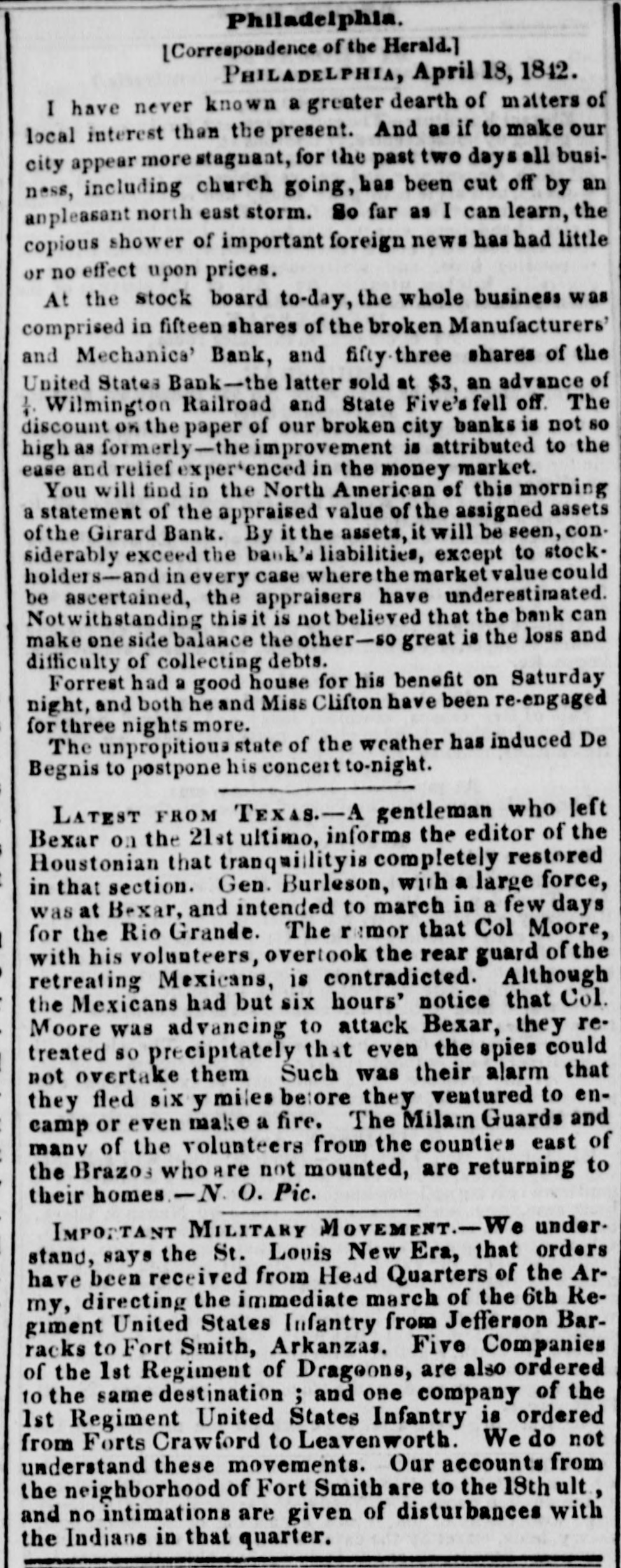
Philadelphia. Correspondence of the Herald.] PHILADELPHIA, April 18, 1842. I have never known a greater dearth of matters of local interest than the present. And as if to make our city appear more stagnant, for the past two days all business, including church going, has been cut off by an anpleasant north east storm. So far as I can learn, the copious shower of important foreign news has had little or no effect upon prices. At the stock board to-day, the whole business was comprised in fifteen shares of the broken Manufacturers' and Mechanics' Bank, and fifty three shares of the United States Bank-the latter sold at $3, an advance of 1/ Wilmington Railroad and State Five's fell off. The discount OK the paper of our broken city banks is not so high as formerly-the improvement is attributed to the ease and relief experienced in the money market. You will find in the North American of this morning a statement of the appraised value of the assigned assets of the Girard Bank. By it the assets, it will be seen, considerably exceed the bank's liabilities, except to stock. holders-and in every case where the market value could be ascertained, the appraisers have underestimated. Notwithstanding this it is not believed that the bank can make one side balance the other-so great is the loss and difficulty of collecting debts. Forrest had a good house for his benefit on Saturday night, and both he and Miss Clifton have been re-engaged for three nights more. The unpropitious state of the weather has induced De Begnis to postpone his concert to-night. LATEST FROM TEXAS.- - A gentleman who left Bexar on the 21st ultimo, informs the editor of the Houstonian that tranquilityis completely restored in that section. Gen. Burleson, with a large force, was at Bexar, and intended to march in a few days for the Rio Grande. The r mor that Col Moore, with his volunteers, overtook the rear guard of the retreating Mexicans, is contradicted. Although the Mexicans had but six hours' notice that Col. Moore was advancing to attack Bexar, they retreated so precipitately that even the spies could not overtake them Such was their alarm that they fled six y miles before they ventured to encamp or even make a fire. The Milain Guards and many of the volunteers from the counties east of the Brazo3 whoard not mounted, are returning to their homes.-N O. Pic. IMPO: TANT MILITARY MOVEMENT.-We under stand, says the St. Louis New Era, that orders have been received from Head Quarters of the Army, directing the immediate march of the 6th Regiment United States Infantry from Jefferson Barracks to Fort Smith, Arkanzas. Five Companies of the 1st Regiment of Drageons, are also ordered to the same destination ; and one company of the 1st Regiment United States Infantry is ordered from Forts Crawford to Leavenworth. We do not understand these movements. Our accounts from the neighborhood of Fort Smith are to the 18th ult, and no intimations are given of disturbances with the Indians in that quarter.


Article from New-York Daily Tribune, January 27, 1844

Click image to open full size in new tab

Article Text

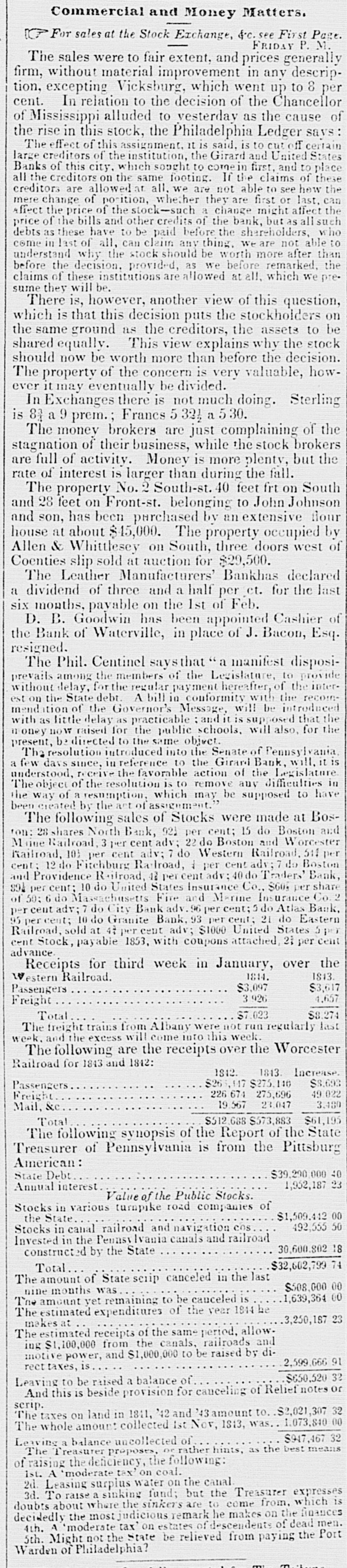
10 For sales at the Stock Exchange, & First Page. FRIDAY P. M. The sales were to fair extent, and prices generally firm, without material improvement in any description, excepting Vicksburg, which went up to 8 per cent. In relation to the decision of the Chancellor of Mississippi alluded to vesterday as the cause of the rise in this stock, the Philadelphia Ledger savs: The effect of this assignment. it is said, is to cut off certain large creditors of the institution, the Girard and United States Banks of this city, which sought to come in first, and to place all the creditors on the same footing. If the claims of these creditors are allowedat all. we are not able to see how the mere change of position, whether they are first or last, can effect the price of the stock-such a change might affect the price of the bills and other credits of the bank, but as all such debts as these have to be paid before the shareholders, who come in last of all, can claim any thing. we are not able to understand why the stock should be worth more after than before the decision. provided, as we before remarked, the claims of these institutions are allowed at all, which We presume they will be. There is, however, another view of this question, which is that this decision puts the stockholders on the same ground as the creditors, the assets to be shared equally. This view explains why the stock should now be worth more than before the decision. The property of the concern is very valuable, however it may eventually be divided. In Exchanges there is not much doing. Sterling is 8 a 9 prem.; Francs 324 a 530. The money brokers are just complaining of the stagnation of their business, while the stock brokers are full of activity. Money is more plenty, but the rate of interest is larger than during the fall. The property No. 2 South-st. 40 feet frt on South and 28 feet on Front-st. belonging to John Johnson and son, has been purchased by an extensive flour house at about $45,000. The property occupied by Allen & Whittlesey on South, three doors west of Coenties slip sold at auction for $29,500. The Leather Manufacturers' Bankhas declared a dividend of three and a half per et. for the last six months, payable on the 1st of Feb. D. B. Goodwin has been appointed Cashier of the Bank of Waterville, in place of J. Bacon, Esq. resigned. The Phil. Centinel saysthat a manifest disposiprevails among the members of the Legislature, to provide withoutdelay, for the regular payment thereafter, of the interon the State debt. bill 10 conformity with the recome mendation of the Governor's Message. will be introduced with as little delay as practicable and it is supposed that the money now raised for the public schools. will also, for the present, be directed to the same object. The resolution introduced into the Senate of Fennsylvania, a few days since, in reference to the Girard Bank, will, it is understood, receive the favorable action of the Legislature The object of the resolution is to remove auv difficulties in the way of a resumption, which may be supposed to have created by the art of assignment." The following sales of Stocks were made at Boston: 28 shares North Bank, 921 per cent; 15 do Boston and Maine Railroad, 3 per cent adv; 22 do Boston and Worcester Railroad, 10) per cent adv; 7 do Western Railroad, 511 per cent: 12 do Fitchburg Raelroad, / per cent adv; 7 do Boston and Providence Reitroad, 42 per cent adv: 40do Traders' Bank, 894 per cent: 10 do United States Insurance Co., $60. per share of 50; 6 do Massachusetts Fire and Marine Insurance Co. per cent adv; do City Bank ad 96 per cent; do Atlas Bank, 95 ercent; 10 do Granite Bank, 93 per cent; 21 do Eastern Railroad, sold at 42 per cent adv; $1000 United States pro cent Stock, payable 1853, with coupons attached 21 per cent advance Receipts for third week in January, over the 1813 1814. Western Railread. $3,097 $3,617 Passengers 3 926 4.657 Freight $8.274 $7.023 Total last The !reight trains from Albany were not run regularly week. and the excess will come into this week. The following are the receipts over the Worcester Railroad for 1843 and 1812: 1813. Increase 1812. $8,693 $265,047 $275,110 Passengers 49.022 226 674 275,696 Freight 23,047 3.480 19.567 Mail, &c $573,883 $61,195 $512,688 Total The following synopsis of the Report of the State Treasurer of Pennsylvania is from the Pittsburg American: $39,290,000 4 State Debt 1,952,187.23 Annual interest Value of the Public Stocks. Stocks in various turnpike road companies of $1,509,412.00 the State 492,555.50 Stocks in canal railroad and navigation cos Invested in the Pennsylvan canals and railroad 30,600,802 18 constructed by the State $32,602,799.74 Total The amount of State scrip canceled in the last $508,000.00 nine months was 1,639,364 00 The amount vet remaining to be canceled is The estimated expenditures of the year 1814 be 13,250,187 23 makes at The estimated receipts of the same period, allowing $1,100,000 from the canals, railroads and motive power, and $1,000,000 to be raised by di2,599,666.91 cttaxes, is $650,520.32 Leaving to be raised a balance of And this is beside provision for canceling of Relief notes or scrip. The taxes on land in 1811, 42 and '43 amount to $2,021,307 32 1.073.840.00 The whole amount collected 1st Nov. 1813, was $947,467.32 Leaving balance uncollected of The Treasurer proposes. rather hints, as the best means of raising the deficiency, the following: 1st. A 'moderate tax' on coal. 2d. Leasing surplus water on the canal 3d. To raise a sinking fund; but the Treasurer expresses doubts about where the sinkers are to come from, which is decidedly the most judicious remark he makes on the finances 4th. A moderate tax on estates of descendents of dead men. 5th. Might not the State be relieved from paying the Port Warden of Philadelphia?


Article from The New York Herald, February 9, 1844

Click image to open full size in new tab

Article Text

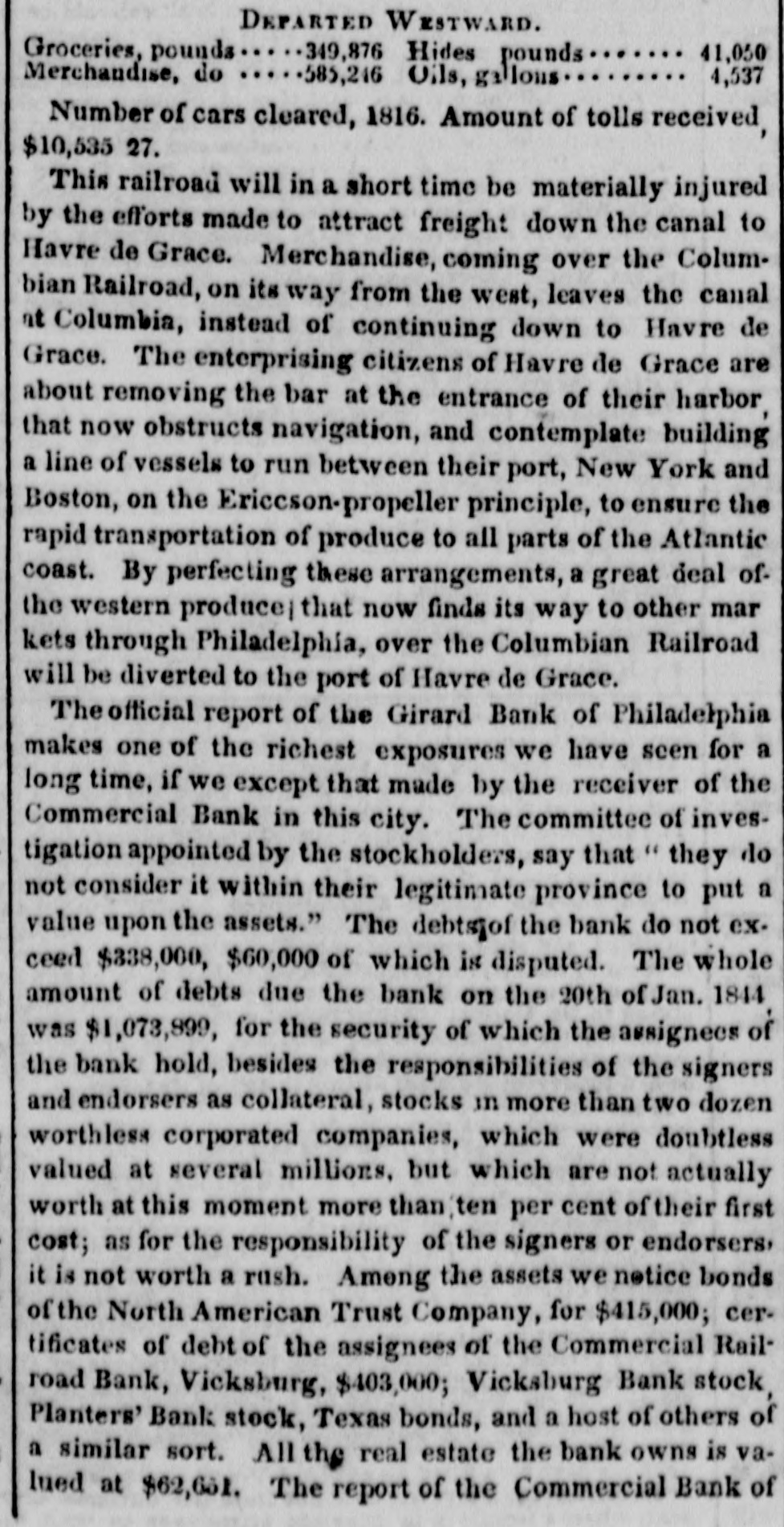
DEPARTED WESTWARD. Groceries, pounds.349,876 Hides pounds. 41,050 Merchandise, do .585,246 Oils, gallons... 4,537 Number of cars cleared, 1816. Amount of tolls received, $10,535 27. This railroad will in a short time be materially injured by the efforts made to attract freight down the canal to Havre de Grace. Merchandise, coming over the Columbian Railroad, on its way from the west, leaves the canal at Columbia, instead of continuing down to Havre de Grace. The enterprising citizens of Havre de Grace are about removing the bar at the entrance of their harbor, that now obstructs navigation, and contemplate building a line of vessels to run between their port, New York and Boston, on the Ericcson-propeller principle, to ensure the rapid transportation of produce to all parts of the Atlantic coast. By perfecting these arrangements, a great deal of the western produce that now finds its way to other markets through Philadelphia, over the Columbian Railroad will be diverted to the port of Havre de Grace. The official report of the Girard Bank of Philadelphia makes one of the richest exposures we have seen for a long time, if we except that made by the receiver of the Commercial Bank in this city. The committee of investigation appointed by the stockholders, say that "they do not consider it within their legitimate province to put a value upon the assets." The debts of the bank do not exceed $338,000, $60,000 of which is disputed. The whole amount of debts due the bank on the 20th of Jan. 1844, was $1,073,999, for the security of which the assignees of the bank hold, besides the responsibilities of the signers and endorsers as collateral, stocks in more than two dozen worthless corporated companies, which were doubtless valued at several millions, but which are not actually worth at this moment more than ten per cent of their first cost; as for the responsibility of the signers or endorsers, it is not worth a rush. Among the assets we notice bonds of the North American Trust Company, for $415,000; certificates of debt of the assignees of the Commercial Railroad Bank, Vicksburg, $403,000; Vicksburg Bank stock, Planters' Bank stock, Texas bonds, and a host of others of a similar sort. All the real estate the bank owns is valued at $62,601. The report of the Commercial Bank of


Article from The New York Herald, November 9, 1857

Click image to open full size in new tab

Article Text

their banks to resume, and a law is passed commanding them to do so before February 1, 1841. 1841, JANUARY 15. The banks of Philadelphia resume. The United States Bank publishes a statement, from which it appears that the bank owes twelve millions, payable on demand, while it had only three millions available cash to pay with. The stock is down to seventy, and falls still deeper. FEBRUARY 4. The Bank of the United States again suspends specie payments. The other banks are obliged to do so likewise, but they gradually resumed, the Legislature passing a relief act, by which the State took their notes as loan currency. APRIL-Important frauds are discovered in the management of the United States Bank. The assets have depreciated seventeen millions in value, making a loss to the stockholders, if the concern was wound up, of twenty millions. The bank officers borrowed money abroad and lent it at home on worthless stocks. Messrs. Biddle, Cowperthwaite and others likewise went into cotton speculations, using the money of the bank therefor without the knowledge of the directors, and allowing it only simple interest. There was a loss of $600,000 on one of these transactions, which after some difficulty, was assumed by Biddle, Wilder & Cowperthwaite. They settled with Texas bonds, wild lands and some cash. Other investigations proved that the bank was rotten to the core. AUGUST 19. Congress passes the Bankrupt law. 1842, JANUARY.-Biddle, Cowperthwaite, Jaudon, Andrews and Dunlap were indicted for conspiracy to defraud the stockholders. They were all brought before the General Sessions on habeas corpus, and discharged on the ground that there was nothing legally to justify the charge. FEBRUARY 1.-Bankrupt law goes into operation. Wipes out $440,934,615 of debts, and clears 33,739 bankrupts. MAY. The United States Bank closes up, and makes a partial assignment. In September an entire assignment was made. During this year the Girard Bank made an assignment, but afterwards paid all its debts and was allowed to resume its business. # THE RAILWAY SMASH OF 1854. 1852 and 1853 were flush times, and the people over-traded and over speculated as if there could not be another '37. They were all at once astounded in 1854, JULY 5. Panic in Wall street. It is announced that Robert Schuyler, President and Transfer Agent of the New York and New Haven Railway Company, has defrauded the bona fide stockholders of two millions of dollars by an overissue of stock to that amount. The NEW YORK HERALD (6th) says "most of the railroad stocks fell two per cent," and characterizes the affair as "another evidence of the extravagance in living and over-speculation which characterize the mercantile population of New York." JULY 7. The panic in Wall street is still worse. It is announced that there has been an overissue in Harlem Railway stock, not heavy, but sufficient to destroy confidence in this class of securities. Schuyler, the New Haven Railway swindler, escapes from the city, and nothing more is heard of him. JULY 12. The HERALD estimates the railway swindles at twelve millions. Stocks go down, but the money market remains easy. AUGUST. Things are still very blue in Wall street. Several stock houses are obliged to suspend. Another fall in fancies, and activity in breadstuffs. Other trade is very dull, and rents go down. The HERALD predicts a general collapse. SEPTEMBER. During the latter part of the summer there has been a great drought, and there are rumors of short crops. The HERALD sends a circular to prominent agriculturists throughout the country requesting information. The answers are of a mixed character, but generally unfavorable. OCTOBER. Fall trade opens dull. Light receipts of breadstuffs and high prices. Railway stocks have depreciated on an average thirty per cent, fancies seventy-five, real estate twenty-five. It has been a bad year all round through over-trading and over-speculation. NOVEMBER. Several heavy failures are announced in the West, and some small banks in the country are obliged to close up. DECEMBER. Hard times have come. No money to pay for the extravagances of the spring. Everybody contracts. Thousands of laborers thrown out of employment. Breadstuffs high. The effects of the hard times tell on all kinds of business. DECEMBER 19. The first soup kitchen is opened in the Seventeenth ward, New York city, and good beef soup is distributed free to all applicants. The number of applicants for admission to the Almshouse increases one-third. DECEMBER 22.- The workingmen hold meetings in the Park. Relief associations are formed in several wards and distribute fuel and food to the poor. DECEMBER 29.-Meetings are held in nearly all the wards and in several other cities, to devise means for the relief of the poor. 1855, JANUARY 6. Times are harder and more distress among the poor. A grand charity ball at the Academy is projected. A fashionable lady issues cards for a party where all the guests are requested to dress in calico. Several heavy failures announced at Boston and New Orleans. JANUARY 15. Several heavy arrivals of gold from California, without corresponding shipments to Europe. Fancy stocks go up a little, but things are as bad as ever with the merchants. FEBRUARY. Stagnation. Trade no better, money no easier. MARCH. Many of the New England manufacturers resumed work which had been suspended two months, and things began to grow easier. MAY. The spring trade opened pretty well, and business prospects being encouraging, things went on in the old way again. # THE REVULSION OF 1857. During the first part of this year, and indeed during the whole of the preceding year there were premonitory signs of a crisis, which were apparent to every one acquainted with the laws of commerce and finance. The HERALD, as in '36, predicted the crisis, from overtrading, stock gambling and inflation of all kinds. Some prudent men took heed of the warning and carried less sail; others however carried on more than ever. 1857, AUGUST. In the early part of this month a few failures were announced, and the list of the Independent newspaper was further enlarged about the 15th. The HERALD (14th) reiterated its statements that we are on the brink of a crisis. AUGUST 17. Over issues and frauds in some of the Western railway stocks. A fall and want of confidence in the street. AUGUST 21. The Persia takes out nearly two millions in specie. The HERALD says this will draw down the bank reserve, and blames the banks for expansion by wholesale. Severe stringency is anticipated. AUGUST 24. Panic among the stock brokers. Everything had a tumble. At about three o'clock great excitement was caused by the announcement of the failure of the Ohio Life and Trust Company. It was a bank of deposit and discount, with a capital of two millions. It had recently paid five per cent semi-annual dividend, and its stock sold at 102. It was ruined by loaning money to railway companies without sufficient security. Several failures in Rochester and Boston announced. Panic in Cincinnati, and a run on the banks. AUGUST 25. John Thompson, Beebe & Co., De Launay, Iselin & Clark, and Jacob Little & Co., heavy brokers in Wall street, are obliged to suspend. The liabilities of the Ohio Life and Trust, are stated at five millions. AUGUST 26.-Long list of country bank failures. The Banks commence to contract their loans. AUGUST 27, 28, 29. There has been a great pressure for money, and two per cent is the lowest street rate for money. AUGUST 31. The bank statement is unfavorable. The deposits and specie have decreased, and the contraction in two weeks amounts to five and a half millions, equal to the whole expansion of the previous six weeks. SEPT. 1. Panic in Wall street. The Mechanics' Banking Association closes its doors. Beebe & Co., specie brokers, connected with the Ohio Life and Trust, suspended. Also several mercantile houses. Mr. Van Blarcan, Teller, of the Mechanics' Banking Association, is reported a defaulter to the amount of $72,000. There was a run by depositors on the Bank of Commerce, Metropolitan, and several other banks. At the second board all the stocks declined. SEPTEMBER 3, 4 and 5. Stocks go up a fraction. Wall street recovers a little. General opinions that there won't be much of a shower. Saturday (5th), however, the market closed depressed. SEPTEMBER 7.-Bank contraction eight millions. The bank statement is bad, and more failures announced. SEPTEMBER 8. The money market tighter than ever. Panic at the stock board. SEPTEMBER 9 and 10.-Several heavy failures among the dry goods houses. Bad news from Boston and the Western cities. Bank of New Jersey, at New Brunswick, and several country banks closed their doors. More failures. SEPTEMBER 12-Wm. J. Bell & Co., bankers, suspend. News of the suspension of several banks in the interior. SEPTEMBER 15. Statement shows that the banks have sustained themselves at the expense of the merchants. Wesley & Co., "bull" stock brokers, are obliged to suspend. SEPTEMBER 16.-News of great stringency in Philadelphia and Boston. SEPTEMBER 18.-The total loss of the California mail