Article Text
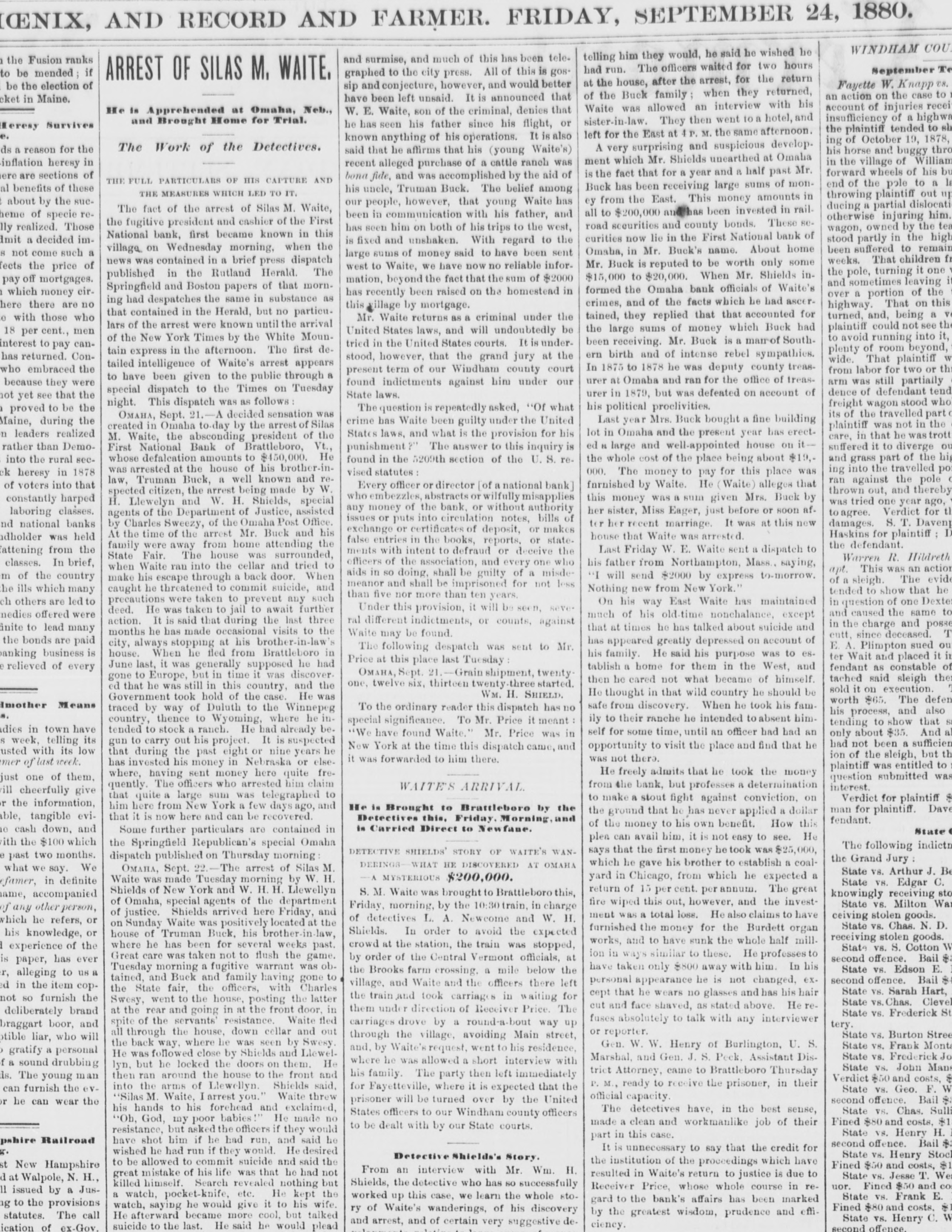
AND RECORD AND FARMER. FRIDAY, SEPTEMBER 24, 1880. WINDHAM COU telling him they would, he said he wished he ranks and surmise, and much of this has been telehad run. The officers waited for two hours September To if mended graphed to the city press. All of this is gosARREST OF SILAS M. WAITE. at the house, after the arrest, for the return of election Fayette W. Knapp vs. sip and conjecture, however, and would better an action on the case to of the Buck family when they returned, have been left unsaid. It is announced that Maine. account of injuries recei Waite was allowed an interview with his He is Apprehended at Omaha, Neb., W. E. Waite, son of the criminal, denies that insufficiency of a highw and Brought Home for Trial. sister-in-law. They then went to a hotel, and Survives he has seen his father since his flight, or the plaintiff tended to si left for the East at 4 P. M. the same afternoon. known anything of his operations. It is also ing of October 19, 1878, The Work of the Detectives. the for A very surprising and suspicious developsaid that he affirms that his (young Waite's) his horse and buggy thro ment which Mr. Shields unearthed at Omaha in in the village of Willian heresy recent alleged purchase of a cattle ranch was forward wheels of his by is the fact that for a year and a half past Mr. of sections bona fide, and was accomplished by the aid of THE FULL PARTICULARS OF HIS CAPTURE AND end of the pole to a la Buck has been receiving large sums of monof these his uncle, Truman Buck. The belief among THE MEASURES WHICH LED TO IT. throwing plaintiff out up the sucey from the East. This money amounts in by our people, however, that young Waite has ducing a partial dislocati The fact of the arrest of Silas M. Waite, all to $200,000 been invested in railrebeen in communication with his father, and specie otherwise injuring him. the fugitive president and cashier of the First road sceurities and county bonds. These seThose has seen him on both of his trips to the west, wagon, owned by the tea National bank, first became known in this curities now lie in the First National bank of imdecided stood partly in the higl is fixed and unshaken. With regard to the been suffered to remair village. on Wednesday morning, when the a such Omaha, in Mr. Buck's name. About home large sums of money said to have been sent weeks. That children f news was contained in a brief press dispatch Mr. Buck is reputed to be worth only some of west to Waite, we have now no reliable inforprice the pole, turning it one published in the Rutland Herald. The $15,000 to $20,000. When Mr. Shields inmortgages. mation, beyond the fact that the sum of $2000 and sometimes leaving i Springfield and Boston papers of that mornformed the Omaha bank officials of Waite's cirmoney has recently been raised on the homestead in over a portion of the ing had despatches the same in substance as crimes, and of the facts which he had ascerno are highway. That on this this illage by mortgage. that contained in the Herald, but no particuturned, and, being a v tained, they replied that that accounted for those who Mr. Waite returns as a criminal under the lars of the arrest were known until the arrival plaintiff could not see th the large sums of money which Buck had men United States laws, and will undoubtedly be cent., to avoid running into it, of the New York Times by the White Mounto been receiving. Mr. Buck is a manof Southtried in the United States courts. It is undercanpay plenty of room beyond, tain express in the afternoon. The first deern birth and of intense rebel sympathies. Constood, however, that the grand jury at the wide. That plaintiff w tailed intelligence of Waite's arrest appears In 1875 to 1878 he was deputy county treasthe mbraced from labor for two or th present term of our Windham county court to have been given to the public through a urer at Omaha and ran for the office of treasarm was still partially were found indictments against him under our they special dispatch to the Times on Tuesday dence of defendant tend urer in 1879, but was defeated on account of State laws. see that the night. This dispatch was as follows : freight wagon stood who be to the his political proclivities. The question is repeatedly asked, "Of what its of the travelled part OMAHA, Sept. 21.-A decided sensation was the Last year Mrs. Buck bought a fine building crime has Waite been guilty under the United during plaintiff was not in the created in Omaha to-day by the arrest of Silas realized lot in Omaha and the present year has erectStates laws, and what is the provision for his care, in that he was trott M. Waite, the absconding president of the than Demoed 11 large and well-appointed house on itFirst National Bank of Brattleboro, Vt., suffered it to diverge ou punishment The answer to this inquiry is whose defalcation amounts to $450,000. He rural and grass part of the hi secfound in the 5209th section of the U. S. rethe whole cost of the place being about $19,was arrested at the house of his brother-ining into the travelled po in vised statutes 1878 000. The money to pay for this place was ran against the pole law, Truman Buck, a well known and reinto that furnished by Waite. He (Waite) alleges that Every officer or director [of a national bank] thrown out, and thereby spected citizen, the arrest being made by W. who embezzles, abstracts or wilfully misapplies this money was a sum given Mrs. Buck by harped was tried one year ago, H. Llewelyn and W. H. Shields, special any money of the bank, or without authority classes. her sister, Miss Eager, just before or soon afagents of the Department of Justice, assisted toagree. Verdict for tl issues or puts into circulation notes, bills of banks ter her recent marriage. It was at this new damages. S. T. Daven by Charles Sweezy, of the Omaha Post Office. exchange or certificates of deposit, or makes At the time of the arrest Mr. Buck and his Haskins for plaintiff I house that Waite was arrested. held was false entries in the books, reports, or statethe defendant. family were away from home attending the from the ments with intent to defraud or deceive the Last Friday W. E. Waite sent a dispatch to State Fair. The house was surrounded, Warren R. Hildreth In officers of the association, and every one who brief, his father from Northampton, Mass., saying, when Waite ran into the cellar and tried to apt. This was an action aids in so doing, shall be guilty of a misdethe "I will send $2000 by express to-morrow. country make his escape through a back door. When of a sleigh. The evid meanor and shall be imprisoned for not less which caught he threatened to commit suicide, and Nothing new from New York." many tended to show that he than five nor more than ten years. precautions were taken to prevent any such led are to On his way East Waite has maintained in question of one Dexte Under this provision, it will be seen, sevedeed. He was taken to jail to await further and caused the same to were offered much of his old-time nonchalance, except action. It is said that during the last three ral different indictments, or counts, against in the charge and posse lead that at times he has talked about suicide and many months he has made occasional visits to the Waite may be found. cutt, since deceased. I are paid has appeared greatly depressed on account of city, always stopping at his brother-in-law's E. A. Plimpton sued ou The following despatch was sent to Mr. is business house. When he fled from Brattleboro in his family. He said his purpose was to ester Wait and placed it it Price at this place last Tuesday June last, it was generally supposed he had of tablish a home for them in the West, and fendant as constable of every OMAHA, Sept. -Grain shipment, twentygone to Europe, but in time it was discover. then he cared not what became of himself. tached said sleigh the one, twelve six, thirteen twenty-three started. ed that he was still in this country, and the sold it on execution. He thought in that wild country he should be WM. H. SHIELD. Government took hold of the case. He was worth $65. The defer eans safe from discovery. When he took his famtraced by way of Duluth to the Winnepeg To the ordinary reader this dispatch has no his process, and also ily to their ranche he intended to absent himcountry, thence to Wyoming, where he inspecial significance. To Mr. Price it meant tending to show that s have town tended to stock a ranch. He had already be. self for some time, until an officer had had an "We have found Waite." Mr. Price was in only about $35. And a its telling gun to carry out his project. It is suspected had not been a sufficier opportunity to visit the place and find that he New York at the time this dispatch came, and its with low that during the past eight or nine years he ion of the sleigh, but th was not thera. it was forwarded to him there. week. has invested his money in Nebraska or elseplaintiff was entitled to He freely admits that he took the money where, having sent money here quite freof them, question submitted was quently. The officers who arrested him claim from the bank, but professes a determination interest. WAITE'S ARRIVAL. give that quite a large sum was telegraphed to to make a stout fight against conviction, on Verdict for plaintiff s information, him here from New York a few days and He is Brought to Brattleboro by the man for plaintiff. Dave the ground that he has never applied a dollar evithat it is now here and can be recovered. angible Detectives this, Friday. Morning, and fendant. of the money to his own benefit. How this in Carried Direct to Newfane. and down, State Some further particulars are contained in plea can avail him, it is not easy to see. He which $100 the Springfield Republican's special Omaha The following indictr DETECTIVE SHIELDS' STORY OF WAITE'S WANsays that the first money he took was $25,000, months. dispatch published on Thursday morning: the Grand Jury which he gave his brother to establish a coalDERINGS-WHAT HE DISCOVERED AT OMAHA We OMAHA, Sept. 22.-The arrest of Silas M. say. State vs. Arthur J. B yard in Chicago, from which he expected a MYSTERIOUS $200,000. definite Waite was made Tuesday morning by W. H. in State VS. Edgar C. return of 15 per cent. per annum. The great Shields of New York and W. H. H. Llewellyn S. M. Waite was brought to Brattleboro this, knowingly receiving sto accompanied of Omaha, special agents of the department fire wiped this out, however, and the investState VS. Milton Wa other Friday, morning, by the 10:30 train, in charge person, of justice. Shields arrived here Friday, and ment was a total loss. He also claims to have ceiving stolen goods. of detectives L. A. Newcome and W. H. or refers, on Sunday Waite was positively located at the State VS. Chas. N. D. furnished the money for the Burdett organ or Shields. In order to avoid the expected nowledge, house of Truman Buck, his brother-in-law, receiving stolen goods. works, and to have sunk the whole half millof the crowd at the station, the train was stopped, where he has been for several weeks past. State VS. S. Cotton W ion in ways similar to these. He professes to Great care was taken not to flush the game. has ever by order of the Central Vermont officials, at second offence. Bail $ Tuesday morning a fugitive warrant was obhave taken only $800 away with him. In his State VS. Edson E. the Brooks farm crossing, a mile below the a us to tained, and Buck and family having gone to second offence. Bail $ personal appearance he is not changed, exvillage, and Waite and the officers there left item copthe State fair, the officers, with Charles State vs. Sarah Hart, cept that he wears no glasses and has his hair the the train and took carriages in waiting for furnish Swesy, went to the house, posting the latter State VS. Chas. Cleve cut and face shaved, as stated above. He rethem under direction of Receiver Price. The brand at the rear and going in at the front door, in State VS. Frederick St fuses absolutely to talk with any interviewer spite of the servants' resistance. Waite fled and carriages drove by a round-a-bout way up boor, tery. or reporter. all through the house, down cellar and out State vs. Burton Stree who will through the village, avoiding Main street, the back way, where he was seen by Swesy. State VS. Frank Mont Gen. W. W. Henry of Burlington, U. S. and, by Waite's request, went to his residence, a personal He was followed close by Shields and LlewelState vs. Frederick Jo Marshal, and Gen. J. S. Peck. Assistant Diswhere he was allowed a short interview with drubbing lyn, but he locked the doors on them. He State vs. John Man trict Attorney, came to Brattleboro Thursday man then ran around the house to the front and his family. The party then left immediately young Verdict $50 and costs, $ P. M., ready to receive the prisoner, in their into the arms of Llewellyn. Shields said, the evfor Fayetteville, where it is expected that the State VS. Geo. F. W official capacity. "Silas M. Waite, arrest you." Waite threw second offence. Bail $ wear the prisoner will be turned over by the United his hands to his forehead and exclaimed, The detectives have, in the best sense, State VS. Chas. Sull States officers to our Windham county officers "Oh, God, my poor babies!" He made no Fined $80 and costs, $1 made a clean and workmanlike job of their to be dealt with by our State courts. resistance, but asked the officers if they would State vs. Henry H. part in this case. Railroad have shot him if he had run, and said he second offence. Bail $ It is unnecessary to say that the credit for wished he had run if they would. He desired State VS. Henry Stoc Detective Shields's Story. to be allowed to commit suicide and said the the institution of the proceedings which have Fined $50 and costs, $ Hampshire From an interview with Mr. Wm. H. great mistake of his life was that he had not resulted in Waite's return to justice is due to State vs. Jesse T. We N. H., alpole, Shields, the detective who has so successfully killed himself. Search revealed nothing but uor. Fined $50 and co Receiver Price, whose whole course in rea Jusby a watch, pocket-knife, etc. He kept the State VS. Frank E. worked up this case, we learn the whole stogard to the bank's affairs has been marked provisions watch, saying he would give it to his wife. Fined $80 and costs, $ ry of Waite's wanderings, of his discovery by the greatest wisdom, prudence and effiThe call He afterward became more cool, but talked State vs. Henry C. w and arrest, and of certain very suggestive deciency. Gov suicide to the last. He said he would plead of second offence.