18972. Banks in Philadelphia (Philadelphia, PA)

Bank Information

Episode Type
Suspension → Reopening
Bank Type
state
Start Date
February 9, 1841
Location
Philadelphia, Pennsylvania (39.952, -75.164)

Metadata

Model
gpt-5-mini
Short Digest
bc200c1d

Response Measures

None

Description

Articles describe Philadelphia banks being closed/shut up in Feb 1841 as part of the broader suspension/resumption crisis; later (1842) discussion concerns resumption efforts. No explicit depositor run is described for these Philadelphia banks in the provided texts, so this is classified as a suspension with later resumption efforts (reopening). Dates are approximate from newspaper excerpts (Philadelfy/Feb 9, 1841 and discussion in 1842).

Events (1)

1. February 9, 1841 Suspension
Cause
Macro News
Cause Details
Part of the broader suspension/resumption monetary crisis of 1841 affecting multiple banks; banks were 'shut up' amid debates over specie payments and resumption policies rather than an isolated bank-specific failure.
Newspaper Excerpt
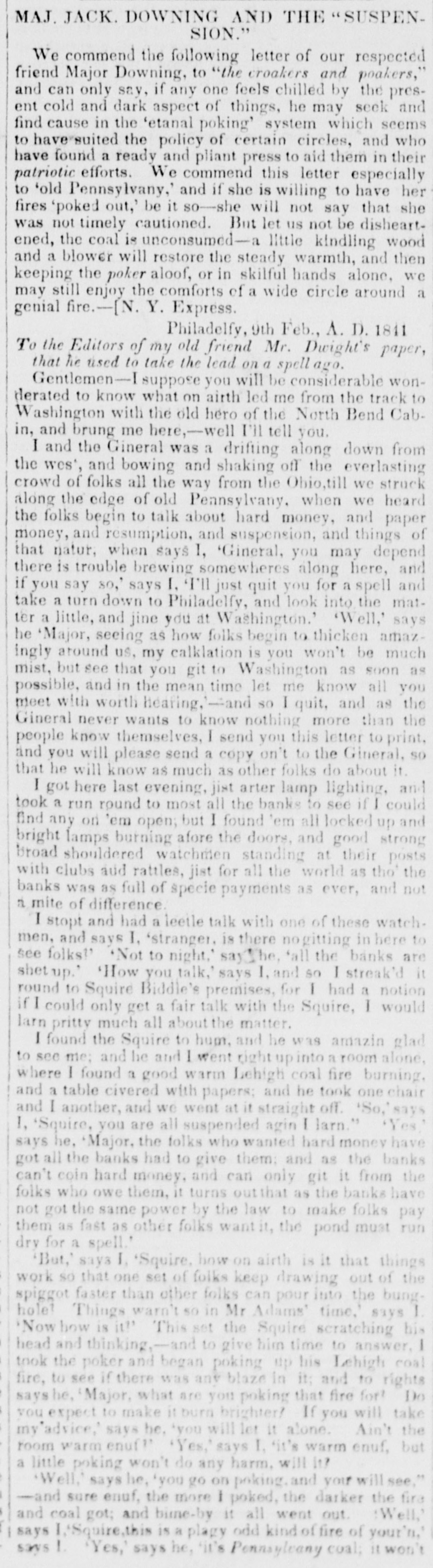
I got here last evening, jist arter lamp lighting, and took a run round to most all the banks to see if I could find any on 'em open; but I found 'em all locked up and bright lamps burning afore the doors, and good strong broad shouldered watchmen standing at their posts ... 'all the banks are shet up.'
Source
newspapers

Newspaper Articles (2)

Article from Rutland Herald, February 23, 1841

Click image to open full size in new tab

Article Text

MAJ. JACK DOWNING AND THE "SUSPENSION." We commend the following letter of our respected friend Major Downing, to "the croakers and poakers," and can only say, if any one feels chilled by the present cold and dark aspect of things, he may seek and find cause in the 'etanal poking' system which seems to have-suited the policy of certain circles, and who have found a ready and pliant press to aid them in their patriotic efforts. We commend this letter especially to 'old Pennsylvany, and if she is willing to have her fires 'poked out,' be it so-she will not say that she was not timely cautioned. But let us not be disheartened, the coal is unconsumed-a little kindling wood and a blower will restore the steady warmth, and then keeping the poker aloof, or in skilful hands alone, we may still enjoy the comforts of a wide circle around a genial fire.-[N. Y. Express. Philadelfy, 9th Feb., A. 1811 To the Editors of my old friend Mr. Dwight's paper, that he used to take the lead on a spell ago. Gentlemen-I suppose you will be considerable wonderated to know what on airth led me from the track to Washington with the old héro of the North Bend Cab. in, and brung me here,-well I'll tell you. I and the Gineral was a drifting along down from the wes', and bowing and shaking off the everlasting crowd of folks all the way from the Ohio,till we struck along the edge of old Pennsylvany. when we heard the folks begin to talk about hard money, and paper money, and resumption, and suspension, and things of that natur, when says I, 'Gineral, you may depend there is trouble brewing somewheres along here, and if you say 80, says 1. 'I'll just quit you for a spell and take a turn down to Philadelfy, and look into the matter a little, and jine you at Washington.' 'Well,' says he 'Major, seeing as how folks begin to thicken amazingly around us. my calklation is you won't be much mist, but see that you git to Washington as soon as possible, and in the mean time let me know all you meet with worth Hearing,- so I quit, and as the Gineral never wants to know nothing more than the people know themselves, I send you this letter to print, and you will please send a copy on't to the Gineral, SO that he will know as much as other folks do about it I got here last evening, jist arter lamp lighting, and took a run round to most all the banks to see if I could find any on 'em open; but I found 'em all locked up and bright lamps burning afore the doors, and good strong broad shouldered watchmen standing at their posts with clubs aud rattles, jist for all the world as tho the banks was as full of specie payments as ever, and not a mite of difference I stopt and had a leetle talk with one of these watch. men, and says I. 'stranger. is there nogitting in here to see folks" Not to night," say The 'all the banks are shet up. 'How you talk," says 1. and so I streak'd it round to Squire Biddle's premises, for I had a notion if I could only get a fair talk with the Squire, I would larn pritty much all about the matter. I found the Squire to hum. and he was amazin glad to see me; and he and I went right upinto a room alone, where I found a good warm Lehigh coal fire burning, and a table civered with papers; and he took one chair and I another, and we went at it straight off. "So," says 'Yes' 1, 'Squire, you are all suspended agin I larn." says he, Major, the folks who wanted hard money have got the banks had to give them and as the banks can't coin hard money. and can only git it from the folks who owe them, it turns out hat as the banks have not got the same power by the law to make folks pay them as fast as other folks want it the pond must run dry for a spell." But, saya I. "Squire, how on airth is it that things work so that one set of folks keep drawing out of the spiggot faster than other folks can pour into the bunghole! Things warn't so in Mr Adams time, says I Now how is it?' This set the Squire scratching his head and thinking,-and to give him time to answer. took the poker and began poking up his Lehigh coal fire, to see if there was any blaze in it: and to rights sayshe, Major. what are you poking that fire for Do you expect to make it burn brighter? If you will take "advice," says he. 'you will let it alone. Ain't the room warm enuf!! 'Yes,' says I. 'it's warm enuf, but a little poking won't do any harm. will 117 Well," says he, 'you go on poking and your will see," -and sure enuf, the more I poked. the darker the fire and coal got; and bime-by it all went out. Well,' says I,'Squire,this is a plagy odd kind of fire of your'n, says 1. Yes, says he, it's Pennsylvany coal; it won't


Article from Daily Richmond Whig, February 16, 1842

Click image to open full size in new tab

Article Text

TUESDAY NIGHT, Feb. Sth, 1542. Dear Sir-Having been engaged with the Board of Directors, your letter of this date did not reach me before 3 o'clock, and instead of a formal answer to the question contained in it, I beg leave to adopt the form of a letter in reply. I regret that some of my answers to the questions propounded by the Committee were not satisfactory. This, I think, may justly be attributed to the nature of some of the questions, which do not appear to me to be susceptible of definite answers. It would have been something like dogmatical pretension in me to reply with confidence to that which may depend on circumstances that may vary every week. It might be as reasonable to suppose that the officers of an army should lay down rules of action to conduct a difficult campaign before they were aware of the movements of the enemy, as that the officers of a bank, in the present crisis of the monetary and banking affairs of the country should undertake to pronounce the manner and amount of curtailments which may, under all circumstancer, be necessary to commence and maintain specie payment. That a slow and continued diminution of discounts is requisite to that end, I have already said and I feel assured of it, but i cannot hazard an opinion as to the quantum, the periods, or the mode of making that diminution. As to the quantum we must ascertain what reduction our customers can bear or we may weaken rather than strengthen the institution; as to the periods, that must depend on the coming in and value of the crops, and the means of the country to pay the debts to the town; and as to the mode, we must be regulated by the capability of the different classes of debtors. In ordinary times it is the readiest way to reduce discounts by rejecting business paper, but when that is carried to any extent, it embarrasses trade and causes a decline in the prices of our agricultural products, by giving ali the advantage to the great capitalists over the moderate dealers. A reduction of the accommodation paper is the most desirable, but that is slower in its operation, or we soon create more suspende debt, and incur the heavy expenses of a multitude of law suits. Much then must be left to the discretion of the Boards of Directors on these points. From the 1st February, 1841, to the 5th April following, when the Banks in Richmond persisted in specie payments, after Baltimore and Philadelphis tal suspended again, the Bank of Virginia (I mean the parent bank) reduced its circulation upwards of one fourth-tha: is from $559 917, to $635 096, and the consequence was that the portion which was not brought in, ceased to be of general circu'ation and was used only for the purpose of drawing specie, while the notes which were not convertible, took the place in circulation of the convertible notes, on the well established principle in political economy that two circulations of unequal value cannot exist together. In that abortive effort of two months, to maintain specie payments, our stock of coin was only reduced about $50,000, but we parted with other funds equivalent to specio to make up the difference. This fact shews that when a resumption does take place, it must be by general co operation of all the banks of this and the adjacent States, or we shall be inundated with a circulation of inferior quality. It would afford me great pleasure to give the Committee precise information on all questions of fact, but on those which I deem not susceptible of definite answers, I cannot venture to offer opinions which may turn out to be right or wrong according to events. I might present a great array of figures and calculations from which the Committee might be led into erroneous conclusions, and I therefore think it more becoming to confine myself to general principles than to indu ge in vain conjectures. The position I take is this, that until there is something approaching equality in value between the exports and imports of the State, especially in a time of distrust, there can be no security for the maintenance of specie payments. The arrival of every rail road car will bring demands upon us, and a premature attempt will only produce a worse state of things than now exists. It will be in my opinion, far more just that the banks should surrender their charters, by which all claimants will have an equal participation in the assets of the banks, than to undertake to pay at a specified time (when they are unprepared) those more importunate applicants who will crowd their counters until their specie is exhausted, and leave distant noteholders to await the collections which shall be made from the debtors to the banks. If, however, the legislature can have sufficient reliance on the banks to allow them their own time and manner of resuming, and will only require them, every bank and branch to reduce their respective loans, including also their real estate, to sixty per cent. on their capital, before the first day of January, 1843, they will all bona fide resume, I confidently believe before that day, provided the neighboring States will co-operate with the.n. The Legislature cannot imagine how irksome it is to the higher officers of the banks to carry on their operations under the present mortifying incidents to which they are exposed. They would, I am justified in declaring, hail with the greatest satisfaction the return to and maintenance of specie payments. No man is more strongly convinced of the evils of an inconvertible paper currency than I am, and permit me to say, those evils cannot be successfully corrected by harsh and precipitate measures. It is a case in which the whole system is deranged, and to use the language of my original profession, the remedy will consist in the alterative course of practice, instead of the more violent and active one. I have committed my thoughts to paper as they arose, and while I have perhaps written with too much freedom for such an occasion, I beg to assure you of my great respect. JOHN BROCKENBROUGH. TO JOEL HOLLEMAN, Esq. Chairman of the Committee on Banks.