
18948. Bank of Philadelphia (Philadelphia, PA)

Bank Information

Episode Type
Suspension → Reopening
Bank Type
state
Start Date
May 17, 1837
Location
Philadelphia, Pennsylvania (39.952, -75.164)

Metadata

Model
gpt-5-mini
Short Digest
3821cf74

Response Measures

None

Description

Articles describe a nationwide suspension of specie payments in 1837 that included Pennsylvania banks; no specific bank run on the Bank of Philadelphia is reported. The sources do not explicitly state reopening for this specific bank, but the suspension is presented as part of the general 1837 suspension (systemic/macroeconomic cause) which historically was temporary — I classify as suspension_reopening because there is only evidence of a systemic suspension, not a run or permanent failure. Significant OCR errors in other articles noted but do not affect this classification.

Events (1)

1. May 17, 1837 Suspension
Cause
Macro News
Cause Details
Nationwide suspension of specie payments in May 1837 (systemic financial crisis affecting banks generally).
Newspaper Excerpt
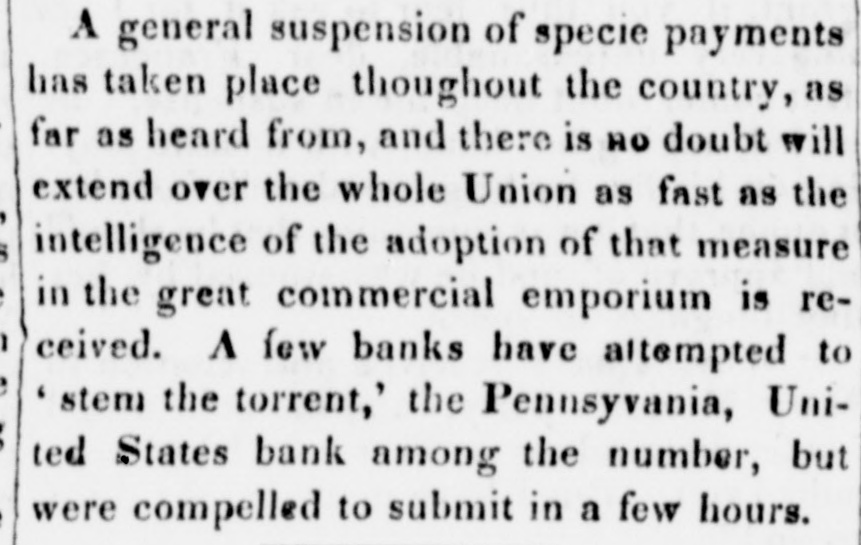
A general suspension of specie payments has taken place thoughout the country, as far as heard from, and there is no doubt will extend over the whole Union as fast as the intelligence of the adoption of that measure in the great commercial emporium is received.
Source
newspapers

Newspaper Articles (3)

Article from The Rhode-Island Republican, May 17, 1837

Click image to open full size in new tab

Article Text

A general suspension of specie payments has taken place thoughout the country, as far as heard from, and there is no doubt will extend over the whole Union as fast as the intelligence of the adoption of that measure in the great commercial emporium is received. A few banks have attempted to 'stem the torrent,' the Pennsylvania, United States bank among the number, but were compelled to submit in a few hours.


Article from Columbus Democrat, September 28, 1839

Click image to open full size in new tab

Article Text

[Continued from the First Page.] in specie is more expedient in every point of view than to collect it in the paper of banks; State or National; such an institution therefore is neither necessary nor proper. The degree of necessity contemplated by the constitution, to warrant the exercise of any power not expressly delegated is absolute necessity. There is no delegated power in the constitution to regulate the currency. The duties of government in relation to this subject, are expressly confined to the coinage, which proves that specie was the constitutional currency intended to be used by the government, as understood by the framers of the constitution. They were hard money men. They had passed through scenes similar to those through which the country is now groping its darkened way. They comprehended the evils of the paper system, and did not intend to confer on Congress the power to make paper money, else, they would have coupled it with the coinage. The opposition are not agreed among themselves, which shall be adopted as custodian of the public money, a National Bank or a select number of the State banks. Mr. Clay urges a National Bank. The whig party in New York not long since repudiated a National Bank, and their State address denied that the whig party was pledged to its support. The whig convention in this State, through its organs, reccommended a National Bank; their candidates for Congress canvass as bank men, while the whig candidate for Governor, Mr. Turner, is said to be electioneering as an avowed anti bank man. Such are the discordant materials of which this party is composed and so little have they any principle in common, except deadly hostility to the republican measures of this administration. Their only bond of action is, to turn out the present incumbent and thrust in themselves. # THE SAFETY OF THE MONEY UNDER THE TWO PLANS. For the safety of the money, the United States Bank could offer its capital as security, the integrity of the various offices, and the safes and strong boxes of the bank. The money would be kept by the mother banks and some twenty-five or thirty branches, with from two hundred and fifty to three hundred bank officers and clerks, who must be trusted in a greater or less degree. The number of State banks and their officers, would not vary much from the above estimate, if the State bank plan should be accepted. In addition to the risk of the dishonesty of this number of bank directors, there is the additional one of all the hazards which attend the banks, from the fact that they are subject to all the revulsions of trade, of commerce, and the fluctuations of paper money. These, although not easily calculated, are always immense. The National Bank might fail, or dissipate its capital stock, and then the government having no security whatever, would lose all its revenues, Nor is this supposition at all improbable. The United States Bank was on the verge of bankruptcy in 1819, and the present Bank of Pennsylvania, although declared by Mr. Biddle to be stronger than the former bank, suspended specie payments in 1837. The risk to the Government as well as to the backs, must always be considerable, from the misconduct of the officers and clerks, for almost every mail brings tidings of robberies and flight by some one of them. In employing State banks, security has heretofore been required. The Constitutional Treasury proposes that the officers of the Government, who collect the revenue, shall keep and pay it out when required. For the faithful discharge of this duty they are under oath, they give heavy bonds, are punished by imprisonment in the penitentiary if they use or embezzle the money. For the security of the money they have the same safes and chests as the banks. If a bank embezzles the money it cannot be punished penally. Will the money not be safer in the hand of individuals selected for probity and honor, under such guards, than in the hands of banking institutions, which defy alike the behests of the law—the precepts of morality and common honesty? When we see banks daily violating their contracts and good faith with impunity, and committing acts of fraud and perfidy that would forever disgrace a private citizen, is it not absurd to say that these institutions are more trust-worthy than the honest freemen of the country? Such an assertion is an insult to the intelligence, honesty and patriotism of the people, and yet it is the common argument of our opponents. # THE EXPENSES OF THE TWO SYSTEMS. The chairman of the committee who reported the Sub-Treasury bill, estimated an expense of ten thousand dollars for the preparation of two buildings, vaults, &c., one at St. Louis, to be erected, and the custom-house to be fitted up at Charleston. By the Sub Treasury bill the present officers are to keep the money without any additional compensation. To these the bill proposes to add four new officers, whose combined salaries are not to be less than eight, nor more than twelve thousand dollars. From six to twelve clerks are also to be added, whose aggregate pay will be from six to twelve thousand dollars. The twenty-four thousand dollars annually is the whole permanent expense of this much abused Sub Treasury system, to support which the country is gravely told, will impoverish the Treasury! The National Bank and the pet banks, receiving the money on general deposite, charge nothing directly but the use of the money for keeping it. But what is this twenty-four thousand dollars compared with what the country loses by the disorder of the currency and business, by the bank using the money in banking operations and producing continual throes and convulsions? What is it compared with the loss on depreciated money; and the time has often been when notes of the United States Bank were worth much less than specie? What is this sum compared with the millions which the Government is compelled to lay out of, and lose in case of suspension of specie payments? The present United States Bank did suspend, and would have been

Article from Democratic Standard, April 5, 1842

Click image to open full size in new tab

Article Text

Galveston, March 10, 1842. [From Kendalls Expositor.] THE BANKING SYSTEM. No. 1. Experience, that ever safe though severe teacher, is fast opening the eyes of the people in relation to the vices and evils of the Banking System. Never was there a time when the minds of men were in a better condition to give heed to sound argument or more ready to concur in conclusions in reference to a subright which deeply involves the rights, ject interests and morals of the whole community Look at the ruins which lay scattered specie Banks around. payments The in general 1837, suspension when the of had in circulation about two hundred millions of dollars in promises to pay, de preciated the whole mass about ten per a some fifteen cent., and millions was equivalent of dollars to upon tax the of people, the second over more was its instantaneously than half suspension, the Union, laid and extening collected.- within scope a repetition of the same species of tax to the amount of eight or ten mill ions. All this was born patiently by the people; for the banks having most of the presses and political men in their interest or in their power, persuaded the was to the nocessary sufferers the public that good. this step In all d States, the Banks took the government d into their hands, and through the Legislatures granted themselves all the indulwas of threatened, gences they because desired. the Revolution Departments the General Government resisted this Bank usurpation, and insisted upon obedience to the constitution and laws in its pecuniary transactions. This stand, as every observing man now knows, by ar raying against it the army of banks and bankrupts, was the principal cause of the overthrow of the late administration in 1840. Year after year have the banks obtained sometimes indulgencies bargaining from the State for them Legislatures, with raco of Statesmen who dared not attempt to raise by honest means, the funds to meet State liabilities, but more often ex. acting them without pretence of an equiv. alent. To what consequences has this surrender of the government to the banks led? The were 10 susto exscenes swinplude,exhibiting pend Missippi payment Banks and the first of the fraud totally first and dling never before exceeded. Not warned by this example, the other states still to giving quietly fraud acquiesced time in the mature Bank dominion, its plans, and leaving the Banks to blow up at their leisure, when their managers should have swindled to the utmost both the people and the stockholders. Look at that tremendous ruin, fearful to enough United States. be sublime, If widows the lateBank and orphans of the a from they have have not the blackened been been driven left starving wall by of their foreign within dwellings enemy them. Look at the Schuylkill Bank, the Girard Bank and the Bank of Pennsylvania. In addition to the plunder of the people by the depreciation of millions of dollars in circulation, there has been lost to the more stockholders alone, than in the forty city millions of Philadelphia of dollars. scenes are on a In every portion presented of the Union smaller similar scale. It our people fraud cannot and and ce mismanagement, stockholders doubted that of the in banks,through losses Repub- of the have within a few years past, amounted to more than NE HUNDRED MIL. LIONS OF DOLLARS. To this conclusion any man will be led who reflects a moment on upon notes and of but about by bank the suspension in the their losses hands, of breaking the brought people and utter hilation Banks, and of Bank the impairing anniStocks, produced by similar callses. But this is not all They increased the currency of the to about t of dollars in while at we an unusual hundred the same time millions country had paper, quaning the money specie cheap in circulation, and increasing thereby price makof all reasonable at dred Now, property millions they have beyond of withdrawn dollars least bounds. a hunof the cur rency, at same more than half and the Union, the have, time, by paper continued in circulaof this tion suspension, tremendous altogether. banished reduction The specie natural of from effect cy as raised low is the the proper reduction level of prices they so were the much curren- be above, a annihiating the fortunes of men who are somewhat in debt and embarrassing all kinds of business.