Article Text
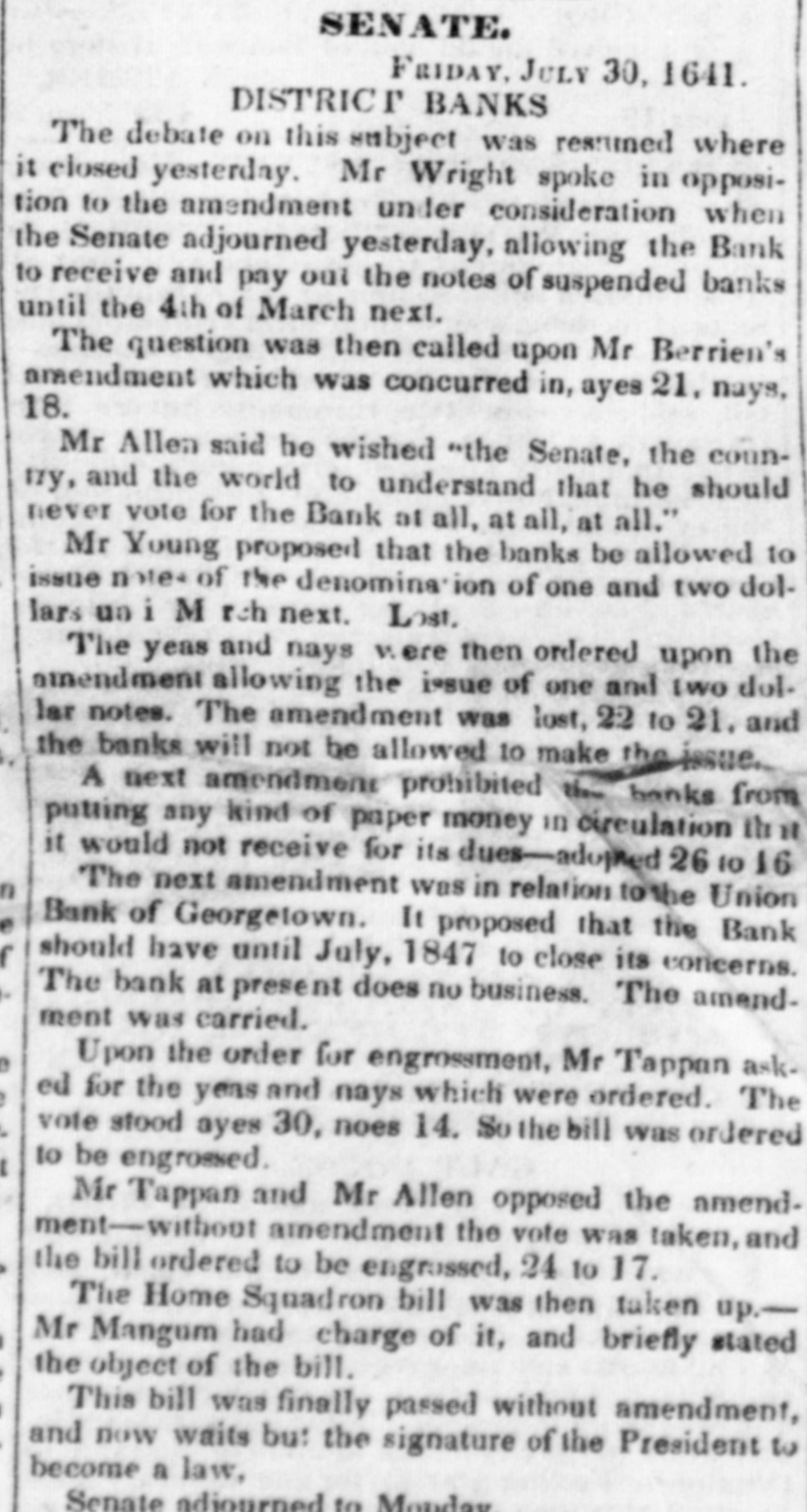
Correspondence of the Baltimore American WASHINGTON, July 30. # UNITED STATED SENATE. Mr TAPPAN called for action upon a joint resolution offered by him in reference to the distribution of certain Patent papersprinted by order of Congress. The resolution was ordered to an engrossment without opposition. # EXECUTIVE SESSIONS. Mr ALLEN presented a resolution, which lies over for one day, for repealing the 44th rule of the Senate, by which the Senate, sits with closed doors upon nominations and treaties, except so far as relates to treaties. # DISTRICT BANKS. The debate on this subject was resumed where it closed yesterday. Mr WRIGHT spoke in opposition to the amendment under consideration when the Senate adjoured yesterday, allowing the Bank to receive and pay out the notes of suspended Banks until the 4th of March next. Mr Wright discussed the subject of Banks generally and in the spirit of strong opposition. The question was then called upon Mr Berrien's amendment, which was concurred in, ayes 21, nays 19. A question of order was next discussed as to the state of the question, which involved a discussion as to the merits of the question. Mr ALLEN said he wished "the Senate, the country, and the world to understand that he should never vote for Banks at ail, at all, at all!" Mr KING found fault with his friend from Ohio because he took the ground he did. Because he could not limit the Banks as he wished he would not limit them at all. The Senator from Georgia had proposed an amendment which limited the time of the Banks to deal in suspended paper to the 1st of March. That was better than an illimitable time which the Senator from Ohio obiected to. This branch of the subject disposed of, a new amendment was proposed, which was to allow the District Banks to issue notes of the denomination of one and two dollars, redeemable in specie. Mr MERRICK stated the object of the amendment which was to drive out the irredeemable small notes in circulation here, and to make the small notes of the Banks redeemable in specie to take their place. Mr YOUNG proposed that the Banks be allowed to issue notes of the denomination of one and two dollars until March next-lost. The yeas and nays were then ordered upon the amendment allowing the issue of one and two dollar notes. The amendment was lost, 22 to 21, and the Banks will not be allowed to make the issue. Other amendments were then considered one of them limited the amount of loan to $10,000 and another required the reduction of one fourth (25 per cent) every 90 days. A next amendment prohibited the Banks from putting any kind of paper money in circulation that it would not receive for its dues, and was adopted, 26 to 16. The next amendment was in relation to the Union Bank of Georgetown. It proposed that the Bank should have until July 1847 to close its concerns. The Bank at present does no business. The amendment was carried, and the amendments adopted in Committee were concurred in. Upon the order for engrossment, Mr TAPPAN asked for the yeas and nays, which were ordered. The vote stood ayes 30, noes 14. So the bill was ordered to be engrossed. A Bill making further provision for the lunatics in the District of Columbia was next brought before the Senate. Mr MERRICK stated the objects of the Bill. The District of Columbia, he said, supported its sane paupers, but had no means of supporting the insane. From the fact that the seat of the General Government was here, poor men were brought here and thrown upon the District to the amount of at least one third or one half of the whole number of pupers. They were brought here in the hopes of exacting justice from the seat of Government in the payment of sums due them for services rendered. It was but right that the Government should share in the expenses created by the appearance of such paupers among us. Mr TAPPAN and Mr ALLEN opposed the amendment-without amendment the vote was taken, and the bill ordered to be engrossed, 24 to 17. Mr SMITH, of Ind, Chairman of the Committee on Public Lands, said he would call up the Land Bill on Monday. # HOME SQUADRON. The Home Squadron Bill was then taken up- Mr MANGUM had charge of it, and briefly stated the objects of the bill. Mr BENTON offered an amendment, instructing the Secretary of the Navy to give preference to American water rotted hemp in the publis ships. Mr LINN made a statement for the purpose of showing that Missouri hemp was superior to Kentucky hemp. Mr CLAY, of Kentucky made a very interesting statement in regard to the growing of hemp, and his own experience in reference to the article. He had no doubt that the hemp of Missouri or Kentucky, or of any other section of the country, if properly rotted, would be equal to the best imported article. Mr BENTON, at the request of his friends, withdrew the amendment. The Bill was then ordered to an engrossment, and before the adjournment, read a third time and passed. The bill has passed the House and wants but the signature of the President. Mr LINN moved that the Senate adjourn to Monday next. Objections being made and Mr Linn being called upon for his reasons, said that the Session had been continued so long that he was completely jaded out. Other gentlemen's heads might be clear always, but he had not the strength to go through the fatigue. The Senate then adjourned to Monday.