Valley National Bank (St Louis, MO)

Episode Information

Episode UID
185800885
Episode Type
Run β†’ Suspension β†’ Reopening
Bank Type
national
Bank ID
18580 national
Charter Number
1858
Start Date
September 25, 1873
Location
St Louis, Missouri (38.627, -90.198)

Metadata

Model
gpt-5-mini (chosen from majority vote of a three-model LLM ensemble)
Short Digest
7eddd3e5036da57c

Response Measures

Accommodated withdrawals, Public signal of financial health, Full suspension

Clearinghouse involved: Yes (loan, examination, or other measures)

Description

Suspension was a city-wide action by St. Louis bankers during the Panic of 1873; Valley National is explicitly described as able to meet demands before and after suspension.

Events (5)

1. August 9, 1871 Chartered
Source
historical_nic
2. September 25, 1873 Run
Cause
Macro News
Cause Details
Panic following eastern financial collapses (Sept. 1873 crisis) produced depositors' withdrawals in St. Louis
Measures
Bankers met and decided to suspend payment of checks or drafts until eastern excitement subsides
Newspaper Excerpt
A slight run having been made on the banks of this city
Source
newspapers
3. September 25, 1873 Suspension
Cause
Macro News
Cause Details
Collective suspension by St. Louis banks in response to nationwide financial panic and inability to realize securities
Newspaper Excerpt
decided at a meeting of bankers held last night to suspend the payment of checks or drafts, either in currency or exchange, until the excitement in the east subsides
Source
newspapers
4. October 27, 1873 Reopening
Newspaper Excerpt
The St. Louis banks all resumed currency payment to-day. There was no excitement, and no signs of a run anywhere.
Source
newspapers
5. December 4, 1885 Voluntary Liquidation
Source
historical_nic

Newspaper Articles (19)

Article from Evening Star, September 25, 1873

Click image to open full size in new tab

Article Text

THE TIDAL WAVE IN THE SOUTH. BANK SUSPENSIONS IN SOUTHERN CITIES. Bank Suspensions in Memphis 3 EMP818, Sept. 25.1 here is great excitem of in this city on account of the suspension or the banks which is due to inability to realIze on the securities in New York. The First N. tional and the Delso banks have closed the r doors' day, and it is rumored that the Freddman's Saving and Trust Company has also suspended. There is a heavy run on other banks. It is expected, however, that all the aspended banks will reopen when the panic subsides Suspensions in Augusta, Ga. AUGUSTA, Ga., Sept. 25 The National Exchange bank, the Merchants' and Planters' Losti and Savings bank have suspended. The THE OR the banks have been heavy, and especially this morning. Cotton is coming in freely, but there is no money to move it. Run on the Savanuah Banks, SAVANNAH, GA., Sept. 25. - A run commenced early this morning on the savings departments of the Savannah Bank and Trust Company and the Southern Bank of Georgia. Large crowds are congregated. The banks are paying dollar for dollar. Business is at a complete standstill for lack of currency. No Scare at Louisville. LOUISVILLE, Sept. 25.-There is some excitement here on account of the depressed condition of affairs in New York, but the banks are uniformly in good condition. No alarm whatever e sts among depositors, and there is no anticipation of a panic. The Trouble Over in Richmond RICHMOND, Sept. 25-1.30 p.m.-The panic has entirely subsided and there 18 no visible excitement on the street A meeting of bank officers this morning unanimously resolved to adopt the system of issuing loan certificates, as now in operation in New York. Philadelphia and Baltimore, so as to give relief to the commonth The reported failure of McLain & Co., of Petersburg, is contradicted. the Situation in St. Louis ST. Lovis, Sept. -Shipments of flour to the east having been virtually suspended by the recent advance in reitroad freights, the board of directors of the merchants' exchange have petitioned the railroad companies to restore the old rates during the present financial troubles. A slight run having been me de on the banks of this city, it was decided at a meetingJof bankers held last night to suspend the payment of checks or drafts, either in currency or exchange, until the excitement in the east subsides and the former condition of the markets is restored. The New Orleaus Banks Suspend. [By Automatic Telegrayh.] NEW ORLEANS, Sept. 25.-The New Orleans banks, with the exception of the Southern, have suspended currency payment.


Article from New-York Tribune, September 26, 1873

Click image to open full size in new tab

Article Text

New-York Daily Tribune. FOUNDED BY HORACE GREELEY. FRIDAY, SEPTEMBER 26, 1873. At a stormy Erie meeting in London, President Watson received a unanimous resolution of thanks, and announced that his road wanted $30,000,000 at once. The French Conservatives claim a majority of 20 in the Assembly in favor of a monarchical restoration; the Republican members threaten to resign in a body. The Spanish Government has demanded of England the release of the Vitoria and Almanza. = The U. steamer Tigress is still searching for the Polaris crew. Secretary Richardson, Attorney-General Williams, and other officials determined, it is said, after long consultation, that the Government should not use any portion of the legal-tender reserve for the purchase of additional bonds. The banks of Chicago, Cincinnati, Baitimore, Nashville, and New-Orleans have suspended the currency payment of large demands. In St. Louis the bank suspension appears to be total. Failures are reported in New-Brunswick, N.J., Selma, Ala., Indianapolis, MemThe schooner Whiting phis, Atlanta, and Augusta. was wrecked at Grand Haven, Mich., all the crew but one being Descued after a thrilling fight with the waves. = An Anti-Kellogg Convention has been called, to meet at New-Orleans Nov. 24. There were no further suspensions in Wall-st., although aid from the Government in the purchase of bonds was entirely withdrawn. The difficulty in getting foreign exchange has affected the export trade somewhat disastrously. The Stock Exchange endeavored, by the appointment of a Committee, to force settlements upon last week's transactions. The Bank Presidents did not favor the theory of the Stock Exchange 10 regard to the resumption of business. ==== Sprague's attorneys endeavored to show that the money for his investments was borrowed from the Brooklyn Trust Company. The Grand Jury issued a public call for testimony. The District-Attorney refused to announce his intentions concerning the jail frauds. The Committee on investigating department affairs or- The Liberal Republican General Commitganized. tees made arrangements for holding primaries, and listened to Gen. Coctrane's remarks on the issues of the campaign. The Kings County Democratic primaries were held. The Newark Democratic Convention made municipal nominations. = An effort to act on the Police Justice nominations falled in the Board of Aldermen. - The Protestant Episcopal Diocesan Convention was addressed by Bishop Potter. - Prominent delegates to the Conference of the Evangelical Alliance, and Wilkie Collins, arrived. Damaging testimony was adduced in the baby-farming examination. The Harlem Rowing Club's Fall races were pulled, and entries for the National Amateur Regatta were announced. = The New-Jersey section of the NewYork and Oswego Midland Railroad is to return to its
Article from New-York Tribune, September 26, 1873

Click image to open full size in new tab

Article Text

NEW-YORK DAILY TRIBUNE, FRIDAY, SEPTEMBER 26, 1873. Liverpool for New-York to-day. Of this amount the and Cincignati banks, which were at first reported as that it was unnecessary to take any special action; NOVsteamship City of Brussels took $150,000, and the steamhaving totally suspended, and the excitement was hightortheless all are agreed that there is no possible fear of a ship Adriatic Β£35,000. ened at noon by the suspension of the private bankingDanie here, of a run on the banks, or of any inconventence A STORMY ERIE MEETING-PRESIDENT WATSON house of Woollen, Web. & Co., owing mainly to the reat all. Indeed, one of the Presidents thinks THANKED--HE WANTS THIRTY MALLIONS. turn of their drafts on the suspended Trust Company of the worst effect it can have directly is to New-York. Public confidence became 80 shaken that LONDON, Sept. 25.-The meeting called by create temporarily a slight uncertainty in the Mr. Watson to consider the affairs of the Erie Railway there was a heavy run on Ritzinger's Bank and on the matter of taking New-York drafts on deposit. as Indianapolis Savings Bank by a class of generally small Company took place to-day. and was attended by 1,000 the banks in this city have always received depositors, and a few persons withdrew their money persons, including many Americans. The session is New-York funds without charging any discount or perfrom other banks. The First National Bank, instead of described as stormy. A resolution of thanks to Mr. centage, no matter how the rates of exchange stood. Of closing at the usual hour, kept open an hour later to give Watson was unanimously adopted. The names of Biscourse, 80 long as the present feeling continues, people depositors an opportunity to withdraw their money if choffsheim and Henry were greeted with a storm of will be anxious to get rid of their New-York funds, and they wished, and when it closed it had received more mingled hisses and cheers. Mr. Watson, in an explanathe banks may find them on their hands to excess. money than it had paid out. The unquestionable soltion of the affairs of the Company, said there was some As New-York is largely indebted to us the banks cannot vency of all the city banks, together with the fearless apparent dubiousness about the accounts, but he besend on checks and get greenbacks. Indeed, one cashier way in which they met the excitement, seems to have lieved they were correct. They wanted $30,000,000 imgoes 80 far as to say there is but one bank in New-York sent home the crowds, who througed the streets until mediately to finish improvements already begun and to independent enough to have it in its power to send Bosafter the banks had closed, in a better state of feeling, lay a third rail. ton checks for greenbacks. and it is not thought that there will be any further COMMENTS OF THE LONDON PRESS-FIVE HUNDRED There is another point in this regard where our banks trouble. Previous to the excitement, the banks in conTHOUSAND POUNDS TO BE SENT TO AMERICA. are strong in comparison with the New-York instituference had decided to go ahead in the usual way, and tions. Their country correspondents are all New-EnLONDON, Sept. 26.-The Daily Telegraph, in this determination will still be followed. gland banks, and form but a very small proportion of another article on the American crisis, says it cannot be their depositors. Nevertheless there have been rumors, too strongly enforced that there is nothing radically unIN MISSOURI. and unpleasant ones, too. sound here or in the United States. The great mass of GENERAL SUSPENSION OF THE BANKS OF ST. LOUISOne rumor prevailed here to-day that checks to a very capitalista is not affected by the trouble in New-York. large amount had been sent on to be cashed, but it FLOUR SHIPMENTS IMPEDED. The Daily News remarto in the adsance of a aya. proved to be entirely unfounded. One banker said to an St. Louis, Sept. 25.-A slight run having tem of long credits, the materials for a panic among Advertiser reporter: cashed in one check one-third of been made on the banks of this city, it was decided at a American trading houses do not exist. It believes the the whole amount that was called for yesterday." This worst is over. meeting of bankers, held last night, to suspend the paywas a check which was by no means hastIt is said that bullion to the amount of Β£500,000 stel ment of checks or drafts, ither in currency or exchange, and former the ened on account of the panic. The genuntil the excitement in the East substuce ling will be withdrawn from the Bank to be sent to tleman continued: "We do business on an condition of the markets is restored. Shipments of nour by next Saturday's steamers. entirely different bagis from that of the New-York


Article from New-York Tribune, September 26, 1873

Click image to open full size in new tab

Article Text

IN MISSOURI. GENERAL SUSPENSION OF THE BANKS OF ST. LOUISFLOUR SHIPMENTS IMPEDED. Sept. 25.-A slight run having St. Lours, been made on the banks of this city, it was decided at a meeting of ban ers, held last night, to suspend the payther in currency or exchange, ment of checks or drafts, address and the former until the excitement in the East condition of the markets is restored. Shipments of nour to the East having been virtually suspended by the recent advance in railroad freights, the Board of Directors of the Merchants' Exchange have petitioned railroad companies to restore the old rate during the present financial troubles.


Article from Chicago Daily Tribune, September 27, 1873

Click image to open full size in new tab

Article Text

MILWAUKEE. Special Dispatch to The Chicago Tribune. MILWAUKER, Bopt. 26,-The suspension of the Ohicago and St. Louis banks has had very little effect here. Our banks have been strengthened by the receipts of currency from Now York during the past two days, and are prepared to respond promptly to all domands made upon them by depositors, but the latter exhibit no apparent uneastricas, and business continuce good in all departments, breadetuffa and produce excepted. The general merchandise markets are aotive, and prices show uo material variation sinco the panic,


Article from The Van Buren Press, September 30, 1873

Click image to open full size in new tab

Article Text

IT All the St. Louis Banks have suspended until the 1st of November. A general suspension of Banks all over the country may be expected.


Article from Knoxville Weekly Chronicle, October 1, 1873

Click image to open full size in new tab

Article Text

The Panic Spreading. ST. LOUIS, Sept. 25.-It was decided at a meeting of the bankers of the city, held last night, to suspend the payment of checks or drafts, either in currency or exchange, until the excitement in the East subsides and the former condition of the markets is restored. PATTERSON, N. J., Sept. 24.-Four hundred and fifteen locomotive unen were discharged from Rogers' locomotive works, making one thousand, two-thirds of the force. LONDON, Sept. 24.-Clews, Hobitch & Co. have decided to suspend. A Berlin dispatch announces the failure of banks in that city. Clews, Hobitch & Co.'s liabilities on account of Henry Clews & Co. are Β£246,000. Their own liabilities are Β£64,000, which they can meet, but not those of 'Henry Clews & Co. WASHINGTON, Sept. 24.-The Freedmen's Savings Bank is enforcing the legal thirty days' notice from depositors. Two million dollars in currency remain in the Treasury for current purposes. Richardson will only draw on the $40,000,000 reserve for Government necessities. The Government, he says has helped banks by issuing $12,000,000 in currency for bonds, and they must now take care of themselves.


Article from The Leavenworth Weekly Times, October 2, 1873

Click image to open full size in new tab

Article Text

AN OPEN QUESTION. Speaking of the determination of the At chison banks, to pay out currency on de mand of depositors, and comparing that course with the course adopted by the Leavnworth banks, the Champion finds cause for much local gratification. At first glance one may think that suspension for a few days, or even the payment of checks for a limited amount, is an acknowledgement of weaknessupon the part of banks adopting the policy, but a deliberate second thought will convince one that the measure is now calculated to promote the business interests of a city. In Chicago, the adoption of that course was strongly advised by the immediate representative in that city of the currency bureau of the Treasury Department, and fully approved and endorsed by gentiemen best quelified to form an intelligent judgment as to its consequences. In St. Louis, the solid old bankers accepted the course to protect the mercantile interests of their city. It is a fact worth considering that dispatches were received by Leavenworth merchants from their Eastern creditors, offering five per cent. discount and payment of charges, wherever remittances were made in currency by express. The immediate result of such transactions would be a drain of currency from the west. The euspension in Leavenworth, qualified as it is, will be only temporary. Early next week the banks expect to resume regular business transactions. There is no panic here. No alarm is felt. Depositors feel perfectly secure. No one questions the ability of our banks to pay every dollar due depositors. Currency is coming here inclood of having, and in the end the window description


Article from Helena Weekly Herald, October 16, 1873

Click image to open full size in new tab

Article Text

A RIBERNIAN BANK INCIDENT. A Woman that Wanted her Money. From the St. Louis Democrat, Septeinber 27, The news of the suspension of the banks of the city, published in the papers of yesterday morning, created intense excitement in Kerry Patch. The thrifty population of that classic precinct are in the habit of depositing their meagre earnings in the savings banks, and anything that casts a shadow upon those useful institutions throws a gloom over the the in Patch. Kerry, The after first feeding duty performed pig and yesterday milking the goat, was to go down town and look after the deposits in bank. One determined WOman took her station in front of the Hibernian Bank, and patiently waited on the sidewalk for two hours, until she saw the doors opened. Then she entered with a firm step, and addressing young Tansey, said, in a voice of thunder: "Is this bank suspended?" 'Yes, madam, but only temporarily." "Tipperarily, is it? I know what a Tipperary suspension is-it manes gone up. I've got $200 deposited in this bank, and I want my money." "Well, madam, you need not talk so loud. Give me your pass book, and you shall have your money." "Have you got it?" "Yes, I've got it. Hand out your book." "Are you sure you've got my $200 safe and sound?" "Yes, here it is. Don't make so much noise." "I've got a right to make a noise. I worked hard for that $200, and do you think I'm going to lose it without making a noise?" "Itell you that your $200 is not lost; here, take it away, and don't talk so loud." "You've got it, have you?" 'Yes; I tell you it is here." My $200?" Yes, your $200; take it and go." What do I want with it? Didn't I put it in and the a launched here for into safe keeping?" lengthy and loud harangue depositor on the banks and bankers, attracting a crowd around the door. One of the directors, finding the woman could not be silenced, called in a policeman, who took her by the arm for the purpose of leading her out. "Is it the likes of you that dares to lay the weight of your dirty claws on a dacent WOman with $200 in bank? Get out of this and lave me alone, ye spalpeen-I'm a dacent woman, G-d-you." At this moment the president of the bank entered, and, learning the cause of the disturbance, ordered the woman to be released, and invited her politely to take a seat. "I don't want to sit down. I've got two hundred dollars in this bank, and I'm used to standin." "Madam, I think you had better take your money." Have you got it ?" Yes, here is your money." What do you take me for? I put my money in this bank for safe keeping, and be not to to it a a away. dad I'm This is goin' bank be of deposit, forced and take I'm depositor-do you mind that?" It was in vain that the depositor was urged to draw her money. She would neither take it nor remain silent. After standing an hour or two longer, and talking all the time at a not children furious had rate, she had remembered their breakfast, that and her with many a protestation against the attempt to force a poor woman to draw her money, and she wended informed her all way the neighbors back to Kerry that the Patch, Hi1 bernian Bank was only foolin', and had not suspended at all.


Article from Chicago Daily Tribune, October 27, 1873

Click image to open full size in new tab

Article Text

# FINANCIAL. A Chapter of Wall Street Rumors. Serious Financial Irregularities Among the Railroads. The Lake Shore and Toledo, Wabash & Western Involved. Vanderbilt's Star Begins to Wane in Wall Street. Reasons Assigned for the Decline in His Stocks. Ex-Secretary McCulloch's Northern Pacific Presentiments. The St. Louis Banks to Resume Currency Payment To-Day. Effects of the Panic on Eastern Manufacturers. NEW YORK. Special Dispatch to The Chicago Tribune. THE DECLINE IN VANDERBILT STOCKS. NEW YORK, Oct. 20. The sudden and rapid decline in Vanderbilt stocks yesterday is attrib-uted to the agitation of the affairs of the Lake Shore Railway Company, and of those of the Union Trust Company, together with the publi-cation of reiterated charges of fraud on the part of the Executive Committee of the Lake Shore Railroad Company. Reports that mismanago-mont had been discovered in the affairs of the Toledo, Wabash, & Western Railroad; and that the New Jersey Southern Railroad was bankrupt; and that the Chesapeake & Ohio Railroad could not pay its debts, also contrib-uted to offect this decline. Lake Shore people strenuously deny the truth of such charges against their Executive Committee, and the officers of the Union Trust Company decline to say any-thing regarding the present condition of their affairs. THE POPULAR OPINION in Wall street concerning Com. Vanderbilt is divided. One side believes in his integrity, and in that of his associates; and the other side as confidently advance the opinion that George Bird Grinnell & Co. are merely the scapegoats of the Vanderbilt party, and deserve the sympathy, not the censure, of the community. THE TELEGRAPH COMPANIES. The project for the formation of a combina-tion of telegraph companies, which has been in contemplation for some time, and is now about to be consummated, has been hastened in conse-quence of Vanderbilt's acquisition of the West-ern Union Telegraph Company. RUMORS OF DEFALCATIONS in several railway companies have exercised a depressing effect on the market for several days. Prominent among suspected corporations is the Lake Shore Company. The embezzlement or fraud said to have taken place in this Company's affairs is variously estimated at from several hundred thousand to several million dollars. The officers of the Com-pany deny this; but inquiry develops the fact that they lost a large amount by the failure of George Bird Grinnell & Co. A Director of the Company says that only about $250,000 was lost through the failure of this firm. THE CANADA SOUTHERN RAILWAY, which was embarrassed during the early days of the panic, is now undergoing a process of resus-citation. The floating debt of the road is re-ported at $20,000,000. It is proposed to fund the floating debt, and, possibly, some of the earliest maturing coupons. The matter will probably be arranged within two days. TOLEDO, WABASH WESTERN. It is alleged that the rumored frauds in the Toledo, Wabash & Western Railway have grown out of the stock operations of Azariah Boody, Vice President of the road. It is said that in-vestigation by an administrator succeeded in discovering frauds exceeding several hundred thousands of dollars. W. L. Scott, Director of the Road, informed a Tribune reporter that a few years ago Mr. Boody was a member of the firm of Kidd, Prolco & Co., No. 19 Broad street. This firm had done stock business for Boody, and he had been accustomed to place the money of the Road in their custody. He withdrew from the firm, which then became O. H. Peirce & Co., and continued to act as his bankers. About the time of the failure of Peirce & Co., a change was made in the direction of the Road, and it was discovered that a part of the Company's funds were still with Peirce. All except a sum not ex-ceeding $100,000 had been recovered, as had nearly all the securities. This amount Boody was abundantly able to pay, so there was little cause for apprehension; and the Road was do-ing as well as could be desired.


Article from Chicago Daily Tribune, October 27, 1873

Click image to open full size in new tab

Article Text

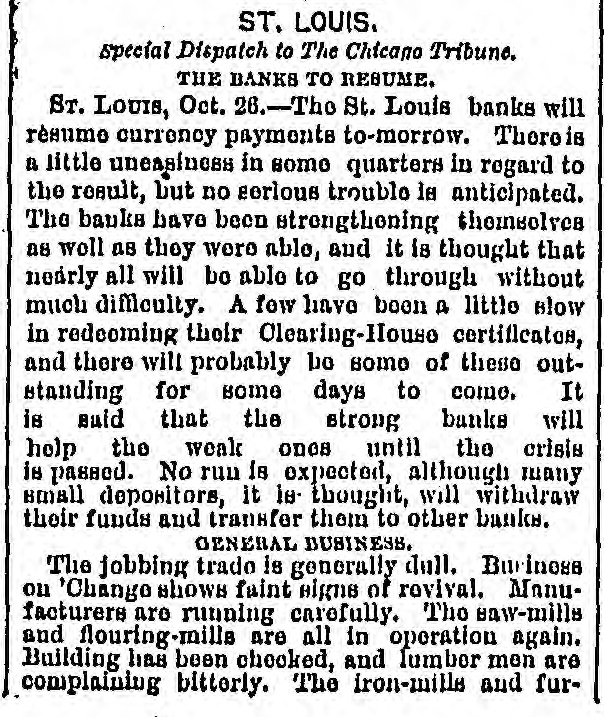
ST. LOUIS. Special Dispatch to The Chicago Tribune. THE BANKS TO RESUME. ST. LOUIS, Oct. 26.-The St. Louis banks will rèsume currency payments to-morrow. There is a little uneasiness in some quarters in regard to the result, but no serious trouble is anticipated. The banks have been strengthening themselves as well as they were able, and it is thought that nearly all will be able to go through without much difficulty. A few have been a little slow in redeeming their Clearing-House certificates, and there will probably be some of these out-standing for some days to come. It is said that the strong banks will help the weak ones until the crisis is passed. No run is expected, although many small depositors, it is thought, will withdraw their funds and transfer them to other banks. GENERAL BUSINESS. The jobbing trade is generally dull. Business on 'Change shows faint signs of revival. Manufacturers are running carefully. The saw-mills and flouring-mills are all in operation again. Building has been checked, and lumber men are complaining bitterly. The iron-mills and fur-


Article from Chicago Daily Tribune, October 28, 1873

Click image to open full size in new tab

Article Text

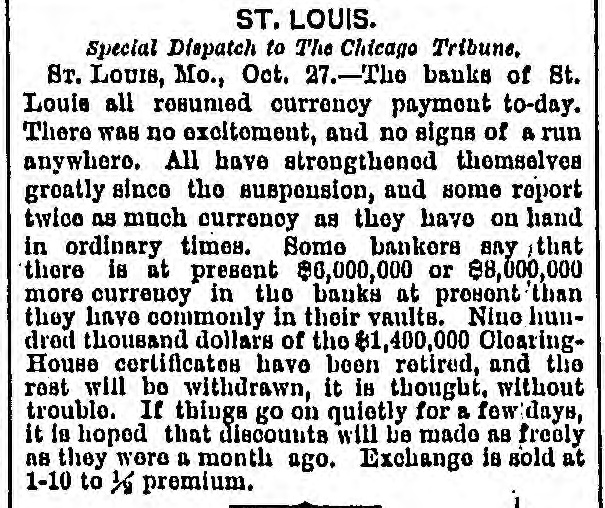
# ST. LOUIS. Special Dispatch to The Chicago Tribune. St. Louis, Mo., Oct. 27.β€”The banks of St. Louis all resumed currency payment to-day. There was no excitement, and no signs of a run anywhere. All have strengthened themselves greatly since the suspension, and some report twice as much currency as they have on hand in ordinary times. Some bankers say that there is at present $6,000,000 or $8,000,000 more currency in the banks at present than they have commonly in their vaults. Nine hundred thousand dollars of the $1,400,000 Clearing-House certificates have been retired, and the rest will be withdrawn, it is thought, without trouble. If things go on quietly for a few days, it is hoped that discounts will be made as freely as they were a month ago. Exchange is sold at 1-10 to ΒΌ premium.


Article from Lexington Weekly Intelligencer, October 29, 1873

Click image to open full size in new tab

Article Text

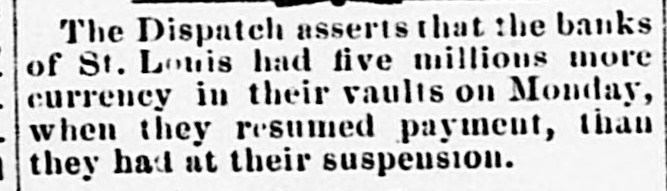
The Dispatch asserts that the banks of St. Louis had five millions more currency in their vaults on Monday, when they resumed payment, than they had at their suspension.


Article from The Saline County Journal, October 30, 1873

Click image to open full size in new tab

Article Text

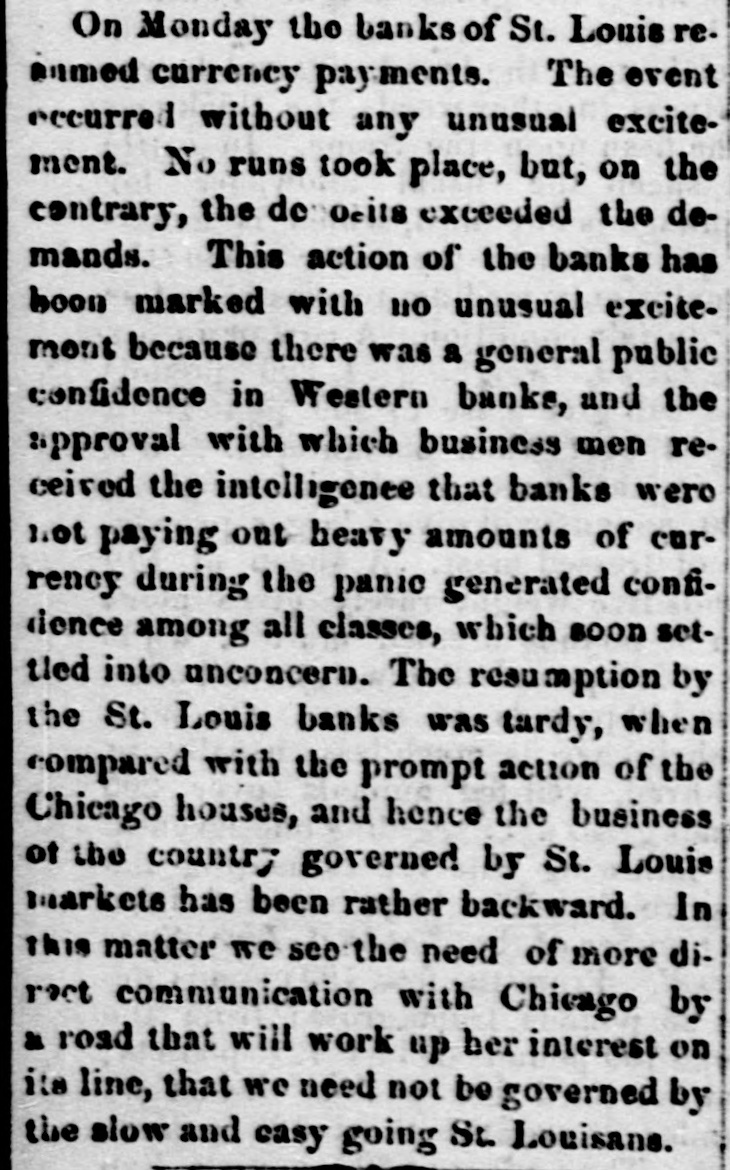
On Monday the banks of St. Louis resumed currency payments. The event occurred without any unusual excitement. No runs took place, but, on the contrary, the deposits exceeded the demands. This action of the banks has been marked with no unusual excitement because there was a general public confidence in Western banks, and the approval with which business men received the intelligence that banks were not paying out heavy amounts of currency during the panic generated confidence among all classes, which soon settled into unconcern. The resumption by the St. Louis banks was tardy, when compared with the prompt action of the Chicago houses, and hence the business of the country governed by St. Louis markets has been rather backward. In this matter we see the need of more direct communication with Chicago by a road that will work up her interest on its line, that we need not be governed by the slow and easy going St. Louisans.


Article from Evening Star, October 30, 1873

Click image to open full size in new tab

Article Text

RESUMPTION OF CURRENCY PAYMENT IN ST. LOUIS. The banks of St. Louis all resumed currency payment on Monday. There was no excitement, and no signs of a run anywhere. All have strengthened themselves greatly since the suspension, and some report twice as much currency as they have on hand in ordinary times. Some bankers say that there is at present $6,000,000 or $8,000,000 more currency in the banks at present than they have commonly in their vaults. Nine hundred thousand dollars of the $1,400,000 clearing-house certificates have been retired, and the rest will be withdrawn, it is thought, without trouble. If things go on quietly for a few days, it is hoped that discounts will be made as freely as they were a month ago. Exchange is sold at 1-10 to ΒΌ.


Article from The Portland Daily Press, November 1, 1873

Click image to open full size in new tab

Article Text

News and Other Items. The secession of Chicago from Illinois, and its establishment as an independent state, is still discussed by the local newspapers. The outcast women of Washingtan are said to have contribated $600 to the Memphis sufferers. The amount of bonds already placed by the syndicate is $70,000,000. Their contract ex:pires December 1st. The St. Louis banks, which suspended currency payments a few weeks ago, have all resumed, and are astonished to find that their receipts of currency exceed the payments. The recent storms did great damage on the lake coast in Huron county, Michigan. Many valuable piers were carried away, and vesse Is were driven upon the rocks. The Washington Chronicle advocates tibe passage of some law which will cure the alley :ed evils resulting from the abolition of the franking privilege. At a trial recently held in St. Louis, the pr isoner at the bar, the lawyer who was defendir ig him, the reporter and the Judge, were all clas 3mates in college.


Article from The Elk County Advocate, November 6, 1873

Click image to open full size in new tab

Article Text

Haven was entered on a recent Satur- day night and the carpet stolen from the floor. Mr. Moore, of the Altoona Sun, has withdrawn his suit against D. R. Ream, for libel, and paid the costs himself. A new Presbyterian church in Gir- ard township, Clearfield county, will be dedicated on next Thursday. Easton has only two policemen, and these spend half the time fighting to see who shall be chief and who the "force'.' The citizens of Indianoplis are proud of one of their girls who whistles over 100 tunes. The Louisville Courier Journal concludes that the only way to reform vicious women is to shoot bad men. How is this for a French description of a young lady: "She leaves off kissing at twelve, and begins again at twenty." The bulding of an ox cart is said to be among the lost arts in Georgia. Florida is reported to be already filling with invalids for the winter season. Sacramento contributes to refined ci7- ilization 8,000 hogsheads of beet sugar. A Texan ranch man boasts of thirteen bullet holes in his skin from Indian rifles. A result of the Nation system of education in England has been to increase the demand for female teachers. Boston is proud of the fact that, with her increased dimensions, she will pay forty per cent. of the entire State tax. Amherst Agricultural College proposes to teach its students to drill for soldiers as well as for turnips, and to cultivate the sword and sward simultaneously. An ingenious Kentuckian has invented a wheelborrow in which a man can trunble himself home at night, if necessary, without troubling his friends. Hannah Ruland, aged 100 years, died in New York city on Sunday. The ship Three Brothers carries 4300 tons of wheat, and is the largest sailing vessel in the world. Her cargo is valued at $199,000. It is stated the Atlantic and Pacific and Kansas City and Northern Railroads will reduce the salaries of all their employes, from presidentdown, 10 per cent. George Wolf, a wealthy farmer residing three miles from Hopkinsville, Ky., was assassinated in his bed Tuesday night, October 23. A bale of cotton for the Memphis sufferers sold on Change at Louisville, last week, for $455, or about $1 per pound. The cigar makes of New York city have been informed that their wages will be reduced to the rates of a year ago. The Newburg, N. Y., steam mills have been stopped for an indefinite period. About 400 persons are thrown out of employment. 2,417 miles of new postal service has been put in operation since June 30, 1873, making a total at this date of 65,876 miles of such service in the United States. All the banks of St. Louis resumed currency payments on Monday. Nothing unusual occurred, there was no excitement, and confidence seems to be restored. The deposits exceed the drafts. An account of the recent hurricane on the Florida coast has been aeceived at the War Department, Washington. Cattle were swept into the sea, house undermined and uuroofed, and boats lost. The two female members of the Wyo ming Legislature are said to have already required great proficiency in the art of throwing ink-stands and dodging law books. Twenty-odd convicts at Auburn, in additional to board and lodgings at the expense of the State, get military pensions from the Federal Government for pocket money. Brashear, La., after congratulating itself on escaping an invasion of the yellow fever, has succumbed to the more fatal importation of 300 barrells of Cincinnati whiskey. The burial of a State elephant with royal honors is noted as an important item of news from Siam. The death of the king would hardly have created a greater sensation. A New Bedford sea captain has invented a new plan for building ships. He proposes to do away with the usual rib frame and double sheathing, and build them with plank twelve inches wide, laid flat one upon the other, and firpaly bolted together


Article from Chicago Daily Tribune, November 6, 1873

Click image to open full size in new tab

Article Text

VALLEY NATIONAL BANK OF ST. LOUIS. The Valley National Bank of St. Louis at presont occupies & more prominent position than any other financial institution of that city, owing to the honorable way in which it has been managed since its organization, and especially during the recent panic. A large amount of its stock is held by country bankers, and from its organization it has had not only an enormous line of city deposits, but also a very extensive and profitable country business. At in meeting of the Board of Directors on the 30th of last June, a dividend of 5 per cent, free of all tax, was declared, and made payable on the 1st of the following month, and on the latter date Messrs. Josiah Hunt, H. H. Curtia, and James H. Waugh, who bad been appointed a Committee of Directors to examine the bank. handed in their report. Thoy carefully counted the cash on hand. nud compared the bills and notes discounted with the lodger's balances, and found everything correct. They were also antisflod as to the soundness of tho paper in the possession of the bank. A comparative statement of the condition of the bank, made at the same time, showed that the resources were $1,669,896.59 as compared with $1,106,984.06 in the previous year, and the liabilities 81,669,696.59 88 compared with $1,196,384.06 in the provious year. Since then the country has auffered from B panic, and all the St. Louis banks ware obliged to suspend. Up to the date of auspension, the Valley National Bank met all domands upon it, including currency orders in full : and since the suspension. only in very few instances wore customers requested to curtail their orders for currency. In the last few days preceding the suspension, it shipped in currency to the country $490,000, and up to the date of resumption it paid over 8900,000 of its deposits -still retaining to itself a perfect ability and willingnosh, if necessary, to pay out every dollar it owes. The Valley National bogs a continuance of public favor.


Article from The Ottawa Free Trader, November 8, 1873

Click image to open full size in new tab

Article Text

THE PANIC. While the west seems to bear up manfully against the panic, and the Chicago and St. Louis banks have not only fully resumed, but the former, at least, are able to extend pretty liberal accommodations to their customers and assist in moving our enormous crops, the outlook at the east continues gloomy and discouraging. In New York the shrinkage of values continues, and on Thursday gold went down to 614, the lowest point it has reached since 1862. The slight buoyancy that had shown itself at the close of last week was rudely dashed by the announcement that the great manufacturing firm of A. & W. Sprague, of Rhode Island, had suspended. The firm has for three generations occupied a leading position among the manufacturers of the east, and of late years the business has been extended vastly, SO that at the present time the Sprague influence permeates almost every branch of trade and finance in Rhode Island, as well as extending into Maine and other contiguous states. They control not only all the cotton manufacturies of the state, the national and savings banks, run several immense dry goods and general supply stores, but may, in fact, be said to run the entire state of Rhode Island, commercially, socially and politically. The assets of the firm are estimated at from sixteen to twenty-five millions, and their debts at $8,000,000. Their complete suspension would involve the discharge of 10,000 factory operatives. Negotiations are on foot to put their affairs in such a shape as not to close the factories, On the heels of the Sprague suspension followed on Tuesday another disaster-no less than the suspension of Tom Scott, the great Pennsylvania railroad king. His case is very much like that of Jay Cooke. He was carrying the Texas Pacific as Cooke was the North ern Pacific railroad. Scott had gone to Europe and negotiated a loan of $10,000,000 to continue work on his road, meantime endorsing vast amounts of the road's paper in anticipation of receiving the $10,000,000 loan. But just as the loan was being consummated, the news of the Jay Cooke explosion reached Europe, and the Scott loan collapsed. As a consequence, his Texas Pacific paper has gone to protest, and Tom Scott is floored The greatest fear is, that the Pennsylvania Central will, in consequence, fail to pay its usual semi-annual dividend of five per cent., which would greatly add to the embarrass. ment of things. To add still further to the gloom, a rumor was current on the 4th that the great mercantile house of H. Claflin & Co. was about to suspend, but this proved groundless. The firm not only show that they are abundantly solvent, but even refused to accept assistance tendered them by the New York banks. As a bit of sunshine amid the gloom, the announcement is made of the speedy resumption of the Philadelphia house of Jay Cooke & Co. A member of the firm is reported as saying, on Tuesday: "The agreements are rapidly being signed by our creditors, and are coming in with gratifying promptitude. We have every reason to be encouraged. We have merely asked forbearance of our creditors and we shall avoid bankruptcy with perfect certainty. The house will be able to resume within a few weeks, at any rate just as soon as the confidence of a great majority of our creditors is assured to us."