18446. City National Bank (Paris, TX)

Bank Information

Episode Type
Run Only
Bank Type
national
Bank ID
4411
Charter Number
4411
Start Date
March 23, 1897
Location
Paris, Texas (33.661, -95.556)

Metadata

Model
gpt-5-mini
Short Digest
7677ae38affa66e5

Response Measures

Accommodated withdrawals, Public signal of financial health, Capital injected

Description

Multiple contemporary newspaper reports (dated March 23–24, 1897) describe a large run on the City National Bank of Paris, Texas, triggered by the failure/assignment of the Farmers and Merchants' Bank (and the collapse of the cotton firm Martin, Wise & Fitzhugh). Col. George F. Hicks placed $100,000 on the City National's counter and the bank announced it would remain open until 6 p.m. to pay depositors; reports indicate the City National met demands and did not suspend. Therefore this is classified as a run_only episode.

Events (3)

1. September 2, 1890 Chartered
Source
historical_nic
2. March 23, 1897 Run
Cause
Local Banks
Cause Details
Run on City National followed the failure/assignment of the Farmers and Merchants' Bank of Paris (itself precipitated by the failure of cotton firm Martin, Wise & Fitzhugh); depositors rushed to City National fearing contagion.
Measures
Colonel George F. Hicks (vice president of the First National) laid $100,000 on the City National's counter and the bank announced it would remain open until 6 p.m. to pay depositors.
Newspaper Excerpt
A big run is in progress at the City National Bank. The line of waiting depositors extends in the street. Excitement runs high.
Source
newspapers
3. August 31, 1926 Voluntary Liquidation
Source
historical_nic

Newspaper Articles (10)

Article from Alexandria Gazette, March 23, 1897

Click image to open full size in new tab

Article Text

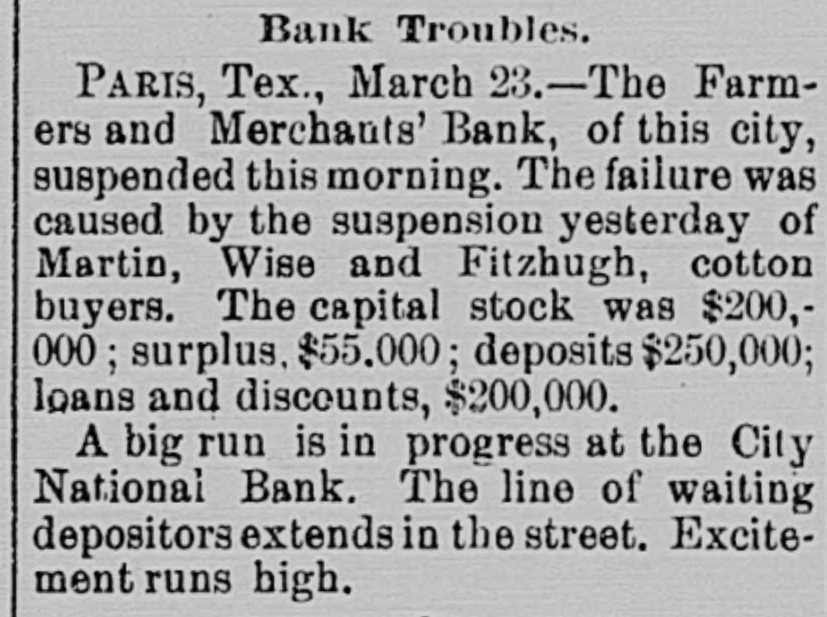
Bank Troubles. PARIS, Tex., March 23.-The Farmers and Merchants' Bank, of this city, suspended this morning. The failure was caused by the suspension yesterday of Martin, Wise and Fitzhugh, cotton buyers. The capital stock was $200,000; surplus, $55,000; deposits $250,000; loans and discounts, $200,000. A big run is in progress at the City National Bank. The line of waiting depositors extends in the street. Excitement runs high.


Article from The Indianapolis Journal, March 24, 1897

Click image to open full size in new tab

Article Text

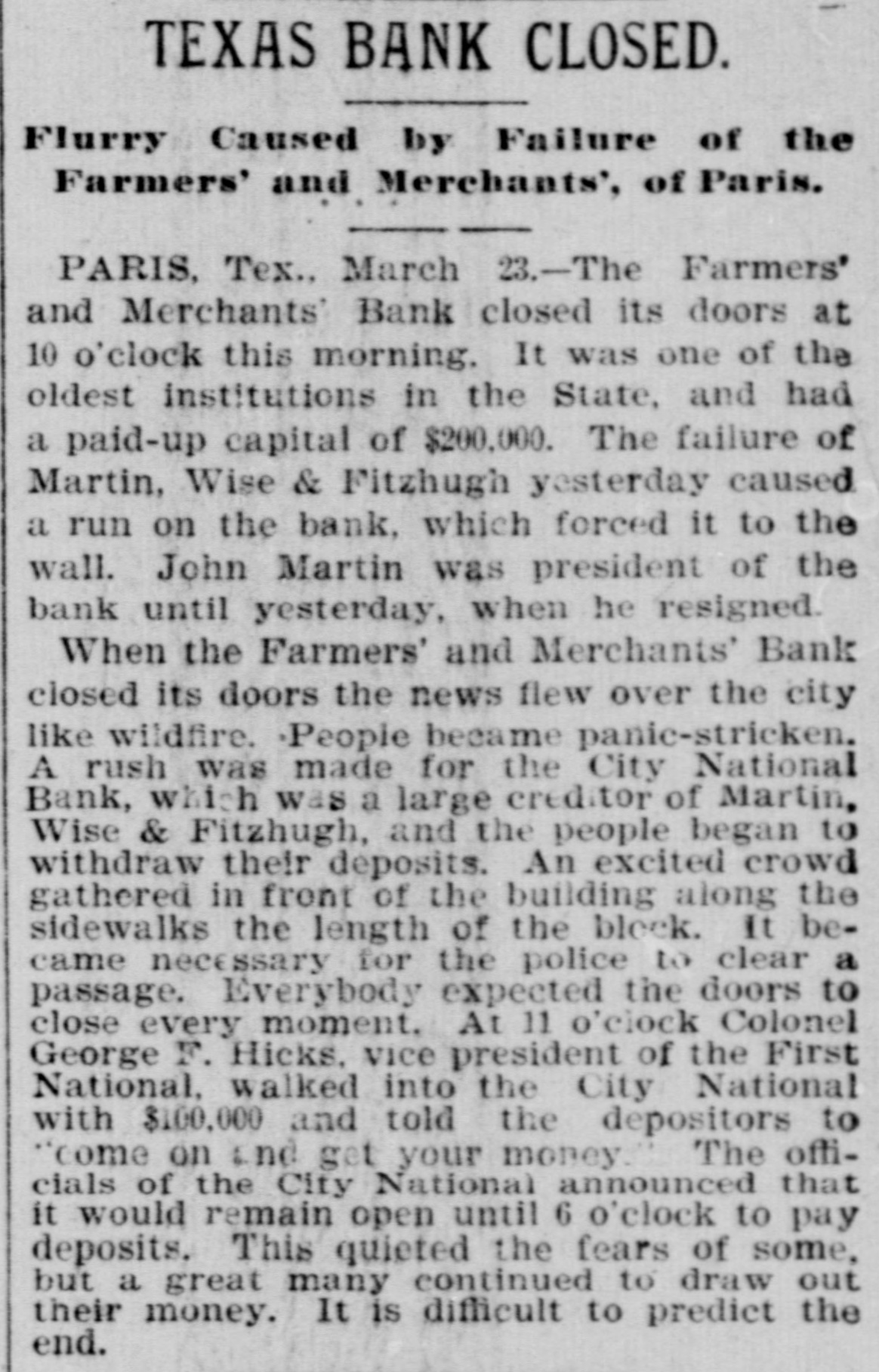
TEXAS BANK CLOSED. Flurry Caused by Failure of the Farmers' and Merchants', of Paris. PARIS, Tex., March 23.-The Farmers' and Merchants' Bank closed its doors at 10 o'clock this morning. It was one of the oldest institutions in the State, and had a paid-up capital of $200,000. The failure of Martin, Wise & Fitzhugh yesterday caused a run on the bank, which forced it to the wall. John Martin was president of the bank until yesterday, when he resigned. When the Farmers' and Merchants' Bank closed its doors the news flew over the city like wildfire. People became panic-stricken. A rush was made for the City National Bank, which was a large creditor of Martin, Wise & Fitzhugh, and the people began to withdraw their deposits. An excited crowd gathered in front of the building along the sidewalks the length of the block. It became necessary for the police to clear a passage. Everybody expected the doors to close every moment. At 11 o'clock Colonel George F. Hicks, vice president of the First National, walked into the City National with $100,000 and told the depositors to "come on and get your money. The officials of the City National announced that it would remain open until 6 o'clock to pay deposits. This quieted the fears of some, but a great many continued to draw out their money. It is difficult to predict the end.


Article from New-York Tribune, March 24, 1897

Click image to open full size in new tab

Article Text

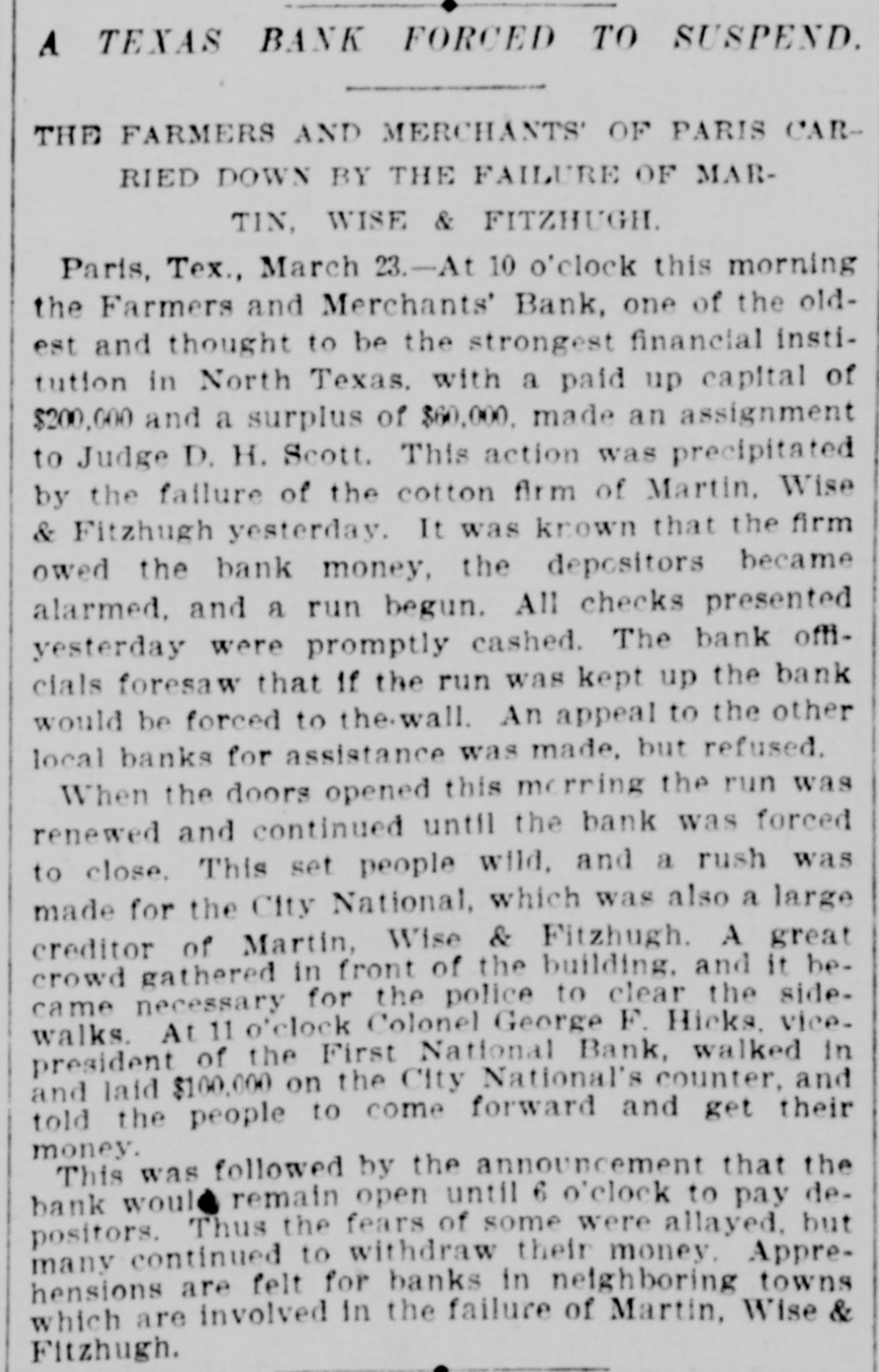
A TEXAS BANK FORCED TO SUSPEND. THE FARMERS AND MERCHANTS' OF PARIS CARRIED DOWN BY THE FAILURE OF MARTIN, WISE & FITZHUGH. Paris, Tex., March 23.-At 10 o'clock this morning the Farmers and Merchants' Bank, one of the oldest and thought to be the strongest financial institution in North Texas, with a paid up capital of $200,000 and a surplus of $60,000. made an assignment to Judge D. H. Scott. This action was precipitated by the failure of the cotton firm of Martin, Wise & Fitzhugh yesterday. It was known that the firm owed the bank money, the depositors became alarmed. and a run begun. All checks presented yesterday were promptly cashed. The bank officials foresaw that If the run was kept up the bank would be forced to wall. An appeal to the other local banks for assistance was made, but refused. When the doors opened this morring the run was renewed and continued until the bank was forced to close. This set people wild, and a rush was made for the City National, which was also a large creditor of Martin, Wise & Fitzhugh. A great crowd gathered in front of the building. and it became necessary for the police to clear the sidewalks. At 11 o'clock Colonel George F. Hicks. vicepresident of the First National Bank, walked in and laid $100,000 on the City National's counter, and told the people to come forward and get their money. This was followed by the announcement that the bank woul remain open until 6 o'clock to pay depositors. Thus the fears of some were allayed. but many continued to withdraw their money. Apprehensions are felt for banks in neighboring towns which are involved in the failure of Martin, Wise & Fitzhugh.


Article from The Portland Daily Press, March 24, 1897

Click image to open full size in new tab

Article Text

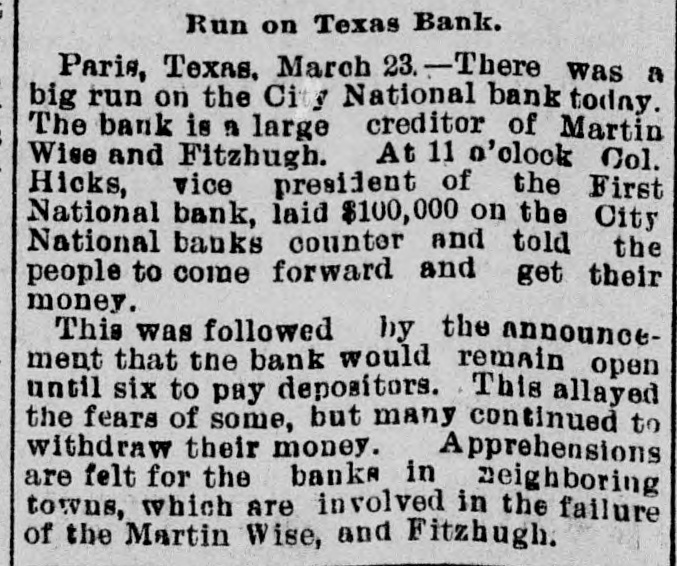
Run on Texas Bank. Paris, Texas, March 23.-There was a big run on the City National bank today. The bank is a large creditor of Martin Wise and Fitzhugh. At 11 o'clock Col. Hicks, vice president of the First National bank, laid $100,000 on the City National banks counter and told the people to come forward and get their money. This was followed by the announcement that the bank would remain open until six to pay depositors. This allayed the fears of some, but many continued to withdraw their money. Apprehensions are felt for the banks in neighboring towns, which are involved in the failure of the Martin Wise, and Fitzhugh.


Article from The Times, March 24, 1897

Click image to open full size in new tab

Article Text

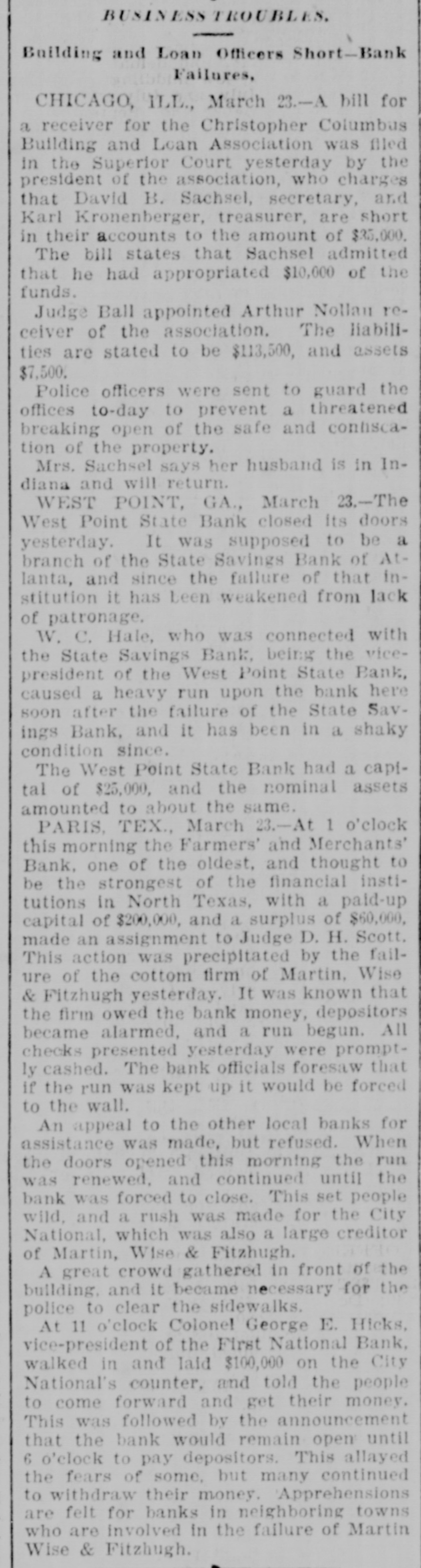
BUSINESS TROUBLES. Building and Loan Officers Short-Bank Failures, CHICAGO, ILL., March 23.-A bill for a receiver for the Christopher Columbus Building and Loan Association was filed in the Superior Court yesterday by the president of the association, who charges that David B. Sachsel, secretary, and Karl Kronenberger, treasurer, are short in their accounts to the amount of $35,000. The bill states that Sachsel admitted that he had appropriated $10,000 of the funds. Judge Ball appointed Arthur Nollan receiver of the association. The liabilities are stated to be $113,500, and assets $7,500. Police officers were sent to guard the offices to-day to prevent a threatened breaking open of the safe and conhscation of the property. Mrs. Sachsel says her husband is in Indiana and will return. WEST POINT, GA., March 23.-The West Point State Bank closed its doors yesterday. It was supposed to be a branch of the State Savings Bank of Atlanta, and since the failure of that institution it has been weakened from lack of patronage. W. C. Hale, who was connected with the State Savings Bank, being the vicepresident of the West Point State Bank, caused a heavy run upon the bank here soon after the failure of the State Savings Bank, and it has been in a shaky condition since. The West Point State Bank had a capital of $25,000, and the nominal assets amounted to about the same. PARIS, TEX., March 23.-At 1 o'clock this morning the Farmers' and Merchants' Bank, one of the oldest, and thought to be the strongest of the financial institutions in North Texas, with a paid-up capital of $200,000, and a surplus of $60,000, made an assignment to Judge D. H. Scott. This action was precipitated by the failure of the cottom firm of Martin, Wise & Fitzhugh yesterday. It was known that the firm owed the bank money, depositors became alarmed, and a run begun. All checks presented yesterday were promptly cashed. The bank officials foresaw that if the run was kept up it would be forced to the wall. An appeal to the other local banks for assistance was made, but refused. When the doors opened this morning the run was renewed, and continued until the bank was forced to close. This set people wild, and a rush was made for the City National, which was also a large creditor of Martin, Wise & Fitzhugh. A great crowd gathered in front of the building. and it became cessary for the police to clear the sidewalks. At 11 o'clock Colonel George E. Hicks, vice-president of the First National Bank, walked in and laid $100,000 on the City National's counter, and told the people to come forward and get their money. This was followed by the announcement that the bank would remain open until 6 o'clock to pay depositors. This allayed the fears of some, but many continued to withdraw their money. Apprehensions are felt for banks in neighboring towns who are involved in the failure of Martin Wise & Fitzhugh.
Article from The Daily Ardmoreite, March 24, 1897

Click image to open full size in new tab

Article Text

PARIS SUFFERS. The Farmers and Merchants National Bank of Paris, Texas, Succumbs at Last. Paris has suffered again, this time its leading banking institutition, the Farmers' and Merchants' National Bank closed its doors and the cause is direct] ly attributable to the filing of a deed of trust by the great cotton firm of Martin, Wise & Fitzhugh. Mr. Martin, the senior member of the cotton firm, was also president of the Farmers' and Merchants' National Bank, and he very promptly yesterday afternoon tendered his resignation and was succeeded by Capt. O. C. Connor. The statement sent out was that the bank would in no way be affected by the failure, as it held gilt-edged collateral for three times the amount of the firm's indebtedness to the bank. The bank had the largest capital stock of any bank in Paris, and its stockholders are all very wealthy, hence the surprise of everyone here when the closing of its doors was announced. Paris. Tex., March 23.-The Farmers' and Merchants' Bank of this city closed its doors at t 10:10 today. D. H. Scott, a real estate man, was made assignee and is in charge of the propS erty. Yesterday morning as soonas it was known that Martin, Wise & Fitzhugh had failed, owing the F. and M. Bank large sums, the depositors began a run on the bank. The officials hoped l' to tide over with what aid could be secured from this city and all depositors were paid as they applied. This morning, however, they realized that the a fight was in vain, and the doors were closed as above stated. The City National Bank was a creditor of Martin, Wise & Fitzhugh and a run was made on that institution also. They were able to meet all demands, however, and before the closing hour yesterday the run was over. e The business men stood by 0 the bank and the bank officials e state that the deposits were equal to the withdrawals. e Business circles have been e much excited up until noon ton f day but at this hour (3 p. m.) matters have quieted down and al no further sensational develop& ments are anticipated.-Shere man Register. is


Article from The Times, March 24, 1897

Click image to open full size in new tab

Article Text

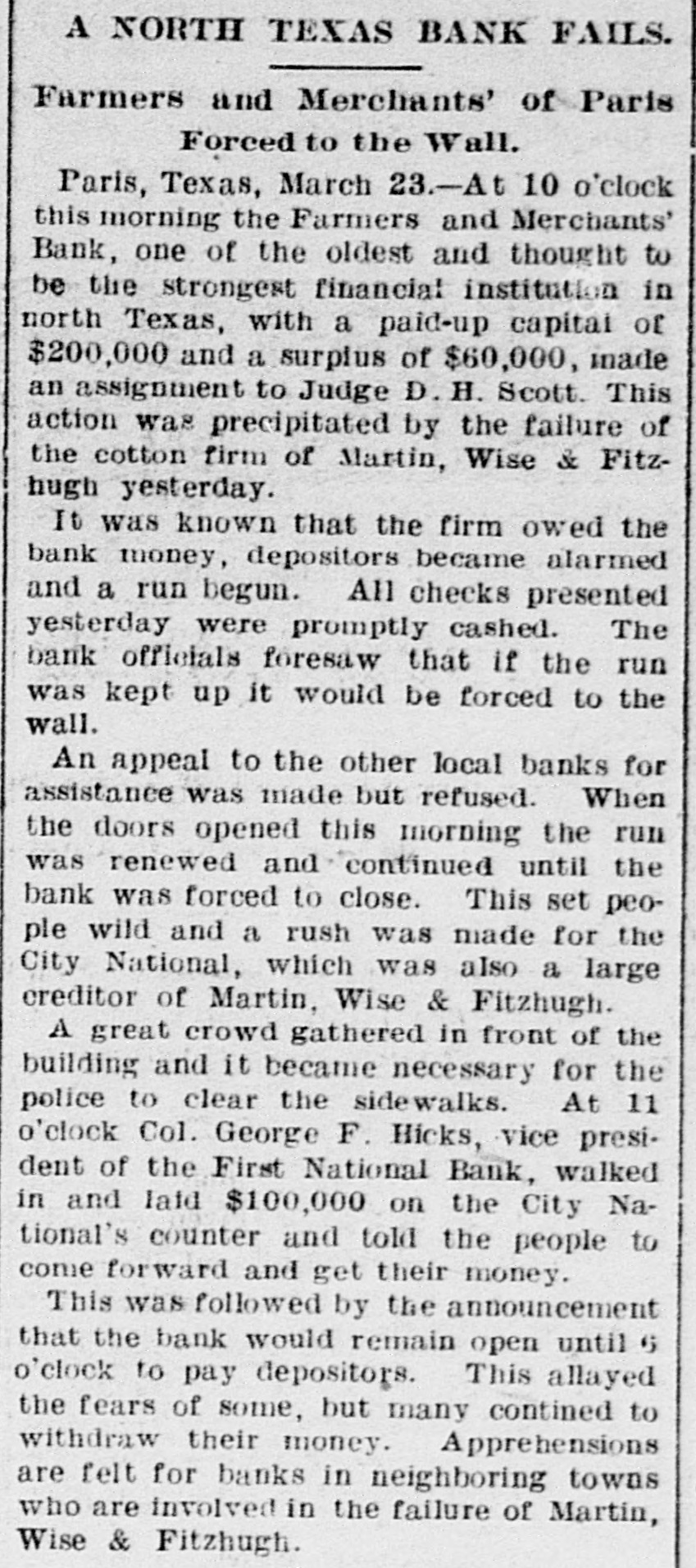
A NORTH TEXAS BANK FAILS. Farmers and Merchants' of Paris Forced to the Wall. Paris, Texas, March 23.-At 10 o'clock this morning the Farmers and Merchants' Bank, one of the oldest and thought to be the strongest financial institution in north Texas, with a paid-up capital of $200,000 and a surplus of $60,000, made an assignment to Judge D.H. Scott. This action was precipitated by the failure of the cotton firm of Martin, Wise & Fitzhugh yesterday. It was known that the firm owed the bank money, depositors became alarmed and a run begun. All checks presented yesterday were promptly cashed. The bank officials foresaw that if the run was kept up it would be forced to the wall. An appeal to the other local banks for assistance was made but refused. When the doors opened this morning the run was renewed and continued until the bank was forced to close. This set people wild and a rush was made for the City National, which was also a large creditor of Martin, Wise & Fitzhugh. A great crowd gathered in front of the building and it became necessary for the police to clear the sidewalks. At 11 o'clock Col. George F. Hicks, vice president of the First National Bank, walked in and laid $100,000 on the City National's counter and told the people to come forward and get their money. This was followed by the announcement that the bank would remain open until 6 o'clock to pay depositors. This allayed the fears of some, but many contined to withdraw their money. Apprehensions are felt for banks in neighboring towns who are involved in the failure of Martin, Wise & Fitzhugh.


Article from The Houston Daily Post, March 24, 1897

Click image to open full size in new tab

Article Text

F. AND M. BANK OF PARIS. Run on It Forced the House to Assign. DEPOSITORS TO BE PAID IN FULL. Assignee Says the Assets will Be Sufficient The City National Stood a Run Easily. Paris, Texas, March 23.-This has been a "black Friday" for this thriving city and it has passed the severest crisis in its history. For the first time a bank has closed its doors and suspended payment. The old Farmers' and Merchants' bank. that has been the depository at one time or another of all the business men of Paris, that has pulled many of them out of the hole and enabled them to continue busi. ness, filed a deed of assignment in the county clerk's office at 10:10 this morning, naming D. H. Scott as assignee. When the failure of Martin, Wise & Fitzbugh was announced yesterday some of the depositors in the Farmers' and Merchants' bank, who knew that Mr. Martin was its president and that the bank was heavily involved, began to draw out their money. This morning the bank opened as usual and the demands of depositors for their money began. The directors had evidently prepared for the contingency last night, and at a few minutes before 10 o'clock the doors werd closed and the deed was filed immediately afterwards. A small crowd gathered about the closed door and peered through the plate glass with the idle curiosity that the human race as a whole exhibits on such occasions. A few of them were depositors, but most of them had nothing to lose. The document filed transfers to D. H. d Scott all of the property of the bank, real, personal and mixed, of whatsoever nature. kind or description, consisting of real estate, money. stocks and bonds, notes. accounts. evidences of indebtedness, and, in fact, all property of whatsoever kind or description which the bank may own for the following purposes: D. H. Scott shall take possession of all of the said property of said bank. consistn ing of real estate, money, stocks and bonds notes, accounts and evidences of debt and to shall sell said real estate, stocks, bonds and other property for cash at public or private sale as he may deem best and shal collect all notes. accounts and evidences of debt and shall out of the proceeds of such sales and collections and money or hand


Article from Richmond Dispatch, March 24, 1897

Click image to open full size in new tab

Article Text

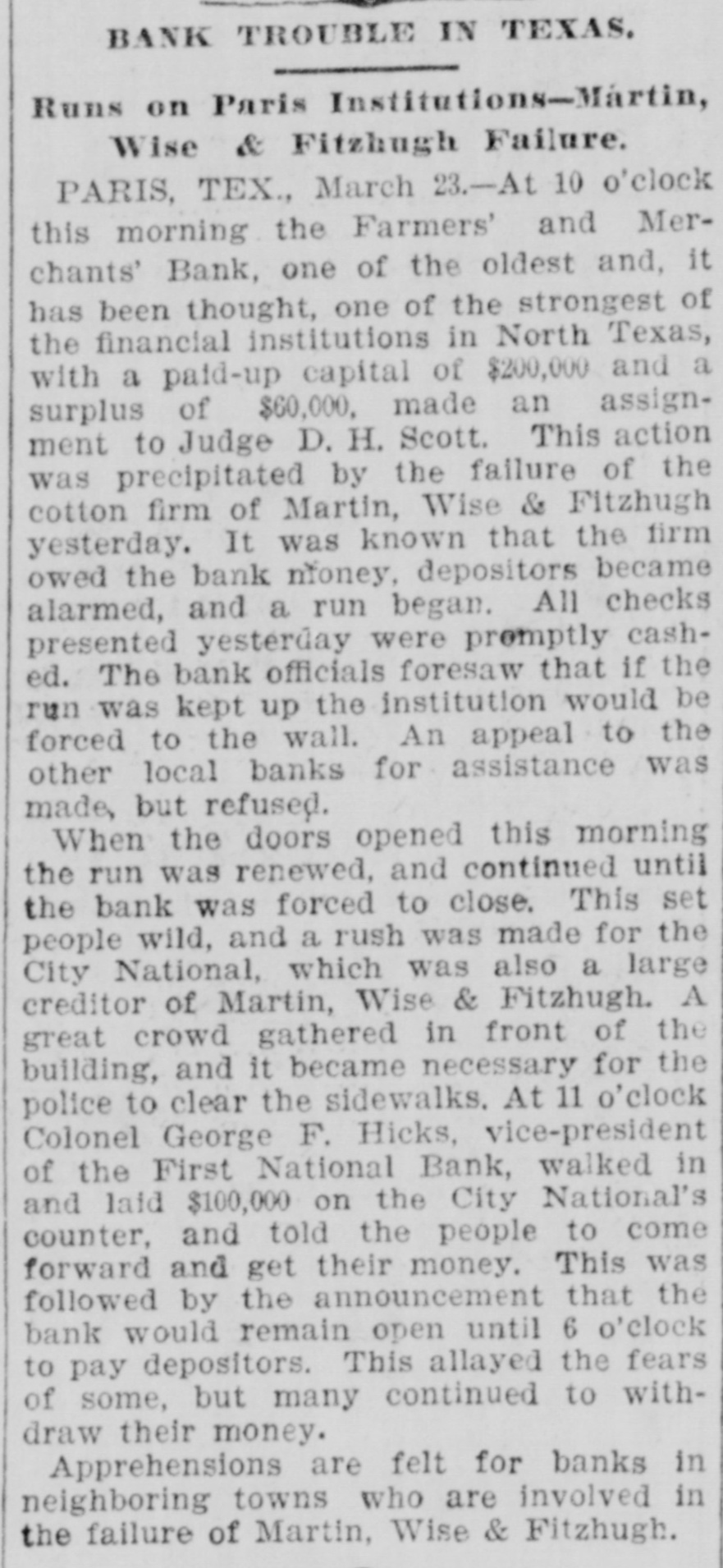
BANK TROUBLE IN TEXAS. Runs on Paris Institutions-MΓ‘rtin, Wise & Fitzhugh Failure. PARIS, TEX., March 23.-At 10 o'clock this morning the Farmers' and Merchants' Bank, one of the oldest and, it has been thought, one of the strongest of the financial institutions in North Texas, with a paid-up capital of $200,000 and a surplus of $60,000, made an assignment to Judge D. H. Scott. This action was precipitated by the failure of the cotton firm of Martin, Wise & Fitzhugh yesterday. It was known that the firm owed the bank nfoney, depositors became alarmed, and a run began. All checks presented yesterday were promptly cashed. The bank officials foresaw that if the run was kept up the institution would be forced to the wall. An appeal to the other local banks for assistance was made, but refused. When the doors opened this morning the run was renewed, and continued until the bank was forced to close. This set people wild, and a rush was made for the City National, which was also a large creditor of Martin, Wise & Fitzhugh. A great crowd gathered in front of the building, and it became necessary for the police to clear the sidewalks. At 11 o'clock Colonel George F. Hicks, vice-president of the First National Bank, walked in and laid $100,000 on the City National's counter, and told the people to come forward and get their money. This was followed by the announcement that the bank would remain open until 6 o'clock to pay depositors. This allayed the fears of some, but many continued to withdraw their money. Apprehensions are felt for banks in neighboring towns who are involved in the failure of Martin, Wise & Fitzhugh.


Article from The Sun, March 24, 1897

Click image to open full size in new tab

Article Text

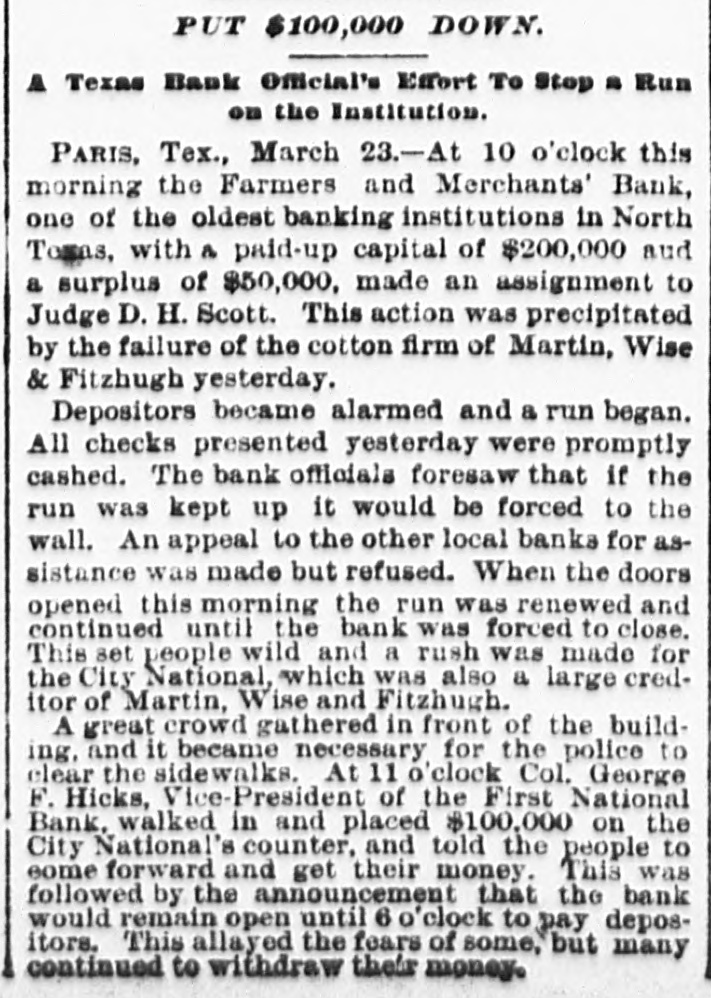
PUT $100,000 DOWN. A Texas Bank Official's Effort To Stop a Run on the Institution. PARIS, Tex., March 23.-At 10 o'clock this morning the Farmers and Merchants' Bank, one of the oldest banking institutions in North Tomas, with & paid-up capital of $200,000 aud a surplus of $50,000, made an assignment to Judge D. H. Scott. This action was precipitated by the failure of the cotton firm of Martin, Wise & Fitzhugh yesterday. Depositors became alarmed and a run began. All checks presented yesterday were promptly cashed. The bank officials foresaw that if the run was kept up it would be forced to the wall. An appeal to the other local banks for assistance was made but refused. When the doors opened this morning the run was renewed and continued until the bank was forced to close. This set people wild and a rush was made for the City National, which was also a large creditor of Martin, Wise and Fitzhugh. A great crowd gathered in front of the building. and it became necessary for the police to clear the sidewalks. At 11 o'clock Col. George F. Hicks, Vice-President of the First National Bank, walked in and placed $100,000 on the City National's counter, and told the people to eome forward and get their money. This was followed by the announcement that the bank would remain open until 6 o'clock to pay depositors. This allay ed the fears of some, but many continued to withdraw their money.