Click image to open full size in new tab
Article Text
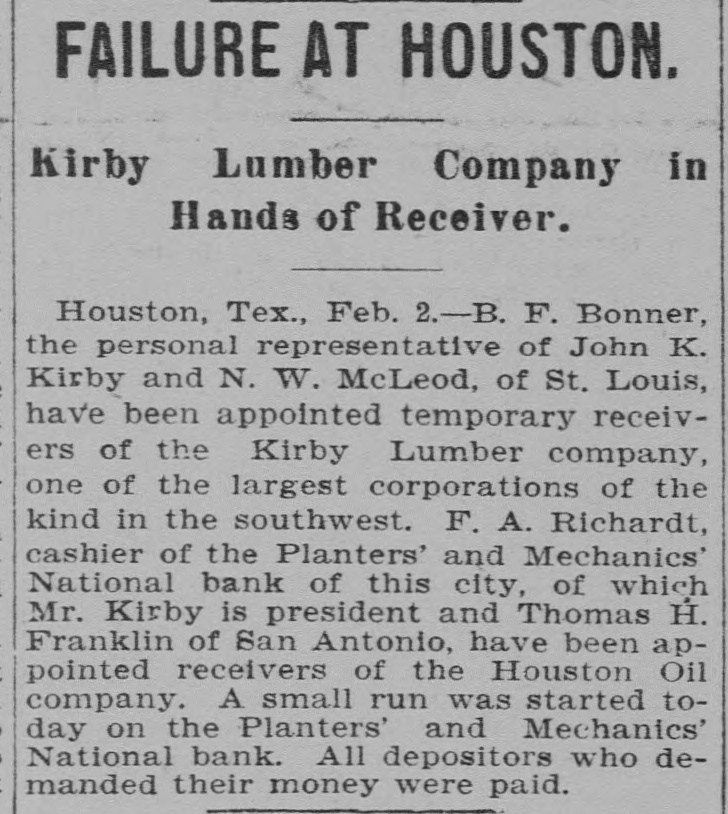
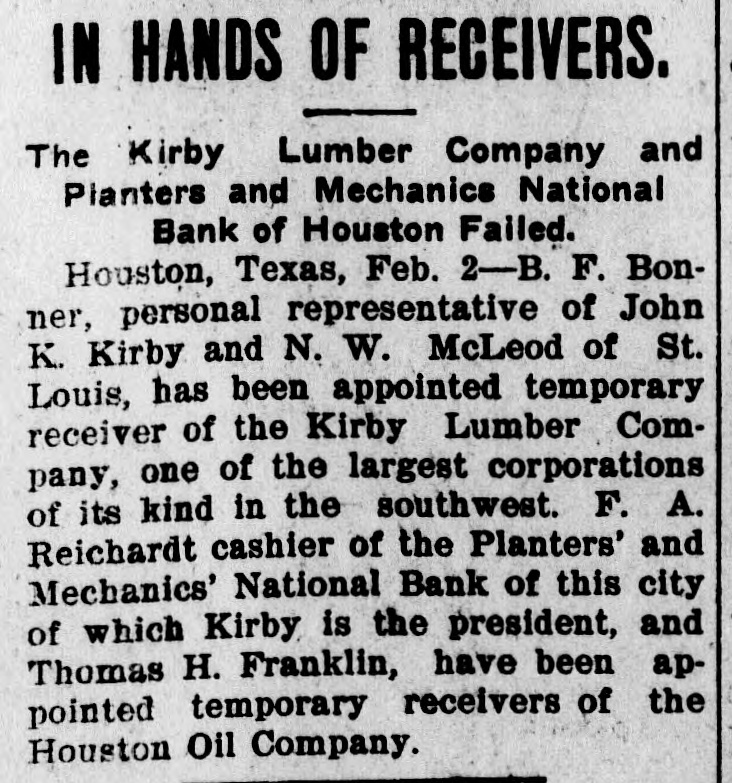
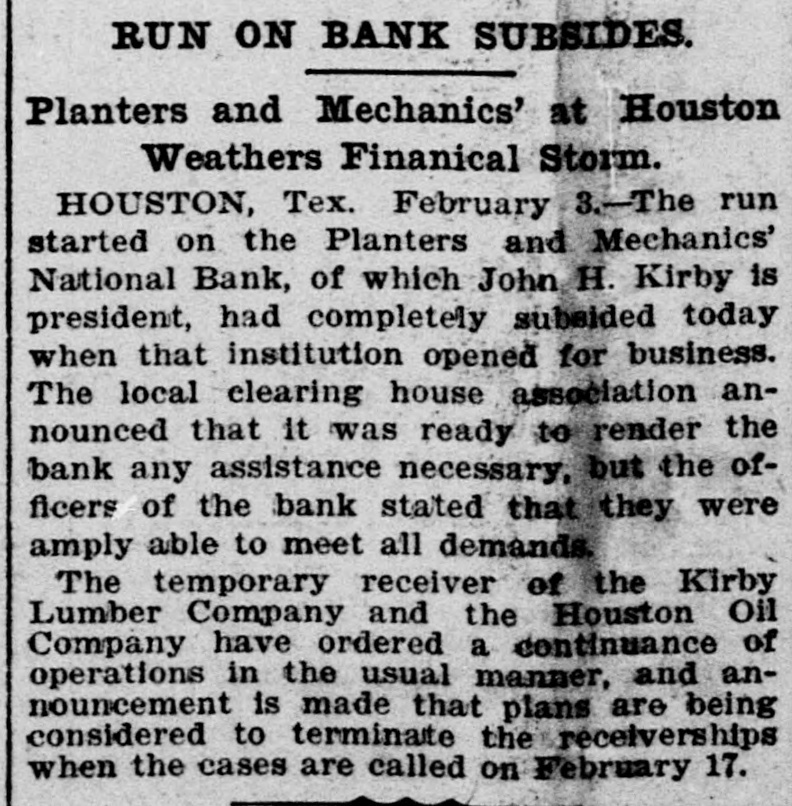
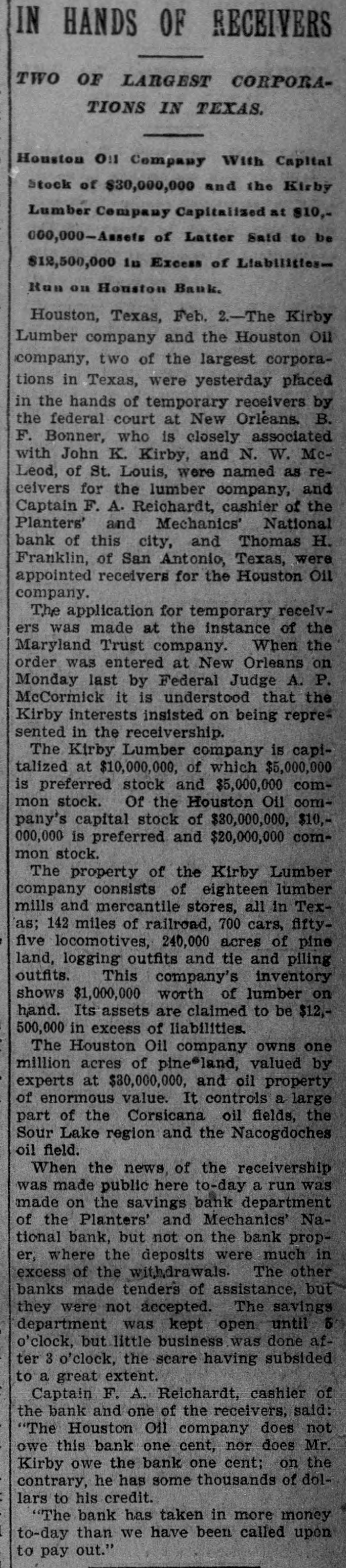
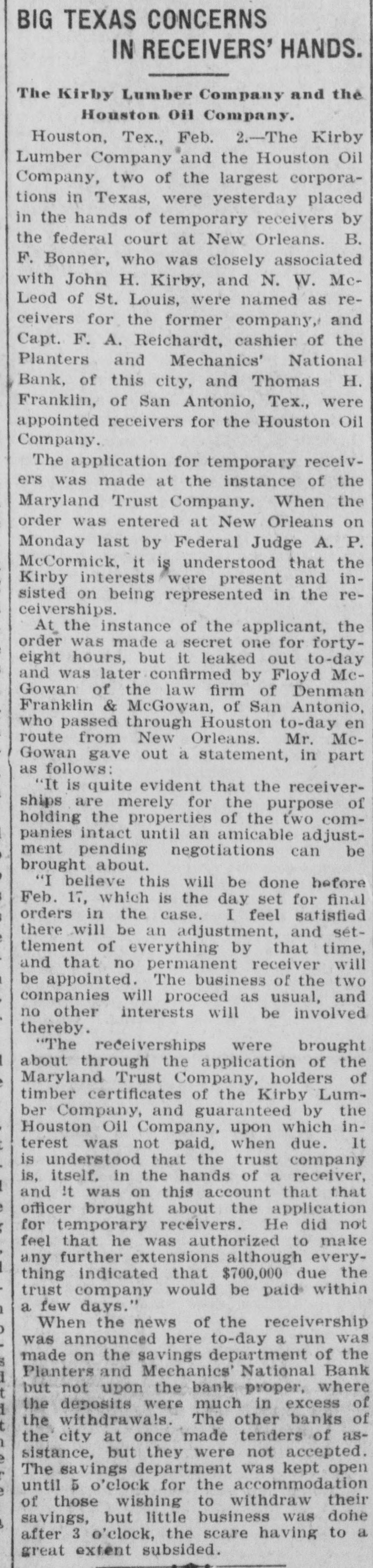
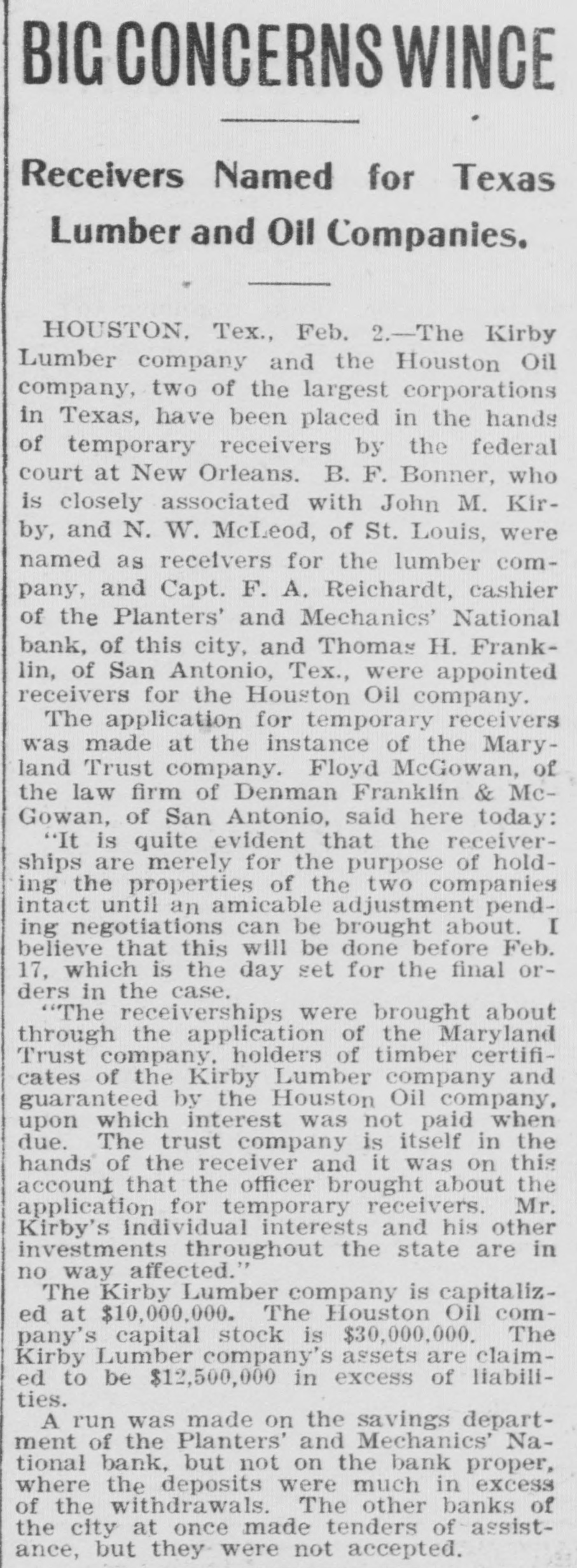
TEMPORARY RECEIVERS FOR TWO TEXAS CONCERNS Kirby Lumber Corporation and Houston Oil Company in the Control of the Court. TO CONTINUE BUSINESS HOUSTON, Tex., Feb. 2.-B. F. Bonner, the personal representative of John H. Kirby and N. W. McLeod, of St. Louis, has been appointed temporary receiver of the Kirby Lumber Company, one of the largest corporations of its kind in the Southwest. F. A. Reychardt, cashier of the Planters' and Mechanics' National Bank, of this city, of which John H. Kirby is president, and Thomas H. Franklin, of San Antonio, have been appointed temporary receivers of the Houston Oil Company. Floyd McGowan, of the firm of Denman, Franklin & McGowan, made this statement: "There is no need whatever for any undue excitement on account of the temporary receivership. It was brought about by the fact that the Maryland Trust Company, holding timber certificates of the Kirby Lumber Company, and guaranteed by the Houston Oil Company, upon which interest was not paid when due, is itself in the hands of a receiver, and it was on this account that action was taken. Plans for a settlement have been pending for several weeks past and yesterday I received advices from the Maryland Trust Company stating that negotiations were near a settlement. The fact of the matter is that this application was prepared more than a month ago and has been held back, as it was the general understanding that it would be withdrawn. It is quite evident that the receivership is merely for the purpose of holding the properties of the two companies intact until an amicable adjustment, pending negotiations, can be brought about. I believe this will be done before Feb. 17, which is the day set for the final orders in the case. The business of the two companies will proceed as usual and no other interests will be involved thereby." The Kirby Lumber Company is capitalized at $10,000,000, of which $5,000,000 is preferred stock and $5,000,000 is common stock. Of the Houston Oil Company's capital stock of $30,000,000, $10,000,000 is preferred stock and $20,000,000 common stock. The property of the K'rby Lumber Company consists of eighteen lumber mills and mercantile stores, all in Texas; 142 miles of railroad, 700 cars, 55 locomotives, 240,000 acres of pine land, logging outfits, tie and piling outfits. This company's inventory shows $1,000,000 worth of lumber on hand. Its assets are claimed to be $12,500,000 in excess of liabilities. The Houston Oil Company owns 1,000,000 acres of pine land, valued by experts at $30,000,000, and oil property of enormous value. It controls a large part of the Corsicana oil fields, the Sour Lake area and the Nacogdoches oil fields. When the news of the receivership was announced here to-day a run was made on the savings department of the Planters' and Mechanics' National Bank, but not on the bank proper, where the deposits were much in excess of the withdrawals. The other banks of the city at once made tenders of assistance, but they were not accepted. The savings department was kept open until 5 o'clock for the accommodation of those wishing to withdraw their savings, but little business was done after 3 p. m., the scare having, to a great extent, subsided.