Article Text
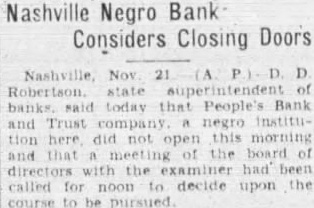
Nashville Negro Bank Considers Closing Doors Nov People's Bank negro morning the board called decide upon be pursued
405cd3b7a3629bf5None
Click image to open full size in new tab
Nashville Negro Bank Considers Closing Doors Nov People's Bank negro morning the board called decide upon be pursued
Click image to open full size in new tab
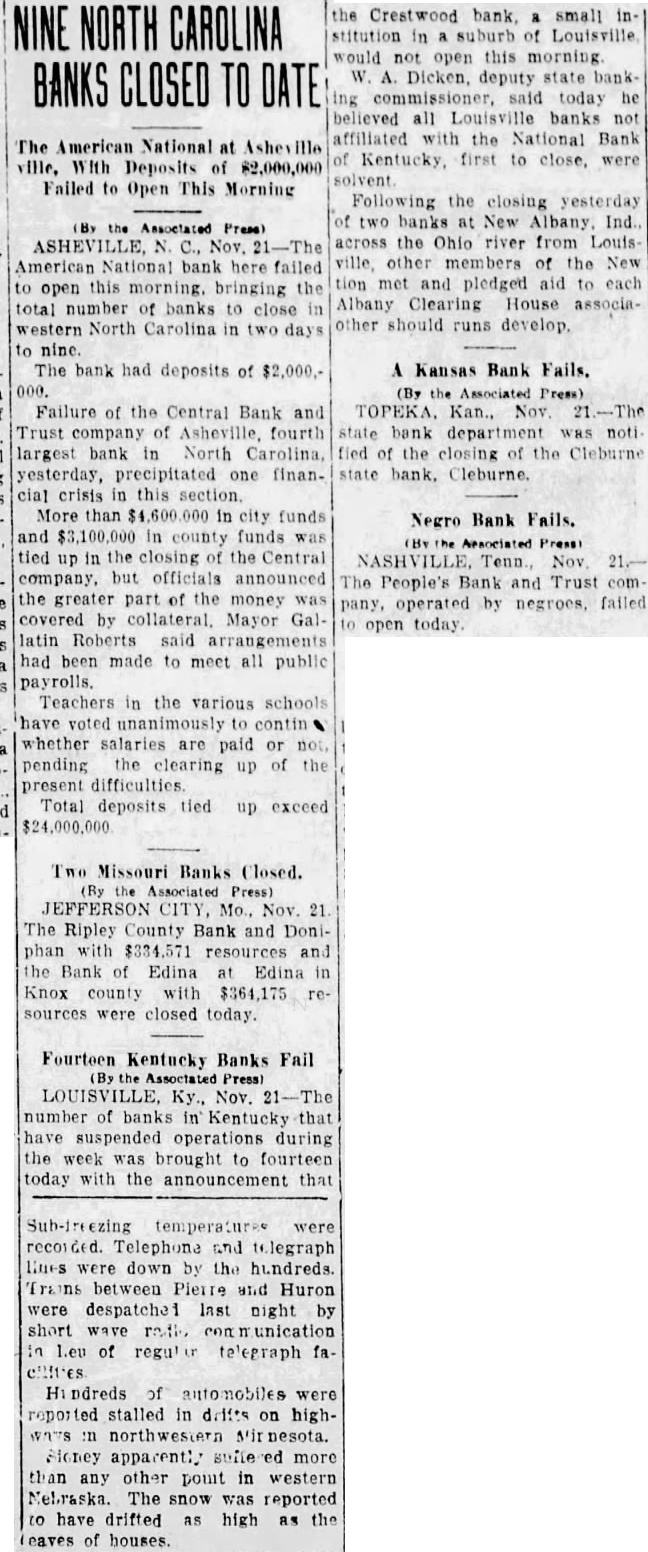
NINE NORTH CAROLINA BANKS CLOSED TO DATE The American National at Asheville ville, With Deposits of $2,000,000 Failed to Open This Morning (By the Associated Press) ASHEVILLE, N. C., Nov. 21-The American National bank here failed to open this morning. bringing the total number of banks to close in western North Carolina in two days to nine. The bank had deposits of $2,000,000. Failure of the Central Bank and Trust company of Asheville, fourth largest bank in North Carolina, yesterday, precipitated one financial crisis in this section. More than $4 in city funds and $3,100,000 in county funds was tied up in the closing of the Central company. but officials announced the greater part of the money was covered by collateral. Mayor Gallatin Roberts said arrangements had been made to meet all public payrolls. Teachers in the various schools have voted unanimously to contin whether salaries are paid or not, pending the clearing up of the present difficulties. Total deposits tied up exceed $24,000,000 Two Missouri Banks Closed. (Ry the Associated Press) JEFFERSON CITY, Mo., Nov. 21. The Ripley County Bank and Doniphan with $334,571 resources and the Bank of Edina at Edina in Knox county with $364,175 resources were closed today. Fourteen Kentucky Banks Fail Associated Press) LOUISVILLE. Ky., Nov. 21-The number of banks in Kentucky that have suspended operations during the week was brought to fourteen today with the announcement that recorded. Telephone and telegraph lines were down by the hundreds Trans between Pierre and Huron were despatched last night by short wave retion munication in Leu of regular telegraph faHindreds of automobiles were reported stalled in drifts on highSigney apparently suite more than any other point in western Mebraska. The snow was reported to have drifted as high as the of houses. the Crestwood bank, a small institution in suburb of Louisville would not open this morning. W. A. Dicken, deputy state banking commissioner, said today he believed all Louisville banks not affiliated with the National Bank of Kentucky, first to close, were solvent. Following the closing yesterday of two banks at New Albany, Ind., across the Ohio river from Louisville, other members of the New tion met and pledged aid to each Albany Clearing House associaother should runs develop. A Kansas Bank Fails, (By the Associated Press) TOPEKA. Kan., Nov. 21.-The state bank department was noti fied of the closing of the Cleburne state bank. Cleburne. Negro Bank Fails. NASH Tenn. Nov. The People's Bank and Trust company, operated by negroes, failed to open today.
Click image to open full size in new tab
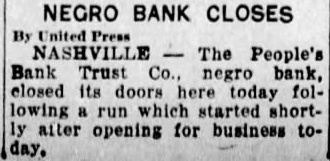
NEGRO BANK CLOSES NASHVILLE The People's Bank Trust Co., negro bank, closed its doors here today following which started shortopening for business
Click image to open full size in new tab
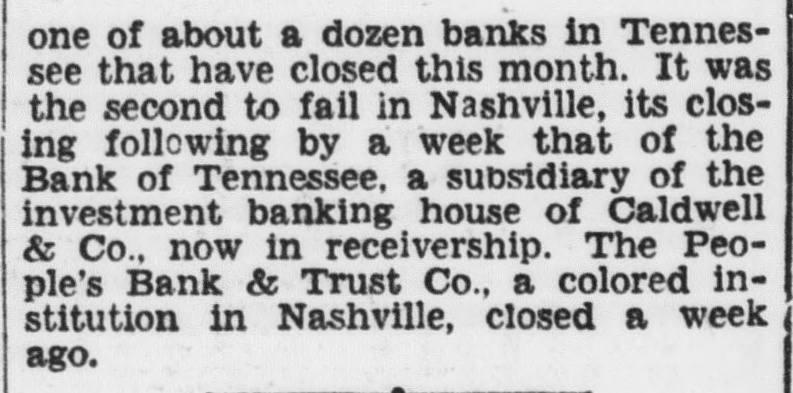
one of about a dozen banks in Tennessee that have closed this month. It was the second to fail in Nashville, its closing following by a week that of the Bank of Tennessee, a subsidiary of the investment banking house of Caldwell & Co., now in receivership. The People's Bank & Trust Co., a colored institution in Nashville, closed a week ago.
Click image to open full size in new tab
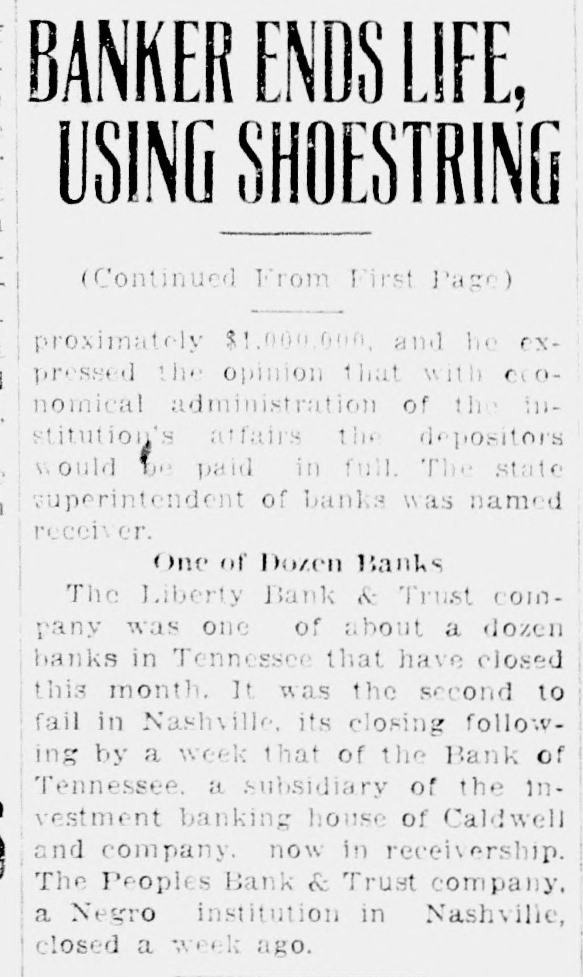
BANKER ENDS LIFE, USING SHOESTRING (Continued From First Page) proximately $1,000,000. and he expressed the opinion that with CCOnomical administration of the in stitution's affairs the depositors would be paid in full. The state superintendent of banks was named receiver. One of Dozen Banks The Liberty Bank & Trust company was one of about a dozen banks in Tennessee that have closed this month. It was the second to fail in Nashville, its closing following by a week that of the Bank of Tennessee. it subsidiary of the investment banking house of Caldwell and company. now in receivership. The Peoples Bank & Trust company. a Negro institution in Nashville, closed a week ago.