18147. Freedman's Savings & Trust Company (nashville Branch) (Nashville, TN)

Bank Information

Episode Type
Suspension β†’ Closure
Bank Type
federal
Start Date
August 14, 1874
Location
Nashville, Tennessee (36.166, -86.784)

Metadata

Model
gpt-5-mini
Short Digest
9a2174c17eda40e7

Response Measures

None

Description

Articles (Aug–Dec 1874 and Jan 1875) describe the Nashville branch of Freedman's Savings & Trust Company as insolvent, with depositors defrauded, suits filed, and a court-ordered receiver appointed. No contemporaneous newspaper language describes a depositor run; instead the legal winding-up and receivership dominate the narrative. The parent institution in Washington was being wound up by congressional commissioners; Tennessee courts attached branch property and appointed a receiver. Dates chosen reflect the court decree (Nov 28, 1874) and the subsequent receiver actions (Dec 1874).

Events (3)

1. August 14, 1874 Other
Newspaper Excerpt
They have taken the hard-earned savings of the Freedman's Nashville branch... I have now found out... Mr. Alvord resigns... the bank was about to Fredit... Frederick Douglass was placed at its head, saw its lawful condition. In the long run, depositors may get something; thank Frederick Douglass of pur- may wide-known integrity and honesty purpose.. (A. G. Merry letter describing mismanagement and loss.)
Source
newspapers
2. November 28, 1874 Suspension
Cause
Bank Specific Adverse Info
Cause Details
Insolvency of the corporation and alleged misappropriation/defalcation at parent level; depositors brought suit seeking attachment of branch property; commissioners in Washington winding up parent institution and promising only a fraction to depositors.
Newspaper Excerpt
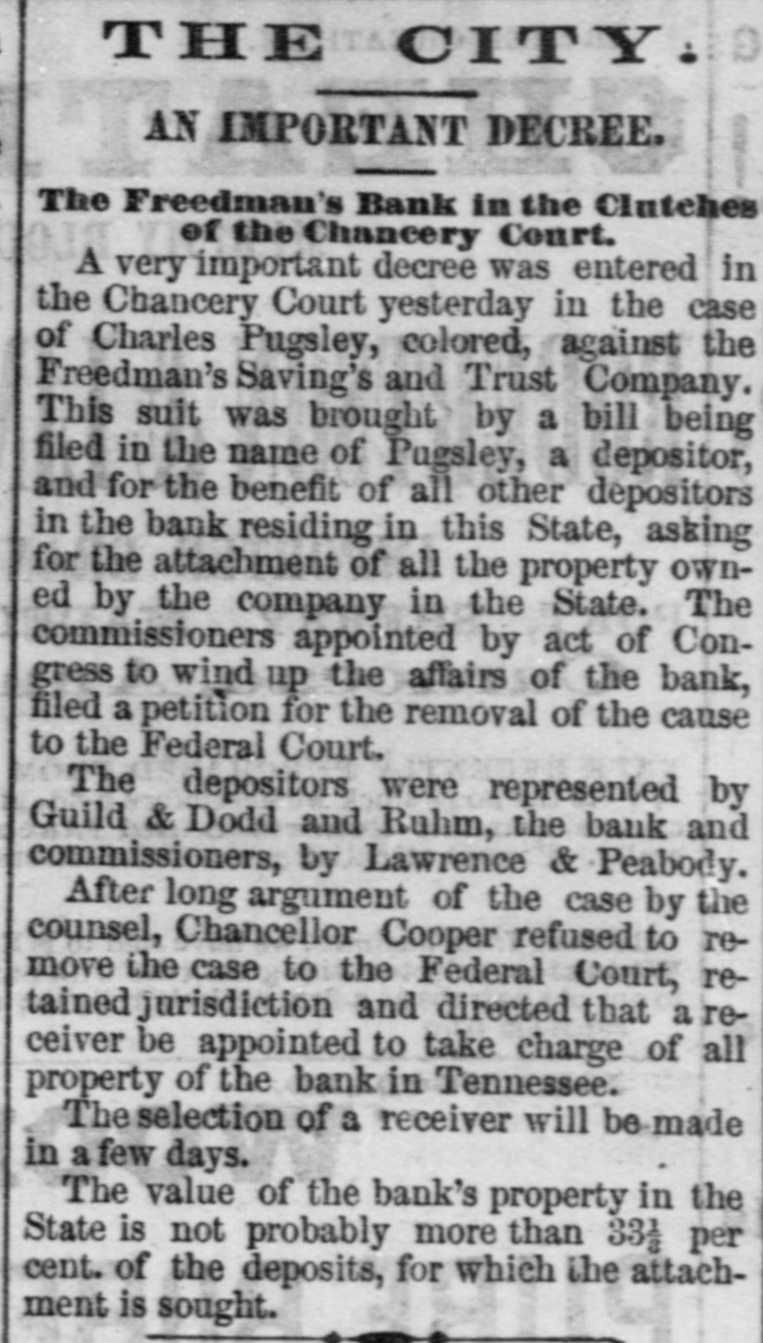
The Freedman's Bank in the Clutches of the Chancery Court... Chancellor Cooper refused to remove the case to the Federal Court, retained jurisdiction and directed that a receiver be appointed to take charge of all property of the bank in Tennessee.
Source
newspapers
3. December 23, 1874 Receivership
Newspaper Excerpt
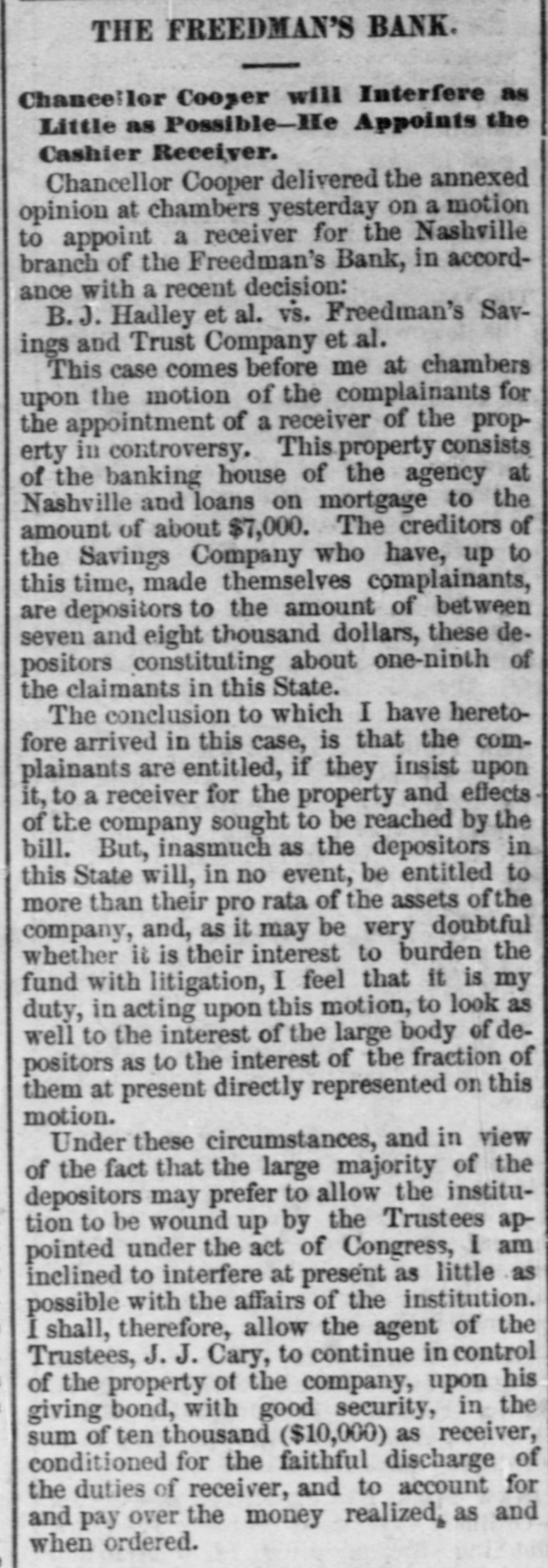
Chancellor Cooper... on a motion to appoint a receiver for the Nashville branch... allow the agent of the Trustees, J. J. Cary, to continue in control of the property of the company, upon his giving bond, with good security, in the sum of ten thousand ($10,000) as receiver, conditioned for the faithful discharge of the duties of receiver, and to account for and pay over the money realized, as and when ordered.
Source
newspapers

Newspaper Articles (6)

Article from Nashville Union and American, August 14, 1874

Click image to open full size in new tab

Article Text

To the Union and American: the you please allow me a space few in words Will of your paper to say a Bank, in columns regard workings. to the Freedman's I also wish Savings to commit- set myand its as one of the advisory Nashv l'e branch, and as a tee of the Gimpal of Jesus ister ee ars standing over I am identified my self community right twenty-ti of the pertains with Clrist to in their min- peo- this for ple in everything prosperity. that They have taken been welfare and and many advantages treated by these who of their friends] In have badly best ignorance Aducational they pretend work to be their other way possible they and every deceived by those who say that Instead been left their h omes to help et. themhave us, they greatly helped in fact, of helping These hypocrites have, one-fourth of selves theffiselves to nearly colored peahelpeti hard-earned savings of the medium of the of the South, through the the ple Freedman's Nashville Bank. branch was established of the in The Several colored ministers of the ad1805. were chosen as members number several gospel board, among the who enjoyed risory of churches, pastors Christian love pastors confidence and I Right of we fell into bad hands. for have watched and cared the the confess their esteem, congregations. that here I, must war. my for myself, ever since the beginning their of distress interest all the class of is my to claim so much seen people who Their distress. is Attiong my interest; love for men one, the of try I have never yet favor colored people one who was really in the eminor found elevation of the black man to have long the the white man. I idea and nence consoled of myself with the will since that the former stareholder near conviction advice and come as that give as the good right as any one do else, more. and doing instances, he will the Freedman's in many these managers in aim was Now, deceived us all. Their being to Bank deceive have in the beginning to be by connected eager for colored preachers board, and thus to influwith membership and in ence in the bank. My to Bank has deposit Freedman's their the advisory few confidence congregations never weeks. been I the until within the past the bank, shaken the utmost confidence in and many placed all our colored people, colored citias did though there are a few doubts whites, this place who have had three as zens of faith of the bank for over to years the and good stopped all business connection with it managers some time of since. this institution have The advantage of us and our ignorance. would regtaken bank at Washington in The parent out agents to the branches ularly send Southern cities to hold public various in churches and there urge upon of the bank as a for our the people that meetings 113 and the safe advantages would place tell money. the suitable These Gen- dolagents was bound for every safe. eral Government that the bank was perfectly lar, time, they would of influence in in 1. for one. did use my it tors At bank. the and to same use their behalf thought influence invite pas- the to of the bank, because I the colorbehalf place for the savings of encourage be a safe I did everything to morality, ined economy, people. as well as education, dustry and Christianity The agents, with their oily tongues, educaproved the bank to be the "greatest as they had tor" for the emancipated. colored people, In 1871 Rev. got J. just President of the First a meeting in my speak to to W. call Alvord, been he church might bank, (the me Colored Baptist), that board and about people. The advisory at the apmy hundred people assembled Alvord, pointed seven time. I introduced Mr. who commenced by saving: I sometimes preach, but now will is talk the 1 about banks. You ask me, Uncle Sam to you safe? I'll ask you, is safe." Anbank voices- Yes, he is I'll Can the bank other safet (many voice- break?") break Unby asking, can you Than you answer you (Cries of "No! No.") can break can as you de Sam? never break this bank. You can break this bank. Uncle Sam just Every as soon dollar of this bank I took is in United States Bonds. I left invested look over her bonds just before Washington. Alvord is a preacher, and mankind I am one to Mr. want the world and all that Rev. also. that I I have now found out pulpit and know W. Alvord stood up in my and in J. lie, thereby fooling many, in the told a the confidence of all present sin (which creasing Unless he repents of this home. bank. is sin), hell will be his filled a great after their pockets were to and go Now, that the bank was about Fredit was seen Mr. Alvord resigns. Hon. head, through, erick Douglass, who was placed at its saw its lawful condition. soon run, depositors may get In the long but, whatever they do get, for they his something; thank Frederick Douglass of purmay wide-known integrity and honesty pose. of nearly two thousand depositors the size in Out branch, I can safely say, from sixteen this congregation, which is about depositors of my that one-fourth of the know hundred, from this direction. Now, told you a truth are look at me as having explanation. they or a falsehood, must so I make this I am, your obedient servant, A. G. MERRY, Pastor First Colored Baptist Church, Nashvilie, Tenn.

Article from Nashville Union and American, November 28, 1874

Click image to open full size in new tab

Article Text

THE CITY. AN IMPORTANT DECREE. The Freedman's Bank in the Clutches of the Chancery Court. A very important decree was entered in the Chancery Court yesterday in the case of Charles Pugsley, colored, against the Freedman's Saving's and Trust Company. This suit was brought by a bill being filed in the name of Pugsley, a depositor, and for the benefit of all other depositors in the bank residing in this State, asking for the attachment of all the property owned by the company in the State. The commissioners appointed by act of Congress to wind up the affairs of the bank, filed a petition for the removal of the cause to the Federal Court. The depositors were represented by Guild & Dodd and Ruhm, the bank and commissioners, by Lawrence & Peabody. After long argument of the case by the counsel, Chancellor Cooper refused to remove the case to the Federal Court, retained jurisdiction and directed that a receiver be appointed to take charge of all property of the bank in Tennessee. The selection of a receiver will be made in a few days. The value of the bank's property in the State is not probably more than 331 per cent. of the deposits, for which the attachment is sought.


Article from Nashville Union and American, November 29, 1874

Click image to open full size in new tab

Article Text

and the filin of the bill The insolvency of the corporation is ad mitted by the agreed case, and such vency, under our decision. does work change in the status of the corporation and the distribution of assets concerned. The officers a corporation, upon its insolvency, having control of its property and effects, become trustees and hold the property for the benefit of creditors and claimants. in the order prescribed by law if any, and. if none, then pro rata for all creditors and claimants Marr Bank of West Tennessee, Cold 471. The insolvency must, however. clearly established, before an adverse right accrues to work this effect. Musely vs Williamson, 5 Heisk., 278, 286. And Court of Equity, after such insolvency. wil not allow one creditor who stands upon the same ground as other creditors, to ap propriate the common fund to his own benefit as to exclude the others Mart vs. Bank of West Tennessee. 4 Cold., 471; Clark vs. State, Cold. 322. The fact, however, that the creditor cannot acquire an exclusive right to the fund he seeking to subject. does not him from his rights to the extent of having his debt ascertained and adand charged upon the trust proper far as it can be, that is, to the extent of rata. The creditor who thus impounds and secures the fund will, more over, ordinarily be entitled to his reasonable costs and expenses incurred in securing the fund Rains Rainey H. 261; ex parte Plite, Wall. Jr. 453. I see nothing in the fact of the insolvency of the incorporation in this case to take it out of the general rule. to deprive the complain ants of the right to enforce their claims to the extent above indicated They are clearly entitled, so far as this objection is concerned, to prosecute their suits of attachment to judgment, and to have their rights, at least to rata of the corporation funds, declared and the property at tached to the extent subjected to the satisfaction of their debts. The insolvency of the Savings company at the filing of the bill does not, therefore, preclude the complainants from prosecuting their suits to a final decree most, only limits the recovery to of the assets of the corporation. The second objection of the defendant corporation is that the title to the property sought to be reached is not now. and was not the filing of the bill, in the the If true this of were in fact and law, then, is clear, that the attachment would fail for want of any thing to operate upon, and, although the complainants might. upon the answer and admission of the defendant, for their debts, yet the decree would be fruitless the property would not to the order of the court, for want of the parties before it. that view, the court might refuse to proceed until the parties were brought before it, or simply give the com plainants judgment against the corporation, leaving them to such further proceed ings they might advised to take. The latter would be the proper course unless the should themselves apply for leave file a supplemental bill, bring all the necessary parties before the court The agreed statement, according to the construction already put upon it. that commissioners have been duly pointed and qualified under the of Congress, the trust by them. and of the bank became the comIt be that there has been the by corporation, and, will allow the statement show the facts. But, taking that there has only an assignment law and the that is sufficient to prevent the depositors in this State from acquiring lien on the property by attachment? The learned counsel have not argued this question, nor undertaken to show me what is the legal effect of statutory assignment upon the rights of third persons. This may depend upon general principles, or upon the of the District of Columbia But, may be its effects upon property in that District, it is clear that it can have none on property in this State (real property certainly, and perhaps personalty until duly under those laws. 2030, 2072. If no formal has made by the corporation to the duly proved and registered before the filing of these bills, then am of opinion that the attaching creditors would acquire. by their attachments. prior right to the property attached the Commissioners. corporation by act of Congress still subject to the laws of the several States in the sale and transfer of propert in those States respectively, acquired precisely like the citizens of the particula State. McCullough vs. Maryland, Wheat 316. And certainly this would be so in the case of a corporation created for the District of Columbia, and only by virtue of the power of Congress as the Legislature the District. The statutory assignment. therefore- admitting its validity as to all property in the District of Columbia presents no obstacle to the relief sought by these complainants as against the property in this State. The citizens of this State, who have creditors of the Freedman's Savings and Trust Co by dealings with its branch at Nashvill are clearly entitled to come into the courts of the State for the purpose of having their rights against this company declared, and subjecting its property this State to the satisfaction of their debts. The government in which property is situated will its comity so far as matter no to prejudice what may be the of its domieil. Gilchrist Cannon, 1 Cold., 581; Allen vs. Bain, 2 Head, 106. As is obvious, however, that complainants not be entitled to more than their pro share of the of the corporation, either by the State law or under the act of Congress, and they cannot legally ascertain their pro without having Cher claimants before the court suggest to the counsel of complainants that they file an amended and bill, as well for for all other creditors and claimants may choose to come and make themselves parties complainant and make the Commissioners parties de fendants, and. satisfaction out of State, ask for proper the that order under and for appointed be well as relief. upon Upon the bill already filed, the complainants would be entitied to fiats of attachment and injunction upon executing bonds as quired by law. Whether the depositors in this State might take the prop erty here to the of foreign alepositors, may be left for consideration A CANADA man tied his dog to the end of a rear car the other day then bet the keep


Article from Public Ledger, December 2, 1874

Click image to open full size in new tab

Article Text

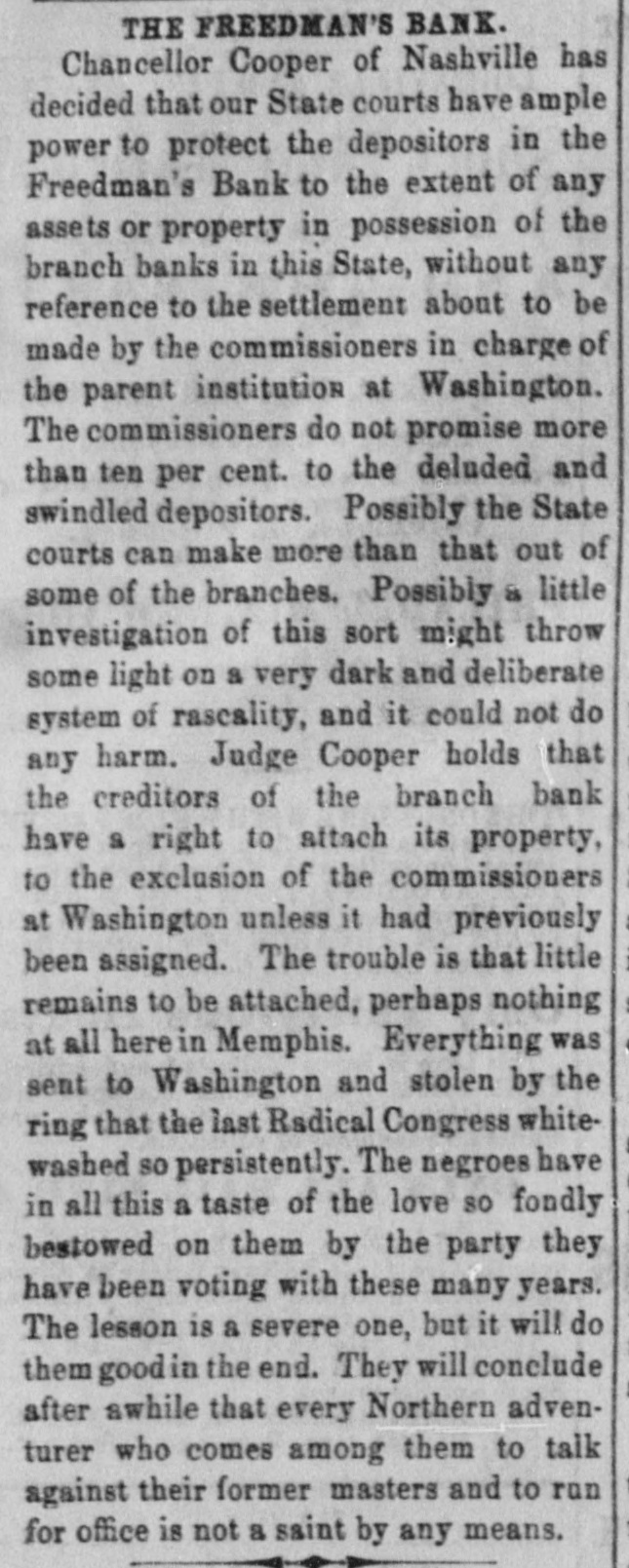
THE FREEDMAN'S BANK. Chancellor Cooper of Nashville has decided that our State courts have ample power to protect the depositors in the Freedman's Bank to the extent of any assets or property in possession of the branch banks in this State, without any reference to the settlement about to be made by the commissioners in charge of the parent institution at Washington. The commissioners do not promise more than ten per cent. to the deluded and swindled depositors. Possibly the State courts can make more than that out of some of the branches. Possibly a little investigation of this sort might throw some light on a very dark and deliberate system of rascality, and it could not do any harm. Judge Cooper holds that the creditors of the branch bank have a right to attach its property, to the exclusion of the commissioners at Washington unless it had previously been assigned. The trouble is that little remains to be attached, perhaps nothing at all here in Memphis. Everything was sent to Washington and stolen by the ring that the last Radical Congress whitewashed so persistently. The negroes have in all this a taste of the love so fondly bestowed on them by the party they have been voting with these many years. The lesson is a severe one, but it will do them good in the end. They will conclude after awhile that every Northern adventurer who comes among them to talk against their former masters and to run for office is not a saint by any means.


Article from Nashville Union and American, December 23, 1874

Click image to open full size in new tab

Article Text

THE FREEDMAN'S BANK. I Chancellor Cooper will Interfere as Little as Possible-He Appoints the Cashier Receiver. Chancellor Cooper delivered the annexed opinion at chambers yesterday on a motion to appoint a receiver for the Nashville branch of the Freedman's Bank, in accordance with a recent decision: B.J. Hadley et al. vs. Freedman's Savings and Trust Company et al. This case comes before me at chambers upon the motion of the complainants for the appointment of a receiver of the property in controversy. This property consists of the banking house of the agency at Nashville and loans on mortgage to the amount of about $7,000. The creditors of the Savings Company who have, up to this time, made themselves complainants, are depositors to the amount of between seven and eight thousand dollars, these depositors constituting about one-ninth of the claimants in this State. The conclusion to which I have heretofore arrived in this case, is that the complainants are entitled, if they insist upon it, to a receiver for the property and effects of the company sought to be reached by the bill. But, inasmuch as the depositors in this State will, in no event, be entitled to more than their pro rata of the assets of the company, and, as it may be very doubtful whether it is their interest to burden the fund with litigation, I feel that it is my duty, in acting upon this motion, to look as well to the interest of the large body of depositors as to the interest of the fraction of them at present directly represented on this motion. Under these circumstances, and in view of the fact that the large majority of the depositors may prefer to allow the institution to be wound up by the Trustees appointed under the act of Congress, I am inclined to interfere at present as little as possible with the affairs of the institution. I shall, therefore, allow the agent of the Trustees, J. J. Cary, to continue in control of the property of the company, upon his giving bond, with good security, in the sum of ten thousand ($10,000) as receiver, conditioned for the faithful discharge of the duties of receiver, and to account for and pay over the money realized, as and when ordered.


Article from Nashville Union and American, January 1, 1875

Click image to open full size in new tab

Article Text

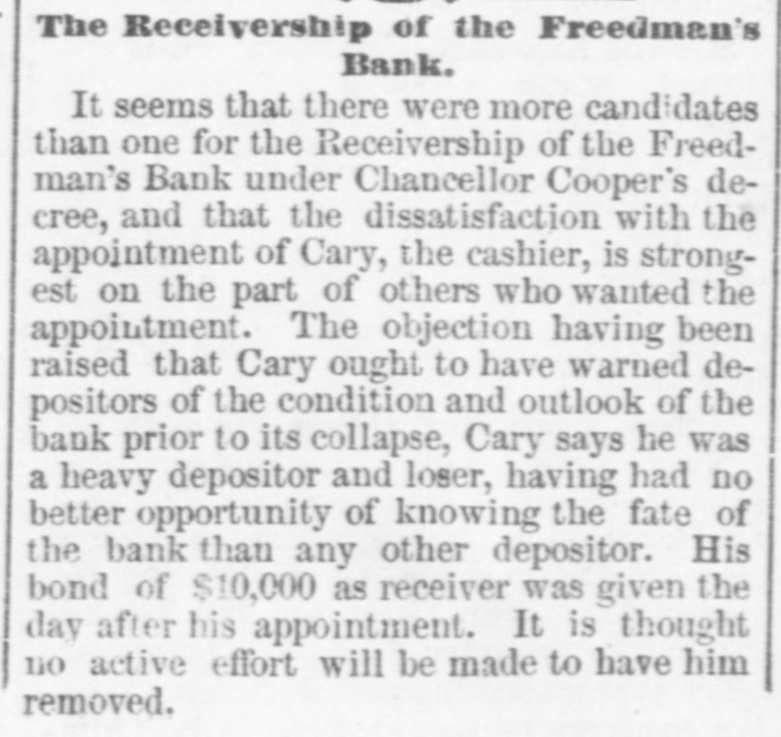
# The Receivership of the Freedman's Bank. It seems that there were more candidates than one for the Receivership of the Freedman's Bank under Chancellor Cooper's decree, and that the dissatisfaction with the appointment of Cary, the cashier, is strongest on the part of others who wanted the appointment. The objection having been raised that Cary ought to have warned depositors of the condition and outlook of the bank prior to its collapse, Cary says he was a heavy depositor and loser, having had no better opportunity of knowing the fate of the bank than any other depositor. His bond of $10,000 as receiver was given the day after his appointment. It is thought no active effort will be made to have him removed.