Article Text
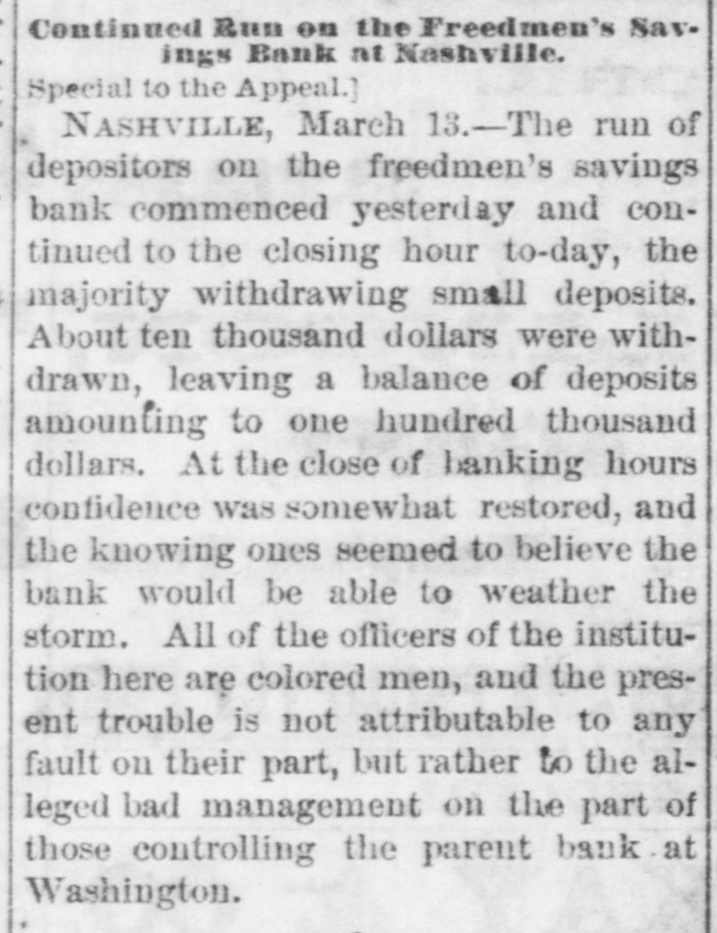
The Teiler Meets the Demand Squarely A Large Crowd of Excited Depositors A few days ago, a Washington correspondent of the Western press telegraphed the following regarding the condition of the Freedman's Savings and Trust Company of that city: The Comptroller of the Currency has made a report on the condition of the Freedmen's Saving and Trust Company of this city, as developed by the present official examination under authority of an act of Congress last winter. The surplus of the bank is shown to be only $7,090; its liabilities $4,476,642, and its assets, including real estate, premium on its Government bonds, and accrued interest on loans, $4,483,732. "The total amount of depositsjis $4,008, 642, and its loans on real estate in Washington, a large portion of which have been made on property not twice the value of the loan, as required by law, $1,794,478. The loans on approved claims of the Board of Public Works, chattel mortgages, and other collateral and personal security, amount to $476,653, of these transactions, the Comptroller says, many of the securities on which the loan has been made are believed to be worth the amount of the loan. The value of other securities is not known, and other additional loans seem to have been made upon the security of promissory notes, rather than upon collateral sesmall can concurity portion held of these by the investments bank. Only a be sidered available for the purpose of raising money in the market to meet unexpected calls of depositors, and it is believed that it was not the intention of the act of incorporation to authorize investments of this character. The Comptroller says: 'The officers and trustees of institution have violated the act under which it was organized, by establishing branches in different cities of the Union; by purchasing real estate and erecting buildings; by loaning money upon real estate of less than one-half the value of the loan; by loaning money upon collateral security not immediately available for the payment of deposits, and by borrowing money.' The report of Bank Examiner Meigs states that there is a deficiency of $16,400 in the Beaufort, S. C., branch; that many of the loans of the bank are of a character that should not appear the records of a savings bank, and will finally result in loss, and that the improvement of property in this city by the bank was clearly in violation of the charter. Comptroller Knox recommends the repeal of the charter of the bank, and the reorganization under a new act, that the branches in the Southern States, if continued, should be authorized by law, the rate of interest to depositors limited by law, and the bank required to accumulate a surplus against future losses.' Upon reading the above statement, a considerable number of our colored citizens, who had money deposited in the branch bank of this place, becau e uneasy and determined to withdraw the amounts that had been deposited. Several made their appearance at the counter on Tuesday, and calling for their balances, presented checks and were paid off. It was not until yesterday, however, that the reports damaging to the character of the institution became generally circulated. It was about 1 o'clock when visitors to the bank on Cedar street became numerous, and that thoroughfare for an hour or more presented a somewhat excited appearance. We suppose at one time there were two in the for was a run on the upwards time neighborhood there of hundred quite of the institution, heavy colored people and small no to depositors, establishment, any explanation who mostly exhibited which however, might disposition by be hear given. At an early hour yesterday morning John J. Carey, the Cashier of the Freedman's Bank here telegraphed to the parent institution at Washington as follows: NASHVILLE, March 12-The report of Comptroller Knox causes uneasiness here; if not true, correct immediately. To this dispatch, the Cashier received at 11 o'clock the following reply: WASHINGTON, March 12-John J. Carey, Cashier: Comptroller's report as telegraphed is false. GEO. W. STICKNEY, Actuary. The reception of this quieted the making the demands most discreet upon of withdrew the those institution, dispatch who from were and largest depositors the field of operations, apparently satisfied that the institution was O. K. Upon announcing their willingness to abide the consequences, the panic subsided, and 3 o'clock, the hour for closing, found the bank, although "slightly disfigured, still in the ring." At 3:15, the Cashier received a second Washington dispatch in these words: "Report of Comptroller, as telegraphed, is false. GEO. W. STICKNEY" The third dispatch received by the Cashier was received at 4:45, and was as follows: WASHINGTON, March 12.-The Company is all right. You can draw on us for all the money you may need. The Comptroller assures us here that he considers the Company sound, and that depositors need not be disturbed. GEO. W. STICKEY. We have heard nothing to the contrary, and suppose the bank will be open as usual to-day.